Electrical Field of a thin Disk © Frits F.M. de Mul
E -field of a thin disk Question : Calculate  E -field in arbitrary points a both sides of the disk Available : A thin circular disk with radius  R  and charge density   [C/m 2 ]
E -field of a thin disk Analysis and symmetry Approach to solution Calculations Conclusions Appendix: angular integration
Analysis and Symmetry 1.   Charge distribution:   C/m 2 ] 3.  Symmetry:  cylinder 4.  Cylinder coordinates: r, z  2.  Coordinate axes: Z-axis = symm. axis,  perpend. to disk Z X Y e r r e z z e  
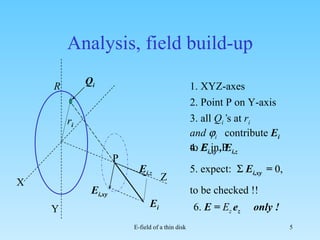
Analysis, field build-up 5. expect:   E i,xy  =  0,  to be checked !!  6.  E =  E z  e z   only ! R 1. XYZ-axes Z Y X 2. Point P on Y-axis P E i Q i r i 3. all  Q i ’ s at  r i  and  i  contribute  E i   to  E  in P 4.  E i,xy  , E i,z E i,z E i,xy
Approach to solution R Z 2. Distributed charges dQ 3.  dE  e r r P 1. Rings and segments 4.  dQ =   dA=   da.)(a d  a d   da 5.  z - component only ! dE xy dE z 6.
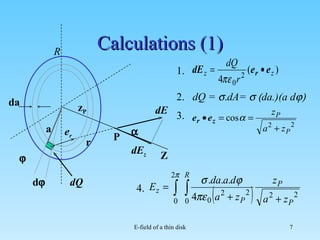
Calculations (1) 2.  dQ =   dA=   da.)(a d  R Z dQ dE  e r r P a d   da dE z  z P 1. 3. 4.
Calculations (2) 6.  If  R  infinity : R Z dQ dE  e r r P a d   da dE z  z P 4.
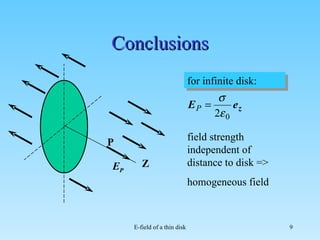
Conclusions field strength independent of distance to disk => homogeneous field Z P E P for infinite disk:
Appendix: angular integration (1) 2.  dQ =   dA=   da.)(a d  R Z dQ dE  e r r P a d   da dE z  z P 1. 
Appendix: angular integration (2) the end R Z dQ dE  e r r P a d   da dE z  z P 

E field disk

  • 1.
    Electrical Field ofa thin Disk © Frits F.M. de Mul
  • 2.
    E -field ofa thin disk Question : Calculate E -field in arbitrary points a both sides of the disk Available : A thin circular disk with radius R and charge density  [C/m 2 ]
  • 3.
    E -field ofa thin disk Analysis and symmetry Approach to solution Calculations Conclusions Appendix: angular integration
  • 4.
    Analysis and Symmetry1. Charge distribution:   C/m 2 ] 3. Symmetry: cylinder 4. Cylinder coordinates: r, z  2. Coordinate axes: Z-axis = symm. axis, perpend. to disk Z X Y e r r e z z e  
  • 5.
    Analysis, field build-up5. expect:  E i,xy = 0, to be checked !! 6. E = E z e z only ! R 1. XYZ-axes Z Y X 2. Point P on Y-axis P E i Q i r i 3. all Q i ’ s at r i and  i  contribute E i to E in P 4. E i,xy , E i,z E i,z E i,xy
  • 6.
    Approach to solutionR Z 2. Distributed charges dQ 3. dE e r r P 1. Rings and segments 4. dQ =  dA=  da.)(a d  a d   da 5. z - component only ! dE xy dE z 6.
  • 7.
    Calculations (1) 2. dQ =  dA=  da.)(a d  R Z dQ dE e r r P a d   da dE z  z P 1. 3. 4.
  • 8.
    Calculations (2) 6. If R  infinity : R Z dQ dE e r r P a d   da dE z  z P 4.
  • 9.
    Conclusions field strengthindependent of distance to disk => homogeneous field Z P E P for infinite disk:
  • 10.
    Appendix: angular integration(1) 2. dQ =  dA=  da.)(a d  R Z dQ dE e r r P a d   da dE z  z P 1. 
  • 11.
    Appendix: angular integration(2) the end R Z dQ dE e r r P a d   da dE z  z P 