Filling a capacitor  with a dielectric II: Partial filling © Frits F.M. de Mul
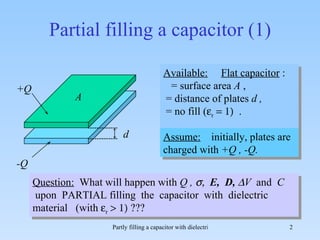
Partial filling a capacitor (1) Available:   Flat capacitor  :  = surface area  A  ,  = distance of plates  d ,   = no fill (  r    .  Question:   What will happen with  Q ,   E,  D,   V  and  C  upon  PARTIAL filling  the  capacitor  with  dielectric material  (with   r  A d Assume:   initially, plates are charged with  +Q , -Q.  +Q -Q
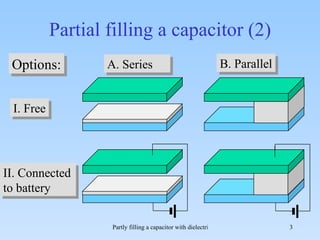
Partial filling a capacitor (2) A. Series B. Parallel I. Free II. Connected to battery Options:
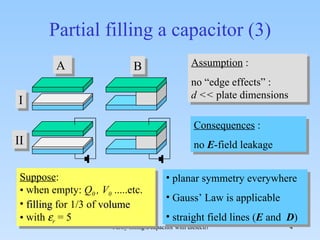
Partial filling a capacitor (3) Suppose : when empty:  Q 0  , V 0  .....etc. filling  for 1/3 of  volume with   r  = 5 Assumption  :  no “edge effects” :  d <<  plate dimensions   Consequences  : no  E -field leakage  planar symmetry everywhere Gauss’ Law is applicable  straight field lines ( E  and  D ) A B I II
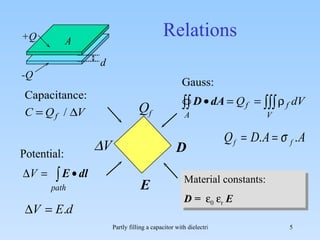
Relations Q f A d +Q -Q D E Material constants: D =    r  E  V
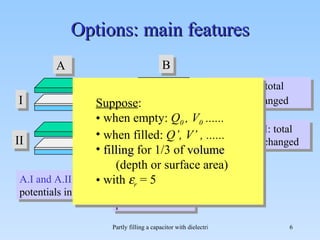
Options: main features A.I and B.I : total charge unchanged   A.II and B.II : total potential unchanged A.I and A.II : potentials in series B.I and B.II : potentials parallel Suppose : when empty:  Q 0  , V 0   ...... when filled:  Q’, V’ , ...... filling  for 1/3 of  volume (depth or surface area) with   r  = 5  A B I II
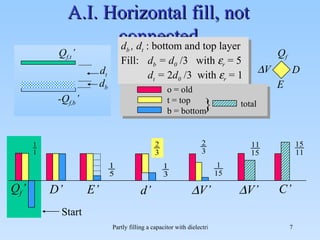
A.I. Horizontal fill, not connected d b  , d t   :   bottom and top layer Fill:  d b  = d 0   /3  with   r  = 5 d t  =  2 d 0   /3  with   r  = 1 Q f ’ D’ E’ d’  V’  V’ C’ Start Q f D E  V d b d t Q f,t ’ -Q f,b ’ o = old t = top b = bottom } total
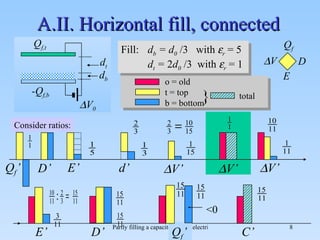
A.II. Horizontal fill, connected Fill:  d b  = d 0   /3  with   r  = 5 d t  =  2 d 0   /3  with   r  = 1 Q f ’ D’ E’ d’  V’  V’ C’  V’ E’ D’ Q f ’ Consider ratios: Q f D E  V d b d t Q f,t -Q f,b  V 0 o = old t = top b = bottom } total <0
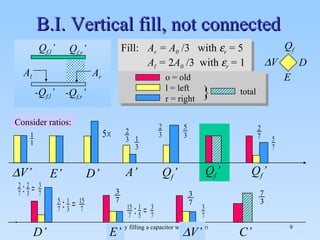
B.I. Vertical fill, not connected Fill:  A r  = A 0   /3  with   r  = 5 A l  =  2 A 0   /3  with   r  = 1 Q f ’ D’ E’ Consider ratios:  V’ A’ Q f D E  V E’ C’ o = old l = left r = right } total Q f,l ’ -Q f,r ’ Q f,r ’ -Q f,l ’ A l A r Q f ’ Q f ’ D’  V’
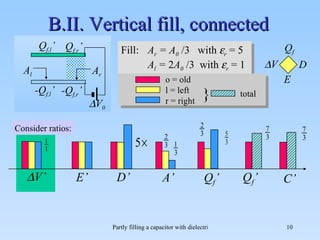
B.II. Vertical fill, connected Fill:  A r  = A 0   /3  with   r  = 5 A l  =  2 A 0   /3  with   r  = 1 Q f ’ D’ E’ C’ Consider ratios:  V’ A’ Q f ’ Q f D E  V o = old l = left r = right } total Q f,l ’ -Q f,r ’ Q f,r ’ -Q f,l ’ A l A r  V 0
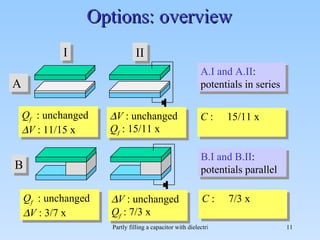
Options: overview C  :  15/11 x Q f   : unchanged  V  : 11/15 x  V  : unchanged Q f  : 15/11 x C  :  7/3 x Q f   : unchanged  V  : 3/7 x  V  : unchanged Q f  : 7/3 x B B.I and B.II : potentials parallel A A.I and A.II : potentials in series I II
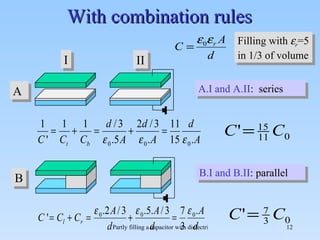
With combination rules Filling with   r =5 in 1/3 of volume B B.I and B.II : parallel A A.I and A.II :  series I II
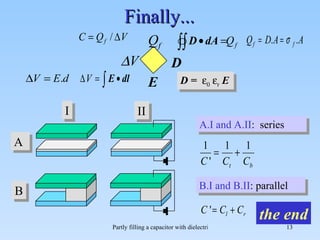
Finally... the end D =    r  E B B.I and B.II : parallel A A.I and A.II :  series I II Q f D E  V

Capacitor partial filling

  • 1.
    Filling a capacitor with a dielectric II: Partial filling © Frits F.M. de Mul
  • 2.
    Partial filling acapacitor (1) Available: Flat capacitor : = surface area A , = distance of plates d , = no fill (  r  . Question: What will happen with Q ,  E, D,  V and C upon PARTIAL filling the capacitor with dielectric material (with  r  A d Assume: initially, plates are charged with +Q , -Q. +Q -Q
  • 3.
    Partial filling acapacitor (2) A. Series B. Parallel I. Free II. Connected to battery Options:
  • 4.
    Partial filling acapacitor (3) Suppose : when empty: Q 0 , V 0 .....etc. filling for 1/3 of volume with  r = 5 Assumption : no “edge effects” : d << plate dimensions Consequences : no E -field leakage planar symmetry everywhere Gauss’ Law is applicable straight field lines ( E and D ) A B I II
  • 5.
    Relations Q fA d +Q -Q D E Material constants: D =    r  E  V
  • 6.
    Options: main featuresA.I and B.I : total charge unchanged A.II and B.II : total potential unchanged A.I and A.II : potentials in series B.I and B.II : potentials parallel Suppose : when empty: Q 0 , V 0 ...... when filled: Q’, V’ , ...... filling for 1/3 of volume (depth or surface area) with  r = 5 A B I II
  • 7.
    A.I. Horizontal fill,not connected d b , d t : bottom and top layer Fill: d b = d 0 /3 with  r = 5 d t = 2 d 0 /3 with  r = 1 Q f ’ D’ E’ d’  V’  V’ C’ Start Q f D E  V d b d t Q f,t ’ -Q f,b ’ o = old t = top b = bottom } total
  • 8.
    A.II. Horizontal fill,connected Fill: d b = d 0 /3 with  r = 5 d t = 2 d 0 /3 with  r = 1 Q f ’ D’ E’ d’  V’  V’ C’  V’ E’ D’ Q f ’ Consider ratios: Q f D E  V d b d t Q f,t -Q f,b  V 0 o = old t = top b = bottom } total <0
  • 9.
    B.I. Vertical fill,not connected Fill: A r = A 0 /3 with  r = 5 A l = 2 A 0 /3 with  r = 1 Q f ’ D’ E’ Consider ratios:  V’ A’ Q f D E  V E’ C’ o = old l = left r = right } total Q f,l ’ -Q f,r ’ Q f,r ’ -Q f,l ’ A l A r Q f ’ Q f ’ D’  V’
  • 10.
    B.II. Vertical fill,connected Fill: A r = A 0 /3 with  r = 5 A l = 2 A 0 /3 with  r = 1 Q f ’ D’ E’ C’ Consider ratios:  V’ A’ Q f ’ Q f D E  V o = old l = left r = right } total Q f,l ’ -Q f,r ’ Q f,r ’ -Q f,l ’ A l A r  V 0
  • 11.
    Options: overview C : 15/11 x Q f : unchanged  V : 11/15 x  V : unchanged Q f : 15/11 x C : 7/3 x Q f : unchanged  V : 3/7 x  V : unchanged Q f : 7/3 x B B.I and B.II : potentials parallel A A.I and A.II : potentials in series I II
  • 12.
    With combination rulesFilling with  r =5 in 1/3 of volume B B.I and B.II : parallel A A.I and A.II : series I II
  • 13.
    Finally... the endD =    r  E B B.I and B.II : parallel A A.I and A.II : series I II Q f D E  V