Dr.T.VARUN RAJU
Senior advanced Laparoscopic Surgeon
D.N.B (Surgery) FIAGES,FMAS & FALS (H.P.B)
Director Laparoscopy Course TVR Laparoscopy Center
H.O.D General & Laparoscopic Surgery
ST.Theresa Hospital
Hyderanbad
HYDERABAD
1.Learning curve
2.T.A.P.P( inguinal) complications & Solutions
3. T.E.P/E-T.E.P (Inguinal) complications & Solutions
4.E-TEP –RS (Ventral) complications & Solutions complications &
Solutions
5.TARM –(Incisional) complications & Solutions
6.E-TEP TAR (Incisional) complications & Solutions
7.IPOM + (Umbilical) complications & Solutions
8.Conclusions
1.LEARNING CURVE
 Many studies in the literature
 Basic laparoscopic training, around 13–15 cases are
required initially to become well versed with both
TEP andTAPP
 No significant difference in the learning curve
between the two procedures.
Learning Curve in Laparoscopic Inguinal Hernia Repair: Experience at aTertiary Care Centre
Virinder Kumar Bansal, Asuri Krishna, Mahesh C. Misra, and Subodh Kumar
Indian J Surg. 2016 Jun; 78(3): 197–202.
2.T.A.P.P( inguinal)
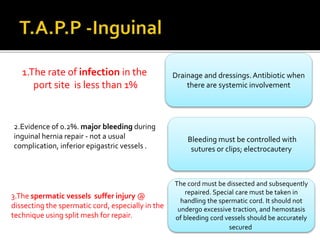
1.The rate of infection in the
port site is less than 1%
Drainage and dressings.Antibiotic when
there are systemic involvement
2.Evidence of 0.2%. major bleeding during
inguinal hernia repair - not a usual
complication, inferior epigastric vessels .
Bleeding must be controlled with
sutures or clips; electrocautery
3.The spermatic vessels suffer injury @
dissecting the spermatic cord, especially in the
technique using split mesh for repair.
The cord must be dissected and subsequently
repaired. Special care must be taken in
handling the spermatic cord. It should not
undergo excessive traction, and hemostasis
of bleeding cord vessels should be accurately
secured
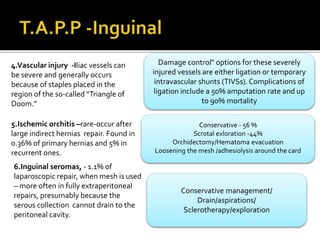
4.Vascular injury -Iliac vessels can
be severe and generally occurs
because of staples placed in the
region of the so-called “Triangle of
Doom.”
5.Ischemic orchitis –rare-occur after
large indirect hernias repair. Found in
0.36% of primary hernias and 5% in
recurrent ones.
6.Inguinal seromas, - 1.1% of
laparoscopic repair, when mesh is used
– more often in fully extraperitoneal
repairs, presumably because the
serous collection cannot drain to the
peritoneal cavity.
Damage control" options for these severely
injured vessels are either ligation or temporary
intravascular shunts (TIVSs).Complications of
ligation include a 50% amputation rate and up
to 90% mortality
Conservative - 56 %
Scrotal exloration -44%
Orchidectomy/Hematoma evacuation
Loosening the mesh /adhesiolysis around the card
Conservative management/
Drain/aspirations/
Sclerotherapy/exploration
7.TAPP technique - 1.6% cases of hydrocele
formation - Completely extraperitoneal
correctionsTEP in 0.50/0.
8.Nerve injuries - 1.6% incidence of
neuralgias- the iliopubic tract is an important
anatomic point. Lateral to the spermatic
vessels, and immediately below the fibers of
the iliopubic tract, are the genital and femoral
branches of the genito-femoral nerve, the
femoral nerve and the lateral femoral
cutaneous nerve- LFCN.
Clips placed below the iliopubic tract and
lateral to the femoral vessels may cause
temporary or permanent neuralgias, involving
one or more of the nerve branches
Conservative management
Erly nerve decompression – best
way .Laparoscopic re operation
provides adequate
visualization,assessment the
injury .Trans abdominal ? the
challenge is to identify which
patients have injury that will not
improve without treatment and
to direct appropriate and prompt
treatment . Interventional
radiology-YES
The iliohypogastric and ilioinguinal nerves
may be injured if the clips are applied too deep
in the muscles of the anterior abdominal wall.
9.Bowel injury- Incarcerated hernias
In strangulated hernias, the laparoscopic
approach can accurately evaluate the viability
of the bowel loop involved.
10.Urinary bladder injury
This injury does not cause significant
morbidity if immediately corrected
with primary suture in association
with decompression of the urinary
bladder with a Foley catheter.
TAPP appears to be safe in acutely
incarcerated/strangulated inguinal
hernias. Should be performed by
experienced surgeons in laparoscopic
techniques.
World J Emerg Surg. 2021; 16: 5
Bowel repair
Suture entrapment of sensory fibers -
resolved by removal of the suture.
Prompt recognition and treatment
prevent subsequent development of
chronic abdomino- pelvic pain.
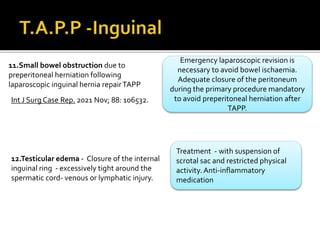
11.Small bowel obstruction due to
preperitoneal herniation following
laparoscopic inguinal hernia repairTAPP
Int J Surg Case Rep. 2021 Nov; 88: 106532.
Emergency laparoscopic revision is
necessary to avoid bowel ischaemia.
Adequate closure of the peritoneum
during the primary procedure mandatory
to avoid preperitoneal herniation after
TAPP.
12.Testicular edema - Closure of the internal
inguinal ring - excessively tight around the
spermatic cord- venous or lymphatic injury.
Treatment - with suspension of
scrotal sac and restricted physical
activity. Anti-inflammatory
medication
13.Port sites,cannulas, look for possible
bleeding, -injury to the epigastric artery with
hypovolemic shock .
14.Scrotal ecchymosis and inguinal
hematoma by small bleeding vessels - the
most frequent complications following
inguinal hernia repair.
15.Mesh infection/abscess
Prevented using an elastic
support for 3-4 weeks
postoperatively.
Control under the vision
Ports of sizes 10 mm and 12 mm
trocars, should be closed to prevent
future herniation.
I&D
Mesh explantation
16.Recurrence
Various series, using technique (TAPP), appears
to result from inadequate surgical technique.
The inadequate fixation of mesh, inadequate
size of the mesh (small) and a flaw in covering
unidentified hernial defects are the main
reasons for early recurrence of hernia.
Late recurrence of hernia - stress on the tissues
–mesh contraction - intrinsic weakness of the
collagen.
A recurrence rates of up to 12% have been
reported with <50% being reoperated.
1.Observation
2.Elective surgical repair:
(excessive pain or discomfort)
3.Emergency surgical repair
Immediate complications
1.Visceral injury (bowel and bladder)
2.Vascular injury
3. Injury to the vas deferens and the spermatic cords.
4.Wound complications, bruising, scrotal swelling, seroma formation and
hematomas.
Delayed or late complications
1. Adhesions (to mesh as well as adhesional bowel obstruction)
2. Fistula formation /Mesh infection
3. Testicular atrophy
4. Nerve entrapment
5. Incisional hernia or a recurrence
6. Chronic pain
1.Overlooked defects or rupture of the posterior layer can
possibly cause internal hernias
risk of incarceration and strangulation of the bowel
2.Essential complications related to the method
A.Rupture or dehiscence of the posterior layer
B.Damage to the linea alba while crossing
C.Unintentional injury to the neurovascular bundle
D.Disruption of the linea semilunaris while performing
lateral dissection.
Good understanding of an
appropriate endoscopic
anatomy and meticulous
dissection in the
retromuscular plane
prevent these events
Khetan M, DeyA, BindalV, Suviraj J, MittalT, Kalhan S, MalikVK, Ramana B (2021) e-TEP repair for midline primary and incisional
hernia: technical considerations and initial experience. Hernia 25(6):1635–1646. https://doi.org/10.1007/s10029-021-02397-6
1. Blood loss and length of stay
2.Convertion due to dense bowel
adhesions.
3.Mesh infection
4.Hernia recurrence
5.PRS suture-line disruption
LaparoscopicTrans-Abdominal Retromuscular (TARM) Repair forVentral Hernia:A Novel, Low-CostTechnique for Sublay and Posterior
Component Separation
Ashwin A. Masurkar
WorldJournal of Surgery volume
SOLUTIONS
Hematoma
Seroma
Surgical site infection –
divided into superficial deep and organ-
related
Pulmonary thromboembolism
Hernia recurrence
There was no statistically significant
association found in the multivariate analysis.
Factors associated with higher
recurrence rates described in the
literature are –
Obesity (BMI greater than 25 kg/m2) -
smoking history - T2DM - corticosteroid
use - procedure performed in an
emergency context
In terms of postoperative complications
such as seroma, hematoma, and SSI, a
clear association has been determined
with smoking history,T2DM, and COPD
Parker SG, Mallett S, Quinn L, Wood CPJ, Boulton RW, Jamshaid S, et al. Identifying predictors of ventral hernia recurrence: Systematic
review and meta-analysis. BJS Open. 2021;5(2):zraa071. doi: 10.1093/bjsopen/zraa071.
Landin M, Kubasiak JC, Schimpke S, Poirier J, Myers JA, Millikan KW, Luu MB.The effect of tobacco use on outcomes of laparoscopic
and open inguinal hernia repairs:A review of the NSQIP dataset. Surg. Endosc.
Seroma
Surgical site infection
Intraoperative complications
Bleeding
Bowel injuries
Port-site hernia
Intestinal obstruction
Intestinal perforation
Chronic sinus formation
SOLUTIONS
 Learning curve is carefully followed
 Endoscopic anatomy – knowledge and experience – essential
 Recognize the complication early to tackle it carefully
 Any gadget can not guarantee the surgeon with less
complications
 Damage control is the key to solve a complication
 Surgeon is the key factor for the immediate post surgery
complication
 Prevention is always better than the cure
1. Schultz LS, Graber J, et al. Laser laparoscopic herniorrhaphy: a clinical trial.
Preliminary results. J Laparosc Endosc Surg. 1991;1:41–45
2. FilipiCJ, Fitzgibbons RJ, Salerno GM, et al. Laparoscopic herniorrhaphy. Surg Clin
North Am. 1992;72(1):109–124
3. GeisWP, Crafton WB, Novak MJ. Laparoscopic herniorrhaphy: results and technical
aspects in 450 consecutive procedures. Surg. 1993:765–773
4. MacFayden BV, Jr, Arregui ME, Corbitt JD, et al. Complications of laparoscopic
herniorrhaphy. Surg Endosc. 1993;7:155–159
5. Arregui ME, Navarrete J, Davis CJ, et al. Laparoscopic inguinal herniorrhaphy. Surg
Clin North Am. 1993;73:543–559
6. Brown RB. Laparoscopic hernia repair: a rural perspective. Surg Laparosc
Endosc. 1994;4:106–109
Complications & Solutions in Laparoscopic Hernia Surgery.pptx

Complications & Solutions in Laparoscopic Hernia Surgery.pptx

  • 1.
    Dr.T.VARUN RAJU Senior advancedLaparoscopic Surgeon D.N.B (Surgery) FIAGES,FMAS & FALS (H.P.B) Director Laparoscopy Course TVR Laparoscopy Center H.O.D General & Laparoscopic Surgery ST.Theresa Hospital Hyderanbad
  • 2.
  • 3.
    1.Learning curve 2.T.A.P.P( inguinal)complications & Solutions 3. T.E.P/E-T.E.P (Inguinal) complications & Solutions 4.E-TEP –RS (Ventral) complications & Solutions complications & Solutions 5.TARM –(Incisional) complications & Solutions 6.E-TEP TAR (Incisional) complications & Solutions 7.IPOM + (Umbilical) complications & Solutions 8.Conclusions
  • 4.
  • 5.
     Many studiesin the literature  Basic laparoscopic training, around 13–15 cases are required initially to become well versed with both TEP andTAPP  No significant difference in the learning curve between the two procedures. Learning Curve in Laparoscopic Inguinal Hernia Repair: Experience at aTertiary Care Centre Virinder Kumar Bansal, Asuri Krishna, Mahesh C. Misra, and Subodh Kumar Indian J Surg. 2016 Jun; 78(3): 197–202.
  • 6.
  • 7.
    1.The rate ofinfection in the port site is less than 1% Drainage and dressings.Antibiotic when there are systemic involvement 2.Evidence of 0.2%. major bleeding during inguinal hernia repair - not a usual complication, inferior epigastric vessels . Bleeding must be controlled with sutures or clips; electrocautery 3.The spermatic vessels suffer injury @ dissecting the spermatic cord, especially in the technique using split mesh for repair. The cord must be dissected and subsequently repaired. Special care must be taken in handling the spermatic cord. It should not undergo excessive traction, and hemostasis of bleeding cord vessels should be accurately secured
  • 8.
    4.Vascular injury -Iliacvessels can be severe and generally occurs because of staples placed in the region of the so-called “Triangle of Doom.” 5.Ischemic orchitis –rare-occur after large indirect hernias repair. Found in 0.36% of primary hernias and 5% in recurrent ones. 6.Inguinal seromas, - 1.1% of laparoscopic repair, when mesh is used – more often in fully extraperitoneal repairs, presumably because the serous collection cannot drain to the peritoneal cavity. Damage control" options for these severely injured vessels are either ligation or temporary intravascular shunts (TIVSs).Complications of ligation include a 50% amputation rate and up to 90% mortality Conservative - 56 % Scrotal exloration -44% Orchidectomy/Hematoma evacuation Loosening the mesh /adhesiolysis around the card Conservative management/ Drain/aspirations/ Sclerotherapy/exploration
  • 9.
    7.TAPP technique -1.6% cases of hydrocele formation - Completely extraperitoneal correctionsTEP in 0.50/0. 8.Nerve injuries - 1.6% incidence of neuralgias- the iliopubic tract is an important anatomic point. Lateral to the spermatic vessels, and immediately below the fibers of the iliopubic tract, are the genital and femoral branches of the genito-femoral nerve, the femoral nerve and the lateral femoral cutaneous nerve- LFCN. Clips placed below the iliopubic tract and lateral to the femoral vessels may cause temporary or permanent neuralgias, involving one or more of the nerve branches Conservative management Erly nerve decompression – best way .Laparoscopic re operation provides adequate visualization,assessment the injury .Trans abdominal ? the challenge is to identify which patients have injury that will not improve without treatment and to direct appropriate and prompt treatment . Interventional radiology-YES
  • 10.
    The iliohypogastric andilioinguinal nerves may be injured if the clips are applied too deep in the muscles of the anterior abdominal wall. 9.Bowel injury- Incarcerated hernias In strangulated hernias, the laparoscopic approach can accurately evaluate the viability of the bowel loop involved. 10.Urinary bladder injury This injury does not cause significant morbidity if immediately corrected with primary suture in association with decompression of the urinary bladder with a Foley catheter. TAPP appears to be safe in acutely incarcerated/strangulated inguinal hernias. Should be performed by experienced surgeons in laparoscopic techniques. World J Emerg Surg. 2021; 16: 5 Bowel repair Suture entrapment of sensory fibers - resolved by removal of the suture. Prompt recognition and treatment prevent subsequent development of chronic abdomino- pelvic pain.
  • 11.
    11.Small bowel obstructiondue to preperitoneal herniation following laparoscopic inguinal hernia repairTAPP Int J Surg Case Rep. 2021 Nov; 88: 106532. Emergency laparoscopic revision is necessary to avoid bowel ischaemia. Adequate closure of the peritoneum during the primary procedure mandatory to avoid preperitoneal herniation after TAPP. 12.Testicular edema - Closure of the internal inguinal ring - excessively tight around the spermatic cord- venous or lymphatic injury. Treatment - with suspension of scrotal sac and restricted physical activity. Anti-inflammatory medication
  • 12.
    13.Port sites,cannulas, lookfor possible bleeding, -injury to the epigastric artery with hypovolemic shock . 14.Scrotal ecchymosis and inguinal hematoma by small bleeding vessels - the most frequent complications following inguinal hernia repair. 15.Mesh infection/abscess Prevented using an elastic support for 3-4 weeks postoperatively. Control under the vision Ports of sizes 10 mm and 12 mm trocars, should be closed to prevent future herniation. I&D Mesh explantation
  • 13.
    16.Recurrence Various series, usingtechnique (TAPP), appears to result from inadequate surgical technique. The inadequate fixation of mesh, inadequate size of the mesh (small) and a flaw in covering unidentified hernial defects are the main reasons for early recurrence of hernia. Late recurrence of hernia - stress on the tissues –mesh contraction - intrinsic weakness of the collagen. A recurrence rates of up to 12% have been reported with <50% being reoperated. 1.Observation 2.Elective surgical repair: (excessive pain or discomfort) 3.Emergency surgical repair
  • 14.
    Immediate complications 1.Visceral injury(bowel and bladder) 2.Vascular injury 3. Injury to the vas deferens and the spermatic cords. 4.Wound complications, bruising, scrotal swelling, seroma formation and hematomas. Delayed or late complications 1. Adhesions (to mesh as well as adhesional bowel obstruction) 2. Fistula formation /Mesh infection 3. Testicular atrophy 4. Nerve entrapment 5. Incisional hernia or a recurrence 6. Chronic pain
  • 15.
    1.Overlooked defects orrupture of the posterior layer can possibly cause internal hernias risk of incarceration and strangulation of the bowel 2.Essential complications related to the method A.Rupture or dehiscence of the posterior layer B.Damage to the linea alba while crossing C.Unintentional injury to the neurovascular bundle D.Disruption of the linea semilunaris while performing lateral dissection. Good understanding of an appropriate endoscopic anatomy and meticulous dissection in the retromuscular plane prevent these events Khetan M, DeyA, BindalV, Suviraj J, MittalT, Kalhan S, MalikVK, Ramana B (2021) e-TEP repair for midline primary and incisional hernia: technical considerations and initial experience. Hernia 25(6):1635–1646. https://doi.org/10.1007/s10029-021-02397-6
  • 16.
    1. Blood lossand length of stay 2.Convertion due to dense bowel adhesions. 3.Mesh infection 4.Hernia recurrence 5.PRS suture-line disruption LaparoscopicTrans-Abdominal Retromuscular (TARM) Repair forVentral Hernia:A Novel, Low-CostTechnique for Sublay and Posterior Component Separation Ashwin A. Masurkar WorldJournal of Surgery volume SOLUTIONS
  • 17.
    Hematoma Seroma Surgical site infection– divided into superficial deep and organ- related Pulmonary thromboembolism Hernia recurrence There was no statistically significant association found in the multivariate analysis. Factors associated with higher recurrence rates described in the literature are – Obesity (BMI greater than 25 kg/m2) - smoking history - T2DM - corticosteroid use - procedure performed in an emergency context In terms of postoperative complications such as seroma, hematoma, and SSI, a clear association has been determined with smoking history,T2DM, and COPD Parker SG, Mallett S, Quinn L, Wood CPJ, Boulton RW, Jamshaid S, et al. Identifying predictors of ventral hernia recurrence: Systematic review and meta-analysis. BJS Open. 2021;5(2):zraa071. doi: 10.1093/bjsopen/zraa071. Landin M, Kubasiak JC, Schimpke S, Poirier J, Myers JA, Millikan KW, Luu MB.The effect of tobacco use on outcomes of laparoscopic and open inguinal hernia repairs:A review of the NSQIP dataset. Surg. Endosc.
  • 18.
    Seroma Surgical site infection Intraoperativecomplications Bleeding Bowel injuries Port-site hernia Intestinal obstruction Intestinal perforation Chronic sinus formation SOLUTIONS
  • 19.
     Learning curveis carefully followed  Endoscopic anatomy – knowledge and experience – essential  Recognize the complication early to tackle it carefully  Any gadget can not guarantee the surgeon with less complications  Damage control is the key to solve a complication  Surgeon is the key factor for the immediate post surgery complication  Prevention is always better than the cure
  • 20.
    1. Schultz LS,Graber J, et al. Laser laparoscopic herniorrhaphy: a clinical trial. Preliminary results. J Laparosc Endosc Surg. 1991;1:41–45 2. FilipiCJ, Fitzgibbons RJ, Salerno GM, et al. Laparoscopic herniorrhaphy. Surg Clin North Am. 1992;72(1):109–124 3. GeisWP, Crafton WB, Novak MJ. Laparoscopic herniorrhaphy: results and technical aspects in 450 consecutive procedures. Surg. 1993:765–773 4. MacFayden BV, Jr, Arregui ME, Corbitt JD, et al. Complications of laparoscopic herniorrhaphy. Surg Endosc. 1993;7:155–159 5. Arregui ME, Navarrete J, Davis CJ, et al. Laparoscopic inguinal herniorrhaphy. Surg Clin North Am. 1993;73:543–559 6. Brown RB. Laparoscopic hernia repair: a rural perspective. Surg Laparosc Endosc. 1994;4:106–109