ENGLISH BEFORE
AND AFTER
INDEPENDENCE
PRESENTED BY
M. HARIKRISHNA & IRFATH ZABEEN
INTRODUCTION:
• English is not only important in getting a better job, it
is everywhere in social interaction.
• If you can’t speak it then you are a nobody.
• People belonging not only to a different language
groups but also to the same speech community make
use of English in their inter-personal communication.
• This view makes it clear that English occupies a place
of prestige in our country.
PRE-INDEPENDENCE PERIOD:
• Due to the British invasion, English language was
widely exposed to our country.
• It is strongly believed that it made its entry
• when the British first came to India after the
incorporation of the East India Company in 1600, and
gained roots because of the educational policies of
Lord Macaulay.
 Since the days of the British Raj, English remained the language of
domination, status and privilege in India. The hegemonic colonial project
India was to create and maintain a class of administrative officers, clerks
and compliant civil servants to carry out the task of ruling the vast and
expansive subcontinent The view expressed above makes it clear that English was the language
of the rulers in India, and as a colonial subjects we had no other choice
but to learn English. In this way the language started gaining roots in
India. Then the people belonging to the middle class advocated and aspired
their education in English, which was the language of rulers. They saw
that the capacity to speak and write English enables them for lucrative
posts under government, which provided a decent income and an
important status in the society.
 Raja Ram Mohan Roy took the issue with all seriousness. He was against
oriental policy of education. When a proposal by General Committee of
public instruction for funding a Sanskrit college in Calcutta was put
forward. view expressed above it becomes clear that Raja Ram Mohan Roy
preferred English to Indian languages for academic, scientific and other
international reasons.
 Macaulay’s motives in spreading English in India were just to create a
group of Indians who would be the interpreters between their rulers and
the ruled. He, by spreading English in India, aimed at just creating a class
of persons, Indian in blood and color but English in taste, in opinions,
morals and intellect. it becomes clear that the beginning of the process of providing English
language to the bilinguals in India was firmly established with the
approval of Lord William Bentick to Macaulay’s educational policy of
modern education in India. English then gradually spread wider in India
and gained roots English then gradually spread wider in India and gained roots in the
educational system. In 1857 three universities at the then Bombay,
Calcutta and Madras were established. By the end of the 19th century two
more universities, one at Punjab and the other at Allahabad were setup.
The foundation of these universities marked a new epoch in the history of
Indian education. This resulted into the spread of schools and colleges,
which ultimately resulted in the increase of more number of Indians who
achieved mastery in this language.
POST-INDEPENDENCE PERIOD:
• English, the language mostly of the colonizers during the
British Raj became accepted to the higher strata,
educationally, economically and socially progressive class
of the Indian society during the post-independence
period.
• English is recognized as an important global or
international language, essential for professional
employment and significantly, a key component of the
cultural capital of middle class Indians
• The foreign language status of English in India thus
appears to have remained for a shorter period initially,
and it gradually seems to have acquired the status of a
second language.
 Since independence, English language continued to be taught in Indian
schools, though in limited schools and colleges initially. With passage of
time the use of English increased resulting in a shift of its status.
 A sizeable group of native Indians emerged by the time in India whose
higher social status was dependent on their good acquisition of English.
Increased English language proficiency was considered instrumental in
fetching well paid job opportunities.
 It was also decided that either Hindi or English could be used for
proceedings of the parliament
 Owing to the increasing importance of English, in the changing times,
various states in India gave the language a respectable place by making it
a compulsory language in their educational setup.
 English thus became the primary requirement for interconnectedness of
people, for free exchange of ideas, cultures, economies, communication,
business and education.
 The wide publication of newspapers, periodicals, and magazines in
English clearly indicates its increasing use in India
 According to Peri Bhaskarrao the total number of newspaper copies for all
languages circulated in 1997 stood at 105,708,191. Of these, a Hindi
newspaper had the highest circulation of 1,292,277 copies followed by an
English newspaper with a circulation of 1,243,603 copies.
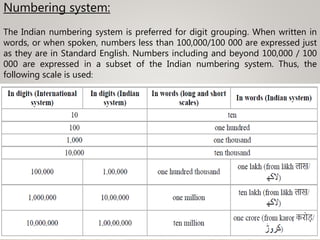
Numbering system:
The Indian numbering system is preferred for digit grouping. When written in
words, or when spoken, numbers less than 100,000/100 000 are expressed just
as they are in Standard English. Numbers including and beyond 100,000 / 100
000 are expressed in a subset of the Indian numbering system. Thus, the
following scale is used:
www.facebook.com/pharmaeducation
https://ultrapharmacy.blogspot.in

English before and after independance

  • 1.
    ENGLISH BEFORE AND AFTER INDEPENDENCE PRESENTEDBY M. HARIKRISHNA & IRFATH ZABEEN
  • 2.
    INTRODUCTION: • English isnot only important in getting a better job, it is everywhere in social interaction. • If you can’t speak it then you are a nobody. • People belonging not only to a different language groups but also to the same speech community make use of English in their inter-personal communication. • This view makes it clear that English occupies a place of prestige in our country.
  • 3.
    PRE-INDEPENDENCE PERIOD: • Dueto the British invasion, English language was widely exposed to our country. • It is strongly believed that it made its entry • when the British first came to India after the incorporation of the East India Company in 1600, and gained roots because of the educational policies of Lord Macaulay.
  • 4.
     Since thedays of the British Raj, English remained the language of domination, status and privilege in India. The hegemonic colonial project India was to create and maintain a class of administrative officers, clerks and compliant civil servants to carry out the task of ruling the vast and expansive subcontinent The view expressed above makes it clear that English was the language of the rulers in India, and as a colonial subjects we had no other choice but to learn English. In this way the language started gaining roots in India. Then the people belonging to the middle class advocated and aspired their education in English, which was the language of rulers. They saw that the capacity to speak and write English enables them for lucrative posts under government, which provided a decent income and an important status in the society.  Raja Ram Mohan Roy took the issue with all seriousness. He was against oriental policy of education. When a proposal by General Committee of public instruction for funding a Sanskrit college in Calcutta was put forward. view expressed above it becomes clear that Raja Ram Mohan Roy preferred English to Indian languages for academic, scientific and other international reasons.
  • 5.
     Macaulay’s motivesin spreading English in India were just to create a group of Indians who would be the interpreters between their rulers and the ruled. He, by spreading English in India, aimed at just creating a class of persons, Indian in blood and color but English in taste, in opinions, morals and intellect. it becomes clear that the beginning of the process of providing English language to the bilinguals in India was firmly established with the approval of Lord William Bentick to Macaulay’s educational policy of modern education in India. English then gradually spread wider in India and gained roots English then gradually spread wider in India and gained roots in the educational system. In 1857 three universities at the then Bombay, Calcutta and Madras were established. By the end of the 19th century two more universities, one at Punjab and the other at Allahabad were setup. The foundation of these universities marked a new epoch in the history of Indian education. This resulted into the spread of schools and colleges, which ultimately resulted in the increase of more number of Indians who achieved mastery in this language.
  • 6.
    POST-INDEPENDENCE PERIOD: • English,the language mostly of the colonizers during the British Raj became accepted to the higher strata, educationally, economically and socially progressive class of the Indian society during the post-independence period. • English is recognized as an important global or international language, essential for professional employment and significantly, a key component of the cultural capital of middle class Indians • The foreign language status of English in India thus appears to have remained for a shorter period initially, and it gradually seems to have acquired the status of a second language.
  • 7.
     Since independence,English language continued to be taught in Indian schools, though in limited schools and colleges initially. With passage of time the use of English increased resulting in a shift of its status.  A sizeable group of native Indians emerged by the time in India whose higher social status was dependent on their good acquisition of English. Increased English language proficiency was considered instrumental in fetching well paid job opportunities.  It was also decided that either Hindi or English could be used for proceedings of the parliament  Owing to the increasing importance of English, in the changing times, various states in India gave the language a respectable place by making it a compulsory language in their educational setup.  English thus became the primary requirement for interconnectedness of people, for free exchange of ideas, cultures, economies, communication, business and education.  The wide publication of newspapers, periodicals, and magazines in English clearly indicates its increasing use in India  According to Peri Bhaskarrao the total number of newspaper copies for all languages circulated in 1997 stood at 105,708,191. Of these, a Hindi newspaper had the highest circulation of 1,292,277 copies followed by an English newspaper with a circulation of 1,243,603 copies.
  • 8.
    Numbering system: The Indiannumbering system is preferred for digit grouping. When written in words, or when spoken, numbers less than 100,000/100 000 are expressed just as they are in Standard English. Numbers including and beyond 100,000 / 100 000 are expressed in a subset of the Indian numbering system. Thus, the following scale is used:
  • 9.

Editor's Notes

  • #5 Britishers did not want the spread of European type of Education in India.