Presented by: Fella Boudjema
English Lecturer and CELTA holder
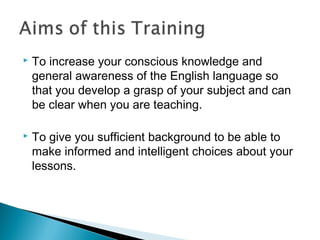
 To increase your conscious knowledge and
general awareness of the English language so
that you develop a grasp of your subject and can
be clear when you are teaching.
 To give you sufficient background to be able to
make informed and intelligent choices about your
lessons.
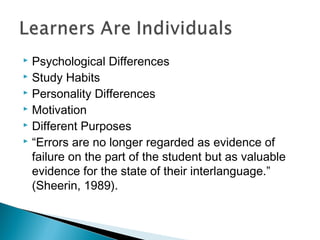
 Psychological Differences
 Study Habits
 Personality Differences
 Motivation
 Different Purposes
 “Errors are no longer regarded as evidence of
failure on the part of the student but as valuable
evidence for the state of their interlanguage.”
(Sheerin, 1989).
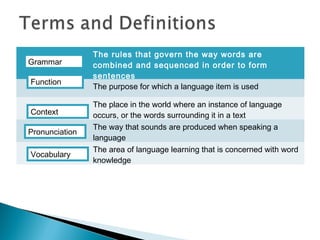
The rules that govern the way words are
combined and sequenced in order to form
sentences
The purpose for which a language item is used
The place in the world where an instance of language
occurs, or the words surrounding it in a text
The way that sounds are produced when speaking a
language
The area of language learning that is concerned with word
knowledge
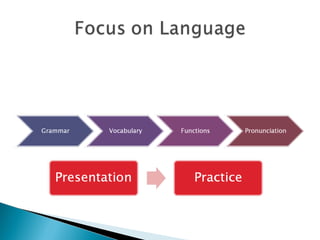
Function
Grammar
Pronunciation
Vocabulary
Context
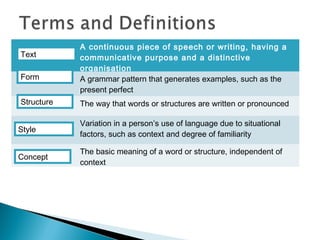
A continuous piece of speech or writing, having a
communicative purpose and a distinctive
organisation
A grammar pattern that generates examples, such as the
present perfect
The way that words or structures are written or pronounced
Variation in a person’s use of language due to situational
factors, such as context and degree of familiarity
The basic meaning of a word or structure, independent of
context
Style
Text
Form
Structure
Concept
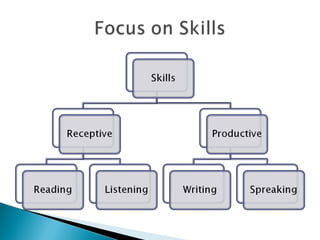
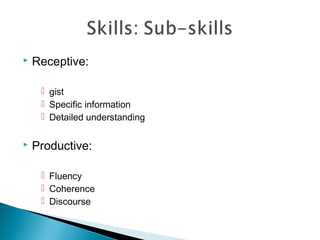
 Receptive:
 gist
 Specific information
 Detailed understanding
 Productive:
 Fluency
 Coherence
 Discourse
 In a normal lesson the fraction is:
◦ 1/3 language
◦ 2/3 skills
 Sheerin, S (1989).Self Access. OUP. Pp 4-6.
 CELTA 5 Training
 CELTA Course

Language focus vs skills focus classes in ESL Teaching

  • 1.
    Presented by: FellaBoudjema English Lecturer and CELTA holder
  • 2.
     To increaseyour conscious knowledge and general awareness of the English language so that you develop a grasp of your subject and can be clear when you are teaching.  To give you sufficient background to be able to make informed and intelligent choices about your lessons.
  • 3.
     Psychological Differences Study Habits  Personality Differences  Motivation  Different Purposes  “Errors are no longer regarded as evidence of failure on the part of the student but as valuable evidence for the state of their interlanguage.” (Sheerin, 1989).
  • 4.
    The rules thatgovern the way words are combined and sequenced in order to form sentences The purpose for which a language item is used The place in the world where an instance of language occurs, or the words surrounding it in a text The way that sounds are produced when speaking a language The area of language learning that is concerned with word knowledge Function Grammar Pronunciation Vocabulary Context
  • 5.
    A continuous pieceof speech or writing, having a communicative purpose and a distinctive organisation A grammar pattern that generates examples, such as the present perfect The way that words or structures are written or pronounced Variation in a person’s use of language due to situational factors, such as context and degree of familiarity The basic meaning of a word or structure, independent of context Style Text Form Structure Concept
  • 8.
     Receptive:  gist Specific information  Detailed understanding  Productive:  Fluency  Coherence  Discourse
  • 9.
     In anormal lesson the fraction is: ◦ 1/3 language ◦ 2/3 skills
  • 10.
     Sheerin, S(1989).Self Access. OUP. Pp 4-6.  CELTA 5 Training  CELTA Course