(Long, 1985.)  Piece of work undertaken for oneself or  for others freely  or for some reward .
Examples of Tasks. Make coffee
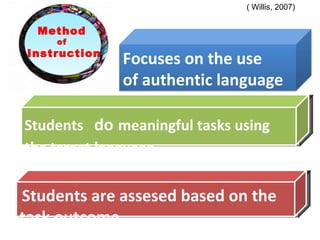
Students  do   meaningful tasks using the target language . Students are assesed based on the task outcome. ( Willis, 2007)  Method of Instruction Focuses on the use  of authentic language
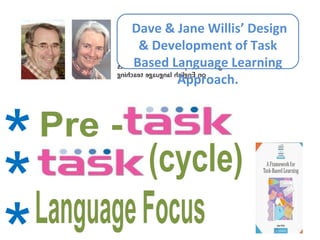
Dave & Jane Willis’ Design & Development of Task Based Language Learning Approach. * * *
Introducction to topic and task Pre-Task
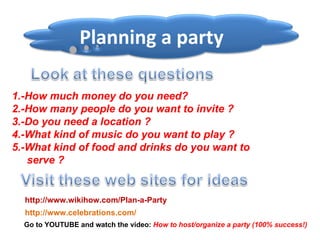
1.-How much money do you need? 2.-How many people do you want to invite ? 3.-Do you need a location ? 4.-What kind of music do you want to play ? 5.-What kind of food and drinks do you want to  serve ? http://www.wikihow.com/Plan-a-Party http://www.celebrations.com/ Go to YOUTUBE and watch the video:  How to host/organize a party (100% success!) Planning a party
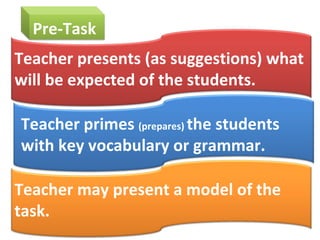
Pre-Task Teacher presents (as suggestions) what will be expected of the students. Teacher primes  (prepares)  the students  with key vocabulary or grammar. Teacher may present a model of the task.
T A S k
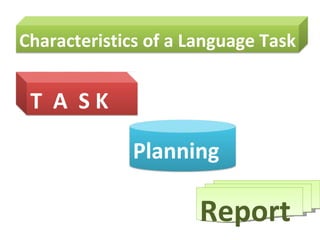
Report Characteristics of a Language Task T  A  S K Planning
 
 
Task Report
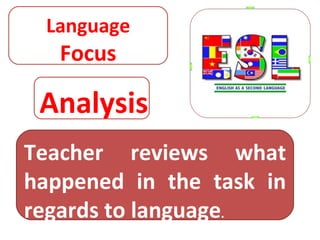
Language Focus Analysis Teacher reviews what happened in the task in regards to language .
Teacher covers material previously mentioned. Practice Teacher emphasizes key language.
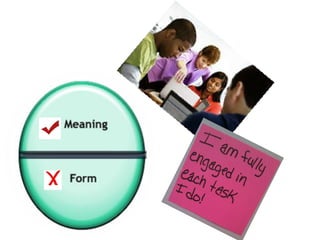
Doing tasks exploits a wider range of vocabulary.  Students may learn more effectively when their minds  are focused on the task, rather  than on the language they  are using. Why?
 
Advantages
Teachers may present language and grammar keys, but students are ultimately free to use what grammar and vocabulary they want. As tasks are familiar to students, these are more engaged to them. Advantages
Students are exposed  to certain forms of language  and neglected of others like debate  or  argumentation. Disadvantages It  is  not appropiate as the foundation of a class for beginners.
References. Longman Group UK limited. (1990)  Dictionary of Contemporaty English  (5th.ed.) England: Longman.  Nunan, D. ( 2004) Task-based Language Teaching  Cambridge University Press. Willis, J. (  1996  )  A framework for Task-Based Learning , Longman Willis, D. & Willis, J. (2007).  Doing task-based teaching .  Oxford: Oxford University Press
 

Task based approach

  • 1.
  • 2.
    (Long, 1985.) Piece of work undertaken for oneself or for others freely or for some reward .
  • 3.
    Examples of Tasks.Make coffee
  • 4.
    Students do meaningful tasks using the target language . Students are assesed based on the task outcome. ( Willis, 2007) Method of Instruction Focuses on the use of authentic language
  • 5.
    Dave & JaneWillis’ Design & Development of Task Based Language Learning Approach. * * *
  • 6.
    Introducction to topicand task Pre-Task
  • 7.
    1.-How much moneydo you need? 2.-How many people do you want to invite ? 3.-Do you need a location ? 4.-What kind of music do you want to play ? 5.-What kind of food and drinks do you want to serve ? http://www.wikihow.com/Plan-a-Party http://www.celebrations.com/ Go to YOUTUBE and watch the video: How to host/organize a party (100% success!) Planning a party
  • 8.
    Pre-Task Teacher presents(as suggestions) what will be expected of the students. Teacher primes (prepares) the students with key vocabulary or grammar. Teacher may present a model of the task.
  • 9.
  • 10.
    Report Characteristics ofa Language Task T A S K Planning
  • 11.
  • 12.
  • 13.
  • 14.
    Language Focus AnalysisTeacher reviews what happened in the task in regards to language .
  • 15.
    Teacher covers materialpreviously mentioned. Practice Teacher emphasizes key language.
  • 16.
    Doing tasks exploitsa wider range of vocabulary. Students may learn more effectively when their minds are focused on the task, rather than on the language they are using. Why?
  • 17.
  • 18.
  • 19.
    Teachers may presentlanguage and grammar keys, but students are ultimately free to use what grammar and vocabulary they want. As tasks are familiar to students, these are more engaged to them. Advantages
  • 20.
    Students are exposed to certain forms of language and neglected of others like debate or argumentation. Disadvantages It is not appropiate as the foundation of a class for beginners.
  • 21.
    References. Longman GroupUK limited. (1990) Dictionary of Contemporaty English (5th.ed.) England: Longman. Nunan, D. ( 2004) Task-based Language Teaching Cambridge University Press. Willis, J. ( 1996 ) A framework for Task-Based Learning , Longman Willis, D. & Willis, J. (2007). Doing task-based teaching . Oxford: Oxford University Press
  • 22.