Language Families

A language family is a group of languages related because they are descended from a common
ancestor, called the proto-language of that family.

Membership of languages in the same language family is established by comparative
linguistics. Daughter languages are said to have a genetic or genealogical relationship; the
former term is more current in modern times, but the latter is equally as traditional. The
evidence of linguistic relationship is observable shared characteristics that are not attributed
to borrowing.

 Membership in a branch or group within a language family is established by shared
innovations; that is, common features of those languages that are not attested in the common
ancestor of the entire family. For example, what makes Germanic languages "Germanic" is that
they share vocabulary and grammatical features that are not believed to have been present in
Proto-Indo-European. These features are believed to be innovations that took place in Proto-
Germanic, a descendant of Proto-Indo-European that was the source of all Germanic languages.

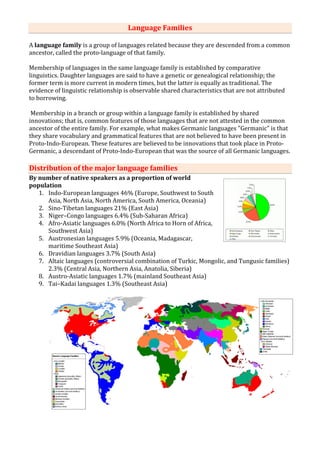
Distribution of the major language families
By number of native speakers as a proportion of world
population
   1. Indo-European languages 46% (Europe, Southwest to South
      Asia, North Asia, North America, South America, Oceania)
   2. Sino-Tibetan languages 21% (East Asia)
   3. Niger–Congo languages 6.4% (Sub-Saharan Africa)
   4. Afro-Asiatic languages 6.0% (North Africa to Horn of Africa,
      Southwest Asia)
   5. Austronesian languages 5.9% (Oceania, Madagascar,
      maritime Southeast Asia)
   6. Dravidian languages 3.7% (South Asia)
   7. Altaic languages (controversial combination of Turkic, Mongolic, and Tungusic families)
      2.3% (Central Asia, Northern Asia, Anatolia, Siberia)
   8. Austro-Asiatic languages 1.7% (mainland Southeast Asia)
   9. Tai–Kadai languages 1.3% (Southeast Asia)

Language families

  • 1.
    Language Families A languagefamily is a group of languages related because they are descended from a common ancestor, called the proto-language of that family. Membership of languages in the same language family is established by comparative linguistics. Daughter languages are said to have a genetic or genealogical relationship; the former term is more current in modern times, but the latter is equally as traditional. The evidence of linguistic relationship is observable shared characteristics that are not attributed to borrowing. Membership in a branch or group within a language family is established by shared innovations; that is, common features of those languages that are not attested in the common ancestor of the entire family. For example, what makes Germanic languages "Germanic" is that they share vocabulary and grammatical features that are not believed to have been present in Proto-Indo-European. These features are believed to be innovations that took place in Proto- Germanic, a descendant of Proto-Indo-European that was the source of all Germanic languages. Distribution of the major language families By number of native speakers as a proportion of world population 1. Indo-European languages 46% (Europe, Southwest to South Asia, North Asia, North America, South America, Oceania) 2. Sino-Tibetan languages 21% (East Asia) 3. Niger–Congo languages 6.4% (Sub-Saharan Africa) 4. Afro-Asiatic languages 6.0% (North Africa to Horn of Africa, Southwest Asia) 5. Austronesian languages 5.9% (Oceania, Madagascar, maritime Southeast Asia) 6. Dravidian languages 3.7% (South Asia) 7. Altaic languages (controversial combination of Turkic, Mongolic, and Tungusic families) 2.3% (Central Asia, Northern Asia, Anatolia, Siberia) 8. Austro-Asiatic languages 1.7% (mainland Southeast Asia) 9. Tai–Kadai languages 1.3% (Southeast Asia)