Spic Seminar Hall 13 th  July 2011 II Hour III BA Literature The Blessed Damozel by S. Nehru
THE BLESSED DAMOZEL D. G. ROSSETTI
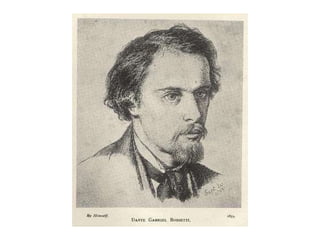
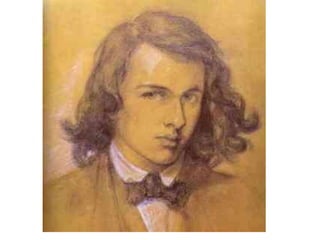
D. G. ROSSETTI LIFE AND WORKS


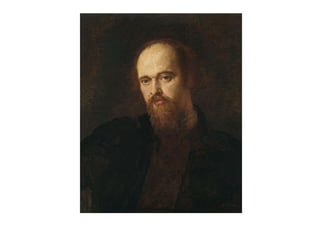
D. G. ROSSETTI Rossetti was born in London 12 th  May 1828 Son of Gabrielle Rosetti Three Siblings All were artistic His sister Christina became a poet His brother William Michael was art critic His sister Maria Francesca published a commentary on Dante
D. G. ROSSETTI Rossetti's name was Gabriel Charles Dante Rossetti  But he changed the order of his name to stress his Italian antecedents and his relationship to Dante From the start Rossetti divided his time between painting and literature
D. G. ROSSETTI He showed an early talent for poetry winning acclaim for  The Blessed Damozel  at eighteen He was an admirer of William Blake and succeeded in buying one of Blake's sketchbooks with ten shillings borrowed from his brother
D. G. ROSSETTI After studying at Sass's drawing academy for four years, in 1846 Rossetti was enrolled at the Royal Academy Schools  However, he was impatient with the painstaking methods of the Academy and abandoned his studies there to work under Ford Madox Brown In 1848 he met Holman Hunt, and they shared a studio together for a time
D. G. ROSSETTI In 1848 he, William Holman Hunt, and  John Everett Millais  began to call themselves the  Pre-Raphaelite Brotherhood   Rosetti's range of talents and interests, combined with his energy and enthusiasm, made him a central figure in the the group  A commission to cover the walls of the Oxford Debating Union with Arthurian murals introduced Rossetti to William Morris, Edward Burne-Jones, and A.C. Swinburne in 1856
D. G. ROSSETTI Rosetti attracted the young Burne-Jones and William Morris to the Pre-Raphaelites  He exhibited his first major oil painting,  The Girlhood of the Virgin Mary  at the Free Exhibition in March 1849  In September and October of that year he visited Paris and Flanders with Holman Hunt
D. G. ROSSETTI He also met his future wife and frequent model  Elizabeth  Siddall  late in 1849 and they married in 1860  In 1862 she died from an overdose of laudanum and Rosetti buried his poems in her grave  He was largely responsible for the Pre-Raphaelite magazine  The Germ , published in 1850
D. G. ROSSETTI In April 1850 he exhibited  Ecce  Ancilla  Domini!  at the National Institution  From 1854 he became friendly with John Ruskin who helped bring the Pre-Raphaelites to public attention, and in 1855 with the poet Robert Browning  In 1856 he was a contributor to Morris's Oxford and Cambridge Magazine
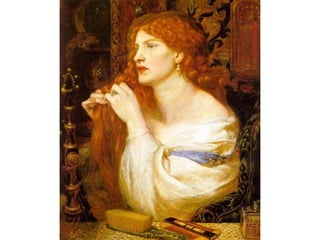
D. G. Rossetti In 1857 he met Jane Burden who married William Morris but she and Rossetti had an intimate relationship over a long period  In 1858 Rossetti founded the Hogarth Club, an exhibiting and social club, with Madox Brown and others  Around this time Fanny Cornforth became his primary model and mistress for the next decade
D. G. Rossetti Rossetti's translation of The Early Italian Poets was published in 1861  From 1861 Rossetti was also involved with Morris, Marshall, Faulkner & Co. in their attempts to return to medieval craftesmanship    Stained-glass windows became by far their most important product
D. G. Rossetti However, the firm was always in financial difficulties and was often subsidized by Morris  Rosetti's design for Christ Church Southgate is in the South West corner of the church on the West wall  The left hand figure of St James is the work of Burne Jones  The right hand figure of St Jude carrying a halberd is the work of Rosetti
D. G. Rossetti Both figures are surmounted by angels carrying shields   From the mid-1860s Rosetti began suffering from eye trouble and insomnia, and showed signs of paranoia  In October 1869 he exhumed his wife's coffin to retrieve his Poems, which were published in 1870
D. G. Rossetti The book was a success but caused a controversy when it was reviewed in 1871 by Robert Buchanan in an essay called "The Fleshly School of Poetry"  Buchanan argued that Rosetti's book was full of indecencies and this started a series of further attacks, defenses and counterattacks  Rossetti wrote an essay of self- defense called "The Stealthy School of Criticism"
D. G. Rossetti Rosetti's health broke down in 1872 and he abandoned many of his old friendships  A new edition of Poems was published in 1881 together with Ballads and Sonnets  He died at Birchington-on-Sea, Kent on 9 th  April 1882
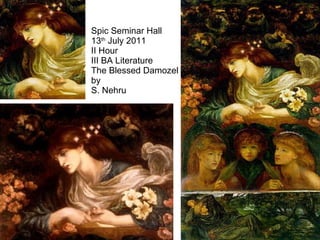
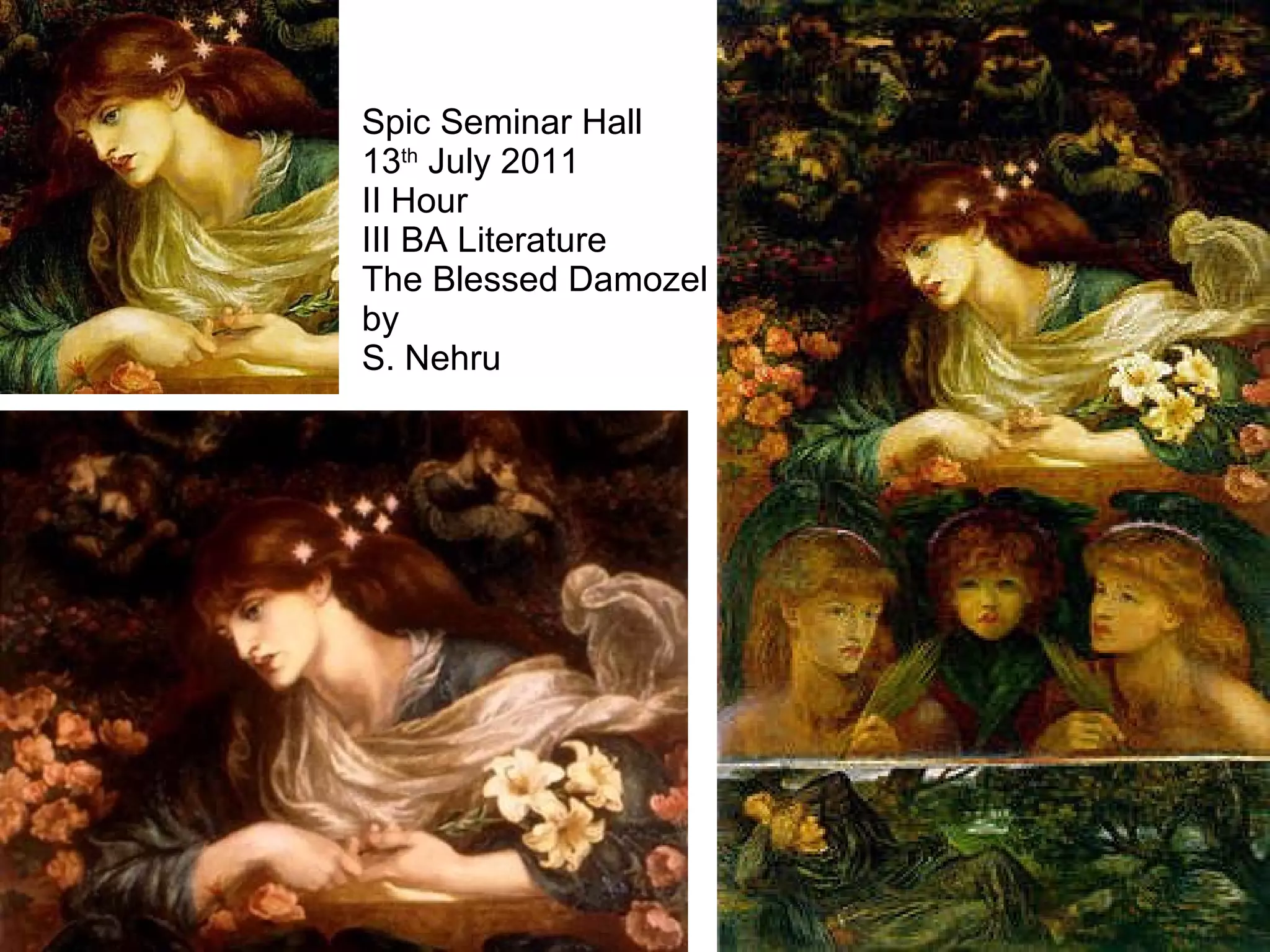
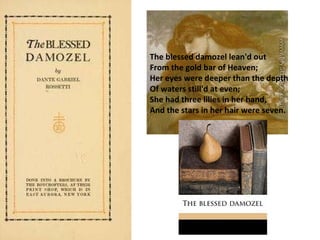
The blessed damozel lean'd out  From the gold bar of Heaven;  Her eyes were deeper than the depth  Of waters still'd at even;  She had three lilies in her hand,  And the stars in her hair were seven.
The blessed Damozel Blessed- heavenly, holy, sacred, bliss, happiness, joy, gifted, favoured with blessings, favoured by God Damozel- a young unmarried woman or girl, maiden
Why is she blessed? She is favoured by God. So she is in heaven. Thus she is blessed She is lucky to be in heaven She is gifted with heaven
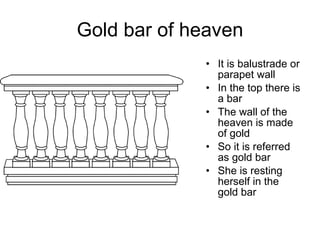
Gold bar of heaven It is balustrade or parapet wall In the top there is a bar The wall of the heaven is made of gold So it is referred as gold bar She is resting herself in the gold bar
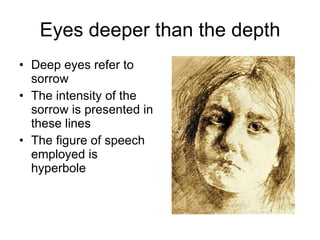
Eyes deeper than the depth Deep eyes refer to sorrow The intensity of the sorrow is presented in these lines The figure of speech employed is hyperbole
Of waters stilled at even Her eyes deeper than the depth of still water In the both eyes water is stilled [staying in the eyes]
She had three lilies in her hand Three lilies refers to purity and nearness to God Lily signifying purity The number three refers to triune [trinity: God as three persons- Father, Son and Holy Spirit]
And the stars in her hair were seven Refers to seven stars of heaven In Greek mythology Atlas and Pleione had seven daughters Those young girls were transformed into heavenly stars after their death They are: Alcyone,Celaeno, Electra, Maia,Merope,Sterope and Taygette They attended the Goddess of virginity, Artemis
More Details Why did she leaned out? It suggests that her mind is not in heaven Melancholy is suggested through the expression of deep eyes Is she really blessed? There is a conflict between joy and sorrow
More Details The expression leaned out is more vital to the first stanza. It sets the texture of the poem It is more suggestive She is not in heaven mentally
Coming in the Next Class Second Stanza
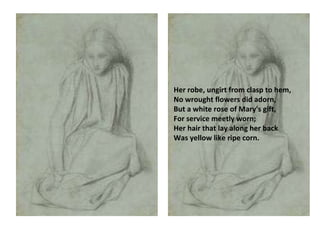
Her robe, ungirt from clasp to hem,  No wrought flowers did adorn,  But a white rose of Mary's gift,  For service meetly worn;  Her hair that lay along her back  Was yellow like ripe corn.
THANK YOU

The Blessed Damozel, I Stanza

  • 1.
    Spic Seminar Hall13 th July 2011 II Hour III BA Literature The Blessed Damozel by S. Nehru
  • 2.
    THE BLESSED DAMOZELD. G. ROSSETTI
  • 3.
    D. G. ROSSETTILIFE AND WORKS
  • 4.
  • 5.
  • 6.
  • 7.
  • 8.
  • 9.
  • 10.
  • 11.
  • 12.
  • 13.
  • 14.
  • 15.
    D. G. ROSSETTIRossetti was born in London 12 th May 1828 Son of Gabrielle Rosetti Three Siblings All were artistic His sister Christina became a poet His brother William Michael was art critic His sister Maria Francesca published a commentary on Dante
  • 16.
    D. G. ROSSETTIRossetti's name was Gabriel Charles Dante Rossetti But he changed the order of his name to stress his Italian antecedents and his relationship to Dante From the start Rossetti divided his time between painting and literature
  • 17.
    D. G. ROSSETTIHe showed an early talent for poetry winning acclaim for  The Blessed Damozel at eighteen He was an admirer of William Blake and succeeded in buying one of Blake's sketchbooks with ten shillings borrowed from his brother
  • 18.
    D. G. ROSSETTIAfter studying at Sass's drawing academy for four years, in 1846 Rossetti was enrolled at the Royal Academy Schools However, he was impatient with the painstaking methods of the Academy and abandoned his studies there to work under Ford Madox Brown In 1848 he met Holman Hunt, and they shared a studio together for a time
  • 19.
    D. G. ROSSETTIIn 1848 he, William Holman Hunt, and  John Everett Millais  began to call themselves the  Pre-Raphaelite Brotherhood Rosetti's range of talents and interests, combined with his energy and enthusiasm, made him a central figure in the the group A commission to cover the walls of the Oxford Debating Union with Arthurian murals introduced Rossetti to William Morris, Edward Burne-Jones, and A.C. Swinburne in 1856
  • 20.
    D. G. ROSSETTIRosetti attracted the young Burne-Jones and William Morris to the Pre-Raphaelites He exhibited his first major oil painting,  The Girlhood of the Virgin Mary  at the Free Exhibition in March 1849 In September and October of that year he visited Paris and Flanders with Holman Hunt
  • 21.
    D. G. ROSSETTIHe also met his future wife and frequent model  Elizabeth Siddall  late in 1849 and they married in 1860 In 1862 she died from an overdose of laudanum and Rosetti buried his poems in her grave He was largely responsible for the Pre-Raphaelite magazine  The Germ , published in 1850
  • 22.
    D. G. ROSSETTIIn April 1850 he exhibited  Ecce Ancilla Domini!  at the National Institution From 1854 he became friendly with John Ruskin who helped bring the Pre-Raphaelites to public attention, and in 1855 with the poet Robert Browning In 1856 he was a contributor to Morris's Oxford and Cambridge Magazine
  • 23.
    D. G. RossettiIn 1857 he met Jane Burden who married William Morris but she and Rossetti had an intimate relationship over a long period In 1858 Rossetti founded the Hogarth Club, an exhibiting and social club, with Madox Brown and others Around this time Fanny Cornforth became his primary model and mistress for the next decade
  • 24.
    D. G. RossettiRossetti's translation of The Early Italian Poets was published in 1861 From 1861 Rossetti was also involved with Morris, Marshall, Faulkner & Co. in their attempts to return to medieval craftesmanship   Stained-glass windows became by far their most important product
  • 25.
    D. G. RossettiHowever, the firm was always in financial difficulties and was often subsidized by Morris Rosetti's design for Christ Church Southgate is in the South West corner of the church on the West wall The left hand figure of St James is the work of Burne Jones The right hand figure of St Jude carrying a halberd is the work of Rosetti
  • 26.
    D. G. RossettiBoth figures are surmounted by angels carrying shields  From the mid-1860s Rosetti began suffering from eye trouble and insomnia, and showed signs of paranoia In October 1869 he exhumed his wife's coffin to retrieve his Poems, which were published in 1870
  • 27.
    D. G. RossettiThe book was a success but caused a controversy when it was reviewed in 1871 by Robert Buchanan in an essay called "The Fleshly School of Poetry" Buchanan argued that Rosetti's book was full of indecencies and this started a series of further attacks, defenses and counterattacks Rossetti wrote an essay of self- defense called "The Stealthy School of Criticism"
  • 28.
    D. G. RossettiRosetti's health broke down in 1872 and he abandoned many of his old friendships A new edition of Poems was published in 1881 together with Ballads and Sonnets He died at Birchington-on-Sea, Kent on 9 th April 1882
  • 29.
    The blessed damozellean'd out  From the gold bar of Heaven;  Her eyes were deeper than the depth  Of waters still'd at even;  She had three lilies in her hand,  And the stars in her hair were seven.
  • 30.
    The blessed DamozelBlessed- heavenly, holy, sacred, bliss, happiness, joy, gifted, favoured with blessings, favoured by God Damozel- a young unmarried woman or girl, maiden
  • 31.
    Why is sheblessed? She is favoured by God. So she is in heaven. Thus she is blessed She is lucky to be in heaven She is gifted with heaven
  • 32.
    Gold bar ofheaven It is balustrade or parapet wall In the top there is a bar The wall of the heaven is made of gold So it is referred as gold bar She is resting herself in the gold bar
  • 33.
    Eyes deeper thanthe depth Deep eyes refer to sorrow The intensity of the sorrow is presented in these lines The figure of speech employed is hyperbole
  • 34.
    Of waters stilledat even Her eyes deeper than the depth of still water In the both eyes water is stilled [staying in the eyes]
  • 35.
    She had threelilies in her hand Three lilies refers to purity and nearness to God Lily signifying purity The number three refers to triune [trinity: God as three persons- Father, Son and Holy Spirit]
  • 36.
    And the starsin her hair were seven Refers to seven stars of heaven In Greek mythology Atlas and Pleione had seven daughters Those young girls were transformed into heavenly stars after their death They are: Alcyone,Celaeno, Electra, Maia,Merope,Sterope and Taygette They attended the Goddess of virginity, Artemis
  • 37.
    More Details Whydid she leaned out? It suggests that her mind is not in heaven Melancholy is suggested through the expression of deep eyes Is she really blessed? There is a conflict between joy and sorrow
  • 38.
    More Details Theexpression leaned out is more vital to the first stanza. It sets the texture of the poem It is more suggestive She is not in heaven mentally
  • 39.
    Coming in theNext Class Second Stanza
  • 40.
    Her robe, ungirt fromclasp to hem,  No wrought flowers did adorn,  But a white rose of Mary's gift,  For service meetly worn;  Her hair that lay along her back  Was yellow like ripe corn.
  • 41.