Chapter 6:  Language
What Are Languages, and What Role Do Languages Play In Culture?Language and CultureLanguage:  a set of sounds and symbols that is used for communication.Language is a cornerstone of cultureGovernmental policies have affected languageAssimilation (e.g. the Quebecois of Canada using their influence in Canadian society to ensure that laws make Canadians speak both French and English)Bilingualism (e.g. the controversy in the United States between English and Spanish involving the “Official English” policies and their countermovement)
What Are Languages, and What Role Do Languages Play In Culture?What Is a Language?Languages are often differentiated between based on mutual intelligibility Mutual intelligibility:  the ability of two people to understand each other when speakingControversy in using this differentiation exists:  there is no accurate way to measure it, and there are a few exceptions to it (e.g. Mandarin Chinese and Cantonese Chinese are the same but not mutually intelligible; Danish and Norwegian differ but are mutually intelligible).There is a range of 3,000 to 6,000 estimated languages.
What Are Languages, and What Role Do Languages Play In Culture?Standardized LanguageStandardized language:  a language that is published, widely distributed, and purposefully taught.New words are added to describe new innovationsPower and influence affect the standardized language
What Are Languages, and What Role Do Languages Play In Culture?DialectsDialects:  variants of a standard language along regional or ethnic linesAffected by differences in vocabulary, syntax, pronunciation, cadence, and speech paceDialect chains:  a set of contiguous dialects in which the dialects nearest to each other at any place in the chain are most closely relatedDistribute across space:  the farther the distance from an original point, the stranger a dialect isIsogloss:  a geographic boundary within which a particular linguistic feature occursDetermine vocabulary differences (e.g. in the US the name used for soft drink changes from region to region)
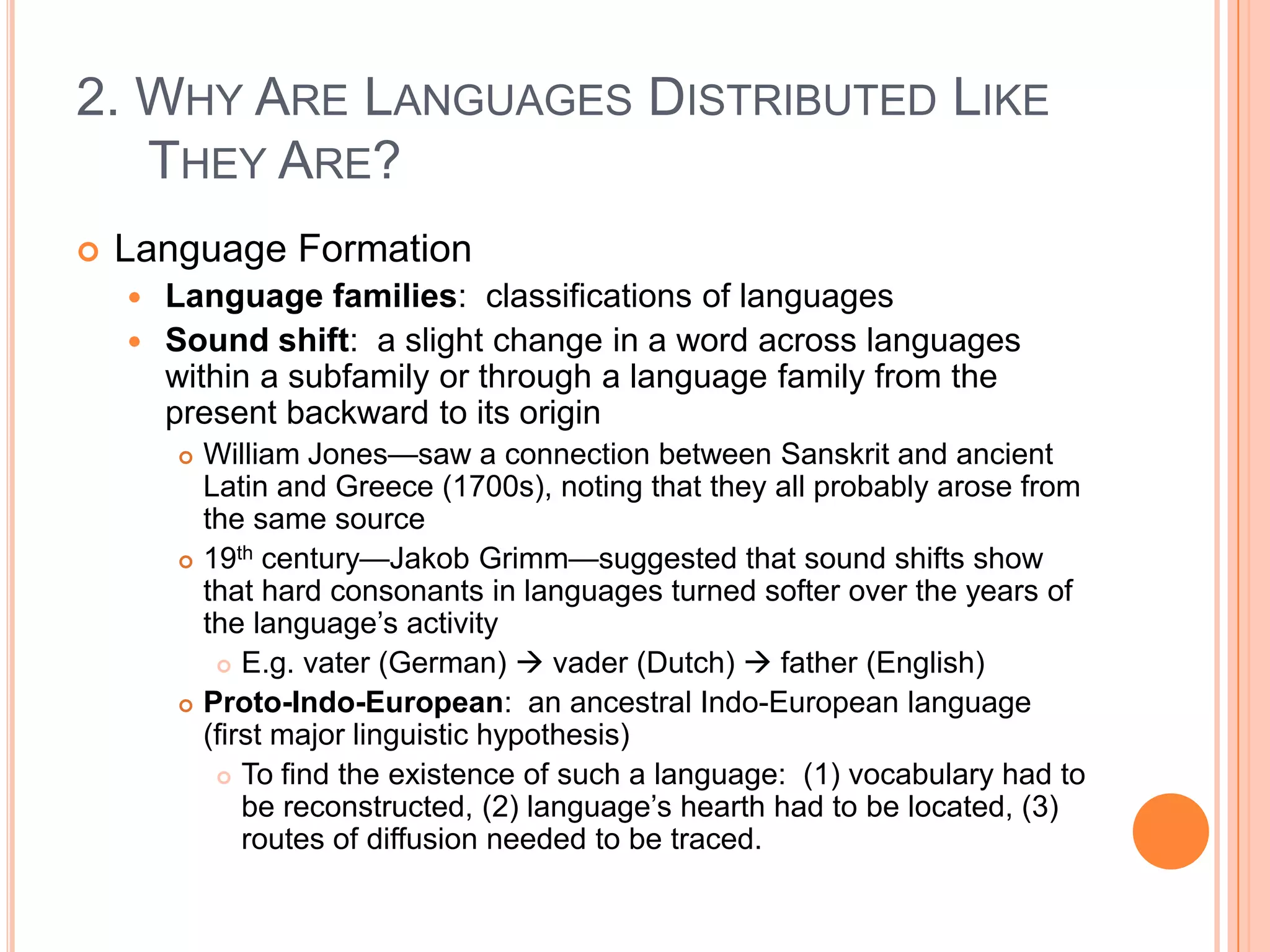
2. Why Are Languages Distributed Like They Are?Language FormationLanguage families:  classifications of languagesSound shift:  a slight change in a word across languages within a subfamily or through a language family from the present backward to its originWilliam Jones—saw a connection between Sanskrit and ancient Latin and Greece (1700s), noting that they all probably arose from the same source19th century—Jakob Grimm—suggested that sound shifts show that hard consonants in languages turned softer over the years of the language’s activityE.g. vater (German)  vader (Dutch)  father (English)Proto-Indo-European:  an ancestral Indo-European language (first major linguistic hypothesis)To find the existence of such a language:  (1) vocabulary had to be reconstructed, (2) language’s hearth had to be located, (3) routes of diffusion needed to be traced.
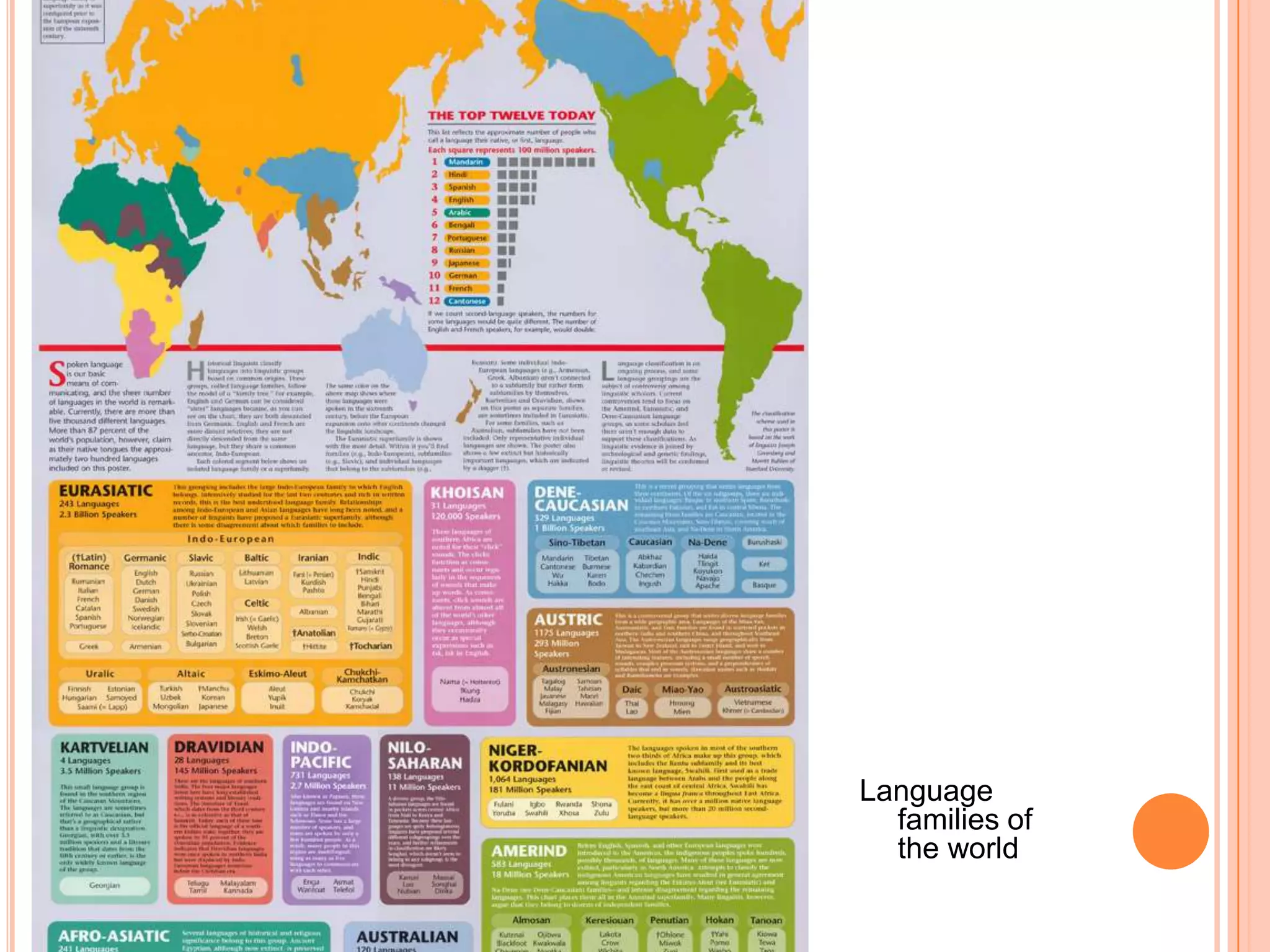
Language families of the world
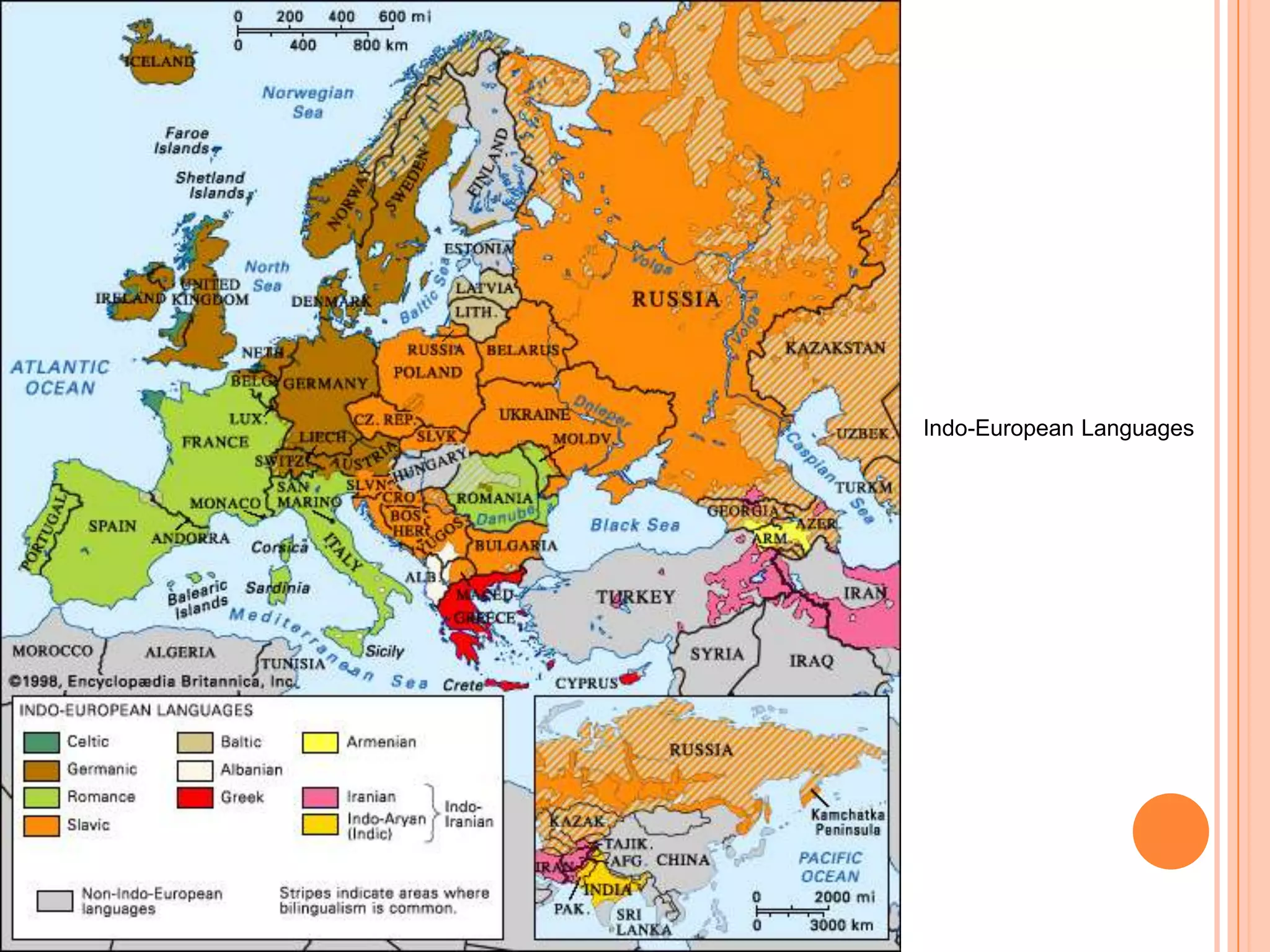
Indo-European Languages
2. Why Are Languages Distributed Like They Are?Language Formation (continued)Reconstructing vocabulary of Proto-Indo-EuropeanBackward reconstruction:  tracking sound shifts and the hardening of consonants “backward” toward the original languageExtinct language:  a language without any native speakersDeep reconstruction:  recreation of the language before an extinct languageVladislavIllich-Svitych and AharonDolgopolsky—two Russian linguists who met up after much individual deep reconstruction and found many similaritiesNostratic:  ancient ancestor of the Proto-Indo-EuropeanUsed 14,000 years ago before the 1st Agricultural Revolution
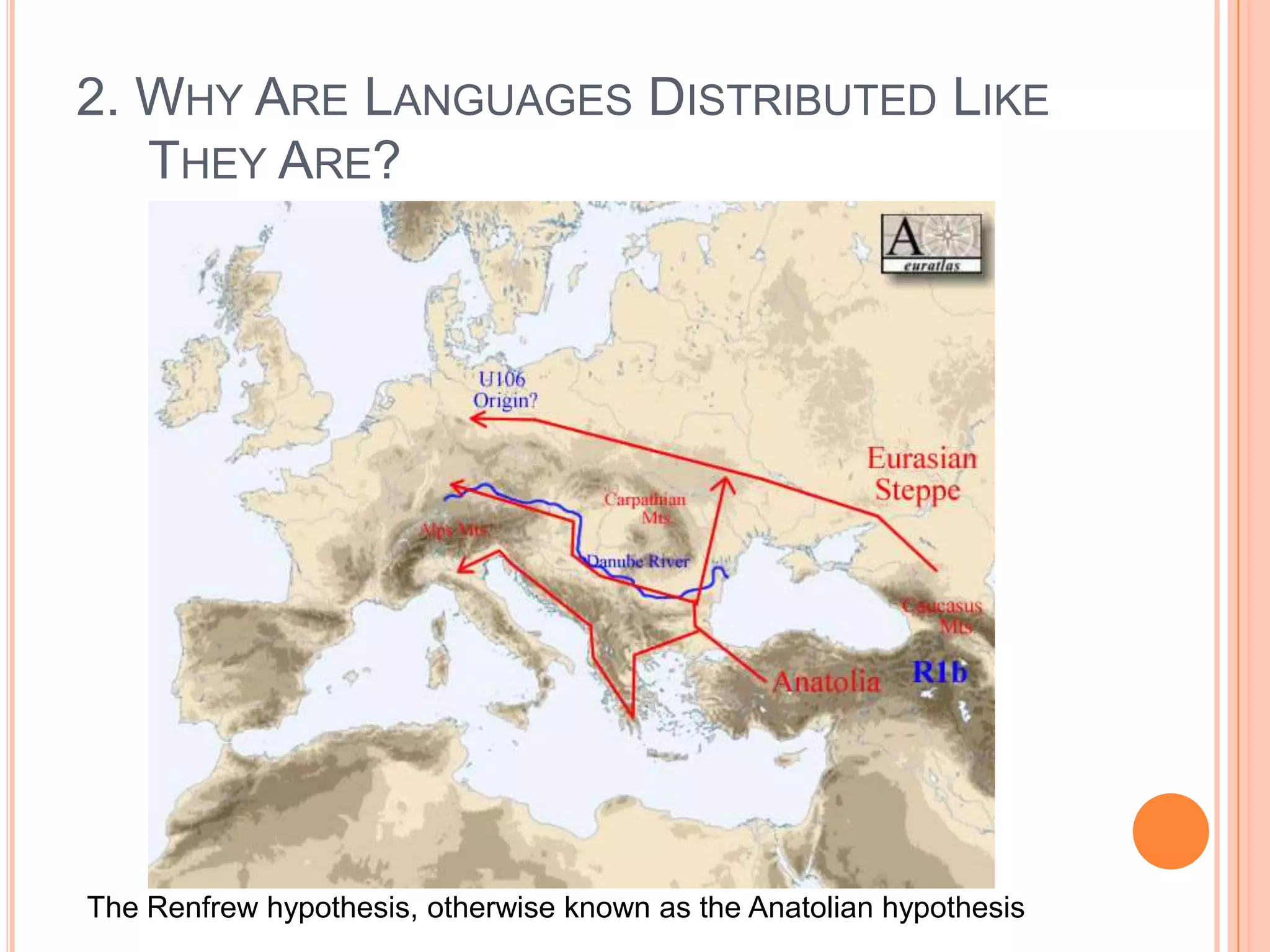
2. Why Are Languages Distributed Like They Are?Language Formation (continued)	2. Locating the Proto-Indo-European hearthLanguage divergence:  spatial interaction among speakers of a language breaks down and the language fragments first into dialects and then into discrete tonguesLanguage convergence:  collapsing two languages into oneBy analyzing the Proto-Indo-European’s vocabulary, linguists and geographers know the environment of its hearth and aspects of the users’ culture and economyOne possible hearth—Black Sea, east-central EuropeRenfrew hypothesis:  three sources of agriculture each gave rise to a major language familyStephen Oppenheimer argued against it, saying people originated in Central Africa, followed the eastern coast, the Southern Arabian Peninsula, and finally ended up in India 80,000 years ago (another possible hearth for the Proto-Indo-European)
2. Why Are Languages Distributed Like They Are?The Renfrew hypothesis, otherwise known as the Anatolian hypothesis
2. Why Are Languages Distributed Like They Are?Language Formation (continued)3. Tracing Proto-Indo-European routes of diffusionDiffusion theories commonly focus on Europe because:The language diffused into Europe over timeThere is a significant body of research focused on the early peopling of EuropeConquest theory:  early speakers of Proto-Indo-European spread from east to west on horseback (for every 25 years, the agricultural frontier moved 11 miles)Dispersal hypothesis:  Indo-European languages that arose from Proto-Indo-European were first carried eastward into southwest Asia, then to the Caspian Sea, then across Russian-Ukrainian plains, then to Balkans1991—genes taken from many different Europeans provided evidence in favor of the agriculture theory—showed farmers moved westward and northward and their genes changed as a result of distance decay
2. Why Are Languages Distributed Like They Are?The Languages of EuropeHalf the world speaks Indo-European languagesCeltic people brought Indo-European languages to Europe 3,000 years ago—migrations and empire building led to the alteration of Celtic into the three characterizations of a European linguistic patternRomance languages (French, Spanish, Italian, Romanian, Portuguese):  lie in areas once controlled but not subsequently overwhelmed by the Roman Empire Germanic languages (English, German, Danish, Norwegian, Swedish):  reflect the expansion of peoples out of northern Europe to the west and southSlavic languages (Russian, Polish, Czech, Slovak, Ukrainian, Slovenian, Serbo-Croatian, Bulgarian):  developed as Slavic people migrated from a base in present-day Ukraine close to 2000 years agoThere is a correlation between languages spoken and political organization of space, with a few exceptions
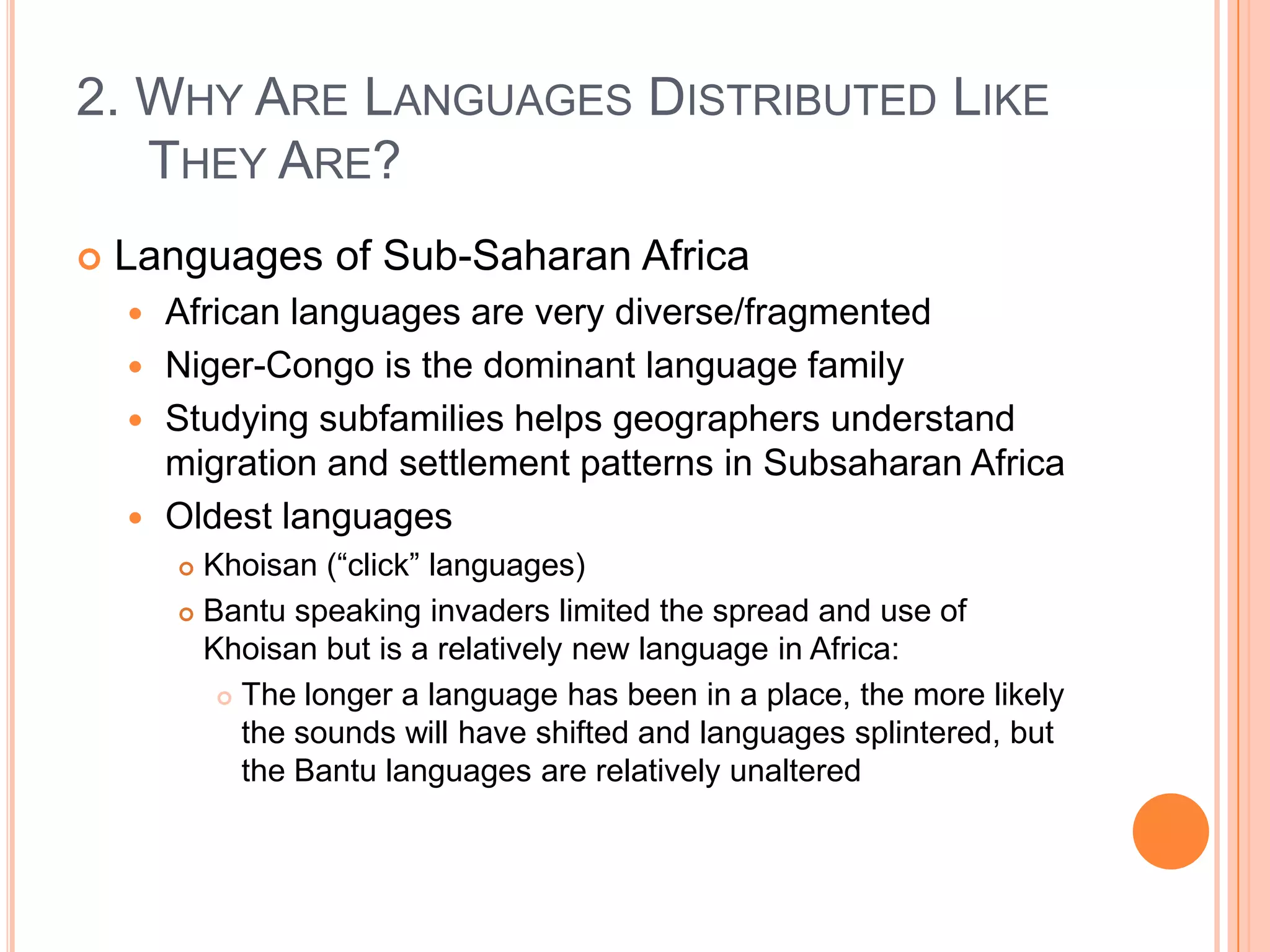
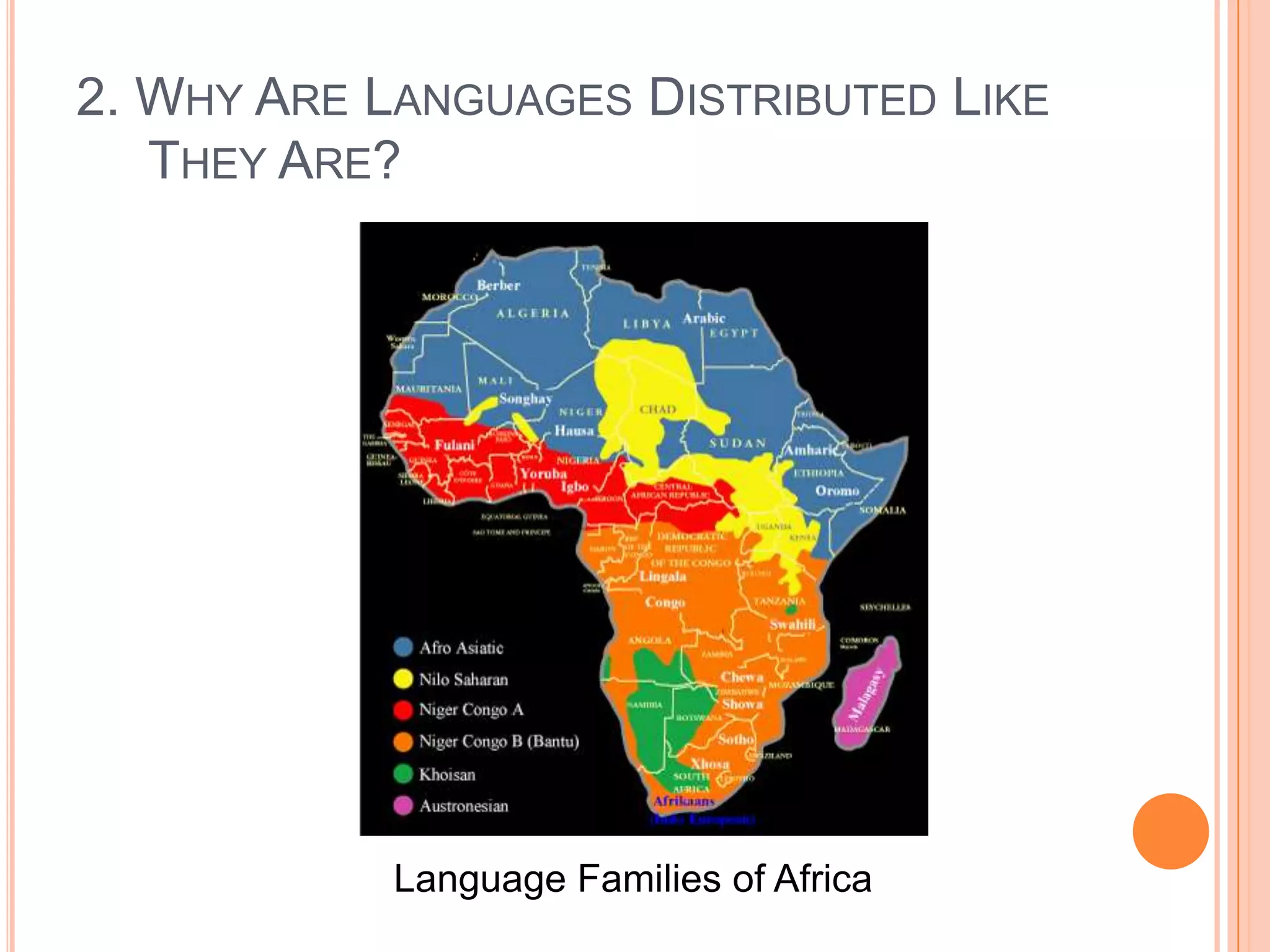
2. Why Are Languages Distributed Like They Are?Languages of Sub-Saharan AfricaAfrican languages are very diverse/fragmentedNiger-Congo is the dominant language familyStudying subfamilies helps geographers understand migration and settlement patterns in Subsaharan AfricaOldest languagesKhoisan (“click” languages)Bantu speaking invaders limited the spread and use of Khoisan but is a relatively new language in Africa:The longer a language has been in a place, the more likely the sounds will have shifted and languages splintered, but the Bantu languages are relatively unaltered
2. Why Are Languages Distributed Like They Are?Language Families of Africa
2. Why Are Languages Distributed Like They Are?Languages of Sub-Saharan Africa (continued)Three major languages of NigeriaHousa (in the north)Yoruba (in the southwest)Ibu (in the southeast)Nigeria is very linguistically diverse—500 languages are spokenBritish colonialism contributed to the creation of Nigeria and many of the arbitrary borders in Africa that completely ignore cultural divisionEnglish is the official language of Nigeria to avoid the political charge attached to the other three languages but it serves little purpose to Nigerians
3.  How Do Languages Diffuse?Lingua FrancaTrade encouraged people speaking different languages to find ways of communicating with each other (led to the development of a lingua franca)Lingua franca:  ¹a tongue spoken in ancient Mediterranean parts comprised of a mixture of Italian, French, Greek, Spanish, and Arabic; ²a common language for purposes of trade and commerceFranks were in the Mediterranean for purposes of seaborne commerce in the 1200s and ended up mixing French, Italian, Greek, Spanish, and ArabicEnglish is a lingua franca, as is Swahili in East AfricaPidgin language:  when parts of two or more languages are combined in a simplified structure and vocabularyCreole language:  a language that began as a Pidgin language but was later adopted as the mother tongue by a people in place of the mother tongue
3. How Do Languages Diffuse?MultilingualismMonolingual states:  countries in which only one language is spokenFew monolingual states exist (Japan, Uruguay, Venezuela, Iceland, Denmark, Portugal, Poland, Lesotho)Multilingual states:  countries in which more than one language is spokenIn some multilingual states, linguistic fragmentation reflects divisive forces as well as strong cultural pluralismOfficial LanguagesOfficial language:  the language selected to promote internal cohesionCountries with linguistic fragmentation tie people together by adopting an official languageSome citizens object to the official language chosenSome countries have two or more official languages
3. How Do Languages Diffuse?Global LanguagesGlobal language:  a common language of trade and commerce used around the worldEnglish is having increased usageWill not become the kind of global language where every person uses it in day-to-day activities because:Population rates are lower in English-speaking placesPeople in non-English speaking places are unwilling to abandon their language (they don’t want to abandon their culture by switching to English)Used as an international language of commerce in increasing frequency.
4. What Role Does Language Play In Making Places?Changing ToponymsToponyms:  place namesWhen people change the names of places, they have the power to change the places’ historyLlanfairpwllgwyngyllgogerychwyrndrobwllllantysiliogogogoch—town changed its name because it feared the loss of the Welsh languageChanges in place names give us an idea about the layers of history and cultural landscapeKenai Peninsula in AK—Natives called it Nanwalek in the early 1800s.  Changed it to Alexandorf when the Russians took it over.  Americans changed it to English Bay when they mapped it.  Natives changed it back to Nanwalek.
4. What Role Does Language Play In Making Places?Changing Toponyms (continued)Types of ToponymsPost-Colonial ToponymsPeople choose new toponyms to escape the colonial past as soon as power changes handsName changes in Africa:  Upper Volta to Burkina Faso, Gold Coast to Ghana, Nyasaland to Malawi, and Northern and Southern Rhodesia to Zambia and ZimbabweName changes in Asia:  East Pakistan to Bangladesh, the Netherlands East Indies to IndonesiaNew independent countries changed names to reflect independence but did not wipe all names awayChange:  Leopoldville became Kinshasa, capital of the Congo; Salisbury, Zimbabwe, became Harare; Lourenço Marques, Mozambique, to MaputoSame:  Etoile (the Congo), Colleen Bawn (Zimbabwe), Cabo Delgado (Mozambique)
4. What Role Does Language Play In Making Places?Changing Toponyms (continued)Types of Toponyms (continued)Post-Revolution ToponymsIndependence and changes in power through coups and revolutions both prompt name changesGeneral Mobutu SeseSeko changed the Belgian Congo to Zaïre, which was adopted willingly by other governments.  1997—Laurent Kabila ousted Mobutu and changed it again to Democratic Republic of the Congo, which everybody adopted.Name changes can make people react strongly
4. What Role Does Language Play In Making Places?Changing Toponyms (continued)Types of Toponyms (continued)Memorial ToponymsPeople choose to change toponyms to memorialize an important person or eventChange to Memorial Park in the US for hundreds of people and eventsEvents like decolonization or a political revolution spur changes as wellAfrican Americans in the US change street names to commemorate Martin Luther King Jr.Revolutions in the thought and behaviorChange to reflect the surrounding community (MLK Jr. Dr.)
4. What Role Does Language Play In Making Places?Changing Toponyms (continued)Types of Toponyms (continued)Commodification of ToponymsInternational media corporations that have global reach bring known names to new placesDisney Corporation opened Tokyo Disneyland in 1983 and Disneyland Paris in 1990—capitalize on the success of Disneyland in the USStadiumsOpening of tunnels in NY named after sponsors

Language

  • 1.
    Chapter 6: Language
  • 2.
    What Are Languages,and What Role Do Languages Play In Culture?Language and CultureLanguage: a set of sounds and symbols that is used for communication.Language is a cornerstone of cultureGovernmental policies have affected languageAssimilation (e.g. the Quebecois of Canada using their influence in Canadian society to ensure that laws make Canadians speak both French and English)Bilingualism (e.g. the controversy in the United States between English and Spanish involving the “Official English” policies and their countermovement)
  • 3.
    What Are Languages,and What Role Do Languages Play In Culture?What Is a Language?Languages are often differentiated between based on mutual intelligibility Mutual intelligibility: the ability of two people to understand each other when speakingControversy in using this differentiation exists: there is no accurate way to measure it, and there are a few exceptions to it (e.g. Mandarin Chinese and Cantonese Chinese are the same but not mutually intelligible; Danish and Norwegian differ but are mutually intelligible).There is a range of 3,000 to 6,000 estimated languages.
  • 4.
    What Are Languages,and What Role Do Languages Play In Culture?Standardized LanguageStandardized language: a language that is published, widely distributed, and purposefully taught.New words are added to describe new innovationsPower and influence affect the standardized language
  • 5.
    What Are Languages,and What Role Do Languages Play In Culture?DialectsDialects: variants of a standard language along regional or ethnic linesAffected by differences in vocabulary, syntax, pronunciation, cadence, and speech paceDialect chains: a set of contiguous dialects in which the dialects nearest to each other at any place in the chain are most closely relatedDistribute across space: the farther the distance from an original point, the stranger a dialect isIsogloss: a geographic boundary within which a particular linguistic feature occursDetermine vocabulary differences (e.g. in the US the name used for soft drink changes from region to region)
  • 6.
    2. Why AreLanguages Distributed Like They Are?Language FormationLanguage families: classifications of languagesSound shift: a slight change in a word across languages within a subfamily or through a language family from the present backward to its originWilliam Jones—saw a connection between Sanskrit and ancient Latin and Greece (1700s), noting that they all probably arose from the same source19th century—Jakob Grimm—suggested that sound shifts show that hard consonants in languages turned softer over the years of the language’s activityE.g. vater (German)  vader (Dutch)  father (English)Proto-Indo-European: an ancestral Indo-European language (first major linguistic hypothesis)To find the existence of such a language: (1) vocabulary had to be reconstructed, (2) language’s hearth had to be located, (3) routes of diffusion needed to be traced.
  • 7.
  • 8.
  • 9.
    2. Why AreLanguages Distributed Like They Are?Language Formation (continued)Reconstructing vocabulary of Proto-Indo-EuropeanBackward reconstruction: tracking sound shifts and the hardening of consonants “backward” toward the original languageExtinct language: a language without any native speakersDeep reconstruction: recreation of the language before an extinct languageVladislavIllich-Svitych and AharonDolgopolsky—two Russian linguists who met up after much individual deep reconstruction and found many similaritiesNostratic: ancient ancestor of the Proto-Indo-EuropeanUsed 14,000 years ago before the 1st Agricultural Revolution
  • 10.
    2. Why AreLanguages Distributed Like They Are?Language Formation (continued) 2. Locating the Proto-Indo-European hearthLanguage divergence: spatial interaction among speakers of a language breaks down and the language fragments first into dialects and then into discrete tonguesLanguage convergence: collapsing two languages into oneBy analyzing the Proto-Indo-European’s vocabulary, linguists and geographers know the environment of its hearth and aspects of the users’ culture and economyOne possible hearth—Black Sea, east-central EuropeRenfrew hypothesis: three sources of agriculture each gave rise to a major language familyStephen Oppenheimer argued against it, saying people originated in Central Africa, followed the eastern coast, the Southern Arabian Peninsula, and finally ended up in India 80,000 years ago (another possible hearth for the Proto-Indo-European)
  • 11.
    2. Why AreLanguages Distributed Like They Are?The Renfrew hypothesis, otherwise known as the Anatolian hypothesis
  • 12.
    2. Why AreLanguages Distributed Like They Are?Language Formation (continued)3. Tracing Proto-Indo-European routes of diffusionDiffusion theories commonly focus on Europe because:The language diffused into Europe over timeThere is a significant body of research focused on the early peopling of EuropeConquest theory: early speakers of Proto-Indo-European spread from east to west on horseback (for every 25 years, the agricultural frontier moved 11 miles)Dispersal hypothesis: Indo-European languages that arose from Proto-Indo-European were first carried eastward into southwest Asia, then to the Caspian Sea, then across Russian-Ukrainian plains, then to Balkans1991—genes taken from many different Europeans provided evidence in favor of the agriculture theory—showed farmers moved westward and northward and their genes changed as a result of distance decay
  • 13.
    2. Why AreLanguages Distributed Like They Are?The Languages of EuropeHalf the world speaks Indo-European languagesCeltic people brought Indo-European languages to Europe 3,000 years ago—migrations and empire building led to the alteration of Celtic into the three characterizations of a European linguistic patternRomance languages (French, Spanish, Italian, Romanian, Portuguese): lie in areas once controlled but not subsequently overwhelmed by the Roman Empire Germanic languages (English, German, Danish, Norwegian, Swedish): reflect the expansion of peoples out of northern Europe to the west and southSlavic languages (Russian, Polish, Czech, Slovak, Ukrainian, Slovenian, Serbo-Croatian, Bulgarian): developed as Slavic people migrated from a base in present-day Ukraine close to 2000 years agoThere is a correlation between languages spoken and political organization of space, with a few exceptions
  • 14.
    2. Why AreLanguages Distributed Like They Are?Languages of Sub-Saharan AfricaAfrican languages are very diverse/fragmentedNiger-Congo is the dominant language familyStudying subfamilies helps geographers understand migration and settlement patterns in Subsaharan AfricaOldest languagesKhoisan (“click” languages)Bantu speaking invaders limited the spread and use of Khoisan but is a relatively new language in Africa:The longer a language has been in a place, the more likely the sounds will have shifted and languages splintered, but the Bantu languages are relatively unaltered
  • 15.
    2. Why AreLanguages Distributed Like They Are?Language Families of Africa
  • 16.
    2. Why AreLanguages Distributed Like They Are?Languages of Sub-Saharan Africa (continued)Three major languages of NigeriaHousa (in the north)Yoruba (in the southwest)Ibu (in the southeast)Nigeria is very linguistically diverse—500 languages are spokenBritish colonialism contributed to the creation of Nigeria and many of the arbitrary borders in Africa that completely ignore cultural divisionEnglish is the official language of Nigeria to avoid the political charge attached to the other three languages but it serves little purpose to Nigerians
  • 17.
    3. HowDo Languages Diffuse?Lingua FrancaTrade encouraged people speaking different languages to find ways of communicating with each other (led to the development of a lingua franca)Lingua franca: ¹a tongue spoken in ancient Mediterranean parts comprised of a mixture of Italian, French, Greek, Spanish, and Arabic; ²a common language for purposes of trade and commerceFranks were in the Mediterranean for purposes of seaborne commerce in the 1200s and ended up mixing French, Italian, Greek, Spanish, and ArabicEnglish is a lingua franca, as is Swahili in East AfricaPidgin language: when parts of two or more languages are combined in a simplified structure and vocabularyCreole language: a language that began as a Pidgin language but was later adopted as the mother tongue by a people in place of the mother tongue
  • 18.
    3. How DoLanguages Diffuse?MultilingualismMonolingual states: countries in which only one language is spokenFew monolingual states exist (Japan, Uruguay, Venezuela, Iceland, Denmark, Portugal, Poland, Lesotho)Multilingual states: countries in which more than one language is spokenIn some multilingual states, linguistic fragmentation reflects divisive forces as well as strong cultural pluralismOfficial LanguagesOfficial language: the language selected to promote internal cohesionCountries with linguistic fragmentation tie people together by adopting an official languageSome citizens object to the official language chosenSome countries have two or more official languages
  • 19.
    3. How DoLanguages Diffuse?Global LanguagesGlobal language: a common language of trade and commerce used around the worldEnglish is having increased usageWill not become the kind of global language where every person uses it in day-to-day activities because:Population rates are lower in English-speaking placesPeople in non-English speaking places are unwilling to abandon their language (they don’t want to abandon their culture by switching to English)Used as an international language of commerce in increasing frequency.
  • 20.
    4. What RoleDoes Language Play In Making Places?Changing ToponymsToponyms: place namesWhen people change the names of places, they have the power to change the places’ historyLlanfairpwllgwyngyllgogerychwyrndrobwllllantysiliogogogoch—town changed its name because it feared the loss of the Welsh languageChanges in place names give us an idea about the layers of history and cultural landscapeKenai Peninsula in AK—Natives called it Nanwalek in the early 1800s. Changed it to Alexandorf when the Russians took it over. Americans changed it to English Bay when they mapped it. Natives changed it back to Nanwalek.
  • 21.
    4. What RoleDoes Language Play In Making Places?Changing Toponyms (continued)Types of ToponymsPost-Colonial ToponymsPeople choose new toponyms to escape the colonial past as soon as power changes handsName changes in Africa: Upper Volta to Burkina Faso, Gold Coast to Ghana, Nyasaland to Malawi, and Northern and Southern Rhodesia to Zambia and ZimbabweName changes in Asia: East Pakistan to Bangladesh, the Netherlands East Indies to IndonesiaNew independent countries changed names to reflect independence but did not wipe all names awayChange: Leopoldville became Kinshasa, capital of the Congo; Salisbury, Zimbabwe, became Harare; Lourenço Marques, Mozambique, to MaputoSame: Etoile (the Congo), Colleen Bawn (Zimbabwe), Cabo Delgado (Mozambique)
  • 22.
    4. What RoleDoes Language Play In Making Places?Changing Toponyms (continued)Types of Toponyms (continued)Post-Revolution ToponymsIndependence and changes in power through coups and revolutions both prompt name changesGeneral Mobutu SeseSeko changed the Belgian Congo to Zaïre, which was adopted willingly by other governments. 1997—Laurent Kabila ousted Mobutu and changed it again to Democratic Republic of the Congo, which everybody adopted.Name changes can make people react strongly
  • 23.
    4. What RoleDoes Language Play In Making Places?Changing Toponyms (continued)Types of Toponyms (continued)Memorial ToponymsPeople choose to change toponyms to memorialize an important person or eventChange to Memorial Park in the US for hundreds of people and eventsEvents like decolonization or a political revolution spur changes as wellAfrican Americans in the US change street names to commemorate Martin Luther King Jr.Revolutions in the thought and behaviorChange to reflect the surrounding community (MLK Jr. Dr.)
  • 24.
    4. What RoleDoes Language Play In Making Places?Changing Toponyms (continued)Types of Toponyms (continued)Commodification of ToponymsInternational media corporations that have global reach bring known names to new placesDisney Corporation opened Tokyo Disneyland in 1983 and Disneyland Paris in 1990—capitalize on the success of Disneyland in the USStadiumsOpening of tunnels in NY named after sponsors