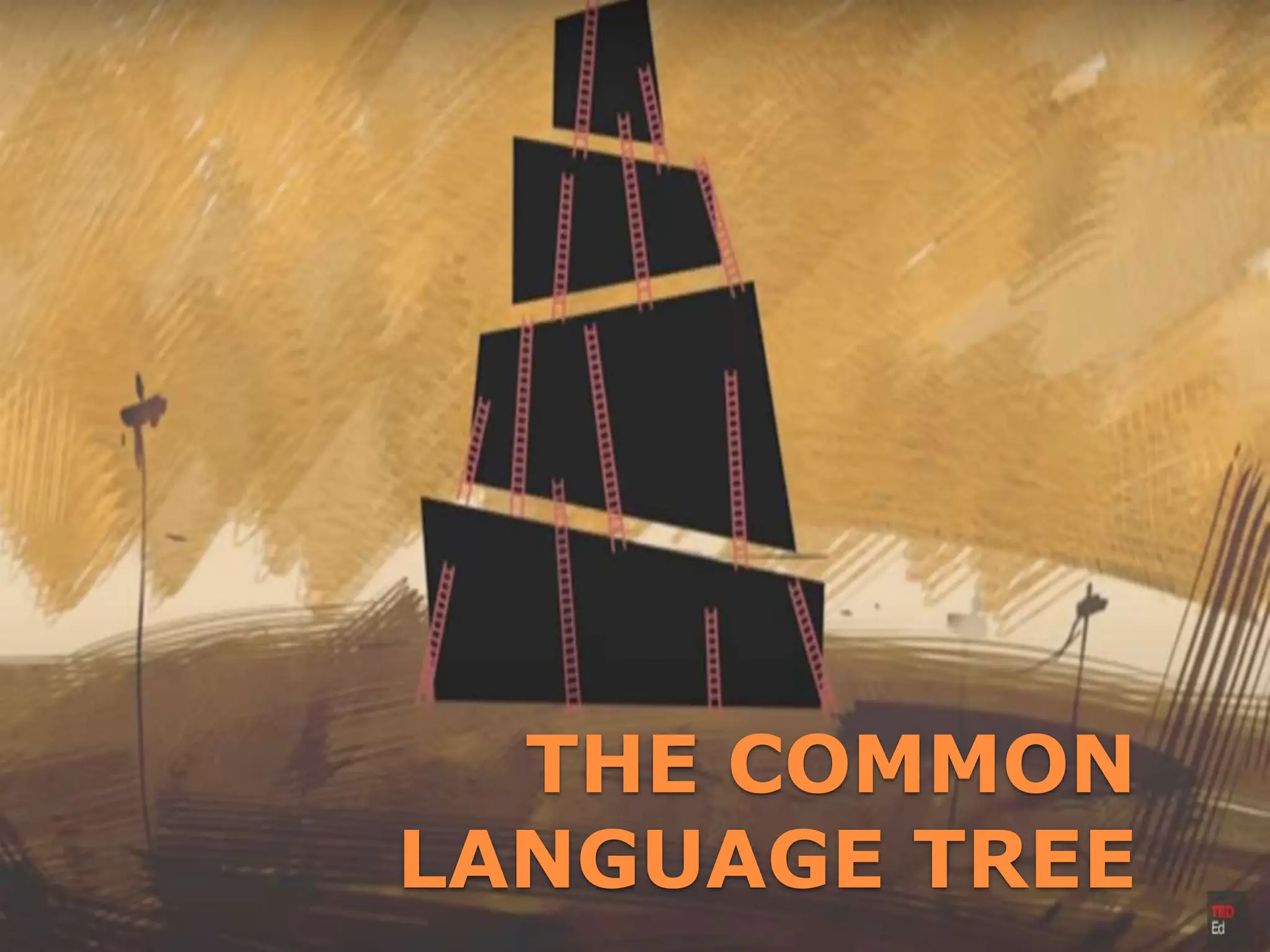
THE COMMON
LANGUAGE TREE
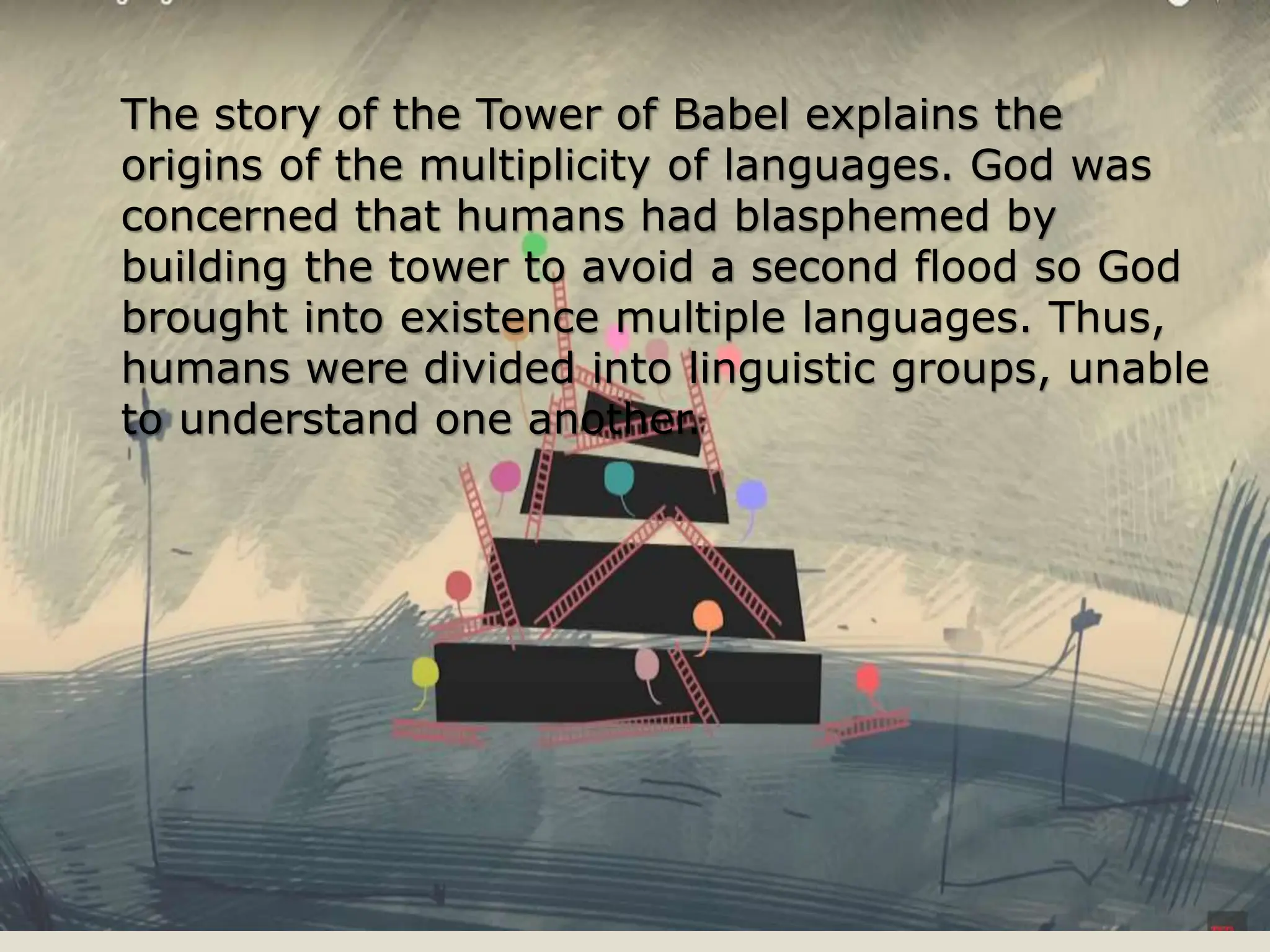
TOWER OF BABEL
The story of the Tower of Babel explains the
origins of the multiplicity of languages. God was
concerned that humans had blasphemed by
building the tower to avoid a second flood so God
brought into existence multiple languages. Thus,
humans were divided into linguistic groups, unable
to understand one another.
We don’t really know if such
language ever existed, but we do
know that the thousands of
language existing today can be
traced back to a smaller number.
How did we end up
with so many?
In early days human migration, the
world was much less populated. As they
migrated and settle in new places, they
became isolated from one another and
develop in different ways. Centuries of
living in a different conditions, eating
different foods and encountering different
neighbors turned similar dialects with
varied pronunciation and vocabulary into
radically different languages, continuing to
divide as populations grew spread out
further.
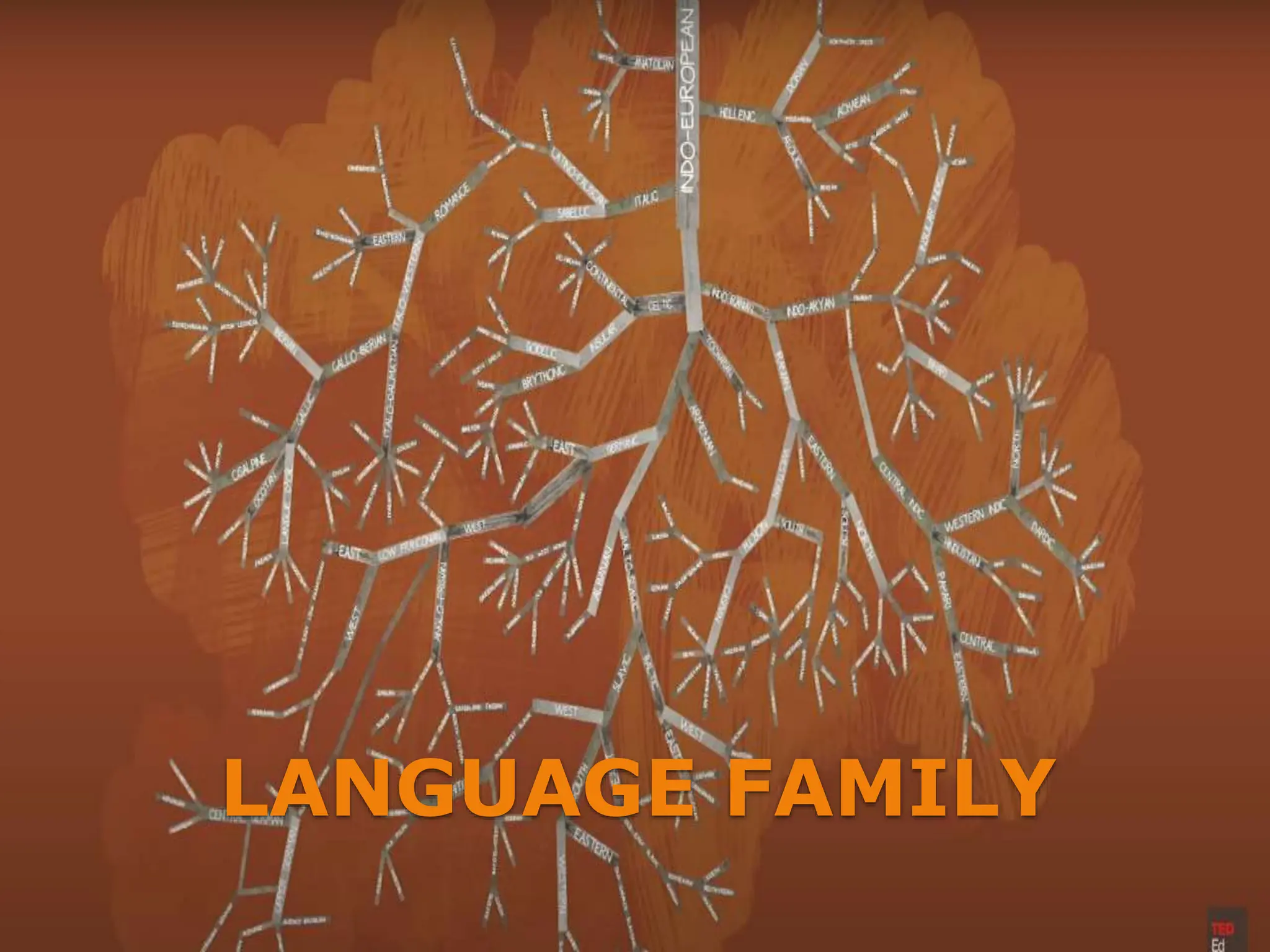
There are thousands of spoken languages in the
world and most can be traced back in history to
show how they are related to each other. By
finding patterns like these, different languages
can be grouped together as members of a
language family. When linguists talk about the
historical relationship between languages, they
use a tree metaphor.
Like genealogist, modern linguists try to map this
process by tracing multiple languages back as far
as they can to their common ancestor or
photolanguage. A group of language related in
this way is called a language family which can
contain many branches and sub-families.
LANGUAGE FAMILY
LINGUISTIC COMPOSITION
 Language patterns in Southeast Asia are
highly complex and are rooted in four
major language families: Sino-
Tibetan, Tai, Austro-Asiatic,
and Austronesian (Malayo-Polynesian).
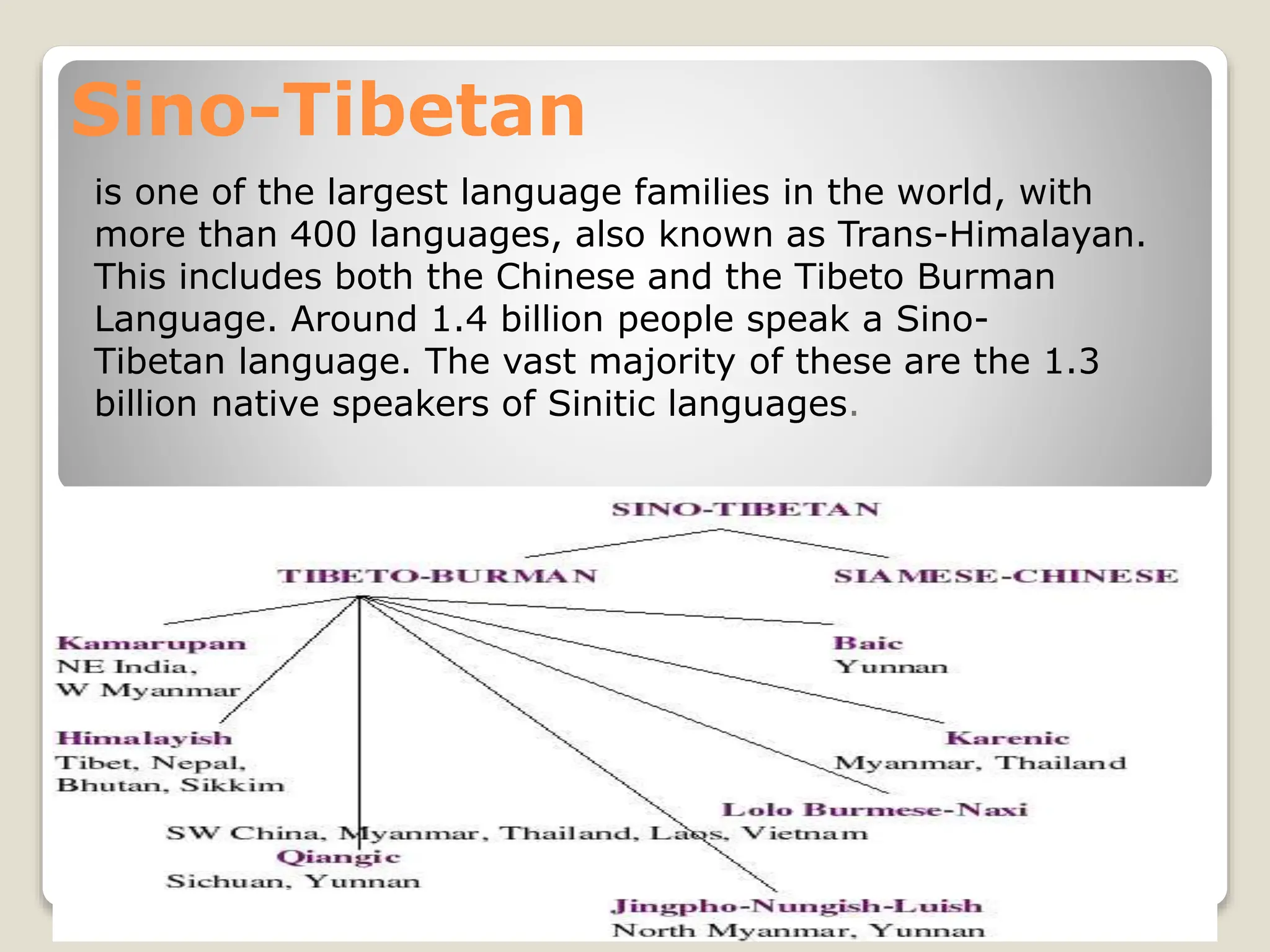
Sino-Tibetan
is one of the largest language families in the world, with
more than 400 languages, also known as Trans-Himalayan.
This includes both the Chinese and the Tibeto Burman
Language. Around 1.4 billion people speak a Sino-
Tibetan language. The vast majority of these are the 1.3
billion native speakers of Sinitic languages.
1. The Sinitic(Chinese) Languages:
 Mandarin- The most widely spoken Chinese
Language, serving as the official language of
China and Taiwan.
 Cantonese, Shanghainese, and others-
Regional varietes with dintinct linguistic
features, spoken in specific areas of China.
2. Tibeto-Burman Languages:
• Tibetic Languages- including Tibetan, spoken
mainly in the Tibetan Plateau.
• Burman Languages- such as burmese,
spoken in Myanmar (Burma).
Austronesian Language
Language family widely spoken throughout
Taiwan, Malay Peninsula, Maritime Southeast
Asia, Madagascar and the islands of the Pacific
Ocean. There are also a few speakers in
continental Asia. They are spoken by about 386
million people. The languages of Malaysia,
Indonesia, and the Philippines are rooted in an
Austronesian and Polynesian stock.
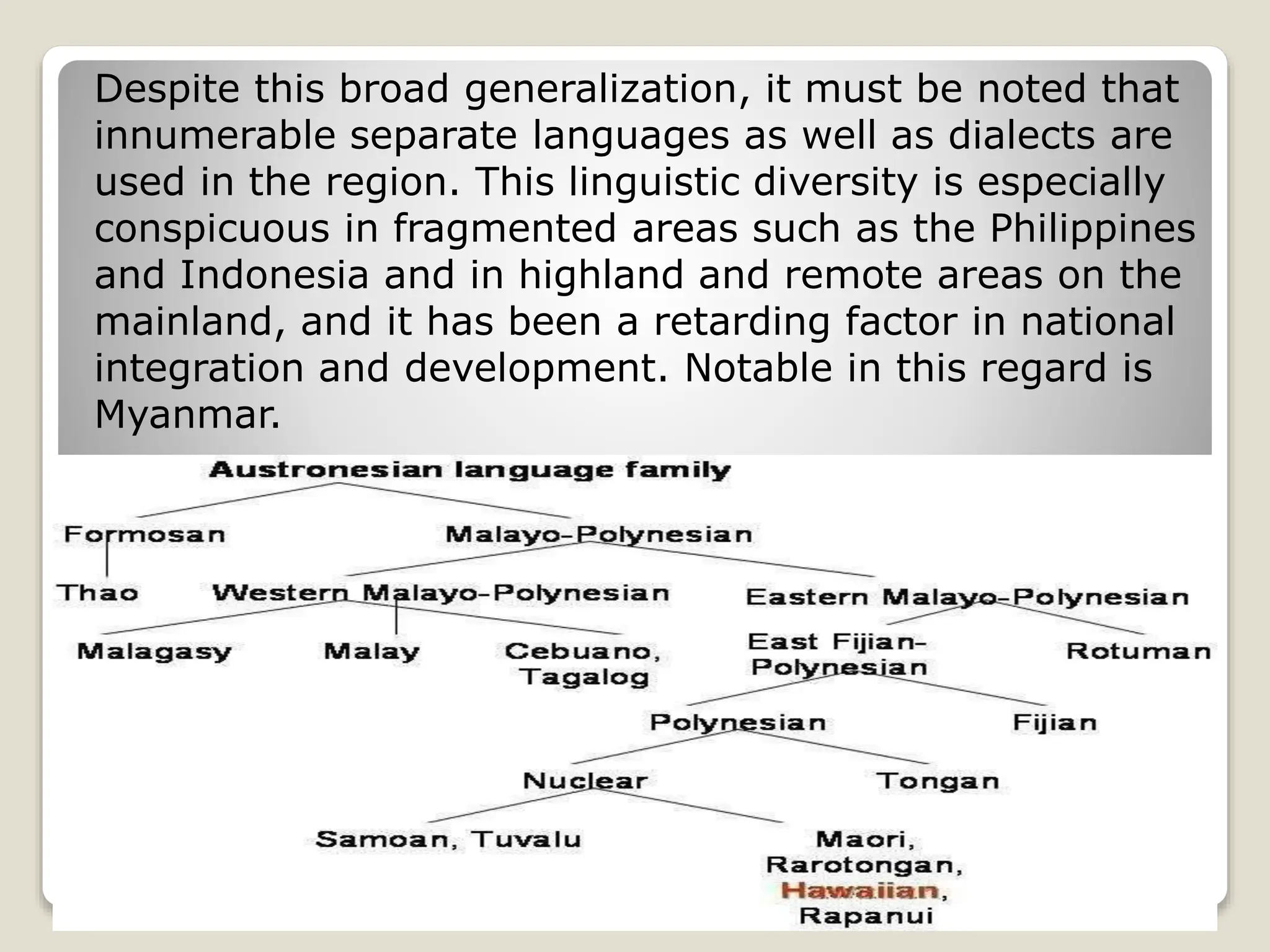
Despite this broad generalization, it must be noted that
innumerable separate languages as well as dialects are
used in the region. This linguistic diversity is especially
conspicuous in fragmented areas such as the Philippines
and Indonesia and in highland and remote areas on the
mainland, and it has been a retarding factor in national
integration and development. Notable in this regard is
Myanmar.
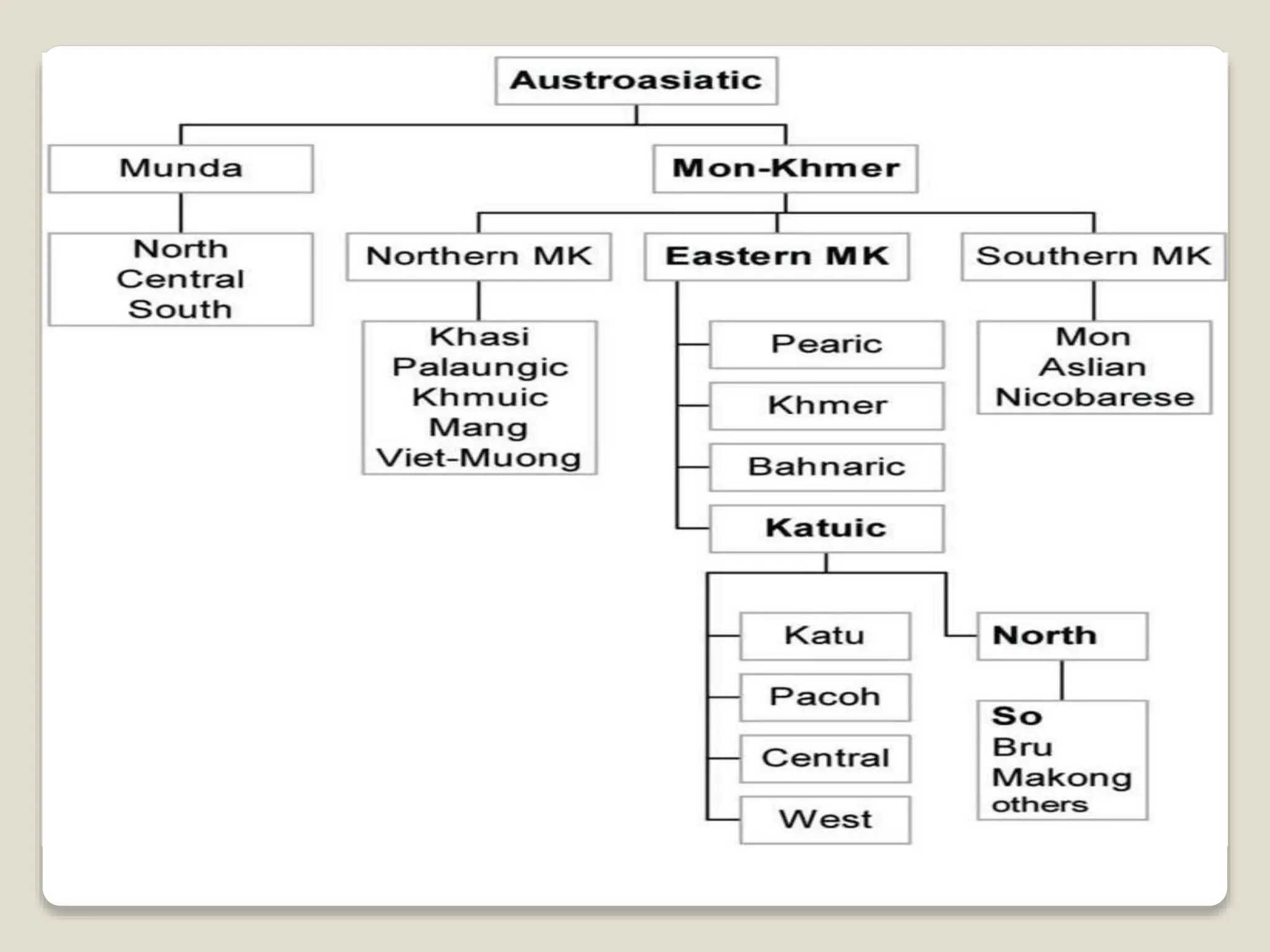
Astro-Asiatic Language
-consists of 169 languages spoken in Southeast Asia, in
countries located between China and Indonesia. A few are
spoken to the west of this area in the Nicobar Islands and in
India. The austro- part of the name comes from the Latin
word ‘south.’
-Major Languages in this family are spoken in countries like
Cambodia, Vietnam, Laos, Thailand, Malaysia, and part of
India.
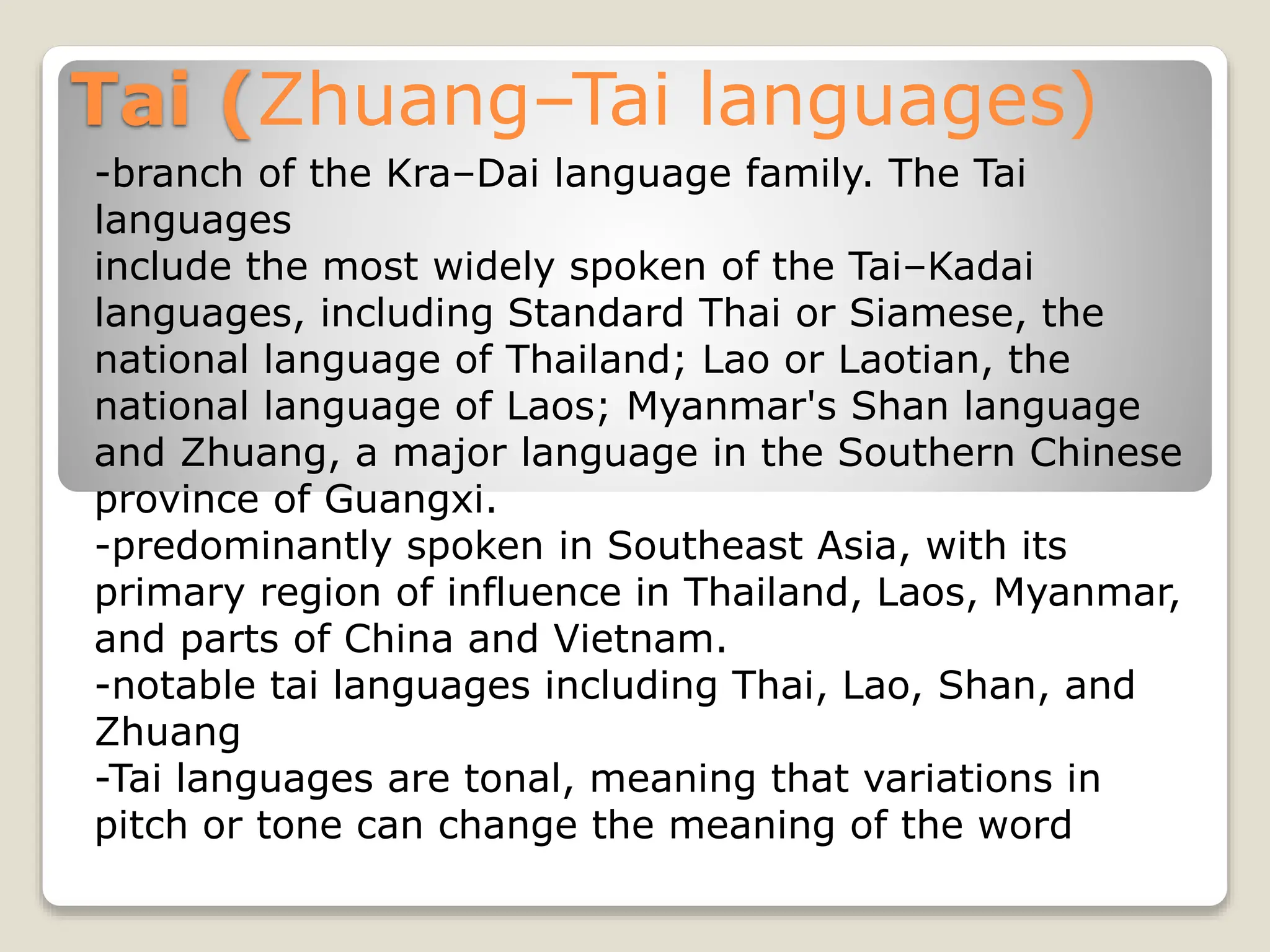
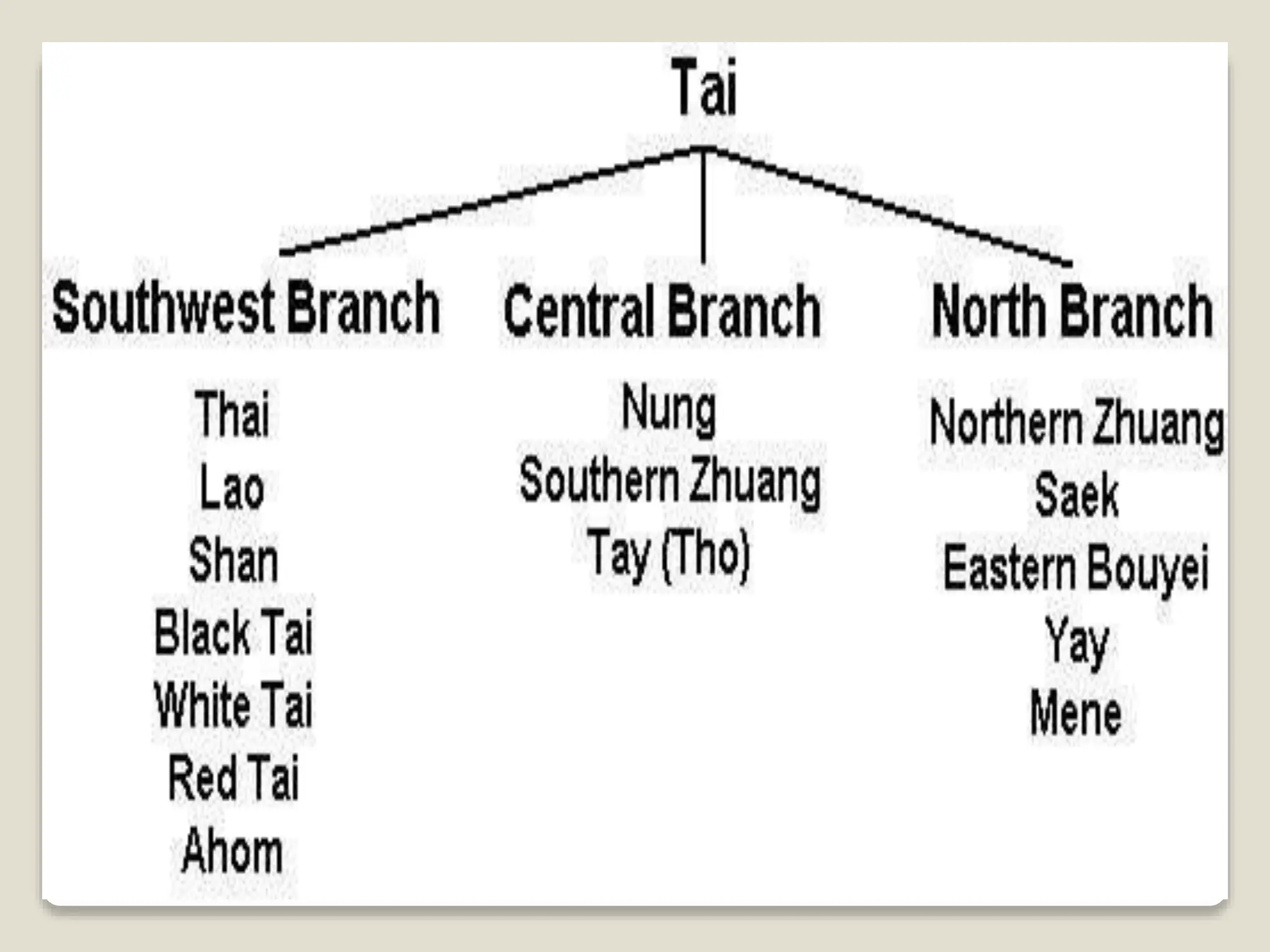
Tai (Zhuang–Tai languages)
-branch of the Kra–Dai language family. The Tai
languages
include the most widely spoken of the Tai–Kadai
languages, including Standard Thai or Siamese, the
national language of Thailand; Lao or Laotian, the
national language of Laos; Myanmar's Shan language
and Zhuang, a major language in the Southern Chinese
province of Guangxi.
-predominantly spoken in Southeast Asia, with its
primary region of influence in Thailand, Laos, Myanmar,
and parts of China and Vietnam.
-notable tai languages including Thai, Lao, Shan, and
Zhuang
-Tai languages are tonal, meaning that variations in
pitch or tone can change the meaning of the word
Dominant languages do exist in most of the
nations. Burmese and Thai are spoken by large groups
of people in Myanmar and Thailand, respectively.
Similarly, Khmer is the primary language in Cambodia,
as is Vietnamese in Vietnam. Within the Philippines,
Pilipino (Filipino) and English are the official languages,
but Tagalog and Visayan also are important. Malay and
Indonesian are, respectively, the official languages of
Malaysia and Indonesia; these languages are quite
similar and are mutually intelligible. Indonesian is a good
example of a true national language and is spoken
widely across the archipelago. Thus, unlike in Myanmar,
language actually has been a unifying element in the
country.
Numerous languages also have been
introduced into the region by immigrant
populations. Perhaps most significant are the
variety of dialects spoken by the Chinese
communities in many Southeast Asian countries.
The most commonly used are Cantonese, Hokkien,
Hakka, and Teochew, reflecting the southern
Chinese coastal origins of many of the immigrants.
The largest concentration of Chinese speakers is in
Singapore, where they constitute the majority
population. Concentrations of ethnic Chinese also
live in most of the larger urban areas of the region.
Language and Culture
The relationship between language and culture is a
complex one. The two are intertwined. A particular language
usually points out to a specific group of people. When you
interact with another language, it means that you are also
interacting with the culture that speaks the language. You
cannot understand one’s culture without accessing its language
directly.
When you learn a new language, it not only involves
learning its alphabet, the word arrangement and the rules of
grammar, but also learning about the specific society’s customs
and behavior. When learning or teaching a language, it is
important that the culture where the language belongs be
referenced, because language is very much ingrained in the
culture.
Origins and Diffusions
Cultural diffusion is the spread of cultural trends across
locations. Beliefs, practices, and ideas get shared from person
to person, and sometimes even around the world through this
diffusion, as happens with viral videos.
Expansion diffusion- this is when a trend is spread from its
originating place, outward. There are several forms of this type
of diffusion: contagious, hierarchical, and stimulus diffusion.
Contagious diffusion, or when a cultural trend is
transmitted from person to person from an original source to
numerous others, similar to a virus. As cultural trends gain in
popularity and draw our attention, profit may become a motive
in perpetuating the trend.
Another form of expansion diffusion is hierarchical
diffusion, or when a cultural trend is spread from one
segment of society to another, in a pattern. Consider how hip
hop culture emerged from within urban areas, but is now
known in all regions of society including suburban and rural
areas, as well. Finally, stimulus diffusion is when a cultural
trend spreads, but is changed by those adopting the idea.
Relocation diffusion- when a person migrates from
their home and shares their culture with a new location.
Around four thousand years ago people
speaking languages belonging to the Austronesian
family (originating in southern China and Taiwan)
began to trickle into island Southeast Asia. Cultural
changes began to affect Southeast Asia around two
thousand years ago with influences coming from
two directions.
The local cultures in the region are diverse,
distinct and vibrantly unique, but the legacy of the
Indian and Chinese traders and soldiers that have
crisscrossed the area for millennia is undeniable.
Over the past two millennia, these all have
combined to create a complete package of high
culture that has seeped into today’s popular culture.
What’s more, it is the classical culture of southern
India that has been most influential.
Southeast Asia, and the diverse cultures
of the hundreds of millions of people that live
there, is a true melting pot of cultures. While
the states of classical India did imbue the
Southeast Asian kingdoms with many of its
traditions, they were not the only contributors.
As the name Indochina implies, the Han
Chinese state also had an impact on the
development of the states to its south, most
notably the Dai Viet Empire that rose in the Red
River valley. However, Chinese and Indian
traditions contributed mostly to the high culture
of the Southeast Asian states. Oftentimes, the
complex cosmologies and exotic ways of faraway
empires had little effect on the peasants that
made up the bulk of the populace. Local
traditions and folk customs made up the core of
mass culture and despite the millennia long
process of Indian cultural infusion, they still do.

THE-COMMON-LANGUAGE-TREE Family in Southeast Asia

  • 1.
  • 2.
  • 3.
    The story ofthe Tower of Babel explains the origins of the multiplicity of languages. God was concerned that humans had blasphemed by building the tower to avoid a second flood so God brought into existence multiple languages. Thus, humans were divided into linguistic groups, unable to understand one another.
  • 4.
    We don’t reallyknow if such language ever existed, but we do know that the thousands of language existing today can be traced back to a smaller number.
  • 5.
    How did weend up with so many?
  • 6.
    In early dayshuman migration, the world was much less populated. As they migrated and settle in new places, they became isolated from one another and develop in different ways. Centuries of living in a different conditions, eating different foods and encountering different neighbors turned similar dialects with varied pronunciation and vocabulary into radically different languages, continuing to divide as populations grew spread out further.
  • 7.
    There are thousandsof spoken languages in the world and most can be traced back in history to show how they are related to each other. By finding patterns like these, different languages can be grouped together as members of a language family. When linguists talk about the historical relationship between languages, they use a tree metaphor. Like genealogist, modern linguists try to map this process by tracing multiple languages back as far as they can to their common ancestor or photolanguage. A group of language related in this way is called a language family which can contain many branches and sub-families.
  • 8.
  • 9.
    LINGUISTIC COMPOSITION  Languagepatterns in Southeast Asia are highly complex and are rooted in four major language families: Sino- Tibetan, Tai, Austro-Asiatic, and Austronesian (Malayo-Polynesian).
  • 10.
    Sino-Tibetan is one ofthe largest language families in the world, with more than 400 languages, also known as Trans-Himalayan. This includes both the Chinese and the Tibeto Burman Language. Around 1.4 billion people speak a Sino- Tibetan language. The vast majority of these are the 1.3 billion native speakers of Sinitic languages.
  • 11.
    1. The Sinitic(Chinese)Languages:  Mandarin- The most widely spoken Chinese Language, serving as the official language of China and Taiwan.  Cantonese, Shanghainese, and others- Regional varietes with dintinct linguistic features, spoken in specific areas of China. 2. Tibeto-Burman Languages: • Tibetic Languages- including Tibetan, spoken mainly in the Tibetan Plateau. • Burman Languages- such as burmese, spoken in Myanmar (Burma).
  • 12.
    Austronesian Language Language familywidely spoken throughout Taiwan, Malay Peninsula, Maritime Southeast Asia, Madagascar and the islands of the Pacific Ocean. There are also a few speakers in continental Asia. They are spoken by about 386 million people. The languages of Malaysia, Indonesia, and the Philippines are rooted in an Austronesian and Polynesian stock.
  • 13.
    Despite this broadgeneralization, it must be noted that innumerable separate languages as well as dialects are used in the region. This linguistic diversity is especially conspicuous in fragmented areas such as the Philippines and Indonesia and in highland and remote areas on the mainland, and it has been a retarding factor in national integration and development. Notable in this regard is Myanmar.
  • 14.
    Astro-Asiatic Language -consists of169 languages spoken in Southeast Asia, in countries located between China and Indonesia. A few are spoken to the west of this area in the Nicobar Islands and in India. The austro- part of the name comes from the Latin word ‘south.’ -Major Languages in this family are spoken in countries like Cambodia, Vietnam, Laos, Thailand, Malaysia, and part of India.
  • 16.
    Tai (Zhuang–Tai languages) -branchof the Kra–Dai language family. The Tai languages include the most widely spoken of the Tai–Kadai languages, including Standard Thai or Siamese, the national language of Thailand; Lao or Laotian, the national language of Laos; Myanmar's Shan language and Zhuang, a major language in the Southern Chinese province of Guangxi. -predominantly spoken in Southeast Asia, with its primary region of influence in Thailand, Laos, Myanmar, and parts of China and Vietnam. -notable tai languages including Thai, Lao, Shan, and Zhuang -Tai languages are tonal, meaning that variations in pitch or tone can change the meaning of the word
  • 18.
    Dominant languages doexist in most of the nations. Burmese and Thai are spoken by large groups of people in Myanmar and Thailand, respectively. Similarly, Khmer is the primary language in Cambodia, as is Vietnamese in Vietnam. Within the Philippines, Pilipino (Filipino) and English are the official languages, but Tagalog and Visayan also are important. Malay and Indonesian are, respectively, the official languages of Malaysia and Indonesia; these languages are quite similar and are mutually intelligible. Indonesian is a good example of a true national language and is spoken widely across the archipelago. Thus, unlike in Myanmar, language actually has been a unifying element in the country.
  • 19.
    Numerous languages alsohave been introduced into the region by immigrant populations. Perhaps most significant are the variety of dialects spoken by the Chinese communities in many Southeast Asian countries. The most commonly used are Cantonese, Hokkien, Hakka, and Teochew, reflecting the southern Chinese coastal origins of many of the immigrants. The largest concentration of Chinese speakers is in Singapore, where they constitute the majority population. Concentrations of ethnic Chinese also live in most of the larger urban areas of the region.
  • 20.
    Language and Culture Therelationship between language and culture is a complex one. The two are intertwined. A particular language usually points out to a specific group of people. When you interact with another language, it means that you are also interacting with the culture that speaks the language. You cannot understand one’s culture without accessing its language directly. When you learn a new language, it not only involves learning its alphabet, the word arrangement and the rules of grammar, but also learning about the specific society’s customs and behavior. When learning or teaching a language, it is important that the culture where the language belongs be referenced, because language is very much ingrained in the culture.
  • 21.
    Origins and Diffusions Culturaldiffusion is the spread of cultural trends across locations. Beliefs, practices, and ideas get shared from person to person, and sometimes even around the world through this diffusion, as happens with viral videos. Expansion diffusion- this is when a trend is spread from its originating place, outward. There are several forms of this type of diffusion: contagious, hierarchical, and stimulus diffusion. Contagious diffusion, or when a cultural trend is transmitted from person to person from an original source to numerous others, similar to a virus. As cultural trends gain in popularity and draw our attention, profit may become a motive in perpetuating the trend.
  • 22.
    Another form ofexpansion diffusion is hierarchical diffusion, or when a cultural trend is spread from one segment of society to another, in a pattern. Consider how hip hop culture emerged from within urban areas, but is now known in all regions of society including suburban and rural areas, as well. Finally, stimulus diffusion is when a cultural trend spreads, but is changed by those adopting the idea. Relocation diffusion- when a person migrates from their home and shares their culture with a new location.
  • 23.
    Around four thousandyears ago people speaking languages belonging to the Austronesian family (originating in southern China and Taiwan) began to trickle into island Southeast Asia. Cultural changes began to affect Southeast Asia around two thousand years ago with influences coming from two directions.
  • 24.
    The local culturesin the region are diverse, distinct and vibrantly unique, but the legacy of the Indian and Chinese traders and soldiers that have crisscrossed the area for millennia is undeniable. Over the past two millennia, these all have combined to create a complete package of high culture that has seeped into today’s popular culture. What’s more, it is the classical culture of southern India that has been most influential.
  • 25.
    Southeast Asia, andthe diverse cultures of the hundreds of millions of people that live there, is a true melting pot of cultures. While the states of classical India did imbue the Southeast Asian kingdoms with many of its traditions, they were not the only contributors.
  • 26.
    As the nameIndochina implies, the Han Chinese state also had an impact on the development of the states to its south, most notably the Dai Viet Empire that rose in the Red River valley. However, Chinese and Indian traditions contributed mostly to the high culture of the Southeast Asian states. Oftentimes, the complex cosmologies and exotic ways of faraway empires had little effect on the peasants that made up the bulk of the populace. Local traditions and folk customs made up the core of mass culture and despite the millennia long process of Indian cultural infusion, they still do.