L ANGUAGE C OMPARISON P OSTER
   A Summary of Research on the Thai Language.

                                       Carrie Lehman
                                     Wilkes University
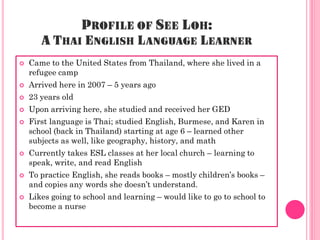
PROFILE OF SEE LOH:
       A THAI ENGLISH LANGUAGE LEARNER
   Came to the United States from Thailand, where she lived in a
    refugee camp
   Arrived here in 2007 – 5 years ago
   23 years old
   Upon arriving here, she studied and received her GED
   First language is Thai; studied English, Burmese, and Karen in
    school (back in Thailand) starting at age 6 – learned other
    subjects as well, like geography, history, and math
   Currently takes ESL classes at her local church – learning to
    speak, write, and read English
   To practice English, she reads books – mostly children’s books –
    and copies any words she doesn’t understand.
   Likes going to school and learning – would like to go to school to
    become a nurse
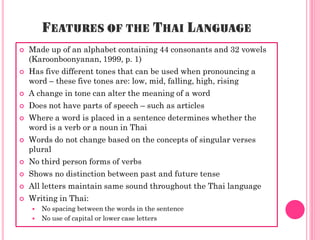
FEATURES OF THE THAI LANGUAGE
   Made up of an alphabet containing 44 consonants and 32 vowels
    (Karoonboonyanan, 1999, p. 1)
   Has five different tones that can be used when pronouncing a
    word – these five tones are: low, mid, falling, high, rising
   A change in tone can alter the meaning of a word
   Does not have parts of speech – such as articles
   Where a word is placed in a sentence determines whether the
    word is a verb or a noun in Thai
   Words do not change based on the concepts of singular verses
    plural
   No third person forms of verbs
   Shows no distinction between past and future tense
   All letters maintain same sound throughout the Thai language
   Writing in Thai:
       No spacing between the words in the sentence
       No use of capital or lower case letters
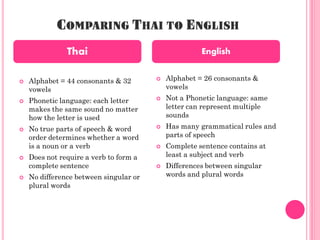
COMPARING THAI TO ENGLISH
               Thai                                   English


   Alphabet = 44 consonants & 32          Alphabet = 26 consonants &
    vowels                                  vowels
   Phonetic language: each letter         Not a Phonetic language: same
    makes the same sound no matter          letter can represent multiple
    how the letter is used                  sounds
   No true parts of speech & word         Has many grammatical rules and
    order determines whether a word         parts of speech
    is a noun or a verb                    Complete sentence contains at
   Does not require a verb to form a       least a subject and verb
    complete sentence                      Differences between singular
   No difference between singular or       words and plural words
    plural words
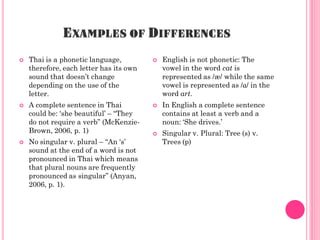
EXAMPLES OF DIFFERENCES
   Thai is a phonetic language,            English is not phonetic: The
    therefore, each letter has its own       vowel in the word cat is
    sound that doesn’t change                represented as /æ/ while the same
    depending on the use of the              vowel is represented as /ɑ/ in the
    letter.                                  word art.
   A complete sentence in Thai             In English a complete sentence
    could be: ‘she beautiful’ – “They        contains at least a verb and a
    do not require a verb” (McKenzie-        noun: ‘She drives.’
    Brown, 2006, p. 1)                      Singular v. Plural: Tree (s) v.
   No singular v. plural – “An ‘s’          Trees (p)
    sound at the end of a word is not
    pronounced in Thai which means
    that plural nouns are frequently
    pronounced as singular” (Anyan,
    2006, p. 1).
LANGUAGE ERROR DATA :
AS COLLECTED IN DATA ANALYSIS JOURNAL
                                         Left column represents what See Loh said; while the right
Tense                                   column represents what would be correct in English.

“Six year old”                    Six years old

“My Mother live with Sister.”     My Mother lives with my Sister

“We go home now?”                 Are we going home now?


Parts of Speech 

 “Americans big.”                  Americans are big.

 “He can be on Monday.”            He can come on Monday.


Prepositions & Articles 

 “I like go to school.”            I like [to] go to school.

 “All kinds writing.”              I am interested in all kinds [of] writing.

 “I need job.”                     I need [a] job.

 “Take ESL class.”                 I take [an] ESL class.
INTERLANGUAGE DEVELOPMENT
   See Loh would likely fall under WIDA Access level 1:
    Entering
        Under this classification (for the category of Speaking) should be capable of the
         following – among some others – “affirm or negate, combine words, answer WH-
         questions, use high frequency vocabulary, produce one-word answers” (Alternate
         Access, 2009, p. 1).


   Problems with communication are likely “because of the gaps in their
    linguistic repertoire” (Pawapatcharaudom, 2007, p. 20).
       It may be hard for the ELL to “find an alternative way of getting the meaning
        across” (Pawapatcharaudom, 2007, p. 20) mid-way through a conversation –
        because of this they may just end the interaction instead of trying to continue.
DISCUSSION
   The quality of See Loh’s spoken English as well as her
    ability to read English was impressive
   Her vocabulary range was fairly small, which can be
    expected of someone still learning English – therefore
    some words had to be defined for her
   She had difficulty using parts of speech like articles
    and prepositions, but this misuse make sense when
    considering her native language is Thai
   Misuse of tense, singular and plural, and third person
    verbs also make sense for the same reason – they do
    not exist as part of the Thai language
CONCLUSION
   Educators may face difficulties when teaching English
    language learners who are native speakers of Thai – since
    there are many aspects found in English that do not exist
    in Thai
   When instructing Thai ELLs extra instruction on some of
    the grammatical aspects of English may be important for
    proper comprehension
   There may be difficulties with the fact that English is not a
    phonetic language – therefore there could be trouble when
    learning how to read
   It is important for educators to provide authentic
    instruction in order to create meaningful learning on the
    part of these students
   Understanding the differences between English and Thai,
    will help educators be able to properly instruct native Thai
    English language learners.
REFERENCES

Anyan, J (2006). Different families, not distant cousins: comparing Thai and
English. MED Magazine, 37. Retrieved from
http://www.macmillandictionaries.com/MED-Magazine/April2006/37-Thai-English-false-
friends.htm


Karoonboonyanan, T (1999). Standardization and implementations of Thai
language . Retrieved from http://www.nectec.or.th/it-standards/thaistd.pdf


McKenzie-Brown, P (2006, November 5). A Study in Thai [Web log post].
Retrieved from http://languageinstinct.blogspot.com/2006/11/thai-language.html


Pawapatcharaudom, R(2007). An investigation of Thai students’ English
language problems and their learning strategies in the international program at
Mahidol university. Retrieved from http://www.nectec.or.th/it-
standards/thaistd.pdf

Language Comparison Poster

  • 1.
    L ANGUAGE COMPARISON P OSTER A Summary of Research on the Thai Language. Carrie Lehman Wilkes University
  • 2.
    PROFILE OF SEELOH: A THAI ENGLISH LANGUAGE LEARNER  Came to the United States from Thailand, where she lived in a refugee camp  Arrived here in 2007 – 5 years ago  23 years old  Upon arriving here, she studied and received her GED  First language is Thai; studied English, Burmese, and Karen in school (back in Thailand) starting at age 6 – learned other subjects as well, like geography, history, and math  Currently takes ESL classes at her local church – learning to speak, write, and read English  To practice English, she reads books – mostly children’s books – and copies any words she doesn’t understand.  Likes going to school and learning – would like to go to school to become a nurse
  • 3.
    FEATURES OF THETHAI LANGUAGE  Made up of an alphabet containing 44 consonants and 32 vowels (Karoonboonyanan, 1999, p. 1)  Has five different tones that can be used when pronouncing a word – these five tones are: low, mid, falling, high, rising  A change in tone can alter the meaning of a word  Does not have parts of speech – such as articles  Where a word is placed in a sentence determines whether the word is a verb or a noun in Thai  Words do not change based on the concepts of singular verses plural  No third person forms of verbs  Shows no distinction between past and future tense  All letters maintain same sound throughout the Thai language  Writing in Thai:  No spacing between the words in the sentence  No use of capital or lower case letters
  • 4.
    COMPARING THAI TOENGLISH Thai English  Alphabet = 44 consonants & 32  Alphabet = 26 consonants & vowels vowels  Phonetic language: each letter  Not a Phonetic language: same makes the same sound no matter letter can represent multiple how the letter is used sounds  No true parts of speech & word  Has many grammatical rules and order determines whether a word parts of speech is a noun or a verb  Complete sentence contains at  Does not require a verb to form a least a subject and verb complete sentence  Differences between singular  No difference between singular or words and plural words plural words
  • 5.
    EXAMPLES OF DIFFERENCES  Thai is a phonetic language,  English is not phonetic: The therefore, each letter has its own vowel in the word cat is sound that doesn’t change represented as /æ/ while the same depending on the use of the vowel is represented as /ɑ/ in the letter. word art.  A complete sentence in Thai  In English a complete sentence could be: ‘she beautiful’ – “They contains at least a verb and a do not require a verb” (McKenzie- noun: ‘She drives.’ Brown, 2006, p. 1)  Singular v. Plural: Tree (s) v.  No singular v. plural – “An ‘s’ Trees (p) sound at the end of a word is not pronounced in Thai which means that plural nouns are frequently pronounced as singular” (Anyan, 2006, p. 1).
  • 6.
    LANGUAGE ERROR DATA: AS COLLECTED IN DATA ANALYSIS JOURNAL Left column represents what See Loh said; while the right Tense  column represents what would be correct in English. “Six year old” Six years old “My Mother live with Sister.” My Mother lives with my Sister “We go home now?” Are we going home now? Parts of Speech  “Americans big.” Americans are big. “He can be on Monday.” He can come on Monday. Prepositions & Articles  “I like go to school.” I like [to] go to school. “All kinds writing.” I am interested in all kinds [of] writing. “I need job.” I need [a] job. “Take ESL class.” I take [an] ESL class.
  • 7.
    INTERLANGUAGE DEVELOPMENT  See Loh would likely fall under WIDA Access level 1: Entering  Under this classification (for the category of Speaking) should be capable of the following – among some others – “affirm or negate, combine words, answer WH- questions, use high frequency vocabulary, produce one-word answers” (Alternate Access, 2009, p. 1).  Problems with communication are likely “because of the gaps in their linguistic repertoire” (Pawapatcharaudom, 2007, p. 20).  It may be hard for the ELL to “find an alternative way of getting the meaning across” (Pawapatcharaudom, 2007, p. 20) mid-way through a conversation – because of this they may just end the interaction instead of trying to continue.
  • 8.
    DISCUSSION  The quality of See Loh’s spoken English as well as her ability to read English was impressive  Her vocabulary range was fairly small, which can be expected of someone still learning English – therefore some words had to be defined for her  She had difficulty using parts of speech like articles and prepositions, but this misuse make sense when considering her native language is Thai  Misuse of tense, singular and plural, and third person verbs also make sense for the same reason – they do not exist as part of the Thai language
  • 9.
    CONCLUSION  Educators may face difficulties when teaching English language learners who are native speakers of Thai – since there are many aspects found in English that do not exist in Thai  When instructing Thai ELLs extra instruction on some of the grammatical aspects of English may be important for proper comprehension  There may be difficulties with the fact that English is not a phonetic language – therefore there could be trouble when learning how to read  It is important for educators to provide authentic instruction in order to create meaningful learning on the part of these students  Understanding the differences between English and Thai, will help educators be able to properly instruct native Thai English language learners.
  • 10.
    REFERENCES Anyan, J (2006).Different families, not distant cousins: comparing Thai and English. MED Magazine, 37. Retrieved from http://www.macmillandictionaries.com/MED-Magazine/April2006/37-Thai-English-false- friends.htm Karoonboonyanan, T (1999). Standardization and implementations of Thai language . Retrieved from http://www.nectec.or.th/it-standards/thaistd.pdf McKenzie-Brown, P (2006, November 5). A Study in Thai [Web log post]. Retrieved from http://languageinstinct.blogspot.com/2006/11/thai-language.html Pawapatcharaudom, R(2007). An investigation of Thai students’ English language problems and their learning strategies in the international program at Mahidol university. Retrieved from http://www.nectec.or.th/it- standards/thaistd.pdf