Alyssa Savitski
    ESL 502
Wilkes University
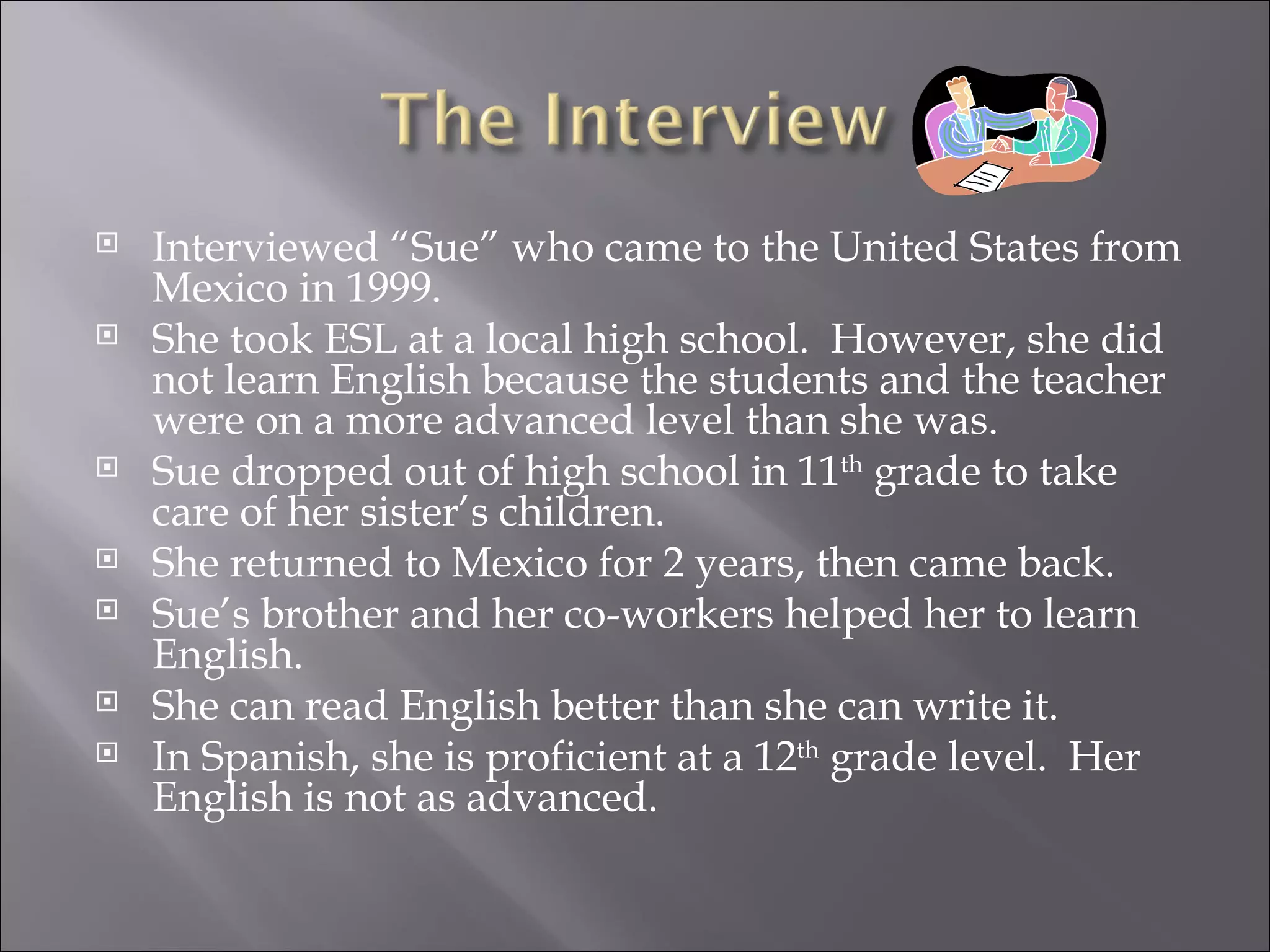
   Interviewed “Sue” who came to the United States from
    Mexico in 1999.
   She took ESL at a local high school. However, she did
    not learn English because the students and the teacher
    were on a more advanced level than she was.
   Sue dropped out of high school in 11th grade to take
    care of her sister’s children.
   She returned to Mexico for 2 years, then came back.
   Sue’s brother and her co-workers helped her to learn
    English.
   She can read English better than she can write it.
   In Spanish, she is proficient at a 12th grade level. Her
    English is not as advanced.
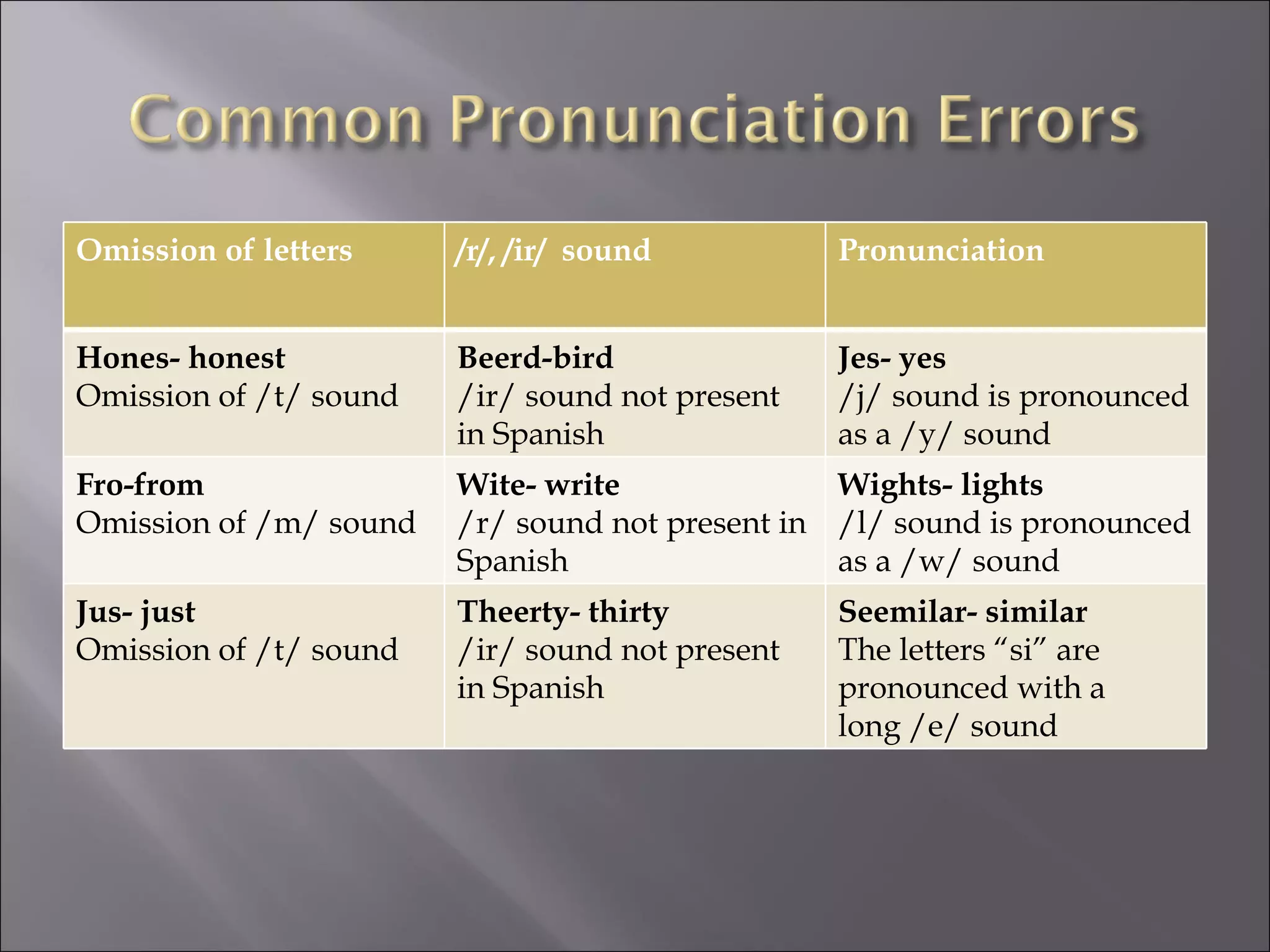
Omission of letters     /r/, /ir/ sound          Pronunciation


Hones- honest           Beerd-bird               Jes- yes
Omission of /t/ sound   /ir/ sound not present   /j/ sound is pronounced
                        in Spanish               as a /y/ sound
Fro-from                Wite- write              Wights- lights
Omission of /m/ sound   /r/ sound not present in /l/ sound is pronounced
                        Spanish                  as a /w/ sound
Jus- just               Theerty- thirty          Seemilar- similar
Omission of /t/ sound   /ir/ sound not present   The letters “si” are
                        in Spanish               pronounced with a
                                                 long /e/ sound
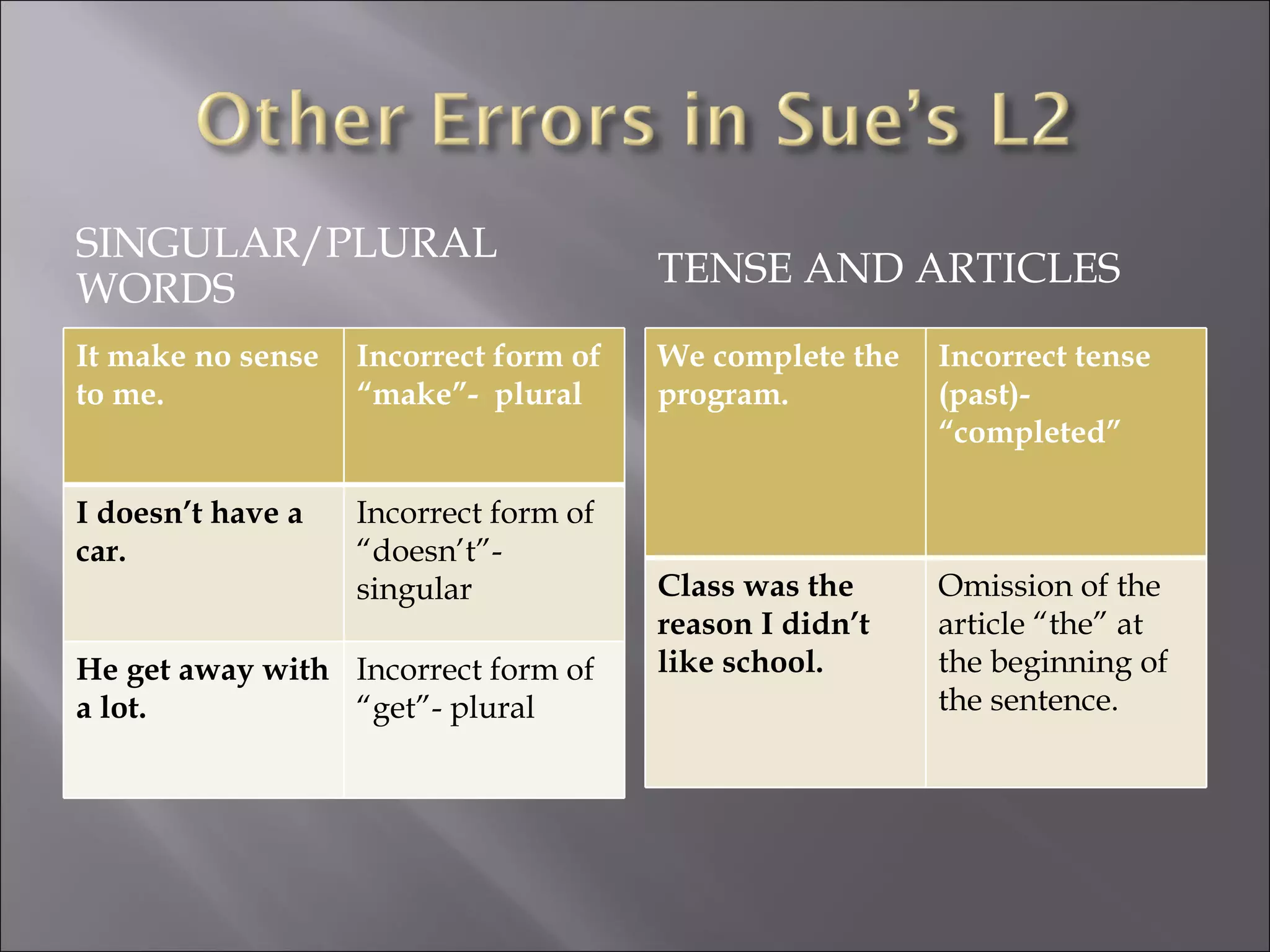
SINGULAR/PLURAL
WORDS                                  TENSE AND ARTICLES
It make no sense   Incorrect form of   We complete the   Incorrect tense
to me.             “make”- plural      program.          (past)-
                                                         “completed”

I doesn’t have a   Incorrect form of
car.               “doesn’t”-
                   singular            Class was the     Omission of the
                                       reason I didn’t   article “the” at
He get away with Incorrect form of     like school.      the beginning of
a lot.           “get”- plural                           the sentence.
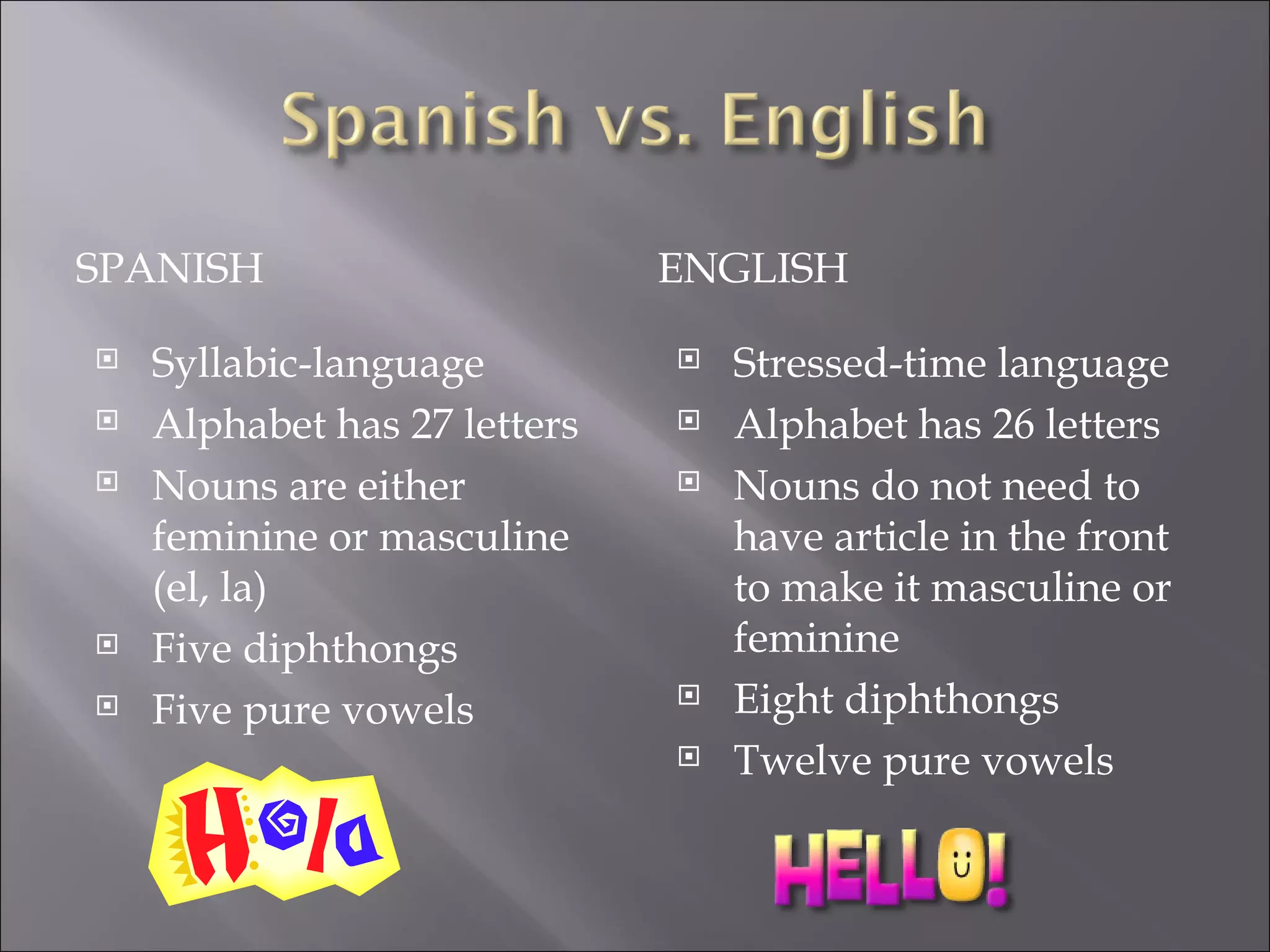
SPANISH                       ENGLISH

   Syllabic-language            Stressed-time language
   Alphabet has 27 letters      Alphabet has 26 letters
   Nouns are either             Nouns do not need to
    feminine or masculine         have article in the front
    (el, la)                      to make it masculine or
   Five diphthongs               feminine
   Five pure vowels             Eight diphthongs
                                 Twelve pure vowels
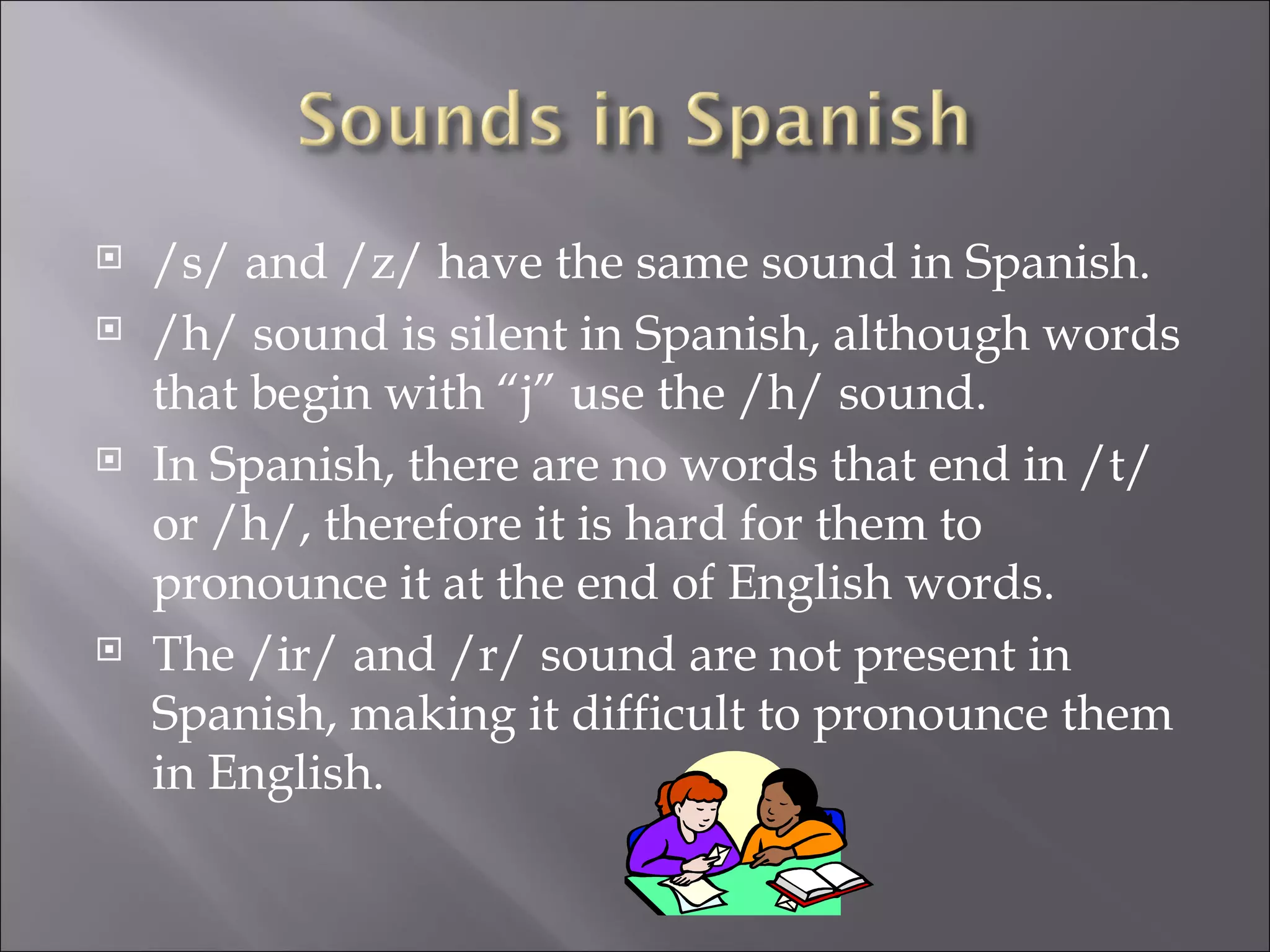
   /s/ and /z/ have the same sound in Spanish.
   /h/ sound is silent in Spanish, although words
    that begin with “j” use the /h/ sound.
   In Spanish, there are no words that end in /t/
    or /h/, therefore it is hard for them to
    pronounce it at the end of English words.
   The /ir/ and /r/ sound are not present in
    Spanish, making it difficult to pronounce them
    in English.
   Students whose L1 is Spanish may have a
    difficult time with producing certain sounds.
   This can lead to difficulty in writing English as
    well as speaking it.
   Written text may not be as difficult for L1
    Spanish students, but understanding
    punctuation and where it belongs in text can be
    challenging.
   Vocabulary and reading are the most beneficial
    to students.
   Six strategies to help ELL’s
       Cognitive
       Metacognitive
       Memory-related
       Compensatory
       Affective
       Social (Hancock, 2002)
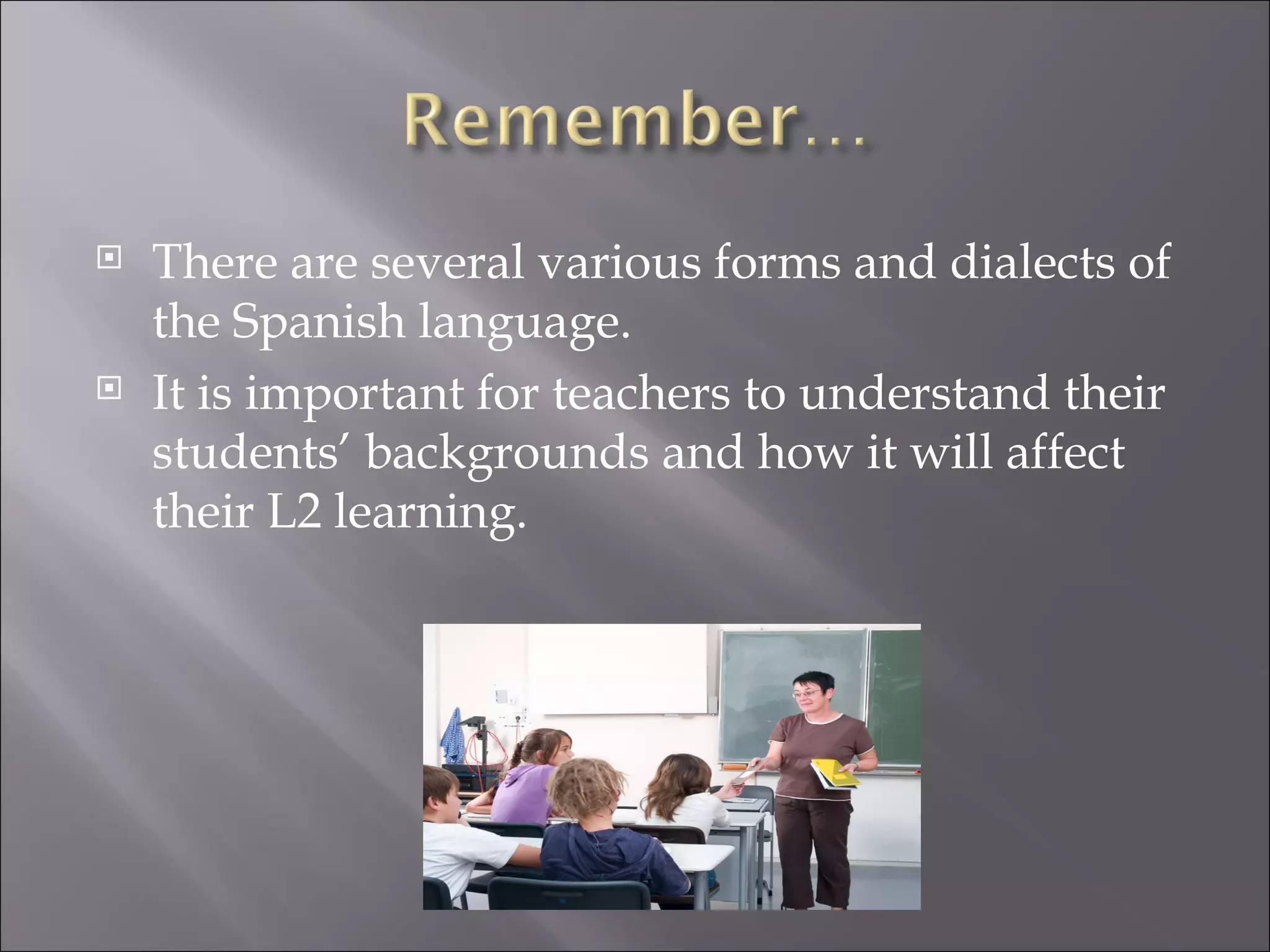
   There are several various forms and dialects of
    the Spanish language.
   It is important for teachers to understand their
    students’ backgrounds and how it will affect
    their L2 learning.
Hancock, Zennia. (2002). Heritage Spanish
   Speakers’ Language Learning Strategies.
   CAL-Center for Applied Linguistics, EDO-
   FL-02-06. Retrieved from
http
   ://www.cal.org/resources/digest/0206hancock.ht

Savitski u11a1

  • 1.
    Alyssa Savitski ESL 502 Wilkes University
  • 2.
    Interviewed “Sue” who came to the United States from Mexico in 1999.  She took ESL at a local high school. However, she did not learn English because the students and the teacher were on a more advanced level than she was.  Sue dropped out of high school in 11th grade to take care of her sister’s children.  She returned to Mexico for 2 years, then came back.  Sue’s brother and her co-workers helped her to learn English.  She can read English better than she can write it.  In Spanish, she is proficient at a 12th grade level. Her English is not as advanced.
  • 3.
    Omission of letters /r/, /ir/ sound Pronunciation Hones- honest Beerd-bird Jes- yes Omission of /t/ sound /ir/ sound not present /j/ sound is pronounced in Spanish as a /y/ sound Fro-from Wite- write Wights- lights Omission of /m/ sound /r/ sound not present in /l/ sound is pronounced Spanish as a /w/ sound Jus- just Theerty- thirty Seemilar- similar Omission of /t/ sound /ir/ sound not present The letters “si” are in Spanish pronounced with a long /e/ sound
  • 4.
    SINGULAR/PLURAL WORDS TENSE AND ARTICLES It make no sense Incorrect form of We complete the Incorrect tense to me. “make”- plural program. (past)- “completed” I doesn’t have a Incorrect form of car. “doesn’t”- singular Class was the Omission of the reason I didn’t article “the” at He get away with Incorrect form of like school. the beginning of a lot. “get”- plural the sentence.
  • 5.
    SPANISH ENGLISH  Syllabic-language  Stressed-time language  Alphabet has 27 letters  Alphabet has 26 letters  Nouns are either  Nouns do not need to feminine or masculine have article in the front (el, la) to make it masculine or  Five diphthongs feminine  Five pure vowels  Eight diphthongs  Twelve pure vowels
  • 6.
    /s/ and /z/ have the same sound in Spanish.  /h/ sound is silent in Spanish, although words that begin with “j” use the /h/ sound.  In Spanish, there are no words that end in /t/ or /h/, therefore it is hard for them to pronounce it at the end of English words.  The /ir/ and /r/ sound are not present in Spanish, making it difficult to pronounce them in English.
  • 7.
    Students whose L1 is Spanish may have a difficult time with producing certain sounds.  This can lead to difficulty in writing English as well as speaking it.  Written text may not be as difficult for L1 Spanish students, but understanding punctuation and where it belongs in text can be challenging.
  • 8.
    Vocabulary and reading are the most beneficial to students.  Six strategies to help ELL’s  Cognitive  Metacognitive  Memory-related  Compensatory  Affective  Social (Hancock, 2002)
  • 9.
    There are several various forms and dialects of the Spanish language.  It is important for teachers to understand their students’ backgrounds and how it will affect their L2 learning.
  • 10.
    Hancock, Zennia. (2002).Heritage Spanish Speakers’ Language Learning Strategies. CAL-Center for Applied Linguistics, EDO- FL-02-06. Retrieved from http ://www.cal.org/resources/digest/0206hancock.ht