The 1st International Conference on Language, Literature, and Cultural Studies
2
ICLLCS 2013
1st International Conference on Language, Literature, and
Cultural Studies
August 22-24, 2013
Organized by:
Department of Western Languages, Faculty of Humanities and Social
Sciences, Burapha University, THAILAND
Published 200 copies
ISBN : 978-974-384-496-6
Get Good Creation, Co.,LTD
Copyright@2013 by Department of Western Languages, Faculty of
Humanities and Social Sciences, Burapha University
The 1st International Conference on Language, Literature, and Cultural Studies
3
CONTENTS
Alexander J. Klemm 4
Writing the City into Being: Cold War Bangkok in The Ninth Directive (1966)
Anusorn Saechan 14
WH-Arguments versus WH-Adjuncts Asymmetry in the Acquisition of English
WH-Questions by Thai Learners
Pudsadee Kaewchawee 25
The Effectiveness of Multimedia-based Instruction in Developing the Sixth Grade
Students’ English Ability
Akkarapon Nuemaihom 34
An Analysis of Thai-English Translation Strategies in the Short Story Level 8 Abbot
Budsaba Kanoksilapatham 44
University Students’ Attitudes towards English Pronunciation Models
Chitra Phunkitchar & Supaporn Yimwilai 54
Environmental Awareness in Children Picture Book: The Secret Garden
Aram Iamlaor 63
An Analysis of Translating Figurative Language by English-Major Students in Thailand
Farhad Mazlum & Fatemeh Poorebrahim 69
English Language Teaching in Iran: a Meta-analytic and Triangulated View of Persistent
Challenges
Hataya Anansuchatkul 81
Effortlessly Yours: Discursive Construction of Spa Service in Chiang Mai
Jaime Moreno Tejada 100
Between Christianity and Modernity: the Many Meanings of “Laziness” and “Boredom” in
Spain and Latin America
Jose G. Tan, JR 110
English Instructional Materials: Imperative Learning Aid for the High School Bound
Summer Program of the MSU-Science High School
Khaing Khaing Oo and Kantatip Sinhaneti 122
An Investigation of Myanmar Migrant Workers’ English Language Problems and Job-
related Needs at D.E.A.R Burma School
Meechai Wongdaeng & Rangsiya Chaengchenkit 135
Interlanguage of English Questions Use by Thai EFL Learners: An Investigation into
Acquisition Patterns and a Testing of Implicational Universals
Khanita Limhan 148
English-Thai Time Expressions Used by Thai EFL Learners
The 1st International Conference on Language, Literature, and Cultural Studies
4
University Students’ Attitudes towards English Pronunciation Models
Budsaba Kanoksilapatham
English Department, Faculty of Arts
Silpakorn University
kanoksib@hotmail.com
Abstract
It has been agreed that the English language is going to be the working language in ASEAN. To comply
with this decision, it is essential that Thai students be prepared to be competent in the English
language, particularly for international communication. To successfully prepare Thai learners for this
challenge, the question of whether Thai university students should conform to native-speaker norms of
English, in an era when English is increasingly used in international contexts and when the integration
of AEC is approaching, is one of the topics which has been keenly debated in recent years. However, it is
not a debate in which the voices of students have been heard. Therefore, this research attempts to shed
some light into the issue. This research study is based largely on onequestionnaire survey, which
examined Thai university students’ attitudes about their English pronunciation to the question of
conforming to native-speaker norms or to the ideologies of EIL, WEs, and ELFwhich focus on
intelligibility. Taken together, the survey drew 387 responses from first and second year students
studying in a public university. Theanalysis of the completed questionnaires demonstrates that Thai
university students held more favorable attitudes towards the model of native speakers. The study
demonstrates that students’ views may differ from the expectations of teachers and academics, and that
it is important for educators to be aware of these viewsfor future decisions related to national
educational plans.
Keywords: EIL, pronunciation, attitudes, learners of English, university students
1. Introduction
It is acknowledged that among all languages in the world, the English language plays an
increasingly vital role in our daily life particularly in business, education, entertainment,
communication, and work. Moreover, the use of the English language is not limited locally but also
internationally for communication between speakers from diverse language backgrounds. Since the
role of the English language used at present is primarily for communication, the English language
skills related to, or emphasizing, communication are significantly important(Graddol, 2004).
As known, oral communication skills include two principal language skills: speaking and
listening. In this regard, it is well known that listening and speaking are the basic skills needed in
order to subsequently develop reading and writing skills, contributing to the enhanced effectiveness
and efficiency of English language learning. This in turn contributes to the integration of language
use in daily life (e.g., Graddol, 2006; Amberg & Vause, 2009).
Although the English language has been taught in Thailand as a foreign language for many
decades, according to educators, Thai students’ performance in the English language subject in
general seems unsatisfactory (Foley, 2005; Wongsothorn,1996). Specifically, even though English
speaking and listening skills are pivotal, Thai learners of English seem to find these skills difficult to
achieve (Kanoksilapatham, 2005, 2009, 2010). It is claimed that, among other things, some of the
major reasons contributing to incomplete mastery of these two skills include the lack of or limited
exposure to the target language of English and other factors related to teachers, learners,
environment, teaching materials, supporting technology, etc. In addition to these external factors,
the success of speaking for communicative purposes is determined by how much the language
learners know about pertinent linguistic characteristics of the English language. That is, in addition
to the content or message to be conveyed and the appropriate choice of language, the clear
44
The 1st International Conference on Language, Literature, and Cultural Studies
5
understanding of the English language sound system is vital. Different from the Thai language to a
certain extent, the English language displays its own unique set of consonant and vowel sounds,
stress placement, and intonation. Finally, paralinguistic features appropriate for certain
situationsare important, contributing to successful communication (Kanoksilapatham, 2009).
In general, English language teaching in Thailand, as far as pronunciation is concerned, aims
to enable learners to master or approximate native-like pronunciation. In other words, it can be said
that, traditionally, the ultimate goal of the English language teaching of pronunciation in Thailand is
to speak like a native speaker of the English language. However, in practice and in reality, as
demonstrated by the studies conducted by Kanoksilapatham (2005, 2010), the pronunciation of not
only Thai learnersbut also Thai teachers of English seems to be unsatisfactory. The factors
responsible for the findings include inadequate instruction, learners, curriculum, and educational
administrators. To elaborate, most of the Thai teachers of English in these studies did not complete
their highest degree in English or in the fields related to English teaching. However, due to the lack
of English teachers with appropriate qualifications, they were asked to teach English. Obviously,
these teachers werenot prepared to teach English. Thai learners, as found in these studies, were
timid and hesitant,when required to use intonation patterns containing high pitches. The national
English curriculum also downplays the integral role of pronunciation, placing an emphasis on the
four major skills of reading, writing, listening, and speaking. Finally, educational administrators
assumed that pronunciation did not need to be explicitly instructed, but can be acquired through
exposure to the language input. However, given the fact that the principle source of English input for
many Thai students was from the Thai teachers of English, as demonstrated by these studies, the
input was usually flawed especially in word stress.
In contrast to the ultimate goal of native-like pronunciation, recently, the notions of World
Englishes (WEs), English as a Lingua Franca (ELF), and English as an International Language (EIL)
have merited substantial and worldwide attention (e.g., Kachru, 1995; Firth, 1996; Warscharuer,
2000; Savignon & Sysoyev, 2002; Jenkins, 2003; Graddol, 2006; Kirkpatrick, 2007). To elaborate, for
instance, English as a Lingua Franca or ELF refers to a situation in which English is chosen to be a
language of communication among speakers who share neither a common native tongue nor a
common national cultural background (Firth, 1996: 240; Jenkins, 2004, 2009: 200). According to
Jenkins (2009), in the context of ELF, the opportunity for learners of English to be exposed to, or
actually use, the English language with native speakers of English is limited. Therefore, intelligibility,
rather than native speaker norms, is considered the ultimate goal of English language learning.
The advent of Thailand’s integration of the ASEAN Economic Community (or AEC) in the near
future has highlighted the fact that the opportunity to use English with the ASEAN members
becomes more imminent and realistic than the expected interaction with native speakers of English
from America, England, New Zealand, Canada, or Australia. Consequently, based on the ELF concept,
the goal and expectation to develop Thai learners’ pronunciation of English for the purpose of
communicating with the ASEAN members should be for intelligibility, a more reasonable and
attainable goal than native-like. That is, these notions of EIL, WEs, and ELF together with the AEC
integration suggest that native speaker norms that the learners of English have to follow might not
be valid. Indeed, a form of language that takes into account their first language and cultural
identities might be more appropriate in the current context.
At this juncture, given the merits for intelligibility of English, the practice of teaching and
learning English in Thailand needs to be reviewed and challenged. This means all sectors and
personnel involved should cooperate in revising the implementation of the English curriculum and
respective pedagogical applications. However, learners’ voice should be heard with regard to their
ultimate goal of learning English pronunciation. Currently, there is no empirical study investigating
Thai learners’ attitudes towards English pronunciation, with reference to the notion of ELF in the
context of, and in preparation for, the AEC integration. A study conducted on Thai university
students would provide insights into how Thai learners of English perceive the spread of English as a
lingua franca, and whether they find the ELF suggestions suitable. To be precise, it remains to be
45
The 1st International Conference on Language, Literature, and Cultural Studies
6
determined if Thai learners of English favor the traditional goal of native-like pronunciation or the
emerging goal of intelligibility.
2. The study
This section presents the details pertaining to the current study, including the objective, the
participants, the instrument, data collection and data analysis.
2.1. Objective
This study sets out to investigate Thai students’ attitudes towards the native-speaker and
other ASEAN models in English pronunciation learning in relation to the ideologies of EIL, WEs, and
ELF that highlights intelligibility. Corresponding to the objective stipulated, the research question
addressed in this study is: What are the Thai English learners’ attitudes towards native-like
pronunciation or the pronunciation of other varieties of English advocated by the notions of EIL,
WEs, and ELF?
2.2. Participants
The participants of this study consist of first and second year students at
SilpakornUniversity. These students, at the time of study, had not selected their majors or minors.
This pool of population was selected for a number of reasons. First, they were considered future
users of English who would be confronted with many English varieties and be judged in their
professional life with competence, intellect, and character based on their English accent. Therefore,
their attitudes towards different varieties of English are considered important and are likely to
provide some empirical insights into the field of EIL, ELF, and WEs. Second, this pool of students was
selected because, as opposed to high school students, these tertiary students were free from the
heavy pressure of learning English in order to pass the national examinations for entering into
higher educational institutions. Consequently, students would have more autonomy in deciding
their investment in learning English.Finally, these first and second year students from
SilpakornUniversity were selected for academic reason. At the time of study, they were not
influenced by the contents of the English phonetics course, which was offered to students majoring
and minoring in English when they are in their third and fourth years. Given the fact that typically
this course is likely to focus on American English or British English, as reflected from a number of
textbooks available, the course contents might have an impact on their attitudes towards
pronunciation. Therefore, it is ideal and crucial that the study be conducted on first and second
yearUniversity students.
2.3. Instrument
The instrument used in this study is a questionnaire. To assure that the participants of this
study had no difficulty understanding the questions asked and responding, the questionnaire was
written in Thai. The initial version of the questionnaire was piloted before being used with 30 first
and second year students at the Faculty of Liberal Arts and Science, Kasetsart University in the
second academic semester of the 2012 academic year. The purpose of this piloting was to make sure
that the language used in the questions asked was understood by the respondents, and the questions
were successful in eliciting what they were supposed to. Based on the comments and feedback from
the respondents, the questionnaire was revised accordingly. Some question items were rewritten,
and others were elaborated to make sure that confusion was eradicated, and clarity was enhanced.
The revised questionnaire used in this studyconsists of three major parts. Part One collects
the participants’ personal information regarding gender, age, the year of study, the onset time of
studying English, and the Likert scale self-assessment of theirEnglish language skills. Part Two
consists of five questions which aim to elicit the respondents’ experience with native-like
pronunciation and other ASEAN English varieties. Part Threeconsists of a series of nine statements
46
The 1st International Conference on Language, Literature, and Cultural Studies
7
to collect information on the respondents’ attitudes towards English pronunciation models of native
like and other models along the concept of ELF.
2.4.Data collection
Upon the final revision and improvement of the tried out questionnaire in 2.3, the
questionnaire was administered to the participants for a period of one week in the middle of the
second semester of the 2012 academic year. The participants were first and second year students of
the Faculty of Arts, SilpakornUniversity. The activity took place on campus and was conducted
entirely on a voluntary basis.
2.5. Data analysis
All of the returned questionnaires (N = 387) were quantitatively analyzed by using the SPSS
program for descriptive statistics in order to calculate mean ratings andpercentages,and to highlight
any trends and significant commonalities, anomalies, etc. The Likert scale data analyzed by
descriptive statistics provided a summary of data that not only identified the most popular answer
for each question but also a group average.
3. Results and discussion
This section presents the analysis results generated by the three parts of the questionnaire,
which are individually presented as follows:
3.1. Respondents’ personal information
A summary of key descriptions about the cohort of 387 respondents as elicited through the
five questions of the questionnaire is as follows. Out of 387 respondents, 73 respondents (18.86%)
are male, and 314 (81.14%) are female. Most of the respondents (271 or 70.03%) are first year
students; 116 (or 29.97%) are second year students. The participants’ age ranges from 17 to 21
years old, with an average of 18.65 years old. Most of them (315 or 81.40%) began studying English
since they were in kindergarten, and the calculated average of English language learning years of the
participants was 14.35 years.The last question on this part probes into the self-assessment of their
English language skills of listening, speaking, reading, and writing. The five Likert scales were used
from the highest to the lowest (5 = excellent, 4 = good, 3 = moderate, 2 = poor, and 1 = very poor).
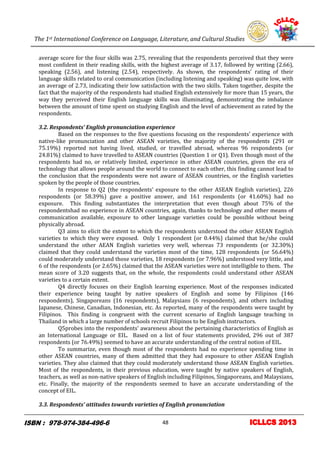
Table 1 displays the frequency of responses regarding their self-assessment of their English language
skills.
Table 1
Frequencies of responses regarding their self-assessment of four English skills
Language
skills
Excellent
(5)
Good
(4)
Moderate
(3)
Poor
(2)
Very
poor(1)
Mean
score
SD
Listening 5 54 135 146 47 2.54 0.92
Speaking 6 26 207 120 28 2.56 0.79
Reading 11 123 188 52 13 3.17 0.82
Writing 4 43 195 106 39 2.66 0.84
To guide the interpretation of the mean scores, in this study, the equidistance between each
pair of the five categories (e.g., categories 1 and 2, and categories 3 and 4) was assumed in this study.
Because there are five categories and the range of the data is 4, the cutoff point was set at interval of
0.8. The mean scores facilitating the comparison of the responses to this question and used as
default statistics for summarizing Likert scale data are as follows:1.00 – 1.80 was interpreted as
‘very poor’; 1.81 – 2.60 as ‘poor’; 2.61 – 3.40 as ‘moderate’; 3.41 – 4.20as ‘good’; and 4.21 – 5.00 as
‘excellent’.On the whole, the mean values ranging from 2.54 to 3.17 for the four skills demonstrated
that generally the respondents did not think they are not capable user of English.Additionally, the
47
The 1st International Conference on Language, Literature, and Cultural Studies
8
average score for the four skills was 2.75, revealing that the respondents perceived that they were
most confident in their reading skills, with the highest average of 3.17, followed by writing (2.66),
speaking (2.56), and listening (2.54), respectively. As shown, the respondents’ rating of their
language skills related to oral communication (including listening and speaking) was quite low, with
an average of 2.73, indicating their low satisfaction with the two skills. Taken together, despite the
fact that the majority of the respondents had studied English extensively for more than 15 years, the
way they perceived their English language skills was illuminating, demonstrating the imbalance
between the amount of time spent on studying English and the level of achievement as rated by the
respondents.
3.2. Respondents’ English pronunciation experience
Based on the responses to the five questions focusing on the respondents’ experience with
native-like pronunciation and other ASEAN varieties, the majority of the respondents (291 or
75.19%) reported not having lived, studied, or travelled abroad, whereas 96 respondents (or
24.81%) claimed to have travelled to ASEAN countries (Question 1 or Q1). Even though most of the
respondents had no, or relatively limited, experience in other ASEAN countries, given the era of
technology that allows people around the world to connect to each other, this finding cannot lead to
the conclusion that the respondents were not aware of ASEAN countries, or the English varieties
spoken by the people of those countries.
In response to Q2 (the respondents’ exposure to the other ASEAN English varieties), 226
respondents (or 58.39%) gave a positive answer, and 161 respondents (or 41.60%) had no
exposure. This finding substantiates the interpretation that even though about 75% of the
respondentshad no experience in ASEAN countries, again, thanks to technology and other means of
communication available, exposure to other language varieties could be possible without being
physically abroad.
Q3 aims to elicit the extent to which the respondents understood the other ASEAN English
varieties to which they were exposed. Only 1 respondent (or 0.44%) claimed that he/she could
understand the other AEAN English varieties very well, whereas 73 respondents (or 32.30%)
claimed that they could understand the varieties most of the time, 128 respondents (or 56.64%)
could moderately understand those varieties, 18 respondents (or 7.96%) understood very little, and
6 of the respondents (or 2.65%) claimed that the ASEAN varieties were not intelligible to them. The
mean score of 3.20 suggests that, on the whole, the respondents could understand other ASEAN
varieties to a certain extent.
Q4 directly focuses on their English learning experience. Most of the responses indicated
their experience being taught by native speakers of English and some by Filipinos (146
respondents), Singaporeans (16 respondents), Malaysians (6 respondents), and others including
Japanese, Chinese, Canadian, Indonesian, etc. As reported, many of the respondents were taught by
Filipinos. This finding is congruent with the current scenario of English language teaching in
Thailand in which a large number of schools recruit Filipinos to be English instructors.
Q5probes into the respondents’ awareness about the pertaining characteristics of English as
an International Language or EIL. Based on a list of four statements provided, 296 out of 387
respondents (or 76.49%) seemed to have an accurate understanding of the central notion of EIL.
To summarize, even though most of the respondents had no experience spending time in
other ASEAN countries, many of them admitted that they had exposure to other ASEAN English
varieties. They also claimed that they could moderately understand those ASEAN English varieties.
Most of the respondents, in their previous education, were taught by native speakers of English,
teachers, as well as non-native speakers of English including Filipinos, Singaporeans, and Malaysians,
etc. Finally, the majority of the respondents seemed to have an accurate understanding of the
concept of EIL.
3.3. Respondents’ attitudes towards varieties of English pronunciation
48
The 1st International Conference on Language, Literature, and Cultural Studies
9
This part consists of nine statements (Ss). Based on the Likert scale of five categories (5 =
strongly agree, 4 = somewhat agree, 3 = neutral, 2 = somewhat disagree, and 1 = strongly disagree),
the researcher was able to observeto what degree different Englishes were favored when students
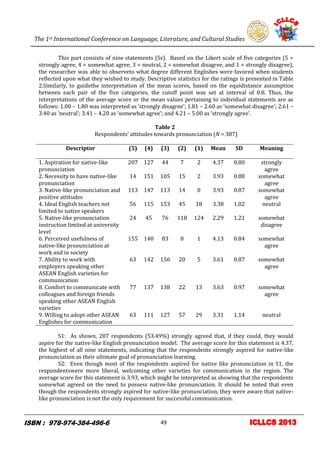
reflected upon what they wished to study. Descriptive statistics for the ratings is presented in Table
2.Similarly, to guidethe interpretation of the mean scores, based on the equidistance assumption
between each pair of the five categories, the cutoff point was set at interval of 0.8. Thus, the
interpretations of the average score or the mean values pertaining to individual statements are as
follows: 1.00 – 1.80 was interpreted as ‘strongly disagree’; 1.81 – 2.60 as ‘somewhat disagree’; 2.61 –
3.40 as ‘neutral’; 3.41 – 4.20 as ‘somewhat agree’; and 4.21 – 5.00 as ‘strongly agree’.
Table 2
Respondents’ attitudes towards pronunciation (N = 387)
Descriptor (5) (4) (3) (2) (1) Mean SD Meaning
1. Aspiration for native-like
pronunciation
207 127 44 7 2 4.37 0.80 strongly
agree
2. Necessity to have native-like
pronunciation
14 151 105 15 2 3.93 0.88 somewhat
agree
3. Native-like pronunciation and
positive attitudes
113 147 113 14 0 3.93 0.87 somewhat
agree
4. Ideal English teachers not
limited to native speakers
56 115 153 45 18 3.38 1.02 neutral
5. Native-like pronunciation
instruction limited at university
level
24 45 76 118 124 2.29 1.21 somewhat
disagree
6. Perceived usefulness of
native-like pronunciation at
work and in society
155 140 83 8 1 4.13 0.84 somewhat
agree
7. Ability to work with
employers speaking other
ASEAN English varieties for
communication
63 142 156 20 5 3.61 0.87 somewhat
agree
8. Comfort to communicate with
colleagues and foreign friends
speaking other ASEAN English
varieties
77 137 138 22 13 3.63 0.97 somewhat
agree
9. Willing to adopt other ASEAN
Englishes for communication
63 111 127 57 29 3.31 1.14 neutral
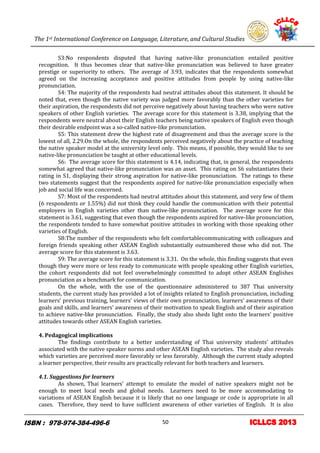
S1: As shown, 207 respondents (53.49%) strongly agreed that, if they could, they would
aspire for the native-like English pronunciation model. The average score for this statement is 4.37,
the highest of all nine statements, indicating that the respondents strongly aspired for native-like
pronunciation as their ultimate goal of pronunciation learning.
S2: Even though most of the respondents aspired for native like pronunciation in S1, the
respondentswere more liberal, welcoming other varieties for communication in the region. The
average score for this statement is 3.93, which might be interpreted as showing that the respondents
somewhat agreed on the need to possess native-like pronunciation. It should be noted that even
though the respondents strongly aspired for native-like pronunciation, they were aware that native-
like pronunciation is not the only requirement for successful communication.
49
The 1st International Conference on Language, Literature, and Cultural Studies
10
S3:No respondents disputed that having native-like pronunciation entailed positive
recognition. It thus becomes clear that native-like pronunciation was believed to have greater
prestige or superiority to others. The average of 3.93, indicates that the respondents somewhat
agreed on the increasing acceptance and positive attitudes from people by using native-like
pronunciation.
S4: The majority of the respondents had neutral attitudes about this statement. It should be
noted that, even though the native variety was judged more favorably than the other varieties for
their aspiration, the respondents did not perceive negatively about having teachers who were native
speakers of other English varieties. The average score for this statement is 3.38, implying that the
respondents were neutral about their English teachers being native speakers of English even though
their desirable endpoint was a so-called native-like pronunciation.
S5: This statement drew the highest rate of disagreement and thus the average score is the
lowest of all, 2.29.On the whole, the respondents perceived negatively about the practice of teaching
the native speaker model at the university level only. This means, if possible, they would like to see
native-like pronunciation be taught at other educational levels.
S6: The average score for this statement is 4.14, indicating that, in general, the respondents
somewhat agreed that native-like pronunciation was an asset. This rating on S6 substantiates their
rating in S1, displaying their strong aspiration for native-like pronunciation. The ratings to these
two statements suggest that the respondents aspired for native-like pronunciation especially when
job and social life was concerned.
S7: Most of the respondents had neutral attitudes about this statement, and very few of them
(6 respondents or 1.55%) did not think they could handle the communication with their potential
employers in English varieties other than native-like pronunciation. The average score for this
statement is 3.61, suggesting that even though the respondents aspired for native-like pronunciation,
the respondents tended to have somewhat positive attitudes in working with those speaking other
varieties of English.
S8:The number of the respondents who felt comfortablecommunicating with colleagues and
foreign friends speaking other ASEAN English substantially outnumbered those who did not. The
average score for this statement is 3.63.
S9: The average score for this statement is 3.31. On the whole, this finding suggests that even
though they were more or less ready to communicate with people speaking other English varieties,
the cohort respondents did not feel overwhelmingly committed to adopt other ASEAN Englishes
pronunciation as a benchmark for communication.
On the whole, with the use of the questionnaire administered to 387 Thai university
students, the current study has provided a lot of insights related to English pronunciation, including
learners’ previous training, learners’ views of their own pronunciation, learners’ awareness of their
goals and skills, and learners’ awareness of their motivation to speak English and of their aspiration
to achieve native-like pronunciation. Finally, the study also sheds light onto the learners’ positive
attitudes towards other ASEAN English varieties.
4. Pedagogical implications
The findings contribute to a better understanding of Thai university students’ attitudes
associated with the native speaker norms and other ASEAN English varieties. The study also reveals
which varieties are perceived more favorably or less favorably. Although the current study adopted
a learner perspective, their results are practically relevant for both teachers and learners.
4.1. Suggestions for learners
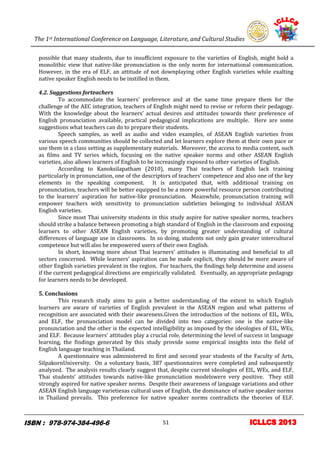
As shown, Thai learners’ attempt to emulate the model of native speakers might not be
enough to meet local needs and global needs. Learners need to be more accommodating to
variations of ASEAN English because it is likely that no one language or code is appropriate in all
cases. Therefore, they need to have sufficient awareness of other varieties of English. It is also
50
The 1st International Conference on Language, Literature, and Cultural Studies
11
possible that many students, due to insufficient exposure to the varieties of English, might hold a
monolithic view that native-like pronunciation is the only norm for international communication.
However, in the era of ELF, an attitude of not downplaying other English varieties while exalting
native speaker English needs to be instilled in them.
4.2. Suggestions forteachers
To accommodate the learners’ preference and at the same time prepare them for the
challenge of the AEC integration, teachers of English might need to revise or reform their pedagogy.
With the knowledge about the learners’ actual desires and attitudes towards their preference of
English pronunciation available, practical pedagogical implications are multiple. Here are some
suggestions what teachers can do to prepare their students.
Speech samples, as well as audio and video examples, of ASEAN English varieties from
various speech communities should be collected and let learners explore them at their own pace or
use them in a class setting as supplementary materials. Moreover, the access to media content, such
as films and TV series which, focusing on the native speaker norms and other ASEAN English
varieties, also allows learners of English to be increasingly exposed to other varieties of English.
According to Kanoksilapatham (2010), many Thai teachers of English lack training
particularly in pronunciation, one of the descriptors of teachers’ competence and also one of the key
elements in the speaking component. It is anticipated that, with additional training on
pronunciation, teachers will be better equipped to be a more powerful resource person contributing
to the learners’ aspiration for native-like pronunciation. Meanwhile, pronunciation training will
empower teachers with sensitivity to pronunciation subtleties belonging to individual ASEAN
English varieties.
Since most Thai university students in this study aspire for native speaker norms, teachers
should strike a balance between promoting a high standard of English in the classroom and exposing
learners to other ASEAN English varieties, by promoting greater understanding of cultural
differences of language use in classrooms. In so doing, students not only gain greater intercultural
competence but will also be empowered users of their own English.
In short, knowing more about Thai learners’ attitudes is illuminating and beneficial to all
sectors concerned. While learners’ aspiration can be made explicit, they should be more aware of
other English varieties prevalent in the region. For teachers, the findings help determine and assess
if the current pedagogical directions are empirically validated. Eventually, an appropriate pedagogy
for learners needs to be developed.
5. Conclusions
This research study aims to gain a better understanding of the extent to which English
learners are aware of varieties of English prevalent in the ASEAN region and what patterns of
recognition are associated with their awareness.Given the introduction of the notions of EIL, WEs,
and ELF, the pronunciation model can be divided into two categories: one is the native-like
pronunciation and the other is the expected intelligibility as imposed by the ideologies of EIL, WEs,
and ELF. Because learners’ attitudes play a crucial role, determining the level of success in language
learning, the findings generated by this study provide some empirical insights into the field of
English language teaching in Thailand.
A questionnaire was administered to first and second year students of the Faculty of Arts,
SilpakornUniversity. On a voluntary basis, 387 questionnaires were completed and subsequently
analyzed. The analysis results clearly suggest that, despite current ideologies of EIL, WEs, and ELF,
Thai students’ attitudes towards native-like pronunciation modelswere very positive. They still
strongly aspired for native speaker norms. Despite their awareness of language variations and other
ASEAN English language varietiesas cultural uses of English, the dominance of native speaker norms
in Thailand prevails. This preference for native speaker norms contradicts the theories of ELF.
51
The 1st International Conference on Language, Literature, and Cultural Studies
12
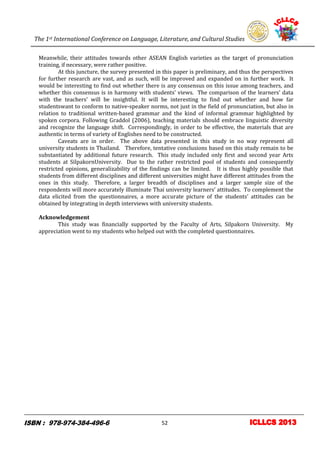
Meanwhile, their attitudes towards other ASEAN English varieties as the target of pronunciation
training, if necessary, were rather positive.
At this juncture, the survey presented in this paper is preliminary, and thus the perspectives
for further research are vast, and as such, will be improved and expanded on in further work. It
would be interesting to find out whether there is any consensus on this issue among teachers, and
whether this consensus is in harmony with students’ views. The comparison of the learners’ data
with the teachers’ will be insightful. It will be interesting to find out whether and how far
studentswant to conform to native-speaker norms, not just in the field of pronunciation, but also in
relation to traditional written-based grammar and the kind of informal grammar highlighted by
spoken corpora. Following Graddol (2006), teaching materials should embrace linguistic diversity
and recognize the language shift. Correspondingly, in order to be effective, the materials that are
authentic in terms of variety of Englishes need to be constructed.
Caveats are in order. The above data presented in this study in no way represent all
university students in Thailand. Therefore, tentative conclusions based on this study remain to be
substantiated by additional future research. This study included only first and second year Arts
students at SilpakornUniversity. Due to the rather restricted pool of students and consequently
restricted opinions, generalizability of the findings can be limited. It is thus highly possible that
students from different disciplines and different universities might have different attitudes from the
ones in this study. Therefore, a larger breadth of disciplines and a larger sample size of the
respondents will more accurately illuminate Thai university learners’ attitudes. To complement the
data elicited from the questionnaires, a more accurate picture of the students’ attitudes can be
obtained by integrating in depth interviews with university students.
Acknowledgement
This study was financially supported by the Faculty of Arts, Silpakorn University. My
appreciation went to my students who helped out with the completed questionnaires.
52
The 1st International Conference on Language, Literature, and Cultural Studies
13
References
Amberg, J., & Vause, D. (2009). American English: History, structure, and usage. Cambridge:
CambridgeUniversity Press.
Firth, A. (1996). The discursive accomplishment of normality: On ‘lingua franca’ English and
conversation analysis. Journal of Pragmatics, 26, 237-259.
Foley, J. A. (2005). English in Thailand. RELC, 36(2), 23-234.
Graddol, D. (2004). The future of language. Science, 303(5662), 1329-1331.
Graddol, D. (2006). English next. Plymouth: The British Council.
Jenkins, J. (2003). World Englishes: A resource book for students. London: Routledge.
Jenkins, J. (2004). Research in teaching pronunciation and intonation.Annual Review of Applied
Linguistics, 24, 109-125.
Jenkins, J. (2009). English as a lingua franca: Interpretations and attitudes. World Englishes 28(2),
200-207.
Kachru, B. (1995). World Englishes: Approaches, issues, and resources. In D.H. Brown & S.T. Gonzo
(Eds.), Readings on second language acquisition (pp. 229-261). Englewood Cliffs: Prentice
Hall.
Kanoksilapatham, B. (2005). Intonation meaning in English discourse: Thai speakers.Indonesian
Journal of English Language Teaching, 1(2), 136-163.
Kanoksilapatham, B. (2009). Teaching English Intonation in Thailand: Overview. Journal of the
Faculty of Arts, 31(2), 299-319.
Kanoksilapatham, B. (2010). Word stress assignment. In Gregory T. Papanikos & Nicholas C. J.
Pappas (Eds.), Horizons in education (pp. 467-477). Athens: Athens Institute for Education
and Research (ATINER).
Kirkpatrick, A. (2007). World Englishes: Implications for international communication and English
language teaching. Cambridge: CambridgeUniversity Press.
Savignon, S. J., & Sysoyev, P. V. (2002). Sociocultural strategies for a dialogue of cultures. Modern
Language Journal, 86, iv.
Warscharuer, M. (2000). The changing global economy and the future of English teaching. TESOL
Quarterly, 34(3), 511-535.
Wongsothorn,A. (1996).National profiles of language education. Bangkok, Thailand: Chulalongkorn
University.
53

2013.ICLLCS.Budsaba published article

  • 2.
    The 1st InternationalConference on Language, Literature, and Cultural Studies 2 ICLLCS 2013 1st International Conference on Language, Literature, and Cultural Studies August 22-24, 2013 Organized by: Department of Western Languages, Faculty of Humanities and Social Sciences, Burapha University, THAILAND Published 200 copies ISBN : 978-974-384-496-6 Get Good Creation, Co.,LTD Copyright@2013 by Department of Western Languages, Faculty of Humanities and Social Sciences, Burapha University
  • 3.
    The 1st InternationalConference on Language, Literature, and Cultural Studies 3 CONTENTS Alexander J. Klemm 4 Writing the City into Being: Cold War Bangkok in The Ninth Directive (1966) Anusorn Saechan 14 WH-Arguments versus WH-Adjuncts Asymmetry in the Acquisition of English WH-Questions by Thai Learners Pudsadee Kaewchawee 25 The Effectiveness of Multimedia-based Instruction in Developing the Sixth Grade Students’ English Ability Akkarapon Nuemaihom 34 An Analysis of Thai-English Translation Strategies in the Short Story Level 8 Abbot Budsaba Kanoksilapatham 44 University Students’ Attitudes towards English Pronunciation Models Chitra Phunkitchar & Supaporn Yimwilai 54 Environmental Awareness in Children Picture Book: The Secret Garden Aram Iamlaor 63 An Analysis of Translating Figurative Language by English-Major Students in Thailand Farhad Mazlum & Fatemeh Poorebrahim 69 English Language Teaching in Iran: a Meta-analytic and Triangulated View of Persistent Challenges Hataya Anansuchatkul 81 Effortlessly Yours: Discursive Construction of Spa Service in Chiang Mai Jaime Moreno Tejada 100 Between Christianity and Modernity: the Many Meanings of “Laziness” and “Boredom” in Spain and Latin America Jose G. Tan, JR 110 English Instructional Materials: Imperative Learning Aid for the High School Bound Summer Program of the MSU-Science High School Khaing Khaing Oo and Kantatip Sinhaneti 122 An Investigation of Myanmar Migrant Workers’ English Language Problems and Job- related Needs at D.E.A.R Burma School Meechai Wongdaeng & Rangsiya Chaengchenkit 135 Interlanguage of English Questions Use by Thai EFL Learners: An Investigation into Acquisition Patterns and a Testing of Implicational Universals Khanita Limhan 148 English-Thai Time Expressions Used by Thai EFL Learners
  • 4.
    The 1st InternationalConference on Language, Literature, and Cultural Studies 4 University Students’ Attitudes towards English Pronunciation Models Budsaba Kanoksilapatham English Department, Faculty of Arts Silpakorn University kanoksib@hotmail.com Abstract It has been agreed that the English language is going to be the working language in ASEAN. To comply with this decision, it is essential that Thai students be prepared to be competent in the English language, particularly for international communication. To successfully prepare Thai learners for this challenge, the question of whether Thai university students should conform to native-speaker norms of English, in an era when English is increasingly used in international contexts and when the integration of AEC is approaching, is one of the topics which has been keenly debated in recent years. However, it is not a debate in which the voices of students have been heard. Therefore, this research attempts to shed some light into the issue. This research study is based largely on onequestionnaire survey, which examined Thai university students’ attitudes about their English pronunciation to the question of conforming to native-speaker norms or to the ideologies of EIL, WEs, and ELFwhich focus on intelligibility. Taken together, the survey drew 387 responses from first and second year students studying in a public university. Theanalysis of the completed questionnaires demonstrates that Thai university students held more favorable attitudes towards the model of native speakers. The study demonstrates that students’ views may differ from the expectations of teachers and academics, and that it is important for educators to be aware of these viewsfor future decisions related to national educational plans. Keywords: EIL, pronunciation, attitudes, learners of English, university students 1. Introduction It is acknowledged that among all languages in the world, the English language plays an increasingly vital role in our daily life particularly in business, education, entertainment, communication, and work. Moreover, the use of the English language is not limited locally but also internationally for communication between speakers from diverse language backgrounds. Since the role of the English language used at present is primarily for communication, the English language skills related to, or emphasizing, communication are significantly important(Graddol, 2004). As known, oral communication skills include two principal language skills: speaking and listening. In this regard, it is well known that listening and speaking are the basic skills needed in order to subsequently develop reading and writing skills, contributing to the enhanced effectiveness and efficiency of English language learning. This in turn contributes to the integration of language use in daily life (e.g., Graddol, 2006; Amberg & Vause, 2009). Although the English language has been taught in Thailand as a foreign language for many decades, according to educators, Thai students’ performance in the English language subject in general seems unsatisfactory (Foley, 2005; Wongsothorn,1996). Specifically, even though English speaking and listening skills are pivotal, Thai learners of English seem to find these skills difficult to achieve (Kanoksilapatham, 2005, 2009, 2010). It is claimed that, among other things, some of the major reasons contributing to incomplete mastery of these two skills include the lack of or limited exposure to the target language of English and other factors related to teachers, learners, environment, teaching materials, supporting technology, etc. In addition to these external factors, the success of speaking for communicative purposes is determined by how much the language learners know about pertinent linguistic characteristics of the English language. That is, in addition to the content or message to be conveyed and the appropriate choice of language, the clear 44
  • 5.
    The 1st InternationalConference on Language, Literature, and Cultural Studies 5 understanding of the English language sound system is vital. Different from the Thai language to a certain extent, the English language displays its own unique set of consonant and vowel sounds, stress placement, and intonation. Finally, paralinguistic features appropriate for certain situationsare important, contributing to successful communication (Kanoksilapatham, 2009). In general, English language teaching in Thailand, as far as pronunciation is concerned, aims to enable learners to master or approximate native-like pronunciation. In other words, it can be said that, traditionally, the ultimate goal of the English language teaching of pronunciation in Thailand is to speak like a native speaker of the English language. However, in practice and in reality, as demonstrated by the studies conducted by Kanoksilapatham (2005, 2010), the pronunciation of not only Thai learnersbut also Thai teachers of English seems to be unsatisfactory. The factors responsible for the findings include inadequate instruction, learners, curriculum, and educational administrators. To elaborate, most of the Thai teachers of English in these studies did not complete their highest degree in English or in the fields related to English teaching. However, due to the lack of English teachers with appropriate qualifications, they were asked to teach English. Obviously, these teachers werenot prepared to teach English. Thai learners, as found in these studies, were timid and hesitant,when required to use intonation patterns containing high pitches. The national English curriculum also downplays the integral role of pronunciation, placing an emphasis on the four major skills of reading, writing, listening, and speaking. Finally, educational administrators assumed that pronunciation did not need to be explicitly instructed, but can be acquired through exposure to the language input. However, given the fact that the principle source of English input for many Thai students was from the Thai teachers of English, as demonstrated by these studies, the input was usually flawed especially in word stress. In contrast to the ultimate goal of native-like pronunciation, recently, the notions of World Englishes (WEs), English as a Lingua Franca (ELF), and English as an International Language (EIL) have merited substantial and worldwide attention (e.g., Kachru, 1995; Firth, 1996; Warscharuer, 2000; Savignon & Sysoyev, 2002; Jenkins, 2003; Graddol, 2006; Kirkpatrick, 2007). To elaborate, for instance, English as a Lingua Franca or ELF refers to a situation in which English is chosen to be a language of communication among speakers who share neither a common native tongue nor a common national cultural background (Firth, 1996: 240; Jenkins, 2004, 2009: 200). According to Jenkins (2009), in the context of ELF, the opportunity for learners of English to be exposed to, or actually use, the English language with native speakers of English is limited. Therefore, intelligibility, rather than native speaker norms, is considered the ultimate goal of English language learning. The advent of Thailand’s integration of the ASEAN Economic Community (or AEC) in the near future has highlighted the fact that the opportunity to use English with the ASEAN members becomes more imminent and realistic than the expected interaction with native speakers of English from America, England, New Zealand, Canada, or Australia. Consequently, based on the ELF concept, the goal and expectation to develop Thai learners’ pronunciation of English for the purpose of communicating with the ASEAN members should be for intelligibility, a more reasonable and attainable goal than native-like. That is, these notions of EIL, WEs, and ELF together with the AEC integration suggest that native speaker norms that the learners of English have to follow might not be valid. Indeed, a form of language that takes into account their first language and cultural identities might be more appropriate in the current context. At this juncture, given the merits for intelligibility of English, the practice of teaching and learning English in Thailand needs to be reviewed and challenged. This means all sectors and personnel involved should cooperate in revising the implementation of the English curriculum and respective pedagogical applications. However, learners’ voice should be heard with regard to their ultimate goal of learning English pronunciation. Currently, there is no empirical study investigating Thai learners’ attitudes towards English pronunciation, with reference to the notion of ELF in the context of, and in preparation for, the AEC integration. A study conducted on Thai university students would provide insights into how Thai learners of English perceive the spread of English as a lingua franca, and whether they find the ELF suggestions suitable. To be precise, it remains to be 45
  • 6.
    The 1st InternationalConference on Language, Literature, and Cultural Studies 6 determined if Thai learners of English favor the traditional goal of native-like pronunciation or the emerging goal of intelligibility. 2. The study This section presents the details pertaining to the current study, including the objective, the participants, the instrument, data collection and data analysis. 2.1. Objective This study sets out to investigate Thai students’ attitudes towards the native-speaker and other ASEAN models in English pronunciation learning in relation to the ideologies of EIL, WEs, and ELF that highlights intelligibility. Corresponding to the objective stipulated, the research question addressed in this study is: What are the Thai English learners’ attitudes towards native-like pronunciation or the pronunciation of other varieties of English advocated by the notions of EIL, WEs, and ELF? 2.2. Participants The participants of this study consist of first and second year students at SilpakornUniversity. These students, at the time of study, had not selected their majors or minors. This pool of population was selected for a number of reasons. First, they were considered future users of English who would be confronted with many English varieties and be judged in their professional life with competence, intellect, and character based on their English accent. Therefore, their attitudes towards different varieties of English are considered important and are likely to provide some empirical insights into the field of EIL, ELF, and WEs. Second, this pool of students was selected because, as opposed to high school students, these tertiary students were free from the heavy pressure of learning English in order to pass the national examinations for entering into higher educational institutions. Consequently, students would have more autonomy in deciding their investment in learning English.Finally, these first and second year students from SilpakornUniversity were selected for academic reason. At the time of study, they were not influenced by the contents of the English phonetics course, which was offered to students majoring and minoring in English when they are in their third and fourth years. Given the fact that typically this course is likely to focus on American English or British English, as reflected from a number of textbooks available, the course contents might have an impact on their attitudes towards pronunciation. Therefore, it is ideal and crucial that the study be conducted on first and second yearUniversity students. 2.3. Instrument The instrument used in this study is a questionnaire. To assure that the participants of this study had no difficulty understanding the questions asked and responding, the questionnaire was written in Thai. The initial version of the questionnaire was piloted before being used with 30 first and second year students at the Faculty of Liberal Arts and Science, Kasetsart University in the second academic semester of the 2012 academic year. The purpose of this piloting was to make sure that the language used in the questions asked was understood by the respondents, and the questions were successful in eliciting what they were supposed to. Based on the comments and feedback from the respondents, the questionnaire was revised accordingly. Some question items were rewritten, and others were elaborated to make sure that confusion was eradicated, and clarity was enhanced. The revised questionnaire used in this studyconsists of three major parts. Part One collects the participants’ personal information regarding gender, age, the year of study, the onset time of studying English, and the Likert scale self-assessment of theirEnglish language skills. Part Two consists of five questions which aim to elicit the respondents’ experience with native-like pronunciation and other ASEAN English varieties. Part Threeconsists of a series of nine statements 46
  • 7.
    The 1st InternationalConference on Language, Literature, and Cultural Studies 7 to collect information on the respondents’ attitudes towards English pronunciation models of native like and other models along the concept of ELF. 2.4.Data collection Upon the final revision and improvement of the tried out questionnaire in 2.3, the questionnaire was administered to the participants for a period of one week in the middle of the second semester of the 2012 academic year. The participants were first and second year students of the Faculty of Arts, SilpakornUniversity. The activity took place on campus and was conducted entirely on a voluntary basis. 2.5. Data analysis All of the returned questionnaires (N = 387) were quantitatively analyzed by using the SPSS program for descriptive statistics in order to calculate mean ratings andpercentages,and to highlight any trends and significant commonalities, anomalies, etc. The Likert scale data analyzed by descriptive statistics provided a summary of data that not only identified the most popular answer for each question but also a group average. 3. Results and discussion This section presents the analysis results generated by the three parts of the questionnaire, which are individually presented as follows: 3.1. Respondents’ personal information A summary of key descriptions about the cohort of 387 respondents as elicited through the five questions of the questionnaire is as follows. Out of 387 respondents, 73 respondents (18.86%) are male, and 314 (81.14%) are female. Most of the respondents (271 or 70.03%) are first year students; 116 (or 29.97%) are second year students. The participants’ age ranges from 17 to 21 years old, with an average of 18.65 years old. Most of them (315 or 81.40%) began studying English since they were in kindergarten, and the calculated average of English language learning years of the participants was 14.35 years.The last question on this part probes into the self-assessment of their English language skills of listening, speaking, reading, and writing. The five Likert scales were used from the highest to the lowest (5 = excellent, 4 = good, 3 = moderate, 2 = poor, and 1 = very poor). Table 1 displays the frequency of responses regarding their self-assessment of their English language skills. Table 1 Frequencies of responses regarding their self-assessment of four English skills Language skills Excellent (5) Good (4) Moderate (3) Poor (2) Very poor(1) Mean score SD Listening 5 54 135 146 47 2.54 0.92 Speaking 6 26 207 120 28 2.56 0.79 Reading 11 123 188 52 13 3.17 0.82 Writing 4 43 195 106 39 2.66 0.84 To guide the interpretation of the mean scores, in this study, the equidistance between each pair of the five categories (e.g., categories 1 and 2, and categories 3 and 4) was assumed in this study. Because there are five categories and the range of the data is 4, the cutoff point was set at interval of 0.8. The mean scores facilitating the comparison of the responses to this question and used as default statistics for summarizing Likert scale data are as follows:1.00 – 1.80 was interpreted as ‘very poor’; 1.81 – 2.60 as ‘poor’; 2.61 – 3.40 as ‘moderate’; 3.41 – 4.20as ‘good’; and 4.21 – 5.00 as ‘excellent’.On the whole, the mean values ranging from 2.54 to 3.17 for the four skills demonstrated that generally the respondents did not think they are not capable user of English.Additionally, the 47
  • 8.
    The 1st InternationalConference on Language, Literature, and Cultural Studies 8 average score for the four skills was 2.75, revealing that the respondents perceived that they were most confident in their reading skills, with the highest average of 3.17, followed by writing (2.66), speaking (2.56), and listening (2.54), respectively. As shown, the respondents’ rating of their language skills related to oral communication (including listening and speaking) was quite low, with an average of 2.73, indicating their low satisfaction with the two skills. Taken together, despite the fact that the majority of the respondents had studied English extensively for more than 15 years, the way they perceived their English language skills was illuminating, demonstrating the imbalance between the amount of time spent on studying English and the level of achievement as rated by the respondents. 3.2. Respondents’ English pronunciation experience Based on the responses to the five questions focusing on the respondents’ experience with native-like pronunciation and other ASEAN varieties, the majority of the respondents (291 or 75.19%) reported not having lived, studied, or travelled abroad, whereas 96 respondents (or 24.81%) claimed to have travelled to ASEAN countries (Question 1 or Q1). Even though most of the respondents had no, or relatively limited, experience in other ASEAN countries, given the era of technology that allows people around the world to connect to each other, this finding cannot lead to the conclusion that the respondents were not aware of ASEAN countries, or the English varieties spoken by the people of those countries. In response to Q2 (the respondents’ exposure to the other ASEAN English varieties), 226 respondents (or 58.39%) gave a positive answer, and 161 respondents (or 41.60%) had no exposure. This finding substantiates the interpretation that even though about 75% of the respondentshad no experience in ASEAN countries, again, thanks to technology and other means of communication available, exposure to other language varieties could be possible without being physically abroad. Q3 aims to elicit the extent to which the respondents understood the other ASEAN English varieties to which they were exposed. Only 1 respondent (or 0.44%) claimed that he/she could understand the other AEAN English varieties very well, whereas 73 respondents (or 32.30%) claimed that they could understand the varieties most of the time, 128 respondents (or 56.64%) could moderately understand those varieties, 18 respondents (or 7.96%) understood very little, and 6 of the respondents (or 2.65%) claimed that the ASEAN varieties were not intelligible to them. The mean score of 3.20 suggests that, on the whole, the respondents could understand other ASEAN varieties to a certain extent. Q4 directly focuses on their English learning experience. Most of the responses indicated their experience being taught by native speakers of English and some by Filipinos (146 respondents), Singaporeans (16 respondents), Malaysians (6 respondents), and others including Japanese, Chinese, Canadian, Indonesian, etc. As reported, many of the respondents were taught by Filipinos. This finding is congruent with the current scenario of English language teaching in Thailand in which a large number of schools recruit Filipinos to be English instructors. Q5probes into the respondents’ awareness about the pertaining characteristics of English as an International Language or EIL. Based on a list of four statements provided, 296 out of 387 respondents (or 76.49%) seemed to have an accurate understanding of the central notion of EIL. To summarize, even though most of the respondents had no experience spending time in other ASEAN countries, many of them admitted that they had exposure to other ASEAN English varieties. They also claimed that they could moderately understand those ASEAN English varieties. Most of the respondents, in their previous education, were taught by native speakers of English, teachers, as well as non-native speakers of English including Filipinos, Singaporeans, and Malaysians, etc. Finally, the majority of the respondents seemed to have an accurate understanding of the concept of EIL. 3.3. Respondents’ attitudes towards varieties of English pronunciation 48
  • 9.
    The 1st InternationalConference on Language, Literature, and Cultural Studies 9 This part consists of nine statements (Ss). Based on the Likert scale of five categories (5 = strongly agree, 4 = somewhat agree, 3 = neutral, 2 = somewhat disagree, and 1 = strongly disagree), the researcher was able to observeto what degree different Englishes were favored when students reflected upon what they wished to study. Descriptive statistics for the ratings is presented in Table 2.Similarly, to guidethe interpretation of the mean scores, based on the equidistance assumption between each pair of the five categories, the cutoff point was set at interval of 0.8. Thus, the interpretations of the average score or the mean values pertaining to individual statements are as follows: 1.00 – 1.80 was interpreted as ‘strongly disagree’; 1.81 – 2.60 as ‘somewhat disagree’; 2.61 – 3.40 as ‘neutral’; 3.41 – 4.20 as ‘somewhat agree’; and 4.21 – 5.00 as ‘strongly agree’. Table 2 Respondents’ attitudes towards pronunciation (N = 387) Descriptor (5) (4) (3) (2) (1) Mean SD Meaning 1. Aspiration for native-like pronunciation 207 127 44 7 2 4.37 0.80 strongly agree 2. Necessity to have native-like pronunciation 14 151 105 15 2 3.93 0.88 somewhat agree 3. Native-like pronunciation and positive attitudes 113 147 113 14 0 3.93 0.87 somewhat agree 4. Ideal English teachers not limited to native speakers 56 115 153 45 18 3.38 1.02 neutral 5. Native-like pronunciation instruction limited at university level 24 45 76 118 124 2.29 1.21 somewhat disagree 6. Perceived usefulness of native-like pronunciation at work and in society 155 140 83 8 1 4.13 0.84 somewhat agree 7. Ability to work with employers speaking other ASEAN English varieties for communication 63 142 156 20 5 3.61 0.87 somewhat agree 8. Comfort to communicate with colleagues and foreign friends speaking other ASEAN English varieties 77 137 138 22 13 3.63 0.97 somewhat agree 9. Willing to adopt other ASEAN Englishes for communication 63 111 127 57 29 3.31 1.14 neutral S1: As shown, 207 respondents (53.49%) strongly agreed that, if they could, they would aspire for the native-like English pronunciation model. The average score for this statement is 4.37, the highest of all nine statements, indicating that the respondents strongly aspired for native-like pronunciation as their ultimate goal of pronunciation learning. S2: Even though most of the respondents aspired for native like pronunciation in S1, the respondentswere more liberal, welcoming other varieties for communication in the region. The average score for this statement is 3.93, which might be interpreted as showing that the respondents somewhat agreed on the need to possess native-like pronunciation. It should be noted that even though the respondents strongly aspired for native-like pronunciation, they were aware that native- like pronunciation is not the only requirement for successful communication. 49
  • 10.
    The 1st InternationalConference on Language, Literature, and Cultural Studies 10 S3:No respondents disputed that having native-like pronunciation entailed positive recognition. It thus becomes clear that native-like pronunciation was believed to have greater prestige or superiority to others. The average of 3.93, indicates that the respondents somewhat agreed on the increasing acceptance and positive attitudes from people by using native-like pronunciation. S4: The majority of the respondents had neutral attitudes about this statement. It should be noted that, even though the native variety was judged more favorably than the other varieties for their aspiration, the respondents did not perceive negatively about having teachers who were native speakers of other English varieties. The average score for this statement is 3.38, implying that the respondents were neutral about their English teachers being native speakers of English even though their desirable endpoint was a so-called native-like pronunciation. S5: This statement drew the highest rate of disagreement and thus the average score is the lowest of all, 2.29.On the whole, the respondents perceived negatively about the practice of teaching the native speaker model at the university level only. This means, if possible, they would like to see native-like pronunciation be taught at other educational levels. S6: The average score for this statement is 4.14, indicating that, in general, the respondents somewhat agreed that native-like pronunciation was an asset. This rating on S6 substantiates their rating in S1, displaying their strong aspiration for native-like pronunciation. The ratings to these two statements suggest that the respondents aspired for native-like pronunciation especially when job and social life was concerned. S7: Most of the respondents had neutral attitudes about this statement, and very few of them (6 respondents or 1.55%) did not think they could handle the communication with their potential employers in English varieties other than native-like pronunciation. The average score for this statement is 3.61, suggesting that even though the respondents aspired for native-like pronunciation, the respondents tended to have somewhat positive attitudes in working with those speaking other varieties of English. S8:The number of the respondents who felt comfortablecommunicating with colleagues and foreign friends speaking other ASEAN English substantially outnumbered those who did not. The average score for this statement is 3.63. S9: The average score for this statement is 3.31. On the whole, this finding suggests that even though they were more or less ready to communicate with people speaking other English varieties, the cohort respondents did not feel overwhelmingly committed to adopt other ASEAN Englishes pronunciation as a benchmark for communication. On the whole, with the use of the questionnaire administered to 387 Thai university students, the current study has provided a lot of insights related to English pronunciation, including learners’ previous training, learners’ views of their own pronunciation, learners’ awareness of their goals and skills, and learners’ awareness of their motivation to speak English and of their aspiration to achieve native-like pronunciation. Finally, the study also sheds light onto the learners’ positive attitudes towards other ASEAN English varieties. 4. Pedagogical implications The findings contribute to a better understanding of Thai university students’ attitudes associated with the native speaker norms and other ASEAN English varieties. The study also reveals which varieties are perceived more favorably or less favorably. Although the current study adopted a learner perspective, their results are practically relevant for both teachers and learners. 4.1. Suggestions for learners As shown, Thai learners’ attempt to emulate the model of native speakers might not be enough to meet local needs and global needs. Learners need to be more accommodating to variations of ASEAN English because it is likely that no one language or code is appropriate in all cases. Therefore, they need to have sufficient awareness of other varieties of English. It is also 50
  • 11.
    The 1st InternationalConference on Language, Literature, and Cultural Studies 11 possible that many students, due to insufficient exposure to the varieties of English, might hold a monolithic view that native-like pronunciation is the only norm for international communication. However, in the era of ELF, an attitude of not downplaying other English varieties while exalting native speaker English needs to be instilled in them. 4.2. Suggestions forteachers To accommodate the learners’ preference and at the same time prepare them for the challenge of the AEC integration, teachers of English might need to revise or reform their pedagogy. With the knowledge about the learners’ actual desires and attitudes towards their preference of English pronunciation available, practical pedagogical implications are multiple. Here are some suggestions what teachers can do to prepare their students. Speech samples, as well as audio and video examples, of ASEAN English varieties from various speech communities should be collected and let learners explore them at their own pace or use them in a class setting as supplementary materials. Moreover, the access to media content, such as films and TV series which, focusing on the native speaker norms and other ASEAN English varieties, also allows learners of English to be increasingly exposed to other varieties of English. According to Kanoksilapatham (2010), many Thai teachers of English lack training particularly in pronunciation, one of the descriptors of teachers’ competence and also one of the key elements in the speaking component. It is anticipated that, with additional training on pronunciation, teachers will be better equipped to be a more powerful resource person contributing to the learners’ aspiration for native-like pronunciation. Meanwhile, pronunciation training will empower teachers with sensitivity to pronunciation subtleties belonging to individual ASEAN English varieties. Since most Thai university students in this study aspire for native speaker norms, teachers should strike a balance between promoting a high standard of English in the classroom and exposing learners to other ASEAN English varieties, by promoting greater understanding of cultural differences of language use in classrooms. In so doing, students not only gain greater intercultural competence but will also be empowered users of their own English. In short, knowing more about Thai learners’ attitudes is illuminating and beneficial to all sectors concerned. While learners’ aspiration can be made explicit, they should be more aware of other English varieties prevalent in the region. For teachers, the findings help determine and assess if the current pedagogical directions are empirically validated. Eventually, an appropriate pedagogy for learners needs to be developed. 5. Conclusions This research study aims to gain a better understanding of the extent to which English learners are aware of varieties of English prevalent in the ASEAN region and what patterns of recognition are associated with their awareness.Given the introduction of the notions of EIL, WEs, and ELF, the pronunciation model can be divided into two categories: one is the native-like pronunciation and the other is the expected intelligibility as imposed by the ideologies of EIL, WEs, and ELF. Because learners’ attitudes play a crucial role, determining the level of success in language learning, the findings generated by this study provide some empirical insights into the field of English language teaching in Thailand. A questionnaire was administered to first and second year students of the Faculty of Arts, SilpakornUniversity. On a voluntary basis, 387 questionnaires were completed and subsequently analyzed. The analysis results clearly suggest that, despite current ideologies of EIL, WEs, and ELF, Thai students’ attitudes towards native-like pronunciation modelswere very positive. They still strongly aspired for native speaker norms. Despite their awareness of language variations and other ASEAN English language varietiesas cultural uses of English, the dominance of native speaker norms in Thailand prevails. This preference for native speaker norms contradicts the theories of ELF. 51
  • 12.
    The 1st InternationalConference on Language, Literature, and Cultural Studies 12 Meanwhile, their attitudes towards other ASEAN English varieties as the target of pronunciation training, if necessary, were rather positive. At this juncture, the survey presented in this paper is preliminary, and thus the perspectives for further research are vast, and as such, will be improved and expanded on in further work. It would be interesting to find out whether there is any consensus on this issue among teachers, and whether this consensus is in harmony with students’ views. The comparison of the learners’ data with the teachers’ will be insightful. It will be interesting to find out whether and how far studentswant to conform to native-speaker norms, not just in the field of pronunciation, but also in relation to traditional written-based grammar and the kind of informal grammar highlighted by spoken corpora. Following Graddol (2006), teaching materials should embrace linguistic diversity and recognize the language shift. Correspondingly, in order to be effective, the materials that are authentic in terms of variety of Englishes need to be constructed. Caveats are in order. The above data presented in this study in no way represent all university students in Thailand. Therefore, tentative conclusions based on this study remain to be substantiated by additional future research. This study included only first and second year Arts students at SilpakornUniversity. Due to the rather restricted pool of students and consequently restricted opinions, generalizability of the findings can be limited. It is thus highly possible that students from different disciplines and different universities might have different attitudes from the ones in this study. Therefore, a larger breadth of disciplines and a larger sample size of the respondents will more accurately illuminate Thai university learners’ attitudes. To complement the data elicited from the questionnaires, a more accurate picture of the students’ attitudes can be obtained by integrating in depth interviews with university students. Acknowledgement This study was financially supported by the Faculty of Arts, Silpakorn University. My appreciation went to my students who helped out with the completed questionnaires. 52
  • 13.
    The 1st InternationalConference on Language, Literature, and Cultural Studies 13 References Amberg, J., & Vause, D. (2009). American English: History, structure, and usage. Cambridge: CambridgeUniversity Press. Firth, A. (1996). The discursive accomplishment of normality: On ‘lingua franca’ English and conversation analysis. Journal of Pragmatics, 26, 237-259. Foley, J. A. (2005). English in Thailand. RELC, 36(2), 23-234. Graddol, D. (2004). The future of language. Science, 303(5662), 1329-1331. Graddol, D. (2006). English next. Plymouth: The British Council. Jenkins, J. (2003). World Englishes: A resource book for students. London: Routledge. Jenkins, J. (2004). Research in teaching pronunciation and intonation.Annual Review of Applied Linguistics, 24, 109-125. Jenkins, J. (2009). English as a lingua franca: Interpretations and attitudes. World Englishes 28(2), 200-207. Kachru, B. (1995). World Englishes: Approaches, issues, and resources. In D.H. Brown & S.T. Gonzo (Eds.), Readings on second language acquisition (pp. 229-261). Englewood Cliffs: Prentice Hall. Kanoksilapatham, B. (2005). Intonation meaning in English discourse: Thai speakers.Indonesian Journal of English Language Teaching, 1(2), 136-163. Kanoksilapatham, B. (2009). Teaching English Intonation in Thailand: Overview. Journal of the Faculty of Arts, 31(2), 299-319. Kanoksilapatham, B. (2010). Word stress assignment. In Gregory T. Papanikos & Nicholas C. J. Pappas (Eds.), Horizons in education (pp. 467-477). Athens: Athens Institute for Education and Research (ATINER). Kirkpatrick, A. (2007). World Englishes: Implications for international communication and English language teaching. Cambridge: CambridgeUniversity Press. Savignon, S. J., & Sysoyev, P. V. (2002). Sociocultural strategies for a dialogue of cultures. Modern Language Journal, 86, iv. Warscharuer, M. (2000). The changing global economy and the future of English teaching. TESOL Quarterly, 34(3), 511-535. Wongsothorn,A. (1996).National profiles of language education. Bangkok, Thailand: Chulalongkorn University. 53