BIOLOGICAL
FOUNDATIONS OF
LANGUAGE
CHAPTER VIII
Psycholinguistics studies the
psychological and neurobiological
factors that allow humans to
acquire, use, and understand
language. The unique human ability
to use language is closely tied to its
biological and neurological
development.
1. The Role of the Brain in Language
Language is primarily controlled by
specific areas in the cerebral cortex
(the cerebrum), mainly in the left
hemisphere for the majority of people
(about 95% of right-handed individuals
and 70% of left-handed individuals).
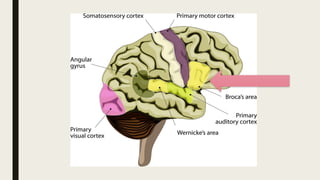
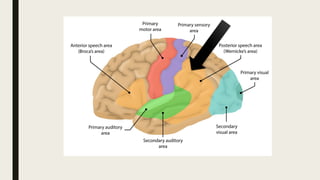
A. Broca's Area
■ Location: Located in the left frontal lobe, close to the motor
area that controls articulation muscles (face and mouth).
■ Primary Function: Responsible for speech production
(expressing ideas with correct grammar) and coordination of
the speech organs.
■ Disorder: Damage to this area causes Broca's Aphasia
(Expressive Aphasia), where patients have difficulty forming
fluent sentences, although their language comprehension is
relatively intact.
B. Wernicke's Area
■ Location: Located in the left temporal lobe, close to the
auditory cortex.
■ Primary Function: Responsible for language comprehension
(both spoken and written), and assigning meaning to words.
■ Disorder: Damage to this area causes Wernicke's Aphasia
(Receptive Aphasia), where patients speak fluently and with
a natural rhythm, but their sentences are often confusing
and lack meaning (sometimes called "word salad"). Patients
also struggle to understand the speech of others.
C. Arcuate Fasciculus
■Function: A bundle of nerve fibers
connecting Broca's Area and
Wernicke's Area, enabling two-way
communication between the
production center and the
comprehension center.
2. Biological Structures Supporting
Language
The human ability to produce complex speech sounds is also supported
by the evolution of specific biological structures:
■ Larynx (Voice Box): In humans, the larynx is positioned lower than in
other primates. This position allows for a larger resonance chamber
(the pharynx), which is essential for producing a wide variety of vowel
sounds.
■ Vocal Apparatus: Organs such as the tongue, lips, teeth, and palate
work under fine neurological control to produce speech articulation.
3. Neurological and Genetic Aspects
■ Brain Lateralization: The division of functions between the two
hemispheres of the brain, where language is generally "located" in the
left hemisphere (left-hemisphere dominance).
■ Language Acquisition Device (LAD): A concept proposed by Noam
Chomsky, stating that humans are genetically (by nature) born with an
innate mental mechanism that enables language acquisition. This
suggests a biological-genetic factor determining language ability.
■ Language Development Schedule: The stages of language element
emergence in children (e.g., first words around age 1, two-word
utterances around age 2) often follow a genetically programmed
timetable that cannot be significantly accelerated or slowed down by
external factors.
4. Aphasia (Language Disorders)
The study of aphasia—language disorders resulting
from brain damage—has provided strong evidence for
the biological foundation of language, particularly in
localizing language function:
■ Global Aphasia: Severe damage involving both
Broca's Area and Wernicke's Area, causing serious
difficulties in both comprehending and producing
language.
5. Dyslexia (Language Disorders)
■ A language-based learning disorder.
■ Affects reading, spelling, and writing skills.
■ Caused by differences in brain processing, not
intelligence.
■ Common signs: difficulty recognizing words, slow
reading, and speed problems with spelling.
■ Shows the strong link between biology and language
ability.
6. Evolution of Language
■ Language evolved as an adaptive trait that supported
human survival
■ Early humans used language to communicate about food,
danger, and social life
■ Brain development and changes in the vocal tract enabled
complex speech Language evolved along side social
interaction and cooperation
■ Unlike animals, human language is creative, symbolic, and
rule-based (Language is a result of biological evolution and
social needs that distinguish humans from other species.)
7. Human Language vs Animal Communication
■ Human Language: creative and productive,
uses grammar and syntax, symbolic (words
represent ideas), can express abstract
concepts, and learned biologically and socially.
■ Animal Communication: Limited and repetitive,
no grammatical structure, mostly signals or
sounds, limited to immediate needs and
mostly instinctive.
8. Importance of Biological Foundations
■ Helps explain how humans acquire and use language
Useful in education, linguistics, and speech therapy
■ Provides understanding of brain–language relationships
■ Explains causes of language and speech disorders
■ Supports fields such as education, linguistics, and
speech therapy
■ Shows why language is a unique human biological
ability
Conclusion
The biological foundations of language suggest
that the human capacity for language is not
merely a result of learning, but a complex
cognitive function supported by anatomical
evolution (vocal apparatus) and specific
neurological structures in the brain (Broca's
Area, Wernicke's Area, etc.), much of which is
innate.

Chapter VIII Biological Foundations of Language

  • 1.
  • 2.
    Psycholinguistics studies the psychologicaland neurobiological factors that allow humans to acquire, use, and understand language. The unique human ability to use language is closely tied to its biological and neurological development.
  • 3.
    1. The Roleof the Brain in Language Language is primarily controlled by specific areas in the cerebral cortex (the cerebrum), mainly in the left hemisphere for the majority of people (about 95% of right-handed individuals and 70% of left-handed individuals).
  • 4.
    A. Broca's Area ■Location: Located in the left frontal lobe, close to the motor area that controls articulation muscles (face and mouth). ■ Primary Function: Responsible for speech production (expressing ideas with correct grammar) and coordination of the speech organs. ■ Disorder: Damage to this area causes Broca's Aphasia (Expressive Aphasia), where patients have difficulty forming fluent sentences, although their language comprehension is relatively intact.
  • 6.
    B. Wernicke's Area ■Location: Located in the left temporal lobe, close to the auditory cortex. ■ Primary Function: Responsible for language comprehension (both spoken and written), and assigning meaning to words. ■ Disorder: Damage to this area causes Wernicke's Aphasia (Receptive Aphasia), where patients speak fluently and with a natural rhythm, but their sentences are often confusing and lack meaning (sometimes called "word salad"). Patients also struggle to understand the speech of others.
  • 8.
    C. Arcuate Fasciculus ■Function:A bundle of nerve fibers connecting Broca's Area and Wernicke's Area, enabling two-way communication between the production center and the comprehension center.
  • 9.
    2. Biological StructuresSupporting Language The human ability to produce complex speech sounds is also supported by the evolution of specific biological structures: ■ Larynx (Voice Box): In humans, the larynx is positioned lower than in other primates. This position allows for a larger resonance chamber (the pharynx), which is essential for producing a wide variety of vowel sounds. ■ Vocal Apparatus: Organs such as the tongue, lips, teeth, and palate work under fine neurological control to produce speech articulation.
  • 10.
    3. Neurological andGenetic Aspects ■ Brain Lateralization: The division of functions between the two hemispheres of the brain, where language is generally "located" in the left hemisphere (left-hemisphere dominance). ■ Language Acquisition Device (LAD): A concept proposed by Noam Chomsky, stating that humans are genetically (by nature) born with an innate mental mechanism that enables language acquisition. This suggests a biological-genetic factor determining language ability. ■ Language Development Schedule: The stages of language element emergence in children (e.g., first words around age 1, two-word utterances around age 2) often follow a genetically programmed timetable that cannot be significantly accelerated or slowed down by external factors.
  • 11.
    4. Aphasia (LanguageDisorders) The study of aphasia—language disorders resulting from brain damage—has provided strong evidence for the biological foundation of language, particularly in localizing language function: ■ Global Aphasia: Severe damage involving both Broca's Area and Wernicke's Area, causing serious difficulties in both comprehending and producing language.
  • 12.
    5. Dyslexia (LanguageDisorders) ■ A language-based learning disorder. ■ Affects reading, spelling, and writing skills. ■ Caused by differences in brain processing, not intelligence. ■ Common signs: difficulty recognizing words, slow reading, and speed problems with spelling. ■ Shows the strong link between biology and language ability.
  • 13.
    6. Evolution ofLanguage ■ Language evolved as an adaptive trait that supported human survival ■ Early humans used language to communicate about food, danger, and social life ■ Brain development and changes in the vocal tract enabled complex speech Language evolved along side social interaction and cooperation ■ Unlike animals, human language is creative, symbolic, and rule-based (Language is a result of biological evolution and social needs that distinguish humans from other species.)
  • 14.
    7. Human Languagevs Animal Communication ■ Human Language: creative and productive, uses grammar and syntax, symbolic (words represent ideas), can express abstract concepts, and learned biologically and socially. ■ Animal Communication: Limited and repetitive, no grammatical structure, mostly signals or sounds, limited to immediate needs and mostly instinctive.
  • 15.
    8. Importance ofBiological Foundations ■ Helps explain how humans acquire and use language Useful in education, linguistics, and speech therapy ■ Provides understanding of brain–language relationships ■ Explains causes of language and speech disorders ■ Supports fields such as education, linguistics, and speech therapy ■ Shows why language is a unique human biological ability
  • 16.
    Conclusion The biological foundationsof language suggest that the human capacity for language is not merely a result of learning, but a complex cognitive function supported by anatomical evolution (vocal apparatus) and specific neurological structures in the brain (Broca's Area, Wernicke's Area, etc.), much of which is innate.