



UNIVERSIDAD PEDAGÓGICA EXPERIMENTAL LIBERTADOR
          INSTITUTO PEDAGÓGICO DE CARACAS
        DEPARTAMENTO DE IDIOMAS MODERNOS
                  PROGRAMA INGLÉS
            INGLÉS PARA FINES ESPECÍFICOS


     Language Description
in English for Specific Purposes

              Alexis Centrella Vegas


                    May, 2012
LANGUAGE DESCRIPTION
             Classical or Traditional Grammar.

             Structural Linguistic.

              Transformational Generative Grammar.

             Language Variation and Register Analysis.

             Functional/Notional Grammar.

             Discourse (Rhetorical) Analysis.
Taken from: Hutchinson , T & Waters, A. (1991). English for Specific Purposes. Great Britain: Cambridge University Press
Clasical or Traditional Grammar
                                 Correctness.
 Emphasize                      Linguistic purisim.
                                 Literacy excellence.


 Categories                     Number, gender, person, tense and voice.


 Model                          Latin and Greek.


 Interest                        Form of the language.

Taken from: Hutchinson , T & Waters, A. (1991). English for Specific Purposes. Great Britain: Cambridge University Press
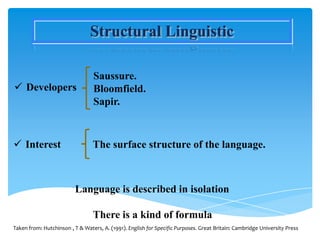
Structural Linguistic

                                 Saussure.
 Developers                     Bloomfield.
                                 Sapir.


 Interest                       The surface structure of the language.


                          Language is described in isolation

                                 There is a kind of formula
Taken from: Hutchinson , T & Waters, A. (1991). English for Specific Purposes. Great Britain: Cambridge University Press
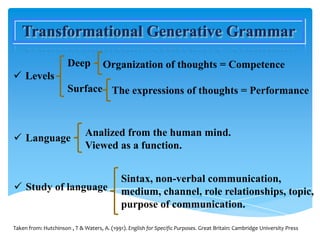
Transformational Generative Grammar
                      Deep           Organization of thoughts = Competence
 Levels
                      Surface The expressions of thoughts = Performance


                              Analized from the human mind.
 Language
                              Viewed as a function.


                                             Sintax, non-verbal communication,
 Study of language                          medium, channel, role relationships, topic,
                                             purpose of communication.

Taken from: Hutchinson , T & Waters, A. (1991). English for Specific Purposes. Great Britain: Cambridge University Press
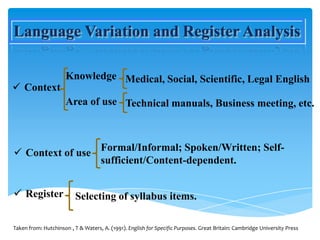
Language Variation and Register Analysis

                      Knowledge Medical, Social, Scientific, Legal English
 Context
                      Area of use Technical manuals, Business meeting, etc.


                                    Formal/Informal; Spoken/Written; Self-
 Context of use
                                    sufficient/Content-dependent.


 Register                Selecting of syllabus items.

Taken from: Hutchinson , T & Waters, A. (1991). English for Specific Purposes. Great Britain: Cambridge University Press
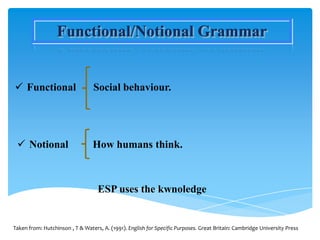
Functional/Notional Grammar


 Functional                     Social behaviour.


  Notional                      How humans think.


                                   ESP uses the kwnoledge


Taken from: Hutchinson , T & Waters, A. (1991). English for Specific Purposes. Great Britain: Cambridge University Press
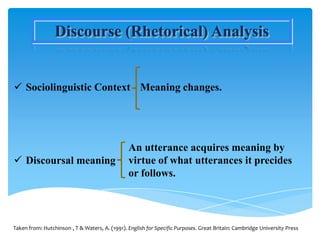
Discourse (Rhetorical) Analysis


 Sociolinguistic Context Meaning changes.


                                                An utterance acquires meaning by
 Discoursal meaning                            virtue of what utterances it precides
                                                or follows.


Taken from: Hutchinson , T & Waters, A. (1991). English for Specific Purposes. Great Britain: Cambridge University Press
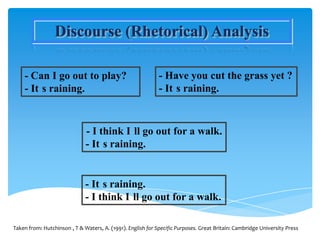
Discourse (Rhetorical) Analysis

    - Can I go out to play?                                  - Have you cut the grass yet ?
    - It s raining.                                          - It s raining.


                              - I think I ll go out for a walk.
                              - It s raining.


                              - It s raining.
                              - I think I ll go out for a walk.

Taken from: Hutchinson , T & Waters, A. (1991). English for Specific Purposes. Great Britain: Cambridge University Press
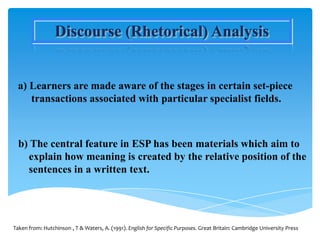
Discourse (Rhetorical) Analysis


 a) Learners are made aware of the stages in certain set-piece
    transactions associated with particular specialist fields.


  b) The central feature in ESP has been materials which aim to
    explain how meaning is created by the relative position of the
    sentences in a written text.


Taken from: Hutchinson , T & Waters, A. (1991). English for Specific Purposes. Great Britain: Cambridge University Press
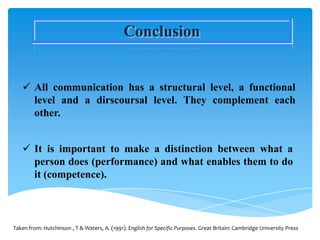
Conclusion


    All communication has a structural level, a functional
     level and a dirscoursal level. They complement each
     other.


    It is important to make a distinction between what a
     person does (performance) and what enables them to do
     it (competence).


Taken from: Hutchinson , T & Waters, A. (1991). English for Specific Purposes. Great Britain: Cambridge University Press

Language analysis 2

  • 1.
    UNIVERSIDAD PEDAGÓGICA EXPERIMENTALLIBERTADOR INSTITUTO PEDAGÓGICO DE CARACAS DEPARTAMENTO DE IDIOMAS MODERNOS PROGRAMA INGLÉS INGLÉS PARA FINES ESPECÍFICOS Language Description in English for Specific Purposes Alexis Centrella Vegas May, 2012
  • 2.
    LANGUAGE DESCRIPTION  Classical or Traditional Grammar.  Structural Linguistic.  Transformational Generative Grammar.  Language Variation and Register Analysis.  Functional/Notional Grammar.  Discourse (Rhetorical) Analysis. Taken from: Hutchinson , T & Waters, A. (1991). English for Specific Purposes. Great Britain: Cambridge University Press
  • 3.
    Clasical or TraditionalGrammar Correctness.  Emphasize Linguistic purisim. Literacy excellence.  Categories Number, gender, person, tense and voice.  Model Latin and Greek.  Interest Form of the language. Taken from: Hutchinson , T & Waters, A. (1991). English for Specific Purposes. Great Britain: Cambridge University Press
  • 4.
    Structural Linguistic Saussure.  Developers Bloomfield. Sapir.  Interest The surface structure of the language. Language is described in isolation There is a kind of formula Taken from: Hutchinson , T & Waters, A. (1991). English for Specific Purposes. Great Britain: Cambridge University Press
  • 5.
    Transformational Generative Grammar Deep Organization of thoughts = Competence  Levels Surface The expressions of thoughts = Performance Analized from the human mind.  Language Viewed as a function. Sintax, non-verbal communication,  Study of language medium, channel, role relationships, topic, purpose of communication. Taken from: Hutchinson , T & Waters, A. (1991). English for Specific Purposes. Great Britain: Cambridge University Press
  • 6.
    Language Variation andRegister Analysis Knowledge Medical, Social, Scientific, Legal English  Context Area of use Technical manuals, Business meeting, etc. Formal/Informal; Spoken/Written; Self-  Context of use sufficient/Content-dependent.  Register Selecting of syllabus items. Taken from: Hutchinson , T & Waters, A. (1991). English for Specific Purposes. Great Britain: Cambridge University Press
  • 7.
    Functional/Notional Grammar  Functional Social behaviour.  Notional How humans think. ESP uses the kwnoledge Taken from: Hutchinson , T & Waters, A. (1991). English for Specific Purposes. Great Britain: Cambridge University Press
  • 8.
    Discourse (Rhetorical) Analysis Sociolinguistic Context Meaning changes. An utterance acquires meaning by  Discoursal meaning virtue of what utterances it precides or follows. Taken from: Hutchinson , T & Waters, A. (1991). English for Specific Purposes. Great Britain: Cambridge University Press
  • 9.
    Discourse (Rhetorical) Analysis - Can I go out to play? - Have you cut the grass yet ? - It s raining. - It s raining. - I think I ll go out for a walk. - It s raining. - It s raining. - I think I ll go out for a walk. Taken from: Hutchinson , T & Waters, A. (1991). English for Specific Purposes. Great Britain: Cambridge University Press
  • 10.
    Discourse (Rhetorical) Analysis a) Learners are made aware of the stages in certain set-piece transactions associated with particular specialist fields. b) The central feature in ESP has been materials which aim to explain how meaning is created by the relative position of the sentences in a written text. Taken from: Hutchinson , T & Waters, A. (1991). English for Specific Purposes. Great Britain: Cambridge University Press
  • 11.
    Conclusion  All communication has a structural level, a functional level and a dirscoursal level. They complement each other.  It is important to make a distinction between what a person does (performance) and what enables them to do it (competence). Taken from: Hutchinson , T & Waters, A. (1991). English for Specific Purposes. Great Britain: Cambridge University Press