CHAPTER 3:
ESP: APPROACH NOT
PRODUCT
What ESP isn’t
It is not a matter of teaching
“specialized varieties” of English
It is not just a matter of words and
grammar for each area
It is not different kind from any form of
language teaching
ESP must be seen as an approach
not as a product
ESP is not a particular kind of
language or methodology, nor does it
consist of a particular type of teaching
material.
It is an approach of language learning
which is based on learner’s need.
All decisions as to content and
method are based on the learner’s
reason for learning.
ESP
COURSE
DESIGN
ADAPTED FROM HUTCHINSON & WATERS
(1987)
I keep six honest serving-men.
(The taught me all I knew.)
Their names are What and Why and When
And How and Where And Who.
(Rudyard Kipling)
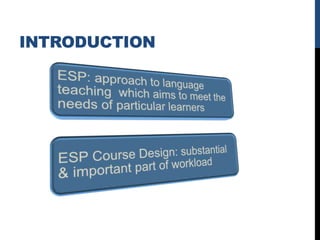
INTRODUCTION
QUESTIONS
1. Why does the S need to learn?
2. Who is going to be involved in the
process?
Teachers, sponsors, inspectors, coord
inators?
3. Where is the learning going to take
place? What potentials does the place
provide? What limitations does it
impose?
+QUESTIONS
4. When is the learning to take place?
How much time is available? How will
it be distributed?
5. What does the S need to learn?
Waht aspects of language will be
needed and how will they be
distributed? What level of proficiency
must be achieved? What topic areas
will need to be covered?
+QUESTIONS
6.How will the learning be achieved?
What learning theory will underlie the
course? What kind of methodology
will be employed?
More questions?
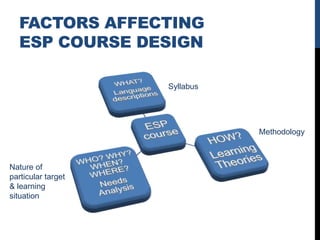
FACTORS AFFECTING
ESP COURSE DESIGN
Syllabus
Methodology
Nature of
particular target
& learning
situation
Language descriptions
They have been at a greet feast of language, and
stolen the scraps. (shakespeare: love’s labour’s lost)
ESP course makes use of explicit or implicit ideas about
the nature of language. These ideas are drawn from the
various language description that have been developed
by succeeding schools of thought linguistics.
12
We can identify six main stages of
development.
1. Classical or traditional grammar
2. Structural linguistics
3. Transformational generative (TG) grammar
4. Language variation and register analysis
5. Functional / notional grammar
6. Discourse (Rhetorical) analysis
13
conclusion
a) There is no single source from which a language
course can, or should, derive its linguistic input.
b) Describing a language for the purpose of
linguistic analysis does not necessarily carry any
implications for language learning.
c) Describing a language is not the same as
describing what enables someone to use or learn
a language.
14

ESP: Approach is not and language description

  • 1.
  • 3.
    What ESP isn’t Itis not a matter of teaching “specialized varieties” of English It is not just a matter of words and grammar for each area It is not different kind from any form of language teaching
  • 4.
    ESP must beseen as an approach not as a product ESP is not a particular kind of language or methodology, nor does it consist of a particular type of teaching material. It is an approach of language learning which is based on learner’s need. All decisions as to content and method are based on the learner’s reason for learning.
  • 5.
  • 6.
    I keep sixhonest serving-men. (The taught me all I knew.) Their names are What and Why and When And How and Where And Who. (Rudyard Kipling)
  • 7.
  • 8.
    QUESTIONS 1. Why doesthe S need to learn? 2. Who is going to be involved in the process? Teachers, sponsors, inspectors, coord inators? 3. Where is the learning going to take place? What potentials does the place provide? What limitations does it impose?
  • 9.
    +QUESTIONS 4. When isthe learning to take place? How much time is available? How will it be distributed? 5. What does the S need to learn? Waht aspects of language will be needed and how will they be distributed? What level of proficiency must be achieved? What topic areas will need to be covered?
  • 10.
    +QUESTIONS 6.How will thelearning be achieved? What learning theory will underlie the course? What kind of methodology will be employed? More questions?
  • 11.
    FACTORS AFFECTING ESP COURSEDESIGN Syllabus Methodology Nature of particular target & learning situation
  • 12.
    Language descriptions They havebeen at a greet feast of language, and stolen the scraps. (shakespeare: love’s labour’s lost) ESP course makes use of explicit or implicit ideas about the nature of language. These ideas are drawn from the various language description that have been developed by succeeding schools of thought linguistics. 12
  • 13.
    We can identifysix main stages of development. 1. Classical or traditional grammar 2. Structural linguistics 3. Transformational generative (TG) grammar 4. Language variation and register analysis 5. Functional / notional grammar 6. Discourse (Rhetorical) analysis 13
  • 14.
    conclusion a) There isno single source from which a language course can, or should, derive its linguistic input. b) Describing a language for the purpose of linguistic analysis does not necessarily carry any implications for language learning. c) Describing a language is not the same as describing what enables someone to use or learn a language. 14