Students: Maria D. Guarecuco
               Franklin Perez
                 Dexis Adam
      Professor: Aida Morillo
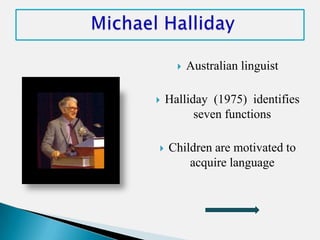
   Australian linguist

   Halliday (1975) identifies
          seven functions

   Children are motivated to
        acquire language
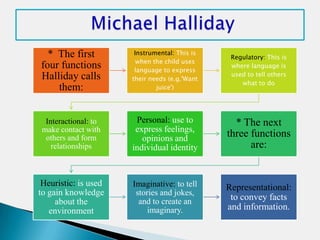
* The first          Instrumental: This is
                                                Regulatory: This is
                        when the child uses
four functions         language to express
                                                where language is
Halliday calls                                  used to tell others
                      their needs (e.g.'Want
                                                   what to do
    them:                     juice')


  Interactional: to    Personal: use to          * The next
 make contact with     express feelings,
  others and form        opinions and          three functions
    relationships     individual identity            are:


 Heuristic: is used   Imaginative: to tell     Representational:
to gain knowledge      stories and jokes,
     about the          and to create an        to convey facts
   environment             imaginary.          and information.
MICHAEL HALLIDAY
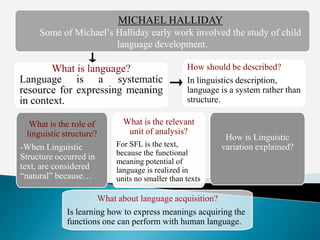
     Some of Michael’s Halliday early work involved the study of child
                       language development.

        What is language?                        How should be described?
Language is a systematic                         In linguistics description,
resource for expressing meaning                  language is a system rather than
in context.                                      structure.

   What is the role of       What is the relevant
  linguistic structure?       unit of analysis?
                                                           How is Linguistic
-When Linguistic           For SFL is the text,           variation explained?
                           because the functional
Structure occurred in
                           meaning potential of
text, are considered       language is realized in
“natural” because…         units no smaller than texts

                       What about language acquisition?
              Is learning how to express meanings acquiring the
              functions one can perform with human language.
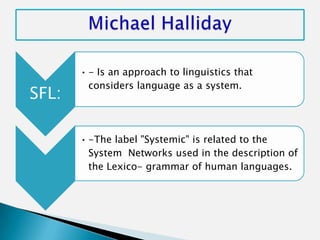
• - Is an approach to linguistics that
         considers language as a system.
SFL:

       • -The label "Systemic" is related to the
         System Networks used in the description of
         the Lexico- grammar of human languages.
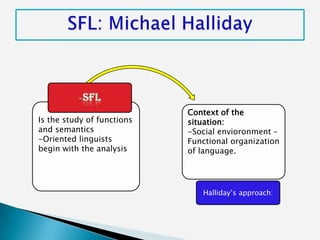
Context of the
Is the study of functions   situation:
and semantics               -Social envioronment –
-Oriented linguists         Functional organization
begin with the analysis     of language.


                               Halliday’s approach:
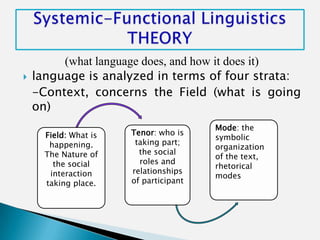
(what language does, and how it does it)
   language is analyzed in terms of four strata:
    -Context, concerns the Field (what is going
    on)
                                        Mode: the
      Field: What is   Tenor: who is
                                        symbolic
       happening.       taking part;
                                        organization
      The Nature of      the social
                                        of the text,
        the social       roles and
                                        rhetorical
       interaction     relationships
                                        modes
      taking place.    of participant
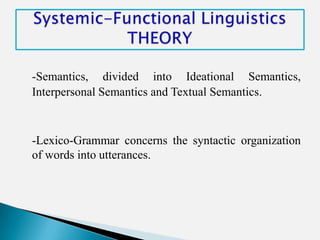
-Semantics, divided into Ideational Semantics,
Interpersonal Semantics and Textual Semantics.


-Lexico-Grammar concerns the syntactic organization
of words into utterances.
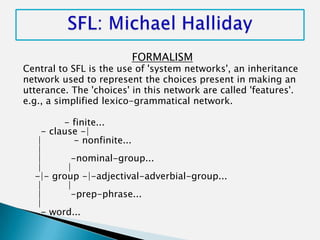
FORMALISM
Central to SFL is the use of 'system networks', an inheritance
network used to represent the choices present in making an
utterance. The 'choices' in this network are called 'features'.
e.g., a simplified lexico-grammatical network.

         - finite...
    - clause -|
   |        - nonfinite...
   |
   |       -nominal-group...
   |      |
  -|- group -|-adjectival-adverbial-group...
   |      |
   |       -prep-phrase...
   |
    - word...
SYSTEMIC FUNCTIONAL LINGUISTICS

   Halliday proposes a linguistic theory:


   Semantics: The speaker does not choose between forms
    but between meanings.

   Functionalisms: The language is organized by
    functions, It is functional because the organization of
    the system becomes on the base of the functions of the
    language.

   The language in use: Those options become in context.
SYSTEMIC FUNCTIONAL LINGUISTICS


The speaker has a meaning potential that it updates when it chooses
  by some of them when producing a text in a specific situational
  context.

Every time we produce a text, we are choosing from the set of options
that provides the linguistic system. Each user of the language makes
his elections within the grammar, in contexts of types of situation.


   What is the registry?

Registry is called to the adjustment of the text to the context. It is the
variety of language determined by the communicative situation.

The users consider the variables of field, tenor and way to carry out
their elections from the system.
SYSTEMIC FUNCTIONAL LINGUISTICS


   Which are the primary functions of the language?


    Ideational: The language organizes our experience and
    aid to conform our vision of the world.


    Interpersonal: The language serves to establish and to
    maintain relations social, to determine communicative
    rolls, social groups and to consolidate the identity of the
    speakers.


   Textual: The language offers to the users appropriate
    means to create coherent messages or texts.

Linguistics presentacion

  • 1.
    Students: Maria D.Guarecuco Franklin Perez Dexis Adam Professor: Aida Morillo
  • 2.
    Australian linguist  Halliday (1975) identifies seven functions  Children are motivated to acquire language
  • 3.
    * The first Instrumental: This is Regulatory: This is when the child uses four functions language to express where language is Halliday calls used to tell others their needs (e.g.'Want what to do them: juice') Interactional: to Personal: use to * The next make contact with express feelings, others and form opinions and three functions relationships individual identity are: Heuristic: is used Imaginative: to tell Representational: to gain knowledge stories and jokes, about the and to create an to convey facts environment imaginary. and information.
  • 4.
    MICHAEL HALLIDAY Some of Michael’s Halliday early work involved the study of child language development. What is language? How should be described? Language is a systematic In linguistics description, resource for expressing meaning language is a system rather than in context. structure. What is the role of What is the relevant linguistic structure? unit of analysis? How is Linguistic -When Linguistic For SFL is the text, variation explained? because the functional Structure occurred in meaning potential of text, are considered language is realized in “natural” because… units no smaller than texts What about language acquisition? Is learning how to express meanings acquiring the functions one can perform with human language.
  • 5.
    • - Isan approach to linguistics that considers language as a system. SFL: • -The label "Systemic" is related to the System Networks used in the description of the Lexico- grammar of human languages.
  • 6.
    Context of the Isthe study of functions situation: and semantics -Social envioronment – -Oriented linguists Functional organization begin with the analysis of language. Halliday’s approach:
  • 7.
    (what language does,and how it does it)  language is analyzed in terms of four strata: -Context, concerns the Field (what is going on) Mode: the Field: What is Tenor: who is symbolic happening. taking part; organization The Nature of the social of the text, the social roles and rhetorical interaction relationships modes taking place. of participant
  • 8.
    -Semantics, divided intoIdeational Semantics, Interpersonal Semantics and Textual Semantics. -Lexico-Grammar concerns the syntactic organization of words into utterances.
  • 9.
    FORMALISM Central to SFLis the use of 'system networks', an inheritance network used to represent the choices present in making an utterance. The 'choices' in this network are called 'features'. e.g., a simplified lexico-grammatical network. - finite... - clause -| | - nonfinite... | | -nominal-group... | | -|- group -|-adjectival-adverbial-group... | | | -prep-phrase... | - word...
  • 10.
    SYSTEMIC FUNCTIONAL LINGUISTICS  Halliday proposes a linguistic theory:  Semantics: The speaker does not choose between forms but between meanings.  Functionalisms: The language is organized by functions, It is functional because the organization of the system becomes on the base of the functions of the language.  The language in use: Those options become in context.
  • 11.
    SYSTEMIC FUNCTIONAL LINGUISTICS Thespeaker has a meaning potential that it updates when it chooses by some of them when producing a text in a specific situational context. Every time we produce a text, we are choosing from the set of options that provides the linguistic system. Each user of the language makes his elections within the grammar, in contexts of types of situation.  What is the registry? Registry is called to the adjustment of the text to the context. It is the variety of language determined by the communicative situation. The users consider the variables of field, tenor and way to carry out their elections from the system.
  • 12.
    SYSTEMIC FUNCTIONAL LINGUISTICS  Which are the primary functions of the language?  Ideational: The language organizes our experience and aid to conform our vision of the world.  Interpersonal: The language serves to establish and to maintain relations social, to determine communicative rolls, social groups and to consolidate the identity of the speakers.  Textual: The language offers to the users appropriate means to create coherent messages or texts.