ENGLISH AS
A FOREIGN LANGUAGE
Name: Johan Sebastian Ortega Maldonado
Cycle: Fourth
INTRODUCTION
This English language curriculum is designed for students in
Elementary General Education (grades 2-10) and Unified
General Education (grades 1-3) whose mother tongue is not
English. Since the Ecuadorian population is composed of
different cultural and linguistic backgrounds, this curriculum
recognizes that there are varying degrees of bilingualism in all
communities.
This curriculum presents a foundation and framework for
learning English while recognizing the authentic and culturally
relevant production and inclusive educational practices of
students, regardless of their L1. It aims to help students be able
to communicate effectively in today's globalized world. The
curriculum also supports general education objectives of
justice, innovation and solidarity. These are the Ecuadorian
skills students will need
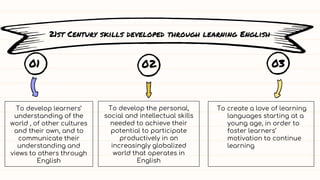
21st Century skills developed through learning English
01 02 03
To develop learners’
understanding of the
world , of other cultures
and their own, and to
communicate their
understanding and
views to others through
English
To develop the personal,
social and intellectual skills
needed to achieve their
potential to participate
productively in an
increasingly globalized
world that operates in
English
To create a love of learning
languages starting at a
young age, in order to
foster learners’
motivation to continue
learning
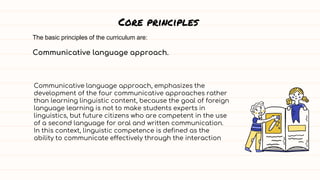
Communicative language approach.
Core principles
The basic principles of the curriculum are:
Communicative language approach, emphasizes the
development of the four communicative approaches rather
than learning linguistic content, because the goal of foreign
language learning is not to make students experts in
linguistics, but future citizens who are competent in the use
of a second language for oral and written communication.
In this context, linguistic competence is defined as the
ability to communicate effectively through the interaction
This curriculum is based on a language-driven CLIL
approach, where content from other disciplines is
used for meaningful and purposeful language use,
supporting the general curriculum by developing the
cognitive and social skills needed for other subjects,
In addition, critical thinking skills serve as a
mechanism to implement
Content and Language Integrated Learning (CLIL)
The Language through the Arts and Communication and Cultural Awareness threads
support the CLIL component of the curriculum by providing written and oral texts,
authentic content-based and cross-curricular materials, Information and
Communications Technology (ICT), and the learners’ social, cultural, and epistemological
knowledge.
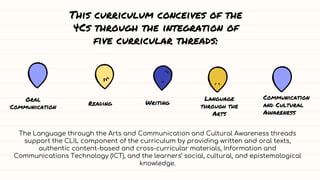
This curriculum conceives of the
4Cs through the integration of
five curricular threads:
Oral
Communication
Reading Writing
Language
through the
Arts
Communication
and Cultural
Awareness
Integration of the five curricular
threads with the 4Cs.
The methodology and classroom procedures to
be applied when teaching within a CLIL model
are part of the teaching and learning
specifications of this curriculum.
The models complement a number of teaching
methodologies. These features include learner-
centred, text-based learning approaches, task-
based learning, the need to use different types
of activities to encourage the use of foreign
languages, etc.
Thinking skills
● Meaningful interaction in a foreign language
requires the application of communication skills
about knowledge and perspectives by integrating
oral skills, written skills, comprehension and
critical thinking skills.
● The inclusion of "thinking" as a fifth skill has been
proposed in the context of language acquisition
as a means of forming and challenging meaning
between L1s and L2s, and the process of making
meaning has been correlated with student
motivation and language achievement.
Learner-centered approach.
The proposed EFL curriculum’s focus is “learner-
centered”.
In other words, teachers recognize that students
are individuals, with different learning styles,
personalities and interests, as well as different
levels of motivation and ability.
The key features of this learner-centered
curriculum are as follows:
• Teachers are focused on what and how the students are learning.
• Teachers recognize that students learn in different ways, and that a
personalized approach to teaching is needed.
• Learners need to develop their own personality English.
• Learning is an active, dynamic process. It occurs more effectively when
students are actively involved.
• Teachers are committed to a constructivist approach by building upon
knowledge that the learners already know.
• Assessment is more formative than summative in nature.
• There is a recognition that learning is not just acquiring facts but also
developing skills that support lifelong learning.
To summarize, this curriculum assumes a learner-centered teaching
methodology in terms of how the content is delivered.
Thanks!!

English as a foreing language

  • 1.
    ENGLISH AS A FOREIGNLANGUAGE Name: Johan Sebastian Ortega Maldonado Cycle: Fourth
  • 2.
    INTRODUCTION This English languagecurriculum is designed for students in Elementary General Education (grades 2-10) and Unified General Education (grades 1-3) whose mother tongue is not English. Since the Ecuadorian population is composed of different cultural and linguistic backgrounds, this curriculum recognizes that there are varying degrees of bilingualism in all communities. This curriculum presents a foundation and framework for learning English while recognizing the authentic and culturally relevant production and inclusive educational practices of students, regardless of their L1. It aims to help students be able to communicate effectively in today's globalized world. The curriculum also supports general education objectives of justice, innovation and solidarity. These are the Ecuadorian skills students will need
  • 3.
    21st Century skillsdeveloped through learning English 01 02 03 To develop learners’ understanding of the world , of other cultures and their own, and to communicate their understanding and views to others through English To develop the personal, social and intellectual skills needed to achieve their potential to participate productively in an increasingly globalized world that operates in English To create a love of learning languages starting at a young age, in order to foster learners’ motivation to continue learning
  • 4.
    Communicative language approach. Coreprinciples The basic principles of the curriculum are: Communicative language approach, emphasizes the development of the four communicative approaches rather than learning linguistic content, because the goal of foreign language learning is not to make students experts in linguistics, but future citizens who are competent in the use of a second language for oral and written communication. In this context, linguistic competence is defined as the ability to communicate effectively through the interaction
  • 5.
    This curriculum isbased on a language-driven CLIL approach, where content from other disciplines is used for meaningful and purposeful language use, supporting the general curriculum by developing the cognitive and social skills needed for other subjects, In addition, critical thinking skills serve as a mechanism to implement Content and Language Integrated Learning (CLIL)
  • 6.
    The Language throughthe Arts and Communication and Cultural Awareness threads support the CLIL component of the curriculum by providing written and oral texts, authentic content-based and cross-curricular materials, Information and Communications Technology (ICT), and the learners’ social, cultural, and epistemological knowledge. This curriculum conceives of the 4Cs through the integration of five curricular threads: Oral Communication Reading Writing Language through the Arts Communication and Cultural Awareness
  • 7.
    Integration of thefive curricular threads with the 4Cs. The methodology and classroom procedures to be applied when teaching within a CLIL model are part of the teaching and learning specifications of this curriculum. The models complement a number of teaching methodologies. These features include learner- centred, text-based learning approaches, task- based learning, the need to use different types of activities to encourage the use of foreign languages, etc.
  • 8.
    Thinking skills ● Meaningfulinteraction in a foreign language requires the application of communication skills about knowledge and perspectives by integrating oral skills, written skills, comprehension and critical thinking skills. ● The inclusion of "thinking" as a fifth skill has been proposed in the context of language acquisition as a means of forming and challenging meaning between L1s and L2s, and the process of making meaning has been correlated with student motivation and language achievement.
  • 9.
    Learner-centered approach. The proposedEFL curriculum’s focus is “learner- centered”. In other words, teachers recognize that students are individuals, with different learning styles, personalities and interests, as well as different levels of motivation and ability.
  • 10.
    The key featuresof this learner-centered curriculum are as follows: • Teachers are focused on what and how the students are learning. • Teachers recognize that students learn in different ways, and that a personalized approach to teaching is needed. • Learners need to develop their own personality English. • Learning is an active, dynamic process. It occurs more effectively when students are actively involved. • Teachers are committed to a constructivist approach by building upon knowledge that the learners already know. • Assessment is more formative than summative in nature. • There is a recognition that learning is not just acquiring facts but also developing skills that support lifelong learning. To summarize, this curriculum assumes a learner-centered teaching methodology in terms of how the content is delivered.
  • 11.