What is Landslide?
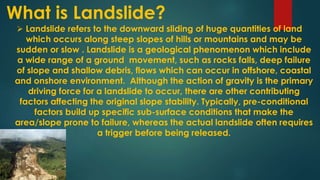
 Landslide refers to the downward sliding of huge quantities of land
which occurs along steep slopes of hills or mountains and may be
sudden or slow . Landslide is a geological phenomenon which include
a wide range of a ground movement, such as rocks falls, deep failure
of slope and shallow debris, flows which can occur in offshore, coastal
and onshore environment. Although the action of gravity is the primary
driving force for a landslide to occur, there are other contributing
factors affecting the original slope stability. Typically, pre-conditional
factors build up specific sub-surface conditions that make the
area/slope prone to failure, whereas the actual landslide often requires
a trigger before being released.
TypesofLandslide
Fall
Topple
Spread
Creep
Flow
Slide
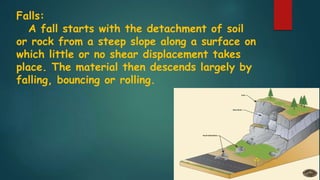
Falls:
A fall starts with the detachment of soil
or rock from a steep slope along a surface on
which little or no shear displacement takes
place. The material then descends largely by
falling, bouncing or rolling.
Topple:
Toppling failures are distinguished by the
forward rotation of a unit or units about
some pivotal point, below or low in the unit,
under the actions of gravity and forces
exerted by adjacent units or by fluids in
cracks
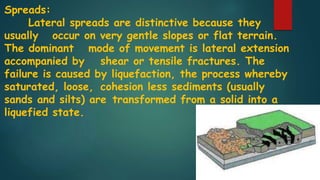
Spreads:
Lateral spreads are distinctive because they
usually occur on very gentle slopes or flat terrain.
The dominant mode of movement is lateral extension
accompanied by shear or tensile fractures. The
failure is caused by liquefaction, the process whereby
saturated, loose, cohesion less sediments (usually
sands and silts) are transformed from a solid into a
liquefied state.
Creep:
Creep is the imperceptibly slow, steady,
downward movement of slope-forming soil or rock.
Movement is caused by shear stress sufficient to
produce permanent deformation, but too small to
produce shear failure.
Slides
A slide is the downslope movement of a
soil or rock mass occurring dominantly on
the surface of rupture or relatively thin
zones of intense shear strain.
Flows
A flow is a spatially continuous movement in
which shear surfaces are short lived, closely
spaced and usually not preserved after the
event. The distribution of velocities in the
displacing mass resembles that in a viscous
fluid.
Predicting and avoiding landslide
Broken water lines and other underground utilities.
Leaning telephone poles, trees, retaining walls or fences.
Dropped-down road beds.
Rapid increase in a stream or creek water levels, possibly
accompanied by increased turbidity (soil content).
Sudden decrease in creek water levels even though rain is
still falling or just recently stopped.
 Listen. A faint rumbling sound can also let you know a
landslide is coming.
Look at any buildings in the area. Be aware that growing cracks
in walls, window frames and pavement are a possible clue.
Additionally, broken or leaking sewer lines, doors that don't
quite close anymore, and sagging or very tight utility lines can
also be warning signs that the ground is shifting and a landslide
is inevitable.
Know what factors contribute to a landslide. The geological
makeup of an area is a good indicator. Gravity plays a role as
well; the steeper the slope, the more likely it is to have a
landslide. Weather such as heavy rains, quick freezing and
thawing, earthquakes, fires, storms and volcanic eruptions can
also be triggers. Additionally, erosion and changes in the
landscape caused by humans can be predictors of landslides.
What to do if suspect imminent landslide danger:
 Contact local fire and police control rooms.
 Inform neighbours who are likely to be
affected. Help them in evacuation.
 Evacuation out of the likely path of the
landslide is the best protection.
Landslide

Landslide

  • 2.
    What is Landslide? Landslide refers to the downward sliding of huge quantities of land which occurs along steep slopes of hills or mountains and may be sudden or slow . Landslide is a geological phenomenon which include a wide range of a ground movement, such as rocks falls, deep failure of slope and shallow debris, flows which can occur in offshore, coastal and onshore environment. Although the action of gravity is the primary driving force for a landslide to occur, there are other contributing factors affecting the original slope stability. Typically, pre-conditional factors build up specific sub-surface conditions that make the area/slope prone to failure, whereas the actual landslide often requires a trigger before being released.
  • 3.
  • 4.
    Falls: A fall startswith the detachment of soil or rock from a steep slope along a surface on which little or no shear displacement takes place. The material then descends largely by falling, bouncing or rolling.
  • 5.
    Topple: Toppling failures aredistinguished by the forward rotation of a unit or units about some pivotal point, below or low in the unit, under the actions of gravity and forces exerted by adjacent units or by fluids in cracks
  • 6.
    Spreads: Lateral spreads aredistinctive because they usually occur on very gentle slopes or flat terrain. The dominant mode of movement is lateral extension accompanied by shear or tensile fractures. The failure is caused by liquefaction, the process whereby saturated, loose, cohesion less sediments (usually sands and silts) are transformed from a solid into a liquefied state.
  • 7.
    Creep: Creep is theimperceptibly slow, steady, downward movement of slope-forming soil or rock. Movement is caused by shear stress sufficient to produce permanent deformation, but too small to produce shear failure.
  • 8.
    Slides A slide isthe downslope movement of a soil or rock mass occurring dominantly on the surface of rupture or relatively thin zones of intense shear strain.
  • 9.
    Flows A flow isa spatially continuous movement in which shear surfaces are short lived, closely spaced and usually not preserved after the event. The distribution of velocities in the displacing mass resembles that in a viscous fluid.
  • 10.
    Predicting and avoidinglandslide Broken water lines and other underground utilities. Leaning telephone poles, trees, retaining walls or fences. Dropped-down road beds. Rapid increase in a stream or creek water levels, possibly accompanied by increased turbidity (soil content). Sudden decrease in creek water levels even though rain is still falling or just recently stopped.  Listen. A faint rumbling sound can also let you know a landslide is coming.
  • 11.
    Look at anybuildings in the area. Be aware that growing cracks in walls, window frames and pavement are a possible clue. Additionally, broken or leaking sewer lines, doors that don't quite close anymore, and sagging or very tight utility lines can also be warning signs that the ground is shifting and a landslide is inevitable. Know what factors contribute to a landslide. The geological makeup of an area is a good indicator. Gravity plays a role as well; the steeper the slope, the more likely it is to have a landslide. Weather such as heavy rains, quick freezing and thawing, earthquakes, fires, storms and volcanic eruptions can also be triggers. Additionally, erosion and changes in the landscape caused by humans can be predictors of landslides.
  • 12.
    What to doif suspect imminent landslide danger:  Contact local fire and police control rooms.  Inform neighbours who are likely to be affected. Help them in evacuation.  Evacuation out of the likely path of the landslide is the best protection.