Landform Regions of
             Canada
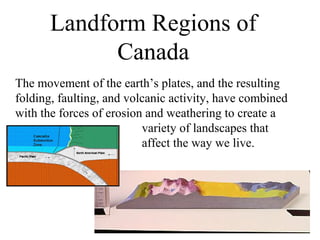
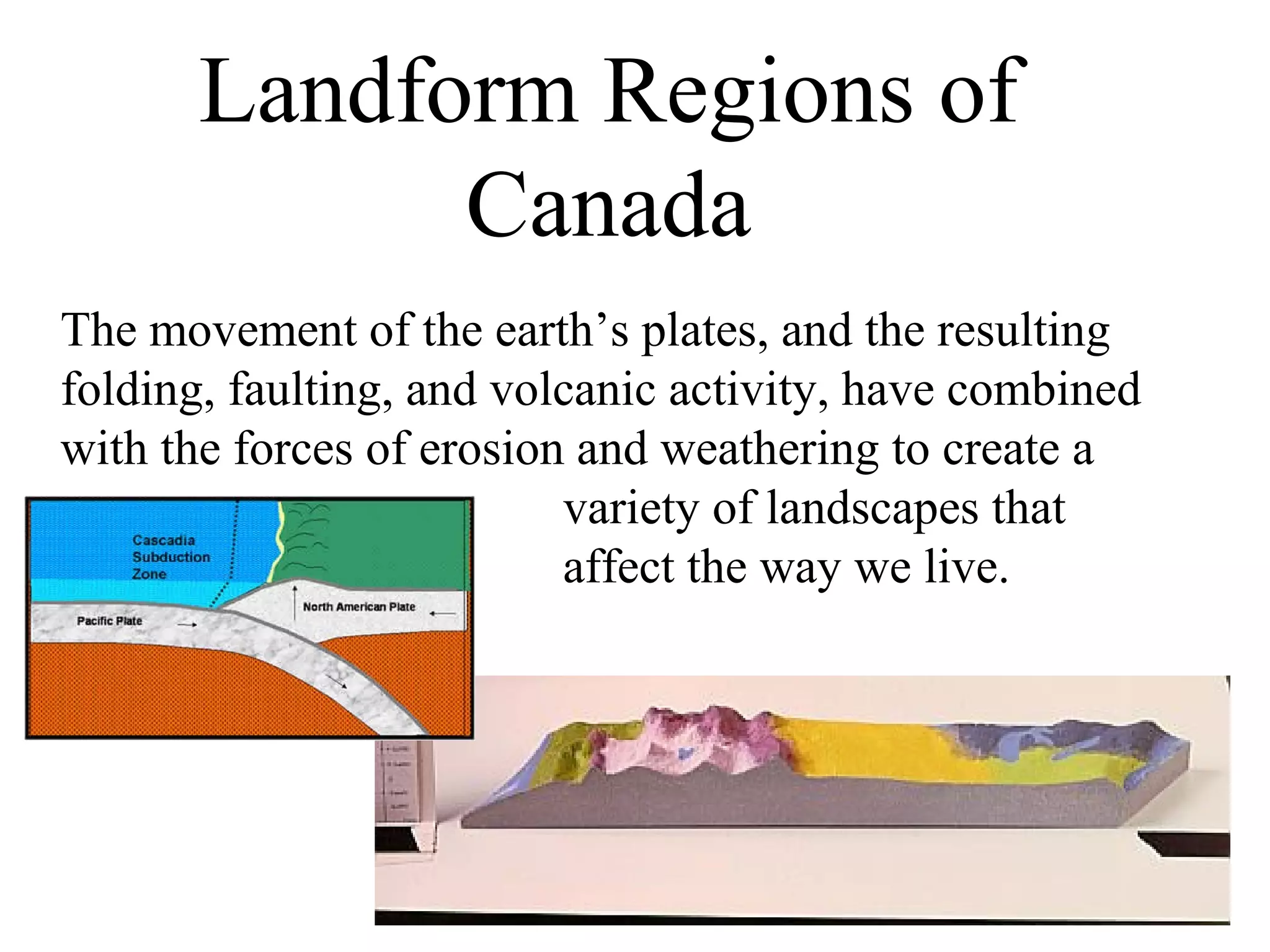
The movement of the earth’s plates, and the resulting
folding, faulting, and volcanic activity, have combined
with the forces of erosion and weathering to create a
                          variety of landscapes that
                          affect the way we live.
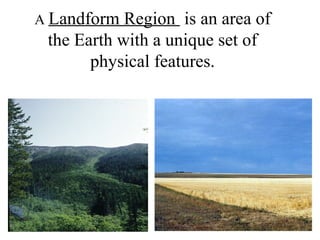
A Landform  Region is an area of
 the Earth with a unique set of
       physical features.
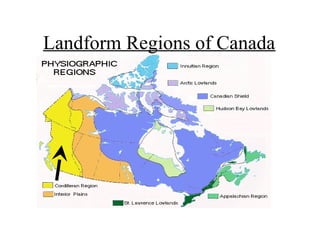
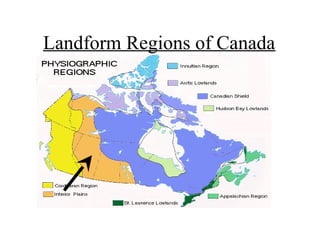
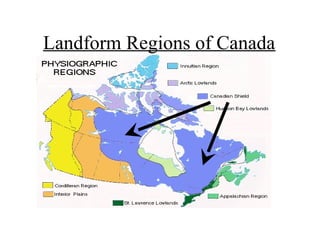
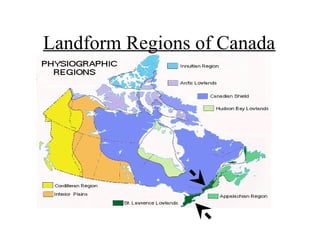
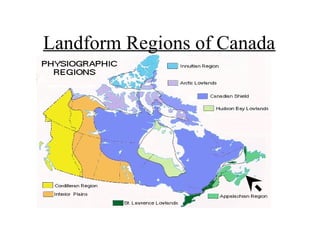
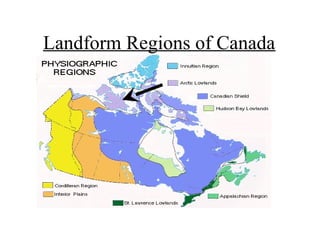
Canada can be Divided into 8
       Landform Regions:
1. Western Cordillera
2. Interior Plains
3. Canadian Shield
4. Great Lakes-St.Lawrence
   Lowlands
5. Appalachian
6. Hudson Bay Lowlands
7. Arctic Lowlands
8. Innuitian Mountains
Landform Regions of Canada
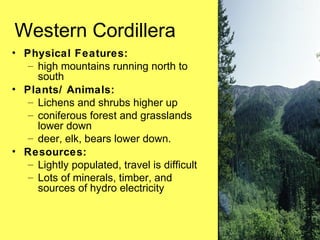
Western Cordillera
• Physical Features:
   – high mountains running north to
     south
• Plants/ Animals:
   – Lichens and shrubs higher up
   – coniferous forest and grasslands
     lower down
   – deer, elk, bears lower down.
• Resources:
   – Lightly populated, travel is difficult
   – Lots of minerals, timber, and
     sources of hydro electricity
Landform Regions of Canada
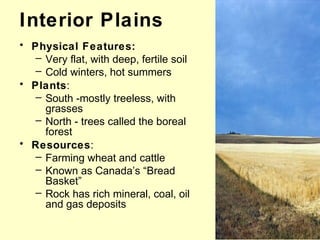
Interior Plains
• Physical Features:
   – Very flat, with deep, fertile soil
   – Cold winters, hot summers
• Plants:
   – South -mostly treeless, with
     grasses
   – North - trees called the boreal
     forest
• Resources:
   – Farming wheat and cattle
   – Known as Canada’s “Bread
     Basket”
   – Rock has rich mineral, coal, oil
     and gas deposits
Landform Regions of Canada
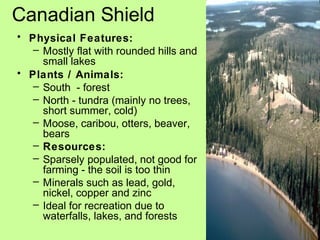
Canadian Shield
• Physical Features:
   – Mostly flat with rounded hills and
     small lakes
• Plants / Animals:
   – South - forest
   – North - tundra (mainly no trees,
     short summer, cold)
   – Moose, caribou, otters, beaver,
     bears
   – Resources:
   – Sparsely populated, not good for
     farming - the soil is too thin
   – Minerals such as lead, gold,
     nickel, copper and zinc
   – Ideal for recreation due to
     waterfalls, lakes, and forests
Landform Regions of Canada
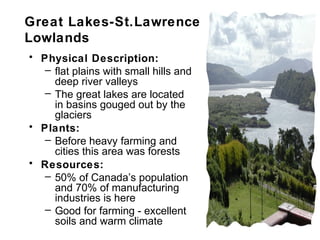
Great Lakes-St.Lawrence
Lowlands
• Physical Description:
   – flat plains with small hills and
     deep river valleys
   – The great lakes are located
     in basins gouged out by the
     glaciers
• Plants:
   – Before heavy farming and
     cities this area was forests
• Resources:
   – 50% of Canada’s population
     and 70% of manufacturing
     industries is here
   – Good for farming - excellent
     soils and warm climate
Landform Regions of Canada
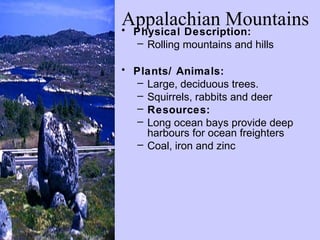
Appalachian Mountains
• Physical Description:
   – Rolling mountains and hills

• Plants/ Animals:
   – Large, deciduous trees.
   – Squirrels, rabbits and deer
   – Resources:
   – Long ocean bays provide deep
     harbours for ocean freighters
   – Coal, iron and zinc
Landform Regions of Canada
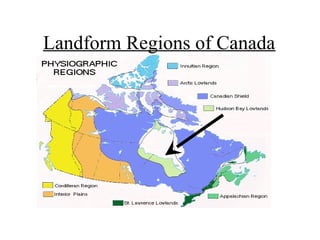
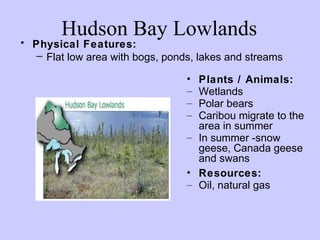
Hudson Bay Lowlands
• Physical Features:
   – Flat low area with bogs, ponds, lakes and streams

                                  • Plants / Animals:
                                  – Wetlands
                                  – Polar bears
                                  – Caribou migrate to the
                                    area in summer
                                  – In summer -snow
                                    geese, Canada geese
                                    and swans
                                  • Resources:
                                  – Oil, natural gas
Landform Regions of Canada
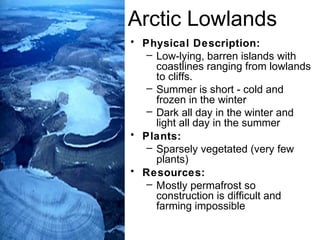
Arctic Lowlands
• Physical Description:
   – Low-lying, barren islands with
     coastlines ranging from lowlands
     to cliffs.
   – Summer is short - cold and
     frozen in the winter
   – Dark all day in the winter and
     light all day in the summer
• Plants:
   – Sparsely vegetated (very few
     plants)
• Resources:
   – Mostly permafrost so
     construction is difficult and
     farming impossible
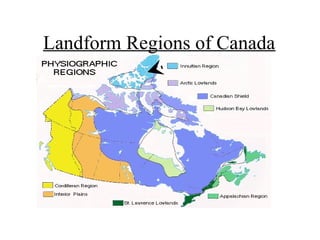
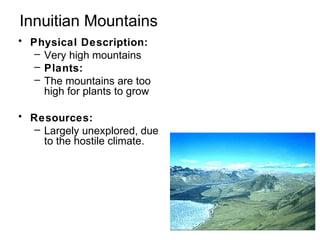
Landform Regions of Canada
Innuitian Mountains
• Physical Description:
   – Very high mountains
   – Plants:
   – The mountains are too
     high for plants to grow

• Resources:
  – Largely unexplored, due
    to the hostile climate.

Landform regions 4:5

  • 1.
    Landform Regions of Canada The movement of the earth’s plates, and the resulting folding, faulting, and volcanic activity, have combined with the forces of erosion and weathering to create a variety of landscapes that affect the way we live.
  • 2.
    A Landform Region is an area of the Earth with a unique set of physical features.
  • 3.
    Canada can beDivided into 8 Landform Regions: 1. Western Cordillera 2. Interior Plains 3. Canadian Shield 4. Great Lakes-St.Lawrence Lowlands 5. Appalachian 6. Hudson Bay Lowlands 7. Arctic Lowlands 8. Innuitian Mountains
  • 4.
  • 5.
    Western Cordillera • PhysicalFeatures: – high mountains running north to south • Plants/ Animals: – Lichens and shrubs higher up – coniferous forest and grasslands lower down – deer, elk, bears lower down. • Resources: – Lightly populated, travel is difficult – Lots of minerals, timber, and sources of hydro electricity
  • 6.
  • 7.
    Interior Plains • PhysicalFeatures: – Very flat, with deep, fertile soil – Cold winters, hot summers • Plants: – South -mostly treeless, with grasses – North - trees called the boreal forest • Resources: – Farming wheat and cattle – Known as Canada’s “Bread Basket” – Rock has rich mineral, coal, oil and gas deposits
  • 8.
  • 9.
    Canadian Shield • PhysicalFeatures: – Mostly flat with rounded hills and small lakes • Plants / Animals: – South - forest – North - tundra (mainly no trees, short summer, cold) – Moose, caribou, otters, beaver, bears – Resources: – Sparsely populated, not good for farming - the soil is too thin – Minerals such as lead, gold, nickel, copper and zinc – Ideal for recreation due to waterfalls, lakes, and forests
  • 10.
  • 11.
    Great Lakes-St.Lawrence Lowlands • PhysicalDescription: – flat plains with small hills and deep river valleys – The great lakes are located in basins gouged out by the glaciers • Plants: – Before heavy farming and cities this area was forests • Resources: – 50% of Canada’s population and 70% of manufacturing industries is here – Good for farming - excellent soils and warm climate
  • 12.
  • 13.
    Appalachian Mountains • PhysicalDescription: – Rolling mountains and hills • Plants/ Animals: – Large, deciduous trees. – Squirrels, rabbits and deer – Resources: – Long ocean bays provide deep harbours for ocean freighters – Coal, iron and zinc
  • 14.
  • 15.
    Hudson Bay Lowlands •Physical Features: – Flat low area with bogs, ponds, lakes and streams • Plants / Animals: – Wetlands – Polar bears – Caribou migrate to the area in summer – In summer -snow geese, Canada geese and swans • Resources: – Oil, natural gas
  • 16.
  • 17.
    Arctic Lowlands • PhysicalDescription: – Low-lying, barren islands with coastlines ranging from lowlands to cliffs. – Summer is short - cold and frozen in the winter – Dark all day in the winter and light all day in the summer • Plants: – Sparsely vegetated (very few plants) • Resources: – Mostly permafrost so construction is difficult and farming impossible
  • 18.
  • 19.
    Innuitian Mountains • PhysicalDescription: – Very high mountains – Plants: – The mountains are too high for plants to grow • Resources: – Largely unexplored, due to the hostile climate.