2Definition
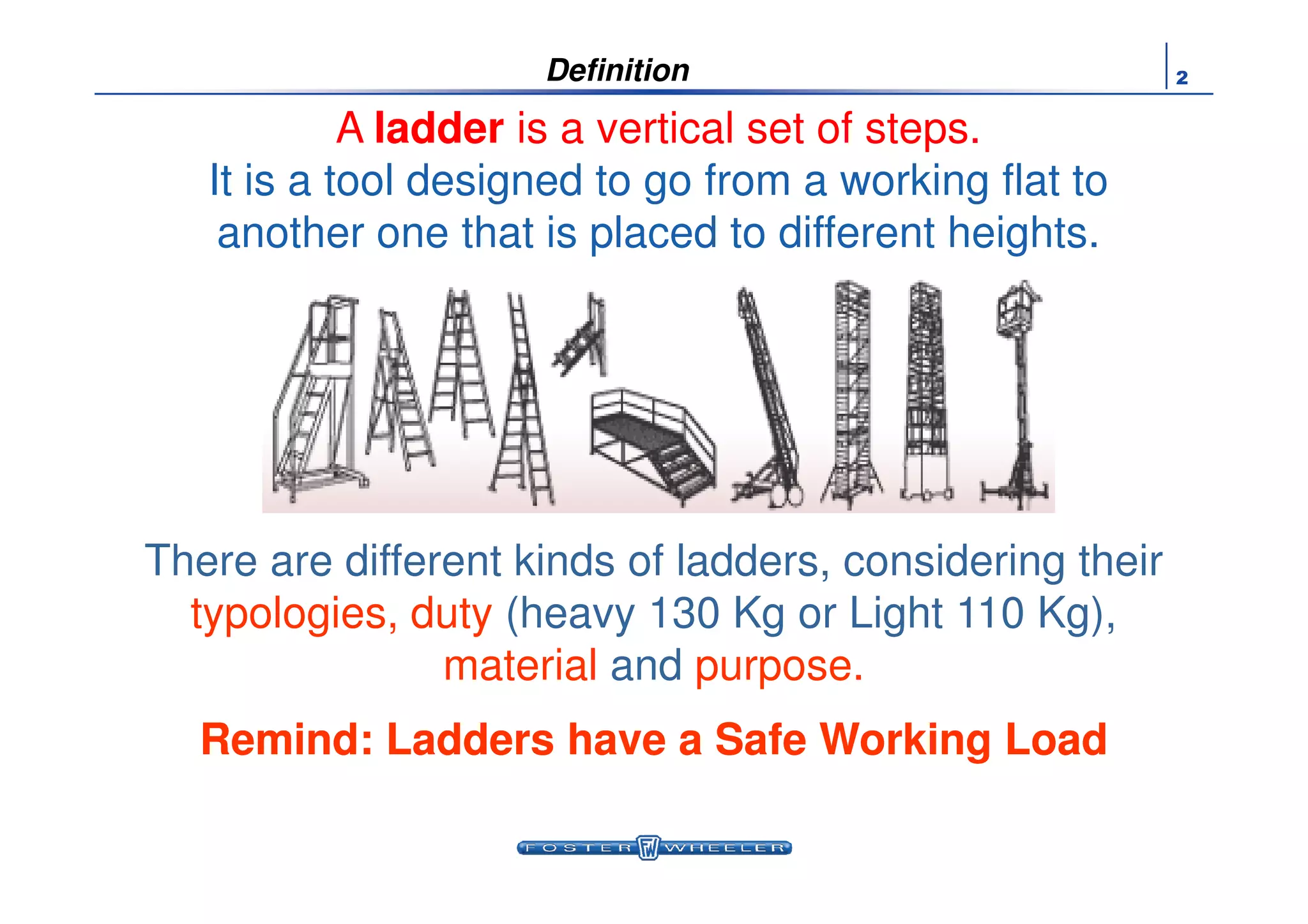
A ladder is a vertical set of steps.
It is a tool designed to go from a working flat to
another one that is placed to different heights.
There are different kinds of ladders, considering their
typologies, duty (heavy 130 Kg or Light 110 Kg),
material and purpose.
Remind: Ladders have a Safe Working LoadRemind: Ladders have a Safe Working Load
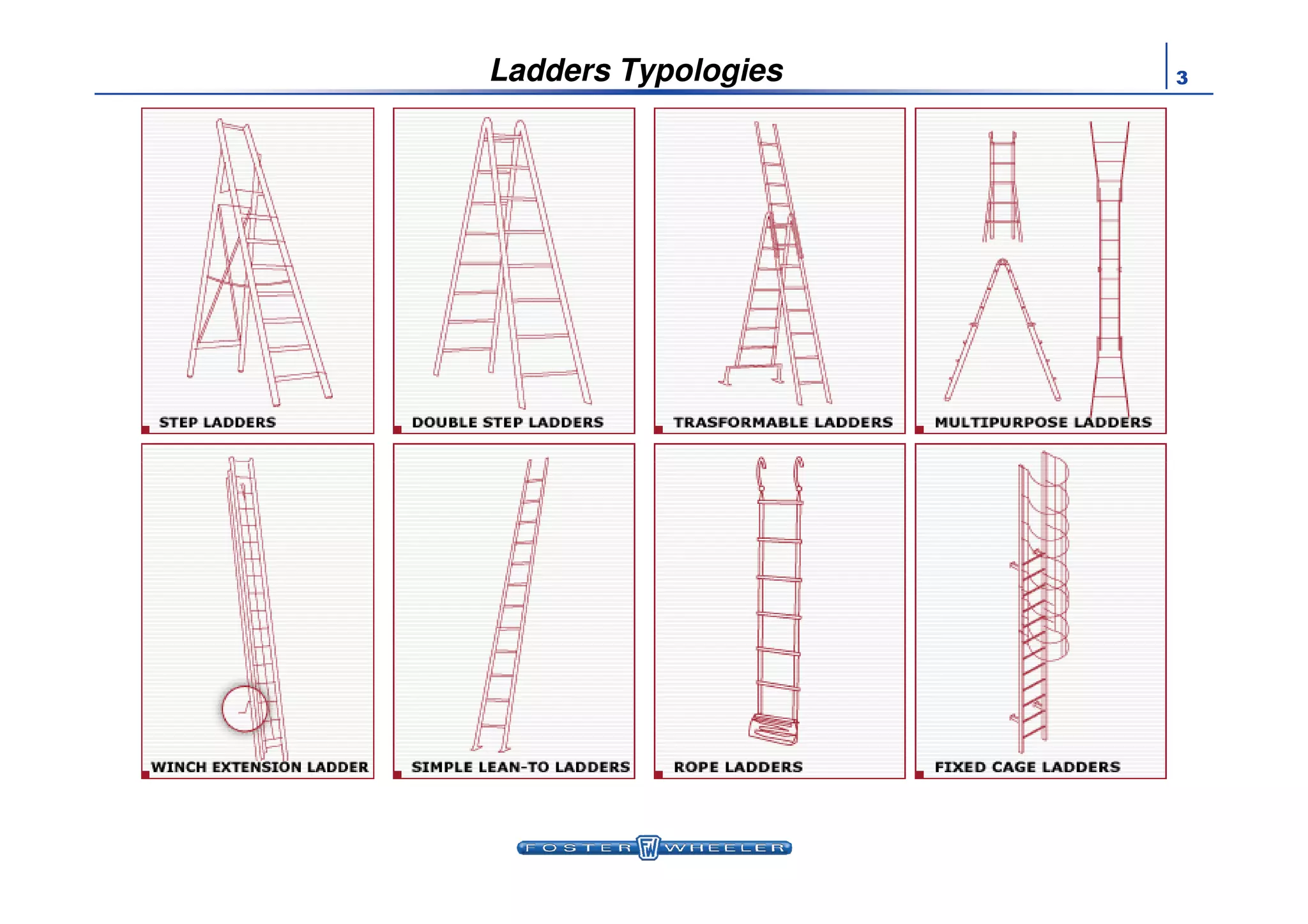
3Ladders Typologies
4Typical Ladders
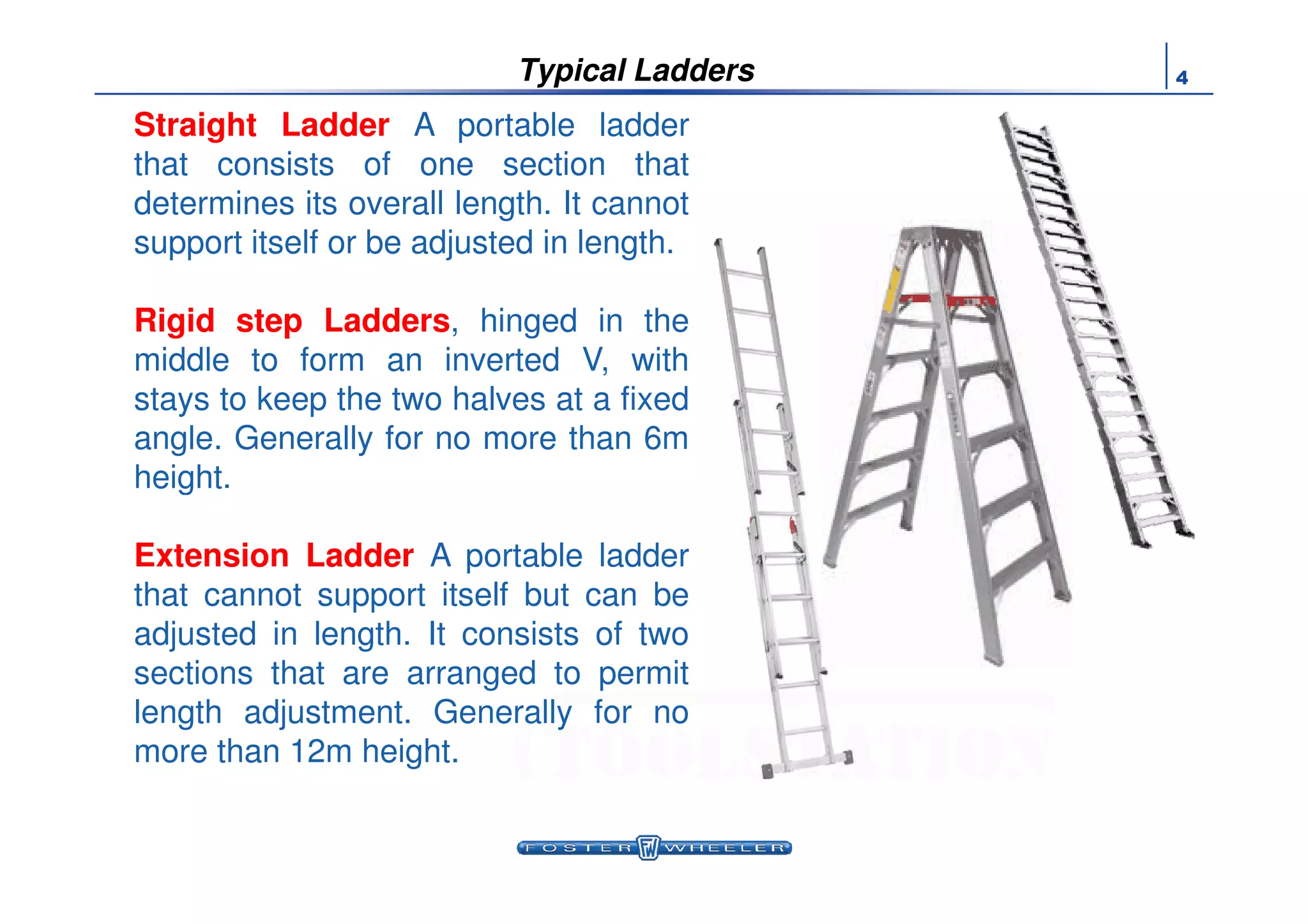
Straight Ladder A portable ladder
that consists of one section that
determines its overall length. It cannot
support itself or be adjusted in length.
Rigid step Ladders, hinged in the
middle to form an inverted V, with
stays to keep the two halves at a fixed
angle. Generally for no more than 6m
height.height.
Extension Ladder A portable ladder
that cannot support itself but can be
adjusted in length. It consists of two
sections that are arranged to permit
length adjustment. Generally for no
more than 12m height.
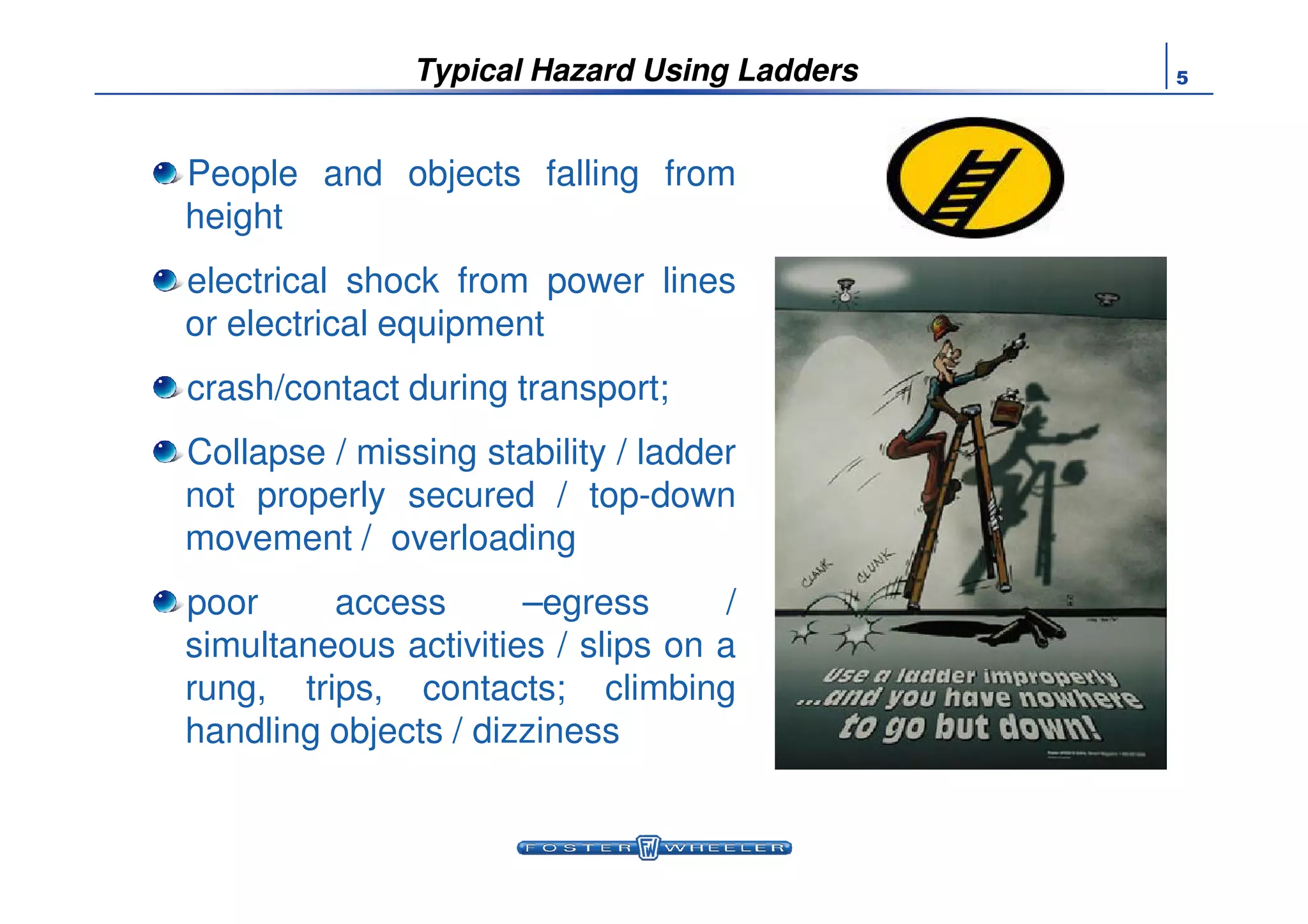
5Typical Hazard Using Ladders
People and objects falling from
height
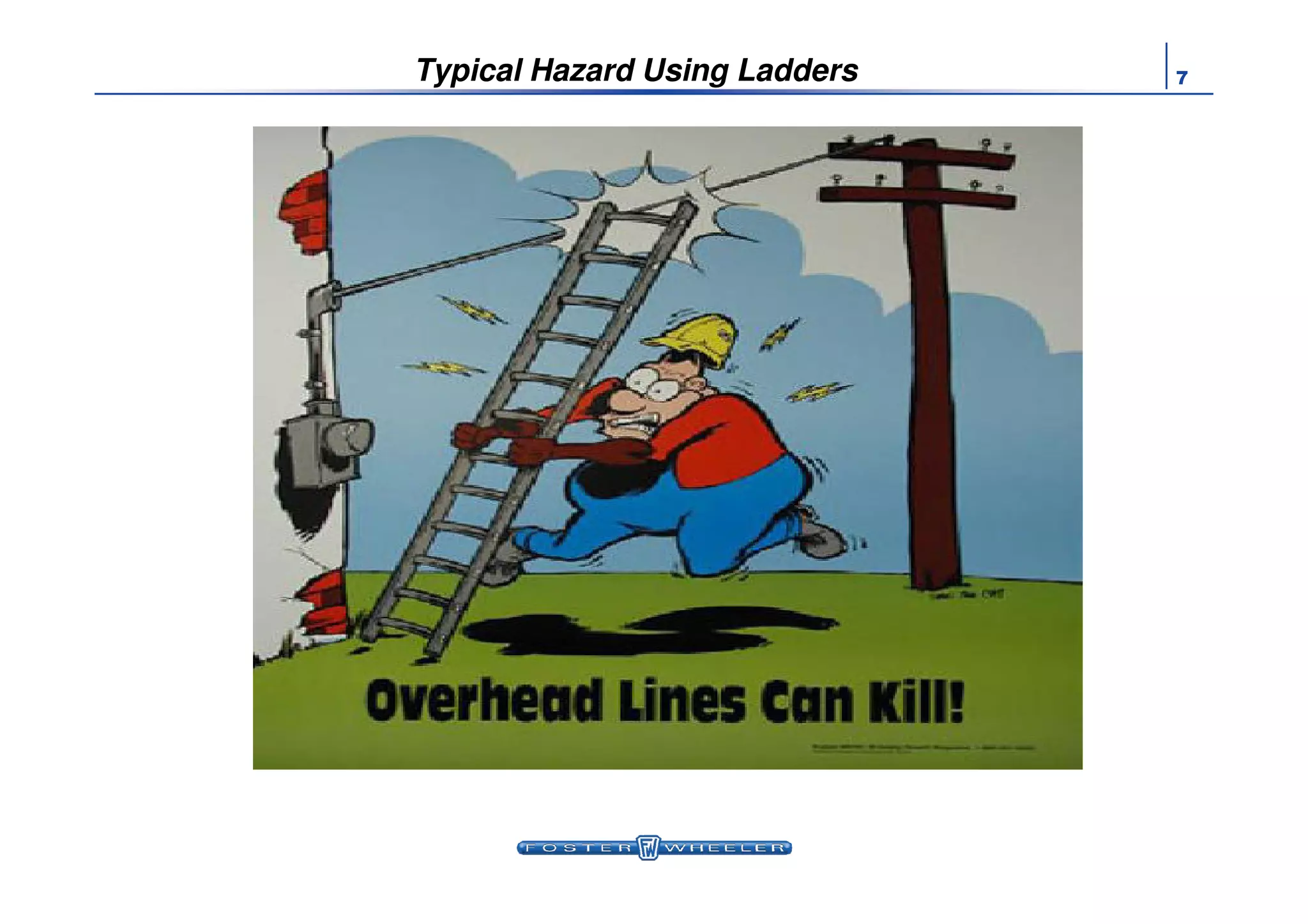
electrical shock from power lines
or electrical equipment
crash/contact during transport;
Collapse / missing stability / ladderCollapse / missing stability / ladder
not properly secured / top-down
movement / overloading
poor access –egress /
simultaneous activities / slips on a
rung, trips, contacts; climbing
handling objects / dizziness
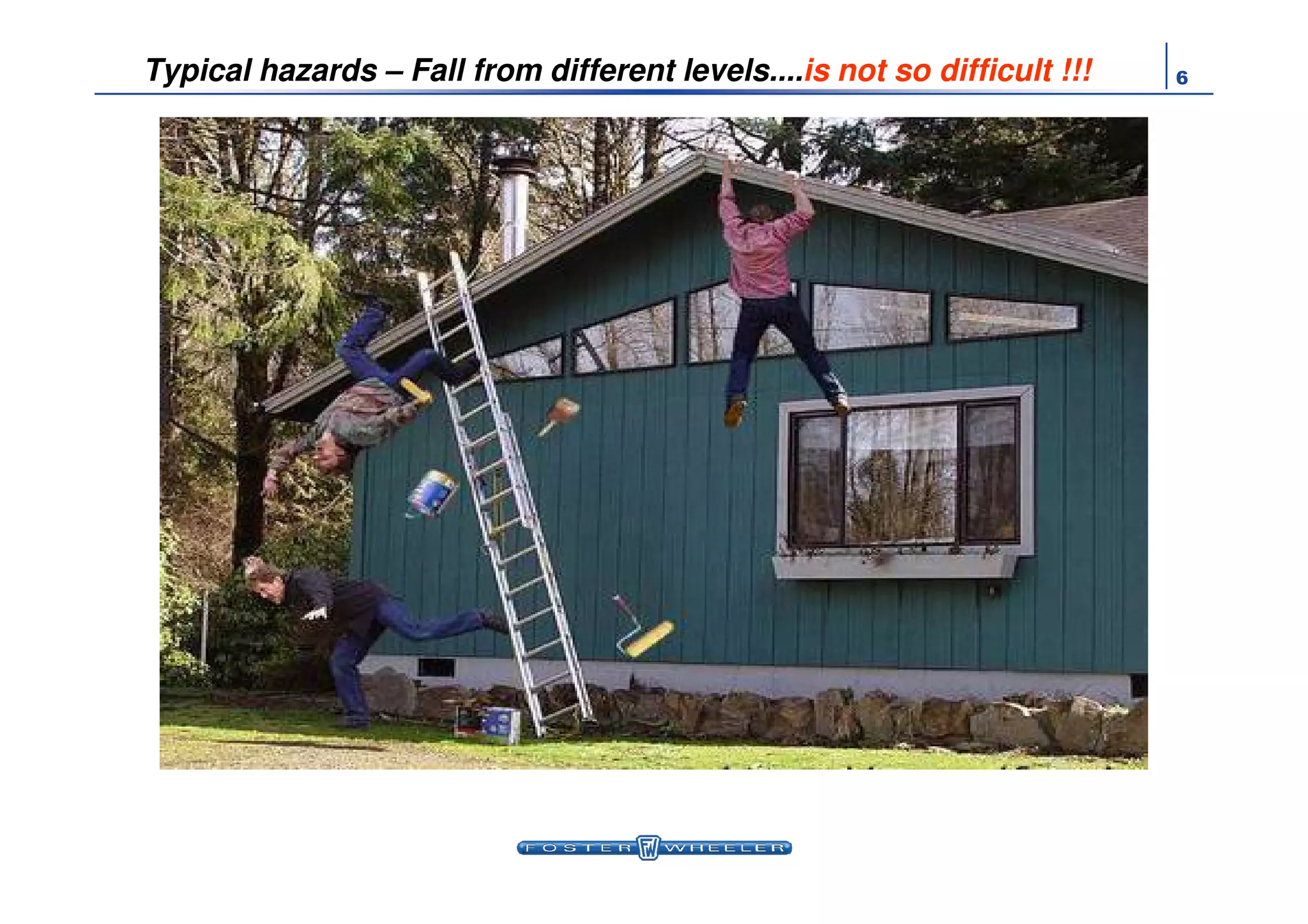
6Typical hazards – Fall from different levels....is not so difficult !!!
7Typical Hazard Using Ladders
85 Basic Factors for Safe Use of Ladders
FIRST OF ALL:FIRST OF ALL: Portable ladders shall only be used for
light duties of short duration, otherwise a properly
constructed means of access shall be provided
Safe ladder practices depend on Five Basic FactorsFive Basic Factors:
SelectionSelection: Select the Right Ladder for the Job
PositioningPositioning: Set Up the Ladder with CarePositioningPositioning: Set Up the Ladder with Care
UseUse: Climb and Descend Ladders in the proper manner
TransportTransport: Move the ladder in a safe way
ConditionCondition: Inspect the Ladder Before You Use It, Store
it and Mantain it Properly
9Selection
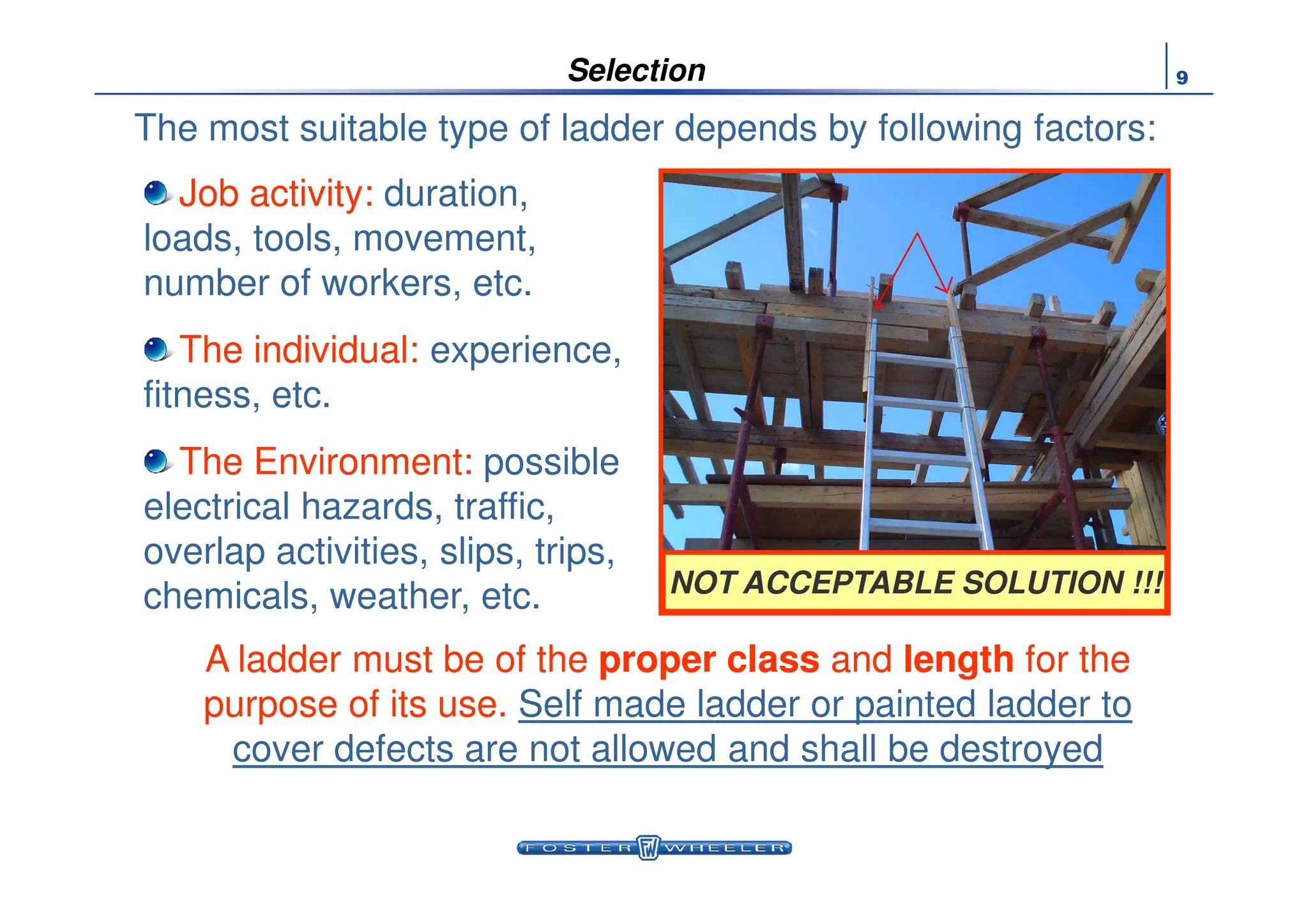
The most suitable type of ladder depends by following factors:
Job activity: duration,
loads, tools, movement,
number of workers, etc.
The individual: experience,
fitness, etc.
The Environment: possibleThe Environment: possible
electrical hazards, traffic,
overlap activities, slips, trips,
chemicals, weather, etc. NOT ACCEPTABLE SOLUTION !!!
A ladder must be of the proper classproper class and lengthlength for the
purpose of its use. Self made ladder or painted ladder to
cover defects are not allowed and shall be destroyed
10Positioning the Ladders
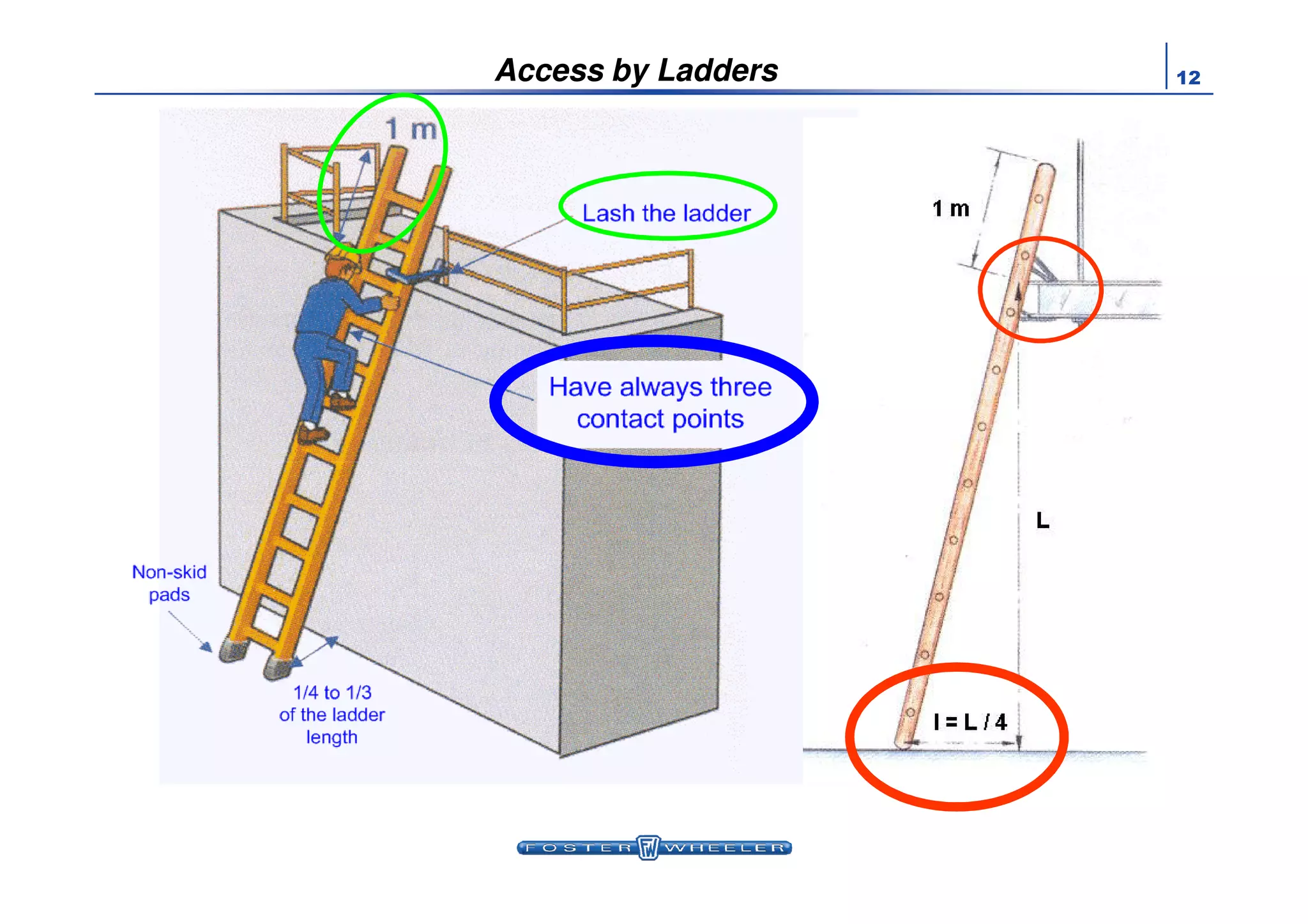
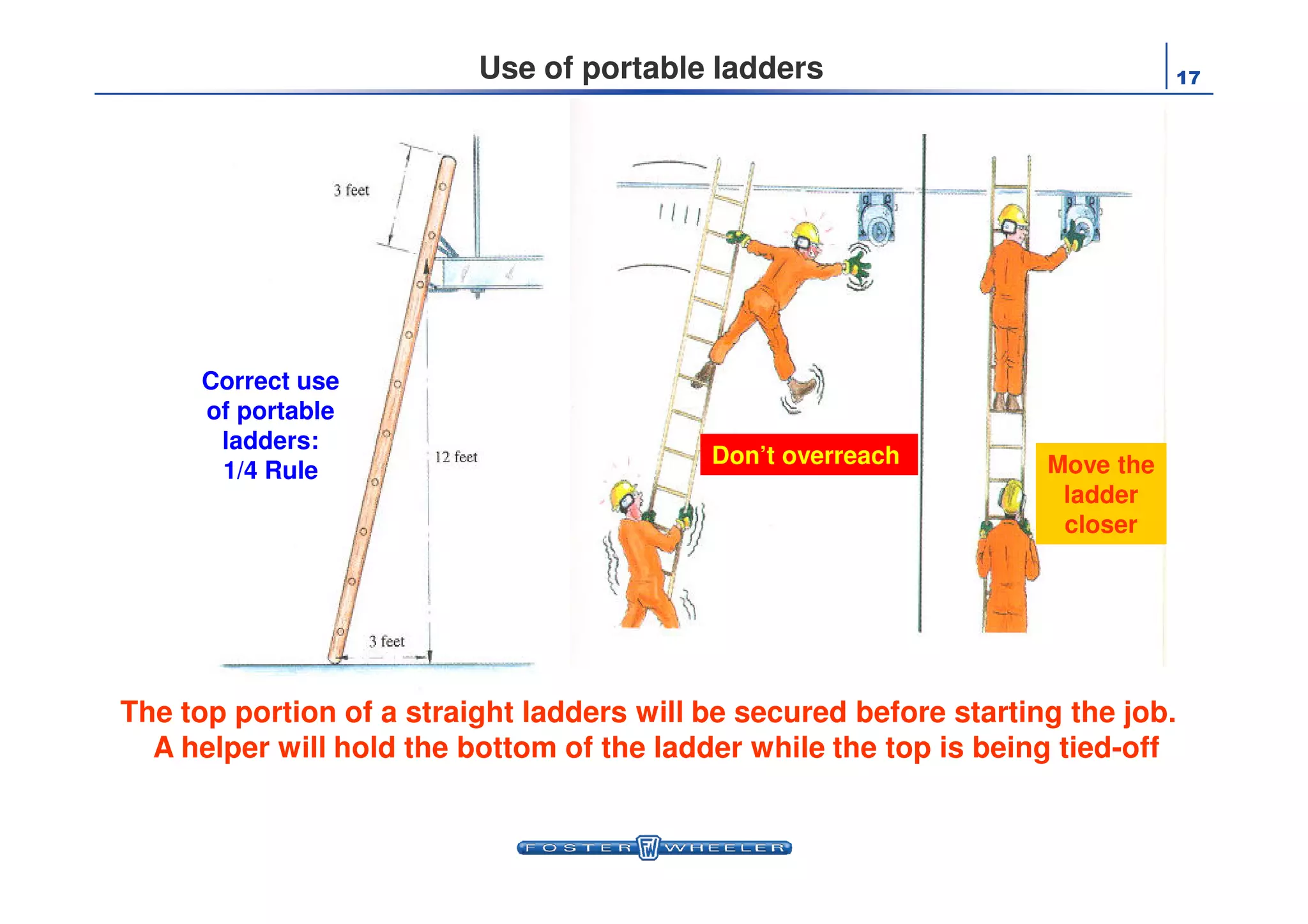
Straight/Extension ladders shall be placed at a slope of 4H:1Bslope of 4H:1B
Straight/Extension ladders may be placed verticallyvertically if both side rails are
attached to a supporting structure (i.e. scaffold) at top, middle and bottom
Ladders shall extend at least 1mshall extend at least 1m above the landing or platform
Both side railsside rails shall be securely in place to prevent movement. Where
secure fixing is impractical other measures shall be taken to prevent
movement by securing at the base even by a stationing man at the base
Fully OpenFully Open a stepladder on four legs (tied off is strongly suggested) and
never lean it against walls for support and never stand on the top step.
Tied off it starting from about 3 meters height
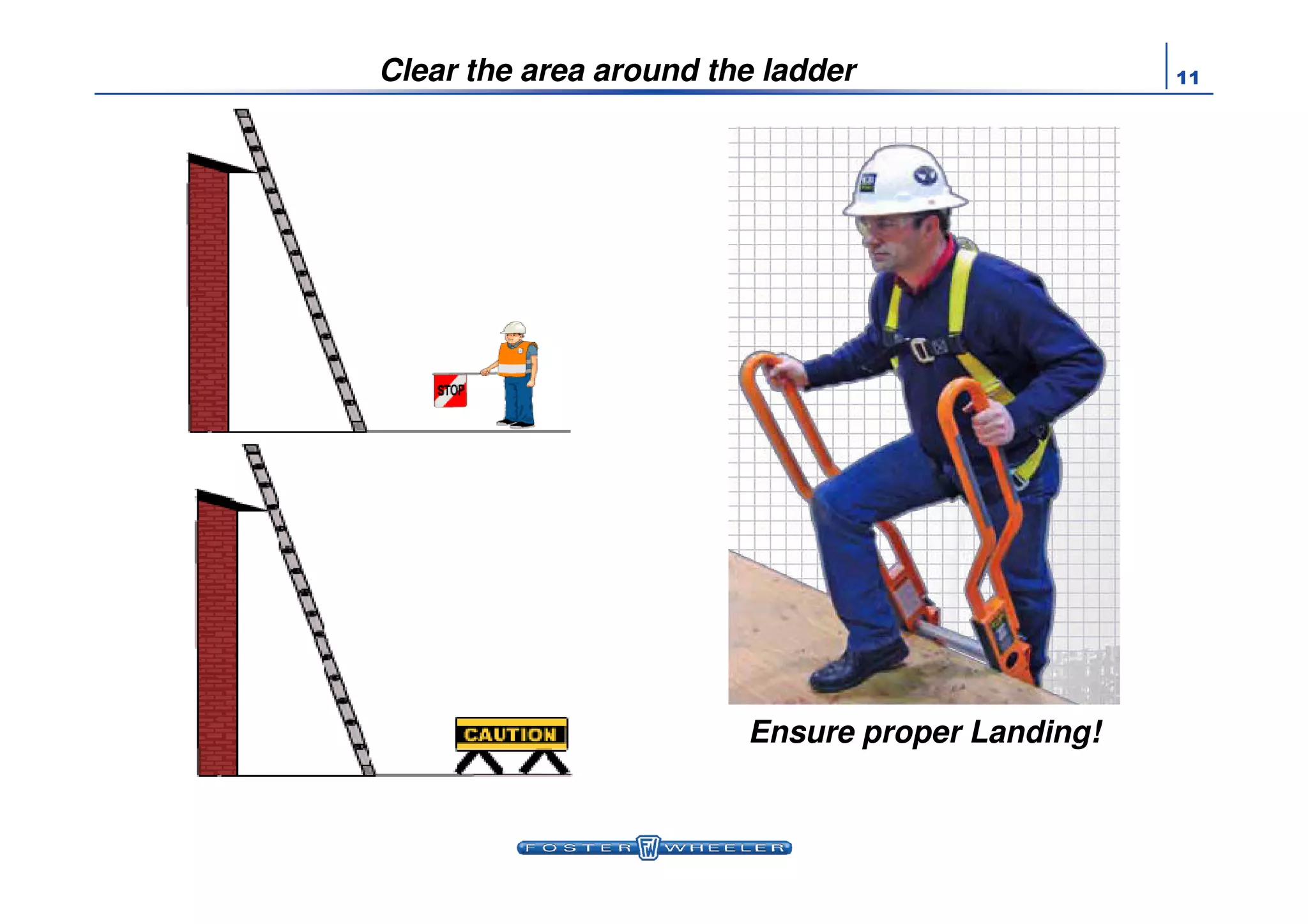
The area at the base of a ladder shall be kept clear
Ladders shall not be used in a horizontal position as platforms,etc.
Rungs shall not be used to support ladders or scaffold planks
If a ladder could be struck by moving vehicles or equipment, a flagman
or a barricade with flashers shall be erected around to warning others
11Clear the area around the ladder
Ensure proper Landing!
12Access by Ladders
13
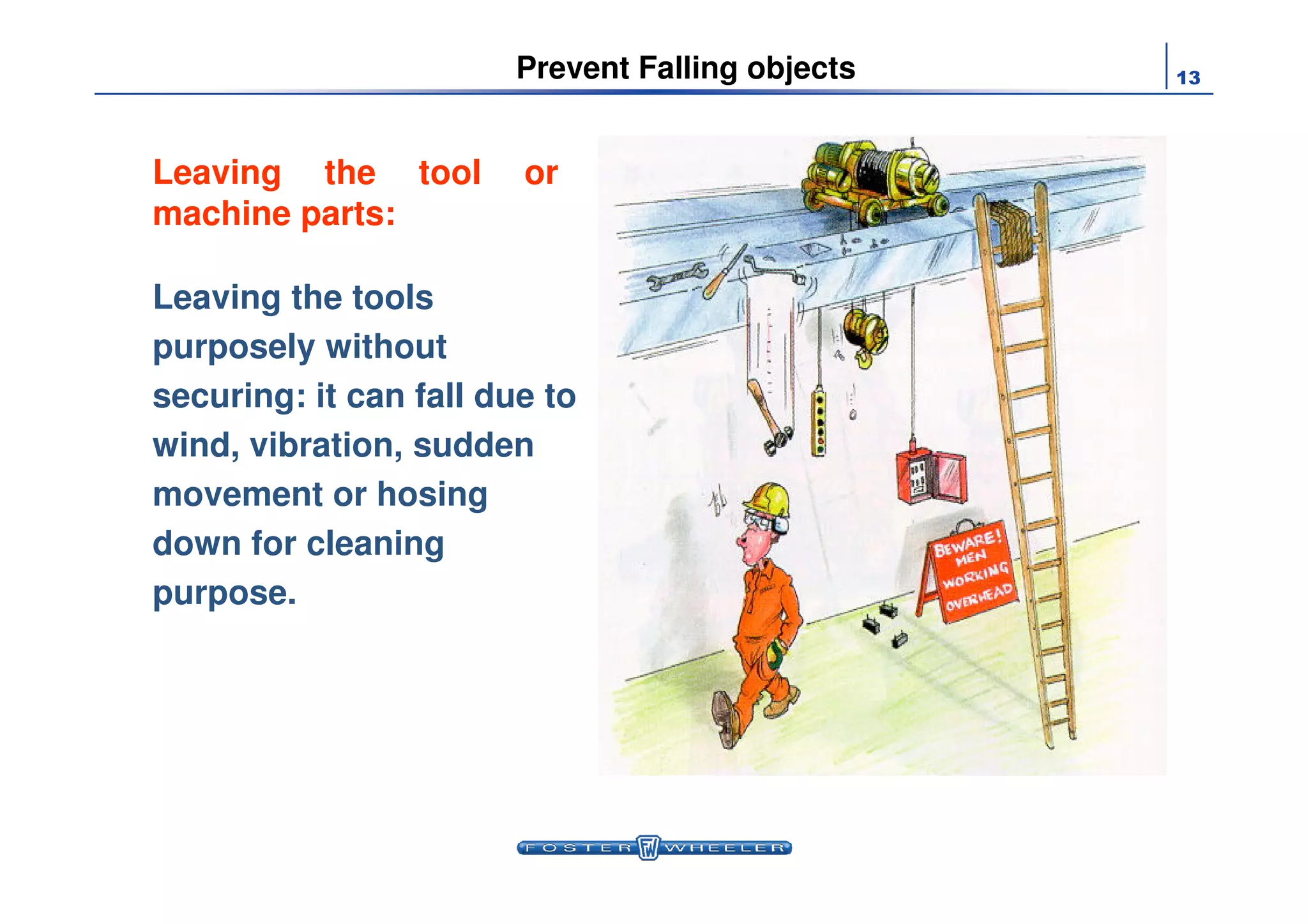
Leaving the tools
purposely without
securing: it can fall due to
wind, vibration, sudden
Leaving the tool or
machine parts:
Prevent Falling objects
wind, vibration, sudden
movement or hosing
down for cleaning
purpose.
24
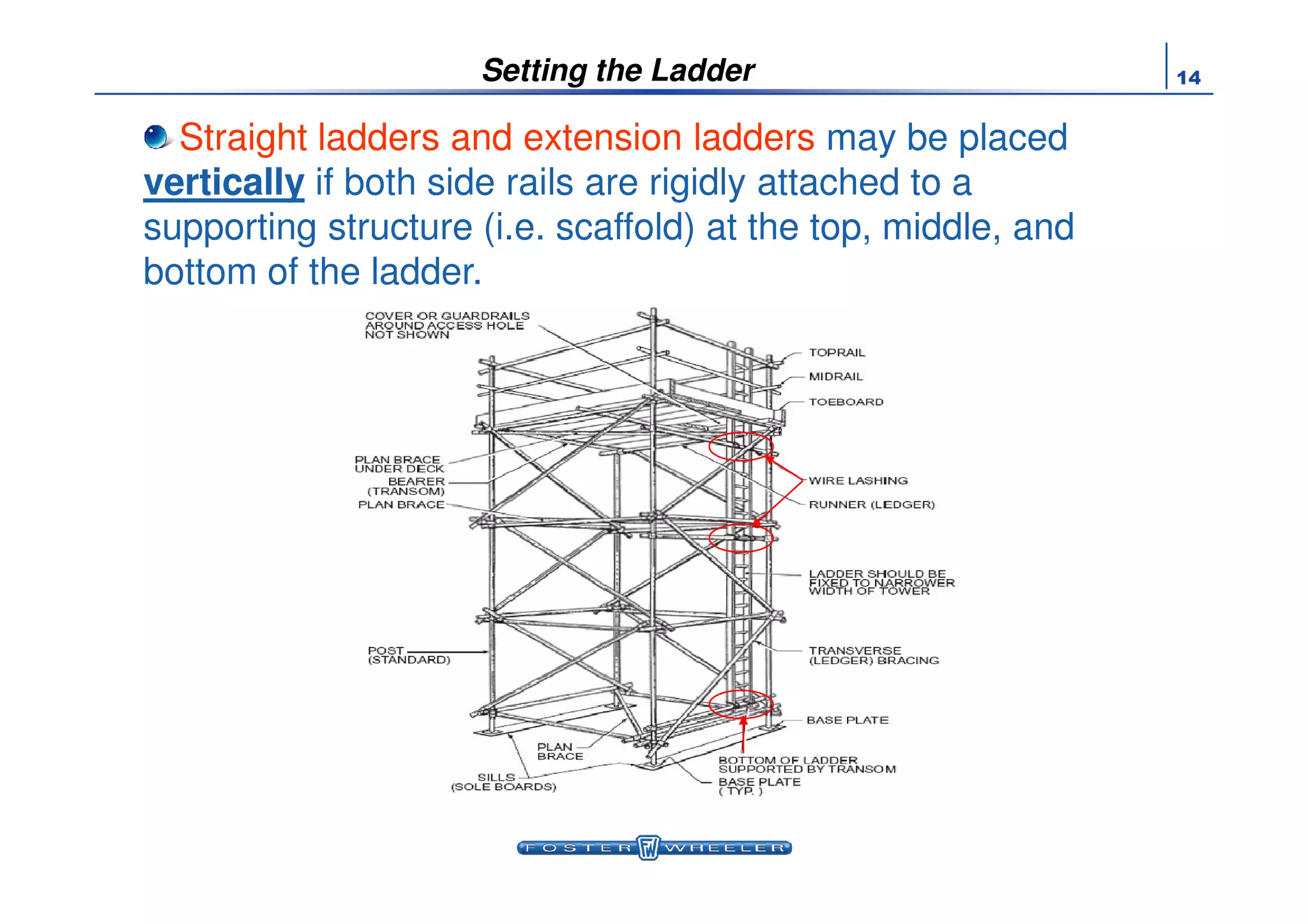
14
Straight ladders and extension ladders may be placed
verticallyvertically if both side rails are rigidly attached to a
supporting structure (i.e. scaffold) at the top, middle, and
bottom of the ladder.
Setting the Ladder
15
USER shall inspect the ladder for safe condition before each use;
ONE person only shall be moving on a ladder at a time
KEEP 2 hands and 1 foot or 2 feet and 1 hand in contact with the
ladder while ascending or descending (ALWAYS THREE
CONTACTS)
FACE the ladder: Do not run up/down or slide down at any time
HANDS FREE while climbing: tools/materials may be carried in
Climbing and Using the Ladder
HANDS FREE while climbing: tools/materials may be carried in
pockets, on basket, etc.;
WORKING on a stable and secured ladder, use a fall arrestuse a fall arrest
device/safety harnessesdevice/safety harnesses if it can be done safely and if an
independent suitable anchor point is available
AT THE END of the work period or of the job, the user will remove
the ladder from the work area to avoid tripping or obstacles and he
will return the ladder to a proper storage place
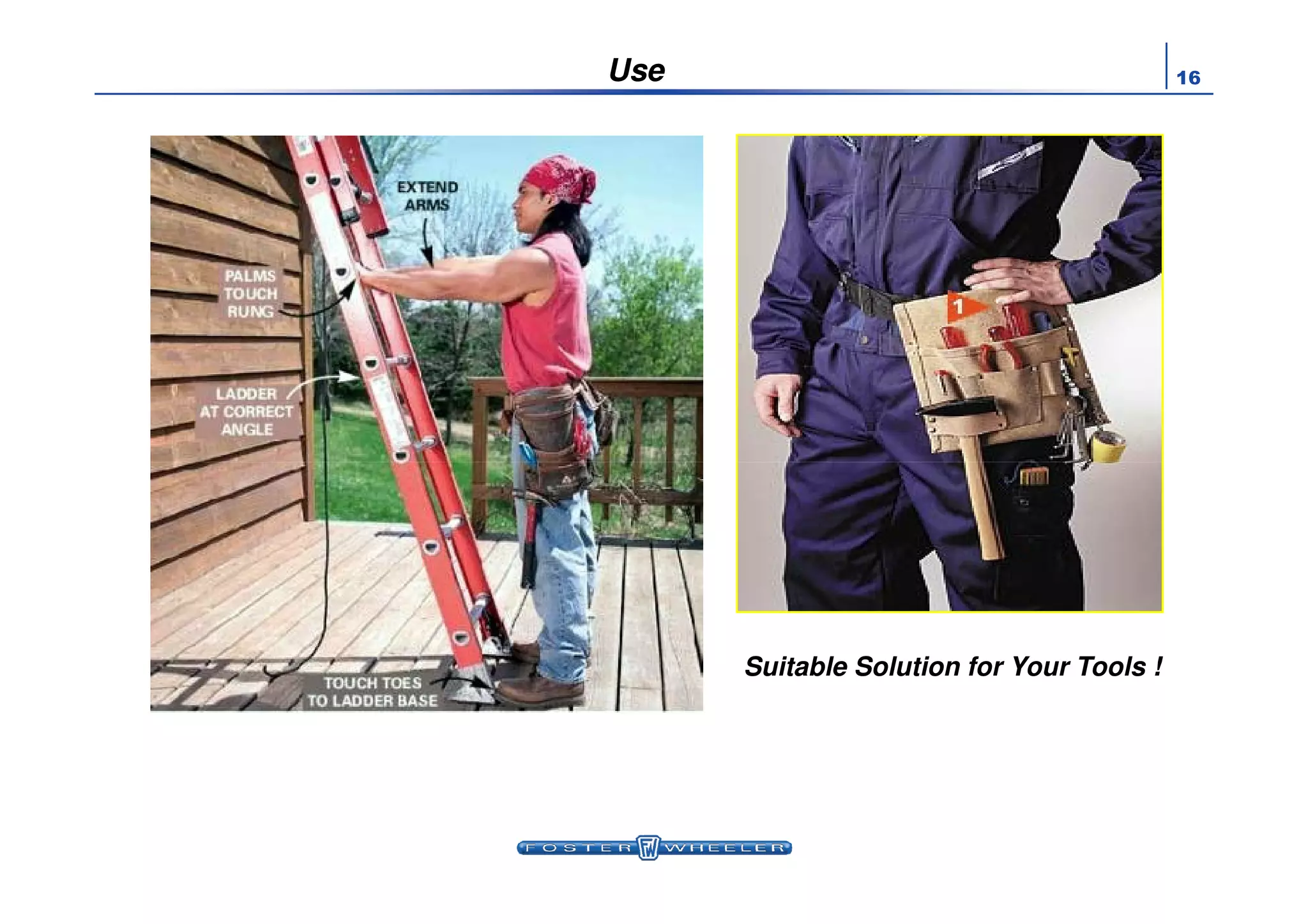
16Use
Suitable Solution for Your Tools !
17Use of portable ladders
Correct use
of portable
ladders:
1/4 Rule Move theDon’t overreach
1/4 Rule Move the
ladder
closer
17
Don’t overreach
The top portion of a straight ladders will be secured before starting the job.
A helper will hold the bottom of the ladder while the top is being tied-off
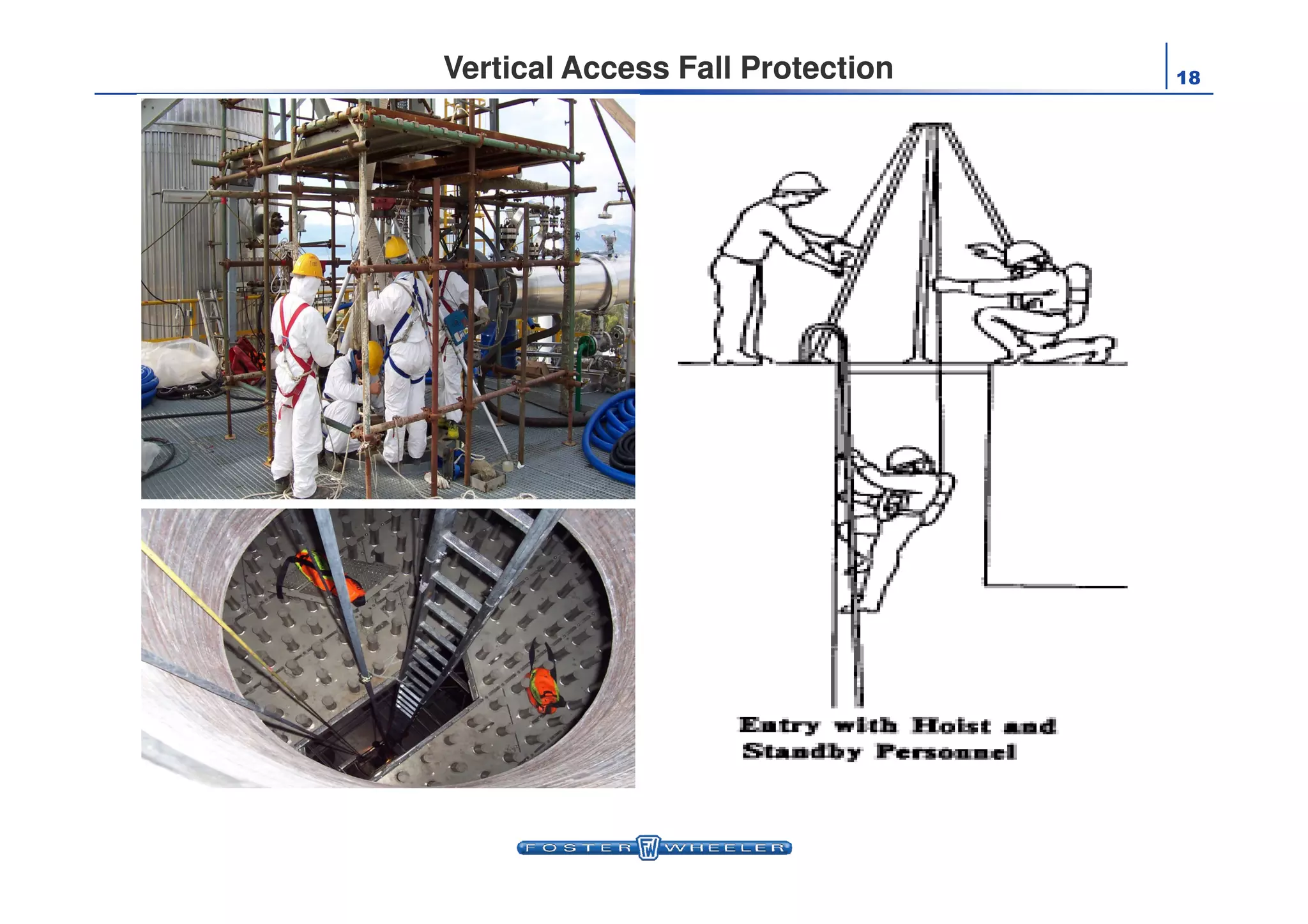
18Vertical Access Fall ProtectionVertical Access Fall Protection
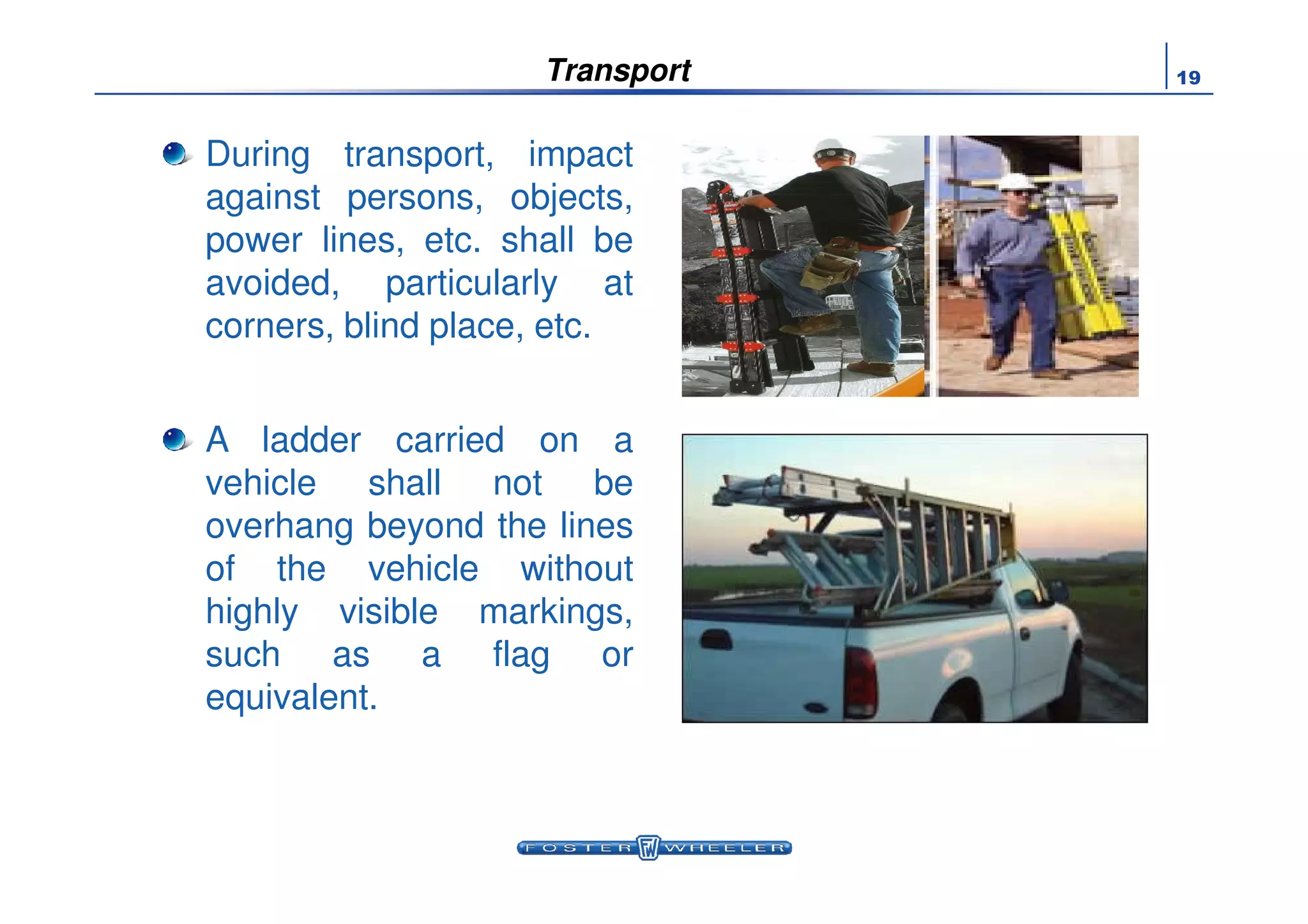
19Transport
During transport, impact
against persons, objects,
power lines, etc. shall be
avoided, particularly at
corners, blind place, etc.
A ladder carried on a
vehicle shall not be
overhang beyond the lines
of the vehicle without
highly visible markings,
such as a flag or
equivalent.
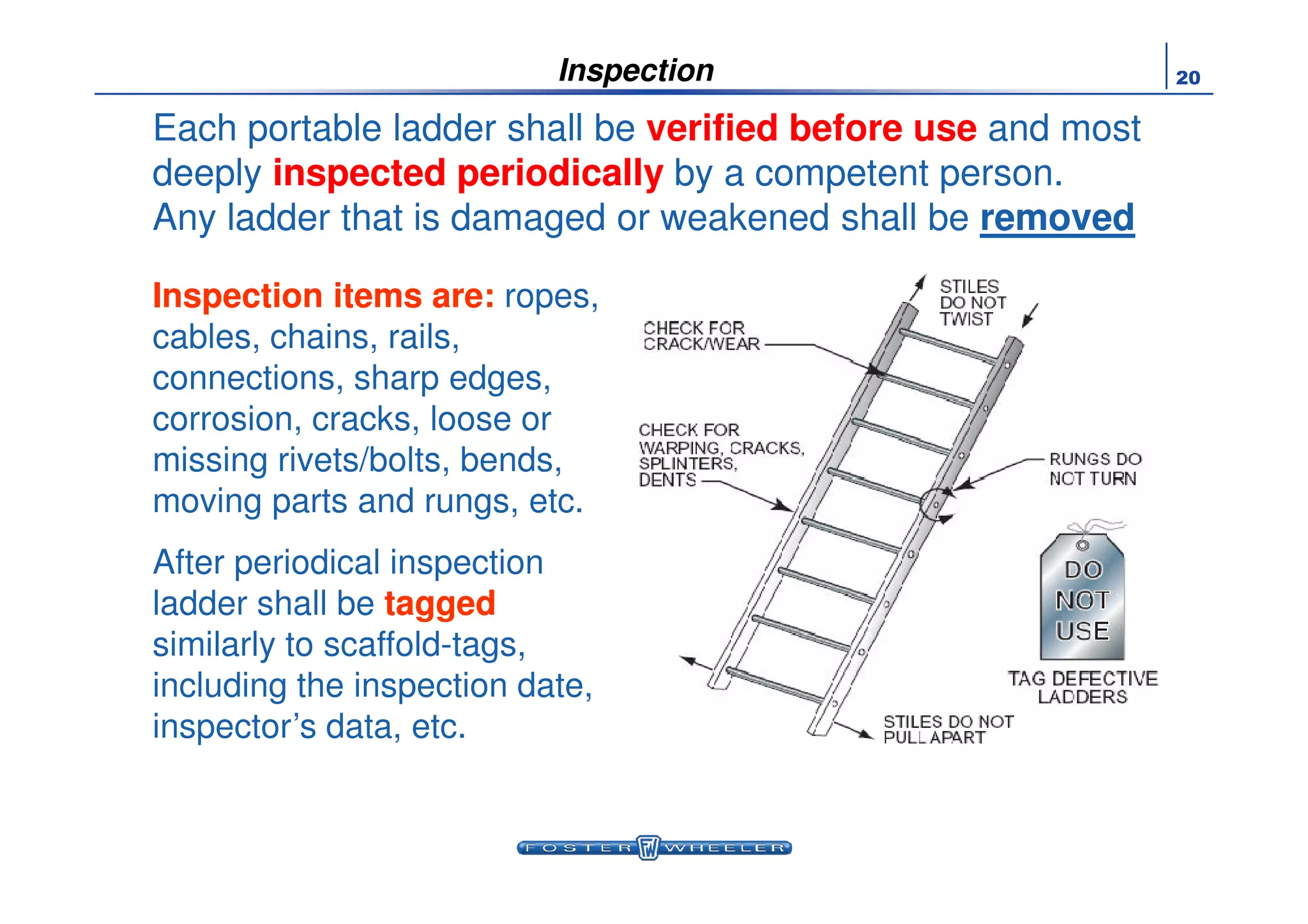
20Inspection
Each portable ladder shall be verified before use and most
deeply inspected periodicallyinspected periodically by a competent person.
Any ladder that is damaged or weakened shall be removedremoved
Inspection items are:Inspection items are: ropes,
cables, chains, rails,
connections, sharp edges,
corrosion, cracks, loose or
missing rivets/bolts, bends,missing rivets/bolts, bends,
moving parts and rungs, etc.
After periodical inspection
ladder shall be taggedtagged
similarly to scaffold-tags,
including the inspection date,
inspector’s data, etc.
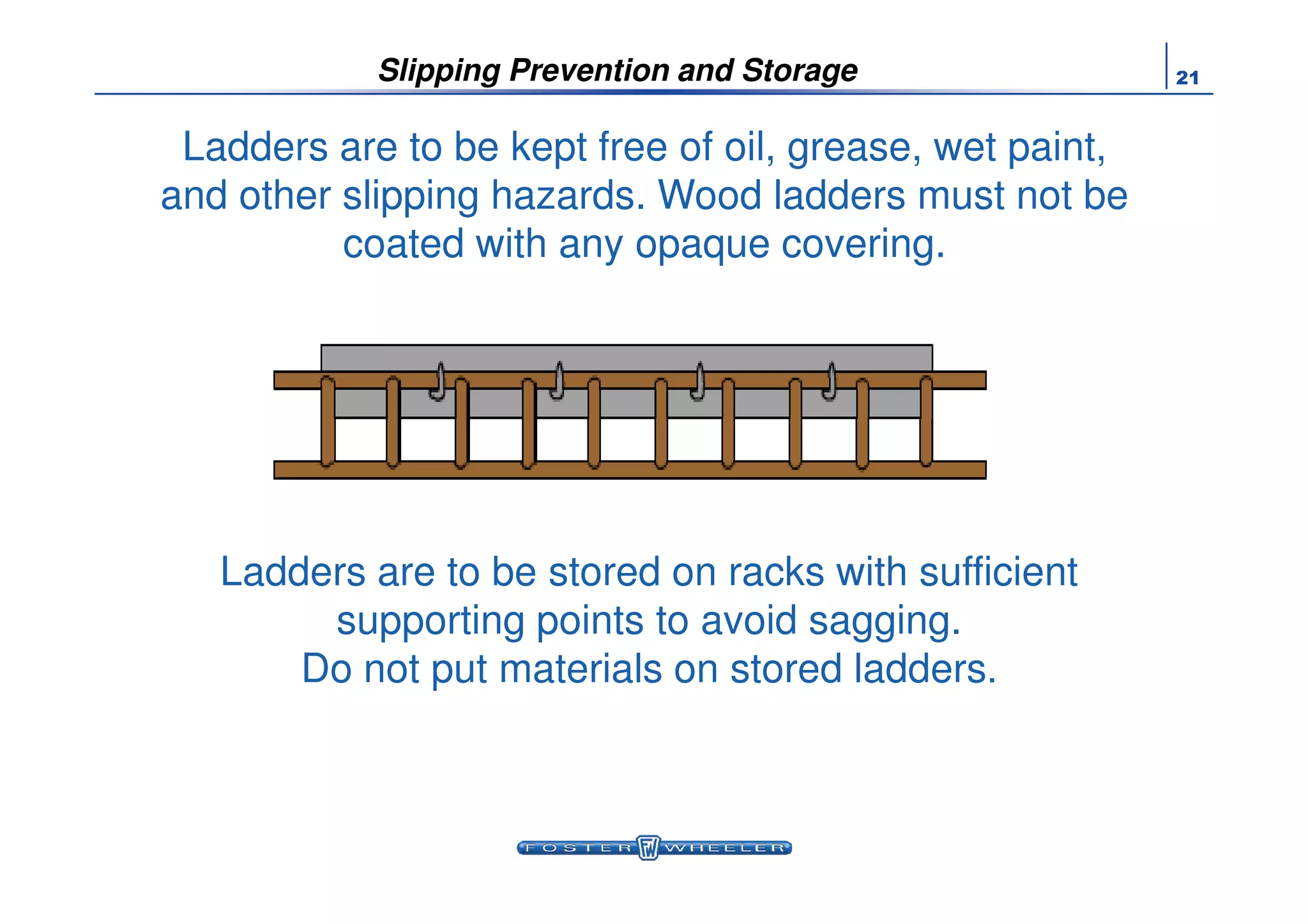
21Slipping Prevention and Storage
Ladders are to be kept free of oil, grease, wet paint,
and other slipping hazards. Wood ladders must not be
coated with any opaque covering.
Ladders are to be stored on racks with sufficient
supporting points to avoid sagging.
Do not put materials on stored ladders.
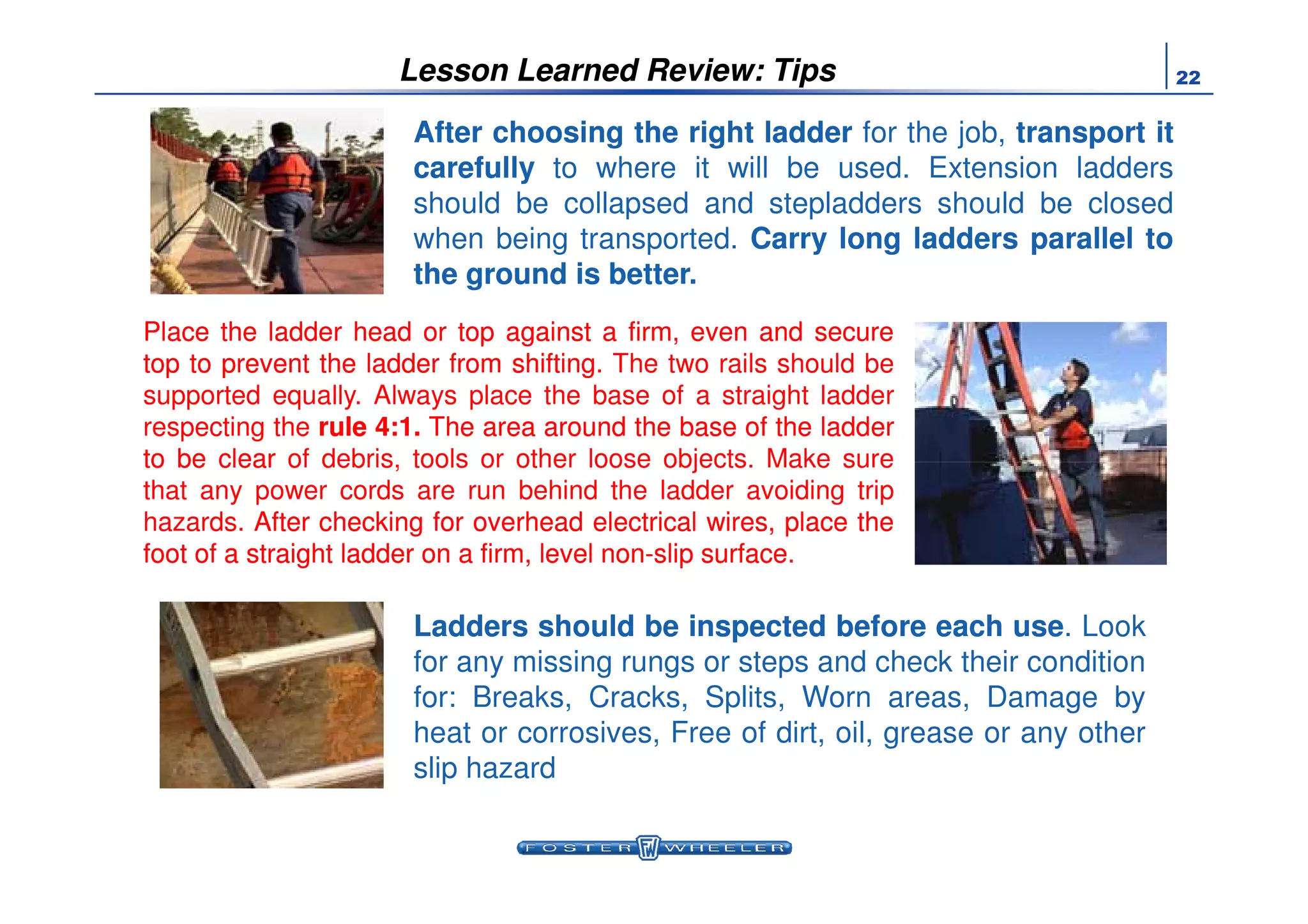
22Lesson Learned Review: Tips
PlacePlace thethe ladderladder headhead oror toptop againstagainst aa firm,firm, eveneven andand securesecure
toptop toto preventprevent thethe ladderladder fromfrom shiftingshifting. The two rails should be
supported equally. Always place the base of a straight ladder
respecting the rulerule 44::11.. TheThe areaarea aroundaround thethe basebase ofof thethe ladderladder
toto bebe clearclear of debris, tools or other loose objects. Make sure
AfterAfter choosingchoosing thethe rightright ladderladder for the job, transporttransport itit
carefullycarefully to where it will be used. Extension ladders
should be collapsed and stepladders should be closed
when being transported. CarryCarry longlong laddersladders parallelparallel toto
thethe groundground isis betterbetter..
LaddersLadders shouldshould bebe inspectedinspected beforebefore eacheach useuse. Look
for any missing rungs or steps and check their condition
for: Breaks, Cracks, Splits, Worn areas, Damage by
heat or corrosives, Free of dirt, oil, grease or any other
slip hazard
toto bebe clearclear of debris, tools or other loose objects. Make sure
that any power cords are run behind the ladder avoiding trip
hazards. AfterAfter checkingchecking forfor overheadoverhead electricalelectrical wires,wires, placeplace thethe
footfoot ofof aa straightstraight ladderladder onon aa firm,firm, levellevel nonnon--slipslip surfacesurface.
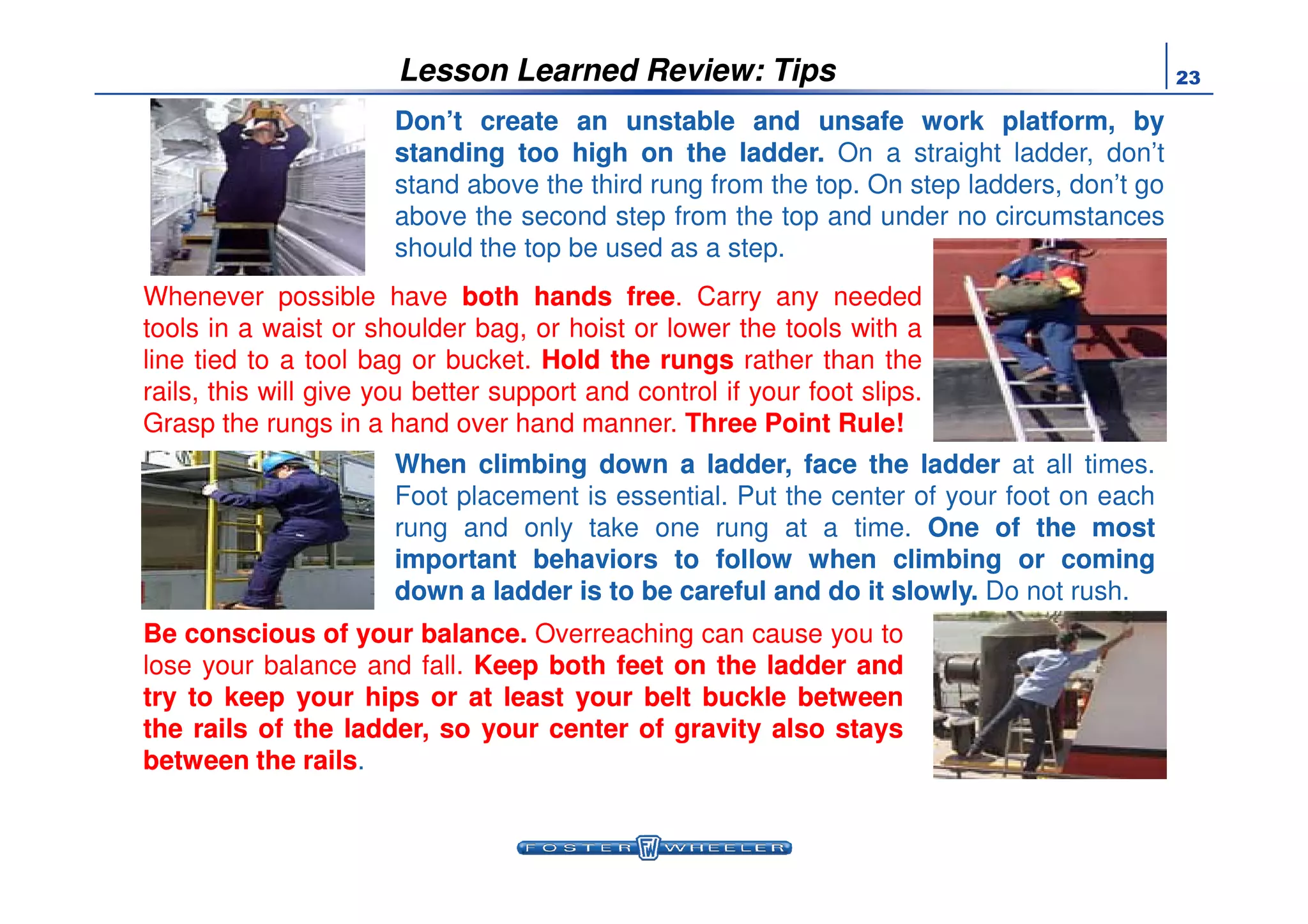
23Lesson Learned Review: Tips
Don’tDon’t createcreate anan unstableunstable andand unsafeunsafe workwork platform,platform, byby
standingstanding tootoo highhigh onon thethe ladderladder.. On a straight ladder, don’t
stand above the third rung from the top. On step ladders, don’t go
above the second step from the top and under no circumstances
should the top be used as a step.
Whenever possible have bothboth handshands freefree. Carry any needed
tools in a waist or shoulder bag, or hoist or lower the tools with a
line tied to a tool bag or bucket. HoldHold thethe rungsrungs rather than the
rails, this will give you better support and control if your foot slips.
Grasp the rungs in a hand over hand manner. Three Point Rule!
WhenWhen climbingclimbing downdown aa ladder,ladder, faceface thethe ladderladder at all times.WhenWhen climbingclimbing downdown aa ladder,ladder, faceface thethe ladderladder at all times.
Foot placement is essential. Put the center of your foot on each
rung and only take one rung at a time. OneOne ofof thethe mostmost
importantimportant behaviorsbehaviors toto followfollow whenwhen climbingclimbing oror comingcoming
downdown aa ladderladder isis toto bebe carefulcareful andand dodo itit slowlyslowly.. Do not rush.
BeBe consciousconscious ofof youryour balancebalance.. Overreaching can cause you to
lose your balance and fall. KeepKeep bothboth feetfeet onon thethe ladderladder andand
trytry toto keepkeep youryour hipships oror atat leastleast youryour beltbelt bucklebuckle betweenbetween
thethe railsrails ofof thethe ladder,ladder, soso youryour centercenter ofof gravitygravity alsoalso staysstays
betweenbetween thethe railsrails.
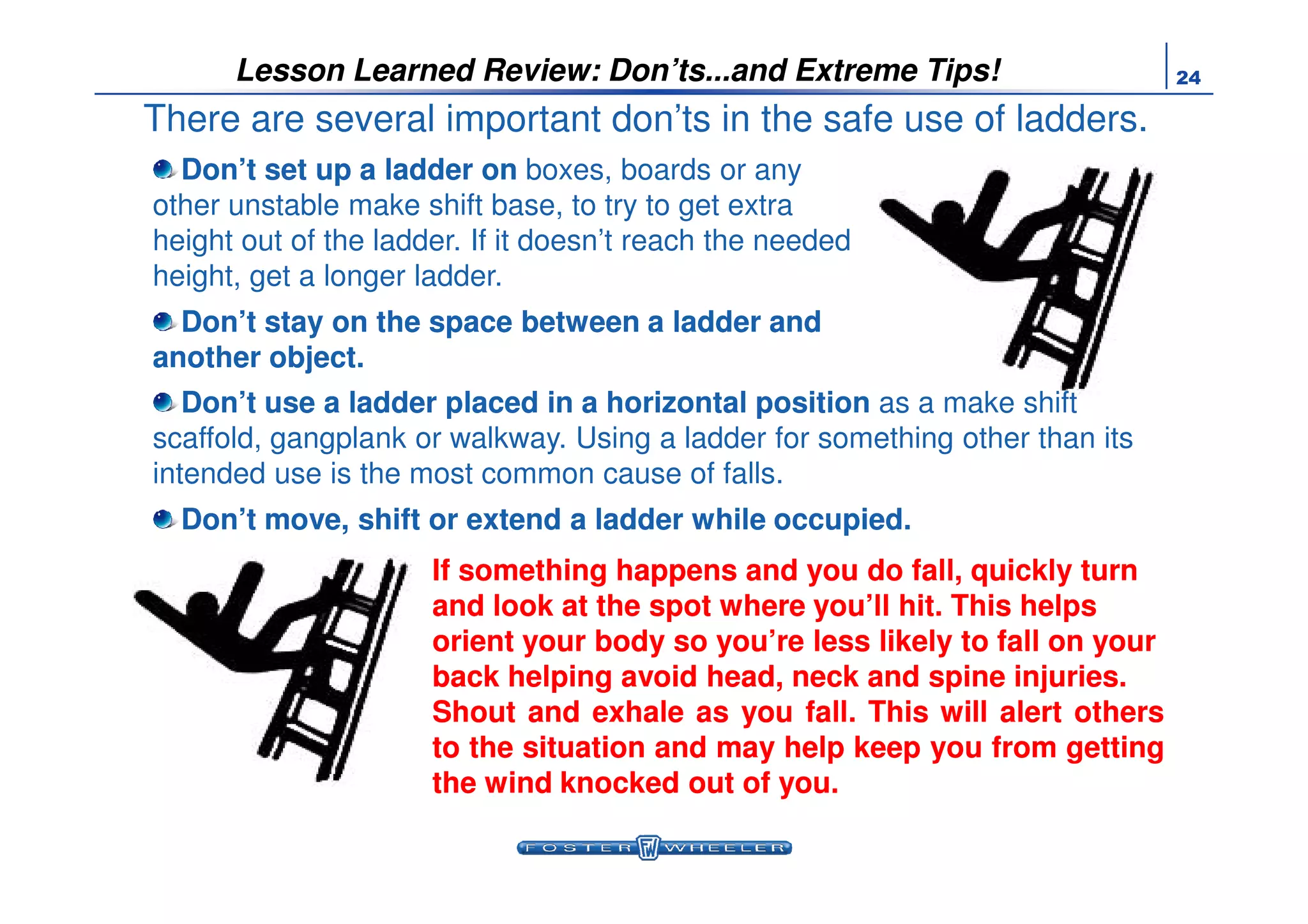
24Lesson Learned Review: Don’ts...and Extreme Tips!
There are several important don’ts in the safe use of ladders.
Don’t set up a ladder onDon’t set up a ladder on boxes, boards or any
other unstable make shift base, to try to get extra
height out of the ladder. If it doesn’t reach the needed
height, get a longer ladder.
Don’t stay on the space between a ladder andDon’t stay on the space between a ladder and
another object.another object.
Don’t use a ladder placed in a horizontal positionDon’t use a ladder placed in a horizontal position as a make shift
scaffold, gangplank or walkway. Using a ladder for something other than its
intended use is the most common cause of falls.intended use is the most common cause of falls.
Don’t move, shift or extend a ladder while occupied.Don’t move, shift or extend a ladder while occupied.
If something happens and you do fall, quickly turnIf something happens and you do fall, quickly turn
and look at the spot where you’ll hit. This helpsand look at the spot where you’ll hit. This helps
orient your body so you’re less likely to fall on yourorient your body so you’re less likely to fall on your
back helping avoid head, neck and spine injuries.back helping avoid head, neck and spine injuries.
ShoutShout andand exhaleexhale asas youyou fallfall.. ThisThis willwill alertalert othersothers
toto thethe situationsituation andand maymay helphelp keepkeep youyou fromfrom gettinggetting
thethe windwind knockedknocked outout ofof youyou..
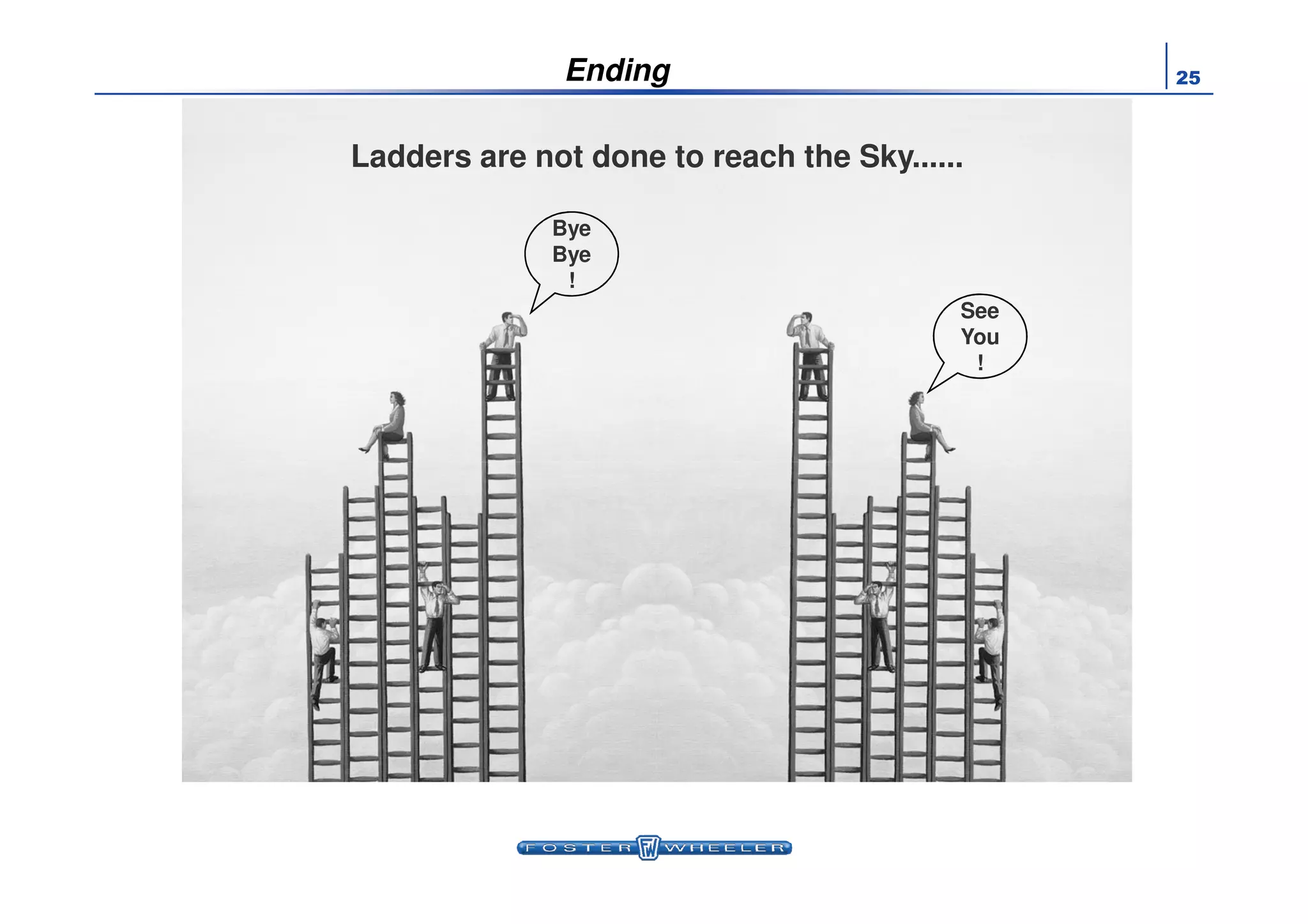
25Ending
Bye
Bye
!
See
You
!
Ladders are not done to reach the Sky......

Ladders I Its Fundamentals I Gaurav Singh Rajput

  • 2.
    2Definition A ladder isa vertical set of steps. It is a tool designed to go from a working flat to another one that is placed to different heights. There are different kinds of ladders, considering their typologies, duty (heavy 130 Kg or Light 110 Kg), material and purpose. Remind: Ladders have a Safe Working LoadRemind: Ladders have a Safe Working Load
  • 3.
  • 4.
    4Typical Ladders Straight LadderA portable ladder that consists of one section that determines its overall length. It cannot support itself or be adjusted in length. Rigid step Ladders, hinged in the middle to form an inverted V, with stays to keep the two halves at a fixed angle. Generally for no more than 6m height.height. Extension Ladder A portable ladder that cannot support itself but can be adjusted in length. It consists of two sections that are arranged to permit length adjustment. Generally for no more than 12m height.
  • 5.
    5Typical Hazard UsingLadders People and objects falling from height electrical shock from power lines or electrical equipment crash/contact during transport; Collapse / missing stability / ladderCollapse / missing stability / ladder not properly secured / top-down movement / overloading poor access –egress / simultaneous activities / slips on a rung, trips, contacts; climbing handling objects / dizziness
  • 6.
    6Typical hazards –Fall from different levels....is not so difficult !!!
  • 7.
  • 8.
    85 Basic Factorsfor Safe Use of Ladders FIRST OF ALL:FIRST OF ALL: Portable ladders shall only be used for light duties of short duration, otherwise a properly constructed means of access shall be provided Safe ladder practices depend on Five Basic FactorsFive Basic Factors: SelectionSelection: Select the Right Ladder for the Job PositioningPositioning: Set Up the Ladder with CarePositioningPositioning: Set Up the Ladder with Care UseUse: Climb and Descend Ladders in the proper manner TransportTransport: Move the ladder in a safe way ConditionCondition: Inspect the Ladder Before You Use It, Store it and Mantain it Properly
  • 9.
    9Selection The most suitabletype of ladder depends by following factors: Job activity: duration, loads, tools, movement, number of workers, etc. The individual: experience, fitness, etc. The Environment: possibleThe Environment: possible electrical hazards, traffic, overlap activities, slips, trips, chemicals, weather, etc. NOT ACCEPTABLE SOLUTION !!! A ladder must be of the proper classproper class and lengthlength for the purpose of its use. Self made ladder or painted ladder to cover defects are not allowed and shall be destroyed
  • 10.
    10Positioning the Ladders Straight/Extensionladders shall be placed at a slope of 4H:1Bslope of 4H:1B Straight/Extension ladders may be placed verticallyvertically if both side rails are attached to a supporting structure (i.e. scaffold) at top, middle and bottom Ladders shall extend at least 1mshall extend at least 1m above the landing or platform Both side railsside rails shall be securely in place to prevent movement. Where secure fixing is impractical other measures shall be taken to prevent movement by securing at the base even by a stationing man at the base Fully OpenFully Open a stepladder on four legs (tied off is strongly suggested) and never lean it against walls for support and never stand on the top step. Tied off it starting from about 3 meters height The area at the base of a ladder shall be kept clear Ladders shall not be used in a horizontal position as platforms,etc. Rungs shall not be used to support ladders or scaffold planks If a ladder could be struck by moving vehicles or equipment, a flagman or a barricade with flashers shall be erected around to warning others
  • 11.
    11Clear the areaaround the ladder Ensure proper Landing!
  • 12.
  • 13.
    13 Leaving the tools purposelywithout securing: it can fall due to wind, vibration, sudden Leaving the tool or machine parts: Prevent Falling objects wind, vibration, sudden movement or hosing down for cleaning purpose. 24
  • 14.
    14 Straight ladders andextension ladders may be placed verticallyvertically if both side rails are rigidly attached to a supporting structure (i.e. scaffold) at the top, middle, and bottom of the ladder. Setting the Ladder
  • 15.
    15 USER shall inspectthe ladder for safe condition before each use; ONE person only shall be moving on a ladder at a time KEEP 2 hands and 1 foot or 2 feet and 1 hand in contact with the ladder while ascending or descending (ALWAYS THREE CONTACTS) FACE the ladder: Do not run up/down or slide down at any time HANDS FREE while climbing: tools/materials may be carried in Climbing and Using the Ladder HANDS FREE while climbing: tools/materials may be carried in pockets, on basket, etc.; WORKING on a stable and secured ladder, use a fall arrestuse a fall arrest device/safety harnessesdevice/safety harnesses if it can be done safely and if an independent suitable anchor point is available AT THE END of the work period or of the job, the user will remove the ladder from the work area to avoid tripping or obstacles and he will return the ladder to a proper storage place
  • 16.
  • 17.
    17Use of portableladders Correct use of portable ladders: 1/4 Rule Move theDon’t overreach 1/4 Rule Move the ladder closer 17 Don’t overreach The top portion of a straight ladders will be secured before starting the job. A helper will hold the bottom of the ladder while the top is being tied-off
  • 18.
    18Vertical Access FallProtectionVertical Access Fall Protection
  • 19.
    19Transport During transport, impact againstpersons, objects, power lines, etc. shall be avoided, particularly at corners, blind place, etc. A ladder carried on a vehicle shall not be overhang beyond the lines of the vehicle without highly visible markings, such as a flag or equivalent.
  • 20.
    20Inspection Each portable laddershall be verified before use and most deeply inspected periodicallyinspected periodically by a competent person. Any ladder that is damaged or weakened shall be removedremoved Inspection items are:Inspection items are: ropes, cables, chains, rails, connections, sharp edges, corrosion, cracks, loose or missing rivets/bolts, bends,missing rivets/bolts, bends, moving parts and rungs, etc. After periodical inspection ladder shall be taggedtagged similarly to scaffold-tags, including the inspection date, inspector’s data, etc.
  • 21.
    21Slipping Prevention andStorage Ladders are to be kept free of oil, grease, wet paint, and other slipping hazards. Wood ladders must not be coated with any opaque covering. Ladders are to be stored on racks with sufficient supporting points to avoid sagging. Do not put materials on stored ladders.
  • 22.
    22Lesson Learned Review:Tips PlacePlace thethe ladderladder headhead oror toptop againstagainst aa firm,firm, eveneven andand securesecure toptop toto preventprevent thethe ladderladder fromfrom shiftingshifting. The two rails should be supported equally. Always place the base of a straight ladder respecting the rulerule 44::11.. TheThe areaarea aroundaround thethe basebase ofof thethe ladderladder toto bebe clearclear of debris, tools or other loose objects. Make sure AfterAfter choosingchoosing thethe rightright ladderladder for the job, transporttransport itit carefullycarefully to where it will be used. Extension ladders should be collapsed and stepladders should be closed when being transported. CarryCarry longlong laddersladders parallelparallel toto thethe groundground isis betterbetter.. LaddersLadders shouldshould bebe inspectedinspected beforebefore eacheach useuse. Look for any missing rungs or steps and check their condition for: Breaks, Cracks, Splits, Worn areas, Damage by heat or corrosives, Free of dirt, oil, grease or any other slip hazard toto bebe clearclear of debris, tools or other loose objects. Make sure that any power cords are run behind the ladder avoiding trip hazards. AfterAfter checkingchecking forfor overheadoverhead electricalelectrical wires,wires, placeplace thethe footfoot ofof aa straightstraight ladderladder onon aa firm,firm, levellevel nonnon--slipslip surfacesurface.
  • 23.
    23Lesson Learned Review:Tips Don’tDon’t createcreate anan unstableunstable andand unsafeunsafe workwork platform,platform, byby standingstanding tootoo highhigh onon thethe ladderladder.. On a straight ladder, don’t stand above the third rung from the top. On step ladders, don’t go above the second step from the top and under no circumstances should the top be used as a step. Whenever possible have bothboth handshands freefree. Carry any needed tools in a waist or shoulder bag, or hoist or lower the tools with a line tied to a tool bag or bucket. HoldHold thethe rungsrungs rather than the rails, this will give you better support and control if your foot slips. Grasp the rungs in a hand over hand manner. Three Point Rule! WhenWhen climbingclimbing downdown aa ladder,ladder, faceface thethe ladderladder at all times.WhenWhen climbingclimbing downdown aa ladder,ladder, faceface thethe ladderladder at all times. Foot placement is essential. Put the center of your foot on each rung and only take one rung at a time. OneOne ofof thethe mostmost importantimportant behaviorsbehaviors toto followfollow whenwhen climbingclimbing oror comingcoming downdown aa ladderladder isis toto bebe carefulcareful andand dodo itit slowlyslowly.. Do not rush. BeBe consciousconscious ofof youryour balancebalance.. Overreaching can cause you to lose your balance and fall. KeepKeep bothboth feetfeet onon thethe ladderladder andand trytry toto keepkeep youryour hipships oror atat leastleast youryour beltbelt bucklebuckle betweenbetween thethe railsrails ofof thethe ladder,ladder, soso youryour centercenter ofof gravitygravity alsoalso staysstays betweenbetween thethe railsrails.
  • 24.
    24Lesson Learned Review:Don’ts...and Extreme Tips! There are several important don’ts in the safe use of ladders. Don’t set up a ladder onDon’t set up a ladder on boxes, boards or any other unstable make shift base, to try to get extra height out of the ladder. If it doesn’t reach the needed height, get a longer ladder. Don’t stay on the space between a ladder andDon’t stay on the space between a ladder and another object.another object. Don’t use a ladder placed in a horizontal positionDon’t use a ladder placed in a horizontal position as a make shift scaffold, gangplank or walkway. Using a ladder for something other than its intended use is the most common cause of falls.intended use is the most common cause of falls. Don’t move, shift or extend a ladder while occupied.Don’t move, shift or extend a ladder while occupied. If something happens and you do fall, quickly turnIf something happens and you do fall, quickly turn and look at the spot where you’ll hit. This helpsand look at the spot where you’ll hit. This helps orient your body so you’re less likely to fall on yourorient your body so you’re less likely to fall on your back helping avoid head, neck and spine injuries.back helping avoid head, neck and spine injuries. ShoutShout andand exhaleexhale asas youyou fallfall.. ThisThis willwill alertalert othersothers toto thethe situationsituation andand maymay helphelp keepkeep youyou fromfrom gettinggetting thethe windwind knockedknocked outout ofof youyou..
  • 25.