GES-R&S- JUNE 2020 1
Rigging & Slinging Training
Course
TRAINING ACADEMY
GES-R&S- JUNE 2020 2
Instructor Name :
Did you sign in your attendance Sheet??
The purpose of attendance Sheet
Concern for the quality assurance Prove the data for certification
Instructor E-mail :
TRAINING ACADEMY
GES-R&S- JUNE 2020 3
TRAINING ACADEMY
GES-R&S- JUNE 2020 4
TRAINING ACADEMY
GES-R&S- JUNE 2020 5
TRAINING ACADEMY
Lifting Operation and Lifting Equipment Regulation
1998 LOLER
Provision and Use of Work Equipment Regulations 1998 PUWER
LEEA Code of Practice Edition 9
Introduction
The Health And Safety At Work Etc Act 1974 HASWA
References
GES-R&S- JUNE 2020 6
TRAINING ACADEMY
Steel wire rope slings —Safety BS EN13414-1 & 3:2003
Forged steel shackles for general lifting purposes — Dee
shackles and bow shackles BS EN13889:2003+A1:2008
Short link chain for lifting purposes —Safety BS EN 818-4
Introduction
Textile slings —Safety BS EN 1492-1 & 2 :2000
Code of Practice for Safe use of cranes BS 7121-1:2016
GES-R&S- JUNE 2020 7
TRAINING ACADEMY
Legislation
GES-R&S- JUNE 2020 8
TRAINING ACADEMY
Covers existing used leased and new equipment
LOLER Key Regulations
▪ Regulation 4: Strength and stability
▪ Regulation 5: Lifting equipment for lifting persons
▪ Regulation 6: Positioning and installation
▪ Regulation 7: Marking of lifting equipment
▪ Regulation 8: Organization of lifting operations
▪ Regulation 9: Thorough examination and inspection
▪ Regulation 10: Reports and defects
▪ Regulation 11: Keeping of information
Lifting Operations and Lifting Equipment Regulations 1998
LOLER
What does LOLER apply to?
LOLER applies to the use of lifting equipment provided as work equipment.
GES-R&S- JUNE 2020 9
TRAINING ACADEMY
What does PUWER apply to?
PUWER applies to the provision and use of all work equipment
The Essentials of PUWER
PUWER places duties on the employer to ensure that:
❑ Work equipment is suitable for the purpose for which it is to be used.
❑ The working conditions and risk to health and safety of personnel in which the
work equipment is used is to be considered.
❑ Equipment is suitably maintained and a log kept up to date.
❑ Equipment is inspected on a regular basis (ref. LOLER).
❑ All inspection and maintenance records are kept and recorded.
❑ All persons using work equipment have sufficient information pertaining to its use.
Provision and Use of Work Equipment Regulations 1998
PUWER
GES-R&S- JUNE 2020 10
TRAINING ACADEMY
PUWER Key Regulations
▪ Regulation 4: Suitability of work equipment
▪ Regulation 5: Maintenance
▪ Regulation 6: Inspection
▪ Regulation 7: Specific risks
▪ Regulation 8: Information and Instructions
▪ Regulations 9: Training
Provision and Use of Work Equipment Regulations 1998
PUWER
GES-R&S- JUNE 2020 11
TRAINING ACADEMY
The Health And Safety At Work Etc Act 1974 HASWA
Employer and employee have a common law duty of care to each other and
to other employees.
Health and Safety at Work Act Section 2
Employers General Duty:
Duty to ensure so far as is reasonably practicable, the health, safety and welfare at work of
all his employees”
1. Safe plant and systems of work
2. Safe use, handling, storage and transportation of articles and substances
3. Information, instruction, training and adequate supervision (I.I.T.S)
4. Safe place of work and a safe means of access and egress
5. Safe working environment and adequate welfare facilities
Duty of Care
GES-R&S- JUNE 2020 12
TRAINING ACADEMY
The Health And Safety At Work Etc Act 1974 HASWA
Health and Safety at Work Act Section 7
Duty of Employees at Work
It shall be the duty of every employee whilst at work:-
▪ To take care of their own health and safety and of any other person who may be
affected by their acts or omissions.
▪ To co-operate with their employer.
▪ Use PPE provided by your employer.
GES-R&S- JUNE 2020 13
TRAINING ACADEMY
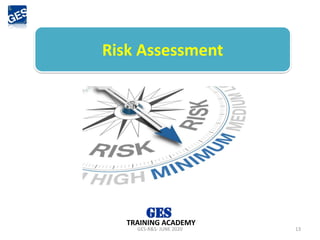
Risk Assessment
GES-R&S- JUNE 2020 14
TRAINING ACADEMY
Definition
Hazard:
• A hazard is something (object or situation) that has the potential to cause
harm.
Risk: (a combination of likelihood and severity)
• Risk is that likelihood that the harm from the hazard is realized
Danger:
• A liability or exposure to harm; something that causes peril
Likelihood:
• How likely it is that someone could be harmed by the hazard
Severity:
• If the potential for harm was to occur, how severe would the accident be?
GES-R&S- JUNE 2020 15
TRAINING ACADEMY
Five Steps to Risk Assessment
Identify the hazards
Decide who may be harmed and how
Evaluate the risks and decide on precautions
(control measures)
Record your findings
Review and monitor
GES-R&S- JUNE 2020 16
TRAINING ACADEMY
Even where engineering controls and safe systems
of work have been applied, some hazards might
remain. These include injuries to:
▪ The lungs, e.g. from breathing in contaminated air
▪ The head and feet, e.g. from falling materials
▪ The eyes, e.g. from flying particles or splashes of
corrosive liquids
▪ The skin, e.g. from contact with corrosive materials
▪ The body, e.g. from extremes of heat or cold
PPE is needed in these cases to reduce the risk.
Personal Protective Equipment (PPE)
GES-R&S- JUNE 2020 17
TRAINING ACADEMY
Key Definitions
GES-R&S- JUNE 2020 18
TRAINING ACADEMY
Competent Person An individual, who, by way of education, training, experience and
defined assessment, is knowledgeable of applicable standards, can identify workplace
hazards relating to the specific operation, is designated by the employer and has
authority to take appropriate actions.
Lifting Accessory A device that is used or designed to be used to connect a load to a
lifting appliance and which does not form part of the load e.g. wire sling, fiber sling,
shackle, hook etc.
Lifting Appliance A device capable of lifting or lowering a load and includes its
attachments used for anchoring, fixing or supporting it e.g. chain hoist, beam clamp,
mobile crane, winch etc.
Lift Category A categorisation of lifting operations reflecting the risk and the level of
control required.
Key Definitions
GES-R&S- JUNE 2020 19
TRAINING ACADEMY
Lifting Equipment Generic term used to describe work equipment that covers both
appliances and accessories.
Lift Plan A document which gives step by step details of the ‘lift’. The document also
identifies all the lifting equipment and lifting accessories to be used, the lifting
equipment configuration and details of responsible persons. The lift plan should also
have attached, or provide, details of the sites safety measures, relevant drawings,
illustrations and data.
Safe Working Load (SWL) The maximum load (as determined by a competent
person) that an item of lifting equipment or system may raise, lower or in a given
configuration or environmental condition (see WLL below). The designated Lifting
Operations competent person must establish the safe loading limit of all components
used in any lift and must NOT exceed the SWL or WLL.
Key Definitions
GES-R&S- JUNE 2020 20
TRAINING ACADEMY
Working Load Limit (WLL) Maximum load that lifting equipment is designed to raise
lower or suspend. The WLL does not account for particular service conditions which
may affect the final rating of the equipment.
Minimum Breaking Load (MBL) The minimum breaking load is the calculated load at
below which the item will not break or fail due to distortion.
Mode Factor A factor applied by the user (slinger / rigger) that takes into account the
geometry of a sling assembly to obtain the maximum load it may lift for a particular
mode of use.
Colour Code A method of marking equipment to give a visual indication of its
certification status.
Key Definitions
GES-R&S- JUNE 2020 21
TRAINING ACADEMY
Roles and Duties of The Slinger
GES-R&S- JUNE 2020 22
TRAINING ACADEMY
➢ The slinger should be properly trained in all aspects of slinging loads and signalling, and
be authorized by the appointed person.
➢ The slinger should be responsible for:
▪ Carrying out pre-use and post-use checks of lifting accessories.
▪ Attaching and detaching the load to and from the crane load-lifting attachment.
▪ Using the correct lifting accessories and other equipment in accordance with the lift
plan.
➢ Ensure that slings are not used at an excessive angle.
➢ Ensure the load is free to lift.
➢ Assume a safe position during lifting operations and be aware of the position of others.
Roles and Duties of The Slinger
Slinger Responsibilities
GES-R&S- JUNE 2020 23
TRAINING ACADEMY
➢ Continuously monitor the lifting operation.
➢ Remain in communication with all parties at all times.
➢ Ensure tag lines are used safely.
➢ Stop and report any unsafe practices or actions.
Roles and Duties of The Slinger
GES-R&S- JUNE 2020 24
TRAINING ACADEMY
Minimum Attributes of The Slinger
Rigger / Slinger should be:
▪ Be 18 years of age or over.
▪ Fit, with particular regard to eyesight, hearing, reflexes and agility.
▪ Physically able to handle lifting accessories and equipment.
▪ Able to establish weights, balance loads and judge distances, heights and clearances.
▪ Trained in the techniques of slinging.
▪ Capable of selecting accessories that have been identified in the lift plan.
▪ Trained in the techniques of signalling and instructed in a common signal Code.
▪ Capable of giving clear verbal instructions where audio equipment (e.g. radio) is used.
▪ Authorized to carry out slinging duties.
Roles and Duties of The Slinger
GES-R&S- JUNE 2020 25
TRAINING ACADEMY
Steel Wire Rope Slings
Types of Wire Rope Sling
GES-R&S- JUNE 2020 26
TRAINING ACADEMY
Single Leg
Steel Wire Rope Sling
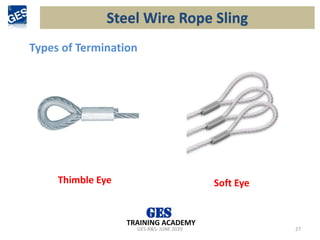
Types of Termination
GES-R&S- JUNE 2020 27
TRAINING ACADEMY
Soft Eye
Thimble Eye
Steel Wire Rope Sling
GES-R&S- JUNE 2020 28
TRAINING ACADEMY
Steel Wire Rope Sling
Fittings
GES-R&S- JUNE 2020 29
TRAINING ACADEMY
Steel Wire Rope Sling
GES-R&S- JUNE 2020 30
TRAINING ACADEMY
Steel Wire Rope Sling
Single Leg Wire Rope Length
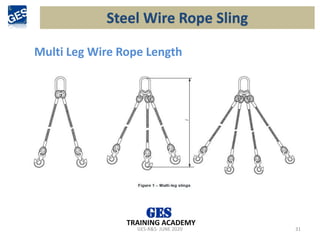
Multi Leg Wire Rope Length
GES-R&S- JUNE 2020 31
TRAINING ACADEMY
Steel Wire Rope Sling
GES-R&S- JUNE 2020 32
TRAINING ACADEMY
Single leg sling . Can be used in
A- Straight Lift :
Max load to be lifted must not exceed the
WLL marked on the sling.
Steel Wire Rope Sling
Single Leg Sling (Method of use)
The most commonly used methods for effectively balanced load illustrated
as follow:
GES-R&S- JUNE 2020 33
TRAINING ACADEMY
B- Choke hitch:
Max load to be lifted must not exceed
the 0.8 x WLL marked on the sling
Steel Wire Rope Sling
GES-R&S- JUNE 2020 34
TRAINING ACADEMY
C- Double wrapped choke hitch:
Max load to be lifted must not exceed
the 0.8 x WLL marked on the sling.
Steel Wire Rope Sling
GES-R&S- JUNE 2020 35
TRAINING ACADEMY
D- Double and choke hitch:
Max load to be lifted must not exceed
the 1.6x WLL marked on the sling
Steel Wire Rope Sling
GES-R&S- JUNE 2020 36
TRAINING ACADEMY
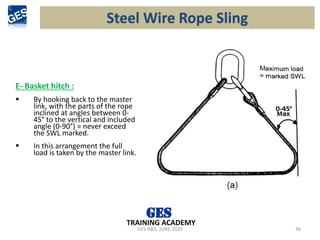
E- Basket hitch :
▪ By hooking back to the master
link, with the parts of the rope
inclined at angles between 0-
45° to the vertical and included
angle (0-90°) = never exceed
the SWL marked.
▪ In this arrangement the full
load is taken by the master link.
Steel Wire Rope Sling
GES-R&S- JUNE 2020 37
TRAINING ACADEMY
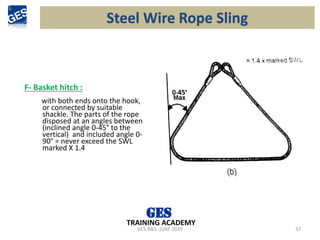
F- Basket hitch :
with both ends onto the hook,
or connected by suitable
shackle. The parts of the rope
disposed at an angles between
(inclined angle 0-45° to the
vertical) and included angle 0-
90° = never exceed the SWL
marked X 1.4
Steel Wire Rope Sling
GES-R&S- JUNE 2020 38
TRAINING ACADEMY
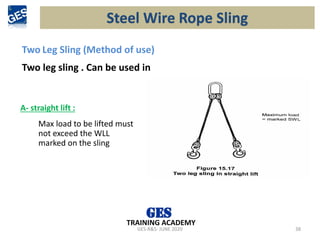
Two Leg Sling (Method of use)
Two leg sling . Can be used in
Steel Wire Rope Sling
A- straight lift :
Max load to be lifted must
not exceed the WLL
marked on the sling
GES-R&S- JUNE 2020 39
TRAINING ACADEMY
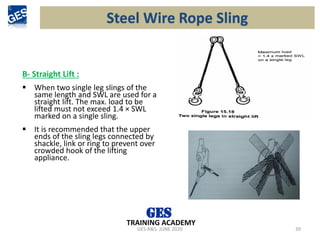
B- Straight Lift :
▪ When two single leg slings of the
same length and SWL are used for a
straight lift. The max. load to be
lifted must not exceed 1.4 × SWL
marked on a single sling.
▪ It is recommended that the upper
ends of the sling legs connected by
shackle, link or ring to prevent over
crowded hook of the lifting
appliance.
Steel Wire Rope Sling
GES-R&S- JUNE 2020 40
TRAINING ACADEMY
C- Choke Hitch:
Max load to be lifted
must not exceed the
0.8 x WLL marked on
the sling.
Steel Wire Rope Sling
GES-R&S- JUNE 2020 41
TRAINING ACADEMY
D- Choke hitch:
▪ When two single leg slings of
the same length and SWL are
used in a choke hitch. The max
load to be lifted must not
exceed 0.8 × 1.4 × SWL
marked on a single sling.
▪ It is recommended that the
upper ends of the sling legs
connected by shackle, link or
ring to prevent over crowded
hook of the lifting appliance.
Steel Wire Rope Sling
GES-R&S- JUNE 2020 42
TRAINING ACADEMY
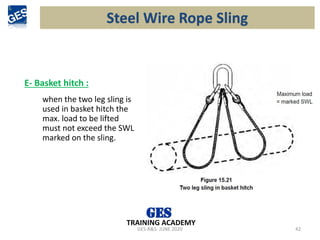
E- Basket hitch :
when the two leg sling is
used in basket hitch the
max. load to be lifted
must not exceed the SWL
marked on the sling.
Steel Wire Rope Sling
GES-R&S- JUNE 2020 43
TRAINING ACADEMY
F- Basket hitch:
when two single leg
slings of the same
length and SWL are
used in basket hitch
with the ends of the
slings connected to the
hook by suitable
shackles (no need to
use shackle in case of
ramshorn hook). The
max load to be lifted
must not exceed 2.1 ×
SWL marked on a single
sling.
Steel Wire Rope Sling
GES-R&S- JUNE 2020 44
TRAINING ACADEMY
Three Leg Sling (Method of use)
Three leg sling . Can be used in
Steel Wire Rope Sling
A- Straight lift :
Max load to be lifted
must not exceed the WLL
marked on the sling for
the appropriate range of
angles.
GES-R&S- JUNE 2020 45
TRAINING ACADEMY
B- Choke & Basket hitch:
▪ The use of three leg sling in either choke or basket hitch is uncommon
method. If used , care must be taken to ensure that all legs are carrying an
equal share of the load.
▪ When used in choke hitch. The max load to be lifted must not exceed 0.8 x
SWL marked on the sling for the appropriate range of angles.
▪ When used in basket hitch. The max load to be lifted must not exceed SWL
marked on the sling for the appropriate range of angles.
Steel Wire Rope Sling
GES-R&S- JUNE 2020 46
TRAINING ACADEMY
Four Leg Sling (Method of use)
Four leg sling . Can be used in
Steel Wire Rope Sling
A- straight lift:
Max load to be lifted must
not exceed the WLL
marked on the sling for the
appropriate range of
angles.
GES-R&S- JUNE 2020 47
TRAINING ACADEMY
B- Choke & Basket hitch:
▪ The use of four leg sling in either choke or basket hitch is uncommon
method. If used , care must be taken to ensure that all legs are carrying
an equal share of the load.
▪ When used in choke hitch. The max load to be lifted must not exceed 0.8
x SWL marked on the sling for the appropriate range of angles.
▪ When used in basket hitch. The max load to be lifted must not exceed
SWL marked on the sling for the appropriate range of angles.
Again, the included angle should be taken as twice the angle to the
vertical of any part of any leg.
Steel Wire Rope Sling
GES-R&S- JUNE 2020 48
TRAINING ACADEMY
Endless Wire Rope Sling (Method of use)
Steel Wire Rope Sling
A- Choke hitch:
▪ Endless wire rope slings
are uncommon
nowadays. They should
be used in choke hitch.
The use of endless slings
in other modes, e.g. in
line lifting, is not
preferred.
▪ The max load to be lifted
must not exceed the
SWL marked on the
sling.
GES-R&S- JUNE 2020 49
TRAINING ACADEMY
The wire rope slings must be regularly visually inspected against the rope defects such as:
In Service Inspection
Steel Wire Rope Sling
1- Broken wires:
- Randomly distributed broken wires:
6 randomly distributed broken
outer wires in a length of 6d but
no more than 14 randomly
distributed broken wires in a
length of 30d where d is the
nominal rope diameter.
- Concentrated broken wires:
3 adjacent broken outer wires in
one strand.
GES-R&S- JUNE 2020 50
TRAINING ACADEMY
2- Excessive wear.
3- Corrosion.
Steel Wire Rope Sling
GES-R&S- JUNE 2020 51
TRAINING ACADEMY
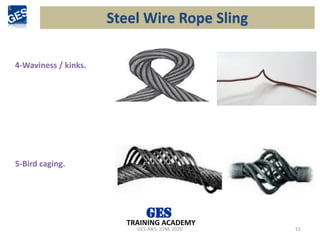
4-Waviness / kinks.
Steel Wire Rope Sling
5-Bird caging.
GES-R&S- JUNE 2020 52
TRAINING ACADEMY
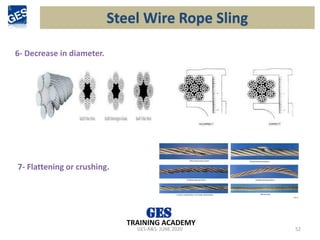
6- Decrease in diameter.
Steel Wire Rope Sling
7- Flattening or crushing.
GES-R&S- JUNE 2020 53
TRAINING ACADEMY
8- Increase in lay length
Steel Wire Rope Sling
9- Thermal damage / treatment.
GES-R&S- JUNE 2020 54
TRAINING ACADEMY
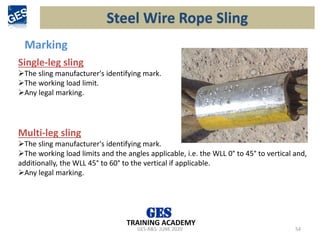
Single-leg sling
➢The sling manufacturer's identifying mark.
➢The working load limit.
➢Any legal marking.
Multi-leg sling
➢The sling manufacturer's identifying mark.
➢The working load limits and the angles applicable, i.e. the WLL 0° to 45° to vertical and,
additionally, the WLL 45° to 60° to the vertical if applicable.
➢Any legal marking.
Steel Wire Rope Sling
Marking
GES-R&S- JUNE 2020 55
TRAINING ACADEMY
1) Never exceed the sling SWL marked upon it. Taking into account the slinging mode.
2) Select the suitable sling, and ensure the lifting appliance is adequate to lift the load.
3) The upper terminal of the sling should be seated on the bowl of the crane hook. Never
on the tip nor the throat.
Steel Wire Rope Sling
Safe Use
GES-R&S- JUNE 2020 56
TRAINING ACADEMY
4) Where more than one sling is used to lift the load, each sling should be adequate for
share of the load imposed on it. Taking into account the slinging method. It is good
practice to join them with a shackle before placing them onto the hook.
Steel Wire Rope Sling
GES-R&S- JUNE 2020 57
TRAINING ACADEMY
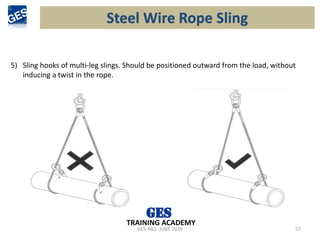
5) Sling hooks of multi-leg slings. Should be positioned outward from the load, without
inducing a twist in the rope.
Steel Wire Rope Sling
GES-R&S- JUNE 2020 58
TRAINING ACADEMY
Storage and Handling:
1) The storage area shall be dry, free from injurious pollution and extremes of temperature
2) Wire rope slings should normally be hung from suspension points.
3) Wire rope should be stored on properly designed racks.
4) Wire rope should be cleaned, brushed if necessary (never use solvent).
5) Wire rope should be lubricated under manufacture guidelines. to protect from
corrosion.
Steel Wire Rope Sling
GES-R&S- JUNE 2020 59
TRAINING ACADEMY
6) Wire rope should not be dropped or thrown down when being handled.
7) Wire rope should not be dragged across the floor surface when being transported.
8) The wire rope has a degree of stiffness and will form a noose, care must be taken
to ensure this doesn’t present a danger to personnel
Steel Wire Rope Sling
GES-R&S- JUNE 2020 60
TRAINING ACADEMY
Practical
GES-R&S- JUNE 2020 61
TRAINING ACADEMY
Textile slings
GES-R&S- JUNE 2020 62
TRAINING ACADEMY
▪ There are a wide range of flat webbing slings polyamide(Nylon), polyester,
polypropylene in a range of width from 25mm to 450 mm.
▪ They are also available in single leg, endless or multiple leg sling. With a choice of
terminations.
▪ They may have soft eyes or fitted with metal ‘D’ links/ plates or similar fittings.
Textile slings
Types of Textile Slings
GES-R&S- JUNE 2020 63
TRAINING ACADEMY
Flat woven
webbing sling
Textile slings
GES-R&S- JUNE 2020 64
TRAINING ACADEMY
Round Sling
Textile slings
GES-R&S- JUNE 2020 65
TRAINING ACADEMY
The distance between
load bearing points of the
sling.
Textile slings
Effective Working Length
GES-R&S- JUNE 2020 66
TRAINING ACADEMY
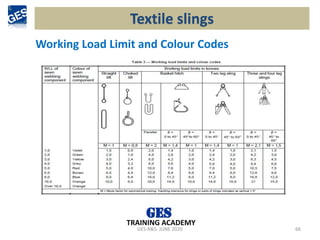
Working Load Limit and Colour Codes
Textile slings
GES-R&S- JUNE 2020 67
TRAINING ACADEMY
TEMPERATURE AND CHEMICALS
Others
Water
Alkalis
Acid
Operating
temperature
range
Color
Name
N/A
Loss of
strength
15%
Immune
Attacked
-40° to + 100°
Green
Polyamide
Attacked by
solvent
(tars &
paints
etc)
Unaffected
by water
Little
affect
Little affect
-40° to + 80°
Brown
Polypropyl
ene
N/A
Unaffected
Attacked
Resistant
-40° to + 100°
Blue
Polyester
Attacked
Loss of
strength
Attacked
Attacked
-40° to + 80°
White
Natural
fibers
The material from which the webbing is made shall be identified by the color of the
label itself on which the information is marked. The following label colors shall be
used:
Textile slings
GES-R&S- JUNE 2020 68
TRAINING ACADEMY
Marking
The marking of the sling shall include at least the following:
1) Identification number
2) The working load limit, in straight lift.
3) The material of the webbing, i.e. polyester, polyamide, polypropylene.
4) Grade of fitting.
5) The nominal length in m.
6) The manufacturer’s name or it’s symbol.
7) The traceability code.
8) The number and relevant Part of the European Standard.
9) Year of manufacturing
10) The factor of safety
Textile slings
GES-R&S- JUNE 2020 69
TRAINING ACADEMY
IN- SERVICE INSPECTION
1) Surface Chafe.
2) Local abrasion
3) Cuts
4) Chemical attack
Textile slings
The Textile slings must be regularly visually inspected against the defects such as:
GES-R&S- JUNE 2020 70
TRAINING ACADEMY
5) Heat and friction damage
6) Weld splatter burns
7) Damaged stitching
8) Loose webbing
9) Damaged eyes or terminal fittings
Textile slings
GES-R&S- JUNE 2020 71
TRAINING ACADEMY
10) Missing or illegible marking
11) Heavy soiling
12) Solar degradation
Textile slings
GES-R&S- JUNE 2020 72
TRAINING ACADEMY
SAFE USE
1) The sling should be of adequate strength and length.
2) Never exceed the SWL for the particular mode of use.
3) Ensure the compatibility of any ancillary equipment used to sling the load
both in size and capacity.
4) Where more than one sling is used to lift the load, each sling should be
adequate for the share of the load imposed on it taking into account the
slinging method.
5) Do not overcrowd the hook of the lifting appliance.
Textile slings
GES-R&S- JUNE 2020 73
TRAINING ACADEMY
6) Damage to labels should be prevented by keeping them away from the load.
7) Position the slings correctly. Use packing protection for sharp edges.
Textile slings
GES-R&S- JUNE 2020 74
TRAINING ACADEMY
8) Webbing sling must not be twisted or crossed in use.
9) Avoid shock loading as it effectively increases the weight of the load and
could result in the lifting equipment being grossly overloaded.
Textile slings
GES-R&S- JUNE 2020 75
TRAINING ACADEMY
Storage and Handling
When not in use, Textile slings should be inspected for any damage which may have
occurred in use. then returned to proper storage as below:
o Store textile slings on a suitable rack.
o Clean, dry and well ventilated store.
o Free from injurious pollution and extremes of temperature
o Away from the sunlight or source of UV light exposure
o Away from chemical attack such as alkalis
o Away from mechanical damage
o Safe from wet places
Textile slings
GES-R&S- JUNE 2020 76
TRAINING ACADEMY
Practical
GES-R&S- JUNE 2020 77
TRAINING ACADEMY
Chain Slings
Types of Chain Slings
GES-R&S- JUNE 2020 78
TRAINING ACADEMY
Chain Sling
Sling Construction
GES-R&S- JUNE 2020 79
TRAINING ACADEMY
Chain Sling
GES-R&S- JUNE 2020 80
TRAINING ACADEMY
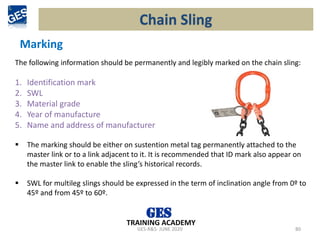
Marking
The following information should be permanently and legibly marked on the chain sling:
1. Identification mark
2. SWL
3. Material grade
4. Year of manufacture
5. Name and address of manufacturer
▪ The marking should be either on sustention metal tag permanently attached to the
master link or to a link adjacent to it. It is recommended that ID mark also appear on
the master link to enable the sling’s historical records.
▪ SWL for multileg slings should be expressed in the term of inclination angle from 0º to
45º and from 45º to 60º.
Chain Sling
GES-R&S- JUNE 2020 81
TRAINING ACADEMY
IN- SERVICE INSPECTION
All chain slings should be visually inspected by competent person prior to use or on a
regular basis. If any of the following faults are present the sling should be withdrawn from
service and referred to a Competent person:
1) Illegible marking
2) Distortion of the top terminal fittings.
3) Stretched chain.
4) Bent or twisted links.
Chain Sling
GES-R&S- JUNE 2020 82
TRAINING ACADEMY
5) Wear most common at the interlink seats.
6) Opening out of hooks
7) Ineffective safety catches where fitted.
8) Cuts, cracks and excessive corrosion.
Chain Sling
GES-R&S- JUNE 2020 83
TRAINING ACADEMY
Chain Sling
Safe Use
1) The sling must not be used to lift a load that is in excess of the SWL marked upon the
sling.
2) Ensure the sling hook is compatible with the lifting point. The load should be seated
well down in the sling hook, never on the point, nor wedged in the throat.
3) Chain is designed to support a load in a straight line. Therefore, chain should never be
loaded when twisted or worse, knotted.
4) Sling hooks of multi-leg slings should be positioned so that they face outward from the
load.
GES-R&S- JUNE 2020 84
TRAINING ACADEMY
Chain Sling
5) When back hooking the sling hook onto the master link or intermediate link to form a
basket hitch, care must be taken to ensure the link is large enough to accept the hook
freely without binding or overcrowding the components already attached to the link.
GES-R&S- JUNE 2020 85
TRAINING ACADEMY
Storage and Handling
When not in use chain slings should be returned to proper storage.
General requirement are as follow:
1) Dry free from injures pollution temperature extreme store.
2) Chain sling normally be kept on properly designed rack they should be not be left
lying on the ground after use where they may be damaged or lost.
3) Protect them from corrosion keep them cleaned and dried.
4) They shall not be dropped thrown down when being transported they should be
dragged across the floor surface.
Chain Sling
GES-R&S- JUNE 2020 86
TRAINING ACADEMY
5) Care must be taken to the chain slings which are lift on the crane
hook to ensure they don’t present danger to persons or property.
6) When one or more legs of multi leg slings are not being used ensure that they are
hocked back to the master link.
Chain Sling
GES-R&S- JUNE 2020 87
TRAINING ACADEMY
Practical
GES-R&S- JUNE 2020 88
TRAINING ACADEMY
Eyebolts
GES-R&S- JUNE 2020 89
TRAINING ACADEMY
Types of Eyebolts
Eyebolts
Collar Eyebolt
GES-R&S- JUNE 2020 90
TRAINING ACADEMY
Eyebolts
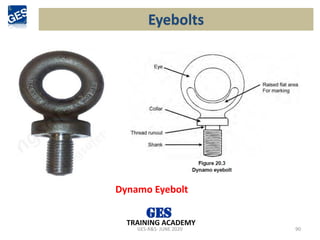
Dynamo Eyebolt
GES-R&S- JUNE 2020 91
TRAINING ACADEMY
Eyebolts
Eyebolt with link
GES-R&S- JUNE 2020 92
TRAINING ACADEMY
Marking
The following information should be permanently and legibly marked on each
eyebolt:-
1. Identification mark.
2. Safe working load.
3. Quality ie grade.
4. Screw thread type such as (M, BSW and UNC).
5. Year manufacture
Eyebolts
GES-R&S- JUNE 2020 93
TRAINING ACADEMY
In Service Inspection
All Eyebolts should be visually inspected by competent person prior to use or on a regular
basis. If any of the following faults are present the eyebolts should be withdrawn from
service and referred to a Competent person:
1) Distortion
2) Thread worn
3) Damage
4) SWL, thread identification and
identification markings missing or illegible.
Eyebolts
GES-R&S- JUNE 2020 94
TRAINING ACADEMY
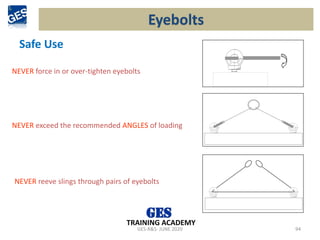
Safe Use
Eyebolts
NEVER force in or over-tighten eyebolts
NEVER exceed the recommended ANGLES of loading
NEVER reeve slings through pairs of eyebolts
GES-R&S- JUNE 2020 95
TRAINING ACADEMY
Eyebolts
Fitting the Eyebolt
1) Eyebolts should only be fitted by a trained person.
2) Inspect the eyebolt and tapped hole before fitting the eyebolt.
3) Ensure that the contacting surface around the tapped hole is smooth and
clean.
4) Ensure that the tapped hole has a fully formed thread and a long enough threaded
portion to engage with the full length of the eyebolt shank.
Attaching the Lifting Gear
1) Collar eyebolts without links need a shackle for connection to a hook.
2) If a single eyebolt is used for lifting a load which is liable to revolve or twist, a swivel
or swivel type hook should be used to prevent the eyebolt unscrewing.
GES-R&S- JUNE 2020 96
TRAINING ACADEMY
Eyebolts
3) Ensure that eyebolts are not overloaded due to the method of slinging, especially
when used in pairs. A sling should not be reeved through the eyebolts or shackles as
by this method the loading in the eyebolt is considerably increased.
GES-R&S- JUNE 2020 97
TRAINING ACADEMY
Storage and Handling
When not in use eye bolts should be returned to proper storage.
General requirement are as follow:
1) Dry free from injures pollution temperature extreme store.
2) Protect them from corrosion keep them cleaned and dried.
3) Eyebolts should be lightly oiled or greased to prevent corrosion.
Eyebolts
GES-R&S- JUNE 2020 98
TRAINING ACADEMY
Shackles
GES-R&S- JUNE 2020 99
TRAINING ACADEMY
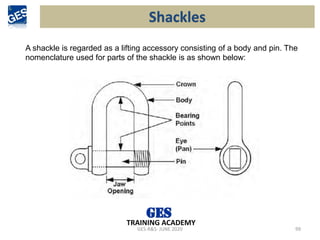
Shackles
A shackle is regarded as a lifting accessory consisting of a body and pin. The
nomenclature used for parts of the shackle is as shown below:
GES-R&S- JUNE 2020 100
TRAINING ACADEMY
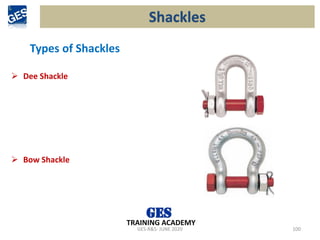
Types of Shackles
➢ Dee Shackle:
➢ Bow Shackle
Shackles
GES-R&S- JUNE 2020 101
TRAINING ACADEMY
Marking
Each shackle shall be legibly and indelibly marked. This marking shall include at
least the following information placed on the shackle by the manufacturer:
1) Working load limit in tonnes e.g. WLL 4,75
2) Grade
3) The manufacturer's name, symbol or code;
4) Traceability code.
Shackles
GES-R&S- JUNE 2020 102
TRAINING ACADEMY
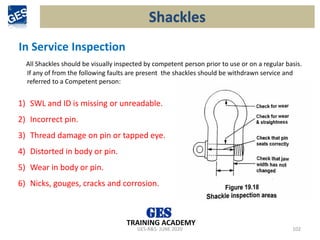
In Service Inspection
All Shackles should be visually inspected by competent person prior to use or on a regular basis.
If any of from the following faults are present the shackles should be withdrawn service and
referred to a Competent person:
1) SWL and ID is missing or unreadable.
2) Incorrect pin.
3) Thread damage on pin or tapped eye.
4) Distorted in body or pin.
5) Wear in body or pin.
6) Nicks, gouges, cracks and corrosion.
Shackles
GES-R&S- JUNE 2020 103
TRAINING ACADEMY
Safe Use
1) Select the correct type and capacity of the shackle for the particular application.
2) Before use, check the shackle’s body and pin are both identifiable with the same
quality grade.
3) Ensure that the pin is correctly screwed into the shackle eye and the collar of the pin
is fully seated on the shackle eye.
4) Ensure the correct pin length, it shall penetrate the full depth of the screwed eye.
5) If the pin does not seat correctly it may be bent or the thread may be too tight or the
pin hole out of alignment. Don’t use the shackle and refer to the competent person.
Shackles
GES-R&S- JUNE 2020 104
TRAINING ACADEMY
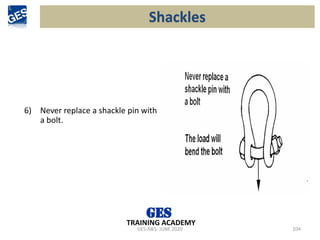
6) Never replace a shackle pin with
a bolt.
Shackles
GES-R&S- JUNE 2020 105
TRAINING ACADEMY
7) Avoid applications where, due to movement of the load or rope, the shackle
pin can roll and possibly unscrew.
Shackles
GES-R&S- JUNE 2020 106
TRAINING ACADEMY
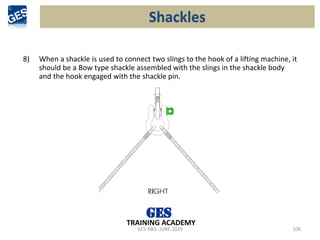
8) When a shackle is used to connect two slings to the hook of a lifting machine, it
should be a Bow type shackle assembled with the slings in the shackle body
and the hook engaged with the shackle pin.
Shackles
GES-R&S- JUNE 2020 107
TRAINING ACADEMY
9) The selection of the shape of the shackle body will depend on the intended
use.
Dee shackles are , in general, used to join two pieces of lifting equipment.
Bow shackles are, in general, used where more than one attachment is to be
made to the body.
Shackles
GES-R&S- JUNE 2020 108
TRAINING ACADEMY
Storage and Handling
When not in use shackles should be returned to proper storage.
General requirement are as follow:
1) Dry free from injures pollution temperature extreme store.
2) Shackles should not be dropped or thrown down.
3) Care should be taken to avoid damage to the screw threads.
4) Ensure that the shackle is fitted with correct pin before storage.
Shackles
GES-R&S- JUNE 2020 109
TRAINING ACADEMY
Practical
110
The use of manual lifting
appliances and accessories
GES-R&S- JUNE 2020
TRAINING ACADEMY
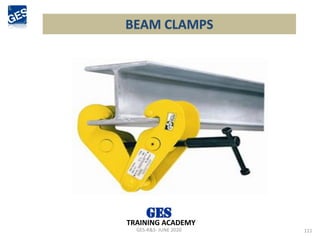
BEAM CLAMPS
111
GES-R&S- JUNE 2020
TRAINING ACADEMY
Beam Clamp
112
The beam clamp is a device designed to
attach to a suitable steel beam section
to provide a means of suspension for a
lifting appliance.
GES-R&S- JUNE 2020
TRAINING ACADEMY
TYPES OF BEAM CLAMP
113
GES-R&S- JUNE 2020
TRAINING ACADEMY
1) Adjustable type Beam Clamps
TYPES OF BEAM CLAMP
114
GES-R&S- JUNE 2020
TRAINING ACADEMY
2) Non-adjustable type Beam Clamps
Marking
115
1) Identification mark.
2) Working load limit or SWL.
3) Width of beam for which the clamp is designed or, in the case of an adjustable
clamp, the range of widths and the section of beam if applicable.
4) Toe thickness of beam if applicable.
5) Year of manufacture
6) Name and address of manufacturer
GES-R&S- JUNE 2020
TRAINING ACADEMY
Inspection
116
1) In the case of a clamp in-situ, distortion of beam to which clamp is attached.
2) Distortion of any part of the clamp.
3) Cracks especially at bends or changes of section, nicks, gouges and corrosion.
4) Wear at application and suspension points, pins, pivots and other moving parts.
5) Insecure locking arrangements including substitute nuts and bolts where used.
6) Illegible SWL or other markings.
GES-R&S- JUNE 2020
TRAINING ACADEMY
PLATE HANDLING CLAMPS
117
GES-R&S- JUNE 2020
TRAINING ACADEMY
TYPES OF PLATE HANDLING CLAMPS
118
GES-R&S- JUNE 2020
TRAINING ACADEMY
Type (1) - Clamps Lifting From the Edge of the Plate by Friction
TYPES OF PLATE HANDLING CLAMPS
119
GES-R&S- JUNE 2020
TRAINING ACADEMY
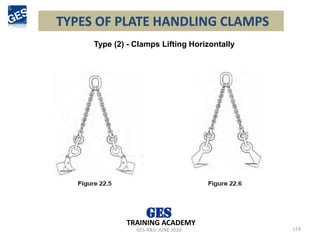
Type (2) - Clamps Lifting Horizontally
Marking
120
1) Range of SWL in straight pull and, where applicable, also at an angle to the side
plate of the clamp, specifying the angle.
2) Identification mark.
3) Range of plate thickness permitted.
4) Business name and address of the manufacturer.
5) Permissible gripping range.
6) Year of manufacture
GES-R&S- JUNE 2020
TRAINING ACADEMY
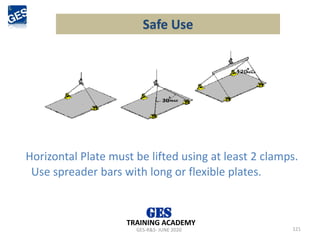
Horizontal Plate must be lifted using at least 2 clamps.
Use spreader bars with long or flexible plates.
Safe Use
121
GES-R&S- JUNE 2020
TRAINING ACADEMY
HAND OPERATED CHAIN HOISTS
122
GES-R&S- JUNE 2020
TRAINING ACADEMY
HAND OPERATED CHAIN HOISTS
123
Chain hoist used in lifting operation. It has two hooks one at the top to
connected to lifting equipment ( pad eye, trolley or crane hook with a
shackle), Second hook at the bottom to lift the load.
GES-R&S- JUNE 2020
TRAINING ACADEMY
TYPES OF HAND OPERATED CHAIN HOIST
124
GES-R&S- JUNE 2020
TRAINING ACADEMY
CHAIN HOIST PARTS
125
GES-R&S- JUNE 2020
TRAINING ACADEMY
Inspection
126
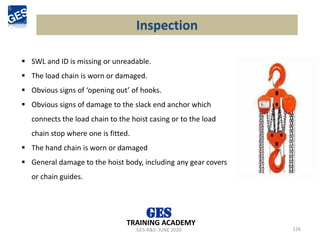
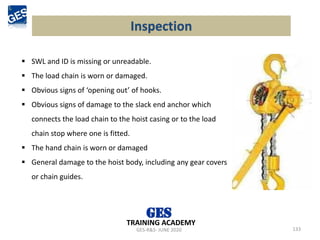
▪ SWL and ID is missing or unreadable.
▪ The load chain is worn or damaged.
▪ Obvious signs of ‘opening out’ of hooks.
▪ Obvious signs of damage to the slack end anchor which
connects the load chain to the hoist casing or to the load
chain stop where one is fitted.
▪ The hand chain is worn or damaged
▪ General damage to the hoist body, including any gear covers
or chain guides.
GES-R&S- JUNE 2020
TRAINING ACADEMY
Inspection
127
Check top Hook
Safety Latch
Check Data(ID, SWL)
Check Chain
Check bottom Hook
Safety Latch
Check Body
Check Chain end
GES-R&S- JUNE 2020
TRAINING ACADEMY
Marking
128
1- ID Number
2- SWL
3- Size and grade of the load chain
4- Name of maker or supplier
5- Year of Manufacture
GES-R&S- JUNE 2020
TRAINING ACADEMY
129
Storage and Handling
GES-R&S- JUNE 2020
TRAINING ACADEMY
1) Raise the bottom hook
2) Wrap the load chain
3) Wrap the hand chain
4) Secure the ends
GES-R&S- JUNE 2020 130
TRAINING ACADEMY
Practical
HAND OPERATED CHAIN LEVER HOISTS
131
GES-R&S- JUNE 2020
TRAINING ACADEMY
HAND OPERATED CHAIN LEVER HOISTS
132
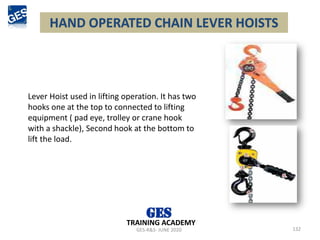
Lever Hoist used in lifting operation. It has two
hooks one at the top to connected to lifting
equipment ( pad eye, trolley or crane hook
with a shackle), Second hook at the bottom to
lift the load.
GES-R&S- JUNE 2020
TRAINING ACADEMY
Inspection
133
GES-R&S- JUNE 2020
TRAINING ACADEMY
▪ SWL and ID is missing or unreadable.
▪ The load chain is worn or damaged.
▪ Obvious signs of ‘opening out’ of hooks.
▪ Obvious signs of damage to the slack end anchor which
connects the load chain to the hoist casing or to the load
chain stop where one is fitted.
▪ The hand chain is worn or damaged
▪ General damage to the hoist body, including any gear covers
or chain guides.
Inspection
134
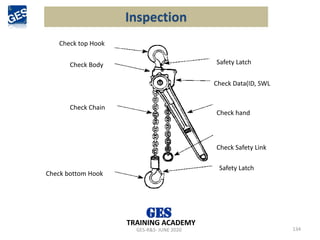
Check top Hook
Check bottom Hook
Safety Latch
Safety Latch
Check Data(ID, SWL
Check Body
Check Chain
Check hand
Check Safety Link
GES-R&S- JUNE 2020
TRAINING ACADEMY
Marking
135
GES-R&S- JUNE 2020
TRAINING ACADEMY
1- ID Number
2- SWL
3- Size and grade of the load chain
(in the case of link chain).
4- Name of maker or supplier
5- Year of Manufacture
136
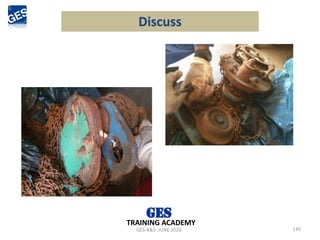
Discuss
GES-R&S- JUNE 2020
TRAINING ACADEMY
Discuss
137
GES-R&S- JUNE 2020
TRAINING ACADEMY
TRAVELLING GIRDER TROLLEYS
138
GES-R&S- JUNE 2020
TRAINING ACADEMY
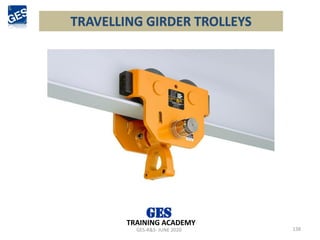
TRAVELLING GIRDER TROLLEYS
139
GES-R&S- JUNE 2020
TRAINING ACADEMY
▪ Girder trolleys are generally used as a means of moving a load suspended a
on structural section in conjunction with a hand or power operated lifting
appliance.
▪ They are therefore commonly used on runways, jib cranes, mobile gantries
and overhead travelling cranes.
140
TYPES OF GIRDER TROLLEY
GES-R&S- JUNE 2020
TRAINING ACADEMY
1) Combined hoist and trolley
TYPES OF GIRDER TROLLEY
141
GES-R&S- JUNE 2020
TRAINING ACADEMY
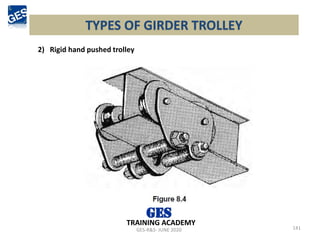
2) Rigid hand pushed trolley
TYPES OF GIRDER TROLLEY
142
GES-R&S- JUNE 2020
TRAINING ACADEMY
3) Multiple trolley with hook suspended chain hoist
Marking
143
The following information should be permanently and legibly marked on a suitable part
of the trolley:
1) Identification mark.
2) SWL or rated capacity.
3) An indication as to whether it is suitable for hand or power operated lifting appliances.
4) The width of the runway beam for which the trolley is designed or, in the case of an
adjustable trolley, the range of widths.
5) Year of manufacture
6) Name and address of manufacturer.
GES-R&S- JUNE 2020
TRAINING ACADEMY
Inspection
144
1) Appreciable wear of the trolley wheel treads and bearings or damage to flanges.
2) Insecurity of the wheels and axle pins.
3) Distortion, particularly in the side plates and load bar.
4) Wear on load bearing points.
5) Cracked or defective welding.
6) Incorrectly substituted components.
7) Worn, corroded or damaged hand chain particularly on the bearing surface on the
inside of the links but also the outside of the links, bearing in mind possible injury to
the operatives’ hands.
8) Illegible SWL or other markings.
GES-R&S- JUNE 2020
TRAINING ACADEMY
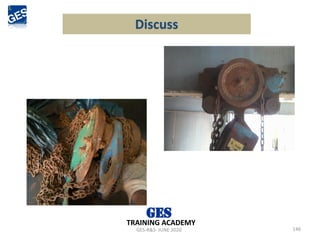
Discuss
145
GES-R&S- JUNE 2020
TRAINING ACADEMY
Discuss
146
GES-R&S- JUNE 2020
TRAINING ACADEMY
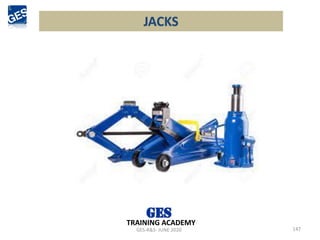
JACKS
147
GES-R&S- JUNE 2020
TRAINING ACADEMY
JACKS
148
GES-R&S- JUNE 2020
TRAINING ACADEMY
TYPES OF JACK
1) Hydraulic Jacks:
- Hydraulic jacks use oil as the lifting medium, the body of the jack acting as a
reservoir for the oil. When the jack is operated, oil is passed under pressure through
a system of non-return valves to the base of the ram chamber
- Hydraulic jack bodies are commonly manufactured from aluminium, steel or cast
iron. The material used affects the design, size, self-weight and capacity of the jack.
JACKS
149
GES-R&S- JUNE 2020
TRAINING ACADEMY
2) Mechanical Jacks:
- Mechanical jacks use ratchet, screw or gear mechanisms as the lifting medium.
Reversal of the mechanism is used to lower the jack.
- Mechanical jacks are usually manufactured from cast ferrous materials although
some models are available manufactured from aluminium.
MARKING
150
GES-R&S- JUNE 2020
TRAINING ACADEMY
The following information should be permanently and legibly marked on a suitable
part or parts of the jack:
(1) Identification mark(s).
(2) Capacity, i.e. maximum load to be lifted on head and/or toe.
(3) Name of manufacturer or supplier.
(4) Year of manufacture.
SAFE USE OF JACKS
151
GES-R&S- JUNE 2020
TRAINING ACADEMY
In addition to any specific instructions relating to the safe use of the jack issued by
the manufacturer, the following points should be observed:
1) In many cases, it will not be possible for the operatives to see all of the load and
it will be necessary to have a Responsible Person in charge of the operation to
ensure the load is kept level and that each jack carries its correct share of the
load within the limits of operation.
2) The floor must be capable of withstanding the load that will be imposed on it by
the jacks. Where necessary, floor plates should be positioned under the jacks to
spread the load over a wider area.
3) The surface on which the jack is to be placed should be level and even, allowing
the base of the jack to sit firmly without any tendency to rock or tilt. If necessary,
suitable floor plates or packers should be used to ensure this condition.
SAFE USE OF JACKS
152
GES-R&S- JUNE 2020
TRAINING ACADEMY
4) The jacking point on the load must be carefully selected so as to ensure the
jacking operation does not damage the load.
5) Never raise a load higher than is necessary. Use suitable packers to ensure the
load will not tilt or fall in the event of a jack failure.
6) Jacking operations are often carried out in confined spaces as no other means of
lifting can gain easy access. Care must be taken to ensure operatives do not
become trapped or pinned by the movement of the load and that they always
have a clear exit.
7) Under no circumstances should anyone be permitted to work or climb on a load
which is supported by jacks.
SNATCH / SHEAVE BLOCK
153
GES-R&S- JUNE 2020
TRAINING ACADEMY
SNATCH / SHEAVE BLOCK
154
GES-R&S- JUNE 2020
TRAINING ACADEMY
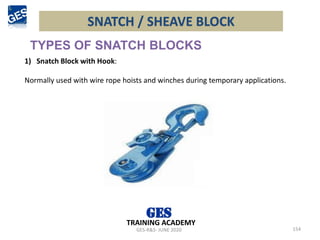
TYPES OF SNATCH BLOCKS
1) Snatch Block with Hook:
Normally used with wire rope hoists and winches during temporary applications.
SNATCH / SHEAVE BLOCK
155
GES-R&S- JUNE 2020
TRAINING ACADEMY
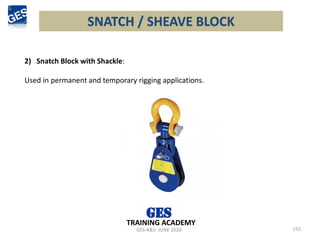
2) Snatch Block with Shackle:
Used in permanent and temporary rigging applications.
MARKING
156
GES-R&S- JUNE 2020
TRAINING ACADEMY
The following information should be permanently and legibly marked on the
snatch/sheave block:
1) Type
2) Size of block
3) Size of wire line to be used
4) Working load limit
5) The manufacturer’s name
6) Identification mark(s).
SAFE USE OF SNATCH BLOCKS
157
GES-R&S- JUNE 2020
TRAINING ACADEMY
In addition to any specific instructions relating to the safe use of the jack issued by
the manufacturer, the following points should be observed:
1) ALWAYS inform yourself … Ask your employer for the Snatch Block safe use
instructions.
2) ALWAYS comply with applicable Federal and local regulations.
3) ALWAYS know applied lift system load.
4) NEVER use a Snatch Block without training.
5) NEVER use a Snatch Block without a legible product identifer.
6) NEVER overload a Snatch Block.
SAFE USE OF SNATCH BLOCKS
158
GES-R&S- JUNE 2020
TRAINING ACADEMY
7) NEVER ride on a Snatch Block or load.
8) NEVER rig a Snatch Block improperly.
9) NEVER use a worn – out or damaged Snatch Block.
10) NEVER use a Snatch Block in extreme temperatures.
11) NEVER use a Snatch Block in alkaline acidic conditions
GES-R&S- JUNE 2020 159
TRAINING ACADEMY
Calculations
GES-R&S- JUNE 2020 160
TRAINING ACADEMY
Calculations
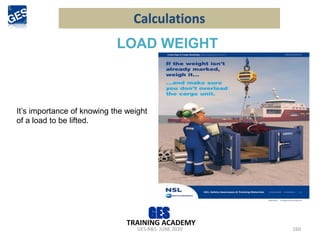
It’s importance of knowing the weight
of a load to be lifted.
LOAD WEIGHT
HOW CAN YOU FIND THE WEIGHT?
GES-R&S- JUNE 2020 161
TRAINING ACADEMY
Calculations
The following gives guidance as to the various ways of obtaining this information.
1. Look to see if the weight is marked on the load. If it is, check to ensure that it is
the weight of all parts of the load.
2. Check the weight stated on any documentation.
3. Look at a drawing of the load. If the weight is marked, check as in (1) above to
ensure it includes all parts of the load.
4. If the load is still on a trailer or truck, weigh it on a weighbridge.
5. Estimate the weight of the load using tables of weights.
GES-R&S- JUNE 2020 162
TRAINING ACADEMY
Calculations
3. Look at a drawing of the load. If the weight is marked, check as in (1) above to
ensure it includes all parts of the load.
4. If the load is still on a trailer or truck, weigh it on a weighbridge.
5. Estimate the weight of the load using tables of weights.
GES-R&S- JUNE 2020 163
TRAINING ACADEMY
Calculations
GES-R&S- JUNE 2020 164
TRAINING ACADEMY
Calculations
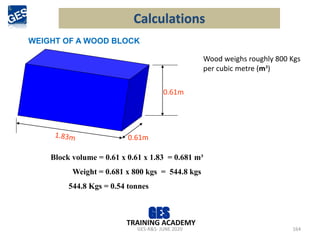
Block volume = 0.61 x 0.61 x 1.83 = 0.681 m³
Weight = 0.681 x 800 kgs = 544.8 kgs
544.8 Kgs = 0.54 tonnes
Wood weighs roughly 800 Kgs
per cubic metre (m³)
0.61m
0.61m
WEIGHT OF A WOOD BLOCK
GES-R&S- JUNE 2020 165
TRAINING ACADEMY
Calculations
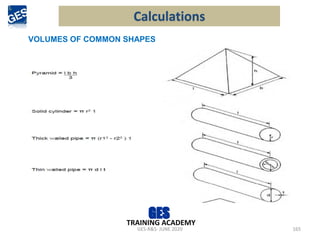
VOLUMES OF COMMON SHAPES
GES-R&S- JUNE 2020 166
TRAINING ACADEMY
Calculations
VOLUMES OF COMMON SHAPES
GES-R&S- JUNE 2020 167
TRAINING ACADEMY
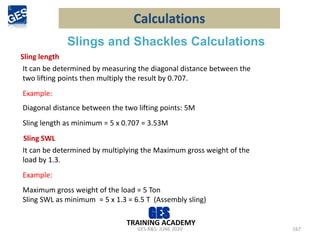
It can be determined by measuring the diagonal distance between the
two lifting points then multiply the result by 0.707.
Example:
Diagonal distance between the two lifting points: 5M
Sling length as minimum = 5 x 0.707 = 3.53M
Sling length
Sling SWL
It can be determined by multiplying the Maximum gross weight of the
load by 1.3.
Example:
Maximum gross weight of the load = 5 Ton
Sling SWL as minimum = 5 x 1.3 = 6.5 T (Assembly sling)
Calculations
Slings and Shackles Calculations
GES-R&S- JUNE 2020 168
TRAINING ACADEMY
Sling SWL
For single slings:
In case of using two slings: 6.5 ÷ 1.4 = 4.6 t
In case of using Three or four slings: 6.5 ÷ 2.1 = 3.1 t
Shackle size and SWL
▪ The shackle should be equal or greater than the sling leg which
attached to it.
▪ Ensure to use the suitable and safe size to avoid any jamming or
distortion.
Calculations
GES-R&S- JUNE 2020 169
TRAINING ACADEMY
Practical
GES-R&S- JUNE 2020 170
TRAINING ACADEMY
Balance and stability
GES-R&S- JUNE 2020 171
TRAINING ACADEMY
Balance and stability
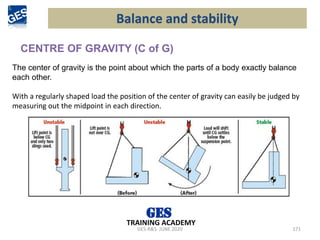
CENTRE OF GRAVITY (C of G)
The center of gravity is the point about which the parts of a body exactly balance
each other.
With a regularly shaped load the position of the center of gravity can easily be judged by
measuring out the midpoint in each direction.
GES-R&S- JUNE 2020 172
TRAINING ACADEMY
Balance and stability
GES-R&S- JUNE 2020 173
TRAINING ACADEMY
Safe Use of Tag Lines
GES-R&S- JUNE 2020 174
TRAINING ACADEMY
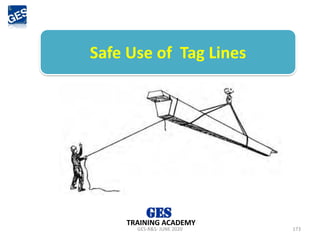
▪ Tag lines should be used in pairs and are “soft” lines (usually polypropylene).
They should be made up from single / continual lengths of rope, i.e. no joining
knots.
▪ Tag lines should be tied to the load and NOT the rigging / accessories.
▪ Tag lines should only be used in normal operating conditions and not as a
control to enable lifting operations to be carried out in adverse weather
conditions.
Safe Use of Tag Lines
GES-R&S- JUNE 2020 175
TRAINING ACADEMY
Do not wrap a tag line around your
hand.
Safe Use of Tag Lines
GES-R&S- JUNE 2020 176
TRAINING ACADEMY
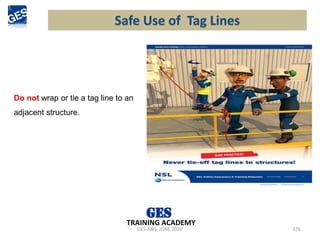
Do not wrap or tie a tag line to an
adjacent structure.
Safe Use of Tag Lines
GES-R&S- JUNE 2020 177
TRAINING ACADEMY
To avoid walking under the load…
Always use a boat hook to retrieve
the tag line.
Safe Use of Tag Lines
GES-R&S- JUNE 2020 178
TRAINING ACADEMY
To avoid trapped hands and fingers…
Always use a push / pull pole
Safe Use of Tag Lines
GES-R&S- JUNE 2020 179
TRAINING ACADEMY
Never allow tag line to coil around
your feet.
Safe Use of Tag Lines
GES-R&S- JUNE 2020 180
TRAINING ACADEMY
Practical
GES-R&S- JUNE 2020 181
TRAINING ACADEMY
Slinging Guidelines
GES-R&S- JUNE 2020 182
TRAINING ACADEMY
Slinging Guidelines
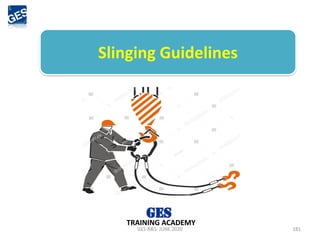
Only bundle together tubulars of the
same diameter. If you mix them up,
the smaller ones will slide out if the
bundle gets jarred or tilted.
GES-R&S- JUNE 2020 183
TRAINING ACADEMY
Slinging Guidelines
Never hammer down the choke hitch
to tighten it. This will increase the
effective sling angle and weaken the
sling.
GES-R&S- JUNE 2020 184
TRAINING ACADEMY
Slinging Guidelines
The slings should be positioned so
that they are a quarter of the tubular
length in from each end.
GES-R&S- JUNE 2020 185
TRAINING ACADEMY
Slinging Guidelines
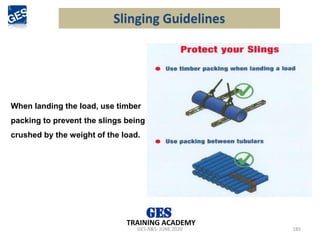
When landing the load, use timber
packing to prevent the slings being
crushed by the weight of the load.
GES-R&S- JUNE 2020 186
TRAINING ACADEMY
Slinging Guidelines
Avoid lashing legs and accidental
hook-ups
GES-R&S- JUNE 2020 187
TRAINING ACADEMY
Slinging Guidelines
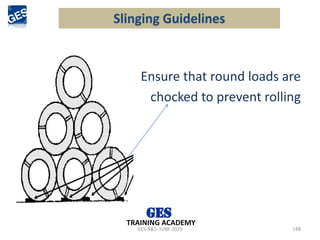
Ensure that round loads are
chocked to prevent rolling
GES-R&S- JUNE 2020 188
TRAINING ACADEMY
Slinging Guidelines
GES-R&S- JUNE 2020 189
TRAINING ACADEMY
Slinging Guidelines
GES-R&S- JUNE 2020 190
TRAINING ACADEMY
Slinging Guidelines
GES-R&S- JUNE 2020 191
TRAINING ACADEMY
Slinging Guidelines
GES-R&S- JUNE 2020 192
TRAINING ACADEMY
Slinging Guidelines
GES-R&S- JUNE 2020 193
TRAINING ACADEMY
Slinging Guidelines
GES-R&S- JUNE 2020 194
TRAINING ACADEMY
Lifting Operation Awareness
GES-R&S- JUNE 2020 195
TRAINING ACADEMY
Lifting Operation Awareness
Always keep hands clear of rigging as
slack is taken up.
GES-R&S- JUNE 2020 196
TRAINING ACADEMY
Lifting Operation Awareness
Avoid placing tubulars next to tanks.
GES-R&S- JUNE 2020 197
TRAINING ACADEMY
Lifting Operation Awareness
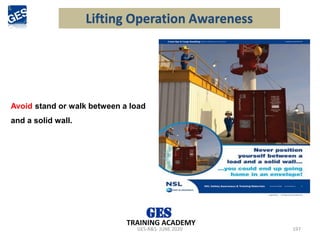
Avoid stand or walk between a load
and a solid wall.
GES-R&S- JUNE 2020 198
TRAINING ACADEMY
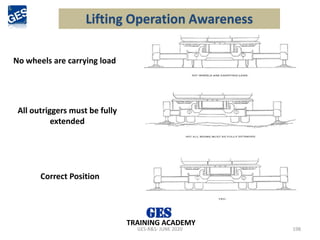
All outriggers must be fully
extended
Correct Position
No wheels are carrying load
Lifting Operation Awareness
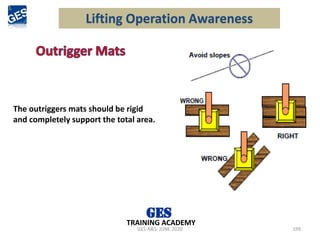
The outriggers mats should be rigid
and completely support the total area.
GES-R&S- JUNE 2020 199
TRAINING ACADEMY
Lifting Operation Awareness
Don’t stand under suspended loads
GES-R&S- JUNE 2020 200
TRAINING ACADEMY
Lifting Operation Awareness
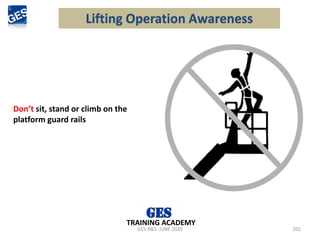
Don’t sit, stand or climb on the
platform guard rails
GES-R&S- JUNE 2020 201
TRAINING ACADEMY
Lifting Operation Awareness
GES-R&S- JUNE 2020 202
TRAINING ACADEMY
Performing the Lifting Operation
1) General Safety Precautions
GES-R&S- JUNE 2020 203
TRAINING ACADEMY
Performing the Lifting Operation
Lifts utilising lifting appliances and accessories shall not commence unless:
• A suitable PTW has been generated, and the written lift plan.
• The weight of the load is known and verified.
• The load does not exceed the capacity of the lifting equipment.
• Operators of all lifting equipment have been trained and certified for that equipment.
• Rigging of the load is carried out by a competent person.
• Lifting equipment has been certified for use and colour coded.
2) Personnel Safety Precautions
GES-R&S- JUNE 2020 204
TRAINING ACADEMY
The following general safety precautions shall be followed by all personnel who are
involved in lifting operations:
• All lifting equipment shall be subjected to a suitable pre-use inspection by the user prior to
use.
• All lifting components shall be operated within manufacturer specifications.
• Documentation of operator training shall be provided.
• Lifting equipment and work areas shall be kept free of oil, grease, and trash.
• All personnel shall wear the required PPE.
• Personnel shall not walk under a suspended load.
Performing the Lifting Operation
3) Toolbox Talk
GES-R&S- JUNE 2020 205
TRAINING ACADEMY
The appointed person shall hold a pre lift meeting / Toolbox Talk (TBT) with all personnel
involved in the lifting operation to ensure that all members of the work party are aware of
the scope of work and shall be signed by all.
Performing the Lifting Operation
4) Arrival on Site
➢ All cranes / mobile appliances arriving on site shall have current inspection / examination
certification.
➢ The mobile appliance operator shall have:
▪ The appropriate operator’s license and training certificates relating to the equipment he is
to operate.
▪ Current valid duty / load radius charts for the crane / configuration being used for the lift.
5) Crane / Mobile Appliance Set Up Requirements
GES-R&S- JUNE 2020 206
TRAINING ACADEMY
• All mobile appliance fitted with outriggers must be set up level.
• Wheels must be clear of the ground at all times.
• Outrigger load spreader mats shall be used for every lift.
• All cranes / mobile appliances require adequate space for the correct deployment of
outriggers. In addition, each crane shall be able to slew and manoeuvre the load with
adequate clearance from obstructions.
Performing the Lifting Operation
GES-R&S- JUNE 2020 207
TRAINING ACADEMY
▪ All lifting operations shall be conducted following the agreed lift plan.
▪ Personnel shall have an escape route in case of an unexpected movement of the load or
equipment. Barriers may be required for this.
▪ Never use lifting equipment in excess of its rated capacity and always ensure that the
lifting equipment remains in a stable condition throughout the lift.
▪ During the lift, all personnel involved shall have the responsibility to stop the lifting
operation at any time if they believe that the operation could, or has, become unsafe or
there is a change to the agreed lift plan.
Performing the Lifting Operation
6) Conducting the Lift
7) Supervision
All lifting operations shall be appropriately supervised.
GES-R&S- JUNE 2020 208
TRAINING ACADEMY
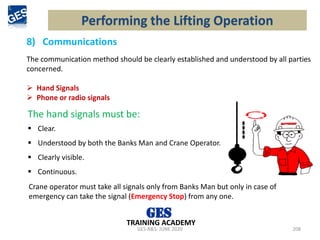
The hand signals must be:
▪ Clear.
▪ Understood by both the Banks Man and Crane Operator.
▪ Clearly visible.
▪ Continuous.
Crane operator must take all signals only from Banks Man but only in case of
emergency can take the signal (Emergency Stop) from any one.
Performing the Lifting Operation
8) Communications
The communication method should be clearly established and understood by all parties
concerned.
➢ Hand Signals
➢ Phone or radio signals
9) Landing the Load
GES-R&S- JUNE 2020 209
TRAINING ACADEMY
Personnel must remain clear of the landing area during this part of the lifting operation,
and may only approach the load once it has been lowered to below waist height. Only at
this point can the load be handled by the Slinger / Load Handler.
Performing the Lifting Operation
10) Completion of the Lift
▪ Once the task has been completed, the load shall be de-rigged of all lifting equipment
and the crane folded up.
▪ Prior to leaving site, all personnel shall ensure that all equipment is removed the work
area is clean and tidy.
GES-R&S- JUNE 2020 210
TRAINING ACADEMY
Practical
GES-R&S- JUNE 2020 211
TRAINING ACADEMY

Rigging & Slinging Training Course.pdf

  • 1.
    GES-R&S- JUNE 20201 Rigging & Slinging Training Course TRAINING ACADEMY
  • 2.
    GES-R&S- JUNE 20202 Instructor Name : Did you sign in your attendance Sheet?? The purpose of attendance Sheet Concern for the quality assurance Prove the data for certification Instructor E-mail : TRAINING ACADEMY
  • 3.
    GES-R&S- JUNE 20203 TRAINING ACADEMY
  • 4.
    GES-R&S- JUNE 20204 TRAINING ACADEMY
  • 5.
    GES-R&S- JUNE 20205 TRAINING ACADEMY Lifting Operation and Lifting Equipment Regulation 1998 LOLER Provision and Use of Work Equipment Regulations 1998 PUWER LEEA Code of Practice Edition 9 Introduction The Health And Safety At Work Etc Act 1974 HASWA References
  • 6.
    GES-R&S- JUNE 20206 TRAINING ACADEMY Steel wire rope slings —Safety BS EN13414-1 & 3:2003 Forged steel shackles for general lifting purposes — Dee shackles and bow shackles BS EN13889:2003+A1:2008 Short link chain for lifting purposes —Safety BS EN 818-4 Introduction Textile slings —Safety BS EN 1492-1 & 2 :2000 Code of Practice for Safe use of cranes BS 7121-1:2016
  • 7.
    GES-R&S- JUNE 20207 TRAINING ACADEMY Legislation
  • 8.
    GES-R&S- JUNE 20208 TRAINING ACADEMY Covers existing used leased and new equipment LOLER Key Regulations ▪ Regulation 4: Strength and stability ▪ Regulation 5: Lifting equipment for lifting persons ▪ Regulation 6: Positioning and installation ▪ Regulation 7: Marking of lifting equipment ▪ Regulation 8: Organization of lifting operations ▪ Regulation 9: Thorough examination and inspection ▪ Regulation 10: Reports and defects ▪ Regulation 11: Keeping of information Lifting Operations and Lifting Equipment Regulations 1998 LOLER What does LOLER apply to? LOLER applies to the use of lifting equipment provided as work equipment.
  • 9.
    GES-R&S- JUNE 20209 TRAINING ACADEMY What does PUWER apply to? PUWER applies to the provision and use of all work equipment The Essentials of PUWER PUWER places duties on the employer to ensure that: ❑ Work equipment is suitable for the purpose for which it is to be used. ❑ The working conditions and risk to health and safety of personnel in which the work equipment is used is to be considered. ❑ Equipment is suitably maintained and a log kept up to date. ❑ Equipment is inspected on a regular basis (ref. LOLER). ❑ All inspection and maintenance records are kept and recorded. ❑ All persons using work equipment have sufficient information pertaining to its use. Provision and Use of Work Equipment Regulations 1998 PUWER
  • 10.
    GES-R&S- JUNE 202010 TRAINING ACADEMY PUWER Key Regulations ▪ Regulation 4: Suitability of work equipment ▪ Regulation 5: Maintenance ▪ Regulation 6: Inspection ▪ Regulation 7: Specific risks ▪ Regulation 8: Information and Instructions ▪ Regulations 9: Training Provision and Use of Work Equipment Regulations 1998 PUWER
  • 11.
    GES-R&S- JUNE 202011 TRAINING ACADEMY The Health And Safety At Work Etc Act 1974 HASWA Employer and employee have a common law duty of care to each other and to other employees. Health and Safety at Work Act Section 2 Employers General Duty: Duty to ensure so far as is reasonably practicable, the health, safety and welfare at work of all his employees” 1. Safe plant and systems of work 2. Safe use, handling, storage and transportation of articles and substances 3. Information, instruction, training and adequate supervision (I.I.T.S) 4. Safe place of work and a safe means of access and egress 5. Safe working environment and adequate welfare facilities Duty of Care
  • 12.
    GES-R&S- JUNE 202012 TRAINING ACADEMY The Health And Safety At Work Etc Act 1974 HASWA Health and Safety at Work Act Section 7 Duty of Employees at Work It shall be the duty of every employee whilst at work:- ▪ To take care of their own health and safety and of any other person who may be affected by their acts or omissions. ▪ To co-operate with their employer. ▪ Use PPE provided by your employer.
  • 13.
    GES-R&S- JUNE 202013 TRAINING ACADEMY Risk Assessment
  • 14.
    GES-R&S- JUNE 202014 TRAINING ACADEMY Definition Hazard: • A hazard is something (object or situation) that has the potential to cause harm. Risk: (a combination of likelihood and severity) • Risk is that likelihood that the harm from the hazard is realized Danger: • A liability or exposure to harm; something that causes peril Likelihood: • How likely it is that someone could be harmed by the hazard Severity: • If the potential for harm was to occur, how severe would the accident be?
  • 15.
    GES-R&S- JUNE 202015 TRAINING ACADEMY Five Steps to Risk Assessment Identify the hazards Decide who may be harmed and how Evaluate the risks and decide on precautions (control measures) Record your findings Review and monitor
  • 16.
    GES-R&S- JUNE 202016 TRAINING ACADEMY Even where engineering controls and safe systems of work have been applied, some hazards might remain. These include injuries to: ▪ The lungs, e.g. from breathing in contaminated air ▪ The head and feet, e.g. from falling materials ▪ The eyes, e.g. from flying particles or splashes of corrosive liquids ▪ The skin, e.g. from contact with corrosive materials ▪ The body, e.g. from extremes of heat or cold PPE is needed in these cases to reduce the risk. Personal Protective Equipment (PPE)
  • 17.
    GES-R&S- JUNE 202017 TRAINING ACADEMY Key Definitions
  • 18.
    GES-R&S- JUNE 202018 TRAINING ACADEMY Competent Person An individual, who, by way of education, training, experience and defined assessment, is knowledgeable of applicable standards, can identify workplace hazards relating to the specific operation, is designated by the employer and has authority to take appropriate actions. Lifting Accessory A device that is used or designed to be used to connect a load to a lifting appliance and which does not form part of the load e.g. wire sling, fiber sling, shackle, hook etc. Lifting Appliance A device capable of lifting or lowering a load and includes its attachments used for anchoring, fixing or supporting it e.g. chain hoist, beam clamp, mobile crane, winch etc. Lift Category A categorisation of lifting operations reflecting the risk and the level of control required. Key Definitions
  • 19.
    GES-R&S- JUNE 202019 TRAINING ACADEMY Lifting Equipment Generic term used to describe work equipment that covers both appliances and accessories. Lift Plan A document which gives step by step details of the ‘lift’. The document also identifies all the lifting equipment and lifting accessories to be used, the lifting equipment configuration and details of responsible persons. The lift plan should also have attached, or provide, details of the sites safety measures, relevant drawings, illustrations and data. Safe Working Load (SWL) The maximum load (as determined by a competent person) that an item of lifting equipment or system may raise, lower or in a given configuration or environmental condition (see WLL below). The designated Lifting Operations competent person must establish the safe loading limit of all components used in any lift and must NOT exceed the SWL or WLL. Key Definitions
  • 20.
    GES-R&S- JUNE 202020 TRAINING ACADEMY Working Load Limit (WLL) Maximum load that lifting equipment is designed to raise lower or suspend. The WLL does not account for particular service conditions which may affect the final rating of the equipment. Minimum Breaking Load (MBL) The minimum breaking load is the calculated load at below which the item will not break or fail due to distortion. Mode Factor A factor applied by the user (slinger / rigger) that takes into account the geometry of a sling assembly to obtain the maximum load it may lift for a particular mode of use. Colour Code A method of marking equipment to give a visual indication of its certification status. Key Definitions
  • 21.
    GES-R&S- JUNE 202021 TRAINING ACADEMY Roles and Duties of The Slinger
  • 22.
    GES-R&S- JUNE 202022 TRAINING ACADEMY ➢ The slinger should be properly trained in all aspects of slinging loads and signalling, and be authorized by the appointed person. ➢ The slinger should be responsible for: ▪ Carrying out pre-use and post-use checks of lifting accessories. ▪ Attaching and detaching the load to and from the crane load-lifting attachment. ▪ Using the correct lifting accessories and other equipment in accordance with the lift plan. ➢ Ensure that slings are not used at an excessive angle. ➢ Ensure the load is free to lift. ➢ Assume a safe position during lifting operations and be aware of the position of others. Roles and Duties of The Slinger Slinger Responsibilities
  • 23.
    GES-R&S- JUNE 202023 TRAINING ACADEMY ➢ Continuously monitor the lifting operation. ➢ Remain in communication with all parties at all times. ➢ Ensure tag lines are used safely. ➢ Stop and report any unsafe practices or actions. Roles and Duties of The Slinger
  • 24.
    GES-R&S- JUNE 202024 TRAINING ACADEMY Minimum Attributes of The Slinger Rigger / Slinger should be: ▪ Be 18 years of age or over. ▪ Fit, with particular regard to eyesight, hearing, reflexes and agility. ▪ Physically able to handle lifting accessories and equipment. ▪ Able to establish weights, balance loads and judge distances, heights and clearances. ▪ Trained in the techniques of slinging. ▪ Capable of selecting accessories that have been identified in the lift plan. ▪ Trained in the techniques of signalling and instructed in a common signal Code. ▪ Capable of giving clear verbal instructions where audio equipment (e.g. radio) is used. ▪ Authorized to carry out slinging duties. Roles and Duties of The Slinger
  • 25.
    GES-R&S- JUNE 202025 TRAINING ACADEMY Steel Wire Rope Slings
  • 26.
    Types of WireRope Sling GES-R&S- JUNE 2020 26 TRAINING ACADEMY Single Leg Steel Wire Rope Sling
  • 27.
    Types of Termination GES-R&S-JUNE 2020 27 TRAINING ACADEMY Soft Eye Thimble Eye Steel Wire Rope Sling
  • 28.
    GES-R&S- JUNE 202028 TRAINING ACADEMY Steel Wire Rope Sling
  • 29.
    Fittings GES-R&S- JUNE 202029 TRAINING ACADEMY Steel Wire Rope Sling
  • 30.
    GES-R&S- JUNE 202030 TRAINING ACADEMY Steel Wire Rope Sling Single Leg Wire Rope Length
  • 31.
    Multi Leg WireRope Length GES-R&S- JUNE 2020 31 TRAINING ACADEMY Steel Wire Rope Sling
  • 32.
    GES-R&S- JUNE 202032 TRAINING ACADEMY Single leg sling . Can be used in A- Straight Lift : Max load to be lifted must not exceed the WLL marked on the sling. Steel Wire Rope Sling Single Leg Sling (Method of use) The most commonly used methods for effectively balanced load illustrated as follow:
  • 33.
    GES-R&S- JUNE 202033 TRAINING ACADEMY B- Choke hitch: Max load to be lifted must not exceed the 0.8 x WLL marked on the sling Steel Wire Rope Sling
  • 34.
    GES-R&S- JUNE 202034 TRAINING ACADEMY C- Double wrapped choke hitch: Max load to be lifted must not exceed the 0.8 x WLL marked on the sling. Steel Wire Rope Sling
  • 35.
    GES-R&S- JUNE 202035 TRAINING ACADEMY D- Double and choke hitch: Max load to be lifted must not exceed the 1.6x WLL marked on the sling Steel Wire Rope Sling
  • 36.
    GES-R&S- JUNE 202036 TRAINING ACADEMY E- Basket hitch : ▪ By hooking back to the master link, with the parts of the rope inclined at angles between 0- 45° to the vertical and included angle (0-90°) = never exceed the SWL marked. ▪ In this arrangement the full load is taken by the master link. Steel Wire Rope Sling
  • 37.
    GES-R&S- JUNE 202037 TRAINING ACADEMY F- Basket hitch : with both ends onto the hook, or connected by suitable shackle. The parts of the rope disposed at an angles between (inclined angle 0-45° to the vertical) and included angle 0- 90° = never exceed the SWL marked X 1.4 Steel Wire Rope Sling
  • 38.
    GES-R&S- JUNE 202038 TRAINING ACADEMY Two Leg Sling (Method of use) Two leg sling . Can be used in Steel Wire Rope Sling A- straight lift : Max load to be lifted must not exceed the WLL marked on the sling
  • 39.
    GES-R&S- JUNE 202039 TRAINING ACADEMY B- Straight Lift : ▪ When two single leg slings of the same length and SWL are used for a straight lift. The max. load to be lifted must not exceed 1.4 × SWL marked on a single sling. ▪ It is recommended that the upper ends of the sling legs connected by shackle, link or ring to prevent over crowded hook of the lifting appliance. Steel Wire Rope Sling
  • 40.
    GES-R&S- JUNE 202040 TRAINING ACADEMY C- Choke Hitch: Max load to be lifted must not exceed the 0.8 x WLL marked on the sling. Steel Wire Rope Sling
  • 41.
    GES-R&S- JUNE 202041 TRAINING ACADEMY D- Choke hitch: ▪ When two single leg slings of the same length and SWL are used in a choke hitch. The max load to be lifted must not exceed 0.8 × 1.4 × SWL marked on a single sling. ▪ It is recommended that the upper ends of the sling legs connected by shackle, link or ring to prevent over crowded hook of the lifting appliance. Steel Wire Rope Sling
  • 42.
    GES-R&S- JUNE 202042 TRAINING ACADEMY E- Basket hitch : when the two leg sling is used in basket hitch the max. load to be lifted must not exceed the SWL marked on the sling. Steel Wire Rope Sling
  • 43.
    GES-R&S- JUNE 202043 TRAINING ACADEMY F- Basket hitch: when two single leg slings of the same length and SWL are used in basket hitch with the ends of the slings connected to the hook by suitable shackles (no need to use shackle in case of ramshorn hook). The max load to be lifted must not exceed 2.1 × SWL marked on a single sling. Steel Wire Rope Sling
  • 44.
    GES-R&S- JUNE 202044 TRAINING ACADEMY Three Leg Sling (Method of use) Three leg sling . Can be used in Steel Wire Rope Sling A- Straight lift : Max load to be lifted must not exceed the WLL marked on the sling for the appropriate range of angles.
  • 45.
    GES-R&S- JUNE 202045 TRAINING ACADEMY B- Choke & Basket hitch: ▪ The use of three leg sling in either choke or basket hitch is uncommon method. If used , care must be taken to ensure that all legs are carrying an equal share of the load. ▪ When used in choke hitch. The max load to be lifted must not exceed 0.8 x SWL marked on the sling for the appropriate range of angles. ▪ When used in basket hitch. The max load to be lifted must not exceed SWL marked on the sling for the appropriate range of angles. Steel Wire Rope Sling
  • 46.
    GES-R&S- JUNE 202046 TRAINING ACADEMY Four Leg Sling (Method of use) Four leg sling . Can be used in Steel Wire Rope Sling A- straight lift: Max load to be lifted must not exceed the WLL marked on the sling for the appropriate range of angles.
  • 47.
    GES-R&S- JUNE 202047 TRAINING ACADEMY B- Choke & Basket hitch: ▪ The use of four leg sling in either choke or basket hitch is uncommon method. If used , care must be taken to ensure that all legs are carrying an equal share of the load. ▪ When used in choke hitch. The max load to be lifted must not exceed 0.8 x SWL marked on the sling for the appropriate range of angles. ▪ When used in basket hitch. The max load to be lifted must not exceed SWL marked on the sling for the appropriate range of angles. Again, the included angle should be taken as twice the angle to the vertical of any part of any leg. Steel Wire Rope Sling
  • 48.
    GES-R&S- JUNE 202048 TRAINING ACADEMY Endless Wire Rope Sling (Method of use) Steel Wire Rope Sling A- Choke hitch: ▪ Endless wire rope slings are uncommon nowadays. They should be used in choke hitch. The use of endless slings in other modes, e.g. in line lifting, is not preferred. ▪ The max load to be lifted must not exceed the SWL marked on the sling.
  • 49.
    GES-R&S- JUNE 202049 TRAINING ACADEMY The wire rope slings must be regularly visually inspected against the rope defects such as: In Service Inspection Steel Wire Rope Sling 1- Broken wires: - Randomly distributed broken wires: 6 randomly distributed broken outer wires in a length of 6d but no more than 14 randomly distributed broken wires in a length of 30d where d is the nominal rope diameter. - Concentrated broken wires: 3 adjacent broken outer wires in one strand.
  • 50.
    GES-R&S- JUNE 202050 TRAINING ACADEMY 2- Excessive wear. 3- Corrosion. Steel Wire Rope Sling
  • 51.
    GES-R&S- JUNE 202051 TRAINING ACADEMY 4-Waviness / kinks. Steel Wire Rope Sling 5-Bird caging.
  • 52.
    GES-R&S- JUNE 202052 TRAINING ACADEMY 6- Decrease in diameter. Steel Wire Rope Sling 7- Flattening or crushing.
  • 53.
    GES-R&S- JUNE 202053 TRAINING ACADEMY 8- Increase in lay length Steel Wire Rope Sling 9- Thermal damage / treatment.
  • 54.
    GES-R&S- JUNE 202054 TRAINING ACADEMY Single-leg sling ➢The sling manufacturer's identifying mark. ➢The working load limit. ➢Any legal marking. Multi-leg sling ➢The sling manufacturer's identifying mark. ➢The working load limits and the angles applicable, i.e. the WLL 0° to 45° to vertical and, additionally, the WLL 45° to 60° to the vertical if applicable. ➢Any legal marking. Steel Wire Rope Sling Marking
  • 55.
    GES-R&S- JUNE 202055 TRAINING ACADEMY 1) Never exceed the sling SWL marked upon it. Taking into account the slinging mode. 2) Select the suitable sling, and ensure the lifting appliance is adequate to lift the load. 3) The upper terminal of the sling should be seated on the bowl of the crane hook. Never on the tip nor the throat. Steel Wire Rope Sling Safe Use
  • 56.
    GES-R&S- JUNE 202056 TRAINING ACADEMY 4) Where more than one sling is used to lift the load, each sling should be adequate for share of the load imposed on it. Taking into account the slinging method. It is good practice to join them with a shackle before placing them onto the hook. Steel Wire Rope Sling
  • 57.
    GES-R&S- JUNE 202057 TRAINING ACADEMY 5) Sling hooks of multi-leg slings. Should be positioned outward from the load, without inducing a twist in the rope. Steel Wire Rope Sling
  • 58.
    GES-R&S- JUNE 202058 TRAINING ACADEMY Storage and Handling: 1) The storage area shall be dry, free from injurious pollution and extremes of temperature 2) Wire rope slings should normally be hung from suspension points. 3) Wire rope should be stored on properly designed racks. 4) Wire rope should be cleaned, brushed if necessary (never use solvent). 5) Wire rope should be lubricated under manufacture guidelines. to protect from corrosion. Steel Wire Rope Sling
  • 59.
    GES-R&S- JUNE 202059 TRAINING ACADEMY 6) Wire rope should not be dropped or thrown down when being handled. 7) Wire rope should not be dragged across the floor surface when being transported. 8) The wire rope has a degree of stiffness and will form a noose, care must be taken to ensure this doesn’t present a danger to personnel Steel Wire Rope Sling
  • 60.
    GES-R&S- JUNE 202060 TRAINING ACADEMY Practical
  • 61.
    GES-R&S- JUNE 202061 TRAINING ACADEMY Textile slings
  • 62.
    GES-R&S- JUNE 202062 TRAINING ACADEMY ▪ There are a wide range of flat webbing slings polyamide(Nylon), polyester, polypropylene in a range of width from 25mm to 450 mm. ▪ They are also available in single leg, endless or multiple leg sling. With a choice of terminations. ▪ They may have soft eyes or fitted with metal ‘D’ links/ plates or similar fittings. Textile slings
  • 63.
    Types of TextileSlings GES-R&S- JUNE 2020 63 TRAINING ACADEMY Flat woven webbing sling Textile slings
  • 64.
    GES-R&S- JUNE 202064 TRAINING ACADEMY Round Sling Textile slings
  • 65.
    GES-R&S- JUNE 202065 TRAINING ACADEMY The distance between load bearing points of the sling. Textile slings Effective Working Length
  • 66.
    GES-R&S- JUNE 202066 TRAINING ACADEMY Working Load Limit and Colour Codes Textile slings
  • 67.
    GES-R&S- JUNE 202067 TRAINING ACADEMY TEMPERATURE AND CHEMICALS Others Water Alkalis Acid Operating temperature range Color Name N/A Loss of strength 15% Immune Attacked -40° to + 100° Green Polyamide Attacked by solvent (tars & paints etc) Unaffected by water Little affect Little affect -40° to + 80° Brown Polypropyl ene N/A Unaffected Attacked Resistant -40° to + 100° Blue Polyester Attacked Loss of strength Attacked Attacked -40° to + 80° White Natural fibers The material from which the webbing is made shall be identified by the color of the label itself on which the information is marked. The following label colors shall be used: Textile slings
  • 68.
    GES-R&S- JUNE 202068 TRAINING ACADEMY Marking The marking of the sling shall include at least the following: 1) Identification number 2) The working load limit, in straight lift. 3) The material of the webbing, i.e. polyester, polyamide, polypropylene. 4) Grade of fitting. 5) The nominal length in m. 6) The manufacturer’s name or it’s symbol. 7) The traceability code. 8) The number and relevant Part of the European Standard. 9) Year of manufacturing 10) The factor of safety Textile slings
  • 69.
    GES-R&S- JUNE 202069 TRAINING ACADEMY IN- SERVICE INSPECTION 1) Surface Chafe. 2) Local abrasion 3) Cuts 4) Chemical attack Textile slings The Textile slings must be regularly visually inspected against the defects such as:
  • 70.
    GES-R&S- JUNE 202070 TRAINING ACADEMY 5) Heat and friction damage 6) Weld splatter burns 7) Damaged stitching 8) Loose webbing 9) Damaged eyes or terminal fittings Textile slings
  • 71.
    GES-R&S- JUNE 202071 TRAINING ACADEMY 10) Missing or illegible marking 11) Heavy soiling 12) Solar degradation Textile slings
  • 72.
    GES-R&S- JUNE 202072 TRAINING ACADEMY SAFE USE 1) The sling should be of adequate strength and length. 2) Never exceed the SWL for the particular mode of use. 3) Ensure the compatibility of any ancillary equipment used to sling the load both in size and capacity. 4) Where more than one sling is used to lift the load, each sling should be adequate for the share of the load imposed on it taking into account the slinging method. 5) Do not overcrowd the hook of the lifting appliance. Textile slings
  • 73.
    GES-R&S- JUNE 202073 TRAINING ACADEMY 6) Damage to labels should be prevented by keeping them away from the load. 7) Position the slings correctly. Use packing protection for sharp edges. Textile slings
  • 74.
    GES-R&S- JUNE 202074 TRAINING ACADEMY 8) Webbing sling must not be twisted or crossed in use. 9) Avoid shock loading as it effectively increases the weight of the load and could result in the lifting equipment being grossly overloaded. Textile slings
  • 75.
    GES-R&S- JUNE 202075 TRAINING ACADEMY Storage and Handling When not in use, Textile slings should be inspected for any damage which may have occurred in use. then returned to proper storage as below: o Store textile slings on a suitable rack. o Clean, dry and well ventilated store. o Free from injurious pollution and extremes of temperature o Away from the sunlight or source of UV light exposure o Away from chemical attack such as alkalis o Away from mechanical damage o Safe from wet places Textile slings
  • 76.
    GES-R&S- JUNE 202076 TRAINING ACADEMY Practical
  • 77.
    GES-R&S- JUNE 202077 TRAINING ACADEMY Chain Slings
  • 78.
    Types of ChainSlings GES-R&S- JUNE 2020 78 TRAINING ACADEMY Chain Sling
  • 79.
    Sling Construction GES-R&S- JUNE2020 79 TRAINING ACADEMY Chain Sling
  • 80.
    GES-R&S- JUNE 202080 TRAINING ACADEMY Marking The following information should be permanently and legibly marked on the chain sling: 1. Identification mark 2. SWL 3. Material grade 4. Year of manufacture 5. Name and address of manufacturer ▪ The marking should be either on sustention metal tag permanently attached to the master link or to a link adjacent to it. It is recommended that ID mark also appear on the master link to enable the sling’s historical records. ▪ SWL for multileg slings should be expressed in the term of inclination angle from 0º to 45º and from 45º to 60º. Chain Sling
  • 81.
    GES-R&S- JUNE 202081 TRAINING ACADEMY IN- SERVICE INSPECTION All chain slings should be visually inspected by competent person prior to use or on a regular basis. If any of the following faults are present the sling should be withdrawn from service and referred to a Competent person: 1) Illegible marking 2) Distortion of the top terminal fittings. 3) Stretched chain. 4) Bent or twisted links. Chain Sling
  • 82.
    GES-R&S- JUNE 202082 TRAINING ACADEMY 5) Wear most common at the interlink seats. 6) Opening out of hooks 7) Ineffective safety catches where fitted. 8) Cuts, cracks and excessive corrosion. Chain Sling
  • 83.
    GES-R&S- JUNE 202083 TRAINING ACADEMY Chain Sling Safe Use 1) The sling must not be used to lift a load that is in excess of the SWL marked upon the sling. 2) Ensure the sling hook is compatible with the lifting point. The load should be seated well down in the sling hook, never on the point, nor wedged in the throat. 3) Chain is designed to support a load in a straight line. Therefore, chain should never be loaded when twisted or worse, knotted. 4) Sling hooks of multi-leg slings should be positioned so that they face outward from the load.
  • 84.
    GES-R&S- JUNE 202084 TRAINING ACADEMY Chain Sling 5) When back hooking the sling hook onto the master link or intermediate link to form a basket hitch, care must be taken to ensure the link is large enough to accept the hook freely without binding or overcrowding the components already attached to the link.
  • 85.
    GES-R&S- JUNE 202085 TRAINING ACADEMY Storage and Handling When not in use chain slings should be returned to proper storage. General requirement are as follow: 1) Dry free from injures pollution temperature extreme store. 2) Chain sling normally be kept on properly designed rack they should be not be left lying on the ground after use where they may be damaged or lost. 3) Protect them from corrosion keep them cleaned and dried. 4) They shall not be dropped thrown down when being transported they should be dragged across the floor surface. Chain Sling
  • 86.
    GES-R&S- JUNE 202086 TRAINING ACADEMY 5) Care must be taken to the chain slings which are lift on the crane hook to ensure they don’t present danger to persons or property. 6) When one or more legs of multi leg slings are not being used ensure that they are hocked back to the master link. Chain Sling
  • 87.
    GES-R&S- JUNE 202087 TRAINING ACADEMY Practical
  • 88.
    GES-R&S- JUNE 202088 TRAINING ACADEMY Eyebolts
  • 89.
    GES-R&S- JUNE 202089 TRAINING ACADEMY Types of Eyebolts Eyebolts Collar Eyebolt
  • 90.
    GES-R&S- JUNE 202090 TRAINING ACADEMY Eyebolts Dynamo Eyebolt
  • 91.
    GES-R&S- JUNE 202091 TRAINING ACADEMY Eyebolts Eyebolt with link
  • 92.
    GES-R&S- JUNE 202092 TRAINING ACADEMY Marking The following information should be permanently and legibly marked on each eyebolt:- 1. Identification mark. 2. Safe working load. 3. Quality ie grade. 4. Screw thread type such as (M, BSW and UNC). 5. Year manufacture Eyebolts
  • 93.
    GES-R&S- JUNE 202093 TRAINING ACADEMY In Service Inspection All Eyebolts should be visually inspected by competent person prior to use or on a regular basis. If any of the following faults are present the eyebolts should be withdrawn from service and referred to a Competent person: 1) Distortion 2) Thread worn 3) Damage 4) SWL, thread identification and identification markings missing or illegible. Eyebolts
  • 94.
    GES-R&S- JUNE 202094 TRAINING ACADEMY Safe Use Eyebolts NEVER force in or over-tighten eyebolts NEVER exceed the recommended ANGLES of loading NEVER reeve slings through pairs of eyebolts
  • 95.
    GES-R&S- JUNE 202095 TRAINING ACADEMY Eyebolts Fitting the Eyebolt 1) Eyebolts should only be fitted by a trained person. 2) Inspect the eyebolt and tapped hole before fitting the eyebolt. 3) Ensure that the contacting surface around the tapped hole is smooth and clean. 4) Ensure that the tapped hole has a fully formed thread and a long enough threaded portion to engage with the full length of the eyebolt shank. Attaching the Lifting Gear 1) Collar eyebolts without links need a shackle for connection to a hook. 2) If a single eyebolt is used for lifting a load which is liable to revolve or twist, a swivel or swivel type hook should be used to prevent the eyebolt unscrewing.
  • 96.
    GES-R&S- JUNE 202096 TRAINING ACADEMY Eyebolts 3) Ensure that eyebolts are not overloaded due to the method of slinging, especially when used in pairs. A sling should not be reeved through the eyebolts or shackles as by this method the loading in the eyebolt is considerably increased.
  • 97.
    GES-R&S- JUNE 202097 TRAINING ACADEMY Storage and Handling When not in use eye bolts should be returned to proper storage. General requirement are as follow: 1) Dry free from injures pollution temperature extreme store. 2) Protect them from corrosion keep them cleaned and dried. 3) Eyebolts should be lightly oiled or greased to prevent corrosion. Eyebolts
  • 98.
    GES-R&S- JUNE 202098 TRAINING ACADEMY Shackles
  • 99.
    GES-R&S- JUNE 202099 TRAINING ACADEMY Shackles A shackle is regarded as a lifting accessory consisting of a body and pin. The nomenclature used for parts of the shackle is as shown below:
  • 100.
    GES-R&S- JUNE 2020100 TRAINING ACADEMY Types of Shackles ➢ Dee Shackle: ➢ Bow Shackle Shackles
  • 101.
    GES-R&S- JUNE 2020101 TRAINING ACADEMY Marking Each shackle shall be legibly and indelibly marked. This marking shall include at least the following information placed on the shackle by the manufacturer: 1) Working load limit in tonnes e.g. WLL 4,75 2) Grade 3) The manufacturer's name, symbol or code; 4) Traceability code. Shackles
  • 102.
    GES-R&S- JUNE 2020102 TRAINING ACADEMY In Service Inspection All Shackles should be visually inspected by competent person prior to use or on a regular basis. If any of from the following faults are present the shackles should be withdrawn service and referred to a Competent person: 1) SWL and ID is missing or unreadable. 2) Incorrect pin. 3) Thread damage on pin or tapped eye. 4) Distorted in body or pin. 5) Wear in body or pin. 6) Nicks, gouges, cracks and corrosion. Shackles
  • 103.
    GES-R&S- JUNE 2020103 TRAINING ACADEMY Safe Use 1) Select the correct type and capacity of the shackle for the particular application. 2) Before use, check the shackle’s body and pin are both identifiable with the same quality grade. 3) Ensure that the pin is correctly screwed into the shackle eye and the collar of the pin is fully seated on the shackle eye. 4) Ensure the correct pin length, it shall penetrate the full depth of the screwed eye. 5) If the pin does not seat correctly it may be bent or the thread may be too tight or the pin hole out of alignment. Don’t use the shackle and refer to the competent person. Shackles
  • 104.
    GES-R&S- JUNE 2020104 TRAINING ACADEMY 6) Never replace a shackle pin with a bolt. Shackles
  • 105.
    GES-R&S- JUNE 2020105 TRAINING ACADEMY 7) Avoid applications where, due to movement of the load or rope, the shackle pin can roll and possibly unscrew. Shackles
  • 106.
    GES-R&S- JUNE 2020106 TRAINING ACADEMY 8) When a shackle is used to connect two slings to the hook of a lifting machine, it should be a Bow type shackle assembled with the slings in the shackle body and the hook engaged with the shackle pin. Shackles
  • 107.
    GES-R&S- JUNE 2020107 TRAINING ACADEMY 9) The selection of the shape of the shackle body will depend on the intended use. Dee shackles are , in general, used to join two pieces of lifting equipment. Bow shackles are, in general, used where more than one attachment is to be made to the body. Shackles
  • 108.
    GES-R&S- JUNE 2020108 TRAINING ACADEMY Storage and Handling When not in use shackles should be returned to proper storage. General requirement are as follow: 1) Dry free from injures pollution temperature extreme store. 2) Shackles should not be dropped or thrown down. 3) Care should be taken to avoid damage to the screw threads. 4) Ensure that the shackle is fitted with correct pin before storage. Shackles
  • 109.
    GES-R&S- JUNE 2020109 TRAINING ACADEMY Practical
  • 110.
    110 The use ofmanual lifting appliances and accessories GES-R&S- JUNE 2020 TRAINING ACADEMY
  • 111.
    BEAM CLAMPS 111 GES-R&S- JUNE2020 TRAINING ACADEMY
  • 112.
    Beam Clamp 112 The beamclamp is a device designed to attach to a suitable steel beam section to provide a means of suspension for a lifting appliance. GES-R&S- JUNE 2020 TRAINING ACADEMY
  • 113.
    TYPES OF BEAMCLAMP 113 GES-R&S- JUNE 2020 TRAINING ACADEMY 1) Adjustable type Beam Clamps
  • 114.
    TYPES OF BEAMCLAMP 114 GES-R&S- JUNE 2020 TRAINING ACADEMY 2) Non-adjustable type Beam Clamps
  • 115.
    Marking 115 1) Identification mark. 2)Working load limit or SWL. 3) Width of beam for which the clamp is designed or, in the case of an adjustable clamp, the range of widths and the section of beam if applicable. 4) Toe thickness of beam if applicable. 5) Year of manufacture 6) Name and address of manufacturer GES-R&S- JUNE 2020 TRAINING ACADEMY
  • 116.
    Inspection 116 1) In thecase of a clamp in-situ, distortion of beam to which clamp is attached. 2) Distortion of any part of the clamp. 3) Cracks especially at bends or changes of section, nicks, gouges and corrosion. 4) Wear at application and suspension points, pins, pivots and other moving parts. 5) Insecure locking arrangements including substitute nuts and bolts where used. 6) Illegible SWL or other markings. GES-R&S- JUNE 2020 TRAINING ACADEMY
  • 117.
    PLATE HANDLING CLAMPS 117 GES-R&S-JUNE 2020 TRAINING ACADEMY
  • 118.
    TYPES OF PLATEHANDLING CLAMPS 118 GES-R&S- JUNE 2020 TRAINING ACADEMY Type (1) - Clamps Lifting From the Edge of the Plate by Friction
  • 119.
    TYPES OF PLATEHANDLING CLAMPS 119 GES-R&S- JUNE 2020 TRAINING ACADEMY Type (2) - Clamps Lifting Horizontally
  • 120.
    Marking 120 1) Range ofSWL in straight pull and, where applicable, also at an angle to the side plate of the clamp, specifying the angle. 2) Identification mark. 3) Range of plate thickness permitted. 4) Business name and address of the manufacturer. 5) Permissible gripping range. 6) Year of manufacture GES-R&S- JUNE 2020 TRAINING ACADEMY
  • 121.
    Horizontal Plate mustbe lifted using at least 2 clamps. Use spreader bars with long or flexible plates. Safe Use 121 GES-R&S- JUNE 2020 TRAINING ACADEMY
  • 122.
    HAND OPERATED CHAINHOISTS 122 GES-R&S- JUNE 2020 TRAINING ACADEMY
  • 123.
    HAND OPERATED CHAINHOISTS 123 Chain hoist used in lifting operation. It has two hooks one at the top to connected to lifting equipment ( pad eye, trolley or crane hook with a shackle), Second hook at the bottom to lift the load. GES-R&S- JUNE 2020 TRAINING ACADEMY
  • 124.
    TYPES OF HANDOPERATED CHAIN HOIST 124 GES-R&S- JUNE 2020 TRAINING ACADEMY
  • 125.
    CHAIN HOIST PARTS 125 GES-R&S-JUNE 2020 TRAINING ACADEMY
  • 126.
    Inspection 126 ▪ SWL andID is missing or unreadable. ▪ The load chain is worn or damaged. ▪ Obvious signs of ‘opening out’ of hooks. ▪ Obvious signs of damage to the slack end anchor which connects the load chain to the hoist casing or to the load chain stop where one is fitted. ▪ The hand chain is worn or damaged ▪ General damage to the hoist body, including any gear covers or chain guides. GES-R&S- JUNE 2020 TRAINING ACADEMY
  • 127.
    Inspection 127 Check top Hook SafetyLatch Check Data(ID, SWL) Check Chain Check bottom Hook Safety Latch Check Body Check Chain end GES-R&S- JUNE 2020 TRAINING ACADEMY
  • 128.
    Marking 128 1- ID Number 2-SWL 3- Size and grade of the load chain 4- Name of maker or supplier 5- Year of Manufacture GES-R&S- JUNE 2020 TRAINING ACADEMY
  • 129.
    129 Storage and Handling GES-R&S-JUNE 2020 TRAINING ACADEMY 1) Raise the bottom hook 2) Wrap the load chain 3) Wrap the hand chain 4) Secure the ends
  • 130.
    GES-R&S- JUNE 2020130 TRAINING ACADEMY Practical
  • 131.
    HAND OPERATED CHAINLEVER HOISTS 131 GES-R&S- JUNE 2020 TRAINING ACADEMY
  • 132.
    HAND OPERATED CHAINLEVER HOISTS 132 Lever Hoist used in lifting operation. It has two hooks one at the top to connected to lifting equipment ( pad eye, trolley or crane hook with a shackle), Second hook at the bottom to lift the load. GES-R&S- JUNE 2020 TRAINING ACADEMY
  • 133.
    Inspection 133 GES-R&S- JUNE 2020 TRAININGACADEMY ▪ SWL and ID is missing or unreadable. ▪ The load chain is worn or damaged. ▪ Obvious signs of ‘opening out’ of hooks. ▪ Obvious signs of damage to the slack end anchor which connects the load chain to the hoist casing or to the load chain stop where one is fitted. ▪ The hand chain is worn or damaged ▪ General damage to the hoist body, including any gear covers or chain guides.
  • 134.
    Inspection 134 Check top Hook Checkbottom Hook Safety Latch Safety Latch Check Data(ID, SWL Check Body Check Chain Check hand Check Safety Link GES-R&S- JUNE 2020 TRAINING ACADEMY
  • 135.
    Marking 135 GES-R&S- JUNE 2020 TRAININGACADEMY 1- ID Number 2- SWL 3- Size and grade of the load chain (in the case of link chain). 4- Name of maker or supplier 5- Year of Manufacture
  • 136.
  • 137.
  • 138.
    TRAVELLING GIRDER TROLLEYS 138 GES-R&S-JUNE 2020 TRAINING ACADEMY
  • 139.
    TRAVELLING GIRDER TROLLEYS 139 GES-R&S-JUNE 2020 TRAINING ACADEMY ▪ Girder trolleys are generally used as a means of moving a load suspended a on structural section in conjunction with a hand or power operated lifting appliance. ▪ They are therefore commonly used on runways, jib cranes, mobile gantries and overhead travelling cranes.
  • 140.
    140 TYPES OF GIRDERTROLLEY GES-R&S- JUNE 2020 TRAINING ACADEMY 1) Combined hoist and trolley
  • 141.
    TYPES OF GIRDERTROLLEY 141 GES-R&S- JUNE 2020 TRAINING ACADEMY 2) Rigid hand pushed trolley
  • 142.
    TYPES OF GIRDERTROLLEY 142 GES-R&S- JUNE 2020 TRAINING ACADEMY 3) Multiple trolley with hook suspended chain hoist
  • 143.
    Marking 143 The following informationshould be permanently and legibly marked on a suitable part of the trolley: 1) Identification mark. 2) SWL or rated capacity. 3) An indication as to whether it is suitable for hand or power operated lifting appliances. 4) The width of the runway beam for which the trolley is designed or, in the case of an adjustable trolley, the range of widths. 5) Year of manufacture 6) Name and address of manufacturer. GES-R&S- JUNE 2020 TRAINING ACADEMY
  • 144.
    Inspection 144 1) Appreciable wearof the trolley wheel treads and bearings or damage to flanges. 2) Insecurity of the wheels and axle pins. 3) Distortion, particularly in the side plates and load bar. 4) Wear on load bearing points. 5) Cracked or defective welding. 6) Incorrectly substituted components. 7) Worn, corroded or damaged hand chain particularly on the bearing surface on the inside of the links but also the outside of the links, bearing in mind possible injury to the operatives’ hands. 8) Illegible SWL or other markings. GES-R&S- JUNE 2020 TRAINING ACADEMY
  • 145.
  • 146.
  • 147.
  • 148.
    JACKS 148 GES-R&S- JUNE 2020 TRAININGACADEMY TYPES OF JACK 1) Hydraulic Jacks: - Hydraulic jacks use oil as the lifting medium, the body of the jack acting as a reservoir for the oil. When the jack is operated, oil is passed under pressure through a system of non-return valves to the base of the ram chamber - Hydraulic jack bodies are commonly manufactured from aluminium, steel or cast iron. The material used affects the design, size, self-weight and capacity of the jack.
  • 149.
    JACKS 149 GES-R&S- JUNE 2020 TRAININGACADEMY 2) Mechanical Jacks: - Mechanical jacks use ratchet, screw or gear mechanisms as the lifting medium. Reversal of the mechanism is used to lower the jack. - Mechanical jacks are usually manufactured from cast ferrous materials although some models are available manufactured from aluminium.
  • 150.
    MARKING 150 GES-R&S- JUNE 2020 TRAININGACADEMY The following information should be permanently and legibly marked on a suitable part or parts of the jack: (1) Identification mark(s). (2) Capacity, i.e. maximum load to be lifted on head and/or toe. (3) Name of manufacturer or supplier. (4) Year of manufacture.
  • 151.
    SAFE USE OFJACKS 151 GES-R&S- JUNE 2020 TRAINING ACADEMY In addition to any specific instructions relating to the safe use of the jack issued by the manufacturer, the following points should be observed: 1) In many cases, it will not be possible for the operatives to see all of the load and it will be necessary to have a Responsible Person in charge of the operation to ensure the load is kept level and that each jack carries its correct share of the load within the limits of operation. 2) The floor must be capable of withstanding the load that will be imposed on it by the jacks. Where necessary, floor plates should be positioned under the jacks to spread the load over a wider area. 3) The surface on which the jack is to be placed should be level and even, allowing the base of the jack to sit firmly without any tendency to rock or tilt. If necessary, suitable floor plates or packers should be used to ensure this condition.
  • 152.
    SAFE USE OFJACKS 152 GES-R&S- JUNE 2020 TRAINING ACADEMY 4) The jacking point on the load must be carefully selected so as to ensure the jacking operation does not damage the load. 5) Never raise a load higher than is necessary. Use suitable packers to ensure the load will not tilt or fall in the event of a jack failure. 6) Jacking operations are often carried out in confined spaces as no other means of lifting can gain easy access. Care must be taken to ensure operatives do not become trapped or pinned by the movement of the load and that they always have a clear exit. 7) Under no circumstances should anyone be permitted to work or climb on a load which is supported by jacks.
  • 153.
    SNATCH / SHEAVEBLOCK 153 GES-R&S- JUNE 2020 TRAINING ACADEMY
  • 154.
    SNATCH / SHEAVEBLOCK 154 GES-R&S- JUNE 2020 TRAINING ACADEMY TYPES OF SNATCH BLOCKS 1) Snatch Block with Hook: Normally used with wire rope hoists and winches during temporary applications.
  • 155.
    SNATCH / SHEAVEBLOCK 155 GES-R&S- JUNE 2020 TRAINING ACADEMY 2) Snatch Block with Shackle: Used in permanent and temporary rigging applications.
  • 156.
    MARKING 156 GES-R&S- JUNE 2020 TRAININGACADEMY The following information should be permanently and legibly marked on the snatch/sheave block: 1) Type 2) Size of block 3) Size of wire line to be used 4) Working load limit 5) The manufacturer’s name 6) Identification mark(s).
  • 157.
    SAFE USE OFSNATCH BLOCKS 157 GES-R&S- JUNE 2020 TRAINING ACADEMY In addition to any specific instructions relating to the safe use of the jack issued by the manufacturer, the following points should be observed: 1) ALWAYS inform yourself … Ask your employer for the Snatch Block safe use instructions. 2) ALWAYS comply with applicable Federal and local regulations. 3) ALWAYS know applied lift system load. 4) NEVER use a Snatch Block without training. 5) NEVER use a Snatch Block without a legible product identifer. 6) NEVER overload a Snatch Block.
  • 158.
    SAFE USE OFSNATCH BLOCKS 158 GES-R&S- JUNE 2020 TRAINING ACADEMY 7) NEVER ride on a Snatch Block or load. 8) NEVER rig a Snatch Block improperly. 9) NEVER use a worn – out or damaged Snatch Block. 10) NEVER use a Snatch Block in extreme temperatures. 11) NEVER use a Snatch Block in alkaline acidic conditions
  • 159.
    GES-R&S- JUNE 2020159 TRAINING ACADEMY Calculations
  • 160.
    GES-R&S- JUNE 2020160 TRAINING ACADEMY Calculations It’s importance of knowing the weight of a load to be lifted. LOAD WEIGHT
  • 161.
    HOW CAN YOUFIND THE WEIGHT? GES-R&S- JUNE 2020 161 TRAINING ACADEMY Calculations The following gives guidance as to the various ways of obtaining this information. 1. Look to see if the weight is marked on the load. If it is, check to ensure that it is the weight of all parts of the load. 2. Check the weight stated on any documentation. 3. Look at a drawing of the load. If the weight is marked, check as in (1) above to ensure it includes all parts of the load. 4. If the load is still on a trailer or truck, weigh it on a weighbridge. 5. Estimate the weight of the load using tables of weights.
  • 162.
    GES-R&S- JUNE 2020162 TRAINING ACADEMY Calculations 3. Look at a drawing of the load. If the weight is marked, check as in (1) above to ensure it includes all parts of the load. 4. If the load is still on a trailer or truck, weigh it on a weighbridge. 5. Estimate the weight of the load using tables of weights.
  • 163.
    GES-R&S- JUNE 2020163 TRAINING ACADEMY Calculations
  • 164.
    GES-R&S- JUNE 2020164 TRAINING ACADEMY Calculations Block volume = 0.61 x 0.61 x 1.83 = 0.681 m³ Weight = 0.681 x 800 kgs = 544.8 kgs 544.8 Kgs = 0.54 tonnes Wood weighs roughly 800 Kgs per cubic metre (m³) 0.61m 0.61m WEIGHT OF A WOOD BLOCK
  • 165.
    GES-R&S- JUNE 2020165 TRAINING ACADEMY Calculations VOLUMES OF COMMON SHAPES
  • 166.
    GES-R&S- JUNE 2020166 TRAINING ACADEMY Calculations VOLUMES OF COMMON SHAPES
  • 167.
    GES-R&S- JUNE 2020167 TRAINING ACADEMY It can be determined by measuring the diagonal distance between the two lifting points then multiply the result by 0.707. Example: Diagonal distance between the two lifting points: 5M Sling length as minimum = 5 x 0.707 = 3.53M Sling length Sling SWL It can be determined by multiplying the Maximum gross weight of the load by 1.3. Example: Maximum gross weight of the load = 5 Ton Sling SWL as minimum = 5 x 1.3 = 6.5 T (Assembly sling) Calculations Slings and Shackles Calculations
  • 168.
    GES-R&S- JUNE 2020168 TRAINING ACADEMY Sling SWL For single slings: In case of using two slings: 6.5 ÷ 1.4 = 4.6 t In case of using Three or four slings: 6.5 ÷ 2.1 = 3.1 t Shackle size and SWL ▪ The shackle should be equal or greater than the sling leg which attached to it. ▪ Ensure to use the suitable and safe size to avoid any jamming or distortion. Calculations
  • 169.
    GES-R&S- JUNE 2020169 TRAINING ACADEMY Practical
  • 170.
    GES-R&S- JUNE 2020170 TRAINING ACADEMY Balance and stability
  • 171.
    GES-R&S- JUNE 2020171 TRAINING ACADEMY Balance and stability CENTRE OF GRAVITY (C of G) The center of gravity is the point about which the parts of a body exactly balance each other. With a regularly shaped load the position of the center of gravity can easily be judged by measuring out the midpoint in each direction.
  • 172.
    GES-R&S- JUNE 2020172 TRAINING ACADEMY Balance and stability
  • 173.
    GES-R&S- JUNE 2020173 TRAINING ACADEMY Safe Use of Tag Lines
  • 174.
    GES-R&S- JUNE 2020174 TRAINING ACADEMY ▪ Tag lines should be used in pairs and are “soft” lines (usually polypropylene). They should be made up from single / continual lengths of rope, i.e. no joining knots. ▪ Tag lines should be tied to the load and NOT the rigging / accessories. ▪ Tag lines should only be used in normal operating conditions and not as a control to enable lifting operations to be carried out in adverse weather conditions. Safe Use of Tag Lines
  • 175.
    GES-R&S- JUNE 2020175 TRAINING ACADEMY Do not wrap a tag line around your hand. Safe Use of Tag Lines
  • 176.
    GES-R&S- JUNE 2020176 TRAINING ACADEMY Do not wrap or tie a tag line to an adjacent structure. Safe Use of Tag Lines
  • 177.
    GES-R&S- JUNE 2020177 TRAINING ACADEMY To avoid walking under the load… Always use a boat hook to retrieve the tag line. Safe Use of Tag Lines
  • 178.
    GES-R&S- JUNE 2020178 TRAINING ACADEMY To avoid trapped hands and fingers… Always use a push / pull pole Safe Use of Tag Lines
  • 179.
    GES-R&S- JUNE 2020179 TRAINING ACADEMY Never allow tag line to coil around your feet. Safe Use of Tag Lines
  • 180.
    GES-R&S- JUNE 2020180 TRAINING ACADEMY Practical
  • 181.
    GES-R&S- JUNE 2020181 TRAINING ACADEMY Slinging Guidelines
  • 182.
    GES-R&S- JUNE 2020182 TRAINING ACADEMY Slinging Guidelines Only bundle together tubulars of the same diameter. If you mix them up, the smaller ones will slide out if the bundle gets jarred or tilted.
  • 183.
    GES-R&S- JUNE 2020183 TRAINING ACADEMY Slinging Guidelines Never hammer down the choke hitch to tighten it. This will increase the effective sling angle and weaken the sling.
  • 184.
    GES-R&S- JUNE 2020184 TRAINING ACADEMY Slinging Guidelines The slings should be positioned so that they are a quarter of the tubular length in from each end.
  • 185.
    GES-R&S- JUNE 2020185 TRAINING ACADEMY Slinging Guidelines When landing the load, use timber packing to prevent the slings being crushed by the weight of the load.
  • 186.
    GES-R&S- JUNE 2020186 TRAINING ACADEMY Slinging Guidelines
  • 187.
    Avoid lashing legsand accidental hook-ups GES-R&S- JUNE 2020 187 TRAINING ACADEMY Slinging Guidelines
  • 188.
    Ensure that roundloads are chocked to prevent rolling GES-R&S- JUNE 2020 188 TRAINING ACADEMY Slinging Guidelines
  • 189.
    GES-R&S- JUNE 2020189 TRAINING ACADEMY Slinging Guidelines
  • 190.
    GES-R&S- JUNE 2020190 TRAINING ACADEMY Slinging Guidelines
  • 191.
    GES-R&S- JUNE 2020191 TRAINING ACADEMY Slinging Guidelines
  • 192.
    GES-R&S- JUNE 2020192 TRAINING ACADEMY Slinging Guidelines
  • 193.
    GES-R&S- JUNE 2020193 TRAINING ACADEMY Slinging Guidelines
  • 194.
    GES-R&S- JUNE 2020194 TRAINING ACADEMY Lifting Operation Awareness
  • 195.
    GES-R&S- JUNE 2020195 TRAINING ACADEMY Lifting Operation Awareness Always keep hands clear of rigging as slack is taken up.
  • 196.
    GES-R&S- JUNE 2020196 TRAINING ACADEMY Lifting Operation Awareness Avoid placing tubulars next to tanks.
  • 197.
    GES-R&S- JUNE 2020197 TRAINING ACADEMY Lifting Operation Awareness Avoid stand or walk between a load and a solid wall.
  • 198.
    GES-R&S- JUNE 2020198 TRAINING ACADEMY All outriggers must be fully extended Correct Position No wheels are carrying load Lifting Operation Awareness
  • 199.
    The outriggers matsshould be rigid and completely support the total area. GES-R&S- JUNE 2020 199 TRAINING ACADEMY Lifting Operation Awareness
  • 200.
    Don’t stand undersuspended loads GES-R&S- JUNE 2020 200 TRAINING ACADEMY Lifting Operation Awareness
  • 201.
    Don’t sit, standor climb on the platform guard rails GES-R&S- JUNE 2020 201 TRAINING ACADEMY Lifting Operation Awareness
  • 202.
    GES-R&S- JUNE 2020202 TRAINING ACADEMY Performing the Lifting Operation
  • 203.
    1) General SafetyPrecautions GES-R&S- JUNE 2020 203 TRAINING ACADEMY Performing the Lifting Operation Lifts utilising lifting appliances and accessories shall not commence unless: • A suitable PTW has been generated, and the written lift plan. • The weight of the load is known and verified. • The load does not exceed the capacity of the lifting equipment. • Operators of all lifting equipment have been trained and certified for that equipment. • Rigging of the load is carried out by a competent person. • Lifting equipment has been certified for use and colour coded.
  • 204.
    2) Personnel SafetyPrecautions GES-R&S- JUNE 2020 204 TRAINING ACADEMY The following general safety precautions shall be followed by all personnel who are involved in lifting operations: • All lifting equipment shall be subjected to a suitable pre-use inspection by the user prior to use. • All lifting components shall be operated within manufacturer specifications. • Documentation of operator training shall be provided. • Lifting equipment and work areas shall be kept free of oil, grease, and trash. • All personnel shall wear the required PPE. • Personnel shall not walk under a suspended load. Performing the Lifting Operation
  • 205.
    3) Toolbox Talk GES-R&S-JUNE 2020 205 TRAINING ACADEMY The appointed person shall hold a pre lift meeting / Toolbox Talk (TBT) with all personnel involved in the lifting operation to ensure that all members of the work party are aware of the scope of work and shall be signed by all. Performing the Lifting Operation 4) Arrival on Site ➢ All cranes / mobile appliances arriving on site shall have current inspection / examination certification. ➢ The mobile appliance operator shall have: ▪ The appropriate operator’s license and training certificates relating to the equipment he is to operate. ▪ Current valid duty / load radius charts for the crane / configuration being used for the lift.
  • 206.
    5) Crane /Mobile Appliance Set Up Requirements GES-R&S- JUNE 2020 206 TRAINING ACADEMY • All mobile appliance fitted with outriggers must be set up level. • Wheels must be clear of the ground at all times. • Outrigger load spreader mats shall be used for every lift. • All cranes / mobile appliances require adequate space for the correct deployment of outriggers. In addition, each crane shall be able to slew and manoeuvre the load with adequate clearance from obstructions. Performing the Lifting Operation
  • 207.
    GES-R&S- JUNE 2020207 TRAINING ACADEMY ▪ All lifting operations shall be conducted following the agreed lift plan. ▪ Personnel shall have an escape route in case of an unexpected movement of the load or equipment. Barriers may be required for this. ▪ Never use lifting equipment in excess of its rated capacity and always ensure that the lifting equipment remains in a stable condition throughout the lift. ▪ During the lift, all personnel involved shall have the responsibility to stop the lifting operation at any time if they believe that the operation could, or has, become unsafe or there is a change to the agreed lift plan. Performing the Lifting Operation 6) Conducting the Lift 7) Supervision All lifting operations shall be appropriately supervised.
  • 208.
    GES-R&S- JUNE 2020208 TRAINING ACADEMY The hand signals must be: ▪ Clear. ▪ Understood by both the Banks Man and Crane Operator. ▪ Clearly visible. ▪ Continuous. Crane operator must take all signals only from Banks Man but only in case of emergency can take the signal (Emergency Stop) from any one. Performing the Lifting Operation 8) Communications The communication method should be clearly established and understood by all parties concerned. ➢ Hand Signals ➢ Phone or radio signals
  • 209.
    9) Landing theLoad GES-R&S- JUNE 2020 209 TRAINING ACADEMY Personnel must remain clear of the landing area during this part of the lifting operation, and may only approach the load once it has been lowered to below waist height. Only at this point can the load be handled by the Slinger / Load Handler. Performing the Lifting Operation 10) Completion of the Lift ▪ Once the task has been completed, the load shall be de-rigged of all lifting equipment and the crane folded up. ▪ Prior to leaving site, all personnel shall ensure that all equipment is removed the work area is clean and tidy.
  • 210.
    GES-R&S- JUNE 2020210 TRAINING ACADEMY Practical
  • 211.
    GES-R&S- JUNE 2020211 TRAINING ACADEMY