TOPIC :
LAC OPERONS
CONTENT:
I N T R O D U C T I O N T O O P E R O N ,
O P E R O N ,
D I S C O V E R Y O F O P E R O N ,
L A C O P E R O N
G E N E S I N V O L V E D I N L A C O P E R O N S Y S T E M , 
F U N C T I O N S O F T H E G E N E ,
T H E L A C O P E R O N - W O R K I N G M E C H A N I S M ,
W O R K I N G M E C H A N I S M O F L A C O P E R O N S Y S T E M U N D E R
D I F F E R E N T S C E N A R I O S ,
W H E N L A C T O S E I S A B S E N T ,
W H E N L A C T O S E I S P R E S E N T ,
W H E N B O T H G L U C O S E A N D L A C T O S E A R E P R E S E N T ,
W H E N G L U C O S E I S A B S E N T A N D L A C T O S E I S
P R E S E N T .
U S E O F L A C O P E R O N S Y S T E M I N M O L E C U L A R B I O L O G Y ,
C O N C L U S I O N A N D
R E F E R E N C E S .
INTRODUCTION TO
OPERONS:
Operons (clusters of co -regulated genes with
related functions) are a well -known feature of
prokaryotic genomes. Archeal and bacterial
genomes generally contain a small number of
highly conserved operons and a much larger
number of unique or rare ones.
Functional gene clustering also occurs in
eukaryotes, from yeasts to filamentous fungi,
mammals, nematodes, and plants. The members of
these eukaryotic gene clusters contribute to a
common function but do not usually share
sequence similarity.
INTRODUCTION TO
OPERONS:
These gene clusters therefore represent
functional gene organizations with operon -
like features (physical clustering and co -
regulation), although the genes are not
usually transcribed as a single Mrna as is the
case in prokaryotes.
OPERON:
Operon-Operon is an operating units which can
be defined as the cluster of genes located
together on the chromosomes and are transcribed
together only.
It is group of closely linked structure genes and
associated control gene which regulate the
metabolic activity.
All the genes of an operon are co -ordinately
controlled by a mechanism
OPERON:
Thi s fe a t ure of a n orga ni sm ,a l l ows p rot e i n
sy nt he si s t o b e c ont rol l e d c o - o r d i na t e l y i n r e sp o nse t o
t he ne e d s of t he c e l l . B y p rovi d i ng t he m e a ns t o
p rod u c e p rot e i ns onl y whe n a nd whe re t he y a re
re qui re d .
T hu s t he op e ron a l l ows t he c e l l t o c onse rve
e ne rgy,whi c h i s a n i m p ort a nt p a rt of a n orga ni sm ’s
l i fe st ra t e gy .
A t y p i c a l op e ron c onsi st s of a grou p of st ru c t u ra l
ge ne s t ha t c od e for e nz ym e s i nvol ve d i n a m e t a b ol i c
p a t hwa y , su c h a s t he b i osy nt he si s of a n a m i no a c i d
DISCOVERY OF OPERON:
The operon theory was first proposed by the
French microbiologists François Jacob and
Jacques monod in the early 1960s.
In their classic paper they described the
regulatory mechanism of the lac operon
of ”Escherichia coli”, a system that allows
the bacterium to repress the production of
enzymes involved in lactose metabolism,
when lactose is not available .
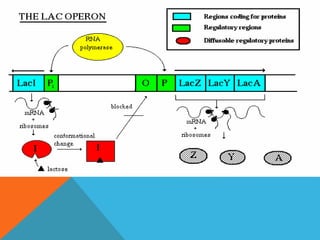
THE LAC OPERON:
LAC OPERON-The lactose operon (also known as
the lac operon) is a set of genes that are
specific for uptake and metabolism of lactose
and is found in E. coli and other bacteria.
Lactose is the disaccharide which is made up of
glucose & galactose.
It is the inducible operon since the presence of
lactose induce the operon to switched on.
GENES INVOLVED IN LAC
OPERON SYSTEM:
R e g u l a t o r y g e n e s - T h e r e g u l a t o r y g e n e s i n c l u d e s ,
1 . T h e r e p r e s s o r ,
2 . P r o m o t e r ( P l a c g e n e ) ,
3 . O p e r a t o r ( l a c O g e n e ) ,
4 . l a c I g e n e a n d
5 . C a t a b o l i t e a c t i v a t o r p r o t e i n .
s t r u c t u r a l g e n e s - T h e l a c o p e r o n c o n s i s t s o f t h r e e
s t r u c t u r a l g e n e s t h a t a r e r e q u i r e d f o r l a c t o s e u t i l i s a t i o n ,
w h i c h i n c l u d e s
1 . l a c z ,
2 . l a c y a n d
3 . l a c a .
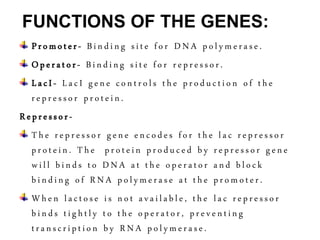
FUNCTIONS OF THE GENES:
Promoter- Binding site for DNA polymerase.
Operator- Binding site for repressor.
LacI- LacI gene controls the production of the
repressor protein.
Repressor-
The repressor gene encodes for the lac repressor
protein. The protein produced by repressor gene
will binds to DNA at the operator and block
binding of RNA polymerase at the promoter.
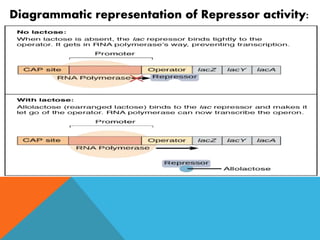
When lactose is not available, the lac repressor
binds tightly to the operator, preventing
transcription by RNA polymerase.
FUNCTIONS OF THE GENES:
However, when lactose is present, the lac repressor
loses its ability to bind DNA. It floats off the
operator, clearing the way for RNA polymerase to
transcribe the operon.
This change in the lac repressor is caused by the
small molecule allolactose, an isomer (rearranged
version) of lactose.
When lactose is available, some molecules will be
converted to allolactose inside the cell. Allolactose
binds to the lac repressor and makes it change shape
so it can no longer bind DNA.
Diagrammatic representation of Repressor activity:
FUNCTIONS OF THE GENES:
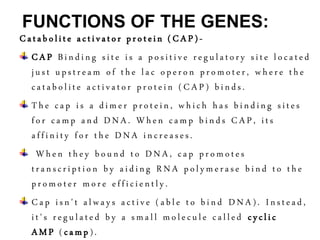
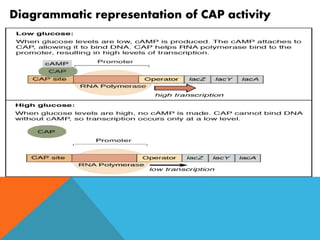
Catabolite activator protein (CAP) -
CAP Binding site is a positive regulatory site located
just upstream of the lac operon promoter, where the
catabolite activator protein (CAP) binds.
The cap is a dimer protein, which has binding sites
for camp and DNA. When camp binds CAP, its
affinity for the DNA increases.
When they bound to DNA, cap promotes
transcription by aiding RNA polymerase bind to the
promoter more efficiently.
Cap isn't always active (able to bind DNA). Instead,
it's regulated by a small molecule called cyclic
AMP (camp).
Camp is a "hunger signal" made by E.
Coli when glucose levels are low. Camp binds
to CAP, changing its shape and making it able
to bind DNA and promote transcription.
Without camp, CAP cannot bind DNA and is
inactive.
Cap is only active when glucose levels are low
(camp levels are high). Thus, the lac operon
can only be transcribed at high levels when
glucose is absent. This strategy ensures that
bacteria only turn on the lac operon and start
using lactose after they have used up all of the
preferred energy source (glucose).
Diagrammatic representation of CAP activity
FUNCTIONS OF THE GENES:
Lac z- Lac z gene produce, β-galactosidase breaks
down lactose into glucose & galactose.
Lacy- Lac y gene produces, a lac permease, this
protein, found in the E. coli cytoplasmic
membrane, actively transports lactose into the
cells.
LACA- Laca gene prodcues an enzyme
transacetylase, The transacetylase transfers an
acetyl group from coenzyme A (coa) to the
hydroxyl group of the galactosides.
THE LAC OPERON-WORKING
MECHANISM:
The first control mechanism is the regulatory
response to lactose, which uses an
intracellular regulatory protein called the lactose
repressor to hinder production of β-
galactosidase in the absence of lactose.
The lacI gene coding for the repressor lies
nearby the lac operon and is always expressed
(constitutive).
If lactose is missing from the growth medium,
the repressor binds very tightly to a short DNA
sequence just downstream of the promoter near
the beginning of lacz called the lac operator.
THE LAC OPERON-WORKING
MECHANISM:
The repressor binding to the operator interferes
with binding of RNAP to the promoter, and
therefore mrna encoding lacz and lacy is only
made at very low levels.
When cells are grown in the presence of lactose,
however, a lactose metabolite called allolactose,
made from lactose by the product of the lacz gene,
binds to the repressor, causing an allosteric shift .
Thus altered, the repressor is unable to bind to
the operator, allowing RNAP to transcribe
the lac genes and thereby leading to higher levels
of the encoded proteins .
THE LAC OPERON-WORKING
MECHANISM:
The second control mechanism is a response to
glucose, which uses the catabolite activator
protein (cap) homodimer to greatly increase
production of β-galactosidase in the absence of
glucose.
Cyclic Adenosin Monophosphate(camp ) is a signal
molecule whose prevalence is inversely proportional
to that of glucose. It binds to the CAP, which in
turn allows the CAP to bind to the CAP binding site
(a 16 bp DNA sequence upstream of the promoter on
the left in the diagram below, about 60 bp upstream
of the transcription start site ),which assists the
RNAP in binding to the DNA.
THE LAC OPERON-WORKING
MECHANISM:
In the absence of glucose, the camp concentration
is high and binding of cap -camp to the DNA
significantly increases the production of β-
galactosidase, enabling the cell to hydrolyse
lactose and release galactose and glucose.
More recently inducer exclusion was shown to
block expression of the lac operon when glucose
is present. Glucose is transported into the cell by
the pep-dependent phosphotransferase system.
THE LAC OPERON-WORKING
MECHANISM:
The phosphate group of phosphoenolpyruvateis
transferred via a phosphorylation cascade
consisting of the general PTS (phosphotransferase
system) proteins hpr and EIA and the glucose -
specific PTS proteins eiia glc and eiibglc, the
cytoplasmic domain of the EII glucose transporter.
Transport of glucose is accompanied by its
phosphorylation by eiib glc, draining the phosphate
group from the other PTS proteins, including
eiiaglc.
THE LAC OPERON-WORKING
MECHANISM:
The unphosphorylated form of eiia glc binds to
the lac permease and prevents it from bringing
lactose into the cell. Therefore, if both glucose
and lactose are present, the transport of
glucose blocks the transport of the inducer of
the lac operon.
WORKING MECHANISM OF LAC OPERON
SYSTEM UNDER DIFFERENT SCENARIOS:
1. LACTOSE ( -)
2. LACTOSE (+)
3. LACTOSE (+) AND GLUCOSE (+)
4. LACTOSE (+) AND GLUCOSE ( -):
WHEN LACTOSE IS ABSENT:
A repressor protein is continuously
synthesised. It sits on a sequence of DNA
just in front of the lac operon, the operator
site.
The repressor protein blocks the promoter
site where there RNA polymerase settles
before it starts transcribing regulator gene
lac operon operator site z y a DNA I o
repressor protein RNA polymerase blocked.
DIGRAMMATIC REPRESENTATION FOR THE WORKING OF THE
LAC OPERON SYSTEM WHEN LACTOSE IS ABSENT
WHEN LACTOSE IS PRESENT:
A small amount of a sugar allolactose is
formed within the bacterial cell.
This fits onto the repressor protein at
another active site (allosteric site)
This causes the repressor protein to change
its shape (a conformational change). It can
no longer sit on the operator site. RNA
polymerase can now reach its promoter site z
y a DNA I O
DIGRAMMATIC REPRESENTATION FOR THE WORKING OF THE
LAC OPERON SYSTEM WHEN LACTOSE IS PRESENT:
WHEN BOTH GLUCOSE AND LACTOSE ARE PRESENT:
When glucose and lactose are present
RNA polymerase can sit on the promoter
site but it is unstable and it keeps
falling off.
Promoter site z y a DNA I O repressor
protein removed RNA polymerase
DIGRAMMATIC REPRESENTATION FOR THE WORKING OF THE
LAC OPERON SYSTEM WHEN LACTOSE AND GLUCOSE IS PRESENT:
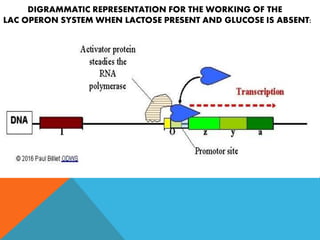
WHEN GLUCOSE IS ABSENT AND LACTOSE IS
PRESENT:
Another protein is needed, an activator
protein. This stabilises RNA polymerase.
The activator protein only works when
glucose is absent.
In this way E.coli only makes enzymes to
metabolise other sugars in the absence of
glucose promotor site z y a DNA I O
transcription activator protein studies
the RNA polymerase.
DIGRAMMATIC REPRESENTATION FOR THE WORKING OF THE
LAC OPERON SYSTEM WHEN LACTOSE PRESENT AND GLUCOSE IS ABSENT:
USE OF LAC OPERON SYSTEM IN MOLECULAR
BIOLOGY:
The lac gene and its derivatives are amenable to
use as a reporter gene in a number of bacterial -
based selection techniques such as two
hybrid analysis, in which the successful binding
of a transcriptional activator to a specific
promoter sequence must be determined.
In LB plates containing x -gal, the colour change
from white colonies to a shade of blue
corresponds to about 20 –100 β-galactosidase unit.
USE OF LAC OPERON SYSTEM IN MOLECULAR
BIOLOGY:
while tetrazolium lactose and macconkey lactose
media have a range of 100 –1000 units, being most
sensitive in the high and low parts of this range
respectively.since macconkey lactose and
tetrazolium lactose media both rely on the
products of lactose breakdown, they require the
presence of both lacz and lacy genes.
The many lac fusion techniques which include
only the lacz gene are thus suited to x -gal
plates or on pg liquid broths
CONCLUSION:
T h e b a c t e r i u m E . C o l i c a n g r o w i n c u l t u r e m e d i u m s
c o n t a i n i n g a v a r i e t y o f e n e r g y s o u r c e s , i n c l u d i n g t h e s u g a r
l a c t o s e . H o w e v e r , t o u s e l a c t o s e , t h e b a c t e r i u m m u s t f i r s t
a l t e r i t s m e t a b o l i s m . T h e b a c t e r i u m m u s t t u r n o n s e v e r a l
g e n e s , f o u n d i n t h e l a c o p e r o n , w h i c h a r e r e q u i r e d f o r
l a c t o s e m e t a b o l i s m .
W h e n l a c t o s e i s n o t p r e s e n t , t h e s e g e n e s i n t h e l a c o p e r o n
a r e n o t e x p r e s s e d . A r e p r e s s o r , w h i c h i s a l w a y s p r e s e n t i n
t h e c e l l , b i n d s t o t h e l a c o p e r o n a n d p r e v e n t s t r a n s c r i p t i o n
b y b l o c k i n g t h e p a s s a g e o f R N A p o l y m e r a s e . H o w e v e r , w h e n
l a c t o s e i s p r e s e n t , l a c t o s e b i n d s t o t h e r e p r e s s o r a n d
c h a n g e s i t s s h a p e , s u c h t h a t t h e r e p r e s s o r c a n n o l o n g e r
b i n d t o t h e o p e r o n . I n t h i s c a s e , R N A p o l y m e r a s e p r o c e e d s
t h r o u g h t h e o p e r o n a n d t r a n s c r i b e s t h e g e n e s n e e d e d f o r
l a c t o s e m e t a b o l i s m .
CONCLUSION:
The lac operon is an inducible system, meaning
that the system is turned off until an inducer -
lactose-arrives on the scene. Other operons, such
as the trp operon, work in the opposite way: this
system expresses genes in the operon until a
repressor becomes activated and turns the
expression off.
REFERENCES:
NCBI official website
J.L. Ramos, ... Z. Udaondo, in Brenner's Encyclopedia of Genetics (Second Edition), 2013
Oehler, S.; Eismann, E. R.; Krämer, H.; Müller-Hill, B. (1990). "The three operators of
thelac operon cooperate in repression". The EMBO Journal. .
Griffiths, Anthony JF; Gelbart, William M.; Miller, Jeffrey H.; Lewontin, Richard C.
(1999). "Regulation of the Lactose System". modern Genetic Analysis. New York: W. H.
Freeman.
Koonin E (2009) Evolution of genome architecture. Int J Biochem Cell Biol 41:298–
306 [PMC free article]
Hurst LD, Pal C, Lercher MJ (2004) The evolutionary dynamics of eukaryotic gene order.
Nat Rev Genet 5:299–310
Jacob F, Perrin D, Sanchez C, Monod J (1960) L’operon: Groupe de genes a l’expression
coordonne par un operateur. C R Acad Sci 245: 1727–729
Jacob F, Monod J (1961) On the regulation of gene activity. In: Cold Spring Harbor
Symposium Quantitative Biology 26, pp 193–211
Jacob F, Monod J (1961) Genetic regulatory mechanisms in the synthesis of proteins. J
Mol Biol
Warren PB, ten Wolde PR (2004) Statistical analysis of the spatial distribution of operons
in the transcriptional regulation network of Escherichia coli. J Mol Biol 342:1379–1390
THANK YOU

Lac operon system

  • 2.
  • 3.
    CONTENT: I N TR O D U C T I O N T O O P E R O N , O P E R O N , D I S C O V E R Y O F O P E R O N , L A C O P E R O N G E N E S I N V O L V E D I N L A C O P E R O N S Y S T E M , F U N C T I O N S O F T H E G E N E , T H E L A C O P E R O N - W O R K I N G M E C H A N I S M , W O R K I N G M E C H A N I S M O F L A C O P E R O N S Y S T E M U N D E R D I F F E R E N T S C E N A R I O S , W H E N L A C T O S E I S A B S E N T , W H E N L A C T O S E I S P R E S E N T , W H E N B O T H G L U C O S E A N D L A C T O S E A R E P R E S E N T , W H E N G L U C O S E I S A B S E N T A N D L A C T O S E I S P R E S E N T . U S E O F L A C O P E R O N S Y S T E M I N M O L E C U L A R B I O L O G Y , C O N C L U S I O N A N D R E F E R E N C E S .
  • 4.
    INTRODUCTION TO OPERONS: Operons (clustersof co -regulated genes with related functions) are a well -known feature of prokaryotic genomes. Archeal and bacterial genomes generally contain a small number of highly conserved operons and a much larger number of unique or rare ones. Functional gene clustering also occurs in eukaryotes, from yeasts to filamentous fungi, mammals, nematodes, and plants. The members of these eukaryotic gene clusters contribute to a common function but do not usually share sequence similarity.
  • 5.
    INTRODUCTION TO OPERONS: These geneclusters therefore represent functional gene organizations with operon - like features (physical clustering and co - regulation), although the genes are not usually transcribed as a single Mrna as is the case in prokaryotes.
  • 6.
    OPERON: Operon-Operon is anoperating units which can be defined as the cluster of genes located together on the chromosomes and are transcribed together only. It is group of closely linked structure genes and associated control gene which regulate the metabolic activity. All the genes of an operon are co -ordinately controlled by a mechanism
  • 7.
    OPERON: Thi s fea t ure of a n orga ni sm ,a l l ows p rot e i n sy nt he si s t o b e c ont rol l e d c o - o r d i na t e l y i n r e sp o nse t o t he ne e d s of t he c e l l . B y p rovi d i ng t he m e a ns t o p rod u c e p rot e i ns onl y whe n a nd whe re t he y a re re qui re d . T hu s t he op e ron a l l ows t he c e l l t o c onse rve e ne rgy,whi c h i s a n i m p ort a nt p a rt of a n orga ni sm ’s l i fe st ra t e gy . A t y p i c a l op e ron c onsi st s of a grou p of st ru c t u ra l ge ne s t ha t c od e for e nz ym e s i nvol ve d i n a m e t a b ol i c p a t hwa y , su c h a s t he b i osy nt he si s of a n a m i no a c i d
  • 8.
    DISCOVERY OF OPERON: Theoperon theory was first proposed by the French microbiologists François Jacob and Jacques monod in the early 1960s. In their classic paper they described the regulatory mechanism of the lac operon of ”Escherichia coli”, a system that allows the bacterium to repress the production of enzymes involved in lactose metabolism, when lactose is not available .
  • 9.
    THE LAC OPERON: LACOPERON-The lactose operon (also known as the lac operon) is a set of genes that are specific for uptake and metabolism of lactose and is found in E. coli and other bacteria. Lactose is the disaccharide which is made up of glucose & galactose. It is the inducible operon since the presence of lactose induce the operon to switched on.
  • 11.
    GENES INVOLVED INLAC OPERON SYSTEM: R e g u l a t o r y g e n e s - T h e r e g u l a t o r y g e n e s i n c l u d e s , 1 . T h e r e p r e s s o r , 2 . P r o m o t e r ( P l a c g e n e ) , 3 . O p e r a t o r ( l a c O g e n e ) , 4 . l a c I g e n e a n d 5 . C a t a b o l i t e a c t i v a t o r p r o t e i n . s t r u c t u r a l g e n e s - T h e l a c o p e r o n c o n s i s t s o f t h r e e s t r u c t u r a l g e n e s t h a t a r e r e q u i r e d f o r l a c t o s e u t i l i s a t i o n , w h i c h i n c l u d e s 1 . l a c z , 2 . l a c y a n d 3 . l a c a .
  • 12.
    FUNCTIONS OF THEGENES: Promoter- Binding site for DNA polymerase. Operator- Binding site for repressor. LacI- LacI gene controls the production of the repressor protein. Repressor- The repressor gene encodes for the lac repressor protein. The protein produced by repressor gene will binds to DNA at the operator and block binding of RNA polymerase at the promoter. When lactose is not available, the lac repressor binds tightly to the operator, preventing transcription by RNA polymerase.
  • 13.
    FUNCTIONS OF THEGENES: However, when lactose is present, the lac repressor loses its ability to bind DNA. It floats off the operator, clearing the way for RNA polymerase to transcribe the operon. This change in the lac repressor is caused by the small molecule allolactose, an isomer (rearranged version) of lactose. When lactose is available, some molecules will be converted to allolactose inside the cell. Allolactose binds to the lac repressor and makes it change shape so it can no longer bind DNA.
  • 14.
    Diagrammatic representation ofRepressor activity:
  • 15.
    FUNCTIONS OF THEGENES: Catabolite activator protein (CAP) - CAP Binding site is a positive regulatory site located just upstream of the lac operon promoter, where the catabolite activator protein (CAP) binds. The cap is a dimer protein, which has binding sites for camp and DNA. When camp binds CAP, its affinity for the DNA increases. When they bound to DNA, cap promotes transcription by aiding RNA polymerase bind to the promoter more efficiently. Cap isn't always active (able to bind DNA). Instead, it's regulated by a small molecule called cyclic AMP (camp).
  • 16.
    Camp is a"hunger signal" made by E. Coli when glucose levels are low. Camp binds to CAP, changing its shape and making it able to bind DNA and promote transcription. Without camp, CAP cannot bind DNA and is inactive. Cap is only active when glucose levels are low (camp levels are high). Thus, the lac operon can only be transcribed at high levels when glucose is absent. This strategy ensures that bacteria only turn on the lac operon and start using lactose after they have used up all of the preferred energy source (glucose).
  • 17.
  • 18.
    FUNCTIONS OF THEGENES: Lac z- Lac z gene produce, β-galactosidase breaks down lactose into glucose & galactose. Lacy- Lac y gene produces, a lac permease, this protein, found in the E. coli cytoplasmic membrane, actively transports lactose into the cells. LACA- Laca gene prodcues an enzyme transacetylase, The transacetylase transfers an acetyl group from coenzyme A (coa) to the hydroxyl group of the galactosides.
  • 19.
    THE LAC OPERON-WORKING MECHANISM: Thefirst control mechanism is the regulatory response to lactose, which uses an intracellular regulatory protein called the lactose repressor to hinder production of β- galactosidase in the absence of lactose. The lacI gene coding for the repressor lies nearby the lac operon and is always expressed (constitutive). If lactose is missing from the growth medium, the repressor binds very tightly to a short DNA sequence just downstream of the promoter near the beginning of lacz called the lac operator.
  • 20.
    THE LAC OPERON-WORKING MECHANISM: Therepressor binding to the operator interferes with binding of RNAP to the promoter, and therefore mrna encoding lacz and lacy is only made at very low levels. When cells are grown in the presence of lactose, however, a lactose metabolite called allolactose, made from lactose by the product of the lacz gene, binds to the repressor, causing an allosteric shift . Thus altered, the repressor is unable to bind to the operator, allowing RNAP to transcribe the lac genes and thereby leading to higher levels of the encoded proteins .
  • 21.
    THE LAC OPERON-WORKING MECHANISM: Thesecond control mechanism is a response to glucose, which uses the catabolite activator protein (cap) homodimer to greatly increase production of β-galactosidase in the absence of glucose. Cyclic Adenosin Monophosphate(camp ) is a signal molecule whose prevalence is inversely proportional to that of glucose. It binds to the CAP, which in turn allows the CAP to bind to the CAP binding site (a 16 bp DNA sequence upstream of the promoter on the left in the diagram below, about 60 bp upstream of the transcription start site ),which assists the RNAP in binding to the DNA.
  • 22.
    THE LAC OPERON-WORKING MECHANISM: Inthe absence of glucose, the camp concentration is high and binding of cap -camp to the DNA significantly increases the production of β- galactosidase, enabling the cell to hydrolyse lactose and release galactose and glucose. More recently inducer exclusion was shown to block expression of the lac operon when glucose is present. Glucose is transported into the cell by the pep-dependent phosphotransferase system.
  • 23.
    THE LAC OPERON-WORKING MECHANISM: Thephosphate group of phosphoenolpyruvateis transferred via a phosphorylation cascade consisting of the general PTS (phosphotransferase system) proteins hpr and EIA and the glucose - specific PTS proteins eiia glc and eiibglc, the cytoplasmic domain of the EII glucose transporter. Transport of glucose is accompanied by its phosphorylation by eiib glc, draining the phosphate group from the other PTS proteins, including eiiaglc.
  • 24.
    THE LAC OPERON-WORKING MECHANISM: Theunphosphorylated form of eiia glc binds to the lac permease and prevents it from bringing lactose into the cell. Therefore, if both glucose and lactose are present, the transport of glucose blocks the transport of the inducer of the lac operon.
  • 25.
    WORKING MECHANISM OFLAC OPERON SYSTEM UNDER DIFFERENT SCENARIOS: 1. LACTOSE ( -) 2. LACTOSE (+) 3. LACTOSE (+) AND GLUCOSE (+) 4. LACTOSE (+) AND GLUCOSE ( -):
  • 26.
    WHEN LACTOSE ISABSENT: A repressor protein is continuously synthesised. It sits on a sequence of DNA just in front of the lac operon, the operator site. The repressor protein blocks the promoter site where there RNA polymerase settles before it starts transcribing regulator gene lac operon operator site z y a DNA I o repressor protein RNA polymerase blocked.
  • 27.
    DIGRAMMATIC REPRESENTATION FORTHE WORKING OF THE LAC OPERON SYSTEM WHEN LACTOSE IS ABSENT
  • 28.
    WHEN LACTOSE ISPRESENT: A small amount of a sugar allolactose is formed within the bacterial cell. This fits onto the repressor protein at another active site (allosteric site) This causes the repressor protein to change its shape (a conformational change). It can no longer sit on the operator site. RNA polymerase can now reach its promoter site z y a DNA I O
  • 29.
    DIGRAMMATIC REPRESENTATION FORTHE WORKING OF THE LAC OPERON SYSTEM WHEN LACTOSE IS PRESENT:
  • 30.
    WHEN BOTH GLUCOSEAND LACTOSE ARE PRESENT: When glucose and lactose are present RNA polymerase can sit on the promoter site but it is unstable and it keeps falling off. Promoter site z y a DNA I O repressor protein removed RNA polymerase
  • 31.
    DIGRAMMATIC REPRESENTATION FORTHE WORKING OF THE LAC OPERON SYSTEM WHEN LACTOSE AND GLUCOSE IS PRESENT:
  • 32.
    WHEN GLUCOSE ISABSENT AND LACTOSE IS PRESENT: Another protein is needed, an activator protein. This stabilises RNA polymerase. The activator protein only works when glucose is absent. In this way E.coli only makes enzymes to metabolise other sugars in the absence of glucose promotor site z y a DNA I O transcription activator protein studies the RNA polymerase.
  • 33.
    DIGRAMMATIC REPRESENTATION FORTHE WORKING OF THE LAC OPERON SYSTEM WHEN LACTOSE PRESENT AND GLUCOSE IS ABSENT:
  • 35.
    USE OF LACOPERON SYSTEM IN MOLECULAR BIOLOGY: The lac gene and its derivatives are amenable to use as a reporter gene in a number of bacterial - based selection techniques such as two hybrid analysis, in which the successful binding of a transcriptional activator to a specific promoter sequence must be determined. In LB plates containing x -gal, the colour change from white colonies to a shade of blue corresponds to about 20 –100 β-galactosidase unit.
  • 36.
    USE OF LACOPERON SYSTEM IN MOLECULAR BIOLOGY: while tetrazolium lactose and macconkey lactose media have a range of 100 –1000 units, being most sensitive in the high and low parts of this range respectively.since macconkey lactose and tetrazolium lactose media both rely on the products of lactose breakdown, they require the presence of both lacz and lacy genes. The many lac fusion techniques which include only the lacz gene are thus suited to x -gal plates or on pg liquid broths
  • 37.
    CONCLUSION: T h eb a c t e r i u m E . C o l i c a n g r o w i n c u l t u r e m e d i u m s c o n t a i n i n g a v a r i e t y o f e n e r g y s o u r c e s , i n c l u d i n g t h e s u g a r l a c t o s e . H o w e v e r , t o u s e l a c t o s e , t h e b a c t e r i u m m u s t f i r s t a l t e r i t s m e t a b o l i s m . T h e b a c t e r i u m m u s t t u r n o n s e v e r a l g e n e s , f o u n d i n t h e l a c o p e r o n , w h i c h a r e r e q u i r e d f o r l a c t o s e m e t a b o l i s m . W h e n l a c t o s e i s n o t p r e s e n t , t h e s e g e n e s i n t h e l a c o p e r o n a r e n o t e x p r e s s e d . A r e p r e s s o r , w h i c h i s a l w a y s p r e s e n t i n t h e c e l l , b i n d s t o t h e l a c o p e r o n a n d p r e v e n t s t r a n s c r i p t i o n b y b l o c k i n g t h e p a s s a g e o f R N A p o l y m e r a s e . H o w e v e r , w h e n l a c t o s e i s p r e s e n t , l a c t o s e b i n d s t o t h e r e p r e s s o r a n d c h a n g e s i t s s h a p e , s u c h t h a t t h e r e p r e s s o r c a n n o l o n g e r b i n d t o t h e o p e r o n . I n t h i s c a s e , R N A p o l y m e r a s e p r o c e e d s t h r o u g h t h e o p e r o n a n d t r a n s c r i b e s t h e g e n e s n e e d e d f o r l a c t o s e m e t a b o l i s m .
  • 38.
    CONCLUSION: The lac operonis an inducible system, meaning that the system is turned off until an inducer - lactose-arrives on the scene. Other operons, such as the trp operon, work in the opposite way: this system expresses genes in the operon until a repressor becomes activated and turns the expression off.
  • 39.
    REFERENCES: NCBI official website J.L.Ramos, ... Z. Udaondo, in Brenner's Encyclopedia of Genetics (Second Edition), 2013 Oehler, S.; Eismann, E. R.; Krämer, H.; Müller-Hill, B. (1990). "The three operators of thelac operon cooperate in repression". The EMBO Journal. . Griffiths, Anthony JF; Gelbart, William M.; Miller, Jeffrey H.; Lewontin, Richard C. (1999). "Regulation of the Lactose System". modern Genetic Analysis. New York: W. H. Freeman. Koonin E (2009) Evolution of genome architecture. Int J Biochem Cell Biol 41:298– 306 [PMC free article] Hurst LD, Pal C, Lercher MJ (2004) The evolutionary dynamics of eukaryotic gene order. Nat Rev Genet 5:299–310 Jacob F, Perrin D, Sanchez C, Monod J (1960) L’operon: Groupe de genes a l’expression coordonne par un operateur. C R Acad Sci 245: 1727–729 Jacob F, Monod J (1961) On the regulation of gene activity. In: Cold Spring Harbor Symposium Quantitative Biology 26, pp 193–211 Jacob F, Monod J (1961) Genetic regulatory mechanisms in the synthesis of proteins. J Mol Biol Warren PB, ten Wolde PR (2004) Statistical analysis of the spatial distribution of operons in the transcriptional regulation network of Escherichia coli. J Mol Biol 342:1379–1390
  • 40.