B2. Costing of Labor
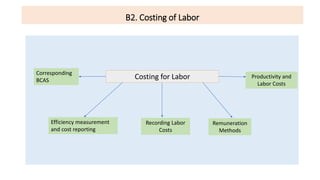
Costing for Labor Productivity and
Labor Costs
Recording Labor
Costs
Remuneration
Methods
Efficiency measurement
and cost reporting
Corresponding
BCAS
Productivity and Labor Cost
Labor cost represents the human contribution to production and is an important cost
factor requiring constant measurement, control, and analysis. Labor cost consists of basic
pay and fringe benefits. The basic pay for work performed is called the base rate or job
rate. Fringe benefits also form a substantial element of labor cost and may include several
items such as holiday pay, vacation pay, overtime premium pay, pension costs, and cost of
living adjustment.
Labor productivity is a measure of economic performance that compares the amount of
goods and services produced (output) with the number of hours worked to produce those
goods and services. Productivity can be better described by the term ‘efficiency’ with
which resources are converted into products or services. Greater productivity can be
achieved by:
• Better utilization of the work force
• Better processes
• Modern equipment
• Methods of compensating labor
Remuneration Methods
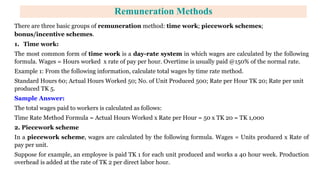
There are three basic groups of remuneration method: time work; piecework schemes;
bonus/incentive schemes.
1. Time work:
The most common form of time work is a day-rate system in which wages are calculated by the following
formula. Wages = Hours worked x rate of pay per hour. Overtime is usually paid @150% of the normal rate.
Example 1: From the following information, calculate total wages by time rate method.
Standard Hours 60; Actual Hours Worked 50; No. of Unit Produced 500; Rate per Hour TK 20; Rate per unit
produced TK 5.
Sample Answer:
The total wages paid to workers is calculated as follows:
Time Rate Method Formula = Actual Hours Worked x Rate per Hour = 50 x TK 20 = TK 1,000
2. Piecework scheme
In a piecework scheme, wages are calculated by the following formula. Wages = Units produced x Rate of
pay per unit.
Suppose for example, an employee is paid TK 1 for each unit produced and works a 40 hour week. Production
overhead is added at the rate of TK 2 per direct labor hour.
Weekly production
Units
Labor costs
Pay (40 hours)
TK
Overhead
TK
Conversion cost
TK
Conversion cost per
unit
TK
40 40 80 120 3.00
50 50 80 130 2.60
60 60 80 140 2.33
70 70 80 150 2.14
Example:
Penny Pincher is paid 50c for each towel she weaves, but she is guaranteed a minimum wage of $ 60 for
a 40-hour week. In a series of four weeks, she makes 100, 120, 140 and 160 towels.
Requirement:
Calculate her pay each week, and the conversion cost per towel if production overhead is added at the
rate of $ 2.50 per direct labor hour.
Week Output Units Pay (Labor cost)
$
Production
overhead
$
Conversion
cost
$
Unit conversion
cost
$
1 100 (minimum) 60 100 160 1.60
2 120 60 100 160 1.33
3 140 70 100 170 1.21
4 160 80 100 180 1.13
Bonus/Incentive Wage Plans
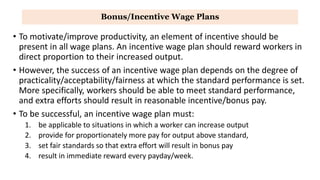
• To motivate/improve productivity, an element of incentive should be
present in all wage plans. An incentive wage plan should reward workers in
direct proportion to their increased output.
• However, the success of an incentive wage plan depends on the degree of
practicality/acceptability/fairness at which the standard performance is set.
More specifically, workers should be able to meet standard performance,
and extra efforts should result in reasonable incentive/bonus pay.
• To be successful, an incentive wage plan must:
1. be applicable to situations in which a worker can increase output
2. provide for proportionately more pay for output above standard,
3. set fair standards so that extra effort will result in bonus pay
4. result in immediate reward every payday/week.
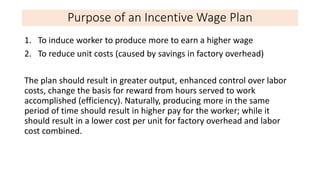
Purpose of an Incentive Wage Plan
1. To induce worker to produce more to earn a higher wage
2. To reduce unit costs (caused by savings in factory overhead)
The plan should result in greater output, enhanced control over labor
costs, change the basis for reward from hours served to work
accomplished (efficiency). Naturally, producing more in the same
period of time should result in higher pay for the worker; while it
should result in a lower cost per unit for factory overhead and labor
cost combined.
Types of Incentive Wage Plans
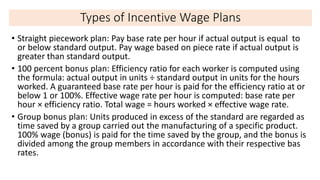
• Straight piecework plan: Pay base rate per hour if actual output is equal to
or below standard output. Pay wage based on piece rate if actual output is
greater than standard output.
• 100 percent bonus plan: Efficiency ratio for each worker is computed using
the formula: actual output in units ÷ standard output in units for the hours
worked. A guaranteed base rate per hour is paid for the efficiency ratio at or
below 1 or 100%. Effective wage rate per hour is computed: base rate per
hour × efficiency ratio. Total wage = hours worked × effective wage rate.
• Group bonus plan: Units produced in excess of the standard are regarded as
time saved by a group carried out the manufacturing of a specific product.
100% wage (bonus) is paid for the time saved by the group, and the bonus is
divided among the group members in accordance with their respective bas
rates.
CMA December 2020
Employees of ET Enterprise work in groups of five, plus a group leader. Standard production for a
group is 400 units for a 40-hour week. The workers are paid Tk.6 an hour until production
reaches 400 units; then a bonus of Tk.1.20 per unit is paid for production over 400 units, with
Tk.1 being divided equally among the five workers and the remainder passing to the group
leader (who is also paid a weekly salary of Tk.300). Factory overhead is Tk.6 per direct labor hour
and includes the group leader's earnings.
The production record of a group for one week shows:
Hours Units
Worked Produced
Monday.................................................................................. 40 72
Tuesday................................................................................. 40 81
Wednesday............................................................................ 40 95
Thursday................................................................................ 40 102
Friday..................................................................................... 40 102
Required:
i. Compute the week's earnings of the group (excluding the leader), the labor cost per unit, the
overhead cost per unit, and the conversion cost per unit, based upon the above data and bonus
plan.
ii. Prepare a schedule showing daily earnings of the group (excluding the leader), unit labor cost, unit
overhead cost, and the conversion cost per unit, assuming that the company uses the group bonus
plan.
Sample Answer
(i)
Hours worked (5 workers X 40 hours)……………………………………………………………………………….200
Regular wage (200 hours X Tk.6).....................................................................................Tk.1,200
Units produced ………………………………………………………………………………………………………………..452
Bonus…………………………………………………………………………………………………………………………….Tk.52*
Weekly earnings.............................................................................................................Tk.1,252
Unit labor cost (Tk.1,252÷452).....................................................................................Tk.2.7699
Unit factory overhead (Tk.1,200÷452)..........................................................................Tk.2.6549
Unit conversion cost.....................................................................................................Tk.5.4248
* 452 units produced - 400 units standard = 52 units above standard
52 units X Tk. 1 workers' share= Tk. 52 bonus
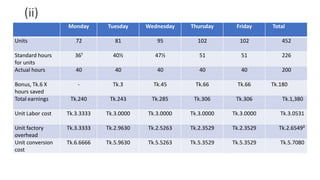
(ii)
Monday Tuesday Wednesday Thursday Friday Total
Units 72 81 95 102 102 452
Standard hours
for units
36¹ 40½ 47½ 51 51 226
Actual hours 40 40 40 40 40 200
Bonus, Tk.6 X
hours saved
- Tk.3 Tk.45 Tk.66 Tk.66 Tk.180
Total earnings Tk.240 Tk.243 Tk.285 Tk.306 Tk.306 Tk.1,380
Unit Labor cost Tk.3.3333 Tk.3.0000 Tk.3.0000 Tk.3.0000 Tk.3.0000 Tk.3.0531
Unit factory
overhead
Tk.3.3333 Tk.2.9630 Tk.2.5263 Tk.2.3529 Tk.2.3529 Tk.2.6549²
Unit conversion
cost
Tk.6.6666 Tk.5.9630 Tk.5.5263 Tk.5.3529 Tk.5.3529 Tk.5.7080
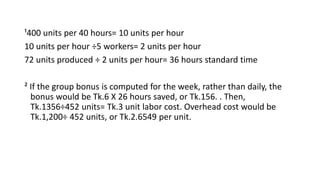
¹400 units per 40 hours= 10 units per hour
10 units per hour ÷5 workers= 2 units per hour
72 units produced ÷ 2 units per hour= 36 hours standard time
² If the group bonus is computed for the week, rather than daily, the
bonus would be Tk.6 X 26 hours saved, or Tk.156. . Then,
Tk.1356÷452 units= Tk.3 unit labor cost. Overhead cost would be
Tk.1,200÷ 452 units, or Tk.2.6549 per unit.
3.c. A worker is paid Tk. 8,000 per month in addition to dearness allowance of Tk.800 per month. He is
entitled to bonus @ 10% on wages. Employer’s contribution is 8% of wages towards contributory provident
fund to which workers also contributes an equal amount. The contribution for social security tax is 1% for
both employer and worker. The employer maintains a canteen where subsidized tea and lunch are provided
to workers and monthlysubsidy of Tk. 40,000 is provided to the canteen. The total number of employees who
takeadvantage of the canteen is 400. Normal idle time amounts to 20%. The worker is entitled to 15 days’
earned leave during the year. The number of working days in a year should betaken to be 300 of 8 hours
each.
Required: Find out the labor cost per hour. [June 2021, 2016]
Solution: Total labor cost per month :
(1) Wages Tk. 8,000
(2) Dearness allowance 800
(3) Bonus @ 10% on wages (8000 x 10%) = 800
(4) Employer’s contribution to CPF @ 8% of wages = (8000 x 8%)= 640
(5) Employer’s contribution to social security tax @ 1% of wages = 80
(6) Proportion of canteen subsidy (Tk. 40,000 / 400) 100
Total labor cost per month for a worker Tk. 10,420
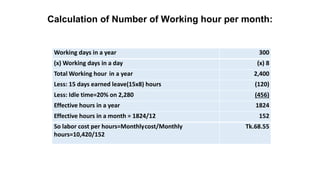
Calculation of Number of Working hour per month:
Working days in a year 300
(x) Working days in a day (x) 8
Total Working hour in a year 2,400
Less: 15 days earned leave(15x8) hours (120)
Less: Idle time=20% on 2,280 (456)
Effective hours in a year 1824
Effective hours in a month = 1824/12 152
So labor cost per hours=Monthlycost/Monthly
hours=10,420/152
Tk.68.55
June 2016
3. a. Assume that Mr. Abu Baker, an assembler of a factory, worked a total of 45 hours in a single week
on job #453. Mr. Baker’s weekly rate of pay is Tk.48 per hour for any hours worked up to 36 hours as per
his union contract, and Tk. 72 per hour for any hours worked in excess of 36 hours per week.
Required:
Calculate Mr. Baker’s total wages for the week and Give journal entries to record Mr. Baker’stotal
wages for the week assuming that:
i. the overtime premium was due to random job scheduling
ii. the overtime results from the requirements of a specific job and not from randomscheduling
iii. the overtime resulted from negligence or poor workmanship on the part of Mr. Baker.
Solution:
Mr. Abu Baker’s total wages for the week are computed ad follows:
OR
Regular Pay (45 hours x Tk. 48) = Tk. 2,160
Overtime premium [(45-36) hr x (Tk. 72 – 48)] = 216
Tk. 2,376
Normal Hours payment = (36 hrs x Tk. 48) = 1728
Over time payment 9 hrs x Tk. 72 = 648
2376
Journal entries to record Mr. Baker’s total wages for the week assuming that
(i) The overtime premium was due to random job scheduling:
(ii) The overtime results from the requirements of a specific job and not from randomscheduling
(iii) The overtime resulted from negligence or poor workmanship on the part of Mr. Baker.
Work in process inventory – Job # 453 …….. Tk. 2,160
Factory overhead control overtime premium 216
Payroll payable Tk. 2,376
Work in process inventory – Job # 453 …….. Tk. 2,376
Payroll payable Tk. 2,376
Work in process inventory – Job # 453 …….. Tk. 2,160
Loss from overtime premium 216
Payroll payable Tk. 2,376
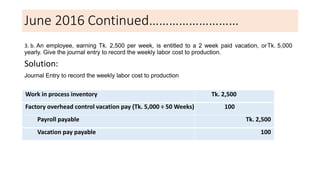
June 2016 Continued………………………
3. b. An employee, earning Tk. 2,500 per week, is entitled to a 2 week paid vacation, orTk. 5,000
yearly. Give the journal entry to record the weekly labor cost to production.
Solution:
Journal Entry to record the weekly labor cost to production
Work in process inventory Tk. 2,500
Factory overhead control vacation pay (Tk. 5,000 ÷ 50 Weeks) 100
Payroll payable Tk. 2,500
Vacation pay payable 100
Learning curve
Recording Labor Costs
Employee cost reporting and measurement of efficiency
Corresponding BCAS

COA B2.pptx

  • 1.
    B2. Costing ofLabor Costing for Labor Productivity and Labor Costs Recording Labor Costs Remuneration Methods Efficiency measurement and cost reporting Corresponding BCAS
  • 2.
    Productivity and LaborCost Labor cost represents the human contribution to production and is an important cost factor requiring constant measurement, control, and analysis. Labor cost consists of basic pay and fringe benefits. The basic pay for work performed is called the base rate or job rate. Fringe benefits also form a substantial element of labor cost and may include several items such as holiday pay, vacation pay, overtime premium pay, pension costs, and cost of living adjustment. Labor productivity is a measure of economic performance that compares the amount of goods and services produced (output) with the number of hours worked to produce those goods and services. Productivity can be better described by the term ‘efficiency’ with which resources are converted into products or services. Greater productivity can be achieved by: • Better utilization of the work force • Better processes • Modern equipment • Methods of compensating labor
  • 3.
    Remuneration Methods There arethree basic groups of remuneration method: time work; piecework schemes; bonus/incentive schemes. 1. Time work: The most common form of time work is a day-rate system in which wages are calculated by the following formula. Wages = Hours worked x rate of pay per hour. Overtime is usually paid @150% of the normal rate. Example 1: From the following information, calculate total wages by time rate method. Standard Hours 60; Actual Hours Worked 50; No. of Unit Produced 500; Rate per Hour TK 20; Rate per unit produced TK 5. Sample Answer: The total wages paid to workers is calculated as follows: Time Rate Method Formula = Actual Hours Worked x Rate per Hour = 50 x TK 20 = TK 1,000 2. Piecework scheme In a piecework scheme, wages are calculated by the following formula. Wages = Units produced x Rate of pay per unit. Suppose for example, an employee is paid TK 1 for each unit produced and works a 40 hour week. Production overhead is added at the rate of TK 2 per direct labor hour.
  • 4.
    Weekly production Units Labor costs Pay(40 hours) TK Overhead TK Conversion cost TK Conversion cost per unit TK 40 40 80 120 3.00 50 50 80 130 2.60 60 60 80 140 2.33 70 70 80 150 2.14
  • 5.
    Example: Penny Pincher ispaid 50c for each towel she weaves, but she is guaranteed a minimum wage of $ 60 for a 40-hour week. In a series of four weeks, she makes 100, 120, 140 and 160 towels. Requirement: Calculate her pay each week, and the conversion cost per towel if production overhead is added at the rate of $ 2.50 per direct labor hour. Week Output Units Pay (Labor cost) $ Production overhead $ Conversion cost $ Unit conversion cost $ 1 100 (minimum) 60 100 160 1.60 2 120 60 100 160 1.33 3 140 70 100 170 1.21 4 160 80 100 180 1.13
  • 6.
    Bonus/Incentive Wage Plans •To motivate/improve productivity, an element of incentive should be present in all wage plans. An incentive wage plan should reward workers in direct proportion to their increased output. • However, the success of an incentive wage plan depends on the degree of practicality/acceptability/fairness at which the standard performance is set. More specifically, workers should be able to meet standard performance, and extra efforts should result in reasonable incentive/bonus pay. • To be successful, an incentive wage plan must: 1. be applicable to situations in which a worker can increase output 2. provide for proportionately more pay for output above standard, 3. set fair standards so that extra effort will result in bonus pay 4. result in immediate reward every payday/week.
  • 7.
    Purpose of anIncentive Wage Plan 1. To induce worker to produce more to earn a higher wage 2. To reduce unit costs (caused by savings in factory overhead) The plan should result in greater output, enhanced control over labor costs, change the basis for reward from hours served to work accomplished (efficiency). Naturally, producing more in the same period of time should result in higher pay for the worker; while it should result in a lower cost per unit for factory overhead and labor cost combined.
  • 8.
    Types of IncentiveWage Plans • Straight piecework plan: Pay base rate per hour if actual output is equal to or below standard output. Pay wage based on piece rate if actual output is greater than standard output. • 100 percent bonus plan: Efficiency ratio for each worker is computed using the formula: actual output in units ÷ standard output in units for the hours worked. A guaranteed base rate per hour is paid for the efficiency ratio at or below 1 or 100%. Effective wage rate per hour is computed: base rate per hour × efficiency ratio. Total wage = hours worked × effective wage rate. • Group bonus plan: Units produced in excess of the standard are regarded as time saved by a group carried out the manufacturing of a specific product. 100% wage (bonus) is paid for the time saved by the group, and the bonus is divided among the group members in accordance with their respective bas rates.
  • 9.
    CMA December 2020 Employeesof ET Enterprise work in groups of five, plus a group leader. Standard production for a group is 400 units for a 40-hour week. The workers are paid Tk.6 an hour until production reaches 400 units; then a bonus of Tk.1.20 per unit is paid for production over 400 units, with Tk.1 being divided equally among the five workers and the remainder passing to the group leader (who is also paid a weekly salary of Tk.300). Factory overhead is Tk.6 per direct labor hour and includes the group leader's earnings. The production record of a group for one week shows: Hours Units Worked Produced Monday.................................................................................. 40 72 Tuesday................................................................................. 40 81 Wednesday............................................................................ 40 95 Thursday................................................................................ 40 102 Friday..................................................................................... 40 102 Required: i. Compute the week's earnings of the group (excluding the leader), the labor cost per unit, the overhead cost per unit, and the conversion cost per unit, based upon the above data and bonus plan. ii. Prepare a schedule showing daily earnings of the group (excluding the leader), unit labor cost, unit overhead cost, and the conversion cost per unit, assuming that the company uses the group bonus plan.
  • 10.
    Sample Answer (i) Hours worked(5 workers X 40 hours)……………………………………………………………………………….200 Regular wage (200 hours X Tk.6).....................................................................................Tk.1,200 Units produced ………………………………………………………………………………………………………………..452 Bonus…………………………………………………………………………………………………………………………….Tk.52* Weekly earnings.............................................................................................................Tk.1,252 Unit labor cost (Tk.1,252÷452).....................................................................................Tk.2.7699 Unit factory overhead (Tk.1,200÷452)..........................................................................Tk.2.6549 Unit conversion cost.....................................................................................................Tk.5.4248 * 452 units produced - 400 units standard = 52 units above standard 52 units X Tk. 1 workers' share= Tk. 52 bonus
  • 11.
    (ii) Monday Tuesday WednesdayThursday Friday Total Units 72 81 95 102 102 452 Standard hours for units 36¹ 40½ 47½ 51 51 226 Actual hours 40 40 40 40 40 200 Bonus, Tk.6 X hours saved - Tk.3 Tk.45 Tk.66 Tk.66 Tk.180 Total earnings Tk.240 Tk.243 Tk.285 Tk.306 Tk.306 Tk.1,380 Unit Labor cost Tk.3.3333 Tk.3.0000 Tk.3.0000 Tk.3.0000 Tk.3.0000 Tk.3.0531 Unit factory overhead Tk.3.3333 Tk.2.9630 Tk.2.5263 Tk.2.3529 Tk.2.3529 Tk.2.6549² Unit conversion cost Tk.6.6666 Tk.5.9630 Tk.5.5263 Tk.5.3529 Tk.5.3529 Tk.5.7080
  • 12.
    ¹400 units per40 hours= 10 units per hour 10 units per hour ÷5 workers= 2 units per hour 72 units produced ÷ 2 units per hour= 36 hours standard time ² If the group bonus is computed for the week, rather than daily, the bonus would be Tk.6 X 26 hours saved, or Tk.156. . Then, Tk.1356÷452 units= Tk.3 unit labor cost. Overhead cost would be Tk.1,200÷ 452 units, or Tk.2.6549 per unit.
  • 13.
    3.c. A workeris paid Tk. 8,000 per month in addition to dearness allowance of Tk.800 per month. He is entitled to bonus @ 10% on wages. Employer’s contribution is 8% of wages towards contributory provident fund to which workers also contributes an equal amount. The contribution for social security tax is 1% for both employer and worker. The employer maintains a canteen where subsidized tea and lunch are provided to workers and monthlysubsidy of Tk. 40,000 is provided to the canteen. The total number of employees who takeadvantage of the canteen is 400. Normal idle time amounts to 20%. The worker is entitled to 15 days’ earned leave during the year. The number of working days in a year should betaken to be 300 of 8 hours each. Required: Find out the labor cost per hour. [June 2021, 2016] Solution: Total labor cost per month : (1) Wages Tk. 8,000 (2) Dearness allowance 800 (3) Bonus @ 10% on wages (8000 x 10%) = 800 (4) Employer’s contribution to CPF @ 8% of wages = (8000 x 8%)= 640 (5) Employer’s contribution to social security tax @ 1% of wages = 80 (6) Proportion of canteen subsidy (Tk. 40,000 / 400) 100 Total labor cost per month for a worker Tk. 10,420
  • 14.
    Calculation of Numberof Working hour per month: Working days in a year 300 (x) Working days in a day (x) 8 Total Working hour in a year 2,400 Less: 15 days earned leave(15x8) hours (120) Less: Idle time=20% on 2,280 (456) Effective hours in a year 1824 Effective hours in a month = 1824/12 152 So labor cost per hours=Monthlycost/Monthly hours=10,420/152 Tk.68.55
  • 15.
    June 2016 3. a.Assume that Mr. Abu Baker, an assembler of a factory, worked a total of 45 hours in a single week on job #453. Mr. Baker’s weekly rate of pay is Tk.48 per hour for any hours worked up to 36 hours as per his union contract, and Tk. 72 per hour for any hours worked in excess of 36 hours per week. Required: Calculate Mr. Baker’s total wages for the week and Give journal entries to record Mr. Baker’stotal wages for the week assuming that: i. the overtime premium was due to random job scheduling ii. the overtime results from the requirements of a specific job and not from randomscheduling iii. the overtime resulted from negligence or poor workmanship on the part of Mr. Baker. Solution: Mr. Abu Baker’s total wages for the week are computed ad follows: OR Regular Pay (45 hours x Tk. 48) = Tk. 2,160 Overtime premium [(45-36) hr x (Tk. 72 – 48)] = 216 Tk. 2,376 Normal Hours payment = (36 hrs x Tk. 48) = 1728 Over time payment 9 hrs x Tk. 72 = 648 2376
  • 16.
    Journal entries torecord Mr. Baker’s total wages for the week assuming that (i) The overtime premium was due to random job scheduling: (ii) The overtime results from the requirements of a specific job and not from randomscheduling (iii) The overtime resulted from negligence or poor workmanship on the part of Mr. Baker. Work in process inventory – Job # 453 …….. Tk. 2,160 Factory overhead control overtime premium 216 Payroll payable Tk. 2,376 Work in process inventory – Job # 453 …….. Tk. 2,376 Payroll payable Tk. 2,376 Work in process inventory – Job # 453 …….. Tk. 2,160 Loss from overtime premium 216 Payroll payable Tk. 2,376
  • 17.
    June 2016 Continued……………………… 3.b. An employee, earning Tk. 2,500 per week, is entitled to a 2 week paid vacation, orTk. 5,000 yearly. Give the journal entry to record the weekly labor cost to production. Solution: Journal Entry to record the weekly labor cost to production Work in process inventory Tk. 2,500 Factory overhead control vacation pay (Tk. 5,000 ÷ 50 Weeks) 100 Payroll payable Tk. 2,500 Vacation pay payable 100
  • 18.
  • 19.
  • 20.
    Employee cost reportingand measurement of efficiency
  • 21.