What do you mean by marketing?
‘Marketing is the management process
that identifies, anticipates and
satisfies customer requirements
profitably’
Defination given by author
‘Marketing is a social and managerial
process by which individuals and
groups obtain what they want and
need through creating, offering and
exchanging products of value with
others’
Kotler 1991
Feature’s of marketing…..
 There are at least two parties.
 Each party has something that might be of
value to the other party.
 Each party is capable of communication and
delivery.
 Each party is free to reject the exchange
offer.
 Each party believes it is appropriate or
desirable to deal with the other party
 Production orientation
 Sales orientation
 Marketing Concept orientation
 Societal marketing orientation
Evolution of Marketing
1. Production Orientation
 The focus for the business is to reduce
costs through mass production.
 A business orientated around production
belives that the ‘economies of scale’
generated by mass production will reduce
costs and maximise profits.
 A production orientated business needs to
avoid production efficiency processes
which affect product design and quality.
2. Sales Orientation
 A sales orientated company’s focus
is simple, make the product, and
then sell it to the target market.
 This type of orientation involves the
organization making what they
think the customer needs or likes
without relevant research.
3. Marketing Orientation . . .
 Focusing on customer wants so the
organization can distinguish its products from
competitors’ .
 Integrating all the organization’s activities,
including promotion, to satisfy these wants.
 Achieving long term goals for the
organization by satisfying customer wants
and needs legally and responsibly.
4. Societal Marketing
Orientation
 Organization exists not only to satisfy
customer wants/needs and to meet
organizational objectives, but also to
preserve and enhance individuals’ and
society’s long-term best interests.
 Extends marketing concept to serve one
more customer - society as a whole.
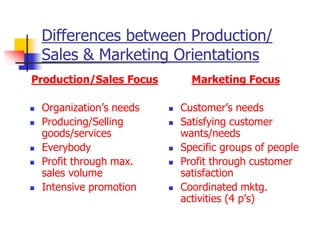
Differences between Production/
Sales & Marketing Orientations
Production/Sales Focus
 Organization’s needs
 Producing/Selling
goods/services
 Everybody
 Profit through max.
sales volume
 Intensive promotion
Marketing Focus
 Customer’s needs
 Satisfying customer
wants/needs
 Specific groups of people
 Profit through customer
satisfaction
 Coordinated mktg.
activities (4 p’s)
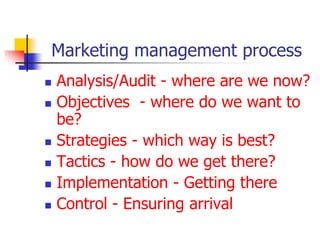
Marketing management process
 Analysis/Audit - where are we now?
 Objectives - where do we want to
be?
 Strategies - which way is best?
 Tactics - how do we get there?
 Implementation - Getting there
 Control - Ensuring arrival
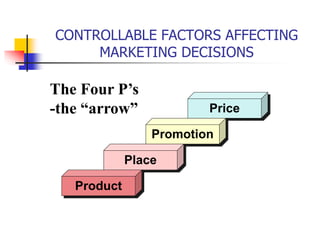
Price
Promotion
Place
Product
The Four P’s
-the “arrow”
CONTROLLABLE FACTORS AFFECTING
MARKETING DECISIONS
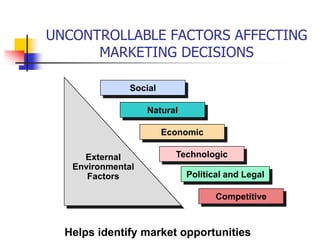
Social
Natural
Economic
Technologic
Political and Legal
Competitive
External
Environmental
Factors
Helps identify market opportunities
UNCONTROLLABLE FACTORS AFFECTING
MARKETING DECISIONS
Marketing Environment
 All the actors and forces
influencing the company’s
ability to transact business
effectively with it’s target
market
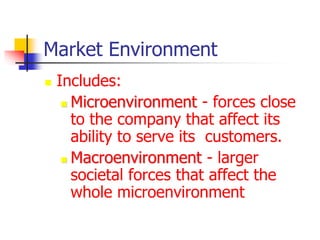
Market Environment
 Includes:
 Microenvironment - forces close
to the company that affect its
ability to serve its customers.
 Macroenvironment - larger
societal forces that affect the
whole microenvironment
Marketing analysis techniques-:
PEST analysis
 Political Factors
 Economic Factors
 Socio-cultural Factors
 Technological Factors
SWOT ANALYSIS
 Strengths
 Weaknesses
 Opportunities
 Threats
Thank you

Introduction to marketing

  • 2.
    What do youmean by marketing? ‘Marketing is the management process that identifies, anticipates and satisfies customer requirements profitably’
  • 3.
    Defination given byauthor ‘Marketing is a social and managerial process by which individuals and groups obtain what they want and need through creating, offering and exchanging products of value with others’ Kotler 1991
  • 4.
    Feature’s of marketing….. There are at least two parties.  Each party has something that might be of value to the other party.  Each party is capable of communication and delivery.  Each party is free to reject the exchange offer.  Each party believes it is appropriate or desirable to deal with the other party
  • 5.
     Production orientation Sales orientation  Marketing Concept orientation  Societal marketing orientation Evolution of Marketing
  • 6.
    1. Production Orientation The focus for the business is to reduce costs through mass production.  A business orientated around production belives that the ‘economies of scale’ generated by mass production will reduce costs and maximise profits.  A production orientated business needs to avoid production efficiency processes which affect product design and quality.
  • 7.
    2. Sales Orientation A sales orientated company’s focus is simple, make the product, and then sell it to the target market.  This type of orientation involves the organization making what they think the customer needs or likes without relevant research.
  • 8.
    3. Marketing Orientation. . .  Focusing on customer wants so the organization can distinguish its products from competitors’ .  Integrating all the organization’s activities, including promotion, to satisfy these wants.  Achieving long term goals for the organization by satisfying customer wants and needs legally and responsibly.
  • 9.
    4. Societal Marketing Orientation Organization exists not only to satisfy customer wants/needs and to meet organizational objectives, but also to preserve and enhance individuals’ and society’s long-term best interests.  Extends marketing concept to serve one more customer - society as a whole.
  • 10.
    Differences between Production/ Sales& Marketing Orientations Production/Sales Focus  Organization’s needs  Producing/Selling goods/services  Everybody  Profit through max. sales volume  Intensive promotion Marketing Focus  Customer’s needs  Satisfying customer wants/needs  Specific groups of people  Profit through customer satisfaction  Coordinated mktg. activities (4 p’s)
  • 11.
    Marketing management process Analysis/Audit - where are we now?  Objectives - where do we want to be?  Strategies - which way is best?  Tactics - how do we get there?  Implementation - Getting there  Control - Ensuring arrival
  • 12.
    Price Promotion Place Product The Four P’s -the“arrow” CONTROLLABLE FACTORS AFFECTING MARKETING DECISIONS
  • 13.
    Social Natural Economic Technologic Political and Legal Competitive External Environmental Factors Helpsidentify market opportunities UNCONTROLLABLE FACTORS AFFECTING MARKETING DECISIONS
  • 14.
    Marketing Environment  Allthe actors and forces influencing the company’s ability to transact business effectively with it’s target market
  • 15.
    Market Environment  Includes: Microenvironment - forces close to the company that affect its ability to serve its customers.  Macroenvironment - larger societal forces that affect the whole microenvironment
  • 16.
  • 17.
    PEST analysis  PoliticalFactors  Economic Factors  Socio-cultural Factors  Technological Factors
  • 18.
    SWOT ANALYSIS  Strengths Weaknesses  Opportunities  Threats
  • 19.