
Perhaps the most important step in the diagnostic
process is feeding back diagnostic information to
the client organization. Although the data may
have been collected with the client’s help, the OD
practitioner often organizes and presents them to
the client. Properly analyzed and meaningful data
can have an impact on organizational change
only if organization members can use the
information to devise appropriate action plans. A
key objective of the feedback process is to be sure
that the client has ownership of the data.
Feeding Back Diagnostic Information
In this chapter, we discuss criteria f
or developing both the content of
feedback information and the
processes for feeding it back. If these criteria are
overlooked, the client is not apt to feel ownership of
the problems facing the organization. A flexible and
potentially powerful technique for data feedback
that has arisen out of the wide use of questionnaires
in OD work is known as survey feedback. Its central
role in many large-scale OD efforts warrants a
special look.
Feeding Back Diagnostic Information
Several characteristics of effective feedback data
have been described in the literature.1They include
the following nine properties:
1. Relevant. Organization members are likely to use
feedback data for problem solving when they find
the information meaningful. Including managers
and employees in the initial data collection activities
can increase the relevance of the data.
Determining the Content of the Feedback
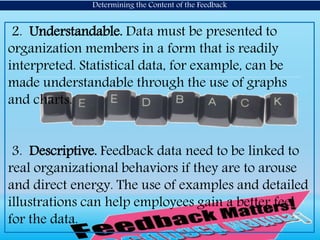
2. Understandable. Data must be presented to
organization members in a form that is readily
interpreted. Statistical data, for example, can be
made understandable through the use of graphs
and charts.
3. Descriptive. Feedback data need to be linked to
real organizational behaviors if they are to arouse
and direct energy. The use of examples and detailed
illustrations can help employees gain a better feel
for the data.
Determining the Content of the Feedback
4. Verifiable.
Feedback data should be valid and accurate if
they are to guide action. Thus, the information
should allow organization members to verify
whether findings really describe the organization.
For example, questionnaire data might include
information about the sample of respondents as
well as frequency distributions for each item or
measure. Such information can help members
verify whether the feedback data accurately
represent organizational events or attitudes.
Determining the Content of the Feedback
5. Timely. Data should be fed back to members as
quickly as possible after being col-lected and
analyzed. This will help ensure that the
information is still valid and is linked to
members’ motivations to examine it.
6. Limited. Because people can easily become
overloaded with too much information, feedback
data should be limited to what employees can
realistically process at one time.
Determining the Content of the Feedback
7. Significant.
Feedback should be limited to those problems
that organization members can do something about
because it will energize them and help direct their
efforts toward realistic changes
Determining the Content of the Feedback
9. Comparative.
Feedback data can be
ambiguous without some
benchmark as a
reference. Whenever
possible, data from
comparative groups
should be provided to
give organization
members a better idea of
how their group fits into
a broader context
Determining the Content of the Feedback
9. Unfinalized
Feedback is primarily a stimulus for action
and thus should spur further diagnosis and problem
solving. Members should be encouraged, for
example, to use the data as a starting point for more
in-depth discussion of organizational issues.
Determining the Content of the Feedback
Ownership of the feedback data is facilitated by the following five
features of successful feedback processes:
1. Motivation to work with the data.
This may require explicit sanction and
support from powerful groups so that people feel
free to raise issues and to identify concerns during
the feedback sessions. If people have little
motivation to work with the data or feel that there
is little chance to use the data for change, then the
information will not be owned by the client system.
Characteristics of the Feedback Process
2. Structure for the meeting
Feedback meetings need some structure or
they may degenerate into chaos or aimless
discussion. An agenda or outline for the meeting
and the presence of a discussion leader can usually
provide the necessary direc-tion. If the meeting is
not kept on track, especially when the data are
negative, ownership can be lost in conversations
that become too general. When this hap-pens, the
energy gained from dealing directly with the
problem is lost.
Characteristics of the Feedback Process
3. Appropriate attendance
Generally, people who have common
problems and can benefit from working together
should be included in the feedback meeting. This
may involve a fully intact work team or groups
comprising members from different functional
areas or hierarchical levels.
Characteristics of the Feedback Process
4. Appropriate power.
It is important to clarify the power
possessed by the group. Members need to
know on which issues they can make
necessary changes, on which they can
only recommend changes, and over
which they have no control.
Unless there are clear boundaries, members are likely to
have some hesitation about using the feedback data for
generating action plans. Moreover, if the group has no
power to make changes, the feedback meeting will become
an empty exercise rather than a real problem-solving
session. Without the power to address change, there will
be little ownership of the data.
Characteristics of the Feedback Process
5. Process help
People in feedback meetings require assistance
in working together as a group. When the data are
negative, there is a natural tendency to resist the
implications, deflect the conversation onto safer
subjects, and the like. An OD prac-titioner with
group process skills can help members stay focused
on the subject and improve feedback discussion,
problem solving, and ownership.
Characteristics of the Feedback Process
When combined with effective feedback data, these
features of successful feedback meetings enhance
member ownership of the data. They help to ensure
that organization members fully discuss the
implications of the diagnostic information and that
their conclusions are directed toward relevant and
feasible organizational changes.
Characteristics of the Feedback Process
Survey feedback is a process of collecting and
feeding back data from an organization or
department through the use of a questionnaire or
survey. The data are analyzed, fed back to
organization members, and used by them to
diagnose the organization and to develop
interventions to improve it. Because questionnaires
often are used in organization diagnosis,
particularly in OD efforts involving large numbers
of participants, and because it is a powerful
intervention in its own right, survey feedback is
discussed here as a special case of data feedback.
SURVEY FEEDBACK
In this step, all parties must be clear about
the level of analysis (organization,
department, or small group) and the
objectives of the survey.
Steps in the Survey Feedback
1 Members of the organization, including those
at the top, are involved in preliminary
planning of the survey.
Planning for a Survey-Feedback Session
Training OD Practitioner in Data Feedback
 Distribute copies of the feedback report in
advance.
This enables people to devote more time at the
meeting to problem solving and less to just
digesting the data. This is especially important
when a large quantity of data is being
presented.
 Think about substantive issues in advance.
Formulate your own view of what the data
suggest about the strengths and
weaknesses of the group. Does the general
picture appear to be positive or problem-
atic? Do the data fit the experience of the
group as you know it? What issues do the
data suggest need group attention? Is the
group likely to avoid any of these issues? If
so, how will you help the group con-front
the difficult issues?
Planning for a Survey-Feedback Session
 Make sure you can answer likely technical
questions about the data.
Survey data have particular strengths and
weaknesses. Be able to acknowledge that the
data are not perfect, but that a lot of effort
has gone into ensuring that they are reliable and
valid.
Planning for a Survey-Feedback Session
 Plan your introduction to the survey-feedback
portion of the meeting.
Make the introduction brief and to the point.
Remind the group of why it is considering the
data, set the stage for problem solving by
pointing out that many groups find such data
helpful in tracking their progress, and be
prepared to run through an example that shows
how to understand the feedback data.
Planning for a Survey-Feedback Session
Problem Solving with Survey-Feedback Data
Training OD Practitioner in Data Feedback
 Chunk the feedback
If a lot of data are being fed back, use your
knowledge of the group and the data to present
small portions of data. Stop periodically to see if
there are questions or comments about each
section or “chunk” of data.
Problem Solving with Survey-Feedback Data
 Stimulate discussion on the data.
What follows are various ways to help get the
discussion going. Help clarify the meaning of
the data by asking
 What questions do you have about
what the data mean?
 What does [a specific number]
mean?
 Does anything in the data surprise
you?
 What do the data tell you about how
we’re doing as a group?
Help develop a shared diagnosis about
the meaning of the data by commenting
 What I hear people saying is . . .
 Does everyone agree with that?
 Several people are saying that . . .
 is a problem. Do we agree that this is
something the group needs to
address?
Problem Solving with Survey-Feedback Data
Some people seem to be saying . . .
 while other comments suggest . . .
 Can you help me understand how
the group sees this?
 The group has really been
struggling with [specific issue that
the facilitator is familiar with], but
the data say that we are strong on
this. Can someone explain this?
Help generate action alternatives by
asking
 What are some of the things we can
do to resolve . . . ?
 Do we want to brainstorm some
action steps to deal with . . . ?
Problem Solving with Survey-Feedback Data
 Focus the group on its own data.
The major benefit of survey feedback for EI
teams will be in learning about the group’s own
behavior and outcomes. Often, however, groups
will avoid dealing with issues concerning their
own group in favor of broader and less helpful
discussions about what other groups are doing
right and wrong. Comments you might use to
help get the group on track include
Problem Solving with Survey-Feedback Data
 Be prepared for problem-solving discussions that
are only loosely connected to the data.
It is more important for the group to use the
data to understand itself better and to solve
problems than it is to follow any particular steps
in analyzing the data. Groups often are not very
systematic in how they analyze survey-feedback
data. They may ignore issues that seem obvious
to them and instead focus on one or two issues
that have meaning for them.
Problem Solving with Survey-Feedback Data
 Hot issues and how to deal with them.
Survey data can be particularly helpful in addressing
some hot issues within the group that might otherwise
be over-looked. For example, a group often will prefer
to portray itself as very effective even though group
members privately acknowledge that such is not the
case. If the data show problems that are not being
addressed, you can raise this issue as a point for
discussion. If someone denies that group members feel
there is a problem, you can point out that the data
come from the group and that group members
reported such-and-such on the survey. Be careful not
to use a parental tone; if you sound like you’re wagging
your finger at or lecturing the group, you’re likely to
get a negative reaction. Use the data to raise issues for
This breadth of data collection is ideal, but
it may be appropriate to administer the
instrument to only a sample of members
because of cost or time constraints. If so, the
size of the sample should be as large as
possible to improve the motivational basis
for participation in the feedback sessions.
Steps in the Survey Feedback
2 The survey instrument is administered to all
members of the organization or department.
Steps in the Survey Feedback
3 The OD consultant usually analyzes the survey
data, tabulates the results, suggests approaches
to diagnosis, and trains client members to lead
the feedback process
This waterfall approach ensures that all groups at all organizational
levels involved in the survey receive appropriate feedback. Most often,
members of each organiza-tion group at each level discuss and deal
with only that portion of the data involv-ing their particular group.
They, in turn, prepare to introduce data to groups at the next lower
organizational level if appropriate.
Data feedback also can occur in a “bottom-up” approach. Initially, the
data for specific work groups or departments are fed back and action
items proposed. At this point, the group addresses problems and issues
within its control.
Steps in the Survey Feedback
4 Data feedback usually begins at the top of the
organization and cascades downward to
groups reporting to managers at successively
lower levels.
At each meeting, members discuss and
interpret their data, diagnose problem
areas, and develop action plans. OD
practitioners can play an important role
during these meetings, facilitating group
discussion to produce accurate
understanding, focus-ing the group on its
strengths and weaknesses, and helping to
develop effective action plans.
Steps in the Survey Feedback
5 Feedback meetings provide an opportunity to
work with the data
Traditionally, the steps of survey feedback have
been applied to work groups and organizational
units with little attention to dependencies among
them. Research suggests, however, that the design of
survey feedback should vary depending on how
closely the participating units are linked with one
another.9 When the units are relatively inde-
pendent and have little need to interact, survey
feedback can focus on the dynamics occurring
within each group and can be applied to the groups
separately.
Survey Feedback and Organizational Deficiencies
When there is greater dependency among units and
they need to coordinate their efforts, survey feed-
back must take into account relationships among
the units, paying particular attention to the
possibility of intergroup conflict. In these situations,
the survey-feedback process needs to be
coordinated across the interdependent groups. The
process will typically be managed by special
committees and task forces representing the groups.
They will facilitate the intergroup confrontation
and conflict resolution generally needed when
relations across groups are diagnosed.
Although the use of survey feedback is widespread in
contemporary organizations, the following limits and risks
have been identified:
1. Ambiguity of purpose.
Managers and staff groups responsible for the
survey-feedback process may have difficulty
reaching sufficient consensus about the purposes
of the survey, its content, and how it will be fed
back to participants. Such confusion can lead to
considerable disagreement over the data
collected and paralysis about doing anything
Limitations of Survey Feedback
2. Distrust
High levels of distrust in the organization can
render the survey feedback ineffective.
Employees need to trust that their responses will
remain anonymous and that management is
serious about sharing the data and solving
problems jointly.
3. Unacceptable topics
Most organizations have certain topics that they
do not want examined. This can severely
constrain the scope of the survey process, par-
ticularly if the neglected topics are important to
Limitations of Survey Feedback
4. Organizational disturbance
The survey-feedback process can unduly disturb
organizational functioning. Data collection and
feedback typically infringe on employee work
time. Moreover, administration of a survey can
call attention to issues with which management
is unwilling to deal, and can create unrealistic
expectations about organizational improvement.
This chapter described the process of feeding back data to a client
system. It concerned identifying the content of the data to be fed
back and designing a feedback process that ensures ownership of
the data. Feeding back data is a central activity in almost any OD
program. If members own the data, they will be motivated to solve
organizational problems. A special application of the data collection
and feedback process is called survey feedback. It is one of the most
accepted processes in orga-nization development, enabling
practitioners to collect diagnostic data from a large number of
organization members and to feed back that information for
purposes of problem solving. Survey feedback highlights the
importance of contracting appro-priately with the client system
(discussed in Chapters 4 and 7), establishing relevant categories for
data collection, and feeding back the data as necessary steps for
diagnosing organizational problems and developing interventions
for resolving them.
SUMMARY
Feeding back diagnostic information   by jeff (copy)

Feeding back diagnostic information by jeff (copy)

  • 2.
    Perhaps the mostimportant step in the diagnostic process is feeding back diagnostic information to the client organization. Although the data may have been collected with the client’s help, the OD practitioner often organizes and presents them to the client. Properly analyzed and meaningful data can have an impact on organizational change only if organization members can use the information to devise appropriate action plans. A key objective of the feedback process is to be sure that the client has ownership of the data. Feeding Back Diagnostic Information
  • 3.
    In this chapter,we discuss criteria f or developing both the content of feedback information and the processes for feeding it back. If these criteria are overlooked, the client is not apt to feel ownership of the problems facing the organization. A flexible and potentially powerful technique for data feedback that has arisen out of the wide use of questionnaires in OD work is known as survey feedback. Its central role in many large-scale OD efforts warrants a special look. Feeding Back Diagnostic Information
  • 4.
    Several characteristics ofeffective feedback data have been described in the literature.1They include the following nine properties: 1. Relevant. Organization members are likely to use feedback data for problem solving when they find the information meaningful. Including managers and employees in the initial data collection activities can increase the relevance of the data. Determining the Content of the Feedback
  • 5.
    2. Understandable. Datamust be presented to organization members in a form that is readily interpreted. Statistical data, for example, can be made understandable through the use of graphs and charts. 3. Descriptive. Feedback data need to be linked to real organizational behaviors if they are to arouse and direct energy. The use of examples and detailed illustrations can help employees gain a better feel for the data. Determining the Content of the Feedback
  • 6.
    4. Verifiable. Feedback datashould be valid and accurate if they are to guide action. Thus, the information should allow organization members to verify whether findings really describe the organization. For example, questionnaire data might include information about the sample of respondents as well as frequency distributions for each item or measure. Such information can help members verify whether the feedback data accurately represent organizational events or attitudes. Determining the Content of the Feedback
  • 7.
    5. Timely. Datashould be fed back to members as quickly as possible after being col-lected and analyzed. This will help ensure that the information is still valid and is linked to members’ motivations to examine it. 6. Limited. Because people can easily become overloaded with too much information, feedback data should be limited to what employees can realistically process at one time. Determining the Content of the Feedback
  • 8.
    7. Significant. Feedback shouldbe limited to those problems that organization members can do something about because it will energize them and help direct their efforts toward realistic changes Determining the Content of the Feedback
  • 9.
    9. Comparative. Feedback datacan be ambiguous without some benchmark as a reference. Whenever possible, data from comparative groups should be provided to give organization members a better idea of how their group fits into a broader context Determining the Content of the Feedback
  • 10.
    9. Unfinalized Feedback isprimarily a stimulus for action and thus should spur further diagnosis and problem solving. Members should be encouraged, for example, to use the data as a starting point for more in-depth discussion of organizational issues. Determining the Content of the Feedback
  • 11.
    Ownership of thefeedback data is facilitated by the following five features of successful feedback processes: 1. Motivation to work with the data. This may require explicit sanction and support from powerful groups so that people feel free to raise issues and to identify concerns during the feedback sessions. If people have little motivation to work with the data or feel that there is little chance to use the data for change, then the information will not be owned by the client system. Characteristics of the Feedback Process
  • 12.
    2. Structure forthe meeting Feedback meetings need some structure or they may degenerate into chaos or aimless discussion. An agenda or outline for the meeting and the presence of a discussion leader can usually provide the necessary direc-tion. If the meeting is not kept on track, especially when the data are negative, ownership can be lost in conversations that become too general. When this hap-pens, the energy gained from dealing directly with the problem is lost. Characteristics of the Feedback Process
  • 13.
    3. Appropriate attendance Generally,people who have common problems and can benefit from working together should be included in the feedback meeting. This may involve a fully intact work team or groups comprising members from different functional areas or hierarchical levels. Characteristics of the Feedback Process
  • 14.
    4. Appropriate power. Itis important to clarify the power possessed by the group. Members need to know on which issues they can make necessary changes, on which they can only recommend changes, and over which they have no control. Unless there are clear boundaries, members are likely to have some hesitation about using the feedback data for generating action plans. Moreover, if the group has no power to make changes, the feedback meeting will become an empty exercise rather than a real problem-solving session. Without the power to address change, there will be little ownership of the data. Characteristics of the Feedback Process
  • 15.
    5. Process help Peoplein feedback meetings require assistance in working together as a group. When the data are negative, there is a natural tendency to resist the implications, deflect the conversation onto safer subjects, and the like. An OD prac-titioner with group process skills can help members stay focused on the subject and improve feedback discussion, problem solving, and ownership. Characteristics of the Feedback Process
  • 16.
    When combined witheffective feedback data, these features of successful feedback meetings enhance member ownership of the data. They help to ensure that organization members fully discuss the implications of the diagnostic information and that their conclusions are directed toward relevant and feasible organizational changes. Characteristics of the Feedback Process
  • 17.
    Survey feedback isa process of collecting and feeding back data from an organization or department through the use of a questionnaire or survey. The data are analyzed, fed back to organization members, and used by them to diagnose the organization and to develop interventions to improve it. Because questionnaires often are used in organization diagnosis, particularly in OD efforts involving large numbers of participants, and because it is a powerful intervention in its own right, survey feedback is discussed here as a special case of data feedback. SURVEY FEEDBACK
  • 18.
    In this step,all parties must be clear about the level of analysis (organization, department, or small group) and the objectives of the survey. Steps in the Survey Feedback 1 Members of the organization, including those at the top, are involved in preliminary planning of the survey.
  • 19.
    Planning for aSurvey-Feedback Session Training OD Practitioner in Data Feedback  Distribute copies of the feedback report in advance. This enables people to devote more time at the meeting to problem solving and less to just digesting the data. This is especially important when a large quantity of data is being presented.
  • 20.
     Think aboutsubstantive issues in advance. Formulate your own view of what the data suggest about the strengths and weaknesses of the group. Does the general picture appear to be positive or problem- atic? Do the data fit the experience of the group as you know it? What issues do the data suggest need group attention? Is the group likely to avoid any of these issues? If so, how will you help the group con-front the difficult issues? Planning for a Survey-Feedback Session
  • 21.
     Make sureyou can answer likely technical questions about the data. Survey data have particular strengths and weaknesses. Be able to acknowledge that the data are not perfect, but that a lot of effort has gone into ensuring that they are reliable and valid. Planning for a Survey-Feedback Session
  • 22.
     Plan yourintroduction to the survey-feedback portion of the meeting. Make the introduction brief and to the point. Remind the group of why it is considering the data, set the stage for problem solving by pointing out that many groups find such data helpful in tracking their progress, and be prepared to run through an example that shows how to understand the feedback data. Planning for a Survey-Feedback Session
  • 23.
    Problem Solving withSurvey-Feedback Data Training OD Practitioner in Data Feedback  Chunk the feedback If a lot of data are being fed back, use your knowledge of the group and the data to present small portions of data. Stop periodically to see if there are questions or comments about each section or “chunk” of data.
  • 24.
    Problem Solving withSurvey-Feedback Data  Stimulate discussion on the data. What follows are various ways to help get the discussion going. Help clarify the meaning of the data by asking  What questions do you have about what the data mean?  What does [a specific number] mean?  Does anything in the data surprise you?  What do the data tell you about how we’re doing as a group? Help develop a shared diagnosis about the meaning of the data by commenting  What I hear people saying is . . .  Does everyone agree with that?  Several people are saying that . . .  is a problem. Do we agree that this is something the group needs to address?
  • 25.
    Problem Solving withSurvey-Feedback Data Some people seem to be saying . . .  while other comments suggest . . .  Can you help me understand how the group sees this?  The group has really been struggling with [specific issue that the facilitator is familiar with], but the data say that we are strong on this. Can someone explain this? Help generate action alternatives by asking  What are some of the things we can do to resolve . . . ?  Do we want to brainstorm some action steps to deal with . . . ?
  • 26.
    Problem Solving withSurvey-Feedback Data  Focus the group on its own data. The major benefit of survey feedback for EI teams will be in learning about the group’s own behavior and outcomes. Often, however, groups will avoid dealing with issues concerning their own group in favor of broader and less helpful discussions about what other groups are doing right and wrong. Comments you might use to help get the group on track include
  • 27.
    Problem Solving withSurvey-Feedback Data  Be prepared for problem-solving discussions that are only loosely connected to the data. It is more important for the group to use the data to understand itself better and to solve problems than it is to follow any particular steps in analyzing the data. Groups often are not very systematic in how they analyze survey-feedback data. They may ignore issues that seem obvious to them and instead focus on one or two issues that have meaning for them.
  • 28.
    Problem Solving withSurvey-Feedback Data  Hot issues and how to deal with them. Survey data can be particularly helpful in addressing some hot issues within the group that might otherwise be over-looked. For example, a group often will prefer to portray itself as very effective even though group members privately acknowledge that such is not the case. If the data show problems that are not being addressed, you can raise this issue as a point for discussion. If someone denies that group members feel there is a problem, you can point out that the data come from the group and that group members reported such-and-such on the survey. Be careful not to use a parental tone; if you sound like you’re wagging your finger at or lecturing the group, you’re likely to get a negative reaction. Use the data to raise issues for
  • 29.
    This breadth ofdata collection is ideal, but it may be appropriate to administer the instrument to only a sample of members because of cost or time constraints. If so, the size of the sample should be as large as possible to improve the motivational basis for participation in the feedback sessions. Steps in the Survey Feedback 2 The survey instrument is administered to all members of the organization or department.
  • 30.
    Steps in theSurvey Feedback 3 The OD consultant usually analyzes the survey data, tabulates the results, suggests approaches to diagnosis, and trains client members to lead the feedback process
  • 31.
    This waterfall approachensures that all groups at all organizational levels involved in the survey receive appropriate feedback. Most often, members of each organiza-tion group at each level discuss and deal with only that portion of the data involv-ing their particular group. They, in turn, prepare to introduce data to groups at the next lower organizational level if appropriate. Data feedback also can occur in a “bottom-up” approach. Initially, the data for specific work groups or departments are fed back and action items proposed. At this point, the group addresses problems and issues within its control. Steps in the Survey Feedback 4 Data feedback usually begins at the top of the organization and cascades downward to groups reporting to managers at successively lower levels.
  • 32.
    At each meeting,members discuss and interpret their data, diagnose problem areas, and develop action plans. OD practitioners can play an important role during these meetings, facilitating group discussion to produce accurate understanding, focus-ing the group on its strengths and weaknesses, and helping to develop effective action plans. Steps in the Survey Feedback 5 Feedback meetings provide an opportunity to work with the data
  • 33.
    Traditionally, the stepsof survey feedback have been applied to work groups and organizational units with little attention to dependencies among them. Research suggests, however, that the design of survey feedback should vary depending on how closely the participating units are linked with one another.9 When the units are relatively inde- pendent and have little need to interact, survey feedback can focus on the dynamics occurring within each group and can be applied to the groups separately. Survey Feedback and Organizational Deficiencies
  • 34.
    Survey Feedback andOrganizational Deficiencies When there is greater dependency among units and they need to coordinate their efforts, survey feed- back must take into account relationships among the units, paying particular attention to the possibility of intergroup conflict. In these situations, the survey-feedback process needs to be coordinated across the interdependent groups. The process will typically be managed by special committees and task forces representing the groups. They will facilitate the intergroup confrontation and conflict resolution generally needed when relations across groups are diagnosed.
  • 35.
    Although the useof survey feedback is widespread in contemporary organizations, the following limits and risks have been identified: 1. Ambiguity of purpose. Managers and staff groups responsible for the survey-feedback process may have difficulty reaching sufficient consensus about the purposes of the survey, its content, and how it will be fed back to participants. Such confusion can lead to considerable disagreement over the data collected and paralysis about doing anything Limitations of Survey Feedback
  • 36.
    Limitations of SurveyFeedback 2. Distrust High levels of distrust in the organization can render the survey feedback ineffective. Employees need to trust that their responses will remain anonymous and that management is serious about sharing the data and solving problems jointly. 3. Unacceptable topics Most organizations have certain topics that they do not want examined. This can severely constrain the scope of the survey process, par- ticularly if the neglected topics are important to
  • 37.
    Limitations of SurveyFeedback 4. Organizational disturbance The survey-feedback process can unduly disturb organizational functioning. Data collection and feedback typically infringe on employee work time. Moreover, administration of a survey can call attention to issues with which management is unwilling to deal, and can create unrealistic expectations about organizational improvement.
  • 38.
    This chapter describedthe process of feeding back data to a client system. It concerned identifying the content of the data to be fed back and designing a feedback process that ensures ownership of the data. Feeding back data is a central activity in almost any OD program. If members own the data, they will be motivated to solve organizational problems. A special application of the data collection and feedback process is called survey feedback. It is one of the most accepted processes in orga-nization development, enabling practitioners to collect diagnostic data from a large number of organization members and to feed back that information for purposes of problem solving. Survey feedback highlights the importance of contracting appro-priately with the client system (discussed in Chapters 4 and 7), establishing relevant categories for data collection, and feeding back the data as necessary steps for diagnosing organizational problems and developing interventions for resolving them. SUMMARY