MODULE 2
RESOURCE MANAGEMENT
 RM is the process of planning the resources necessary to meet
the objectives of the project, and to satisfy the clients
requirements.
 Without proper RM , projects can fall behind schedule, or can
become unprofitable.
 The main objective is to ensure the adequate and timely supply
of resources , while at the same time maximizing the
utilization of resources between the projects.
Construction resources may include:-
 Products and materials
 Construction plant , tools and equipments.
 Human resources
 Space and facilities
 Subcontractors
 Finance.
Fundamental to resource management is real time visibility
of:-
 What resources are needed
 What resources are available
 Where resources are located
 The ability to reschedule those resources accordingly.
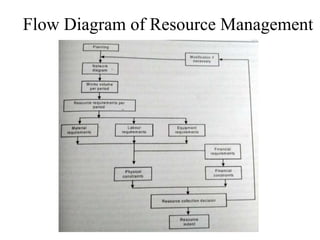
Flow Diagram of Resource Management
A RM plan can be used to:-
 Ensure resource availability and resolve resource conflicts.
 Optimize time, effort and cost.
 Ensure workers with the right skills are available.
 Identify limitations such as site access, weather conditions and
so on.
 Track resources utilization to avoid excessive resourcing or
under-utilization.
It should list key information about the required resources
for each activity:-
1) Type of activity
2) Start date and duration of activity
3) Activity owner
4) Resource type and quantity required
5) Source or supplier of each resource type
6) Equipment required
7) Cost estimates for each of the resources to be supplied
8) Risk mitigation.
Successful resource management requires:-
• Access to the up-to-date project plan with clear definition of
the different phases of work and activity scheduling.
• Understanding the types of resources that are needed.
• Understanding the availability and optimum utilization of
resources.
• Understanding the potential for developing resources for new
uses.
• Understanding of the lead time required to ensure that
resources are available when needed.
Class of labour
Construction labour can broadly divided into two types:-
1.Casual labour
2. Regular establishment
Casual labour:
 Casual labour is employed as and when required for the
execution of work, payment is made on the basis of the
number of days the labour works.
 There is no provision of leave, except the weekly holidays.
This is also known as daily labour.
Regular Establishment:
 Regular establishment generally includes supervisory personal
that are required for more or less continuous period during
construction.
 They are paid monthly wages and entitled to leave and other
benefits.
 The employees may be temporary or permanent. Permanent
employees have great security of service and may be entitled
to more service benefits than the temporary employees.
Wages and statutory requirement:-
Wages are of two types.
1. Nominal wage: This is the remuneration paid to the worker
in the form of money, but it does not include the value of any
other benefit that may be provided.
2. Real Wage: Labour is often entitled to different benefits, such
as leave, medical care, house rent allowance, bonus etc.If the
value of such benefits is added to the nominal wage, it is
known as real wage.
Wages are paid to the labour based on two methods:
1. Depending upon time devoted to the work. This method is
known as time rate system.
2. Depending upon the quantity of work performed. This method
is known as piece rate system.
Minimum Wages Act, 1948
 The Minimum wages Act of 1948 was passed for the welfare
of labour and provided for fixing the minimum rate of wages
of labour.
The main provisions of Minimum wages Act are:
1. The setting of advisory committees to collect information on
which the minimum wages are based.
2. The wages of a worker in any scheduled employment shall be
paid on a working day by:
(i) The 7th day after the last day of the wage period if the
establishment has less than 1,000 employees.
(ii) The 10th day after the last day of the wage period if
establishment has more than 1,000 employees.
3. The wages of an employee should be paid without any
deductions except those items given below.
(i) Fines in respect of acts of omission.
(ii) Absence from duty.
(iii) Loss of goods directly attributed to the neglect of the
employee.
(iv) House accommodation provided by the employer.
(v) Amenities and services provided by the employer.
(vi) Income tax etc.,.
Workmen Compensation Act, 1923
 The Workmen Compensation Act passed to protect the victims
of accidents and their families from hardships out of and in the
course of employment.
 The Act provides for payment of compensation in case of
accidents on work sites.
The compensation, however, is not payable for injuries due to
(i) Disobedience or negligence,
(ii) Non observance of safety measures
(iii) consumption of liquor
(iv) diseases which are not contracted as a result of the
occupation.
 In the case of the death of a worker, compensation is paid
under all circumstances.
Accidents are due to
(i) Human causes such as poor eye sight, negligence, effect of
intoxicants,
(ii) Mechanical causes such as inadequate safety devices, live
electrical equipment, unreliable scaffolding etc.
(iii) Environmental causes. Such as poor lighting, heat, noise etc.
The result of an accident may be:
1. Temporary disablement, which may be total or partial.
2. Permanent total disablement.
3. Permanent partial disablement.
4. Death.
The Compensation to be paid is depends on the result of the
accident.
Contract labour act, 1970
 The Act is of importance to the construction industry where
works are executed through contractors or by contract labour.
 The Act applies to every establishment and contractor
employing twenty or more workmen.
 The Act does not apply to establishments in which only work
of an intermittent or casual nature is performed.
The main provisions of the Act are:
1) Registration of Establishments:
2) Licensing of Contractors:
3) Welfare and Health of Contract Labour:
4) Payment of wages:
LABOUR PRODUCTION RATE OR PRODUCTIVITY
 Productivity in construction is broadly defined as output per
labour hour.
 Since labour constitutes a large part of the construction cost
and the quantity of labour hours in performing a task in
construction is more easily influenced to the management than
materials or capital, this productivity measure is often referred
to as labour productivity.
 For example, by investing in a piece of new equipment to
perform certain tasks in construction, output may be increased
for the same number of labour hours, thus resulting in higher
labour productivity.
Productivity at the Job Site
 Contractors and owners are often concerned with the labour
activity at job sites.
 Hence for this purpose, it is convenient to express labour
productivity as functional units per labour hour for each type
of construction task.
 hile each contractor or owner is free to use its own system to
measure labour productivity at a site, it is a good practice to set
up a system which can be used to track productivity trends
over time and in varied locations.

Productivity in the Construction Industry
 For this general type of productivity measure, it is more
convenient to express labour productivity as constant dollars
per labour hours since dollar values are more easily aggregated
from a large amount of data collected from different sources.
 The use of constant dollars allows meaningful approximations
of the changes in construction output from one year to another
when price deflators are applied to current dollars to obtain the
corresponding values in constant dollars.
MATERIAL MANAGEMENT
 Materials management is a process for planning, executing and
controlling field and office activities in construction.
 The goal of materials management is to insure that
construction materials are available at their point of use when
needed.
 The materials management system attempts to insure that the
right quality and quantity of materials are appropriately
selected, purchased, delivered and handled on site in a timely
manner and at a reasonable cost.
 Materials represent a major expense in construction, thus
minimizing the procurement costs improves opportunities for
reducing the overall project costs.
 Poor materials management can result in increased costs
during construction.
 Materials may get deteriorated during storage or get stolen
until and unless special care is taken on them.
 The performance of materials management should be
measured in order to effectively manage and control the
materials.
OBJECTIVES OF MATERIAL MANAGEMENT
 Quality assurance
 Improved departmental efficiency
 Procuring and receiving
 Efficient material planning
 Supply and distribution of materials
 Storing and inventory control
 Good supplier and customer relationship
 Buying or Purchasing
FUNCTIONS OF MATERIALS MANAGEMENT
The primary functions of the materials management are as
follows:
 Quality Control of Materials
 Departmental Efficiency
 Inventory Planning and Control
 Purchasing
 Materials Requirements Planning (MRP)
 Ascertaining and Maintaining the Flow and Supply of
Materials
Secondary Functions
 Coding and Classification of Materials
 Forecasting and Planning
 Standardization and Simplification
 Make and Buy Decisions
INVENTORY MANAGEMENT
 The term inventory includes materials – raw, in process,
finished packaging, spares and others stocks in order to meet
an unexpected demand or distribution in the future.
 Inventory management is primarily about specifying the size
& placement of stocked goods.
 It is a system & processes which identifies the inventory
requirements, set targets, provides replenishment techniques
and it reports the actual and projected inventory status.
 It involves a retailer seeking to acquire & maintain a proper
goods for sale or to promote the sale which has a varied
collection while ordering, shipping, handling and related costs
are kept in check.
Inventory control
 Inventory control is a planned approach of determining
 what to order,
 when to order
 how much to order
 how much to stock
so that costs associated with buying and storing are optimal
without interrupting production and sales.
Inventory control basically deals with two problems:
(i) When should an order be placed?
(ii) How much should be ordered?
Importance of Inventory Control
 Eliminate the possibility of duplicate ordering.
 Smooth & uninterrupted production and hence no stock out.
 Efficient utilization of working capital
 It is important in purchasing the Economy.
 Improvement in customer’s relationship because of the timely
delivery of goods & service.
Reasons for Keeping Inventories
 To prevent loss of orders.
 To keep pace with changing market conditions
 To meet the demand during the replenishment period.
 To stabilize production
 To take advantage of price discounts
For the project execution, the physical resources required are
 manpower of different categories,
 construction materials,
 equipment
 other site specific infrastructure facilities in terms of water,
power, roads, communication and other required facilities.
Manpower resources
Manpower resources under the categories of construction workers
and technicians shall be planned for their
 quantities,
 skills and time of requirement based on the project details,
 WBS, time schedule and estimates.
 Planning shall be done to take care of any situation in case of
non-availability of local labour force necessitating import from
other localities as in case of projects in remote locations.
Construction Materials
Material resource management involves
 Identification of various categories of material requirements
 Market survey about their source of availability,
 Cost and leads involved,
 Estimation of total quantities,
 Determining the quantum and timing of requirements as per
project schedule,
 Procurement process from suppliers and delivery at site.
The site related material management processes are
 Storage and handling
 Usage in works
 Site practices for minimization of wastages
 Prevention of environmental degradation.
CONSTRUCTION EQUIPMENTS
Some of the major construction equipment usage are the
equipment:-
 For earthwork operations
 Concrete production
 Transportation
 Placement and compaction
 False work and shuttering
 Pile foundations
 Well foundations
 Launching of girders for bridges diaphragm wall
constructions
 Road surfacing
 Material hoisting and handling
 And smaller portable equipment for individual construction
activities.
 During the equipment resource planning process, the
equipment type and production capacities are decided based on
the project requirements.
 The selection of the appropriate type and size of construction
equipment often affects the required amount of time and effort
and thus the jobsite productivity of a project.
Proper use of the appropriate equipment contributes to :-
 Economy
 Quality
 Safety
 Speed and timely completion of a project.
 It is a common fact that we find a wide variety of construction
machines on every construction sites.
 It makes the construction jobs easy, safe and quicker.
 Good project management in construction must vigorously
pursue the efficient utilization of labour, material and
equipment.
 Equipment’s are used for highway projects, irrigation,
buildings, power projects etc.
 Almost 15-30% of total project cost has been accounted
towards equipment and machinery.
Advantages of utilizing the construction equipment :
 Eliminate the heavy manual work by human thus reducing
fatigue and eliminates various other hazards and health issues.
 Maintain the high quality standards often required by present-
day design.
 Increase the rate of output.
 Carry out activities which cannot be done manually.
 To do work more economically and much faster.
 Maintain the planned rate of production where there is a shortage of
skilled or unskilled labour.
 Reduce the overall construction costs especially for large contracts.
Classification of Construction Equipments
1. Earth Moving Equipment
2. Earth – Compacting Equipment
3. Hauling Equipment
4. Hoisting Equipment
5. Conveying Equipment
6. Aggregate production Equipment
7. Equipment used in Concrete Construction
8. Pile-driving Equipment
Earth-Moving Equipment
The selection of earth-moving equipment is mainly dependent on the following factors:
 Quantities of material to be moved.
 The available time to complete the work the job conditions
 The prevailing soil types, the swell and compaction factors, etc.
 The job conditions include factors such as availability of loading and dumping area,
accessibility of site, traffic flows and weather conditions at site.
 Some of the earth moving equipment’s are :
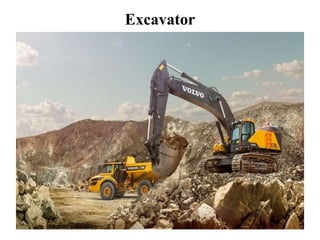
 Excavators
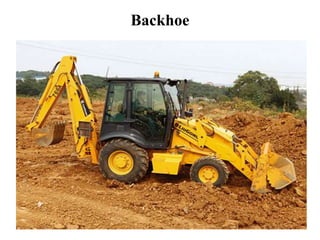
 Back hoe
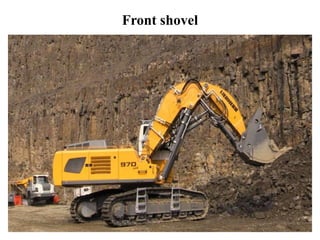
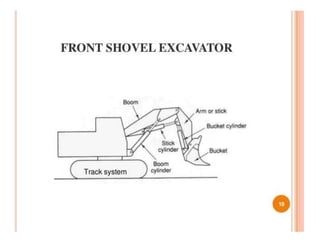
 Front shovel
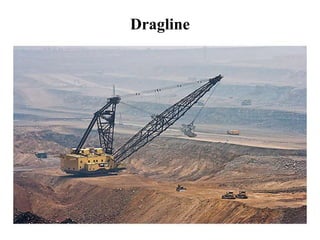
 Dragline
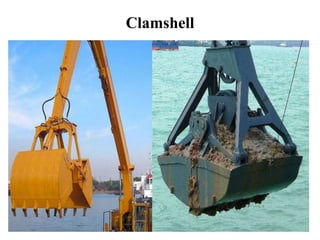
 Clamshell
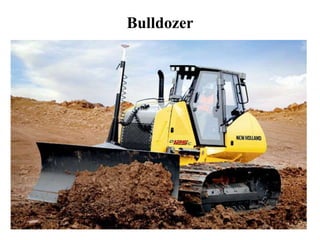
 Bulldozers
 Scraper
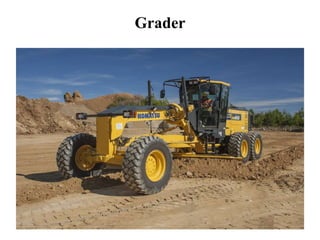
 Grader
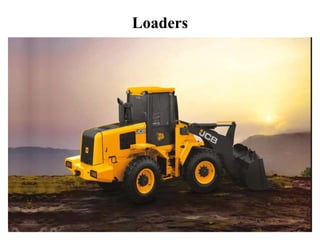
 Loaders
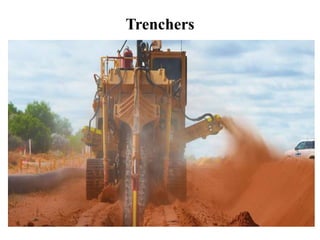
 Trenching Machines.
Excavator
Backhoe
Front shovel
Dragline
Clamshell
Bulldozer
Scarpers
Grader
Loaders
Trenchers
Earth-compacting equipment
 Compactors are the machines frequently used to compact
materials such as soil in order to increase its density for
construction.
 The degree of compaction that may be achieved depends on
the properties of soil, its moisture content, the thickness of the
soil layer for compaction and the method of compaction.
These categories are further divided below:
 Smooth-wheel rollers
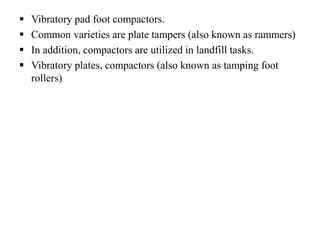
 Pneumatic-tired rollers
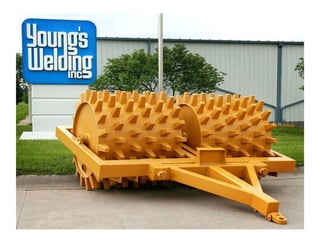
 Sheep-foot rollers
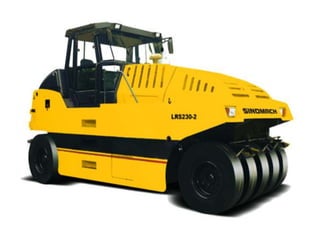
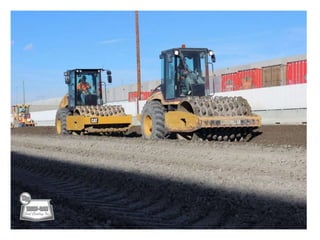
 Vibratory pad foot compactors.
 Common varieties are plate tampers (also known as rammers)
 In addition, compactors are utilized in landfill tasks.
 Vibratory plates, compactors (also known as tamping foot
rollers)
Smooth wheel rollers
Pneumatic tired roller
Sheep foot rollers
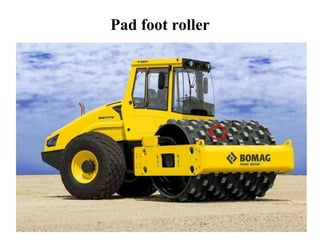
Pad foot roller
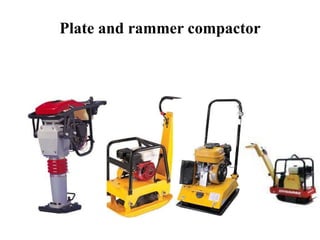
Plate and rammer compactor
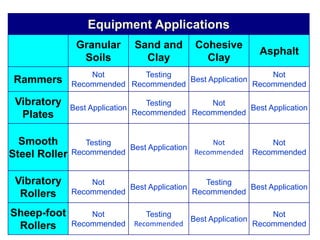
Equipment Applications
Granular
Soils
Sand and
Clay
Cohesive
Clay
Asphalt
Rammers
Not
Recommended
Testing
Recommended
Best Application
Not
Recommended
Vibratory
Plates
Best Application
Testing
Recommended
Not
Recommended
Best Application
Smooth
Steel Roller
Testing
Recommended
Best Application
Not
Recommended
Not
Recommended
Vibratory
Rollers
Not
Recommended
Best Application
Testing
Recommended
Best Application
Sheep-foot
Rollers
Not
Recommended
Testing
Recommended
Best Application
Not
Recommended
Hauling Equipment
 The equipment used for transportation of material are known
as hauling equipment or simply haulers. Haulers may operate
on the roadways or railways
It involves
 transportation of building materials,
 carriage and disposal of excavated earth
 Haulage of heavy construction equipment.
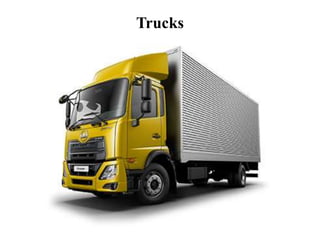
 Haulage by road is carried out by
 Trucks
 Rubber tired tractor with wagons
 Crawler tractor with wagons.
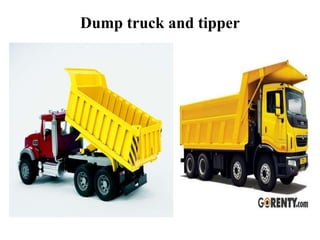
 It transports the earth, aggregate, rock, ore, coal and other
materials.
 Some of the hauling equipment’s are Truck, Dump Truck,
Dumpers, Tippers and Trailers.
Trucks
Rubber tired tractors
Crawler tractor
Dump truck and tipper
Hoisting Equipment
 Hoisting is the lifting a weight from one location and moving
it to another location which is at a reasonable distance.
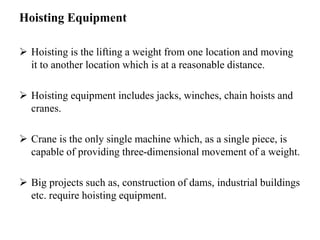
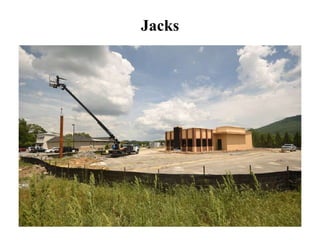
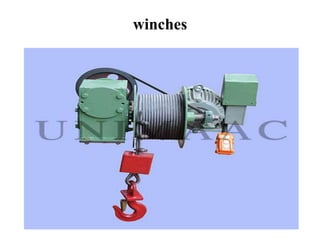
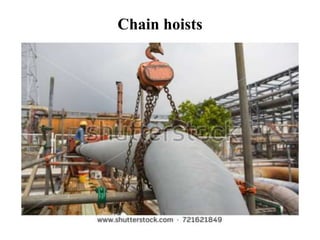
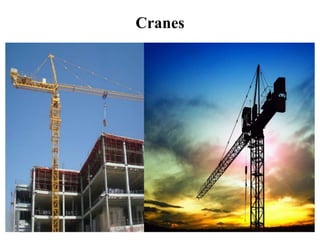
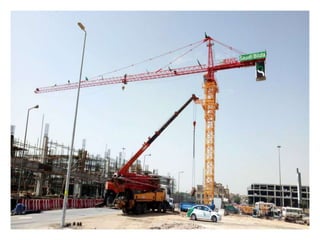
 Hoisting equipment includes jacks, winches, chain hoists and
cranes.
 Crane is the only single machine which, as a single piece, is
capable of providing three-dimensional movement of a weight.
 Big projects such as, construction of dams, industrial buildings
etc. require hoisting equipment.
Jacks
winches
Chain hoists
Cranes
Conveying equipment
 A conveyor system is a mechanical handling equipment that
moves materials from one location to another.
 Conveying is mainly used in mining, construction and in some
of the industries
 In construction industry, conveyors are mainly used for
concreting purpose.
 Conveyors are especially useful in applications involving the
transportation of heavy or bulky materials.
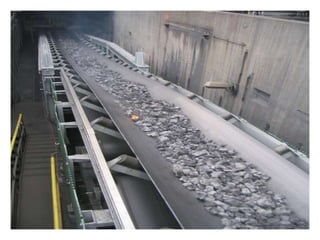
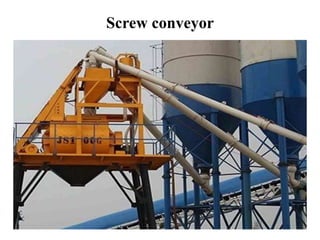
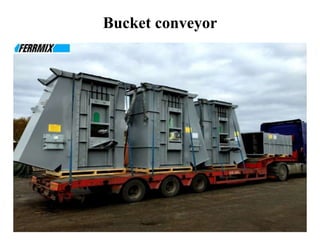
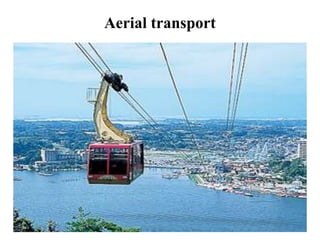
 Example: Belt conveyor, Screw conveyor, Bucket conveyor
and Aerial transport.
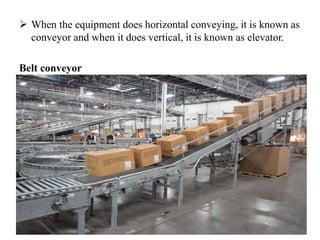
 When the equipment does horizontal conveying, it is known as
conveyor and when it does vertical, it is known as elevator.
Belt conveyor
Screw conveyor
Bucket conveyor
Aerial transport
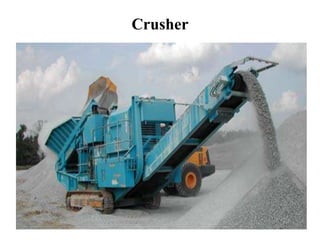
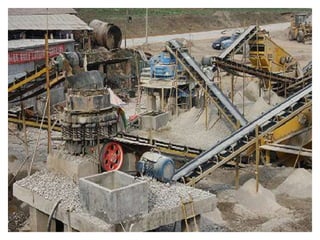
Aggregate production equipment
 Aggregate production consists of two stages that is recovery
and processing.
 In any project where concrete requirement is very high, an
aggregate preparation and processing plant is essential to
complete the concreting operations.
 Aggregate has to be produced at the site, if the quantity needed
is very large.
Crusher
Equipment used in Concrete Construction
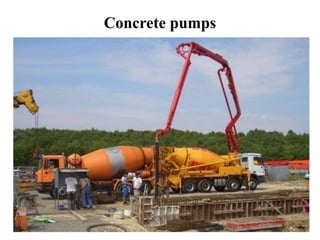
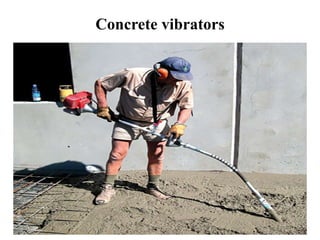
 Concrete is basically cement, aggregate & water mixed
together and then deposited and permitted to solidify.
 In huge concreting concrete and quality depends on time of
mixing, so mixers are used.
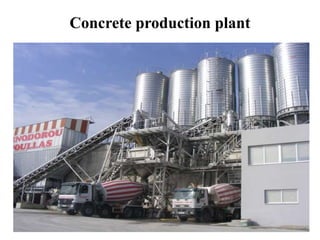
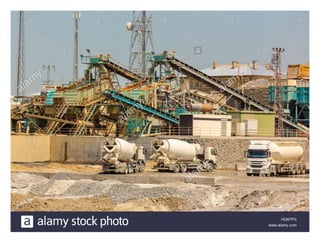
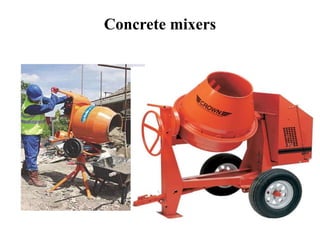
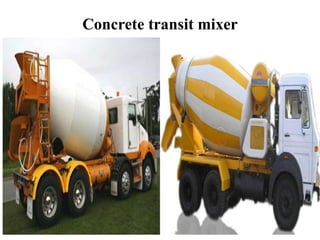
 Examples: Concrete production plants, Concrete mixers,
Concrete transit mixers, Concrete pumps and Vibrator.
Concrete production plant
Concrete mixers
Concrete transit mixer
Concrete pumps
Concrete vibrators
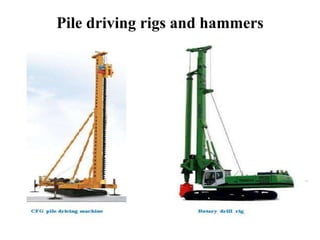
Pile driving equipment
 The process of pile driving involves lifting the piles into
position, holding it to refusal or to a specified depth.
 Driving is accomplished through hammering the pile top with
a hammer.
 Equipment are so designed for driven effectively at an
economical cost.
Major pile driving equipment are:
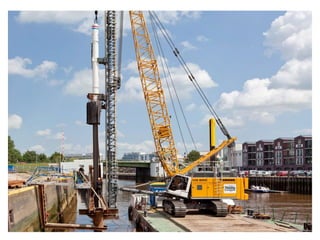
 Pile driving rigs
 Pile driving hammers
Pile driving rigs and hammers
ESTIMATION OF OWNERSHIP COST,
OPERATIONAL AND MAINTENANCE COST OF
CONSTRUCTION EQUIPMENTS
 Choosing the right machines and methods for this kind of mass
excavation comes down to carefully detailing owning and
operating costs and then applying those figures to the amount
of material (tons or cubic yards) you can move in an hour.
 The total cost of a piece of construction equipment consists of
two components namely ownership cost and operating cost.
 This is also referred as O&O cost of the construction
equipment.
OWNERSHIP COSTS
Ownership cost is the total cost associated with the construction
equipment for owning it irrespective of the equipment is
employed or not in the project.
The ownership cost consists of the following; a) Initial cost, b)
Salvage value, c) Interest cost or cost of capital investment, d)
Taxes, e) Insurance cost, and f) Storage cost
Purchase price/ Initial cost
 The typical price for a new machine in the 40-ton category
prices ranges from around Rs. 300 to Rs. 450 lakh.
 You may want to compare the purchase price against buying a
low-hour used machine or a refurbished machine.
 The normal refurbishment cost can be somewhere between 30
to 45 percent of the price of a new machine.
 If the equipment is mounted on rubber tires (pneumatic tires),
then the tire cost is deducted from the initial cost for
calculating ownership cost.
 This is because the expected service life of pneumatic tires is
less than that of the remaining of the equipment.
 Cost of tires is considered as a part of operating cost of the
equipment.
 Salvage value represents expected cash inflow that will be
received by disposing of equipment at the end of its useful life.
Interest cost or cost of capital investment
 It is the annual cost of interest charged on the borrowed money
or that of capital investment to acquire the ownership of the
equipment.
 If the equipment is purchased by borrowing money from a
lender, then interest cost is the interest charged (at interest rate
charged by lender) on the borrowed amount.
 Even though the construction firm uses its own funds to
purchase the equipment, cost of capital investment is charged
as part of the ownership cost because the construction firm
could have invested the funds elsewhere to earn the return
instead of purchasing the equipment.
Taxes
 It represents the property taxes to be paid to the state or central
government. It depends on the value of the equipment owned
and the applicable tax rate for a given location.
 Generally it ranges from 2 to 5% of the average annual
investment or book value of equipment.
Insurance cost
 It represents the annual premium to be paid to insurance
companies to cover the cost incurred due to accident, fire, theft
etc. for the construction equipment.
 It is generally about 1 to 3% of the average annual investment
or book value of equipment.
Storage cost
It is the cost of keeping the equipment in storage yards when it is
not operating at the work site.
 Storage cost includes the rental and maintenance charge for
storage yards.
 wages of security guards and wages of workers employed for
bringing in and out of the storage yards.
 It is around 0.5 to 1.5% of the average annual investment or
book value of equipment.
Operating cost
 It is incurred only when the equipment is operated.
 The operating cost of the equipment is influenced by various
parameters namely number of operating hours, location of job site,
operating conditions, category of equipment etc.
The operating cost consists of the following;
a) Repair and maintenance cost,
b) Fuel cost,
c) Cost of lubricating oil, filter and grease,
d) Tire cost
e) Equipment operator wages,
f) Cost of replacing high-wear items and
g) Cost of mobilization, demobilization and assembly
a) Repair and maintenance cost
 Repair and maintenance cost is incurred as the construction
equipment is subjected to wear and tear due to the operations it
performs.
 The repair and maintenance cost includes the cost of replacement
parts, labor charges and the cost of setting up and operating
facilities to carry out major repair and maintenance operations.
 The repair and maintenance cost varies from one year to another
over the service life of the equipment, however it increases with
age of the equipment.
 This cost contributes a substantial portion of the operating cost.
 The increase in service life and decrease in repair and
maintenance cost of construction equipment can be achieved
by carrying out timely recommended maintenance and repair
operations.
 The minor repairs can be carried out at the job site where the
equipment is operating,
 However the major repairs can be carried out in the facilities
set up by the equipment owner or in the workshop of
authorized dealers for the equipment.
 The hourly repair and maintenance cost can be calculated by
dividing the annual cost by the number of operating hours per
year.
b) Fuel cost
 The construction equipments are generally powered by internal
combustion engines which use either gasoline (petrol) or diesel
as the fuel.
 If these records are not available, equipment manufacturer’s
fuel consumption data can be used to estimate the fuel cost.
 The hourly fuel cost can be calculated by multiplying the
hourly fuel consumption by its unit price.
c) Cost of lubricating oil, filter and grease
 The quantity of lubricating oil(to make it work smoothly),
filter and grease required depends on operating hours,
frequency of changes, engine characteristics and working
conditions at the job site.
 The equipment manufacturer guidelines or past data from
experience of similar equipment in similar working conditions
can be used to estimate of time period between the changes.
d) Tire cost
 The cost of pneumatic tires (rubber tires) is considered as a
part of operating cost.
 The tire cost includes the tire repair and replacement charges.
 The service life of tires is generally shorter than that of the
equipment as the tires wear out at a faster rate than the
equipment.
 The life of tires varies according to extent of wear it is
subjected to, which depends on the job site conditions.
 The hourly tire repair and replacement cost can be calculated
by dividing the sum of the cost of a set of tires and repair
charges by the life of tires in hours.
e) Equipment operator wages
 The operator cost includes the hourly wages and benefits paid
by the company to the operators.
 It includes normal wages, workmen’s compensation insurance
premium, fringe benefits(free health insurance), bonus etc.
 The operator wages vary from project to project.
 The operator cost is normally calculated as a separate cost
category and is added to other components of operating cost.
f) Cost of replacing high-wear items
 It represents the cost of high-wears items and these items have
a shorter life as compared to the service life of the equipment.
 The high-wear items include blades, cutting edges, drill bits,
bucket teeth etc.
 The expected life of these items can be estimated from past
records or from manufacture guidelines.
g) Cost of mobilization, assembly and demobilization
 This cost includes transportation charges from one project site
to another
 cost required for getting road permits, unloading charges, cost
of assembly at the project site etc.
 The hourly cost can be calculated by dividing the total cost by
the number of operating hours.
Maintenance cost
 Each manufacturer will have slightly different schedules and
parameters and as a result the costs and service intervals may
vary considerably.
 This is another reason you should use the dealer’s cost
estimating programs.
 As a very rough estimate you could assume an average cost of
about Rs. 200 per operating hour over the course of a 12,000
to 15,000 hour lifecycle.
 Cleaning
 Oil analysis
 Inspections
 Testing
 Sampling
 Measurements
 Adjustments
 Repairs
 Proper documentation.
SELECTION OF CONSTRUCTION EQUIPMENT
 Construction Equipment (CE) can improve the quality of
production and increase project efficiency, cost savings,
profitability and safety at any jobsite.
 Hence, selection of right CE is a very important step.
 Since, there are different options to choose from, the selection
of appropriate CE becomes more difficult.
Below is a list of factors that affect the selection of CE and
should always be kept in mind...
1. Economic factors:
 Economic considerations such as the cost of owning the
equipment and operation and fuel costs are some of the most
important factors that play a deciding role in selecting the
equipment.
2. Factors specific to companies:
 The selection of Construction Equipment also depend on the
need of the company.
 If the company has a lot of projects in hand for the coming few
months or even years, then it definitely makes sense for it to
invest in the heavy CE..
 However, if there is a one-off job or a short term job that needs
to be completed, then the company might opt for renting the
equipment
 Further, if the company is doing really well and is ready to
expand, then this also has a considerable impact on CE
selection decision.
 If the projects are given on a contract-basis to the third party,
then the investment on equipment is kept low.
 Further, storage issues also come into play.
 If the company has its own industrial garage where it can store
the equipment, then it may prefer to buy the CE.
3. Factors specific to the jobsite:
 Both ground as well as climatic conditions at the site also
affect the selection decision.
 For example, the soil and overall terrain at the jobsite and
nearby surroundings define which CE should be used.
 At the same time, climatic conditions such as the presence of
strong winds, visibility level etc., also affect the decision
process.
4. Factors specific to the equipment: CE are always very costly.
So, standard equipment which are manufactured in large numbers
by various manufacturers and whose spare parts are easily
available are preferred by the companies.
 The size of the equipment is also an important factor. The
bigger the equipment, the more the investment and other
considerations.
 Further, if the company is in a position to bear the repair and
maintenance cost, then it can select any equipment type
 But if the case is otherwise, then a lot of thought needs to be
put in before finalising on any equipment.
5.Project timeline considerations:
Project deadlines also affect the selection of the equipment.
 If there is limited time available to complete a project, then
companies may prefer highly advanced CE that can reduce a
project’s completion time significantly.
6. Labour considerations:
 If there is a shortage of manpower at the jobsite, then the
companies may opt for highly automated machines.
7. Safety considerations:
 There are obvious safety concerns associated with workers
operating on the ground, particularly within confined spaces
when heavy materials are being moved around.
MAINTENANCE
 Preventative maintenance prevents breakdowns and ensures
that equipment is operational and safe to use.
 Preventative maintenance consists of a number of tasks of
varying technical complexity, carried out by different groups
of people.
 Equipment users, including clinic and operating theatre staff,
can be trained to perform many of the simple care and
maintenance duties that need to be done on a regular basis.
 Such as dusting, cleaning, lubricating, protecting, and
checking equipment, including safety checks.
 More complex work has to be done by specialised
maintenance and repair personnel contracted or employed by
the vendor or manufacturer.
 This consists of a timetable stating when (and how frequently)
maintenance should be done, and a list of maintenance
activities for each item.
 These schedules should provide simple guidelines for all types
of equipment, covering the tasks to be undertaken in the
following areas:
 Care and cleaning
 Safety checks
 Functional and performance checks
 Maintenance tasks (changing bulbs, lubricating moving parts,
etc.)
 Schedules need to be developed separately for both users and
maintainers.
 For example, users can perform checks and basic maintenance
tasks on a daily basis,
 whereas the maintenance team can set aside a specific day of
the week or month to carry out regular maintenance tasks.
 It is helpful to display maintenance schedules for users on or
near the equipment they refer to;
 this can serve as a useful daily reminder of the tasks that
should be performed.

MODULE 2.pptx

  • 1.
  • 2.
     RM isthe process of planning the resources necessary to meet the objectives of the project, and to satisfy the clients requirements.  Without proper RM , projects can fall behind schedule, or can become unprofitable.  The main objective is to ensure the adequate and timely supply of resources , while at the same time maximizing the utilization of resources between the projects. Construction resources may include:-  Products and materials  Construction plant , tools and equipments.
  • 3.
     Human resources Space and facilities  Subcontractors  Finance. Fundamental to resource management is real time visibility of:-  What resources are needed  What resources are available  Where resources are located  The ability to reschedule those resources accordingly.
  • 4.
    Flow Diagram ofResource Management
  • 5.
    A RM plancan be used to:-  Ensure resource availability and resolve resource conflicts.  Optimize time, effort and cost.  Ensure workers with the right skills are available.  Identify limitations such as site access, weather conditions and so on.  Track resources utilization to avoid excessive resourcing or under-utilization.
  • 6.
    It should listkey information about the required resources for each activity:- 1) Type of activity 2) Start date and duration of activity 3) Activity owner 4) Resource type and quantity required 5) Source or supplier of each resource type 6) Equipment required 7) Cost estimates for each of the resources to be supplied 8) Risk mitigation.
  • 7.
    Successful resource managementrequires:- • Access to the up-to-date project plan with clear definition of the different phases of work and activity scheduling. • Understanding the types of resources that are needed. • Understanding the availability and optimum utilization of resources. • Understanding the potential for developing resources for new uses. • Understanding of the lead time required to ensure that resources are available when needed.
  • 8.
    Class of labour Constructionlabour can broadly divided into two types:- 1.Casual labour 2. Regular establishment Casual labour:  Casual labour is employed as and when required for the execution of work, payment is made on the basis of the number of days the labour works.  There is no provision of leave, except the weekly holidays. This is also known as daily labour.
  • 9.
    Regular Establishment:  Regularestablishment generally includes supervisory personal that are required for more or less continuous period during construction.  They are paid monthly wages and entitled to leave and other benefits.  The employees may be temporary or permanent. Permanent employees have great security of service and may be entitled to more service benefits than the temporary employees.
  • 10.
    Wages and statutoryrequirement:- Wages are of two types. 1. Nominal wage: This is the remuneration paid to the worker in the form of money, but it does not include the value of any other benefit that may be provided. 2. Real Wage: Labour is often entitled to different benefits, such as leave, medical care, house rent allowance, bonus etc.If the value of such benefits is added to the nominal wage, it is known as real wage. Wages are paid to the labour based on two methods: 1. Depending upon time devoted to the work. This method is known as time rate system.
  • 11.
    2. Depending uponthe quantity of work performed. This method is known as piece rate system. Minimum Wages Act, 1948  The Minimum wages Act of 1948 was passed for the welfare of labour and provided for fixing the minimum rate of wages of labour. The main provisions of Minimum wages Act are: 1. The setting of advisory committees to collect information on which the minimum wages are based.
  • 12.
    2. The wagesof a worker in any scheduled employment shall be paid on a working day by: (i) The 7th day after the last day of the wage period if the establishment has less than 1,000 employees. (ii) The 10th day after the last day of the wage period if establishment has more than 1,000 employees. 3. The wages of an employee should be paid without any deductions except those items given below. (i) Fines in respect of acts of omission. (ii) Absence from duty. (iii) Loss of goods directly attributed to the neglect of the employee.
  • 13.
    (iv) House accommodationprovided by the employer. (v) Amenities and services provided by the employer. (vi) Income tax etc.,. Workmen Compensation Act, 1923  The Workmen Compensation Act passed to protect the victims of accidents and their families from hardships out of and in the course of employment.  The Act provides for payment of compensation in case of accidents on work sites. The compensation, however, is not payable for injuries due to
  • 14.
    (i) Disobedience ornegligence, (ii) Non observance of safety measures (iii) consumption of liquor (iv) diseases which are not contracted as a result of the occupation.  In the case of the death of a worker, compensation is paid under all circumstances. Accidents are due to (i) Human causes such as poor eye sight, negligence, effect of intoxicants, (ii) Mechanical causes such as inadequate safety devices, live electrical equipment, unreliable scaffolding etc.
  • 15.
    (iii) Environmental causes.Such as poor lighting, heat, noise etc. The result of an accident may be: 1. Temporary disablement, which may be total or partial. 2. Permanent total disablement. 3. Permanent partial disablement. 4. Death. The Compensation to be paid is depends on the result of the accident.
  • 16.
    Contract labour act,1970  The Act is of importance to the construction industry where works are executed through contractors or by contract labour.  The Act applies to every establishment and contractor employing twenty or more workmen.  The Act does not apply to establishments in which only work of an intermittent or casual nature is performed. The main provisions of the Act are: 1) Registration of Establishments: 2) Licensing of Contractors: 3) Welfare and Health of Contract Labour: 4) Payment of wages:
  • 17.
    LABOUR PRODUCTION RATEOR PRODUCTIVITY  Productivity in construction is broadly defined as output per labour hour.  Since labour constitutes a large part of the construction cost and the quantity of labour hours in performing a task in construction is more easily influenced to the management than materials or capital, this productivity measure is often referred to as labour productivity.  For example, by investing in a piece of new equipment to perform certain tasks in construction, output may be increased for the same number of labour hours, thus resulting in higher labour productivity.
  • 18.
    Productivity at theJob Site  Contractors and owners are often concerned with the labour activity at job sites.  Hence for this purpose, it is convenient to express labour productivity as functional units per labour hour for each type of construction task.  hile each contractor or owner is free to use its own system to measure labour productivity at a site, it is a good practice to set up a system which can be used to track productivity trends over time and in varied locations.
  • 19.
    Productivity in theConstruction Industry  For this general type of productivity measure, it is more convenient to express labour productivity as constant dollars per labour hours since dollar values are more easily aggregated from a large amount of data collected from different sources.  The use of constant dollars allows meaningful approximations of the changes in construction output from one year to another when price deflators are applied to current dollars to obtain the corresponding values in constant dollars.
  • 20.
    MATERIAL MANAGEMENT  Materialsmanagement is a process for planning, executing and controlling field and office activities in construction.  The goal of materials management is to insure that construction materials are available at their point of use when needed.  The materials management system attempts to insure that the right quality and quantity of materials are appropriately selected, purchased, delivered and handled on site in a timely manner and at a reasonable cost.
  • 21.
     Materials representa major expense in construction, thus minimizing the procurement costs improves opportunities for reducing the overall project costs.  Poor materials management can result in increased costs during construction.  Materials may get deteriorated during storage or get stolen until and unless special care is taken on them.  The performance of materials management should be measured in order to effectively manage and control the materials.
  • 22.
    OBJECTIVES OF MATERIALMANAGEMENT  Quality assurance  Improved departmental efficiency  Procuring and receiving  Efficient material planning  Supply and distribution of materials  Storing and inventory control  Good supplier and customer relationship  Buying or Purchasing
  • 23.
    FUNCTIONS OF MATERIALSMANAGEMENT The primary functions of the materials management are as follows:  Quality Control of Materials  Departmental Efficiency  Inventory Planning and Control  Purchasing  Materials Requirements Planning (MRP)  Ascertaining and Maintaining the Flow and Supply of Materials
  • 24.
    Secondary Functions  Codingand Classification of Materials  Forecasting and Planning  Standardization and Simplification  Make and Buy Decisions
  • 25.
    INVENTORY MANAGEMENT  Theterm inventory includes materials – raw, in process, finished packaging, spares and others stocks in order to meet an unexpected demand or distribution in the future.  Inventory management is primarily about specifying the size & placement of stocked goods.  It is a system & processes which identifies the inventory requirements, set targets, provides replenishment techniques and it reports the actual and projected inventory status.
  • 26.
     It involvesa retailer seeking to acquire & maintain a proper goods for sale or to promote the sale which has a varied collection while ordering, shipping, handling and related costs are kept in check. Inventory control  Inventory control is a planned approach of determining  what to order,  when to order  how much to order  how much to stock so that costs associated with buying and storing are optimal without interrupting production and sales.
  • 27.
    Inventory control basicallydeals with two problems: (i) When should an order be placed? (ii) How much should be ordered? Importance of Inventory Control  Eliminate the possibility of duplicate ordering.  Smooth & uninterrupted production and hence no stock out.  Efficient utilization of working capital  It is important in purchasing the Economy.  Improvement in customer’s relationship because of the timely delivery of goods & service.
  • 28.
    Reasons for KeepingInventories  To prevent loss of orders.  To keep pace with changing market conditions  To meet the demand during the replenishment period.  To stabilize production  To take advantage of price discounts
  • 29.
    For the projectexecution, the physical resources required are  manpower of different categories,  construction materials,  equipment  other site specific infrastructure facilities in terms of water, power, roads, communication and other required facilities. Manpower resources Manpower resources under the categories of construction workers and technicians shall be planned for their  quantities,  skills and time of requirement based on the project details,  WBS, time schedule and estimates.
  • 30.
     Planning shallbe done to take care of any situation in case of non-availability of local labour force necessitating import from other localities as in case of projects in remote locations. Construction Materials Material resource management involves  Identification of various categories of material requirements  Market survey about their source of availability,  Cost and leads involved,  Estimation of total quantities,  Determining the quantum and timing of requirements as per project schedule,  Procurement process from suppliers and delivery at site.
  • 31.
    The site relatedmaterial management processes are  Storage and handling  Usage in works  Site practices for minimization of wastages  Prevention of environmental degradation.
  • 32.
    CONSTRUCTION EQUIPMENTS Some ofthe major construction equipment usage are the equipment:-  For earthwork operations  Concrete production  Transportation  Placement and compaction  False work and shuttering  Pile foundations
  • 33.
     Well foundations Launching of girders for bridges diaphragm wall constructions  Road surfacing  Material hoisting and handling  And smaller portable equipment for individual construction activities.
  • 35.
     During theequipment resource planning process, the equipment type and production capacities are decided based on the project requirements.  The selection of the appropriate type and size of construction equipment often affects the required amount of time and effort and thus the jobsite productivity of a project. Proper use of the appropriate equipment contributes to :-  Economy  Quality  Safety  Speed and timely completion of a project.
  • 36.
     It isa common fact that we find a wide variety of construction machines on every construction sites.  It makes the construction jobs easy, safe and quicker.  Good project management in construction must vigorously pursue the efficient utilization of labour, material and equipment.  Equipment’s are used for highway projects, irrigation, buildings, power projects etc.  Almost 15-30% of total project cost has been accounted towards equipment and machinery.
  • 37.
    Advantages of utilizingthe construction equipment :  Eliminate the heavy manual work by human thus reducing fatigue and eliminates various other hazards and health issues.  Maintain the high quality standards often required by present- day design.  Increase the rate of output.  Carry out activities which cannot be done manually.  To do work more economically and much faster.
  • 38.
     Maintain theplanned rate of production where there is a shortage of skilled or unskilled labour.  Reduce the overall construction costs especially for large contracts. Classification of Construction Equipments 1. Earth Moving Equipment 2. Earth – Compacting Equipment 3. Hauling Equipment 4. Hoisting Equipment 5. Conveying Equipment 6. Aggregate production Equipment 7. Equipment used in Concrete Construction 8. Pile-driving Equipment
  • 39.
    Earth-Moving Equipment The selectionof earth-moving equipment is mainly dependent on the following factors:  Quantities of material to be moved.  The available time to complete the work the job conditions  The prevailing soil types, the swell and compaction factors, etc.  The job conditions include factors such as availability of loading and dumping area, accessibility of site, traffic flows and weather conditions at site.  Some of the earth moving equipment’s are :  Excavators  Back hoe  Front shovel  Dragline  Clamshell  Bulldozers  Scraper  Grader  Loaders  Trenching Machines.
  • 40.
  • 41.
  • 42.
  • 44.
  • 45.
  • 46.
  • 47.
  • 48.
  • 49.
  • 50.
  • 51.
    Earth-compacting equipment  Compactorsare the machines frequently used to compact materials such as soil in order to increase its density for construction.  The degree of compaction that may be achieved depends on the properties of soil, its moisture content, the thickness of the soil layer for compaction and the method of compaction. These categories are further divided below:  Smooth-wheel rollers  Pneumatic-tired rollers  Sheep-foot rollers
  • 52.
     Vibratory padfoot compactors.  Common varieties are plate tampers (also known as rammers)  In addition, compactors are utilized in landfill tasks.  Vibratory plates, compactors (also known as tamping foot rollers)
  • 53.
  • 54.
  • 56.
  • 59.
  • 61.
  • 62.
    Equipment Applications Granular Soils Sand and Clay Cohesive Clay Asphalt Rammers Not Recommended Testing Recommended BestApplication Not Recommended Vibratory Plates Best Application Testing Recommended Not Recommended Best Application Smooth Steel Roller Testing Recommended Best Application Not Recommended Not Recommended Vibratory Rollers Not Recommended Best Application Testing Recommended Best Application Sheep-foot Rollers Not Recommended Testing Recommended Best Application Not Recommended
  • 63.
    Hauling Equipment  Theequipment used for transportation of material are known as hauling equipment or simply haulers. Haulers may operate on the roadways or railways It involves  transportation of building materials,  carriage and disposal of excavated earth  Haulage of heavy construction equipment.
  • 64.
     Haulage byroad is carried out by  Trucks  Rubber tired tractor with wagons  Crawler tractor with wagons.  It transports the earth, aggregate, rock, ore, coal and other materials.  Some of the hauling equipment’s are Truck, Dump Truck, Dumpers, Tippers and Trailers.
  • 65.
  • 66.
  • 67.
  • 68.
  • 69.
    Hoisting Equipment  Hoistingis the lifting a weight from one location and moving it to another location which is at a reasonable distance.  Hoisting equipment includes jacks, winches, chain hoists and cranes.  Crane is the only single machine which, as a single piece, is capable of providing three-dimensional movement of a weight.  Big projects such as, construction of dams, industrial buildings etc. require hoisting equipment.
  • 70.
  • 71.
  • 72.
  • 73.
  • 75.
    Conveying equipment  Aconveyor system is a mechanical handling equipment that moves materials from one location to another.  Conveying is mainly used in mining, construction and in some of the industries  In construction industry, conveyors are mainly used for concreting purpose.  Conveyors are especially useful in applications involving the transportation of heavy or bulky materials.  Example: Belt conveyor, Screw conveyor, Bucket conveyor and Aerial transport.
  • 76.
     When theequipment does horizontal conveying, it is known as conveyor and when it does vertical, it is known as elevator. Belt conveyor
  • 78.
  • 79.
  • 80.
  • 81.
    Aggregate production equipment Aggregate production consists of two stages that is recovery and processing.  In any project where concrete requirement is very high, an aggregate preparation and processing plant is essential to complete the concreting operations.  Aggregate has to be produced at the site, if the quantity needed is very large.
  • 82.
  • 84.
    Equipment used inConcrete Construction  Concrete is basically cement, aggregate & water mixed together and then deposited and permitted to solidify.  In huge concreting concrete and quality depends on time of mixing, so mixers are used.  Examples: Concrete production plants, Concrete mixers, Concrete transit mixers, Concrete pumps and Vibrator.
  • 85.
  • 87.
  • 88.
  • 89.
  • 90.
  • 91.
    Pile driving equipment The process of pile driving involves lifting the piles into position, holding it to refusal or to a specified depth.  Driving is accomplished through hammering the pile top with a hammer.  Equipment are so designed for driven effectively at an economical cost. Major pile driving equipment are:  Pile driving rigs  Pile driving hammers
  • 92.
    Pile driving rigsand hammers
  • 94.
    ESTIMATION OF OWNERSHIPCOST, OPERATIONAL AND MAINTENANCE COST OF CONSTRUCTION EQUIPMENTS  Choosing the right machines and methods for this kind of mass excavation comes down to carefully detailing owning and operating costs and then applying those figures to the amount of material (tons or cubic yards) you can move in an hour.  The total cost of a piece of construction equipment consists of two components namely ownership cost and operating cost.  This is also referred as O&O cost of the construction equipment.
  • 95.
    OWNERSHIP COSTS Ownership costis the total cost associated with the construction equipment for owning it irrespective of the equipment is employed or not in the project. The ownership cost consists of the following; a) Initial cost, b) Salvage value, c) Interest cost or cost of capital investment, d) Taxes, e) Insurance cost, and f) Storage cost Purchase price/ Initial cost  The typical price for a new machine in the 40-ton category prices ranges from around Rs. 300 to Rs. 450 lakh.  You may want to compare the purchase price against buying a low-hour used machine or a refurbished machine.
  • 96.
     The normalrefurbishment cost can be somewhere between 30 to 45 percent of the price of a new machine.  If the equipment is mounted on rubber tires (pneumatic tires), then the tire cost is deducted from the initial cost for calculating ownership cost.  This is because the expected service life of pneumatic tires is less than that of the remaining of the equipment.  Cost of tires is considered as a part of operating cost of the equipment.
  • 97.
     Salvage valuerepresents expected cash inflow that will be received by disposing of equipment at the end of its useful life. Interest cost or cost of capital investment  It is the annual cost of interest charged on the borrowed money or that of capital investment to acquire the ownership of the equipment.  If the equipment is purchased by borrowing money from a lender, then interest cost is the interest charged (at interest rate charged by lender) on the borrowed amount.
  • 98.
     Even thoughthe construction firm uses its own funds to purchase the equipment, cost of capital investment is charged as part of the ownership cost because the construction firm could have invested the funds elsewhere to earn the return instead of purchasing the equipment. Taxes  It represents the property taxes to be paid to the state or central government. It depends on the value of the equipment owned and the applicable tax rate for a given location.  Generally it ranges from 2 to 5% of the average annual investment or book value of equipment.
  • 99.
    Insurance cost  Itrepresents the annual premium to be paid to insurance companies to cover the cost incurred due to accident, fire, theft etc. for the construction equipment.  It is generally about 1 to 3% of the average annual investment or book value of equipment. Storage cost It is the cost of keeping the equipment in storage yards when it is not operating at the work site.
  • 100.
     Storage costincludes the rental and maintenance charge for storage yards.  wages of security guards and wages of workers employed for bringing in and out of the storage yards.  It is around 0.5 to 1.5% of the average annual investment or book value of equipment.
  • 101.
    Operating cost  Itis incurred only when the equipment is operated.  The operating cost of the equipment is influenced by various parameters namely number of operating hours, location of job site, operating conditions, category of equipment etc. The operating cost consists of the following; a) Repair and maintenance cost, b) Fuel cost, c) Cost of lubricating oil, filter and grease, d) Tire cost e) Equipment operator wages, f) Cost of replacing high-wear items and g) Cost of mobilization, demobilization and assembly
  • 102.
    a) Repair andmaintenance cost  Repair and maintenance cost is incurred as the construction equipment is subjected to wear and tear due to the operations it performs.  The repair and maintenance cost includes the cost of replacement parts, labor charges and the cost of setting up and operating facilities to carry out major repair and maintenance operations.  The repair and maintenance cost varies from one year to another over the service life of the equipment, however it increases with age of the equipment.  This cost contributes a substantial portion of the operating cost.
  • 103.
     The increasein service life and decrease in repair and maintenance cost of construction equipment can be achieved by carrying out timely recommended maintenance and repair operations.  The minor repairs can be carried out at the job site where the equipment is operating,  However the major repairs can be carried out in the facilities set up by the equipment owner or in the workshop of authorized dealers for the equipment.  The hourly repair and maintenance cost can be calculated by dividing the annual cost by the number of operating hours per year.
  • 104.
    b) Fuel cost The construction equipments are generally powered by internal combustion engines which use either gasoline (petrol) or diesel as the fuel.  If these records are not available, equipment manufacturer’s fuel consumption data can be used to estimate the fuel cost.  The hourly fuel cost can be calculated by multiplying the hourly fuel consumption by its unit price.
  • 105.
    c) Cost oflubricating oil, filter and grease  The quantity of lubricating oil(to make it work smoothly), filter and grease required depends on operating hours, frequency of changes, engine characteristics and working conditions at the job site.  The equipment manufacturer guidelines or past data from experience of similar equipment in similar working conditions can be used to estimate of time period between the changes. d) Tire cost  The cost of pneumatic tires (rubber tires) is considered as a part of operating cost.  The tire cost includes the tire repair and replacement charges.
  • 106.
     The servicelife of tires is generally shorter than that of the equipment as the tires wear out at a faster rate than the equipment.  The life of tires varies according to extent of wear it is subjected to, which depends on the job site conditions.  The hourly tire repair and replacement cost can be calculated by dividing the sum of the cost of a set of tires and repair charges by the life of tires in hours.
  • 107.
    e) Equipment operatorwages  The operator cost includes the hourly wages and benefits paid by the company to the operators.  It includes normal wages, workmen’s compensation insurance premium, fringe benefits(free health insurance), bonus etc.  The operator wages vary from project to project.  The operator cost is normally calculated as a separate cost category and is added to other components of operating cost.
  • 108.
    f) Cost ofreplacing high-wear items  It represents the cost of high-wears items and these items have a shorter life as compared to the service life of the equipment.  The high-wear items include blades, cutting edges, drill bits, bucket teeth etc.  The expected life of these items can be estimated from past records or from manufacture guidelines.
  • 109.
    g) Cost ofmobilization, assembly and demobilization  This cost includes transportation charges from one project site to another  cost required for getting road permits, unloading charges, cost of assembly at the project site etc.  The hourly cost can be calculated by dividing the total cost by the number of operating hours.
  • 110.
    Maintenance cost  Eachmanufacturer will have slightly different schedules and parameters and as a result the costs and service intervals may vary considerably.  This is another reason you should use the dealer’s cost estimating programs.  As a very rough estimate you could assume an average cost of about Rs. 200 per operating hour over the course of a 12,000 to 15,000 hour lifecycle.
  • 111.
     Cleaning  Oilanalysis  Inspections  Testing  Sampling  Measurements  Adjustments  Repairs  Proper documentation.
  • 112.
    SELECTION OF CONSTRUCTIONEQUIPMENT  Construction Equipment (CE) can improve the quality of production and increase project efficiency, cost savings, profitability and safety at any jobsite.  Hence, selection of right CE is a very important step.  Since, there are different options to choose from, the selection of appropriate CE becomes more difficult. Below is a list of factors that affect the selection of CE and should always be kept in mind...
  • 113.
    1. Economic factors: Economic considerations such as the cost of owning the equipment and operation and fuel costs are some of the most important factors that play a deciding role in selecting the equipment. 2. Factors specific to companies:  The selection of Construction Equipment also depend on the need of the company.  If the company has a lot of projects in hand for the coming few months or even years, then it definitely makes sense for it to invest in the heavy CE..
  • 114.
     However, ifthere is a one-off job or a short term job that needs to be completed, then the company might opt for renting the equipment  Further, if the company is doing really well and is ready to expand, then this also has a considerable impact on CE selection decision.  If the projects are given on a contract-basis to the third party, then the investment on equipment is kept low.  Further, storage issues also come into play.  If the company has its own industrial garage where it can store the equipment, then it may prefer to buy the CE.
  • 115.
    3. Factors specificto the jobsite:  Both ground as well as climatic conditions at the site also affect the selection decision.  For example, the soil and overall terrain at the jobsite and nearby surroundings define which CE should be used.  At the same time, climatic conditions such as the presence of strong winds, visibility level etc., also affect the decision process. 4. Factors specific to the equipment: CE are always very costly. So, standard equipment which are manufactured in large numbers by various manufacturers and whose spare parts are easily available are preferred by the companies.
  • 116.
     The sizeof the equipment is also an important factor. The bigger the equipment, the more the investment and other considerations.  Further, if the company is in a position to bear the repair and maintenance cost, then it can select any equipment type  But if the case is otherwise, then a lot of thought needs to be put in before finalising on any equipment. 5.Project timeline considerations: Project deadlines also affect the selection of the equipment.
  • 117.
     If thereis limited time available to complete a project, then companies may prefer highly advanced CE that can reduce a project’s completion time significantly. 6. Labour considerations:  If there is a shortage of manpower at the jobsite, then the companies may opt for highly automated machines. 7. Safety considerations:  There are obvious safety concerns associated with workers operating on the ground, particularly within confined spaces when heavy materials are being moved around.
  • 118.
    MAINTENANCE  Preventative maintenanceprevents breakdowns and ensures that equipment is operational and safe to use.  Preventative maintenance consists of a number of tasks of varying technical complexity, carried out by different groups of people.  Equipment users, including clinic and operating theatre staff, can be trained to perform many of the simple care and maintenance duties that need to be done on a regular basis.  Such as dusting, cleaning, lubricating, protecting, and checking equipment, including safety checks.
  • 119.
     More complexwork has to be done by specialised maintenance and repair personnel contracted or employed by the vendor or manufacturer.  This consists of a timetable stating when (and how frequently) maintenance should be done, and a list of maintenance activities for each item.  These schedules should provide simple guidelines for all types of equipment, covering the tasks to be undertaken in the following areas:  Care and cleaning  Safety checks  Functional and performance checks  Maintenance tasks (changing bulbs, lubricating moving parts, etc.)
  • 120.
     Schedules needto be developed separately for both users and maintainers.  For example, users can perform checks and basic maintenance tasks on a daily basis,  whereas the maintenance team can set aside a specific day of the week or month to carry out regular maintenance tasks.  It is helpful to display maintenance schedules for users on or near the equipment they refer to;  this can serve as a useful daily reminder of the tasks that should be performed.