Labor and Delivery
• Labor is the series of events by which the
products of conception are expelled from the
woman’s body. The terms childbirth,
encouchment, confinement, parturition, and
travail are all synonyms for labor. Labor is an
apt term because a great deal of work is
involved in the process of birth. For the woman
and the fetus alike it is a time of change, both a
time of ending and a time for beginning.
A. THE FETAL SKULL
• Importance: From an obstetrical point of view the
fetal skull is the most important part of the fetus
because it is the :
• Largest part of the body
• Most frequent presenting part
• Least compressible of all parts
• Once the head has been born, the birth of the rest
of the body is rarely delayed.
• Three major parts of the fetal skull :
1. The face
2. The base of the skull (cranium)
3. Vault of the cranium (roof)
• Cranial bones: the first 3 are not important
because they lie at the base of the cranium
and, therefore, are never the presenting parts.
1. sphenoid - 1 4. frontal - 2
2. ethmoid - 1 5. occipital - 1
3. temporal - 2 6. parietal - 2
• These bones are not fused, allowing this
portion of the head to adjust in shape as the
presenting parts passes through the narrow
portions of the pelvis. The cranial bones
overlap under pressure of the powers of labor
and the demands of the underlying pelvis. The
overlapping is called molding.
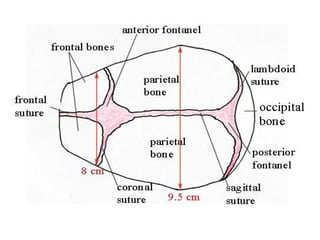
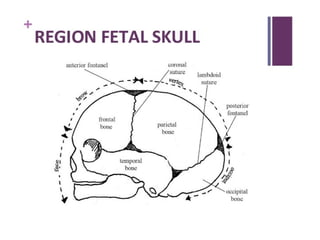
• Membrane spaces: Suture lines are important because
they allow the bones to move and overlap, changing
the shape of the fetal head in order to fit through the
birth canal, a process called molding.
1. Sagittal suture line – the membranous interspace
which joins the parietal bones.
2. Coronal suture line – the membranous interspace
which joins the frontal bone and the parietal bones.
3. Lamboid suture line – the membranous interspace
which joins the occiput and parietals
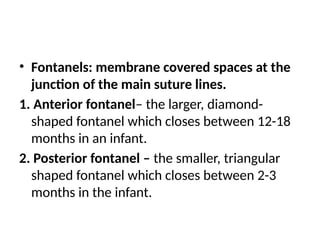
• Fontanels: membrane covered spaces at the
junction of the main suture lines.
1. Anterior fontanel– the larger, diamond-
shaped fontanel which closes between 12-18
months in an infant.
2. Posterior fontanel – the smaller, triangular
shaped fontanel which closes between 2-3
months in the infant.
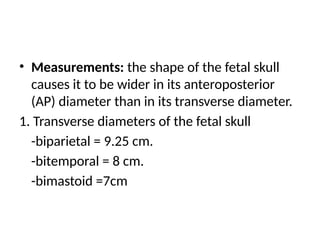
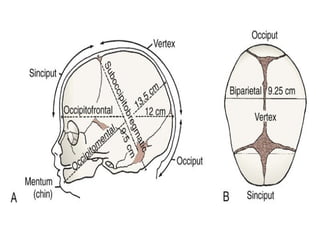
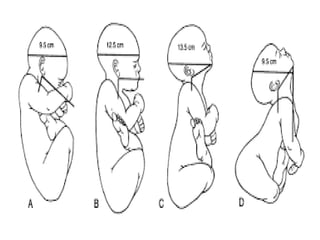
• Measurements: the shape of the fetal skull
causes it to be wider in its anteroposterior
(AP) diameter than in its transverse diameter.
1. Transverse diameters of the fetal skull
-biparietal = 9.25 cm.
-bitemporal = 8 cm.
-bimastoid =7cm
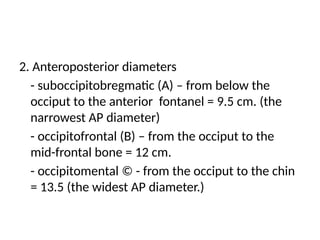
2. Anteroposterior diameters
- suboccipitobregmatic (A) – from below the
occiput to the anterior fontanel = 9.5 cm. (the
narrowest AP diameter)
- occipitofrontal (B) – from the occiput to the
mid-frontal bone = 12 cm.
- occipitomental © - from the occiput to the chin
= 13.5 (the widest AP diameter.)
B. THEORIES OF LABOR ONSET
Labor normally begins when the fetus is sufficiently
mature to cope with extra-uterine life yet not to
large to cause mechanical difficulties in delivery.
However, the trigger that converts the random
painless contractions into strong, coordinated,
productive labor contractions is unknown. A
number of theories have been proposed to explain
why labor begins. These includes:
1. Uterine stretch theory – any hollow body organ when
stretched to capacity will necessary contract and empty.
2. Oxytocin theory – labor, being considered a stressful
event, stimulates the hypophysis to produce oxytocin
from to posterior pituitary gland. Oxytocin causes
transaction of the smooth muscles of the body. E.g.,
uterine muscles.
3. Progesterone deprivation theory – progesterone, being
the hormone designed to promote pregnancy, is believed
to inhibit uterine motility. Thus, if its amount decreases,
labor pains occur.
4. Prostaglandin theory – initiation of labor is
said to result from the release of Arachidonic
acid produced by steroid action on lipid
precursors. Arachidonic acid is said to increase
prostaglandin synthesis which , in turn causes
uterine contractions.
5. Theory of aging placenta – because of the
decrease in blood supply, the uterus contracts.
• Components of Labor
A successful labor depends on these integrated
concepts:
1. Passageway – this refers to the route the fetus
must travel from the uterus through the cervix
and vagina to the perineum; because these
organs are contained inside the pelvis, the
fetus must also pass between the pelvic ring.
2. Passenger – Several aspects of the fetus body and
position are critical to the outcome of labor. Primary
among these are the size and the orientation of the
fetal head. The fetus is of appropriate size and in
advantageous position and presentation.
3. Power – this is supplied by the fundus of the uterus
and implemented by uterine contractions, a process
that causes cervical dilatation and the expulsion of
the fetus from the uterus.
4. Psyche – the woman’s psyche is preserved so
afterwards labor can be viewed as a positive
experience.
C. PRELIMINARY/PRODROMAL/PREMONITORY
SIGNS OF LABOR
1.Lightening – the settling of the fetal head into
the pelvic brim. In primis, it occurs 2 weeks
before EDC; in multis, on or before labor onset.
Lightening should not be confused with
engagement. Engagement occurs when the
presenting part has descended into the pelvic
inlet.
Lightening results in:
- Increase in urinary frequency
- Relief of abdominal tightness and
diaphragmatic pressure.
- Shooting pains down the legs because of
pressure on the sciatic nerve.
- Increase in the amount of vaginal discharges.
- Increases lordosis as the fetus enters the pelvis
and falls further forward
- increased varicosities
2. Increased in activity level –due to increased
epinephrine secreted to prepare the body for the
coming “work” ahead. Advise the pregnant woman
not to use this increased energy for doing household
chores.
3. Loss of weight – about 2-3 lbs. 1- 2 days before labor
onset, probably due to decrease in progesterone
production, leading to decrease in fluid retention.
4. Braxton-Hicks contractions – painless, irregular
practice contractions.
What is Braxton Hicks?
• Before experiencing true contractions, many women
have what’s known as Braxton Hicks contractions,
also referred to as practice contractions or false
labor. They are described by the American Congress
of Obstetricians and Gynecologists as “irregular and
they do not come closer together.” Therefore, the
key to recognizing actual labor is understanding the
pattern of the contractions.
These false labor contractions can begin in the
second or third trimester and have been said
to be the uterus practicing or toning up for
real labor. They can range from a completely
painless tightening to a jolt that can take your
breath away. They can sometimes increase in
frequency as the big day approaches.
False vs. True Labor
• The timing of the contractions is a big component
for recognizing the differences between true and
false labor. Other differences you might notice
include the contractions changing when you
change positions, like stopping with movement
or rest. The strength of contractions is also
different, and the pain is felt in different places.
It’s false labor if…
• Contractions don’t come regularly and they
don’t get closer together
• They stop with walking or resting or with
changes in position
• They are usually weak and don’t get stronger,
or start strong and get weaker
• Usually the pain is only felt in the front
It’s true labor if…
• Contractions come and get closer together
over time, lasting about 30-70 seconds each
• They continue regardless of movement or
resting
• They progressively get stronger
• Usually they start in the back and move to the
front
Other ways to recognize labor:
• The 5-1-1 Rule: The contractions come every 5
minutes, lasting 1 minute each, for at least 1 hour
• Fluids and other signs:
– You might notice amniotic fluid from the sac that
holds the baby. This doesn’t always mean you’re in
labor, but could mean it’s coming
– A bloody show or a “mucus plug” could mean a
cervical change, which means labor is close
– Nausea and/or vomiting might happen due to the
contractions becoming very intense and the change in
hormones in the blood
– Sometimes vaginal tears can indicate the discomfort is
more intense and things are progressing
• One definite sign: The only way to know for sure if
you’re in true labor is to be evaluated by a
professional, as true labor is when contractions cause
cervical change
When to Call Your Provider
• If you’re leaking fluid or think you might be
• If you notice decreased fetal movement
• If you’re bleeding
• If you have painful contractions of six or more
in an hour — before 37 weeks of pregnancy
5. Ripening of the cervix – from Goodell’s sign,
the cervix becomes the “ butter-soft”
SIGNS OF TRUE LABOR
1. Uterine Contractions – the surest sign that labor
has begun is the initiation of effective,
productive, involuntary, uterine contractions.
• Pain in uterine contractions result from:
- Contraction of uterine muscles when in an
ischemic state.
- Pressure on nerve ganglia in the cervix and lower
uterine segment.
- Stretching of ligaments adjacent to the uterus
and in the pelvic joints.
- Stretching and in displacement of the tissues
of the vulva and perineum.
• Phases of uterine contractions:
- Increment – first phases during which the intensity
of contraction increases; also known as crescendo.
- Acme – the height of the uterine contraction; also
known as apex.
-Decrement – last phase during which intensity of
contraction decreases; also known as decrescendo.
• Characteristics of Contractions
1. Frequency – this is the time from the beginning
of one contraction to the beginning of the next.
2. Duration – this is the time from the moment
the uterus begins to tighten until it relaxes
again.
3. Intensity – it may be mild, moderate or strong
at its acme.
a. mild – the uterine muscle becomes somewhat
tense, but can be indented with gentle pressure.
b. moderate – the uterus becomes moderately firm
and a firmer pressure is needed to indent it.
c. strong – the uterus becomes so firm that it has the
fee of the wood like hardness, and at the height of
the contraction, the uterus cannot be indented
when pressure is applied by the examiner’s finger.
2. Uterine Changes
 As labor contraction progresses, the uterus is
gradually differentiated into two distinct
portions. These are distinguished by a ridge
formed in the inner uterine surface, the
physiologic ring.
• Physiological retraction ring is formed at the
boundary of the upper and lower uterine
segments. In difficult labor when the fetus is
larger than the birth canal, the round ligaments
of the uterus becomes tense during dilatation
and expulsion, causing an abdominal indentation
called Bandl’s pathological retraction ring, a
danger sign of labor signifying impending rupture
of the uterus if the obstruction is not relieved
Two distinct portion of the uterus:
a. Upper uterine segment – this portion
becomes thicker and active, preparing it to
exert the strength necessary to expel the fetus
during the expulsion phase.
b. Lower uterine segment – this portion becomes
thin walled, supple, and passive so that the
fetus can pushed out of the uterus easily
Contour of the uterus changes – from a round
ovoid to a structure markedly elongated in a
vertical diameter than horizontally. This serves
to straighten the body of the fetus and place it
in better alignment to the cervix and pelvis.
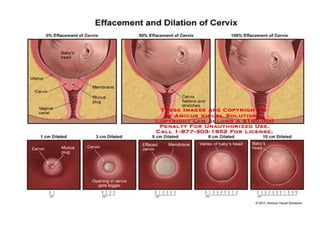
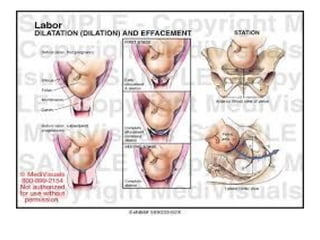
3. Cervical Changes
a. Effacement – shortening and thinning of the
cervical canal to paper-thin edges as distinct
from the uterus. In primiparas, effacement is
accomplished before dilatation begins while
with multiparas, dilatation may proceed before
effacement is completes. It is expressed in
percentage.
b. Dilatation – enlargement of the external
cervical is up to 10 cm primarily as a result of
uterine contractions and secondarily as a result
of pressure of the presenting part and the BOW.
• Dilatation occurs for two reasons :
1. Uterine contractions gradually increase the
diameter of the cervical canal lumen by pulling
the cervix up over the presenting part of the
fetus.
2. The fluid-filled membranes press against the
cervix.
4. Show - due to pressure of the descending
presenting part of the fetus which causes
rupture of minute capillaries in the mucus
membrane of the cervix. Blood mixes with
mucus when the operculum is released. Show,
therefore, is only a pinkish vaginal discharge.
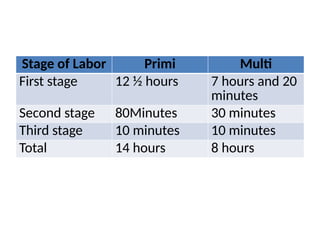
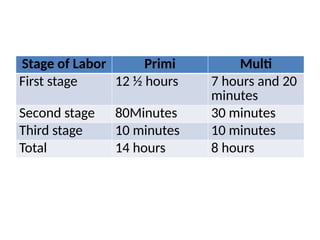
Stage of Labor Primi Multi
First stage 12 ½ hours 7 hours and 20
minutes
Second stage 80Minutes 30 minutes
Third stage 10 minutes 10 minutes
Total 14 hours 8 hours
5. Rupture of the membranes – this is the sudden gush
or a scanty slow seeping of amniotic fluid from the
vagina. It is important to remember that once
membranes (BOW) have ruptured:
• Labor is inevitable. It will occur within 24 hours.
• The integrity of the uterus has been destroyed.
Infection, therefore, can easily set in. That is why once
membranes have ruptured:
- Aseptic techniques should be observed in all
procedures.
- Doctors do less obstetric manipulation (e.g., IE).
- Enema is no longer ordered.
- Temperature should be taken regularly so that
fever, a sign of infection, can be detected.
• Umbilical cord compression and/or cord
prolapsed can occur (especially in breech
presentation.) nursing action depends on the
specific situation
- A woman in labor seeking admission to the
hospital and saying that her BOW has
ruptured should be put to bed immediately,
and the fetal heart tones taken consequently.
- If a woman in the Labor Room says that her
membranes have ruptured, the initial nursing
action is to take the fetal heart tones.
- If a woman in labor says that’s he feels a loop of
the cord coming out of the vagina (umbilical cord
prolapse), the first nursing action is to put her on
Trendelenburg position (lower the head of the
client) in order to reduce pressure on the cord.
(Remember: only 5 minutes of cord compression
can already lead to irreversible brain damage or
even death.) In addition, apply a warm saline
saturated OS on the prolapsed cord to prevent
drying of the cord
• The color of the amniotic fluid should always be
noted.
 at term, this is clear, almost colorless and
contains specks of vernix caseosa
Freen staining means it has been contaminated
with meconium, a sign of fetal distress
Yellow staining may mean blood incompatibility
Pink staining may indicate bleeding
• If labor does not occur spontaneously at the
end of 24 hrs after membrane ruptures, labor
will be induced, provided the woman is
estimated to be term.
Stage of Labor Primi Multi
First stage 12 ½ hours 7 hours and 20
minutes
Second stage 80Minutes 30 minutes
Third stage 10 minutes 10 minutes
Total 14 hours 8 hours
• STAGES OF LABOR
• First stage (stage of dilatation) – begins with true
labor pains and ends with complete dilatation of
the cervix.
• Phases:
• Latent – early time in labor
• Cervical dilatation is minimal because effacement
is occurring.
• Cervix dilates only 3-4 cm.
• Contractions are of short duration and occur
regularly 5-10 minutes apart (the best time for
the pregnant woman to seek admission to the
hospital.)
• Mother is excited but has some degree of
apprehension and still has the ability to
communicate.
• Active/accelerated
• Cervical dilatation reaches 4-8 cm.
• Rapid increase in duration, frequency and
intensity of contractions.
• Mother fears of losing control of herself.
• Nursing care
• Hospital admission – provide privacy and reassurance
from the very start.
• Personal; data – name, age, address, civil status
• Obstetrical data – determine the EDC; obstetrical score
(gravida, para, TPAL); amount and character of show;
and whether or not membrane have ruptured.
• General physical examination, internal exam and
Leopold’s maneuvers are done to determine:
• Effacement and dilatation
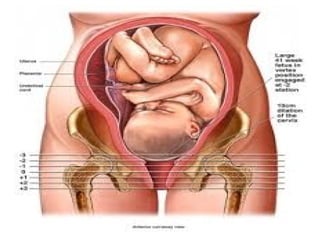
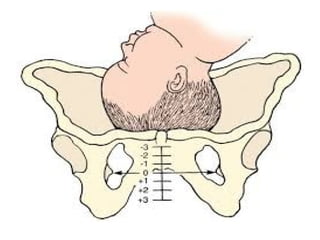
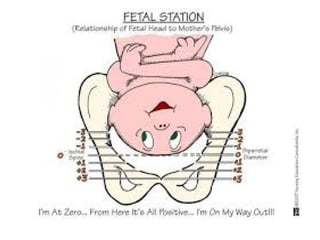
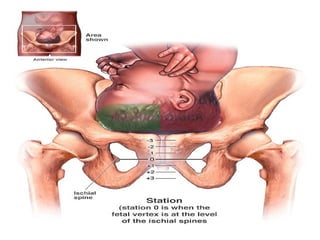
• Station - relationship of the fetal presenting part to the
level of the ischial spines.
• Station 0: at the level of the ischial spines; synonymous
to engagement
• Station -1: presenting part above the level of the ischial
spines
• Station +1: presenting part below the level of the ischial
spines.
• Station +3 or +4: synonymous to crowning (encircling of
the largest diameter of the fetal head by the vulvar ring.)
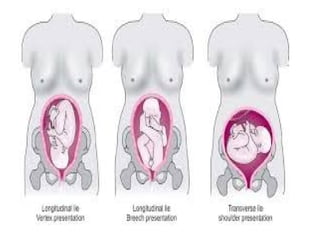
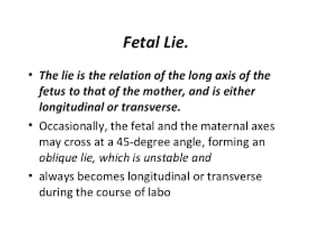
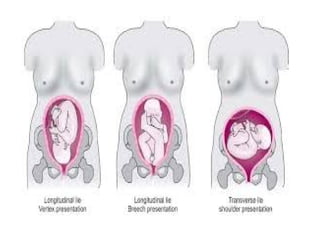
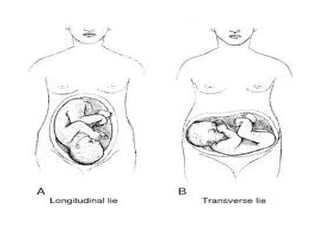
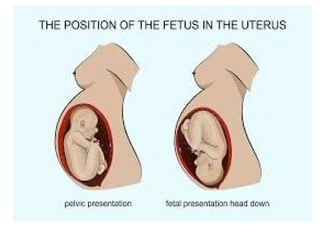
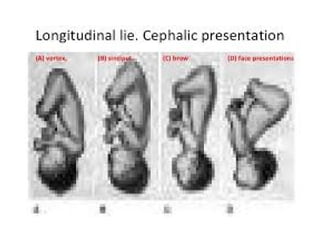
• Presentation – relationship of the long axis of
the mother to the long axis of the fetus; also
known as lie. Presenting part is the fetal part
which enters the pelvis first and covers the
internal cervical os
1. Vertical
a. Cephalic
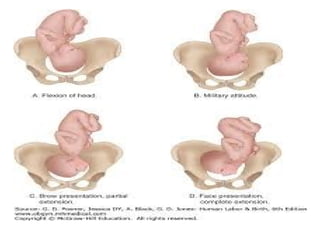
• Vertex: head is sharply flexed, making the
parietal bones the presenting parts.
• In poor flexion:
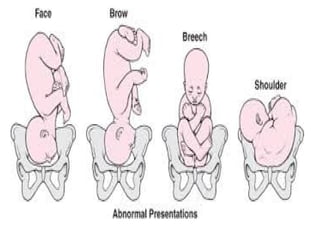
• Face
• Brow
• Chin
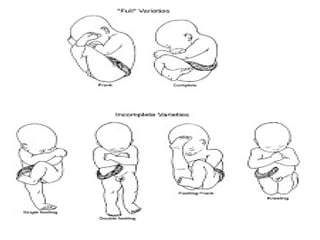
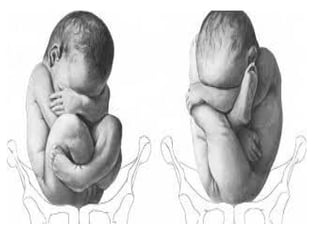
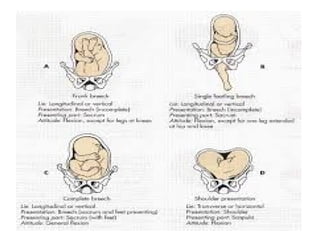
• Breech: buttocks are the presenting parts
• - complete: thighs is flexed on the abdomen and legs are
on the thighs.
• - Frank: thighs are flexed and legs are extended, resting
on the anterior surface of the body.
• c. Footing
• - Single: one leg unflexed and extended;one foot
presenting
• - Double: legs unflexed and extended; both feet are
presenting
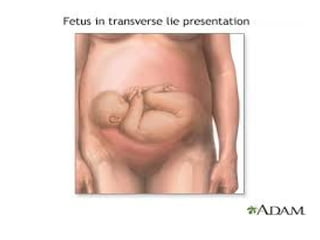
• Horizontal
• a. Transverse lie
• b. Shoulder presentation
• 3. Important Considerations:
• a. in vertex and breech presentations, fetal heart
sounds (FHS) are best heard at the area of the fetal
back; in face presentations FHS are at the area of the
fetal chest.
• b. in vertex presentations, FHS are usually located in
either the left or right lower quadrant (LLQ or RLQ);
in breech presentation, at or above the level of the
umbilicus, either left or right upper quadrant (LUQ or
RUQ).
• . hazards of breech deliver:
• - cord compression
• - Abruption placenta
• - Erb-duchenne paralysis
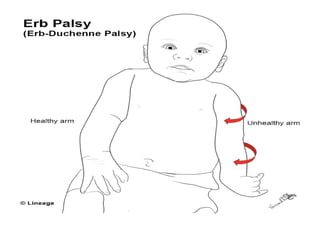
• Erb's palsy or Erb–Duchenne palsy is
a paralysis of the arm caused by injury to the
upper trunk C5–C6 nerves. They form part of
the brachial plexus, comprising the ventral
rami of spinal nerves C5–C8 and
thoracic nerve T1. These injuries arise most
commonly from shoulder dystocia during a
difficult birth.
• horizontal lie is very rare (1%) and maybe due
to a relaxed abdominal wall because of
multiparity, pelvic contraction or placenta
previa.
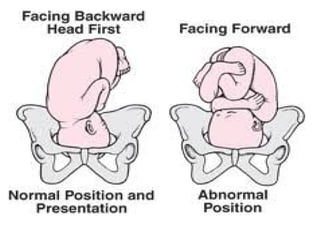
• Position – relationship of the fetal presenting
part to a specific quadrant I the mother’s
pelvis
1. The pelvis is divided into four quadrants:
a. Right anterior
b. Left anterior
c. Right posterior
d. Left posterior
• Position – relationship of the fetal presenting
part
• to a specific quadrant I the mother’s pelvis
• 1. The pelvis is divided into four quadrants
• a. Right anterior
• b. Left anterior
• c. Right posterior
• d. Left posterior
• Posterior positions result in more backaches
because of pressure of the fetal presenting
part on the maternal sacrum
• 2. Points of direction in the fetus:
a. occiput – in vertex presentation
b. chin (mentum) – in face presentations
c. sacrum – in breech presentations
d. scapula (acromio) – in horizontal
presentations.
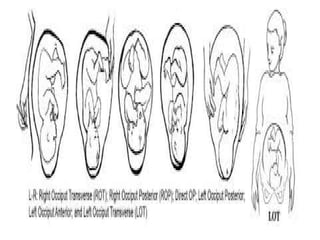
• 3. Possible fetal positions
a. Vertex
- LOA (left occipitoanterior (most common and
favorable position at birth)
- LOP (left occipitoposterior)
- LOT (left occipitotransverse)
- ROA (right occipitoanterior)
- ROP (right occipitoposterior
- ROT (right occipitotransverse)
• b. Breech
- LSA (left sacroanterior)
- LSP (left sacroposterior)
- LST (left sactrotransverse)
- RSA (right sacroanterior)
- RSP (right sacroposterior)
- RST (right sacrotransverse)
• c. Face
- LMA (left mentoanterior)
- LMP (left mentoposterior)
- LMT (left metrotransverse)
- RMA (right mentoanterior)
- RMP (right monteposterior)
- RMT (right mentotransverse)
• d. Shoulder
- LADA (left acromiodorsoanterior)
- LADP (left acromiodorsoposterior)
- RADA (right acromiodorsoanterior)
- RADP (right acromiodorsoposterior)
Monitoring and evaluating important
aspects
In assessing uterine contractions, fingers should
be spared lightly over the fundus
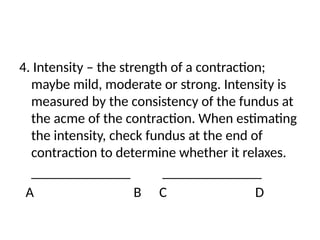
1. Duration – from the beginning of one
contraction to the end of the same
contraction (A an B)
 Duration during early labor : 20-30 seconds
 Duration late in labor : 60 to 70 seconds
(should never be longer)
2. Interval – from the end of one contraction to the
beginning of the next contraction ( B to C)
Interval early in labor : 40 – 45 minutes
Interval late in labor : 2- 3 minutes
3. Frequency – from the beginning of one
contraction to the beginning of the next
contraction (A to C). Observe 3-4 contractions to
have a good picture of the frequency of
contractions
4. Intensity – the strength of a contraction;
maybe mild, moderate or strong. Intensity is
measured by the consistency of the fundus at
the acme of the contraction. When estimating
the intensity, check fundus at the end of
contraction to determine whether it relaxes.
______________ ______________
A B C D
• Blood pressure – should not be taken during a contraction
as it tends to increase. Because no blood supply goes to
the placenta during a contraction, all of the blood is in the
periphery that is why there is increased BP during uterine
contractions.
1. BP reading should be taken at least every half hour during
active labor.
2. When a woman in labor complains of a headache, the first
nursing action is to take the BP. If it is normal, it is only
stress headache; if the BP is increased, refer immediately
to the doctor (it could be a sign of toxemia)
• Blood pressure – should not be taken during a contraction
as it tends to increase. Because no blood supply goes to
the placenta during a contraction, all of the blood is in the
periphery that is why there is increased BP during uterine
contractions.
1. BP reading should be taken at least every half hour during
active labor.
2. When a woman in labor complains of a headache, the first
nursing action is to take the BP. If it is normal, it is only
stress headache; if the BP is increased, refer immediately
to the doctor (it could be a sign of toxemia)
•  Fetal heart rate (FHR) – should not be mistaken
for uterine soufflé (synchronizes with maternal
pulse rate)
1. Normally 120 to 160 per minute.
2. Should not be taken during uterine contraction
because it tends to decrease the FHB.
Compression of the fetal head when the uterus
contracts stimulates the vagal reflex which in turn,
causes bradycardia.
3. Should be taken every hour during the latent
phase of labor, every half hour during the
active phase and every 15 minutes during the
transition period.
4. For any abnormality in FHR, the initial nursing
action is to change the mother’s position.
5. Signs of fetal distress:
- Bradycardia (FHR less than 100/minute) or
tachycardia (FHR more than 180/minute)
- Meconium- stained amniotic fluid in non-
breech presentation
- fetal thrashing (hyperactivity of the fetus as it
struggles for more oxygen)
e. Emotional support is provided for the woman
in labor by keeping her constantly informed of
the progress of labor.
f. Health teachings
Bath – advisable if contractions are tolerable
or not too close to one another. Will make the
mother feel more comfortable.
Ambulation – during the latent phase of labor
helps shorten the first stage of labor. But
definitely not allowed anymore if membranes
have ruptured.
Solid or liquid foods are to be avoided because
digestion is delayed during labor. A full
stomach interferes with proper bearing down.
May vomit and cause aspiration.
g. Enema – not a routine procedure
Purposes:
- A full bowel hinders the progress of labor – effectiveness
of enema in labor can be determined by evaluating
change in uterine tone and the amount of show
- Expulsion of feces during second stage of labor
predisposes mother and baby to infection
- Full bowel predisposes to postpartum discomfort
• Procedure of enema administration
- enema solution may either be soap suds or
Fleet enema (contraindicated in patients with
toxemia because of its sodium content.)
- optimum temperature of the solution – 105
degrees Fahrenheit to 115 degrees Fahrenheit
(40.5 degrees Celsius – 46.1 degrees Celsius)
- patient on side- lying position
-when there is resistance while inserting rectal
catheter, withdraw the tube slightly while
letting a small amount of solution enter
- clamp rectal tube during a contraction
- important nursing action : check FHR after
enema administration to determine after
fetal distress.
Contraindications to enema in labor
- Vaginal bleeding
- Premature labor
- Abnormal fetal presentation or position
- Ruptured membranes
- Crowning
h. Encourage the mother to void every 2-3
hours by offering the bedpan because
- A full bladder retards fetal descent
- Urinary stasis can lead to urinary tract
infection
- A full bladder can be traumatized during the
delivery
i. Perineal prep – done aseptically.
- Use “no.7” method, always from front to back
j. Perineal shave – not a routine procedure;
- maybe done to provide a clean area for
delivery.
- muscles at the symphysis pubis area should
be kept taut and razor moved along the
direction of hair growth.
k. Encourage Sim’s position because it:
- Favors anterior rotation of the fetal head
- Promotes relaxation between contractions
- Prevents continual pressure of the gravid
uterus on the inferior vena cava (the blood
vessel which brings unoxygenated blood back
to the heart.
- pressure results in supine hypotensive
syndrome, also called vena cava syndrome.
Hypotension is due to the reduced venous
return resulting in decreased cardiac output
and therefore, a fall in arterial BP.
l. Woman in labor should not be allowed to
- push or bear down unnecessarily during
contractions of the first stage because
 It leads to unnecessary exhaustion.
Repeated strong pounding of the fetus against
the pelvic floor will lead to cervical edema,
thus interfering with dilatation and prolonging
length of labor.
m. Abdominal breathing is advised for
contractions during the first stage in order
to reduce tension and prevent
hyperventilation.
n. Administer analgesics as ordered. The dosage is based
on the patient’s weight, status of labor and age of
gestation.
- Narcotics are the most commonly used, specifically,
Demerol.
- Pharmacologic effect: depresses the sensory portion
of the cerebral cortex. It is not only a potent
analgesics, it is also a sedative and an antispasmodic.
- It is not given early in labor because it can retard
progress (is an antispasmodic), but cannot also be
given if deliver is only one hour away because it
- It is not given early in labor because it can retard
progress (is an antispasmodic), but cannot also
be given if deliver is only one hour away because
it causes respiratory depression in the new born
(that is why it can be given only if cervical
dilatation is 6-8 cm.)
- Given 25-100 mg., depending on body weight.
- Takes effect in 20 minutes – patient experiences
a sense of well – being and euphoria.
-Narcotic antagonists (e.g., Narcan, Nalline) are given to
counteract any toxic effects of Demerol.
- Assist in administration of regional anesthesia –
preferred over any other form of anesthesia because :
 it does not enter maternal circulation and so does not
affect the fetus.
Patient is completely awake and aware of what is
happening. Does not depress uterine tone, thus
optimal uterine contraction is achieved.
- Xylocaine is the anesthetic of choice
- Patient on NPO with IV to prevent dehydration,
exhaustion and aspiration because glucose
aids in proper functioning of the fetus.
• Types of Anesthesia
a. Paracervical – transvaginal injection into
either side of the cervix. Patient on lithotomy
position. Coupled with a local anesthetic
results in “painless childbirth” (uterine
contractions are not felt by mother.)
b. Pudendal – through the sacrospinous ligament into
the posterior areolar tissues to reduce perception of
pain during second stage and make patient
comfortable.
Patient on lithotomy. Side effect: an ecchymotic
(purplish discoloration of the skin due to blood in
subcutaneous tissues) area of hematoma in the
perineum may be an aftermath. No special
treatment is needed: ice bag applied to the area on
the first day may reduce the swelling.
• c. Low spinal
- Epidural – injection of local anesthetic at the lumbar
level outside the dura mater.
- Saddle block – injection into the 5th
lumbar space,
causing anesthesia in the parts of the body that come
in contact with a saddle (perineum, upper thighs and
lower pelvis.) blocks nerves that transmit pain of first
stage of labor. In sitting or side- lying position, with
back flexed.
- Forceps are generally needed in delivery of
patient under anesthesia because of loss of
coordination in second –stage pushing.
- Post spinal headaches may be due to leakage
of anesthetic into the CSF or injection of air at
time of needle insertion. Management: flat on
bed for 12 hours and increase fluid intake.
• Common Side Effects:
- Hypotension – because Xylocaine is a vasodilator.
- Management:
turning side; prompt elevation of leg;
administration of vasopressor and oxygen, as
ordered.)
- Fetal bradycardia
- Decreased maternal respirations
o. A sure sign that the baby is about to be born is
the bulging of the perineum. In general,
Primigravidas are transported from the labor
Room to the Delivery Room when the cervix is
fully dilated or when there is bulging of the
perineum.
Multiparas, on the other hand, are transported
when cervical dilatations are 7-9 cm.
• Transition Period– when the mood of the
woman suddenly changes and the nature of
the contractions intensify.
a. Characteristics
 If membranes are still intact, this period is marked
by a sudden gush of amniotic fluid as fetus is pushed
into the birth canal. If spontaneous rupture does not
occur, amniotomy (snipping of BOW with a sterile
pointed instrument, e.g, Kelly or Allis forceps or
amniohook to allow amniotic fluid to drain) is done
to prevent fetus from aspirating the amniotic fluid
as it makes its different fetal position changes.
Amniotomy, however, cannot be done if station is still
“minus” , as this can lead to cord compression.
 There is an uncontrollable urge to push with
contractions, a sign of impending second stage of
labor. Profuse perspiration and distention of neck veins
are seen.
 Nausea and vomiting is a reflex reaction due to a
decreased gastric motility and absorption.
 In primis, baby is delivered within 20 contractions (40
minutes); in multis, after 10 contractions (20 minutes)
b. Nursing actions are primarily comfort measures:
 Sacral pressure (applying pressure with the heel of
the hand on the sacrum) – relieves discomfort from
contractions.
Proper bearing down techniques m- push with
contractions.
Controlled chest (costal) breathing during
contractions.
Emotional support
3. Second Stage (stage expulsion) – begins
with complete dilatation of the cervix and
ends with the delivery of the baby.
a. Powers/Forces: involuntary uterine
contractions and contractions of the
diaphragmatic and abdominal muscles
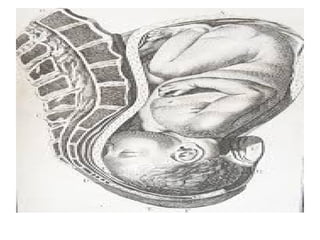
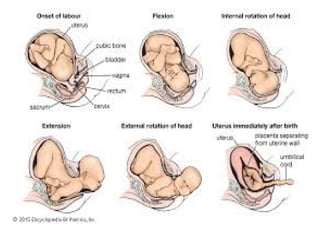
b. Mechanism of labor/Fetal position Changes (D FIRE ERE)
 Descent – may be preceded by engagement.
 Flexion – as decent occurs, pressure from the pelvic floor
causes chin to bend forward onto the chest.
 Internal Rotation – from AP to transverse, then AP to AP.
 Extension – as the head comes out, the back of the neck
stops beneath the public arch. The head extends and the
forehead, nose, mouth and chin appear.
 External Rotation (also called restitution) – Anterior
shoulder rotates externally to the AP position.
 Expulsion – delivery of the rest of the body.
c. Nursing Care:
• When positioning legs on lithotomy, put them up at the same
time to prevent injury to the uterine ligaments.
• As soon as the fetal head crowns, instruct the mother not to
push, but to pant (rapid and shallow breathing to prevent rapid
expulsion of the baby). If panting is deep and rapid, called
hyperventilation, the patient will experience lightheadedness
and tingling sensation of the fingers leading to carpopedal
spasms because of respiratory alkalosis.
• Management: let the patient breathe into a brown paper bag to
recover lost carbon dioxide; a cupped hand over the mouth and
nose will serve the same purpose.
• Assist in episiotomy (incision made in the
perineum primarily to prevent lacerations)
Other Purposes:
a. prevent prolonged and severe stretching of
muscles supporting the bladder or rectum.
b. reduce duration of second stage when there is
hypertension or fetal distress.
c. enlarge outlet, as in breech presentation or
forceps delivery.
• Types of episiotomy:
a. Median – from middle portion of the lower vaginal
border directed towards the anus.
b. Mediolateral – begun in the midline but directed laterally
away from the anus. Often done because it prevents 4th
degree laceration should it occur despite episiotomy.
 Natural anesthesia is used in episiotomy, i.e.; no
anesthetic is injected because pressure of fetal presenting
part against the perenium is so intense that nerve
endings for pain are momentarily deadened.
d. Apply the modified Ritgen’s maneuver.
1. Cover the anus with a sterile towel and exert
upward and forward pressure on the fetal chin,
while exerting gentle pressure with two fingers
on the head to control emerging head. This will
not only support the perineum, thus preventing
lacerations, but will also favor flexion so that
the smallest suboccipitobregmatic diameter of
the fetal head is presented.
2. Ease the head out and immediately wipe the
nose and mouth of secretions to establish a
patent airway (remember: the first and most
important principle in the care of the newborn
is established and maintains a patent airway.)
The head should be delivered in between
contractions.
3. Insert 2 fingers into the vagina so as to feel for the
presence of a cord looped around the neck (nuchal cord).
If so, but loose, slip it down the shoulders or up over the
head; but if tight, clamp the cord twice, an inch apart, and
then cut I between.
4. As the head rotates, deliver the anterior shoulder by
exerting a gentle downward push and the slowly give an
upward lift to deliver the posterior shoulder.
5. While supporting the head and the neck, deliver the
rest of the body. Take note of the time of the delivery of
the baby.
e. Immediately after the delivery, the newborn should be
held below the level of the mother’s vulva for a few minutes
to encourage flow of the blood from the placenta to the
baby.
f. The infant is held with his head in a dependent position
(head lower than the rest of the body) to allow for drainage
of secretions. (Remember: Never stimulate a baby to cry
unless you have drained him out of his secretions.)
g. Wrap the baby in a sterile towel to keep him warm.
(Remember: Chilling increases the body’s need for oxygen.)
h. Put the baby on the mother’s abdomen. The
weight of the baby will help contract the uterus.
i. Cutting of the cord is postponed until the
pulsations have stopped because it is believed
that 50-100 ml of blood is flowing from the
placenta to the baby at this time. After cord
pulsations have stopped, clamp it twice, an inch
apart and then cut in between.
j. Show the baby to the mother, inform her of
the sex and time of the delivery then give the
baby to the circulating nurse.
4. Third stage (placental stage) – begins with the
delivery of the baby and ends with the delivery of
the placenta.
a. Signs of Placental separation:
Uterus becoming round and firming again, rising
high to the level of the umbilicus (Calkin’s sign) –
in the earliest sign of placental separation
Sudden gush of blood from the vagina
Lengthening of the cord
b. types of placental delivery:
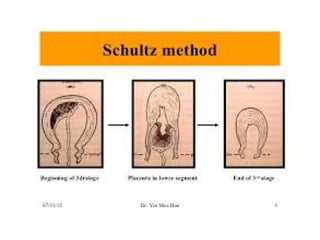
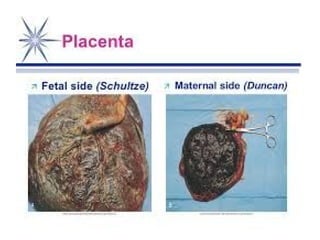
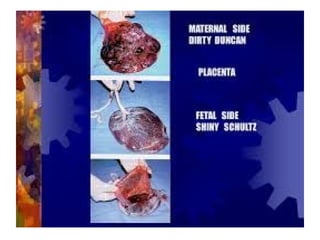
 Schultz – if placenta separates first at its center and then at
its edges, it tends to fold on itself like an umbrella and
presents the fetal surface which is shiny (“Shiny” for
Schultz); 80% of placentas separate in this manner.
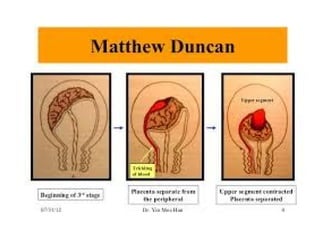
 Duncan – if placenta separates firsts at its edges, it slides
along the uterine surface and presents with the maternal
surface which is raw, red, beefy, irregular and “dirty”
(“Dirty” for Duncan). Only about 210% of placentas
separate this way.
c. Nursing Care
1. Do not hurry the expulsion of the placenta by forcefully pulling
out the cord or doing vigorous fundal push as this can cause
uterine inversion. Just watch for the signs of placental separation.
2. Tract the cord slowly, winding it around the clamp until the
placenta spontaneously comes out, slowly rotating it so that no
membranes are left inside the uterus, a method called Brandt-
Andrews maneuver.
3. Take note of the time of placental delivery. It should be delivered
within 20 minutes after the delivery of the baby. Otherwise, refer
immediately to the doctor as this can cause severe bleeding in the
mother.
4. Take note of the time of placental delivery. It should be
delivered within 20 minutes after the delivery of the baby.
Otherwise, refer immediately to the doctor as this can cause
severe bleeding in the mother.
5. Inspect for completeness of cotyledons; any placental fragment
retained can also cause severe bleeding and possible death.
6. Palpate the uterus to determine degree of contraction. If
relaxed boggy or non-contracted, first nursing action is to
massage gently and properly. An ice cap over the abdomen
will also help contract the uterus since cold causes
vasoconstriction.
7. Inject oxytocin (Methergin = 0.2mg/ml or
Syntocinon = 100/ml) IM to maintain uterine
contractions, thus prevent hemorrhage. Note:
oxytocins are not given before placental delivery.
8. Inspect the perineum for lacerations. Any time the
uterus is firm following placental delivery, yet
bright red vaginal bleeding is gushing forth from
the vaginal opening, suspect lacerations (tend to
heal more slowly because of ragged edges)
 Categories of Lacerations:
1. First degree – involves the vaginal mucous
membranes and perineal skin.
2. Second degree – involves not only the muscles,
vaginal mucous membranes and skin, but also the
muscles.
3. Third degree – involves not only the vaginal mucous
membranes and skin, but also the extern al sphincter
of the rectum.
4. Fourth Degree – involves not only the external sphincter of the
rectum, the muscles, vaginal mucous membranes and skin, but
also the mucous membranes of the rectum.
a. Assist the doctor in doing episiorrhaphy (repair of episiotomy
or lacerations). In vaginal episiorrhaphy, packing is done to
maintain pressure on the suture line, thus prevent further
bleeding. Note: vaginal packs have to be removed after 24-48
hours.
b. Make mother comfortable by perineal care and applying clean
sanitary napkin snugly to prevent its moving forward from the
anus to the vaginal opening. Soiled napkins should be removed
from front to back.
c. Position the newly-delivered mother flat on bed without
pillows to prevent dizziness due to decrease in intra-
abdominal pressure.
d. The newly-delivered mother may suddenly complain of
chills due to decreased blood pressure, fatigue or cold
temperature in the delivery room.
Management:
a. Provide additional blankets to keep her warm.
b. May give initial nourishment, e.g., milk, coffee, or tea.
c. Allow patient to sleep in order to regain lost energy.
5. Fourth Stage – first 1-2 hours after delivery which
is said to be the most critical stage for the mother
because of unstable vital signs.
a. Assessment
• Fundus – should be checked every 15 minutes for 1
hour then every 30 minutes for the next 4 hours.
Fundus should be firm, in the midline, and during
the first 12 hours postpartum, is a little above the
umbilicus. First nursing action for a non-contracted
uterus: massage.
• Lochia- should be moderate in amount.
Immediately after delivery, a perineal pad can
be fully saturated in 15 minutes or earlier, may
mean hemorrhage.
• Bladder – a full bladder is evidenced by a fundus
which is to the right of the midline and dark-red
bleeding with some clots. Will prevent adequate
uterine contraction.
• Perineum – is normally tender, discolored and
edematous. It should be clean, with intact sutures.
• Blood pressure and pulse rate may be slightly
increased from excitement and effort of delivery,
but normalize within one hour.
b. Lactation – suppressing the agents –
estrogen – androgen preparations given within
the first hours postpartum to prevent breast
milk production in mothers who will not (or
cannot) breastfeed, e.g., diethylstilbestrol,
TACE#, Parlodel or deladumone. These drugs
tend to increase uterine bleeding and retard
menstrual return.
c. Rooming-in concept – mother and baby are
together while in the hospital. The concept of a
family, therefore, is felt from the very beginning
because parents have the baby with them, thus
providing opportunities for developing a
positive relationship between parents and
newborn (maternal-infant bonding). Eye-to-
eye contact is immediately established,
releasing the maternal caretaking responses
Labor-and-Delivery-Maternal Lab and Lecppt.pptx

Labor-and-Delivery-Maternal Lab and Lecppt.pptx

  • 1.
  • 2.
    • Labor isthe series of events by which the products of conception are expelled from the woman’s body. The terms childbirth, encouchment, confinement, parturition, and travail are all synonyms for labor. Labor is an apt term because a great deal of work is involved in the process of birth. For the woman and the fetus alike it is a time of change, both a time of ending and a time for beginning.
  • 3.
    A. THE FETALSKULL • Importance: From an obstetrical point of view the fetal skull is the most important part of the fetus because it is the : • Largest part of the body • Most frequent presenting part • Least compressible of all parts • Once the head has been born, the birth of the rest of the body is rarely delayed.
  • 4.
    • Three majorparts of the fetal skull : 1. The face 2. The base of the skull (cranium) 3. Vault of the cranium (roof)
  • 5.
    • Cranial bones:the first 3 are not important because they lie at the base of the cranium and, therefore, are never the presenting parts. 1. sphenoid - 1 4. frontal - 2 2. ethmoid - 1 5. occipital - 1 3. temporal - 2 6. parietal - 2
  • 6.
    • These bonesare not fused, allowing this portion of the head to adjust in shape as the presenting parts passes through the narrow portions of the pelvis. The cranial bones overlap under pressure of the powers of labor and the demands of the underlying pelvis. The overlapping is called molding.
  • 7.
    • Membrane spaces:Suture lines are important because they allow the bones to move and overlap, changing the shape of the fetal head in order to fit through the birth canal, a process called molding. 1. Sagittal suture line – the membranous interspace which joins the parietal bones. 2. Coronal suture line – the membranous interspace which joins the frontal bone and the parietal bones. 3. Lamboid suture line – the membranous interspace which joins the occiput and parietals
  • 10.
    • Fontanels: membranecovered spaces at the junction of the main suture lines. 1. Anterior fontanel– the larger, diamond- shaped fontanel which closes between 12-18 months in an infant. 2. Posterior fontanel – the smaller, triangular shaped fontanel which closes between 2-3 months in the infant.
  • 11.
    • Measurements: theshape of the fetal skull causes it to be wider in its anteroposterior (AP) diameter than in its transverse diameter. 1. Transverse diameters of the fetal skull -biparietal = 9.25 cm. -bitemporal = 8 cm. -bimastoid =7cm
  • 12.
    2. Anteroposterior diameters -suboccipitobregmatic (A) – from below the occiput to the anterior fontanel = 9.5 cm. (the narrowest AP diameter) - occipitofrontal (B) – from the occiput to the mid-frontal bone = 12 cm. - occipitomental © - from the occiput to the chin = 13.5 (the widest AP diameter.)
  • 14.
    B. THEORIES OFLABOR ONSET Labor normally begins when the fetus is sufficiently mature to cope with extra-uterine life yet not to large to cause mechanical difficulties in delivery. However, the trigger that converts the random painless contractions into strong, coordinated, productive labor contractions is unknown. A number of theories have been proposed to explain why labor begins. These includes:
  • 15.
    1. Uterine stretchtheory – any hollow body organ when stretched to capacity will necessary contract and empty. 2. Oxytocin theory – labor, being considered a stressful event, stimulates the hypophysis to produce oxytocin from to posterior pituitary gland. Oxytocin causes transaction of the smooth muscles of the body. E.g., uterine muscles. 3. Progesterone deprivation theory – progesterone, being the hormone designed to promote pregnancy, is believed to inhibit uterine motility. Thus, if its amount decreases, labor pains occur.
  • 16.
    4. Prostaglandin theory– initiation of labor is said to result from the release of Arachidonic acid produced by steroid action on lipid precursors. Arachidonic acid is said to increase prostaglandin synthesis which , in turn causes uterine contractions. 5. Theory of aging placenta – because of the decrease in blood supply, the uterus contracts.
  • 17.
    • Components ofLabor A successful labor depends on these integrated concepts: 1. Passageway – this refers to the route the fetus must travel from the uterus through the cervix and vagina to the perineum; because these organs are contained inside the pelvis, the fetus must also pass between the pelvic ring.
  • 18.
    2. Passenger –Several aspects of the fetus body and position are critical to the outcome of labor. Primary among these are the size and the orientation of the fetal head. The fetus is of appropriate size and in advantageous position and presentation. 3. Power – this is supplied by the fundus of the uterus and implemented by uterine contractions, a process that causes cervical dilatation and the expulsion of the fetus from the uterus.
  • 19.
    4. Psyche –the woman’s psyche is preserved so afterwards labor can be viewed as a positive experience.
  • 20.
    C. PRELIMINARY/PRODROMAL/PREMONITORY SIGNS OFLABOR 1.Lightening – the settling of the fetal head into the pelvic brim. In primis, it occurs 2 weeks before EDC; in multis, on or before labor onset. Lightening should not be confused with engagement. Engagement occurs when the presenting part has descended into the pelvic inlet.
  • 21.
    Lightening results in: -Increase in urinary frequency - Relief of abdominal tightness and diaphragmatic pressure. - Shooting pains down the legs because of pressure on the sciatic nerve. - Increase in the amount of vaginal discharges.
  • 22.
    - Increases lordosisas the fetus enters the pelvis and falls further forward - increased varicosities
  • 23.
    2. Increased inactivity level –due to increased epinephrine secreted to prepare the body for the coming “work” ahead. Advise the pregnant woman not to use this increased energy for doing household chores. 3. Loss of weight – about 2-3 lbs. 1- 2 days before labor onset, probably due to decrease in progesterone production, leading to decrease in fluid retention. 4. Braxton-Hicks contractions – painless, irregular practice contractions.
  • 24.
    What is BraxtonHicks? • Before experiencing true contractions, many women have what’s known as Braxton Hicks contractions, also referred to as practice contractions or false labor. They are described by the American Congress of Obstetricians and Gynecologists as “irregular and they do not come closer together.” Therefore, the key to recognizing actual labor is understanding the pattern of the contractions.
  • 25.
    These false laborcontractions can begin in the second or third trimester and have been said to be the uterus practicing or toning up for real labor. They can range from a completely painless tightening to a jolt that can take your breath away. They can sometimes increase in frequency as the big day approaches.
  • 26.
    False vs. TrueLabor • The timing of the contractions is a big component for recognizing the differences between true and false labor. Other differences you might notice include the contractions changing when you change positions, like stopping with movement or rest. The strength of contractions is also different, and the pain is felt in different places.
  • 27.
    It’s false laborif… • Contractions don’t come regularly and they don’t get closer together • They stop with walking or resting or with changes in position • They are usually weak and don’t get stronger, or start strong and get weaker • Usually the pain is only felt in the front
  • 28.
    It’s true laborif… • Contractions come and get closer together over time, lasting about 30-70 seconds each • They continue regardless of movement or resting • They progressively get stronger • Usually they start in the back and move to the front
  • 29.
    Other ways torecognize labor: • The 5-1-1 Rule: The contractions come every 5 minutes, lasting 1 minute each, for at least 1 hour • Fluids and other signs: – You might notice amniotic fluid from the sac that holds the baby. This doesn’t always mean you’re in labor, but could mean it’s coming – A bloody show or a “mucus plug” could mean a cervical change, which means labor is close
  • 30.
    – Nausea and/orvomiting might happen due to the contractions becoming very intense and the change in hormones in the blood – Sometimes vaginal tears can indicate the discomfort is more intense and things are progressing • One definite sign: The only way to know for sure if you’re in true labor is to be evaluated by a professional, as true labor is when contractions cause cervical change
  • 31.
    When to CallYour Provider • If you’re leaking fluid or think you might be • If you notice decreased fetal movement • If you’re bleeding • If you have painful contractions of six or more in an hour — before 37 weeks of pregnancy
  • 32.
    5. Ripening ofthe cervix – from Goodell’s sign, the cervix becomes the “ butter-soft”
  • 33.
    SIGNS OF TRUELABOR 1. Uterine Contractions – the surest sign that labor has begun is the initiation of effective, productive, involuntary, uterine contractions. • Pain in uterine contractions result from: - Contraction of uterine muscles when in an ischemic state. - Pressure on nerve ganglia in the cervix and lower uterine segment.
  • 34.
    - Stretching ofligaments adjacent to the uterus and in the pelvic joints. - Stretching and in displacement of the tissues of the vulva and perineum.
  • 35.
    • Phases ofuterine contractions: - Increment – first phases during which the intensity of contraction increases; also known as crescendo. - Acme – the height of the uterine contraction; also known as apex. -Decrement – last phase during which intensity of contraction decreases; also known as decrescendo.
  • 36.
    • Characteristics ofContractions 1. Frequency – this is the time from the beginning of one contraction to the beginning of the next. 2. Duration – this is the time from the moment the uterus begins to tighten until it relaxes again. 3. Intensity – it may be mild, moderate or strong at its acme.
  • 37.
    a. mild –the uterine muscle becomes somewhat tense, but can be indented with gentle pressure. b. moderate – the uterus becomes moderately firm and a firmer pressure is needed to indent it. c. strong – the uterus becomes so firm that it has the fee of the wood like hardness, and at the height of the contraction, the uterus cannot be indented when pressure is applied by the examiner’s finger.
  • 38.
    2. Uterine Changes As labor contraction progresses, the uterus is gradually differentiated into two distinct portions. These are distinguished by a ridge formed in the inner uterine surface, the physiologic ring.
  • 39.
    • Physiological retractionring is formed at the boundary of the upper and lower uterine segments. In difficult labor when the fetus is larger than the birth canal, the round ligaments of the uterus becomes tense during dilatation and expulsion, causing an abdominal indentation called Bandl’s pathological retraction ring, a danger sign of labor signifying impending rupture of the uterus if the obstruction is not relieved
  • 40.
    Two distinct portionof the uterus: a. Upper uterine segment – this portion becomes thicker and active, preparing it to exert the strength necessary to expel the fetus during the expulsion phase. b. Lower uterine segment – this portion becomes thin walled, supple, and passive so that the fetus can pushed out of the uterus easily
  • 41.
    Contour of theuterus changes – from a round ovoid to a structure markedly elongated in a vertical diameter than horizontally. This serves to straighten the body of the fetus and place it in better alignment to the cervix and pelvis.
  • 42.
    3. Cervical Changes a.Effacement – shortening and thinning of the cervical canal to paper-thin edges as distinct from the uterus. In primiparas, effacement is accomplished before dilatation begins while with multiparas, dilatation may proceed before effacement is completes. It is expressed in percentage.
  • 43.
    b. Dilatation –enlargement of the external cervical is up to 10 cm primarily as a result of uterine contractions and secondarily as a result of pressure of the presenting part and the BOW. • Dilatation occurs for two reasons : 1. Uterine contractions gradually increase the diameter of the cervical canal lumen by pulling the cervix up over the presenting part of the fetus.
  • 44.
    2. The fluid-filledmembranes press against the cervix.
  • 47.
    4. Show -due to pressure of the descending presenting part of the fetus which causes rupture of minute capillaries in the mucus membrane of the cervix. Blood mixes with mucus when the operculum is released. Show, therefore, is only a pinkish vaginal discharge.
  • 48.
    Stage of LaborPrimi Multi First stage 12 ½ hours 7 hours and 20 minutes Second stage 80Minutes 30 minutes Third stage 10 minutes 10 minutes Total 14 hours 8 hours
  • 49.
    5. Rupture ofthe membranes – this is the sudden gush or a scanty slow seeping of amniotic fluid from the vagina. It is important to remember that once membranes (BOW) have ruptured: • Labor is inevitable. It will occur within 24 hours. • The integrity of the uterus has been destroyed. Infection, therefore, can easily set in. That is why once membranes have ruptured: - Aseptic techniques should be observed in all procedures.
  • 50.
    - Doctors doless obstetric manipulation (e.g., IE). - Enema is no longer ordered. - Temperature should be taken regularly so that fever, a sign of infection, can be detected. • Umbilical cord compression and/or cord prolapsed can occur (especially in breech presentation.) nursing action depends on the specific situation
  • 51.
    - A womanin labor seeking admission to the hospital and saying that her BOW has ruptured should be put to bed immediately, and the fetal heart tones taken consequently. - If a woman in the Labor Room says that her membranes have ruptured, the initial nursing action is to take the fetal heart tones.
  • 52.
    - If awoman in labor says that’s he feels a loop of the cord coming out of the vagina (umbilical cord prolapse), the first nursing action is to put her on Trendelenburg position (lower the head of the client) in order to reduce pressure on the cord. (Remember: only 5 minutes of cord compression can already lead to irreversible brain damage or even death.) In addition, apply a warm saline saturated OS on the prolapsed cord to prevent drying of the cord
  • 53.
    • The colorof the amniotic fluid should always be noted.  at term, this is clear, almost colorless and contains specks of vernix caseosa Freen staining means it has been contaminated with meconium, a sign of fetal distress Yellow staining may mean blood incompatibility
  • 54.
    Pink staining mayindicate bleeding • If labor does not occur spontaneously at the end of 24 hrs after membrane ruptures, labor will be induced, provided the woman is estimated to be term.
  • 55.
    Stage of LaborPrimi Multi First stage 12 ½ hours 7 hours and 20 minutes Second stage 80Minutes 30 minutes Third stage 10 minutes 10 minutes Total 14 hours 8 hours
  • 56.
    • STAGES OFLABOR • First stage (stage of dilatation) – begins with true labor pains and ends with complete dilatation of the cervix. • Phases: • Latent – early time in labor • Cervical dilatation is minimal because effacement is occurring. • Cervix dilates only 3-4 cm.
  • 57.
    • Contractions areof short duration and occur regularly 5-10 minutes apart (the best time for the pregnant woman to seek admission to the hospital.) • Mother is excited but has some degree of apprehension and still has the ability to communicate. • Active/accelerated
  • 58.
    • Cervical dilatationreaches 4-8 cm. • Rapid increase in duration, frequency and intensity of contractions. • Mother fears of losing control of herself.
  • 59.
    • Nursing care •Hospital admission – provide privacy and reassurance from the very start. • Personal; data – name, age, address, civil status • Obstetrical data – determine the EDC; obstetrical score (gravida, para, TPAL); amount and character of show; and whether or not membrane have ruptured. • General physical examination, internal exam and Leopold’s maneuvers are done to determine: • Effacement and dilatation
  • 60.
    • Station -relationship of the fetal presenting part to the level of the ischial spines. • Station 0: at the level of the ischial spines; synonymous to engagement • Station -1: presenting part above the level of the ischial spines • Station +1: presenting part below the level of the ischial spines. • Station +3 or +4: synonymous to crowning (encircling of the largest diameter of the fetal head by the vulvar ring.)
  • 65.
    • Presentation –relationship of the long axis of the mother to the long axis of the fetus; also known as lie. Presenting part is the fetal part which enters the pelvis first and covers the internal cervical os
  • 66.
    1. Vertical a. Cephalic •Vertex: head is sharply flexed, making the parietal bones the presenting parts. • In poor flexion: • Face • Brow • Chin
  • 67.
    • Breech: buttocksare the presenting parts • - complete: thighs is flexed on the abdomen and legs are on the thighs. • - Frank: thighs are flexed and legs are extended, resting on the anterior surface of the body. • c. Footing • - Single: one leg unflexed and extended;one foot presenting • - Double: legs unflexed and extended; both feet are presenting
  • 68.
    • Horizontal • a.Transverse lie • b. Shoulder presentation
  • 69.
    • 3. ImportantConsiderations: • a. in vertex and breech presentations, fetal heart sounds (FHS) are best heard at the area of the fetal back; in face presentations FHS are at the area of the fetal chest. • b. in vertex presentations, FHS are usually located in either the left or right lower quadrant (LLQ or RLQ); in breech presentation, at or above the level of the umbilicus, either left or right upper quadrant (LUQ or RUQ).
  • 70.
    • . hazardsof breech deliver: • - cord compression • - Abruption placenta • - Erb-duchenne paralysis
  • 71.
    • Erb's palsyor Erb–Duchenne palsy is a paralysis of the arm caused by injury to the upper trunk C5–C6 nerves. They form part of the brachial plexus, comprising the ventral rami of spinal nerves C5–C8 and thoracic nerve T1. These injuries arise most commonly from shoulder dystocia during a difficult birth.
  • 73.
    • horizontal lieis very rare (1%) and maybe due to a relaxed abdominal wall because of multiparity, pelvic contraction or placenta previa.
  • 83.
    • Position –relationship of the fetal presenting part to a specific quadrant I the mother’s pelvis 1. The pelvis is divided into four quadrants: a. Right anterior b. Left anterior c. Right posterior d. Left posterior
  • 84.
    • Position –relationship of the fetal presenting part • to a specific quadrant I the mother’s pelvis • 1. The pelvis is divided into four quadrants • a. Right anterior • b. Left anterior • c. Right posterior • d. Left posterior
  • 85.
    • Posterior positionsresult in more backaches because of pressure of the fetal presenting part on the maternal sacrum
  • 86.
    • 2. Pointsof direction in the fetus: a. occiput – in vertex presentation b. chin (mentum) – in face presentations c. sacrum – in breech presentations d. scapula (acromio) – in horizontal presentations.
  • 87.
    • 3. Possiblefetal positions a. Vertex - LOA (left occipitoanterior (most common and favorable position at birth) - LOP (left occipitoposterior) - LOT (left occipitotransverse) - ROA (right occipitoanterior) - ROP (right occipitoposterior - ROT (right occipitotransverse)
  • 88.
    • b. Breech -LSA (left sacroanterior) - LSP (left sacroposterior) - LST (left sactrotransverse) - RSA (right sacroanterior) - RSP (right sacroposterior) - RST (right sacrotransverse)
  • 89.
    • c. Face -LMA (left mentoanterior) - LMP (left mentoposterior) - LMT (left metrotransverse) - RMA (right mentoanterior) - RMP (right monteposterior) - RMT (right mentotransverse)
  • 90.
    • d. Shoulder -LADA (left acromiodorsoanterior) - LADP (left acromiodorsoposterior) - RADA (right acromiodorsoanterior) - RADP (right acromiodorsoposterior)
  • 98.
    Monitoring and evaluatingimportant aspects In assessing uterine contractions, fingers should be spared lightly over the fundus 1. Duration – from the beginning of one contraction to the end of the same contraction (A an B)  Duration during early labor : 20-30 seconds  Duration late in labor : 60 to 70 seconds (should never be longer)
  • 99.
    2. Interval –from the end of one contraction to the beginning of the next contraction ( B to C) Interval early in labor : 40 – 45 minutes Interval late in labor : 2- 3 minutes 3. Frequency – from the beginning of one contraction to the beginning of the next contraction (A to C). Observe 3-4 contractions to have a good picture of the frequency of contractions
  • 100.
    4. Intensity –the strength of a contraction; maybe mild, moderate or strong. Intensity is measured by the consistency of the fundus at the acme of the contraction. When estimating the intensity, check fundus at the end of contraction to determine whether it relaxes. ______________ ______________ A B C D
  • 101.
    • Blood pressure– should not be taken during a contraction as it tends to increase. Because no blood supply goes to the placenta during a contraction, all of the blood is in the periphery that is why there is increased BP during uterine contractions. 1. BP reading should be taken at least every half hour during active labor. 2. When a woman in labor complains of a headache, the first nursing action is to take the BP. If it is normal, it is only stress headache; if the BP is increased, refer immediately to the doctor (it could be a sign of toxemia)
  • 102.
    • Blood pressure– should not be taken during a contraction as it tends to increase. Because no blood supply goes to the placenta during a contraction, all of the blood is in the periphery that is why there is increased BP during uterine contractions. 1. BP reading should be taken at least every half hour during active labor. 2. When a woman in labor complains of a headache, the first nursing action is to take the BP. If it is normal, it is only stress headache; if the BP is increased, refer immediately to the doctor (it could be a sign of toxemia)
  • 103.
    •  Fetalheart rate (FHR) – should not be mistaken for uterine soufflé (synchronizes with maternal pulse rate) 1. Normally 120 to 160 per minute. 2. Should not be taken during uterine contraction because it tends to decrease the FHB. Compression of the fetal head when the uterus contracts stimulates the vagal reflex which in turn, causes bradycardia.
  • 104.
    3. Should betaken every hour during the latent phase of labor, every half hour during the active phase and every 15 minutes during the transition period. 4. For any abnormality in FHR, the initial nursing action is to change the mother’s position.
  • 105.
    5. Signs offetal distress: - Bradycardia (FHR less than 100/minute) or tachycardia (FHR more than 180/minute) - Meconium- stained amniotic fluid in non- breech presentation - fetal thrashing (hyperactivity of the fetus as it struggles for more oxygen)
  • 106.
    e. Emotional supportis provided for the woman in labor by keeping her constantly informed of the progress of labor. f. Health teachings Bath – advisable if contractions are tolerable or not too close to one another. Will make the mother feel more comfortable.
  • 107.
    Ambulation – duringthe latent phase of labor helps shorten the first stage of labor. But definitely not allowed anymore if membranes have ruptured. Solid or liquid foods are to be avoided because digestion is delayed during labor. A full stomach interferes with proper bearing down. May vomit and cause aspiration.
  • 108.
    g. Enema –not a routine procedure Purposes: - A full bowel hinders the progress of labor – effectiveness of enema in labor can be determined by evaluating change in uterine tone and the amount of show - Expulsion of feces during second stage of labor predisposes mother and baby to infection - Full bowel predisposes to postpartum discomfort
  • 109.
    • Procedure ofenema administration - enema solution may either be soap suds or Fleet enema (contraindicated in patients with toxemia because of its sodium content.) - optimum temperature of the solution – 105 degrees Fahrenheit to 115 degrees Fahrenheit (40.5 degrees Celsius – 46.1 degrees Celsius) - patient on side- lying position
  • 110.
    -when there isresistance while inserting rectal catheter, withdraw the tube slightly while letting a small amount of solution enter - clamp rectal tube during a contraction - important nursing action : check FHR after enema administration to determine after fetal distress.
  • 111.
    Contraindications to enemain labor - Vaginal bleeding - Premature labor - Abnormal fetal presentation or position - Ruptured membranes - Crowning
  • 112.
    h. Encourage themother to void every 2-3 hours by offering the bedpan because - A full bladder retards fetal descent - Urinary stasis can lead to urinary tract infection - A full bladder can be traumatized during the delivery
  • 113.
    i. Perineal prep– done aseptically. - Use “no.7” method, always from front to back j. Perineal shave – not a routine procedure; - maybe done to provide a clean area for delivery. - muscles at the symphysis pubis area should be kept taut and razor moved along the direction of hair growth.
  • 114.
    k. Encourage Sim’sposition because it: - Favors anterior rotation of the fetal head - Promotes relaxation between contractions - Prevents continual pressure of the gravid uterus on the inferior vena cava (the blood vessel which brings unoxygenated blood back to the heart.
  • 115.
    - pressure resultsin supine hypotensive syndrome, also called vena cava syndrome. Hypotension is due to the reduced venous return resulting in decreased cardiac output and therefore, a fall in arterial BP.
  • 116.
    l. Woman inlabor should not be allowed to - push or bear down unnecessarily during contractions of the first stage because  It leads to unnecessary exhaustion. Repeated strong pounding of the fetus against the pelvic floor will lead to cervical edema, thus interfering with dilatation and prolonging length of labor.
  • 117.
    m. Abdominal breathingis advised for contractions during the first stage in order to reduce tension and prevent hyperventilation.
  • 118.
    n. Administer analgesicsas ordered. The dosage is based on the patient’s weight, status of labor and age of gestation. - Narcotics are the most commonly used, specifically, Demerol. - Pharmacologic effect: depresses the sensory portion of the cerebral cortex. It is not only a potent analgesics, it is also a sedative and an antispasmodic. - It is not given early in labor because it can retard progress (is an antispasmodic), but cannot also be given if deliver is only one hour away because it
  • 119.
    - It isnot given early in labor because it can retard progress (is an antispasmodic), but cannot also be given if deliver is only one hour away because it causes respiratory depression in the new born (that is why it can be given only if cervical dilatation is 6-8 cm.) - Given 25-100 mg., depending on body weight. - Takes effect in 20 minutes – patient experiences a sense of well – being and euphoria.
  • 120.
    -Narcotic antagonists (e.g.,Narcan, Nalline) are given to counteract any toxic effects of Demerol. - Assist in administration of regional anesthesia – preferred over any other form of anesthesia because :  it does not enter maternal circulation and so does not affect the fetus. Patient is completely awake and aware of what is happening. Does not depress uterine tone, thus optimal uterine contraction is achieved.
  • 121.
    - Xylocaine isthe anesthetic of choice - Patient on NPO with IV to prevent dehydration, exhaustion and aspiration because glucose aids in proper functioning of the fetus.
  • 122.
    • Types ofAnesthesia a. Paracervical – transvaginal injection into either side of the cervix. Patient on lithotomy position. Coupled with a local anesthetic results in “painless childbirth” (uterine contractions are not felt by mother.)
  • 123.
    b. Pudendal –through the sacrospinous ligament into the posterior areolar tissues to reduce perception of pain during second stage and make patient comfortable. Patient on lithotomy. Side effect: an ecchymotic (purplish discoloration of the skin due to blood in subcutaneous tissues) area of hematoma in the perineum may be an aftermath. No special treatment is needed: ice bag applied to the area on the first day may reduce the swelling.
  • 124.
    • c. Lowspinal - Epidural – injection of local anesthetic at the lumbar level outside the dura mater. - Saddle block – injection into the 5th lumbar space, causing anesthesia in the parts of the body that come in contact with a saddle (perineum, upper thighs and lower pelvis.) blocks nerves that transmit pain of first stage of labor. In sitting or side- lying position, with back flexed.
  • 125.
    - Forceps aregenerally needed in delivery of patient under anesthesia because of loss of coordination in second –stage pushing. - Post spinal headaches may be due to leakage of anesthetic into the CSF or injection of air at time of needle insertion. Management: flat on bed for 12 hours and increase fluid intake.
  • 126.
    • Common SideEffects: - Hypotension – because Xylocaine is a vasodilator. - Management: turning side; prompt elevation of leg; administration of vasopressor and oxygen, as ordered.) - Fetal bradycardia - Decreased maternal respirations
  • 127.
    o. A suresign that the baby is about to be born is the bulging of the perineum. In general, Primigravidas are transported from the labor Room to the Delivery Room when the cervix is fully dilated or when there is bulging of the perineum. Multiparas, on the other hand, are transported when cervical dilatations are 7-9 cm.
  • 128.
    • Transition Period–when the mood of the woman suddenly changes and the nature of the contractions intensify.
  • 129.
    a. Characteristics  Ifmembranes are still intact, this period is marked by a sudden gush of amniotic fluid as fetus is pushed into the birth canal. If spontaneous rupture does not occur, amniotomy (snipping of BOW with a sterile pointed instrument, e.g, Kelly or Allis forceps or amniohook to allow amniotic fluid to drain) is done to prevent fetus from aspirating the amniotic fluid as it makes its different fetal position changes.
  • 130.
    Amniotomy, however, cannotbe done if station is still “minus” , as this can lead to cord compression.  There is an uncontrollable urge to push with contractions, a sign of impending second stage of labor. Profuse perspiration and distention of neck veins are seen.  Nausea and vomiting is a reflex reaction due to a decreased gastric motility and absorption.  In primis, baby is delivered within 20 contractions (40 minutes); in multis, after 10 contractions (20 minutes)
  • 131.
    b. Nursing actionsare primarily comfort measures:  Sacral pressure (applying pressure with the heel of the hand on the sacrum) – relieves discomfort from contractions. Proper bearing down techniques m- push with contractions. Controlled chest (costal) breathing during contractions. Emotional support
  • 132.
    3. Second Stage(stage expulsion) – begins with complete dilatation of the cervix and ends with the delivery of the baby. a. Powers/Forces: involuntary uterine contractions and contractions of the diaphragmatic and abdominal muscles
  • 133.
    b. Mechanism oflabor/Fetal position Changes (D FIRE ERE)  Descent – may be preceded by engagement.  Flexion – as decent occurs, pressure from the pelvic floor causes chin to bend forward onto the chest.  Internal Rotation – from AP to transverse, then AP to AP.  Extension – as the head comes out, the back of the neck stops beneath the public arch. The head extends and the forehead, nose, mouth and chin appear.  External Rotation (also called restitution) – Anterior shoulder rotates externally to the AP position.  Expulsion – delivery of the rest of the body.
  • 137.
    c. Nursing Care: •When positioning legs on lithotomy, put them up at the same time to prevent injury to the uterine ligaments. • As soon as the fetal head crowns, instruct the mother not to push, but to pant (rapid and shallow breathing to prevent rapid expulsion of the baby). If panting is deep and rapid, called hyperventilation, the patient will experience lightheadedness and tingling sensation of the fingers leading to carpopedal spasms because of respiratory alkalosis. • Management: let the patient breathe into a brown paper bag to recover lost carbon dioxide; a cupped hand over the mouth and nose will serve the same purpose.
  • 138.
    • Assist inepisiotomy (incision made in the perineum primarily to prevent lacerations) Other Purposes: a. prevent prolonged and severe stretching of muscles supporting the bladder or rectum. b. reduce duration of second stage when there is hypertension or fetal distress. c. enlarge outlet, as in breech presentation or forceps delivery.
  • 139.
    • Types ofepisiotomy: a. Median – from middle portion of the lower vaginal border directed towards the anus. b. Mediolateral – begun in the midline but directed laterally away from the anus. Often done because it prevents 4th degree laceration should it occur despite episiotomy.  Natural anesthesia is used in episiotomy, i.e.; no anesthetic is injected because pressure of fetal presenting part against the perenium is so intense that nerve endings for pain are momentarily deadened.
  • 140.
    d. Apply themodified Ritgen’s maneuver. 1. Cover the anus with a sterile towel and exert upward and forward pressure on the fetal chin, while exerting gentle pressure with two fingers on the head to control emerging head. This will not only support the perineum, thus preventing lacerations, but will also favor flexion so that the smallest suboccipitobregmatic diameter of the fetal head is presented.
  • 141.
    2. Ease thehead out and immediately wipe the nose and mouth of secretions to establish a patent airway (remember: the first and most important principle in the care of the newborn is established and maintains a patent airway.) The head should be delivered in between contractions.
  • 142.
    3. Insert 2fingers into the vagina so as to feel for the presence of a cord looped around the neck (nuchal cord). If so, but loose, slip it down the shoulders or up over the head; but if tight, clamp the cord twice, an inch apart, and then cut I between. 4. As the head rotates, deliver the anterior shoulder by exerting a gentle downward push and the slowly give an upward lift to deliver the posterior shoulder. 5. While supporting the head and the neck, deliver the rest of the body. Take note of the time of the delivery of the baby.
  • 143.
    e. Immediately afterthe delivery, the newborn should be held below the level of the mother’s vulva for a few minutes to encourage flow of the blood from the placenta to the baby. f. The infant is held with his head in a dependent position (head lower than the rest of the body) to allow for drainage of secretions. (Remember: Never stimulate a baby to cry unless you have drained him out of his secretions.) g. Wrap the baby in a sterile towel to keep him warm. (Remember: Chilling increases the body’s need for oxygen.)
  • 144.
    h. Put thebaby on the mother’s abdomen. The weight of the baby will help contract the uterus. i. Cutting of the cord is postponed until the pulsations have stopped because it is believed that 50-100 ml of blood is flowing from the placenta to the baby at this time. After cord pulsations have stopped, clamp it twice, an inch apart and then cut in between.
  • 145.
    j. Show thebaby to the mother, inform her of the sex and time of the delivery then give the baby to the circulating nurse.
  • 146.
    4. Third stage(placental stage) – begins with the delivery of the baby and ends with the delivery of the placenta. a. Signs of Placental separation: Uterus becoming round and firming again, rising high to the level of the umbilicus (Calkin’s sign) – in the earliest sign of placental separation Sudden gush of blood from the vagina Lengthening of the cord
  • 147.
    b. types ofplacental delivery:  Schultz – if placenta separates first at its center and then at its edges, it tends to fold on itself like an umbrella and presents the fetal surface which is shiny (“Shiny” for Schultz); 80% of placentas separate in this manner.  Duncan – if placenta separates firsts at its edges, it slides along the uterine surface and presents with the maternal surface which is raw, red, beefy, irregular and “dirty” (“Dirty” for Duncan). Only about 210% of placentas separate this way.
  • 148.
    c. Nursing Care 1.Do not hurry the expulsion of the placenta by forcefully pulling out the cord or doing vigorous fundal push as this can cause uterine inversion. Just watch for the signs of placental separation. 2. Tract the cord slowly, winding it around the clamp until the placenta spontaneously comes out, slowly rotating it so that no membranes are left inside the uterus, a method called Brandt- Andrews maneuver. 3. Take note of the time of placental delivery. It should be delivered within 20 minutes after the delivery of the baby. Otherwise, refer immediately to the doctor as this can cause severe bleeding in the mother.
  • 149.
    4. Take noteof the time of placental delivery. It should be delivered within 20 minutes after the delivery of the baby. Otherwise, refer immediately to the doctor as this can cause severe bleeding in the mother. 5. Inspect for completeness of cotyledons; any placental fragment retained can also cause severe bleeding and possible death. 6. Palpate the uterus to determine degree of contraction. If relaxed boggy or non-contracted, first nursing action is to massage gently and properly. An ice cap over the abdomen will also help contract the uterus since cold causes vasoconstriction.
  • 154.
    7. Inject oxytocin(Methergin = 0.2mg/ml or Syntocinon = 100/ml) IM to maintain uterine contractions, thus prevent hemorrhage. Note: oxytocins are not given before placental delivery. 8. Inspect the perineum for lacerations. Any time the uterus is firm following placental delivery, yet bright red vaginal bleeding is gushing forth from the vaginal opening, suspect lacerations (tend to heal more slowly because of ragged edges)
  • 155.
     Categories ofLacerations: 1. First degree – involves the vaginal mucous membranes and perineal skin. 2. Second degree – involves not only the muscles, vaginal mucous membranes and skin, but also the muscles. 3. Third degree – involves not only the vaginal mucous membranes and skin, but also the extern al sphincter of the rectum.
  • 156.
    4. Fourth Degree– involves not only the external sphincter of the rectum, the muscles, vaginal mucous membranes and skin, but also the mucous membranes of the rectum. a. Assist the doctor in doing episiorrhaphy (repair of episiotomy or lacerations). In vaginal episiorrhaphy, packing is done to maintain pressure on the suture line, thus prevent further bleeding. Note: vaginal packs have to be removed after 24-48 hours. b. Make mother comfortable by perineal care and applying clean sanitary napkin snugly to prevent its moving forward from the anus to the vaginal opening. Soiled napkins should be removed from front to back.
  • 157.
    c. Position thenewly-delivered mother flat on bed without pillows to prevent dizziness due to decrease in intra- abdominal pressure. d. The newly-delivered mother may suddenly complain of chills due to decreased blood pressure, fatigue or cold temperature in the delivery room. Management: a. Provide additional blankets to keep her warm. b. May give initial nourishment, e.g., milk, coffee, or tea. c. Allow patient to sleep in order to regain lost energy.
  • 158.
    5. Fourth Stage– first 1-2 hours after delivery which is said to be the most critical stage for the mother because of unstable vital signs. a. Assessment • Fundus – should be checked every 15 minutes for 1 hour then every 30 minutes for the next 4 hours. Fundus should be firm, in the midline, and during the first 12 hours postpartum, is a little above the umbilicus. First nursing action for a non-contracted uterus: massage.
  • 159.
    • Lochia- shouldbe moderate in amount. Immediately after delivery, a perineal pad can be fully saturated in 15 minutes or earlier, may mean hemorrhage.
  • 160.
    • Bladder –a full bladder is evidenced by a fundus which is to the right of the midline and dark-red bleeding with some clots. Will prevent adequate uterine contraction. • Perineum – is normally tender, discolored and edematous. It should be clean, with intact sutures. • Blood pressure and pulse rate may be slightly increased from excitement and effort of delivery, but normalize within one hour.
  • 161.
    b. Lactation –suppressing the agents – estrogen – androgen preparations given within the first hours postpartum to prevent breast milk production in mothers who will not (or cannot) breastfeed, e.g., diethylstilbestrol, TACE#, Parlodel or deladumone. These drugs tend to increase uterine bleeding and retard menstrual return.
  • 162.
    c. Rooming-in concept– mother and baby are together while in the hospital. The concept of a family, therefore, is felt from the very beginning because parents have the baby with them, thus providing opportunities for developing a positive relationship between parents and newborn (maternal-infant bonding). Eye-to- eye contact is immediately established, releasing the maternal caretaking responses