MANSA COLLEGE OF NURSING AND
MIDWIFERY
MIDWIFERY DEPARTMENT
Presenter
Anthony Nsama
RN/RM/BScNRS/MPH{Cand’}
NORMAL
LABOUR
Introduction
• It is a woman’s desire to have a non complicated
process of giving birth.
• We must understand that not all babies are born
the same way.
• It is important as skilled birth attendant to support
and only intervene when circumstances demand
during the process.
• The attitude of the skilled attendant will
determine to some extent the outcome labour.
Specific objectives
• Define labour
• Explain factors regulating onset of labour
• Explain the stages of labour
• Describe the premonitory signs of labour
• State the true signs of labour
• Differentiate true from false labour
• Describe the physiology of first, second and third stages of
labour
• Discuss the management of a woman in first, second and third
stages of labour.
Definition of Terms
• Labour: it is a process by which the foetus,
placenta and its membranes are expelled
from the birth canal after 28 weeks of gestation.
• Normal labour: the process by which the fetus
is born at term (occurs between 37 and 42
weeks) and presents by vertex, the process is
started and completed spontaneously within
18 hours of labour with no complications to
either the mother or the baby.
Definition of Terms
• Premature labour; it is defines as labour
occurring after the 28th but before the 37th
complete week of gestation.
• Prolonged labour: it is defined as labour lasting
an excess of 24 hours in primigravida and 18
hours in a multigravida.
• Precipitate labour is when a labour is very quick
and short, and the baby is born less than 3 hours
after the start of contractions.
Factors Regulating Onset Of Labour
• The cause of labour is not known or fully
understood.
• Factors associated to it are;
1. hormonal and
2. mechanical.
HORMONAL FACTORS
• Progesterone; during pregnancy progesterone is
available to sedate the uterus up to term, this is
initially secreted by the corpus luteum and later on
by the placenta causing sedation of uterine
muscles .
• Towards term the placenta begins to age and
hence its function diminish and the amount of
progesterone reduce, thus fail to maintain the
uterine muscles sedated, facilitating onset of
labour.
HORMONAL FACTORS
• Oestrogen ; during the last weeks of
pregnancy it is reported that there is a sharp
rise in maternal oestrogen, its presence
stimulates the release of prostaglandins
that induce production of enzymes that will
digest collagen in the cervix helping it to
soften and ripen.( which is why
prostaglandins are given when inducing
labour).
HORMONAL FACTORS
• Prostaglandins; are produced naturally by the
body during the process of labour. Their role is to
prepare the cervix and to help open the cervix in
response to contractions.
• Oxytocin; it is produced from the posterior
pituitary gland as progesterone decreases, its
effect is to initiate uterine contractions thus
stimulating labour. The fetal pituitary gland is also
believed to produce oxytocin.
Mechanical factors
• Overstretching of uterus /over
distension of the uterus; irritation of
the uterus as a result of overstretching
stimulates onset of uterine contractions
and labour.
• Increased activity; towards term there
is increased activity of the uterus,
Braxton hicks contractions come in
and increase in intensity and frequency
as pregnancy advances contributing to
onset of labour.
Mechanical factors
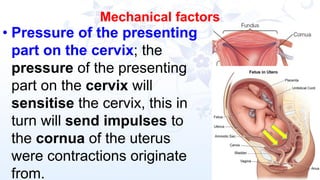
• Pressure of the presenting
part on the cervix; the
pressure of the presenting
part on the cervix will
sensitise the cervix, this in
turn will send impulses to
the cornua of the uterus
were contractions originate
from.
Factors Affecting the Process of Labour
• There are six factors affecting the process of
labour and birth, 6Ps or more;
P- powers ;are contractions of the uterus
P-passage; refers to the way( birth canal) in
the bony pelvis, cervix ,vagina and the
introitus
P- passenger; include the fetus, amniotic sac,
umbilical cord and the placenta.
Factors Affecting the Process of Labour
P- position; the position of the mother(supine)
P- psychological response/personality; previous
labour and childbirth experiences may affect the
wellbeing of women and tension can interfere with
birth.
P- professional assistance; appropriate
assistance of care by skilled midwife/medical
practioner will determine the outcome of care.
Premonitory Signs Of Labour
• These signs occur 2-3 weeks before labour
starts and they determine the approach of
labour and these include;
1. Lightening;
• This is the sinking of the
Uterus 2-3 weeks before term,
• The fundus no longer
clouds the lungs and
breathing is easier
• It occurs as a result of the Softening and relaxed
pelvic floor allow the uterus to descend further into the
true pelvis.
2. shelfing
• After lightening has taken place, and
the woman is in standing position. The
uterus will lean forward creating a shelf
like shape.
•
3. Frequency of micturition; mild incontinence of
urine occurs due to weakened bladder control
because of pelvic floor muscle relaxation, this
reduces sphincter function as the sphincters are also
pelvic muscles. Also the pressure of the fetal head
on the bladder limits its capacity requiring to be
emptied at all times.
4. False pains/Braxton hicks contractions; these
contractions are more intense but are erratic and
irregular, these contractions have been occurring
through out pregnancy-may become uncomfortable.
5. Cervical effacement; the
cervix is drawn up and emerges
in to the lower uterine segment
and becomes part of the uterus,
this is possible because of the
softened pelvic floor .
• In primigravida taking up of
cervix occurs before dilation of
external os(before labour) while
in multi gravida it occurs in
labour as dilation of the cervix
begins.
6. Sudden burst of energy;
• Some women report a sudden burst of energy
approximately 24-48 hours before labour.
• The cause of energy spurt is unknown.
• In prenatal teaching the nurse should warn
prospective mothers not to over exert
themselves during energy burst so they will
not be excessively tired when labour begins.
• Other signs include;
Weight loss of 2.2-6.6kg resulting from
fluid loss and electrolyte shifts due to
changes in oestrogen and progesterone levels.
Increased backache ,sacro iliac pressure
from the influence of relaxin hormone on the
pelvic joints.
Diarrhoea, indigestion, nausea and vomiting
just prior to the onset of labour.
True Signs of Labour
1. Painful rhythmic uterine contractions:
• The contractions are regular ,rhythmic, painful and
increase in intensity.
• Interval between contractions: when contractions
intensify the interval between contractions shorten
gradually.
True Signs of Labour
2. Presence of show: this
is due to the plugging off of
the operculum; it will be
with blood and appears as
blood stained mucoid
discharge.
True Signs of Labour
3. Dilatation of the
cervix: effacement
accompanied by dilation of
the cervix is a true sign of
labour, it is due to upward
retraction of the of the
uterine muscle fibres' and
well fitting presenting part.
True Signs of Labour
4. Formation of fore waters or rupture of
membranes with good uterine contractions.
True Signs of Labour
• 5. descent with good uterine muscle contractions which
pushes the fetus downward pelvic cavity
False And True Labour
PARAMETERS TRUE LABOUR FALSE LABOUR
PAIN
Regular, rhythmic, and painful and
increase in intensity
painful but not regular and do not
increase in intensity
CONTRACTIONS
Increase in intensity, Do not increase in intensity
Intervals between contractions
shorten gradually
Interval between contractions
varies
CERVIX
Effacement of the cervix takes place,
accompanied by progressive
dilatation of the cervix.
Effacement of the cervix takes place
but there is no accompanying
dilatation of the cervix.
SHOW Present as the operculum is shed Show is absent.
DESCENT
Fetus continues to descend into
the pelvis
No significant change in fetal
position
STAGES OF
LABOUR
FIRST STAGE OF LABOUR
• This is the longest stage of labour.
• Starts from the initiation of painful regular
rhythmic uterine contractions to full cervical
dilatation.
Duration
• Primigravida; lasts about 11 to 14 hours and
should not exceed 16 hours.
• Multigravida lasts 6 to 9 hours and should not
exceed 12 hours.
First stages of Labour cont’
Two sub stages (phases) of the first stage of labour. The first
stage
First = Latent phase which is 0 to 3 cm dilatation
•As the cervix begins to dilate it also effaces ,although little or no
fetal descent is evident.
•Mild contractions increase in frequency, duration and
intensity.
•Woman feels can cope with discomfort. She may be relieved
that labour has finally started, she is often smiling and eager to
talk about herself and answer questions. Levels of excitement are
high.
Second= Active phase
• 4cm to 10cm dilatation, Rapid Cervical dilatation
which is be at least 1cm/hour in primigravida and
1.5 cm /hour in multigravida.
• It takes 4-6 hours in a primigravida and 2-4 hours in
a multigravida.
• Contractions become stronger in intensity and
duration, which increases to between 40-60
seconds and the frequency from two to three
contractions in ten minutes.
Second Stage Labour
• Starts from full cervical dilatation to the complete delivery
of the baby,
• Primigravida; lasts approximately 40 to 45 minutes and
should not exceed 1 hour
• Multigravida; lasts approximately 15-30 minutes should
not exceed 30 minutes.
• Woman feels the urge to push
• Contractions become more painful and intense
Third Stage Labour
• Starts from complete birth of the baby to complete
expulsion of the placenta and its membranes.
• Duration depends on the type of management used
• In natural or passive management it lasts about 10-15
minutes not exceeding 1 hour.
• In active management with administration of oxytocic
drugs it should last 5 minutes.
• Woman feel relieved from painful expulsive uterine
contractions.
Fourth stage of labour
• Immediate Postnatal Period, from complete
delivery of the placenta and its membranes
about an hour to 2 hours post delivery.
• The tone of the uterus is reestablished as the
uterus contracts again, expelling any remaining
contents.
• This is the observation period of the mother to
rule out any abnormalities that can occur after
delivery such as PPH or Eclampsia.
PHYSIOLOGY
OF FIRST STAGE
OF LABOUR
PHYSIOLOGY OF FIRST STAGE OF LABOUR
• These are physiological series of events which take place
from the onset of labour pains to full dilatation of the cervix
1. FUNDAL DOMINANCE
2. POLARITY
3. CONTRACTION AND RETRACTION
4. FORMATION OF UPER AND LOWER UTERINR SEGMENTS
5. FORMATION OF RETRACTION RING
6. CERVICAL EFFACEMENT AND DILATATION
7. SHOW
8. FORMATION OF FORE WATERS
9. GENERAL FLUID PRESSURE
10.RUPTURE OF MEMBRANES
11.FETAL AXIS PRESSURE
1. FUNDAL DOMINANCE
• Each contraction starts in the
fundus near one of the
cornua and spreads across
and downwards, they last
longer in the fundus as well.
• The peak is reduced
simultaneously in the whole
uterus and contractions fade
from all parts together. This
allows the contracting fundus
to expel the fetus.
2. POLARITY
• This is the neuromuscular harmony that
occurs between the upper and lower
uterine segments through out labour.
• Upper segment contracts and retracts
strongly reducing the space in the cavity
thereby pushing out the fetus
• Lower segment contracts slightly and
dilates slowly to allow expulsion of the
fetus.
• If polarity is disorganised there is no
noticeable progress of labour or progress
may be inhibited.
3. CONTRACTION & RETRACTION
• When uterine muscles contracts, they do not go back to
their normal length instead they retains some shortening
of the contraction which is called retraction.
• This helps in the progressive expulsion of the fetus as
the upper segment shortens and becomes thicker
reducing the uterine cavity pushing the fetus out.
4. FORMATION OF UPPER &
LOWER UTERINE SEGMENT
• During labour, the uterus is divided
into two segments.
• Upper and lower uterine segment.
• Upper uterine segment contracts
and retracts becoming thicker and
muscular,
• Lower segment becomes thinner to
allow for distension and dilatation
during labour and child birth.
UPPER
LOWER
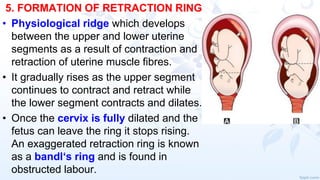
5. FORMATION OF RETRACTION RING
• Physiological ridge which develops
between the upper and lower uterine
segments as a result of contraction and
retraction of uterine muscle fibres.
• It gradually rises as the upper segment
continues to contract and retract while
the lower segment contracts and dilates.
• Once the cervix is fully dilated and the
fetus can leave the ring it stops rising.
An exaggerated retraction ring is known
as a bandl‘s ring and is found in
obstructed labour.
6. CERVICAL EFFACEMENT AND DILATATION
• During effacement the muscle fibres around the internal os of
the cervix are drawn upwards and merge into the lower uterine
segment .
• The cervical canal widens at the level of the internal os.
• Dilatation of the cervix will occur due to counter pressure
applied by the bag of membranes or the presenting part on the
cervix.
7. SHOW
• When the cervix dilates the
operculum which formed
the cervical plug during
pregnancy falls off and is
shed as show.
• The mucous plug is mixed
with blood from ruptured
capillaries where the chorion
has become detached from
the decidua.
8. FORMATION OF FORE WATERS
• As the cervix dilates, the chorion
becomes detached and the increased
intrauterine pressure causes this
loosened part of membrane containing
a small quantity of liqour to bulge
downwards into the vagina as (fore
waters).
• The well flexed head fits into the
cervix and cuts off the fluid in front of
the head from that which surrounds
the rest of the body (hind waters).
• This helps to prevent
rapture of membranes
because, the pressure
applied to the hind waters
during contractions will not
be applied to the fore
waters.
9. GENERAL FLUID
PRESSURE
• This is the term used to describe
the force exerted on the
amniotic fluid by the uterine
contractions in labour. As the
force is applied ,the fluid cannot
be compressed hence there is
equalised pressure through out
the uterus and over the fetal
body.
10. RUPTURE OF MEMBRANES
• This is the breaking of the bag
containing amniotic fluid due to the
increased pressure in the uterus as
contractions continues.
• When the membranes rupture and a
significant amount of fluid is lost
during uterine contractions the
placenta and membranes are
compressed between the uterine
wall and fetus, causing diminished
oxygen supply to the fetus.
11. FETAL AXIS PRESSURE
• After rupture of membranes the
walls of the uterus come in
contact with the fetus.
• During a contraction, the force
is transmitted direct on the
upper pole of the fetus, and
down the long axis of the fetus
and applied to the presenting
part.
QUESTIONS?
PHYSIOLOGY
OF SECOND STAGE OF
LABOUR
PHYSIOLOGY OF SECOND STAGE LABOUR
• In the second stage, the purpose is to expel the fetus, it is mainly
characterised by:
1. UTERINE CONTRACTIONS
2. THE FETUS
3. AUXILIARY MUSCLES OF THE SECOND STAGE OF
LABOUR
4. DISPLACEMENT OF AND CHANGES TO THE PELVIC
FLOOR AND PELVIC ORGANS
5. THE BIRTH OF THE BABY
1. UTERINE CONTRACTIONS
• Become more stronger, intense, painful and expulsive
in nature, to force the fetus out. Bearing down of the
mother counteracts /decreases the pain experienced.
• If membranes have not ruptured ,this time they will rupture.
becauses fully dilated and no longer supports the bag of
fore waters.
• This causes additional stimulation of the uterine muscles
resulting in stronger contractions.
• Rupturing of membranes brings the uterus in close contact
with the fetus- fetal axis pressure comes into play.
2. THE FETUS
• The head of the fetus reaches the pelvic floor where it
undergoes passive movements which allows it to pass
down the pelvic canal and through the outlet of the
pelvis to the vaginal orifice.
• The placenta circulation is interfered ,putting the fetus
at increased risk of developing hypoxia- if you delay the
fetus will die ,although there is great flexion of the fetal
head, the fetal spine straightens out and the fetus
elongates as it passes /is forced through the pelvis.
• This results in the fundus remaining above even when
the head may have descended well in the pelvis.
3. AUXILIARY MUSCLES OF THE SECOND STAGE OF
LABOUR.
• Some skeletal, abdominal muscles and diaphragm
aid in expelling the fetus from the uterus.
• These are brought in to play when the woman
bears down. This urge to push is felt by the
woman herself.
• During bearing down there is reduction in the
oxygen supply to the fetus due to an increase in
the intra uterine pressure.
4. DISPLACEMENT OF AND CHANGES TO THE PELVIC
FLOOR AND PELVIC ORGANS
As the fetal head descends there is pressure and
stretching of soft tissue and organs of the pelvis:
• The bladder- is drawn upwards and becomes an
abdominal organ creating more space in the pelvis for
the fetus to pass and also preventing injury and damage
to the bladder.
• The urethra- is nipped (cut or blocked) between the
fetal head and bony pelvis. This makes it difficult for the
woman to pass urine.
• The vagina- stretches as the head descends and this
may cause lacerations of vaginal mucosa .
• The rectum- is compressed by the descending fetal
head forcing it to empty all the faecal contents through
the anus
• The perineal body and perineum are pushed
downwards and elongate as the head is crowning.
• There is pouting and gapping of the anus. This is
referred to as the perineal phase.
5. THE BIRTH OF THE BABY
• The flexed head passes under
the pubic arch and the widest
diameter distends the vaginal
introitus and the head crowns.
• After the birth of the head there
is a pause before the next
contraction occurs.
• The head is born following the
steps of mechanism of labour,
then the shoulders and then the
rest of the body is born.
• The remainder of the amniotic
fluid is expelled with the fetus.
• The mother relaxes after
delivery of the baby and draws
her attention to her baby.
MECHANISM OF
SECOND STAGE
OF LABOUR
MECHANISM OF LABOUR
• Mechanism of labour is a series of movements that the fetus
undergoes as it passes through the birth canal . These
movements occur in the position and attitude the fetus
undertakes.
• It is a continuous process till the time the baby is delivered .
• The fetus has to pass through the curved birth canal which has
different sizes and shapes ( inlet, cavity, and outlet).
• The fetal head enters the pelvic brim in the right or left oblique
diameter or in the transverse diameter.
MECHANISM OF LABOUR cont’
1. DESCENT OF THE FETAL HEAD
• Descent occurs through out first stage of
labour as the uterine muscles contracts and
retract reducing space in the uterus thereby
exerting pressure on the fetus to descend.
• It is important to note that descent is more
rapid in second stage of labour, because
with the woman bearing down the
abdominal muscles and the diaphragm
assist the muscle action of the uterus.
2. FLEXION OF THE FETAL HEAD
• With descent ,increased flexion of the
fetal head takes place through out labour.
• The fetal spine is attached nearer to the
posterior part of the fetal skull.
• When pressure is exerted on the fetal
axis, it will be more forcibly transmitted to
the occiput than the sinciput, this will
increase flexion of the head resulting in
smaller diameters presenting and
negotiating the pelvis more easily.
• At the onset of labour, the sub occipital frontal diameter
(10cm) presents and with greater flexion the sub occipital
bregmatic diameter (9.5cm) engages.
• This smaller diameter will facilitate further descent to take
place.
• Flexion is due to various factors ,one theory suggests
that in a normal vertex presentation, the long axis of the
fetus lies parallel to the long axis of the mother and the
fetus is already in an attitude of general flexion, with the
occiput slightly lower than the sinciput.
INTERNAL ROTATION OF THE HEAD
• During uterine contractions the fetus descends
further and the leading part reaches the pelvic
floor first and meets resistance.
• It will rotate forward through 1/8 of a circle causing
a twist in the neck of the fetus as the head is no
longer in direct alignment with the shoulders.
• In vertex presentation the occiput is the leading
part.
CROWNING
• Crowning occurs when the occiput escapes under the
symphysis pubis, and it does not recede back between
contractions.
• The widest transverse diameter is born (bi parietal 9.5
cm).
• If flexion is maintained the sub occipital bregmatic
diameter distends the vagina orifice.
• Crowning of the fetal head refers to the stage at which
the largest presenting diameter of the fetal head passes
through the vulva orifice.
EXTENSION
• This is when the fetal head becomes extended on the neck (
sub occipital region around the pubic bone) releasing the
sinciput, face and chin, to sweep the perineum and the head is
born by movement of extension.
RESTITUTION
• This is the untwisting of the of the twist in the fetal
neck that occurred during internal rotation of the
fetal head.
• In a normal vertex delivery the occiput moves 1/8
of a circle back along the side of the pelvis from
which it came before internal rotation of the head.
• This shows the midwife the position of the fetus
and hence help manage the delivery of the
shoulders without causing perineal lacerations.
INTERNAL ROTATION OF THE SHOULDERS
• The movement is similar to internal rotation of the head.
The shoulders enter the pelvis in the oblique
diameter(right or left).
• The anterior shoulder becomes the leading part and
meets the pelvic floor first ,and it rotates anteriorly to lie
under the symphysis pubis.
• It occurs simultaneously with external rotation of the
head.
• The shoulders now lie in the anterior posterior diameter
of the outlet.
EXTERNAL ROTATION OF THE
HEAD
• This is a turning of the head which
accompanies internal rotation of the
shoulders.
• The occiput turns a further 1/8 of the
circle in the same position as in
restitution.
• The movement indicate that the
shoulders are now in the AP diameter
of the outlet.
LATERAL FLEXION OF THE BODY
• The shoulders are usually born sequentially. The body
lies in the lateral position.
• It is the bending of the spine which takes place while the
body is being expelled so that it conforms to the curve of
carus (birth canal) .
• The anterior shoulder escapes under the symphysis
pubis and the posterior shoulder passes over the
perineum or sweeps past the perineum.
• The body is born by lateral flexion on to the mothers
abdomen.
MECHANISM OF LEFT OCCIPITAL ANTERIOR
PREAMBLE
• Lie is longitudinal
• Attitude is that of well flexion/general flexion
• Presentation is cephalic
• Position is left occipital anterior
• Denominator is the occiput
• Presenting part is the vertex (posterior part of the anterior parietal
bone)
• Presenting diameter is sub occipito frontal (10cm)
• Engaging diameter is sub occipito bregmatic (9.5 cm)
• The sagital suture lies in the right oblique diameter
• The shoulders lie in the left oblique diameter
MOVEMENTS
• With good uterine contractions and retractions, descent
takes place through out labour .
• The presenting diameter is the SOF (10cm).
• Further descent increases the flexion of the head and
the smaller diameter of SOB (9.5cm) enters the pelvic
brim.
• The occiput becomes the leading part ,it reaches the
pelvic floor first and meets resistance and then it rotates
1/8 of a circle forward along the left side of the mother’s
pelvis to escape under the symphysis pubis.
MOVEMENTS
• The sagital suture now lies in the AP diameter of the
pelvic outlet. With the next contraction ,the occiput slips
beneath the pubic arch and the widest transverse
diameter of the head (bi parietal-9.5cm) is born.
• The head will no longer recede in between contractions;
this is known as crowning.
• The head will pivot at the nape of the neck allowing it to
extend.
• The sinciput ,face and chin sweep past the perineum and
the head is born in the movement of extension.
MOVEMENTS
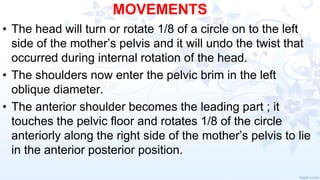
• The head will turn or rotate 1/8 of a circle on to the left
side of the mother’s pelvis and it will undo the twist that
occurred during internal rotation of the head.
• The shoulders now enter the pelvic brim in the left
oblique diameter.
• The anterior shoulder becomes the leading part ; it
touches the pelvic floor and rotates 1/8 of the circle
anteriorly along the right side of the mother’s pelvis to lie
in the anterior posterior position.
MOVEMENTS
• This takes place simultaneously with the external rotation
of the head.
• The head turns a further 1/8 of a circle to the left side of
the pelvis.
• With the downward movement of the head the anterior
shoulder escapes under the pubic arch and with the
upward movement the posterior shoulder sweeps the
perineum.
• The rest of the body is born in the movement of lateral
flexion on to the mother’s abdomen.
PHYSIOLOGY
OF THIRD STAGE OF
LABOUR
PHYSIOLOGY OF THIRD STAGE
• The physiological changes in the third stage
of labour are affected by ; mechanical and
haemostatic factors.
MECHANICAL FACTORS
• The separation of the placenta takes place as follows;
• With the expulsion of the baby at birth, the placenta
surface area in the uterus decreases.
• The uterine muscles continue to contract and retract
except at the site of placenta attachment.
• This will cause the placenta area to shrink and the
shearing off of the placenta will start from the uterine
wall.
Uterine Retraction and Placental Separation
• Blood vessels from the uterus which
carry blood to and from the maternal
side of the placenta are ruptured and
there is an outflow of blood or
collection of blood referred to as the
retro placental clot.
• This clot aids in further separation of
the placenta.
• With continuous contractions and
retractions of the uterus , the whole
placenta will detach from the uterine
wall.
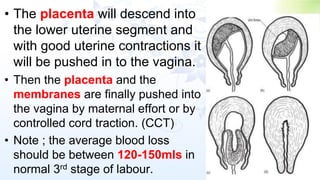
• The placenta will descend into
the lower uterine segment and
with good uterine contractions it
will be pushed in to the vagina.
• Then the placenta and the
membranes are finally pushed into
the vagina by maternal effort or by
controlled cord traction. (CCT)
• Note ; the average blood loss
should be between 120-150mls in
normal 3rd stage of labour.
HAEMOSTATIC FACTORS
• Normal volume of blood flow through the placenta site is
between 500-800 mls/minute.
• During the placental separation ,haemorrhage has to be
arrested within seconds, otherwise serious haemorrhage
would occur.
• There are three factors within the normal physiological
process of the placenta separation that takes place in
order to control or minimise blood loss. These are as
follows;
1. Retraction of the oblique muscle fibres
in the upper uterine segments through
which tortuous blood vessels intertwine.
• Resulting in the thickening of the
muscles exerting pressure on the torn
vessels acting as clumps securing the
ligature.
• The absence of the oblique muscle
fibres in the lower segment explains
why there is an increased blood loss
accompanying placental separation in
placenta praevia.
2. The pressure of
the vigorous uterine
contractions
following separation
of the placenta brings
the walls in to
apportion so that
further pressure is
exerted on the
placental site.
apportion
3. A transitional activation of coagulation and
fibrinolytic system during and after placental
separation.
• And the response is active at the placental site to
intensify clot formation on the torn vessels.
• Hence facilitates the rapid formation of the fibrin
cover on the placental site, utilising 5-10 % of the
circulating fibrinogen.
SIGNS OF PLACENTA SEPARATION
1. There will be a rise in the uterine fundus to the level of
the umbilical region, the uterus becomes hard, round and
well contracted.
2. Then there will be a gush of blood from the vagina and
the placenta becomes visible at the introitus.
3. The cord will elongate at the vulva.
4. And on application of suprapubic pressure, the cord
does not recede into the vagina.
METHODS OF PLACENTA SEPARATION
AND EXPULSION
• The manner in which the placenta separates
describes the way in which it will emerge from
the birth canal.
• There are two methods of placenta separation
namely;
• Schultze method
• Matthew duncans ( dirty) method.
Schultze (shinney) method;
• Placenta is implanted in the uterine
fundus.
• Placenta separates centrally from the
uterine wall causing the blood to collect
in the centre of the placenta forming a
retro placental clot.
• Then the placenta inverts as it descends
in to the uterus and the birth canal.
• This will cause the emergence of the
shiny fetal surface from the vaginal
orifice first.
• The blood is usually contained within the
membranes and the membranes appear to be
intact except the hole where the fetus passed
through to be born called the fenestrum.
• This method is also referred to as a clean delivery
of the placenta because there is no blood spillage.
Matthew duncans (dirty method)
• Placenta is implanted on the sides of the
uterus.
• The placenta starts to separate from its
edges and the blood escapes from the
edges of the uterus where separation has
taken place through the vagina and out
through the orifice.
• The edges of the placenta that separated
first emerges from the vagina orifice
followed by a gush of blood ,and then the
maternal surface of the placenta , torn
rugged membranes are expelled.
• This method is associated with the retained membranes
which results in bleeding.
FACTORS THAT PREVENT EFFECTIVE UTERINE
CONTRACTION AND RETRACTION
• The following factors prevent effective uterine
contractions and retractions by causing a failure of
the myometrium at the placental site to contract
and retract.
• Causing a poor or weak compression on the torn
blood vessels and fail to control blood loss by
having no ligature action, causing post partum
haemorrhage.
• Full bladder
• Overstretching of the uterine muscles as in
multiple pregnancy ,polyhydraminous or big baby.
• Tired or debilitated muscles as in prolonged
labour.
• Abnormal uterine action e.g. Uterine atony
• Partial separation of the placenta
• Retained products of conception
QUESTIONS?
SUMMARY
• Define labour
• Explain factors regulating onset of labour
• Explain the stages of labour
• Describe the premonitory signs of labour
• State the true signs of labour
• Differentiate true from false labour
• Describe the physiology of first, second and third stages of
labour
• Discuss the management of a woman in first, second and third
stages of labour.
THE END!

NORMAL_LABOUR_-Nurses Class Presentation.pdf

  • 1.
    MANSA COLLEGE OFNURSING AND MIDWIFERY MIDWIFERY DEPARTMENT
  • 2.
  • 3.
  • 4.
    Introduction • It isa woman’s desire to have a non complicated process of giving birth. • We must understand that not all babies are born the same way. • It is important as skilled birth attendant to support and only intervene when circumstances demand during the process. • The attitude of the skilled attendant will determine to some extent the outcome labour.
  • 5.
    Specific objectives • Definelabour • Explain factors regulating onset of labour • Explain the stages of labour • Describe the premonitory signs of labour • State the true signs of labour • Differentiate true from false labour • Describe the physiology of first, second and third stages of labour • Discuss the management of a woman in first, second and third stages of labour.
  • 6.
    Definition of Terms •Labour: it is a process by which the foetus, placenta and its membranes are expelled from the birth canal after 28 weeks of gestation. • Normal labour: the process by which the fetus is born at term (occurs between 37 and 42 weeks) and presents by vertex, the process is started and completed spontaneously within 18 hours of labour with no complications to either the mother or the baby.
  • 7.
    Definition of Terms •Premature labour; it is defines as labour occurring after the 28th but before the 37th complete week of gestation. • Prolonged labour: it is defined as labour lasting an excess of 24 hours in primigravida and 18 hours in a multigravida. • Precipitate labour is when a labour is very quick and short, and the baby is born less than 3 hours after the start of contractions.
  • 8.
    Factors Regulating OnsetOf Labour • The cause of labour is not known or fully understood. • Factors associated to it are; 1. hormonal and 2. mechanical.
  • 9.
    HORMONAL FACTORS • Progesterone;during pregnancy progesterone is available to sedate the uterus up to term, this is initially secreted by the corpus luteum and later on by the placenta causing sedation of uterine muscles . • Towards term the placenta begins to age and hence its function diminish and the amount of progesterone reduce, thus fail to maintain the uterine muscles sedated, facilitating onset of labour.
  • 10.
    HORMONAL FACTORS • Oestrogen; during the last weeks of pregnancy it is reported that there is a sharp rise in maternal oestrogen, its presence stimulates the release of prostaglandins that induce production of enzymes that will digest collagen in the cervix helping it to soften and ripen.( which is why prostaglandins are given when inducing labour).
  • 11.
    HORMONAL FACTORS • Prostaglandins;are produced naturally by the body during the process of labour. Their role is to prepare the cervix and to help open the cervix in response to contractions. • Oxytocin; it is produced from the posterior pituitary gland as progesterone decreases, its effect is to initiate uterine contractions thus stimulating labour. The fetal pituitary gland is also believed to produce oxytocin.
  • 12.
    Mechanical factors • Overstretchingof uterus /over distension of the uterus; irritation of the uterus as a result of overstretching stimulates onset of uterine contractions and labour. • Increased activity; towards term there is increased activity of the uterus, Braxton hicks contractions come in and increase in intensity and frequency as pregnancy advances contributing to onset of labour.
  • 13.
    Mechanical factors • Pressureof the presenting part on the cervix; the pressure of the presenting part on the cervix will sensitise the cervix, this in turn will send impulses to the cornua of the uterus were contractions originate from.
  • 14.
    Factors Affecting theProcess of Labour • There are six factors affecting the process of labour and birth, 6Ps or more; P- powers ;are contractions of the uterus P-passage; refers to the way( birth canal) in the bony pelvis, cervix ,vagina and the introitus P- passenger; include the fetus, amniotic sac, umbilical cord and the placenta.
  • 15.
    Factors Affecting theProcess of Labour P- position; the position of the mother(supine) P- psychological response/personality; previous labour and childbirth experiences may affect the wellbeing of women and tension can interfere with birth. P- professional assistance; appropriate assistance of care by skilled midwife/medical practioner will determine the outcome of care.
  • 16.
    Premonitory Signs OfLabour • These signs occur 2-3 weeks before labour starts and they determine the approach of labour and these include;
  • 17.
    1. Lightening; • Thisis the sinking of the Uterus 2-3 weeks before term, • The fundus no longer clouds the lungs and breathing is easier • It occurs as a result of the Softening and relaxed pelvic floor allow the uterus to descend further into the true pelvis.
  • 18.
    2. shelfing • Afterlightening has taken place, and the woman is in standing position. The uterus will lean forward creating a shelf like shape. •
  • 19.
    3. Frequency ofmicturition; mild incontinence of urine occurs due to weakened bladder control because of pelvic floor muscle relaxation, this reduces sphincter function as the sphincters are also pelvic muscles. Also the pressure of the fetal head on the bladder limits its capacity requiring to be emptied at all times. 4. False pains/Braxton hicks contractions; these contractions are more intense but are erratic and irregular, these contractions have been occurring through out pregnancy-may become uncomfortable.
  • 20.
    5. Cervical effacement;the cervix is drawn up and emerges in to the lower uterine segment and becomes part of the uterus, this is possible because of the softened pelvic floor . • In primigravida taking up of cervix occurs before dilation of external os(before labour) while in multi gravida it occurs in labour as dilation of the cervix begins.
  • 21.
    6. Sudden burstof energy; • Some women report a sudden burst of energy approximately 24-48 hours before labour. • The cause of energy spurt is unknown. • In prenatal teaching the nurse should warn prospective mothers not to over exert themselves during energy burst so they will not be excessively tired when labour begins.
  • 22.
    • Other signsinclude; Weight loss of 2.2-6.6kg resulting from fluid loss and electrolyte shifts due to changes in oestrogen and progesterone levels. Increased backache ,sacro iliac pressure from the influence of relaxin hormone on the pelvic joints. Diarrhoea, indigestion, nausea and vomiting just prior to the onset of labour.
  • 23.
    True Signs ofLabour 1. Painful rhythmic uterine contractions: • The contractions are regular ,rhythmic, painful and increase in intensity. • Interval between contractions: when contractions intensify the interval between contractions shorten gradually.
  • 24.
    True Signs ofLabour 2. Presence of show: this is due to the plugging off of the operculum; it will be with blood and appears as blood stained mucoid discharge.
  • 25.
    True Signs ofLabour 3. Dilatation of the cervix: effacement accompanied by dilation of the cervix is a true sign of labour, it is due to upward retraction of the of the uterine muscle fibres' and well fitting presenting part.
  • 26.
    True Signs ofLabour 4. Formation of fore waters or rupture of membranes with good uterine contractions.
  • 27.
    True Signs ofLabour • 5. descent with good uterine muscle contractions which pushes the fetus downward pelvic cavity
  • 28.
    False And TrueLabour PARAMETERS TRUE LABOUR FALSE LABOUR PAIN Regular, rhythmic, and painful and increase in intensity painful but not regular and do not increase in intensity CONTRACTIONS Increase in intensity, Do not increase in intensity Intervals between contractions shorten gradually Interval between contractions varies CERVIX Effacement of the cervix takes place, accompanied by progressive dilatation of the cervix. Effacement of the cervix takes place but there is no accompanying dilatation of the cervix. SHOW Present as the operculum is shed Show is absent. DESCENT Fetus continues to descend into the pelvis No significant change in fetal position
  • 29.
  • 30.
    FIRST STAGE OFLABOUR • This is the longest stage of labour. • Starts from the initiation of painful regular rhythmic uterine contractions to full cervical dilatation. Duration • Primigravida; lasts about 11 to 14 hours and should not exceed 16 hours. • Multigravida lasts 6 to 9 hours and should not exceed 12 hours.
  • 31.
    First stages ofLabour cont’ Two sub stages (phases) of the first stage of labour. The first stage First = Latent phase which is 0 to 3 cm dilatation •As the cervix begins to dilate it also effaces ,although little or no fetal descent is evident. •Mild contractions increase in frequency, duration and intensity. •Woman feels can cope with discomfort. She may be relieved that labour has finally started, she is often smiling and eager to talk about herself and answer questions. Levels of excitement are high.
  • 32.
    Second= Active phase •4cm to 10cm dilatation, Rapid Cervical dilatation which is be at least 1cm/hour in primigravida and 1.5 cm /hour in multigravida. • It takes 4-6 hours in a primigravida and 2-4 hours in a multigravida. • Contractions become stronger in intensity and duration, which increases to between 40-60 seconds and the frequency from two to three contractions in ten minutes.
  • 33.
    Second Stage Labour •Starts from full cervical dilatation to the complete delivery of the baby, • Primigravida; lasts approximately 40 to 45 minutes and should not exceed 1 hour • Multigravida; lasts approximately 15-30 minutes should not exceed 30 minutes. • Woman feels the urge to push • Contractions become more painful and intense
  • 34.
    Third Stage Labour •Starts from complete birth of the baby to complete expulsion of the placenta and its membranes. • Duration depends on the type of management used • In natural or passive management it lasts about 10-15 minutes not exceeding 1 hour. • In active management with administration of oxytocic drugs it should last 5 minutes. • Woman feel relieved from painful expulsive uterine contractions.
  • 35.
    Fourth stage oflabour • Immediate Postnatal Period, from complete delivery of the placenta and its membranes about an hour to 2 hours post delivery. • The tone of the uterus is reestablished as the uterus contracts again, expelling any remaining contents. • This is the observation period of the mother to rule out any abnormalities that can occur after delivery such as PPH or Eclampsia.
  • 36.
  • 37.
    PHYSIOLOGY OF FIRSTSTAGE OF LABOUR • These are physiological series of events which take place from the onset of labour pains to full dilatation of the cervix 1. FUNDAL DOMINANCE 2. POLARITY 3. CONTRACTION AND RETRACTION 4. FORMATION OF UPER AND LOWER UTERINR SEGMENTS 5. FORMATION OF RETRACTION RING 6. CERVICAL EFFACEMENT AND DILATATION 7. SHOW 8. FORMATION OF FORE WATERS 9. GENERAL FLUID PRESSURE 10.RUPTURE OF MEMBRANES 11.FETAL AXIS PRESSURE
  • 38.
    1. FUNDAL DOMINANCE •Each contraction starts in the fundus near one of the cornua and spreads across and downwards, they last longer in the fundus as well. • The peak is reduced simultaneously in the whole uterus and contractions fade from all parts together. This allows the contracting fundus to expel the fetus.
  • 39.
    2. POLARITY • Thisis the neuromuscular harmony that occurs between the upper and lower uterine segments through out labour. • Upper segment contracts and retracts strongly reducing the space in the cavity thereby pushing out the fetus • Lower segment contracts slightly and dilates slowly to allow expulsion of the fetus. • If polarity is disorganised there is no noticeable progress of labour or progress may be inhibited.
  • 40.
    3. CONTRACTION &RETRACTION • When uterine muscles contracts, they do not go back to their normal length instead they retains some shortening of the contraction which is called retraction. • This helps in the progressive expulsion of the fetus as the upper segment shortens and becomes thicker reducing the uterine cavity pushing the fetus out.
  • 41.
    4. FORMATION OFUPPER & LOWER UTERINE SEGMENT • During labour, the uterus is divided into two segments. • Upper and lower uterine segment. • Upper uterine segment contracts and retracts becoming thicker and muscular, • Lower segment becomes thinner to allow for distension and dilatation during labour and child birth. UPPER LOWER
  • 42.
    5. FORMATION OFRETRACTION RING • Physiological ridge which develops between the upper and lower uterine segments as a result of contraction and retraction of uterine muscle fibres. • It gradually rises as the upper segment continues to contract and retract while the lower segment contracts and dilates. • Once the cervix is fully dilated and the fetus can leave the ring it stops rising. An exaggerated retraction ring is known as a bandl‘s ring and is found in obstructed labour.
  • 43.
    6. CERVICAL EFFACEMENTAND DILATATION • During effacement the muscle fibres around the internal os of the cervix are drawn upwards and merge into the lower uterine segment . • The cervical canal widens at the level of the internal os. • Dilatation of the cervix will occur due to counter pressure applied by the bag of membranes or the presenting part on the cervix.
  • 44.
    7. SHOW • Whenthe cervix dilates the operculum which formed the cervical plug during pregnancy falls off and is shed as show. • The mucous plug is mixed with blood from ruptured capillaries where the chorion has become detached from the decidua.
  • 45.
    8. FORMATION OFFORE WATERS • As the cervix dilates, the chorion becomes detached and the increased intrauterine pressure causes this loosened part of membrane containing a small quantity of liqour to bulge downwards into the vagina as (fore waters). • The well flexed head fits into the cervix and cuts off the fluid in front of the head from that which surrounds the rest of the body (hind waters). • This helps to prevent rapture of membranes because, the pressure applied to the hind waters during contractions will not be applied to the fore waters.
  • 46.
    9. GENERAL FLUID PRESSURE •This is the term used to describe the force exerted on the amniotic fluid by the uterine contractions in labour. As the force is applied ,the fluid cannot be compressed hence there is equalised pressure through out the uterus and over the fetal body.
  • 47.
    10. RUPTURE OFMEMBRANES • This is the breaking of the bag containing amniotic fluid due to the increased pressure in the uterus as contractions continues. • When the membranes rupture and a significant amount of fluid is lost during uterine contractions the placenta and membranes are compressed between the uterine wall and fetus, causing diminished oxygen supply to the fetus.
  • 48.
    11. FETAL AXISPRESSURE • After rupture of membranes the walls of the uterus come in contact with the fetus. • During a contraction, the force is transmitted direct on the upper pole of the fetus, and down the long axis of the fetus and applied to the presenting part.
  • 49.
  • 50.
  • 51.
    PHYSIOLOGY OF SECONDSTAGE LABOUR • In the second stage, the purpose is to expel the fetus, it is mainly characterised by: 1. UTERINE CONTRACTIONS 2. THE FETUS 3. AUXILIARY MUSCLES OF THE SECOND STAGE OF LABOUR 4. DISPLACEMENT OF AND CHANGES TO THE PELVIC FLOOR AND PELVIC ORGANS 5. THE BIRTH OF THE BABY
  • 52.
    1. UTERINE CONTRACTIONS •Become more stronger, intense, painful and expulsive in nature, to force the fetus out. Bearing down of the mother counteracts /decreases the pain experienced. • If membranes have not ruptured ,this time they will rupture. becauses fully dilated and no longer supports the bag of fore waters. • This causes additional stimulation of the uterine muscles resulting in stronger contractions. • Rupturing of membranes brings the uterus in close contact with the fetus- fetal axis pressure comes into play.
  • 53.
    2. THE FETUS •The head of the fetus reaches the pelvic floor where it undergoes passive movements which allows it to pass down the pelvic canal and through the outlet of the pelvis to the vaginal orifice. • The placenta circulation is interfered ,putting the fetus at increased risk of developing hypoxia- if you delay the fetus will die ,although there is great flexion of the fetal head, the fetal spine straightens out and the fetus elongates as it passes /is forced through the pelvis. • This results in the fundus remaining above even when the head may have descended well in the pelvis.
  • 54.
    3. AUXILIARY MUSCLESOF THE SECOND STAGE OF LABOUR. • Some skeletal, abdominal muscles and diaphragm aid in expelling the fetus from the uterus. • These are brought in to play when the woman bears down. This urge to push is felt by the woman herself. • During bearing down there is reduction in the oxygen supply to the fetus due to an increase in the intra uterine pressure.
  • 55.
    4. DISPLACEMENT OFAND CHANGES TO THE PELVIC FLOOR AND PELVIC ORGANS As the fetal head descends there is pressure and stretching of soft tissue and organs of the pelvis: • The bladder- is drawn upwards and becomes an abdominal organ creating more space in the pelvis for the fetus to pass and also preventing injury and damage to the bladder. • The urethra- is nipped (cut or blocked) between the fetal head and bony pelvis. This makes it difficult for the woman to pass urine.
  • 56.
    • The vagina-stretches as the head descends and this may cause lacerations of vaginal mucosa . • The rectum- is compressed by the descending fetal head forcing it to empty all the faecal contents through the anus • The perineal body and perineum are pushed downwards and elongate as the head is crowning. • There is pouting and gapping of the anus. This is referred to as the perineal phase.
  • 57.
    5. THE BIRTHOF THE BABY • The flexed head passes under the pubic arch and the widest diameter distends the vaginal introitus and the head crowns. • After the birth of the head there is a pause before the next contraction occurs.
  • 58.
    • The headis born following the steps of mechanism of labour, then the shoulders and then the rest of the body is born. • The remainder of the amniotic fluid is expelled with the fetus. • The mother relaxes after delivery of the baby and draws her attention to her baby.
  • 59.
  • 60.
    MECHANISM OF LABOUR •Mechanism of labour is a series of movements that the fetus undergoes as it passes through the birth canal . These movements occur in the position and attitude the fetus undertakes. • It is a continuous process till the time the baby is delivered . • The fetus has to pass through the curved birth canal which has different sizes and shapes ( inlet, cavity, and outlet). • The fetal head enters the pelvic brim in the right or left oblique diameter or in the transverse diameter.
  • 61.
    MECHANISM OF LABOURcont’ 1. DESCENT OF THE FETAL HEAD • Descent occurs through out first stage of labour as the uterine muscles contracts and retract reducing space in the uterus thereby exerting pressure on the fetus to descend. • It is important to note that descent is more rapid in second stage of labour, because with the woman bearing down the abdominal muscles and the diaphragm assist the muscle action of the uterus.
  • 62.
    2. FLEXION OFTHE FETAL HEAD • With descent ,increased flexion of the fetal head takes place through out labour. • The fetal spine is attached nearer to the posterior part of the fetal skull. • When pressure is exerted on the fetal axis, it will be more forcibly transmitted to the occiput than the sinciput, this will increase flexion of the head resulting in smaller diameters presenting and negotiating the pelvis more easily.
  • 63.
    • At theonset of labour, the sub occipital frontal diameter (10cm) presents and with greater flexion the sub occipital bregmatic diameter (9.5cm) engages. • This smaller diameter will facilitate further descent to take place. • Flexion is due to various factors ,one theory suggests that in a normal vertex presentation, the long axis of the fetus lies parallel to the long axis of the mother and the fetus is already in an attitude of general flexion, with the occiput slightly lower than the sinciput.
  • 64.
    INTERNAL ROTATION OFTHE HEAD • During uterine contractions the fetus descends further and the leading part reaches the pelvic floor first and meets resistance. • It will rotate forward through 1/8 of a circle causing a twist in the neck of the fetus as the head is no longer in direct alignment with the shoulders. • In vertex presentation the occiput is the leading part.
  • 66.
    CROWNING • Crowning occurswhen the occiput escapes under the symphysis pubis, and it does not recede back between contractions. • The widest transverse diameter is born (bi parietal 9.5 cm). • If flexion is maintained the sub occipital bregmatic diameter distends the vagina orifice. • Crowning of the fetal head refers to the stage at which the largest presenting diameter of the fetal head passes through the vulva orifice.
  • 68.
    EXTENSION • This iswhen the fetal head becomes extended on the neck ( sub occipital region around the pubic bone) releasing the sinciput, face and chin, to sweep the perineum and the head is born by movement of extension.
  • 69.
    RESTITUTION • This isthe untwisting of the of the twist in the fetal neck that occurred during internal rotation of the fetal head. • In a normal vertex delivery the occiput moves 1/8 of a circle back along the side of the pelvis from which it came before internal rotation of the head. • This shows the midwife the position of the fetus and hence help manage the delivery of the shoulders without causing perineal lacerations.
  • 71.
    INTERNAL ROTATION OFTHE SHOULDERS • The movement is similar to internal rotation of the head. The shoulders enter the pelvis in the oblique diameter(right or left). • The anterior shoulder becomes the leading part and meets the pelvic floor first ,and it rotates anteriorly to lie under the symphysis pubis. • It occurs simultaneously with external rotation of the head. • The shoulders now lie in the anterior posterior diameter of the outlet.
  • 72.
    EXTERNAL ROTATION OFTHE HEAD • This is a turning of the head which accompanies internal rotation of the shoulders. • The occiput turns a further 1/8 of the circle in the same position as in restitution. • The movement indicate that the shoulders are now in the AP diameter of the outlet.
  • 73.
    LATERAL FLEXION OFTHE BODY • The shoulders are usually born sequentially. The body lies in the lateral position. • It is the bending of the spine which takes place while the body is being expelled so that it conforms to the curve of carus (birth canal) . • The anterior shoulder escapes under the symphysis pubis and the posterior shoulder passes over the perineum or sweeps past the perineum. • The body is born by lateral flexion on to the mothers abdomen.
  • 74.
    MECHANISM OF LEFTOCCIPITAL ANTERIOR PREAMBLE • Lie is longitudinal • Attitude is that of well flexion/general flexion • Presentation is cephalic • Position is left occipital anterior • Denominator is the occiput • Presenting part is the vertex (posterior part of the anterior parietal bone) • Presenting diameter is sub occipito frontal (10cm) • Engaging diameter is sub occipito bregmatic (9.5 cm) • The sagital suture lies in the right oblique diameter • The shoulders lie in the left oblique diameter
  • 75.
    MOVEMENTS • With gooduterine contractions and retractions, descent takes place through out labour . • The presenting diameter is the SOF (10cm). • Further descent increases the flexion of the head and the smaller diameter of SOB (9.5cm) enters the pelvic brim. • The occiput becomes the leading part ,it reaches the pelvic floor first and meets resistance and then it rotates 1/8 of a circle forward along the left side of the mother’s pelvis to escape under the symphysis pubis.
  • 76.
    MOVEMENTS • The sagitalsuture now lies in the AP diameter of the pelvic outlet. With the next contraction ,the occiput slips beneath the pubic arch and the widest transverse diameter of the head (bi parietal-9.5cm) is born. • The head will no longer recede in between contractions; this is known as crowning. • The head will pivot at the nape of the neck allowing it to extend. • The sinciput ,face and chin sweep past the perineum and the head is born in the movement of extension.
  • 77.
    MOVEMENTS • The headwill turn or rotate 1/8 of a circle on to the left side of the mother’s pelvis and it will undo the twist that occurred during internal rotation of the head. • The shoulders now enter the pelvic brim in the left oblique diameter. • The anterior shoulder becomes the leading part ; it touches the pelvic floor and rotates 1/8 of the circle anteriorly along the right side of the mother’s pelvis to lie in the anterior posterior position.
  • 78.
    MOVEMENTS • This takesplace simultaneously with the external rotation of the head. • The head turns a further 1/8 of a circle to the left side of the pelvis. • With the downward movement of the head the anterior shoulder escapes under the pubic arch and with the upward movement the posterior shoulder sweeps the perineum. • The rest of the body is born in the movement of lateral flexion on to the mother’s abdomen.
  • 80.
  • 81.
    PHYSIOLOGY OF THIRDSTAGE • The physiological changes in the third stage of labour are affected by ; mechanical and haemostatic factors.
  • 82.
    MECHANICAL FACTORS • Theseparation of the placenta takes place as follows; • With the expulsion of the baby at birth, the placenta surface area in the uterus decreases. • The uterine muscles continue to contract and retract except at the site of placenta attachment. • This will cause the placenta area to shrink and the shearing off of the placenta will start from the uterine wall.
  • 83.
    Uterine Retraction andPlacental Separation
  • 84.
    • Blood vesselsfrom the uterus which carry blood to and from the maternal side of the placenta are ruptured and there is an outflow of blood or collection of blood referred to as the retro placental clot. • This clot aids in further separation of the placenta. • With continuous contractions and retractions of the uterus , the whole placenta will detach from the uterine wall.
  • 85.
    • The placentawill descend into the lower uterine segment and with good uterine contractions it will be pushed in to the vagina. • Then the placenta and the membranes are finally pushed into the vagina by maternal effort or by controlled cord traction. (CCT) • Note ; the average blood loss should be between 120-150mls in normal 3rd stage of labour.
  • 86.
    HAEMOSTATIC FACTORS • Normalvolume of blood flow through the placenta site is between 500-800 mls/minute. • During the placental separation ,haemorrhage has to be arrested within seconds, otherwise serious haemorrhage would occur. • There are three factors within the normal physiological process of the placenta separation that takes place in order to control or minimise blood loss. These are as follows;
  • 87.
    1. Retraction ofthe oblique muscle fibres in the upper uterine segments through which tortuous blood vessels intertwine. • Resulting in the thickening of the muscles exerting pressure on the torn vessels acting as clumps securing the ligature. • The absence of the oblique muscle fibres in the lower segment explains why there is an increased blood loss accompanying placental separation in placenta praevia.
  • 88.
    2. The pressureof the vigorous uterine contractions following separation of the placenta brings the walls in to apportion so that further pressure is exerted on the placental site. apportion
  • 89.
    3. A transitionalactivation of coagulation and fibrinolytic system during and after placental separation. • And the response is active at the placental site to intensify clot formation on the torn vessels. • Hence facilitates the rapid formation of the fibrin cover on the placental site, utilising 5-10 % of the circulating fibrinogen.
  • 90.
    SIGNS OF PLACENTASEPARATION 1. There will be a rise in the uterine fundus to the level of the umbilical region, the uterus becomes hard, round and well contracted. 2. Then there will be a gush of blood from the vagina and the placenta becomes visible at the introitus. 3. The cord will elongate at the vulva. 4. And on application of suprapubic pressure, the cord does not recede into the vagina.
  • 91.
    METHODS OF PLACENTASEPARATION AND EXPULSION • The manner in which the placenta separates describes the way in which it will emerge from the birth canal. • There are two methods of placenta separation namely; • Schultze method • Matthew duncans ( dirty) method.
  • 92.
    Schultze (shinney) method; •Placenta is implanted in the uterine fundus. • Placenta separates centrally from the uterine wall causing the blood to collect in the centre of the placenta forming a retro placental clot. • Then the placenta inverts as it descends in to the uterus and the birth canal. • This will cause the emergence of the shiny fetal surface from the vaginal orifice first.
  • 93.
    • The bloodis usually contained within the membranes and the membranes appear to be intact except the hole where the fetus passed through to be born called the fenestrum. • This method is also referred to as a clean delivery of the placenta because there is no blood spillage.
  • 94.
    Matthew duncans (dirtymethod) • Placenta is implanted on the sides of the uterus. • The placenta starts to separate from its edges and the blood escapes from the edges of the uterus where separation has taken place through the vagina and out through the orifice. • The edges of the placenta that separated first emerges from the vagina orifice followed by a gush of blood ,and then the maternal surface of the placenta , torn rugged membranes are expelled.
  • 95.
    • This methodis associated with the retained membranes which results in bleeding.
  • 96.
    FACTORS THAT PREVENTEFFECTIVE UTERINE CONTRACTION AND RETRACTION • The following factors prevent effective uterine contractions and retractions by causing a failure of the myometrium at the placental site to contract and retract. • Causing a poor or weak compression on the torn blood vessels and fail to control blood loss by having no ligature action, causing post partum haemorrhage.
  • 97.
    • Full bladder •Overstretching of the uterine muscles as in multiple pregnancy ,polyhydraminous or big baby. • Tired or debilitated muscles as in prolonged labour. • Abnormal uterine action e.g. Uterine atony • Partial separation of the placenta • Retained products of conception
  • 98.
  • 99.
    SUMMARY • Define labour •Explain factors regulating onset of labour • Explain the stages of labour • Describe the premonitory signs of labour • State the true signs of labour • Differentiate true from false labour • Describe the physiology of first, second and third stages of labour • Discuss the management of a woman in first, second and third stages of labour.
  • 100.