Art in early
civilization
art in early civilization
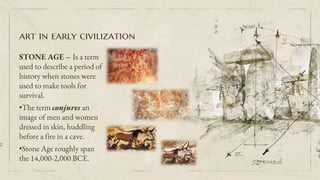
STONE AGE – Is a term
used to describe a period of
history when stones were
used to make tools for
survival.
•The term conjures an
image of men and women
dressed in skin, huddling
before a fire in a cave.
•Stone Age roughly span
the 14,000-2,000 BCE.
2
3
art in early civilization
THREE PERIODS OF
STONE AGE
°PALEOLITHIC – the
late years of the old Stone
Age.
°MESOLITHIC –
Middle Stone Age.
°NEOLITHIC - New
Stone Age.
4
• In unearthing of archeological artifacts and
remains provides modern society a glimpse of
the beliefs, practices, and activities of early
civilization. The motives and reasons behind
the creation of ancient materials such as
sculptures, painting, and architectural
structures may not be clearly defined.
Nevertheless, the early people produced such
material that reflect their attitudes and belief
system on spiritual, social, political, and
economic matters.
5
•As the early humans started to transition from being
nomads to permanent settlers, their everyday activities
also had some changes, which is evident through the
materials and even the works of art they have created.
Despite changes as a result of adapting to their
environment, there are central themes in their artworks.
Most ancient artworks depict religious symbols, a wide
array of organisms from nature and activities of everyday
life.
Prehistoric Art
“
The Stone Age has witnessed how
humans were able to lead more stable
lives and eventually come up with
permanent shelters and tools for
survival.To complement this stability
and sense of Permanence, early humans
also turned to the Creation of paintings
and sculptures that depict humans,
animals, and their natural habitats.
8
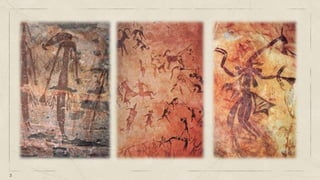
Paleolithic Art is a product of climate
change. As the climate got colder, part of
the early humans’ instinct is to look for
shelters that would provide them will
warmth. Caves became protective havens
for the early humans and these caves
paved the way for the birth of their first
attempt to create art.
9
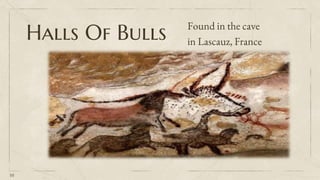
Halls Of Bulls Found in the cave
in Lascauz, France
10
Mesolithic Art
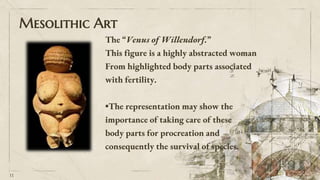
The “Venus of Willendorf.”
This figure is a highly abstracted woman
From highlighted body parts associated
with fertility.
•The representation may show the
importance of taking care of these
body parts for procreation and
consequently the survival of species.
11
NEOLITHIC ART
12
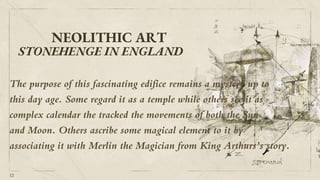
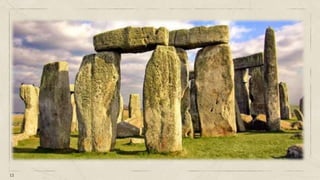
STONEHENGE IN ENGLAND
The purpose of this fascinating edifice remains a mystery up to
this day age. Some regard it as a temple while others see it as
complex calendar the tracked the movements of both the Sun
and Moon. Others ascribe some magical element to it by
associating it with Merlin the Magician from King Arthurs’s story.
13
EGYPTIAN ART
14
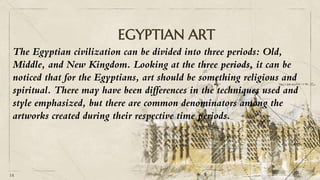
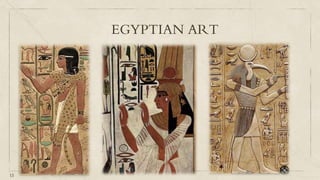
The Egyptian civilization can be divided into three periods: Old,
Middle, and New Kingdom. Looking at the three periods, it can be
noticed that for the Egyptians, art should be something religious and
spiritual. There may have been differences in the techniques used and
style emphasized, but there are common denominators among the
artworks created during their respective time periods.
EGYPTIAN ART
15
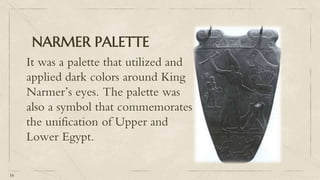
NARMER PALETTE
It was a palette that utilized and
applied dark colors around King
Narmer’s eyes. The palette was
also a symbol that commemorates
the unification of Upper and
Lower Egypt.
16
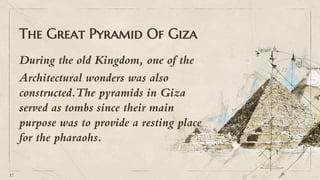
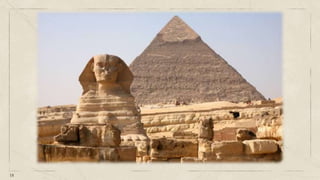
The Great Pyramid Of Giza
During the old Kingdom, one of the
Architectural wonders was also
constructed.The pyramids in Giza
served as tombs since their main
purpose was to provide a resting place
for the pharaohs.
17
18
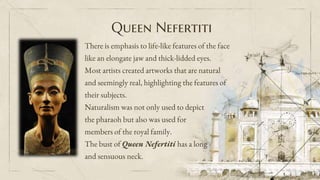
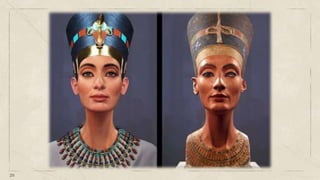
Queen Nefertiti
There is emphasis to life-like features of the face
like an elongate jaw and thick-lidded eyes.
Most artists created artworks that are natural
and seemingly real, highlighting the features of
their subjects.
Naturalism was not only used to depict
the pharaoh but also was used for
members of the royal family.
The bust of Queen Nefertiti has a long
and sensuous neck.
20
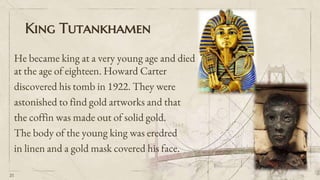
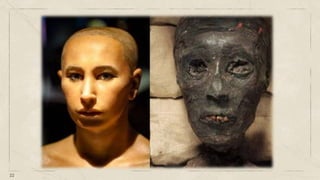
King Tutankhamen
He became king at a very young age and died
at the age of eighteen. Howard Carter
discovered his tomb in 1922. They were
astonished to find gold artworks and that
the coffin was made out of solid gold.
The body of the young king was eredred
in linen and a gold mask covered his face.
21
22
23
SUMMARY
During the prehistoric period, the early humans had transitioned from
a nomadic lifestyle to that of more permanent one, which led to early
civilizations. Some of the works discovered from this period would give
modern society a glimpse of what was life like during that period. One
of the early civilizations where art flourished was the egyptian
civilization. Throughout the three kingdoms all the way to the
Amarna Revolution, art has been directly used particularly in religious
and spiritual activities. Through these unearthed and discovered
artworks, the modern world could have a better understanding of the
past and how it can affect the present.
24
Thank You!

Art-in-early-civilization.pptx

  • 1.
  • 2.
    art in earlycivilization STONE AGE – Is a term used to describe a period of history when stones were used to make tools for survival. •The term conjures an image of men and women dressed in skin, huddling before a fire in a cave. •Stone Age roughly span the 14,000-2,000 BCE. 2
  • 3.
  • 4.
    art in earlycivilization THREE PERIODS OF STONE AGE °PALEOLITHIC – the late years of the old Stone Age. °MESOLITHIC – Middle Stone Age. °NEOLITHIC - New Stone Age. 4
  • 5.
    • In unearthingof archeological artifacts and remains provides modern society a glimpse of the beliefs, practices, and activities of early civilization. The motives and reasons behind the creation of ancient materials such as sculptures, painting, and architectural structures may not be clearly defined. Nevertheless, the early people produced such material that reflect their attitudes and belief system on spiritual, social, political, and economic matters. 5
  • 6.
    •As the earlyhumans started to transition from being nomads to permanent settlers, their everyday activities also had some changes, which is evident through the materials and even the works of art they have created. Despite changes as a result of adapting to their environment, there are central themes in their artworks. Most ancient artworks depict religious symbols, a wide array of organisms from nature and activities of everyday life.
  • 7.
  • 8.
    “ The Stone Agehas witnessed how humans were able to lead more stable lives and eventually come up with permanent shelters and tools for survival.To complement this stability and sense of Permanence, early humans also turned to the Creation of paintings and sculptures that depict humans, animals, and their natural habitats. 8
  • 9.
    Paleolithic Art isa product of climate change. As the climate got colder, part of the early humans’ instinct is to look for shelters that would provide them will warmth. Caves became protective havens for the early humans and these caves paved the way for the birth of their first attempt to create art. 9
  • 10.
    Halls Of BullsFound in the cave in Lascauz, France 10
  • 11.
    Mesolithic Art The “Venusof Willendorf.” This figure is a highly abstracted woman From highlighted body parts associated with fertility. •The representation may show the importance of taking care of these body parts for procreation and consequently the survival of species. 11
  • 12.
    NEOLITHIC ART 12 STONEHENGE INENGLAND The purpose of this fascinating edifice remains a mystery up to this day age. Some regard it as a temple while others see it as complex calendar the tracked the movements of both the Sun and Moon. Others ascribe some magical element to it by associating it with Merlin the Magician from King Arthurs’s story.
  • 13.
  • 14.
    EGYPTIAN ART 14 The Egyptiancivilization can be divided into three periods: Old, Middle, and New Kingdom. Looking at the three periods, it can be noticed that for the Egyptians, art should be something religious and spiritual. There may have been differences in the techniques used and style emphasized, but there are common denominators among the artworks created during their respective time periods.
  • 15.
  • 16.
    NARMER PALETTE It wasa palette that utilized and applied dark colors around King Narmer’s eyes. The palette was also a symbol that commemorates the unification of Upper and Lower Egypt. 16
  • 17.
    The Great PyramidOf Giza During the old Kingdom, one of the Architectural wonders was also constructed.The pyramids in Giza served as tombs since their main purpose was to provide a resting place for the pharaohs. 17
  • 18.
  • 19.
    Queen Nefertiti There isemphasis to life-like features of the face like an elongate jaw and thick-lidded eyes. Most artists created artworks that are natural and seemingly real, highlighting the features of their subjects. Naturalism was not only used to depict the pharaoh but also was used for members of the royal family. The bust of Queen Nefertiti has a long and sensuous neck.
  • 20.
  • 21.
    King Tutankhamen He becameking at a very young age and died at the age of eighteen. Howard Carter discovered his tomb in 1922. They were astonished to find gold artworks and that the coffin was made out of solid gold. The body of the young king was eredred in linen and a gold mask covered his face. 21
  • 22.
  • 23.
    23 SUMMARY During the prehistoricperiod, the early humans had transitioned from a nomadic lifestyle to that of more permanent one, which led to early civilizations. Some of the works discovered from this period would give modern society a glimpse of what was life like during that period. One of the early civilizations where art flourished was the egyptian civilization. Throughout the three kingdoms all the way to the Amarna Revolution, art has been directly used particularly in religious and spiritual activities. Through these unearthed and discovered artworks, the modern world could have a better understanding of the past and how it can affect the present.
  • 24.