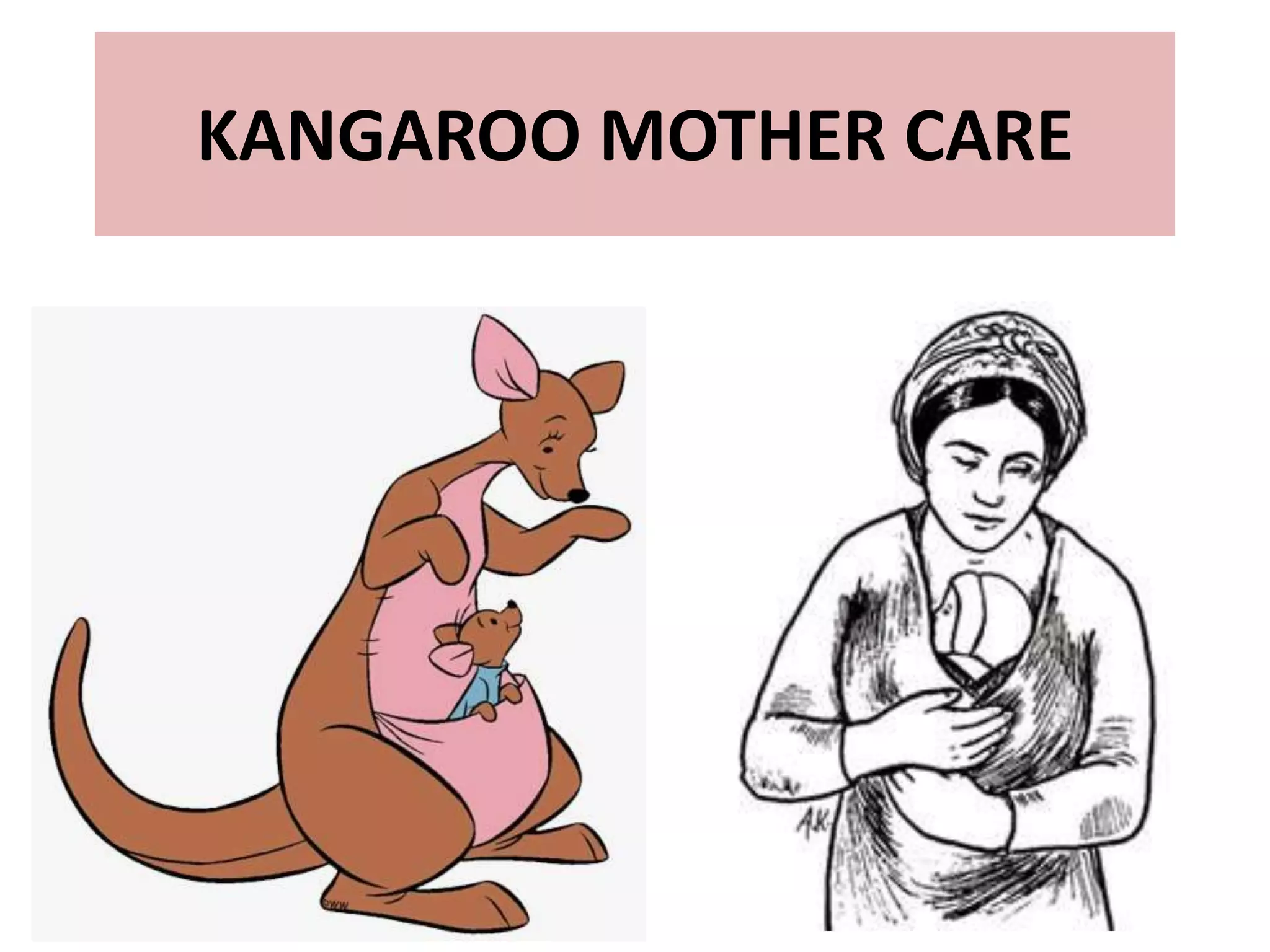
KANGAROO MOTHER CARE
WHY IS IT CALLED
KANGAROO MOTHER CARE?
• A newborn baby kangaroo (joey) is very
immature at birth and very small in size
• The mother kangaroo’s pouch provides
warmth, safety and a constant supply of
milk to the joey
• Similar to kangaroo care giving the
human infant is also immature and
especially the LBW infant benefits
from skin-to-skin care because it
provides warmth, safety and food
Whitelaw 1985, Malawi KMC Training Manual
KMC
• Kangaroo Mother Care (KMC) is care of newborn infants
secured skin-to-skin to the mother
• KMC is a powerful and easy to use method to promote the
health and well-being of
– Low birth weight (LBW) - infants with birth weight below 2500g
– Preterm infants – infants with gestational age less than 37 weeks
REASONS WHY KMC WAS
IMPLEMENTED
• In 1979, Dr Edgar Rey & Hector Martinez worked in Bogotá,
Colombia
• At the hospital where they worked large numbers of LBW & preterm
infants delivered because of:
◦ Poor Ante Natal Care attendance
◦ High incidence of toxaemia of pregnancy, anaemia & infections
◦Shortages of staff & inadequate equipment
◦High infection & mortality rate because of overcrowding
◦Large numbers of infants who were abandoned by their
mothers
Whitelaw A and Sleath K, 1985
ADVANTAGES AFTER IMPLEMENTATION
• This practice resulted in:
Improved outcome for LBW infants
◦ Humanized general care of infants in hospital
◦ Decreased hospitalisation time and mortality
◦ Less overcrowding
◦ Less abandoned infants
◦ Improved staff moral
Whitelaw A and Sleath K, 1985
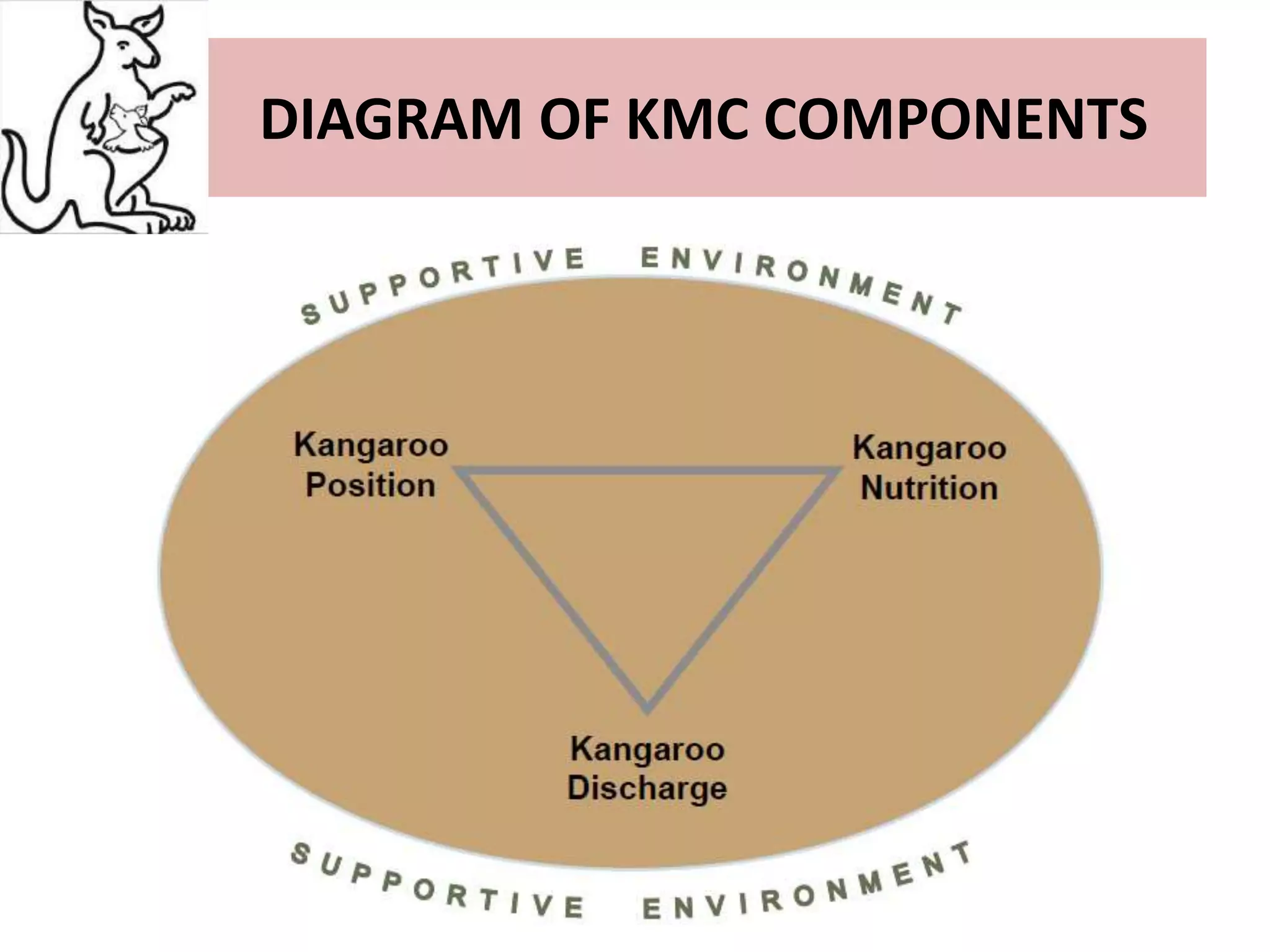
DIAGRAM OF KMC COMPONENTS
COMPONENTS/ELEMENTS OF KMC
• Kangaroo position
 Skin-to-skin on the mother’s chest
 Secured with a wrap
• Kangaroo nutrition
 Exclusive breastfeeding whenever possible
• Kangaroo discharge
 Mother continues KMC practice at home after discharge
• Kangaroo Support
 Health care staff provide support to the mother to take care
of her infant in the hospital
 Family support of mother in practicing KMC at home
WHAT SHOULD
THE MOTHER
WEAR?
WHAT SHOULD
THE BABY WEAR?
KMC POSITION
• Place the baby between the mother’s breasts in an upright
position
• Turn the head to the side, in a slightly extended
position
 This is to keep the airway open
 It also allows eye-to-eye contact between mother and baby
• Avoid forward flexion & hyperextension of the neck
 Infant should be in a flexed position - legs & arms
 Secure baby with a binder / wrap
 The top of the binder should be at the baby’s ear
THE SUPPORT BINDER
• Tie the binder firmly enough so that the baby will not slide
out
• Make sure that the tight part of the cloth is across the baby’s
chest
• The baby’s abdomen should not be constricted
• Baby should have enough room for abdominal breathing
• Examples
THE SUPPORT BINDER
ANY FAMILY MEMBER CAN DO IT !
• Father &
other family
members
can do.
ANY FAMILY MEMBER CAN DO IT !
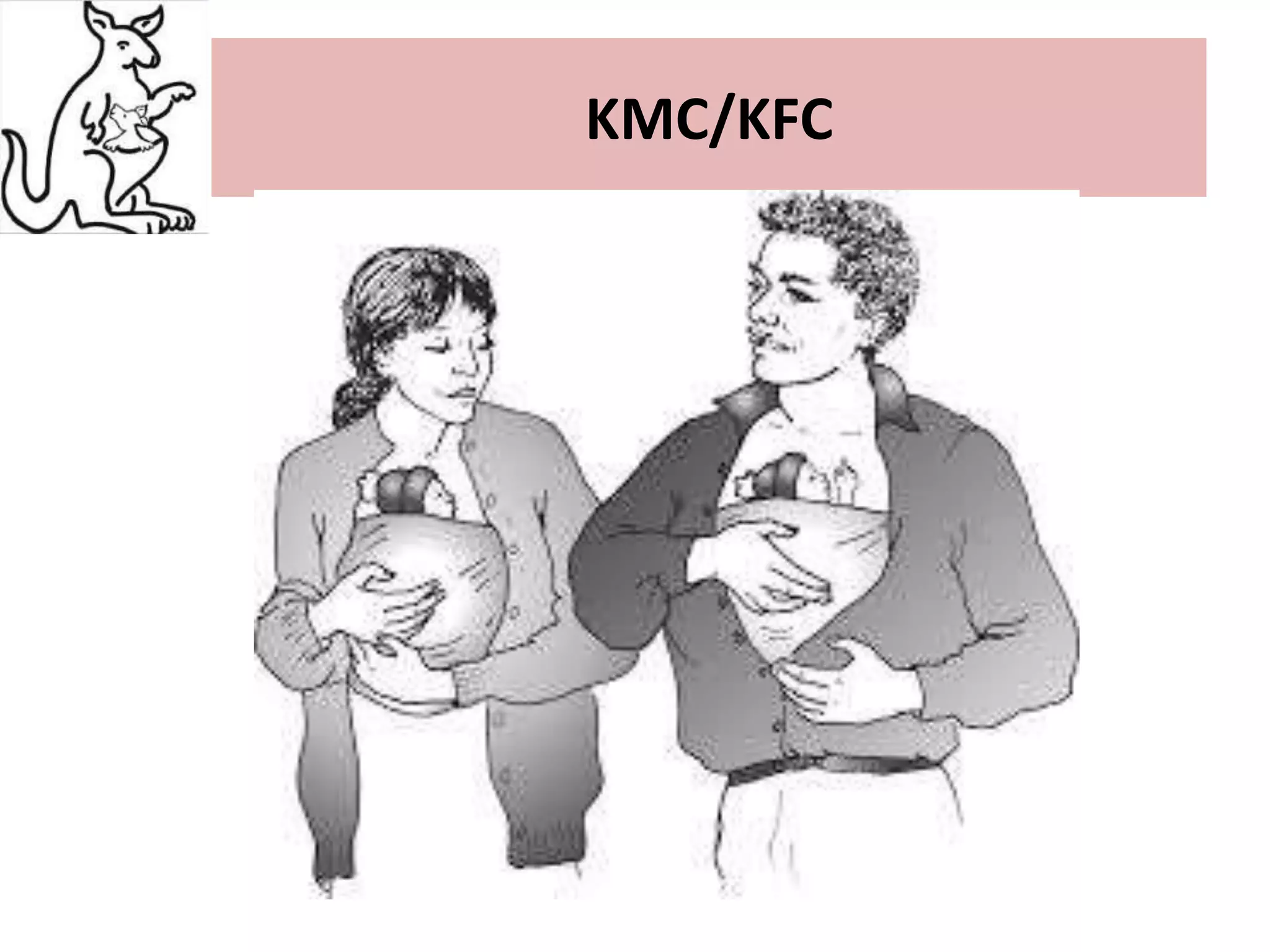
KMC/KFC
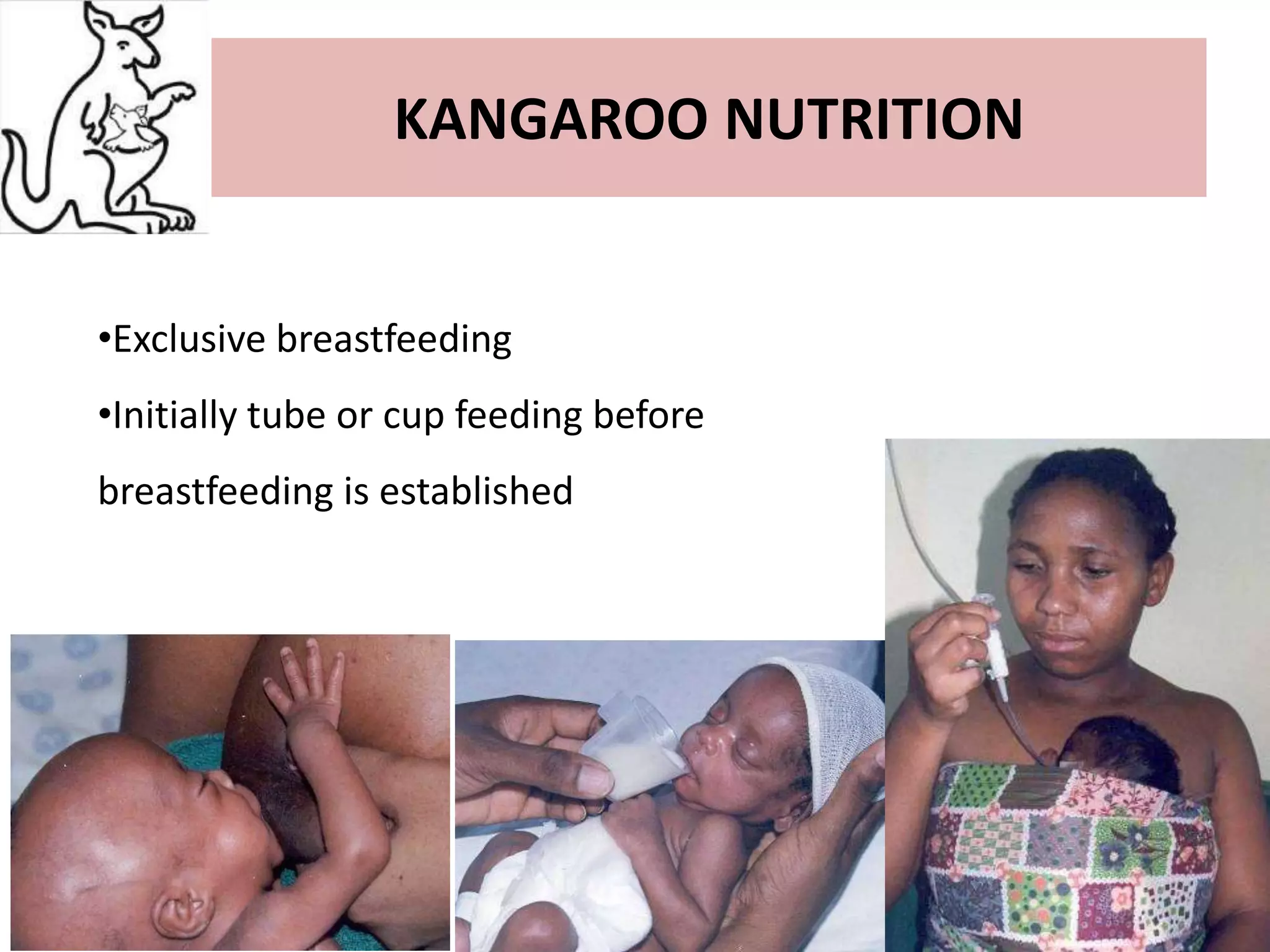
KANGAROO NUTRITION
•Exclusive breastfeeding
•Initially tube or cup feeding before
breastfeeding is established
KANGAROO DISCHARGE
• Once the baby is feeding well, maintaining stable body
temperature in KMC position and gaining weight, mother
and baby can go home
• Baby is well with no evidence of infection
• Feeding well (predominant breast milk)
• Gaining weight (15-20 gm/kg/day)
• Maintaining body temperature(in room temperature)
KANGAROO DISCHARGE
• Mother confident of taking care of the baby
• The mother continues to practice KMC after the infant is
discharged home
• Follow-up visits ensured
KANGAROO SUPPORT
• Health care staff support in hospital
◦ Emotional support – The mother needs encouragement if
she is to give KMC
◦Teaching mothers the skill to take care of their LBW infants
• After discharge infants need regular followup to check
satisfactory weight gain
• Support from the family at home to help mother take care of
her infant and practice KMC at home
BENEFITS OF KMC
KMC: BENEFITS TO THE BABY
• Improved cardiac and respiratory stability
• Fewer episodes of desaturation & apnoea
• KMC can successfully treat mild respiratory distress
• Improved gastrointestinal function
• Higher initiation & duration of breastfeeding
& satisfactory weight gain
• Protection against infections
KMC: Benefits to the Baby
• Effective thermal control
◦ Baby’s temperature is maintained within a narrow temperature
range
◦ A thermal synchrony develops between mother & baby
• Infants are much less stressed and this provides neurological
protection to the infant and the result is:
◦ Improved neurodevelopment
◦ Better organised sleep patterns
◦ More mature and organised electrical brain activity
KMC: BENEFITS TO THE BABY
BENEFITS TO THE MOTHER
• Boosts mother’s confidence in caring her infant
• Improved bonding between mother and infant due to the
physical closeness between them
• Mothers are empowered to play an active role in their infants
care
• Mothers are enabled to become the primary care giver of
their infants by building up their confidence.
• Breast feeding is promoted
BENEFITS TO THE HOSPITAL
• Significant cost-savings
• Better outcomes
 Less dependence on incubators
 Less nursing staff necessary
 Shorter hospital stay
• Improved morale & quality of care
• Better survival
TYPES OF KMC: INTERMITTENT
• Intermittent KMC is practiced with infants
◦Where incubators or warm rooms are available
◦Who are very small and still need incubator care
◦Who are not on full oral feeds
◦Who are receiving oxygen therapy
• Range from many times per day to only once every few days
• The time period can vary from minutes to hours at a time
TYPES OF KMC: INTERMITTENT
• The duration of intermittent KMC depends on the condition
of the infant and the availability of the mother
• It encourages the mother to take part in care of her infant
while still in the nursery(family centred)
TYPES OF KMC: CONTINUOUS
• It is KMC that is given continuously, both day & night
• KMC may discontinue for very short periods when the mother has
to attend personal needs
• Can be practiced in hospital or when doing KMC at
home
• It should always be used where there are no incubators
• It requires support from the family members, including
the husband
• It is the ideal type of KMC for LBW infants
DISCONTINUATION OF KMC
• Term gestation
• Weight ~ 2500 gm or more
• Baby uncomfortable
• Pulls limbs out
• Cries from mouth
• Mother can continue KMC after giving the baby a bath and
during cold nights
1998 BOGOTÁ DECLARATION
“Kangaroo Mother Care is a basic right of the newborn and
should be an integral part of the management of low
birth weight and full term infants in allsettings at all levels of
care and in all communities.”
IMPATIENT OPTIMISTS
BILL AND MELINDA GATES
FOUNDATION
THANK YOU

KMC

  • 1.
  • 2.
    WHY IS ITCALLED KANGAROO MOTHER CARE? • A newborn baby kangaroo (joey) is very immature at birth and very small in size • The mother kangaroo’s pouch provides warmth, safety and a constant supply of milk to the joey • Similar to kangaroo care giving the human infant is also immature and especially the LBW infant benefits from skin-to-skin care because it provides warmth, safety and food Whitelaw 1985, Malawi KMC Training Manual
  • 3.
    KMC • Kangaroo MotherCare (KMC) is care of newborn infants secured skin-to-skin to the mother • KMC is a powerful and easy to use method to promote the health and well-being of – Low birth weight (LBW) - infants with birth weight below 2500g – Preterm infants – infants with gestational age less than 37 weeks
  • 4.
    REASONS WHY KMCWAS IMPLEMENTED • In 1979, Dr Edgar Rey & Hector Martinez worked in Bogotá, Colombia • At the hospital where they worked large numbers of LBW & preterm infants delivered because of: ◦ Poor Ante Natal Care attendance ◦ High incidence of toxaemia of pregnancy, anaemia & infections ◦Shortages of staff & inadequate equipment ◦High infection & mortality rate because of overcrowding ◦Large numbers of infants who were abandoned by their mothers Whitelaw A and Sleath K, 1985
  • 5.
    ADVANTAGES AFTER IMPLEMENTATION •This practice resulted in: Improved outcome for LBW infants ◦ Humanized general care of infants in hospital ◦ Decreased hospitalisation time and mortality ◦ Less overcrowding ◦ Less abandoned infants ◦ Improved staff moral Whitelaw A and Sleath K, 1985
  • 6.
    DIAGRAM OF KMCCOMPONENTS
  • 7.
    COMPONENTS/ELEMENTS OF KMC •Kangaroo position  Skin-to-skin on the mother’s chest  Secured with a wrap • Kangaroo nutrition  Exclusive breastfeeding whenever possible • Kangaroo discharge  Mother continues KMC practice at home after discharge • Kangaroo Support  Health care staff provide support to the mother to take care of her infant in the hospital  Family support of mother in practicing KMC at home
  • 8.
  • 10.
  • 13.
    KMC POSITION • Placethe baby between the mother’s breasts in an upright position • Turn the head to the side, in a slightly extended position  This is to keep the airway open  It also allows eye-to-eye contact between mother and baby • Avoid forward flexion & hyperextension of the neck  Infant should be in a flexed position - legs & arms  Secure baby with a binder / wrap  The top of the binder should be at the baby’s ear
  • 15.
    THE SUPPORT BINDER •Tie the binder firmly enough so that the baby will not slide out • Make sure that the tight part of the cloth is across the baby’s chest • The baby’s abdomen should not be constricted • Baby should have enough room for abdominal breathing • Examples
  • 16.
  • 18.
    ANY FAMILY MEMBERCAN DO IT ! • Father & other family members can do.
  • 19.
    ANY FAMILY MEMBERCAN DO IT !
  • 20.
  • 21.
    KANGAROO NUTRITION •Exclusive breastfeeding •Initiallytube or cup feeding before breastfeeding is established
  • 22.
    KANGAROO DISCHARGE • Oncethe baby is feeding well, maintaining stable body temperature in KMC position and gaining weight, mother and baby can go home • Baby is well with no evidence of infection • Feeding well (predominant breast milk) • Gaining weight (15-20 gm/kg/day) • Maintaining body temperature(in room temperature)
  • 23.
    KANGAROO DISCHARGE • Motherconfident of taking care of the baby • The mother continues to practice KMC after the infant is discharged home • Follow-up visits ensured
  • 24.
    KANGAROO SUPPORT • Healthcare staff support in hospital ◦ Emotional support – The mother needs encouragement if she is to give KMC ◦Teaching mothers the skill to take care of their LBW infants • After discharge infants need regular followup to check satisfactory weight gain • Support from the family at home to help mother take care of her infant and practice KMC at home
  • 25.
  • 26.
    KMC: BENEFITS TOTHE BABY • Improved cardiac and respiratory stability • Fewer episodes of desaturation & apnoea • KMC can successfully treat mild respiratory distress • Improved gastrointestinal function • Higher initiation & duration of breastfeeding & satisfactory weight gain • Protection against infections
  • 27.
    KMC: Benefits tothe Baby • Effective thermal control ◦ Baby’s temperature is maintained within a narrow temperature range ◦ A thermal synchrony develops between mother & baby • Infants are much less stressed and this provides neurological protection to the infant and the result is: ◦ Improved neurodevelopment ◦ Better organised sleep patterns ◦ More mature and organised electrical brain activity KMC: BENEFITS TO THE BABY
  • 28.
    BENEFITS TO THEMOTHER • Boosts mother’s confidence in caring her infant • Improved bonding between mother and infant due to the physical closeness between them • Mothers are empowered to play an active role in their infants care • Mothers are enabled to become the primary care giver of their infants by building up their confidence. • Breast feeding is promoted
  • 29.
    BENEFITS TO THEHOSPITAL • Significant cost-savings • Better outcomes  Less dependence on incubators  Less nursing staff necessary  Shorter hospital stay • Improved morale & quality of care • Better survival
  • 30.
    TYPES OF KMC:INTERMITTENT • Intermittent KMC is practiced with infants ◦Where incubators or warm rooms are available ◦Who are very small and still need incubator care ◦Who are not on full oral feeds ◦Who are receiving oxygen therapy • Range from many times per day to only once every few days • The time period can vary from minutes to hours at a time
  • 31.
    TYPES OF KMC:INTERMITTENT • The duration of intermittent KMC depends on the condition of the infant and the availability of the mother • It encourages the mother to take part in care of her infant while still in the nursery(family centred)
  • 32.
    TYPES OF KMC:CONTINUOUS • It is KMC that is given continuously, both day & night • KMC may discontinue for very short periods when the mother has to attend personal needs • Can be practiced in hospital or when doing KMC at home • It should always be used where there are no incubators • It requires support from the family members, including the husband • It is the ideal type of KMC for LBW infants
  • 33.
    DISCONTINUATION OF KMC •Term gestation • Weight ~ 2500 gm or more • Baby uncomfortable • Pulls limbs out • Cries from mouth • Mother can continue KMC after giving the baby a bath and during cold nights
  • 34.
    1998 BOGOTÁ DECLARATION “KangarooMother Care is a basic right of the newborn and should be an integral part of the management of low birth weight and full term infants in allsettings at all levels of care and in all communities.”
  • 35.
    IMPATIENT OPTIMISTS BILL ANDMELINDA GATES FOUNDATION
  • 37.