





M365 Chicago – 2021
Drew Madelung
Labelling in Microsoft 365:
Retention & Sensitivity
https://otsn.live/M365CHI-CFFDonation
Your donations make a difference!
Help Us Improve OurConference!
Help Our Speakers Improve!
https://otsn.live/M365CHI-Feedback
Drew Madelung
Email : drew.madelung@protiviti.com
Twitter : @dmadelung
Website: drewmadelung.com
Associate Director – Cloud Applications
Data Classification
Labelling in M365
Sensitivity Labels
Retention Labels
Labelling in Microsoft
365: Retention &
Sensitivity
M365 Chicago 2021
Demos on Demos
Where is everyone with
data classification &
labels?
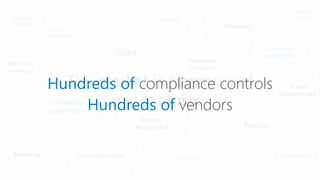
The market is fragmented
and confusing
Breach
notification
Supervision
GDPR
Information
governance
Data loss
prevention
Archiving
Fraud
prevention
Information
protection
eDiscovery
Privacy
Records
management
Access
management
Hundreds of compliance controls
Hundreds of vendors
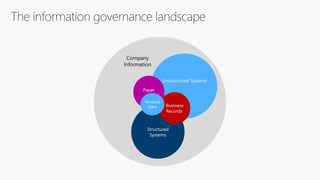
Structured
Systems
Unstructured Systems
Company
Information
Paper
Business
Records
Personal
Data
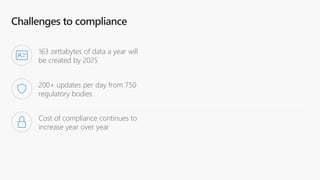
163 zettabytes of data a year will
be created by 2025
Cost of compliance continues to
increase year over year
200+ updates per day from 750
regulatory bodies
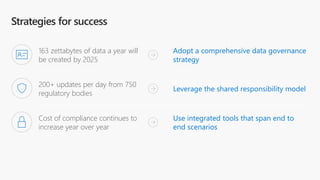
Adopt a comprehensive data governance
strategy
Leverage the shared responsibility model
Use integrated tools that span end to
end scenarios
163 zettabytes of data a year will
be created by 2025
200+ updates per day from 750
regulatory bodies
Cost of compliance continues to
increase year over year
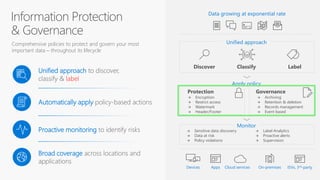
Unified approach to discover,
classify & label
Automatically apply policy-based actions
Proactive monitoring to identify risks
Broad coverage across locations and
applications
Data growing at exponential rate
Label
Discover Classify
Unified approach
Devices Apps Cloud services On-premises ISVs, 3rd-party
 Sensitive data discovery
 Data at risk
 Policy violations
Monitor
 Label Analytics
 Proactive alerts
 Supervision
Protection Governance
 Encryption
 Restrict access
 Watermark
 Header/Footer
 Archiving
 Retention & deletion
 Records management
 Event based
Apply policy
Comprehensive policies to protect and govern your most
important data – throughout its lifecycle
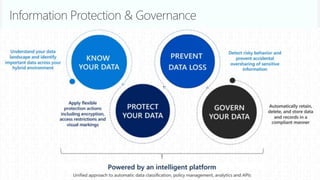
Powered by
Powered by
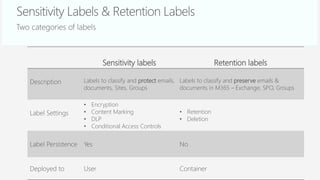
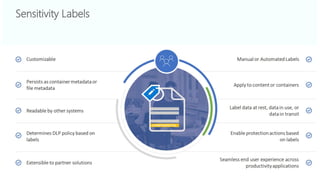
Sensitivity labels Retention labels
Description Labels to classify and protect emails,
documents, Sites, Groups
Labels to classify and preserve emails &
documents in M365 – Exchange, SPO, Groups
Label Settings
• Encryption
• Content Marking
• DLP
• Conditional Access Controls
• Retention
• Deletion
Label Persistence Yes No
Deployed to User Container
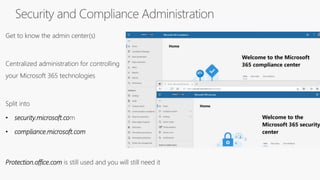
Get to know the admin center(s)
Centralized administration for controlling
your Microsoft 365 technologies
Split into
• security.microsoft.com
• compliance.microsoft.com
Protection.office.com is still used and you will still need it
Questions &
Discussion
Sensitivity Labels
Powered by
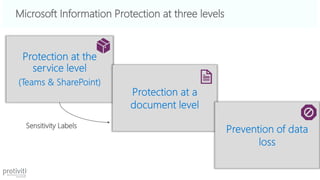
Microsoft Information Protection at three levels
Sensitivity Labels
Powered by
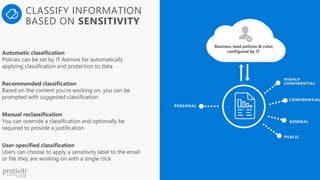
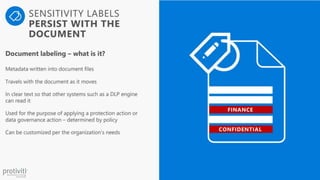
Sensitivity Labels
Powered by
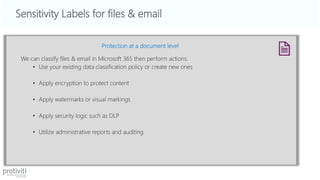
Sensitivity Labels for files & email
Powered by
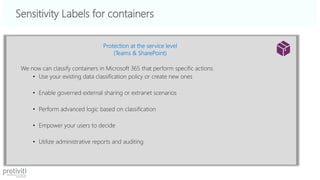
Sensitivity Labels for containers
Questions &
Discussion
Retention Labels
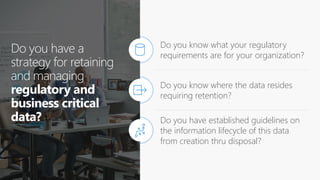
Do you have a
strategy for retaining
and managing
regulatory and
business critical
data?
Do you know what your regulatory
requirements are for your organization?
Do you know where the data resides
requiring retention?
Do you have established guidelines on
the information lifecycle of this data
from creation thru disposal?
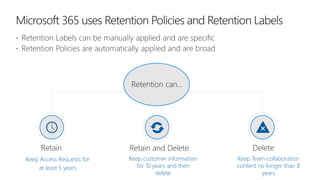
Retain Retain and Delete Delete
Retention can…
Keep Access Requests for
at least 5 years
Keep customer information
for 10 years and then
delete
Keep Team collaboration
content no longer than 8
years
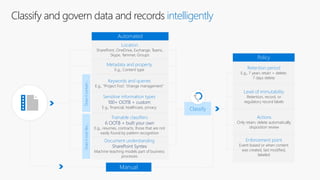
Classify and govern data and records intelligently
Manual
Location
SharePoint, OneDrive, Exchange, Teams,
Skype, Yammer, Groups
Metadata and property
E.g., Content type
Trainable classifiers
6 OOTB + built your own
E.g., resumes, contracts, those that are not
easily found by pattern recognition
Sensitive information types
100+ OOTB + custom
E.g., financial, healthcare, privacy
Keywords and queries
E.g., “Project Foo”, “change management”
Classify
Automated
Policy
Retention period
E.g., 7 years retain + delete;
7 days delete
Level of immutability
Retention, record, or
regulatory record labels
Actions
Only retain, delete automatically,
disposition review
Enforcement point
Event-based or when content
was created, last modified,
labeled
Document understanding
SharePoint Syntex
Machine teaching models part of business
processes
Does
it
look
like…
Does
it
contain…
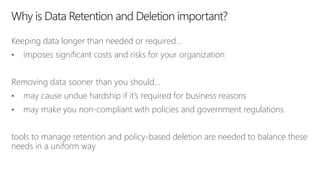
Keeping data longer than needed or required…
• imposes significant costs and risks for your organization
Removing data sooner than you should…
• may cause undue hardship if it’s required for business reasons
• may make you non-compliant with policies and government regulations
tools to manage retention and policy-based deletion are needed to balance these
needs in a uniform way
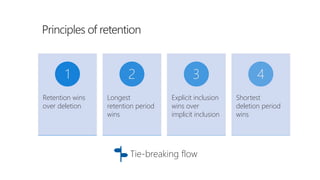
Retention wins
over deletion​
1
Longest
retention period
wins​
2
Explicit inclusion
wins over
implicit inclusion​
3
Shortest
deletion period
wins
4
Tie-breaking flow
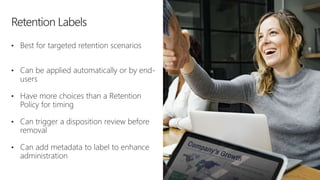
• Best for targeted retention scenarios
• Can be applied automatically or by end-
users
• Have more choices than a Retention
Policy for timing
• Can trigger a disposition review before
removal
• Can add metadata to label to enhance
administration
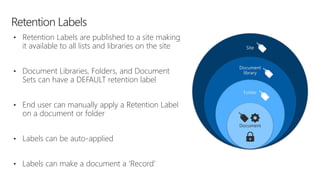
Site
Document
library
Folder
Document
• Retention Labels are published to a site making
it available to all lists and libraries on the site
• Document Libraries, Folders, and Document
Sets can have a DEFAULT retention label
• End user can manually apply a Retention Label
on a document or folder
• Labels can be auto-applied
• Labels can make a document a ‘Record’
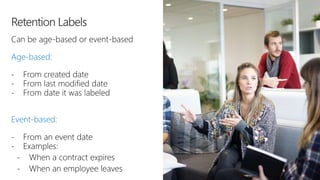
Can be age-based or event-based
Age-based:
- From created date
- From last modified date
- From date it was labeled
Event-based:
- From an event date
- Examples:
- When a contract expires
- When an employee leaves
Questions &
Discussion
Powered by
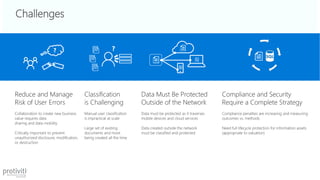
Challenges
? ?
What are the things I can do today based on my licensing?
@AaronDinnage
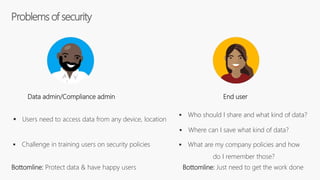
Problems of security
 Users need to access data from any device, location
End user
Data admin/Compliance admin
 Challenge in training users on security policies
Bottomline: Protect data & have happy users
 Who should I share and what kind of data?
 Where can I save what kind of data?
 What are my company policies and how
do I remember those?
Bottomline: Just need to get the work done
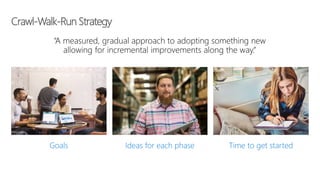
Crawl-Walk-Run Strategy
Goals Ideas for each phase Time to get started
“A measured, gradual approach to adopting something new
allowing for incremental improvements along the way.”
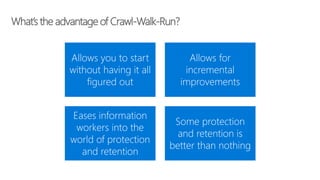
What’s the advantage of Crawl-Walk-Run?
Allows you to start
without having it all
figured out
Allows for
incremental
improvements
Eases information
workers into the
world of protection
and retention
Some protection
and retention is
better than nothing
Questions?
Email: drew.madelung@protiviti.com
Twitter: @dmadelung
Website: drewmadelung.com
Slides: http://bit.ly/DrewSlides
Labelling in
Microsoft 365
– Retention &
Sensitivity
M365 Chicago 2021

Labelling in Microsoft 365 - Retention & Sensitivity

  • 1.
    M365 Chicago –2021 Drew Madelung Labelling in Microsoft 365: Retention & Sensitivity
  • 2.
  • 4.
    Help Us ImproveOurConference! Help Our Speakers Improve! https://otsn.live/M365CHI-Feedback
  • 5.
    Drew Madelung Email :drew.madelung@protiviti.com Twitter : @dmadelung Website: drewmadelung.com Associate Director – Cloud Applications
  • 6.
    Data Classification Labelling inM365 Sensitivity Labels Retention Labels Labelling in Microsoft 365: Retention & Sensitivity M365 Chicago 2021 Demos on Demos
  • 7.
    Where is everyonewith data classification & labels?
  • 9.
    The market isfragmented and confusing Breach notification Supervision GDPR Information governance Data loss prevention Archiving Fraud prevention Information protection eDiscovery Privacy Records management Access management Hundreds of compliance controls Hundreds of vendors
  • 12.
  • 13.
    163 zettabytes ofdata a year will be created by 2025 Cost of compliance continues to increase year over year 200+ updates per day from 750 regulatory bodies
  • 14.
    Adopt a comprehensivedata governance strategy Leverage the shared responsibility model Use integrated tools that span end to end scenarios 163 zettabytes of data a year will be created by 2025 200+ updates per day from 750 regulatory bodies Cost of compliance continues to increase year over year
  • 15.
    Unified approach todiscover, classify & label Automatically apply policy-based actions Proactive monitoring to identify risks Broad coverage across locations and applications Data growing at exponential rate Label Discover Classify Unified approach Devices Apps Cloud services On-premises ISVs, 3rd-party  Sensitive data discovery  Data at risk  Policy violations Monitor  Label Analytics  Proactive alerts  Supervision Protection Governance  Encryption  Restrict access  Watermark  Header/Footer  Archiving  Retention & deletion  Records management  Event based Apply policy Comprehensive policies to protect and govern your most important data – throughout its lifecycle
  • 16.
  • 17.
    Powered by Sensitivity labelsRetention labels Description Labels to classify and protect emails, documents, Sites, Groups Labels to classify and preserve emails & documents in M365 – Exchange, SPO, Groups Label Settings • Encryption • Content Marking • DLP • Conditional Access Controls • Retention • Deletion Label Persistence Yes No Deployed to User Container
  • 18.
    Get to knowthe admin center(s) Centralized administration for controlling your Microsoft 365 technologies Split into • security.microsoft.com • compliance.microsoft.com Protection.office.com is still used and you will still need it
  • 20.
  • 21.
  • 22.
    Powered by Microsoft InformationProtection at three levels Sensitivity Labels
  • 23.
  • 24.
  • 27.
  • 29.
  • 30.
  • 31.
    Do you havea strategy for retaining and managing regulatory and business critical data? Do you know what your regulatory requirements are for your organization? Do you know where the data resides requiring retention? Do you have established guidelines on the information lifecycle of this data from creation thru disposal?
  • 32.
    Retain Retain andDelete Delete Retention can… Keep Access Requests for at least 5 years Keep customer information for 10 years and then delete Keep Team collaboration content no longer than 8 years
  • 33.
    Classify and governdata and records intelligently Manual Location SharePoint, OneDrive, Exchange, Teams, Skype, Yammer, Groups Metadata and property E.g., Content type Trainable classifiers 6 OOTB + built your own E.g., resumes, contracts, those that are not easily found by pattern recognition Sensitive information types 100+ OOTB + custom E.g., financial, healthcare, privacy Keywords and queries E.g., “Project Foo”, “change management” Classify Automated Policy Retention period E.g., 7 years retain + delete; 7 days delete Level of immutability Retention, record, or regulatory record labels Actions Only retain, delete automatically, disposition review Enforcement point Event-based or when content was created, last modified, labeled Document understanding SharePoint Syntex Machine teaching models part of business processes Does it look like… Does it contain…
  • 34.
    Keeping data longerthan needed or required… • imposes significant costs and risks for your organization Removing data sooner than you should… • may cause undue hardship if it’s required for business reasons • may make you non-compliant with policies and government regulations tools to manage retention and policy-based deletion are needed to balance these needs in a uniform way
  • 35.
    Retention wins over deletion​ 1 Longest retentionperiod wins​ 2 Explicit inclusion wins over implicit inclusion​ 3 Shortest deletion period wins 4 Tie-breaking flow
  • 36.
    • Best fortargeted retention scenarios • Can be applied automatically or by end- users • Have more choices than a Retention Policy for timing • Can trigger a disposition review before removal • Can add metadata to label to enhance administration
  • 37.
    Site Document library Folder Document • Retention Labelsare published to a site making it available to all lists and libraries on the site • Document Libraries, Folders, and Document Sets can have a DEFAULT retention label • End user can manually apply a Retention Label on a document or folder • Labels can be auto-applied • Labels can make a document a ‘Record’
  • 38.
    Can be age-basedor event-based Age-based: - From created date - From last modified date - From date it was labeled Event-based: - From an event date - Examples: - When a contract expires - When an employee leaves
  • 40.
  • 41.
  • 42.
    What are thethings I can do today based on my licensing?
  • 43.
  • 44.
    Problems of security Users need to access data from any device, location End user Data admin/Compliance admin  Challenge in training users on security policies Bottomline: Protect data & have happy users  Who should I share and what kind of data?  Where can I save what kind of data?  What are my company policies and how do I remember those? Bottomline: Just need to get the work done
  • 45.
    Crawl-Walk-Run Strategy Goals Ideasfor each phase Time to get started “A measured, gradual approach to adopting something new allowing for incremental improvements along the way.”
  • 46.
    What’s the advantageof Crawl-Walk-Run? Allows you to start without having it all figured out Allows for incremental improvements Eases information workers into the world of protection and retention Some protection and retention is better than nothing
  • 47.
    Questions? Email: drew.madelung@protiviti.com Twitter: @dmadelung Website:drewmadelung.com Slides: http://bit.ly/DrewSlides
  • 48.
    Labelling in Microsoft 365 –Retention & Sensitivity M365 Chicago 2021