Validating Hypothesis
with User Research
UX Agency for
next generation companies
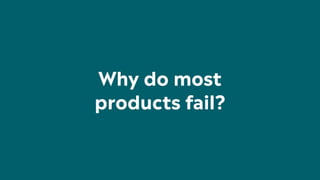
Why do most
products fail?
3. Not the right team 23%
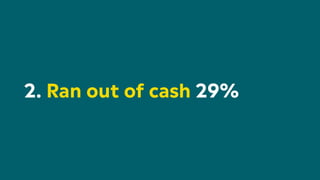
2. Ran out of cash 29%
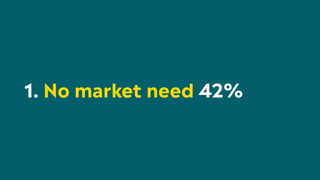
1. No market need 42%
What can we do
different?
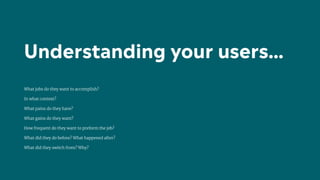
What jobs do they want to accomplish?
In what context?
What pains do they have?
What gains do they want?
How frequent do they want to preform the job?
What did they do before? What happened after?
What did they switch from? Why?
Understanding your users…
…and validating our
hypothesis
How do you validate your
hypothesis?
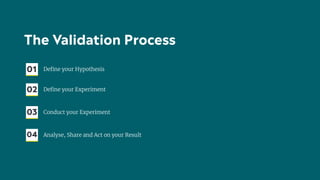
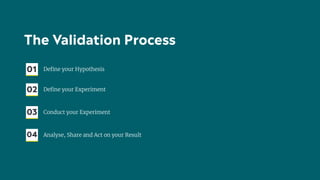
01 Define your Hypothesis
02 Define your Experiment
03 Conduct your Experiment
04 Analyse, Share and Act on your Result
The Validation Process
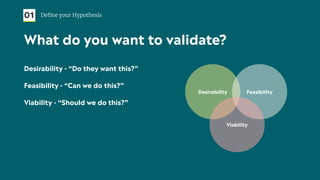
What do you want to validate?
Desirability - “Do they want this?”
Feasibility - “Can we do this?”
Viability - “Should we do this?”
01 Define your Hypothesis
Desirability Feasibility
Viability
“We believe that …”
✅ Testable
✅ Precise
✅ Focused
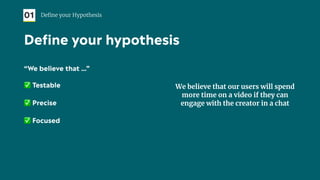
01 Define your Hypothesis
Define your hypothesis
We believe that our users will spend
more time on a video if they can
engage with the creator in a chat
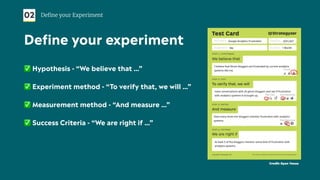
✅ Hypothesis - “We believe that …”
✅ Experiment method - “To verify that, we will …”
✅ Measurement method - “And measure …”
✅ Success Criteria - “We are right if …”
02 Define your Experiment
Define your experiment
Credit: Ryan Yosua
Picking the right
experiment method
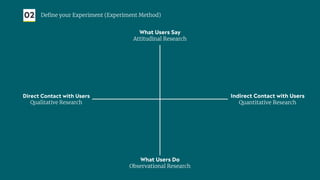
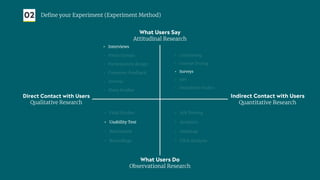
02 Define your Experiment (Experiment Method)
What Users Do
Observational Research
What Users Say
Attitudinal Research
Direct Contact with Users
Qualitative Research
Indirect Contact with Users
Quantitative Research
02 Define your Experiment (Experiment Method)
What Users Do
Observational Research
What Users Say
Attitudinal Research
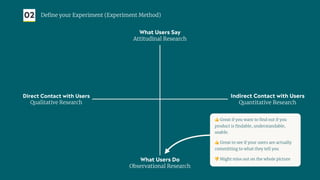
👍 Great if you want to find out if you
product is findable, understandable,
usable.
👍 Great to see if your users are actually
committing to what they tell you
👎 Might miss out on the whole picture
Direct Contact with Users
Qualitative Research
Indirect Contact with Users
Quantitative Research
02 Define your Experiment (Experiment Method)
What Users Do
Observational Research
What Users Say
Attitudinal Research
Direct Contact with Users
Qualitative Research
Indirect Contact with Users
Quantitative Research
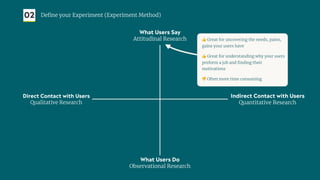
👍 Great for uncovering the needs, pains,
gains your users have
👍 Great for understanding why your users
preform a job and finding their
motivations
👎 Often more time consuming
02 Define your Experiment (Experiment Method)
What Users Do
Observational Research
What Users Say
Attitudinal Research
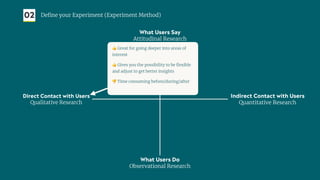
👍 Great for going deeper into areas of
interest
👍 Gives you the possibility to be flexible
and adjust to get better insights
👎 Time consuming before/during/after
Direct Contact with Users
Qualitative Research
Indirect Contact with Users
Quantitative Research
02 Define your Experiment (Experiment Method)
What Users Do
Observational Research
What Users Say
Attitudinal Research
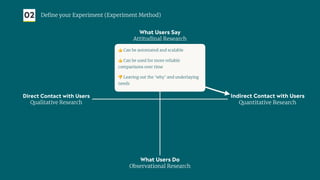
👍 Can be automated and scalable
👍 Can be used for more reliable
comparisons over time
👎 Leaving out the ‘why’ and underlaying
needs
Direct Contact with Users
Qualitative Research
Indirect Contact with Users
Quantitative Research
02 Define your Experiment (Experiment Method)
What Users Do
Observational Research
What Users Say
Attitudinal Research
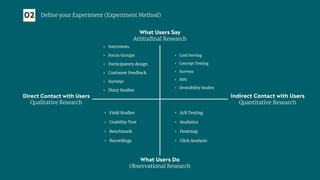
• Field Studies
• Usability Test
• Benchmark
• Recordings
• A/B Testing
• Analytics
• Heatmap
• Click Analysis
• Interviews
• Focus Groups
• Participatory design
• Customer Feedback
• Surveys
• Diary Studies
• Card Sorting
• Concept Testing
• Surveys
• NPS
• Desirability Studies
Direct Contact with Users
Qualitative Research
Indirect Contact with Users
Quantitative Research
02 Define your Experiment (Experiment Method)
What Users Do
Observational Research
What Users Say
Attitudinal Research
• Field Studies
• Usability Test
• Benchmark
• Recordings
• A/B Testing
• Analytics
• Heatmap
• Click Analysis
• Interviews
• Focus Groups
• Participatory design
• Customer Feedback
• Surveys
• Diary Studies
• Card Sorting
• Concept Testing
• Surveys
• NPS
• Desirability Studies
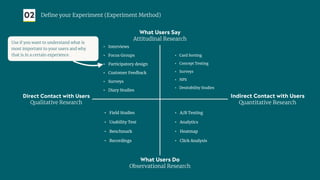
Use if you want to understand what is
most important to your users and why
that is in a certain experience.
Direct Contact with Users
Qualitative Research
Indirect Contact with Users
Quantitative Research
02 Define your Experiment (Experiment Method)
What Users Do
Observational Research
What Users Say
Attitudinal Research
Why & What to fix
Qualitative Research
• Field Studies
• Usability Test
• Benchmark
• Recordings
• A/B Testing
• Analytics
• Heatmap
• Click Analysis
• Interviews
• Focus Groups
• Participatory design
• Customer Feedback
• Surveys
• Diary Studies
• Card Sorting
• Concept Testing
• Surveys
• NPS
• Desirability Studies
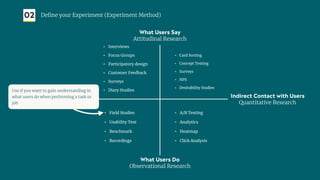
Use if you want to gain understanding in
what users do when performing a task or
job
Indirect Contact with Users
Quantitative Research
02 Define your Experiment (Experiment Method)
What Users Do
Observational Research
What Users Say
Attitudinal Research
• Field Studies
• Usability Test
• Benchmark
• Recordings
• A/B Testing
• Analytics
• Heatmap
• Click Analysis
• Interviews
• Focus Groups
• Participatory design
• Customer Feedback
• Surveys
• Diary Studies
• Card Sorting
• Concept Testing
• Surveys
• NPS
• Desirability Studies
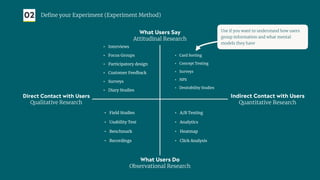
Use if you want to understand how users
group information and what mental
models they have
Direct Contact with Users
Qualitative Research
Indirect Contact with Users
Quantitative Research
Deep-dive in
Experiment Methods
02 Define your Experiment (Experiment Method)
What Users Do
Observational Research
What Users Say
Attitudinal Research
• Field Studies
• Usability Test
• Benchmark
• Recordings
• A/B Testing
• Analytics
• Heatmap
• Click Analysis
• Interviews
• Focus Groups
• Participatory design
• Customer Feedback
• Surveys
• Diary Studies
• Card Sorting
• Concept Testing
• Surveys
• NPS
• Desirability Studies
Direct Contact with Users
Qualitative Research
Indirect Contact with Users
Quantitative Research
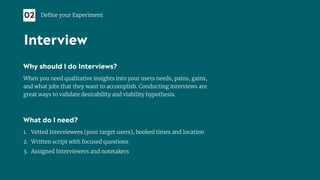
Why should I do Interviews?
When you need qualitative insights into your users needs, pains, gains,
and what jobs that they want to accomplish. Conducting interviews are
great ways to validate desirability and viability hypothesis.
What do I need?
1. Vetted Interviewees (your target users), booked times and location
2. Written script with focused questions
3. Assigned Interviewers and notetakers
02 Define your Experiment
Interview
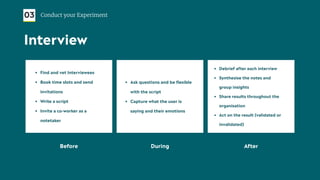
• Find and vet Interviewees
• Book time slots and send
invitations
• Write a script
• Invite a co-worker as a
notetaker
Before During After
• Debrief after each interview
• Synthesise the notes and
group insights
• Share results throughout the
organisation
• Act on the result (validated or
invalidated)
• Ask questions and be flexible
with the script
• Capture what the user is
saying and their emotions
03 Conduct your Experiment
Interview
Tools to use
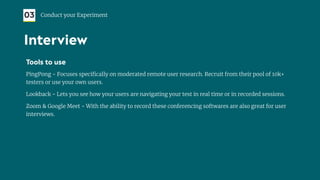
PingPong - Focuses specifically on moderated remote user research. Recruit from their pool of 10k+
testers or use your own users.
Lookback - Lets you see how your users are navigating your test in real time or in recorded sessions.
Zoom & Google Meet - With the ability to record these conferencing softwares are also great for user
interviews.
03 Conduct your Experiment
Interview
Have in mind
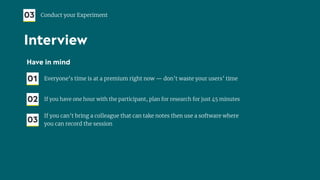
01 Everyone’s time is at a premium right now — don’t waste your users’ time
02 If you have one hour with the participant, plan for research for just 45 minutes
03
If you can’t bring a colleague that can take notes then use a software where
you can record the session
03 Conduct your Experiment
Interview
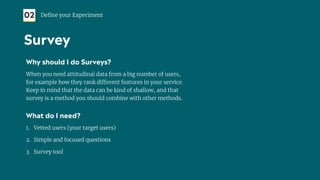
Why should I do Surveys?
When you need attitudinal data from a big number of users,
for example how they rank different features in your service.
Keep in mind that the data can be kind of shallow, and that
survey is a method you should combine with other methods.
What do I need?
1. Vetted users (your target users)
2. Simple and focused questions
3. Survey tool
02 Define your Experiment
Survey
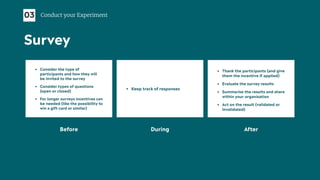
• Consider the type of
participants and how they will
be invited to the survey
• Consider types of questions
(open or closed)
• For longer surveys incentives can
be needed (like the possibility to
win a gift card or similar)
Before During After
• Keep track of responses
• Thank the participants (and give
them the incentive if applied)
• Evaluate the survey results
• Summarise the results and share
within your organisation
• Act on the result (validated or
invalidated)
03 Conduct your Experiment
Survey
Recommended tools
• Google Forms
• Typeform
• Surveymonkey
• Hotjar
03 Conduct your Experiment
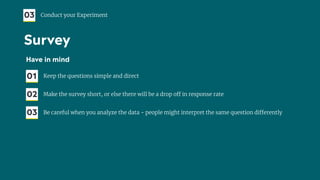
Survey
Have in mind
01 Keep the questions simple and direct
02 Make the survey short, or else there will be a drop off in response rate
03 Be careful when you analyze the data - people might interpret the same question differently
03 Conduct your Experiment
Survey
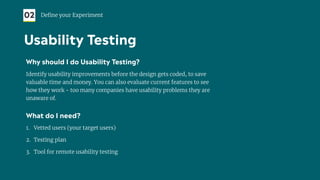
Why should I do Usability Testing?
Identify usability improvements before the design gets coded, to save
valuable time and money. You can also evaluate current features to see
how they work - too many companies have usability problems they are
unaware of.
What do I need?
1. Vetted users (your target users)
2. Testing plan
3. Tool for remote usability testing
02 Define your Experiment
Usability Testing
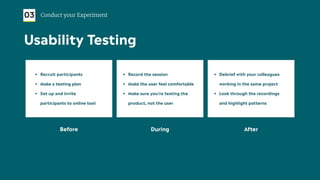
• Recruit participants
• Make a testing plan
• Set up and invite
participants to online tool
Before During
• Record the session
• Make the user feel comfortable
• Make sure you’re testing the
product, not the user
After
• Debrief with your colleagues
working in the same project
• Look through the recordings
and highlight patterns
03 Conduct your Experiment
Usability Testing
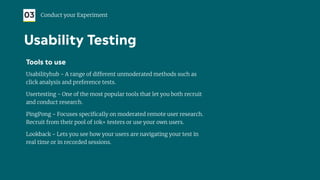
Tools to use
Usabilityhub - A range of different unmoderated methods such as
click analysis and preference tests.
Usertesting - One of the most popular tools that let you both recruit
and conduct research.
PingPong - Focuses specifically on moderated remote user research.
Recruit from their pool of 10k+ testers or use your own users.
Lookback - Lets you see how your users are navigating your test in
real time or in recorded sessions.
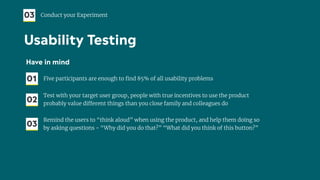
03 Conduct your Experiment
Usability Testing
Have in mind
01 Five participants are enough to find 85% of all usability problems
02
Test with your target user group, people with true incentives to use the product
probably value different things than you close family and colleagues do
03
Remind the users to “think aloud” when using the product, and help them doing so
by asking questions - “Why did you do that?” “What did you think of this button?”
03 Conduct your Experiment
Usability Testing
01 Define your Hypothesis
02 Define your Experiment
03 Conduct your Experiment
04 Analyse, Share and Act on your Result
The Validation Process
Validating hypotheses with user research

Validating hypotheses with user research

  • 1.
  • 2.
    UX Agency for nextgeneration companies
  • 3.
  • 4.
    3. Not theright team 23%
  • 5.
    2. Ran outof cash 29%
  • 6.
    1. No marketneed 42%
  • 7.
    What can wedo different?
  • 8.
    What jobs dothey want to accomplish? In what context? What pains do they have? What gains do they want? How frequent do they want to preform the job? What did they do before? What happened after? What did they switch from? Why? Understanding your users…
  • 9.
  • 10.
    How do youvalidate your hypothesis?
  • 11.
    01 Define yourHypothesis 02 Define your Experiment 03 Conduct your Experiment 04 Analyse, Share and Act on your Result The Validation Process
  • 12.
    What do youwant to validate? Desirability - “Do they want this?” Feasibility - “Can we do this?” Viability - “Should we do this?” 01 Define your Hypothesis Desirability Feasibility Viability
  • 13.
    “We believe that…” ✅ Testable ✅ Precise ✅ Focused 01 Define your Hypothesis Define your hypothesis We believe that our users will spend more time on a video if they can engage with the creator in a chat
  • 14.
    ✅ Hypothesis -“We believe that …” ✅ Experiment method - “To verify that, we will …” ✅ Measurement method - “And measure …” ✅ Success Criteria - “We are right if …” 02 Define your Experiment Define your experiment Credit: Ryan Yosua
  • 15.
    Picking the right experimentmethod 02 Define your Experiment (Experiment Method)
  • 16.
    02 Define yourExperiment (Experiment Method) What Users Do Observational Research What Users Say Attitudinal Research Direct Contact with Users Qualitative Research Indirect Contact with Users Quantitative Research
  • 17.
    02 Define yourExperiment (Experiment Method) What Users Do Observational Research What Users Say Attitudinal Research 👍 Great if you want to find out if you product is findable, understandable, usable. 👍 Great to see if your users are actually committing to what they tell you 👎 Might miss out on the whole picture Direct Contact with Users Qualitative Research Indirect Contact with Users Quantitative Research
  • 18.
    02 Define yourExperiment (Experiment Method) What Users Do Observational Research What Users Say Attitudinal Research Direct Contact with Users Qualitative Research Indirect Contact with Users Quantitative Research 👍 Great for uncovering the needs, pains, gains your users have 👍 Great for understanding why your users preform a job and finding their motivations 👎 Often more time consuming
  • 19.
    02 Define yourExperiment (Experiment Method) What Users Do Observational Research What Users Say Attitudinal Research 👍 Great for going deeper into areas of interest 👍 Gives you the possibility to be flexible and adjust to get better insights 👎 Time consuming before/during/after Direct Contact with Users Qualitative Research Indirect Contact with Users Quantitative Research
  • 20.
    02 Define yourExperiment (Experiment Method) What Users Do Observational Research What Users Say Attitudinal Research 👍 Can be automated and scalable 👍 Can be used for more reliable comparisons over time 👎 Leaving out the ‘why’ and underlaying needs Direct Contact with Users Qualitative Research Indirect Contact with Users Quantitative Research
  • 21.
    02 Define yourExperiment (Experiment Method) What Users Do Observational Research What Users Say Attitudinal Research • Field Studies • Usability Test • Benchmark • Recordings • A/B Testing • Analytics • Heatmap • Click Analysis • Interviews • Focus Groups • Participatory design • Customer Feedback • Surveys • Diary Studies • Card Sorting • Concept Testing • Surveys • NPS • Desirability Studies Direct Contact with Users Qualitative Research Indirect Contact with Users Quantitative Research
  • 22.
    02 Define yourExperiment (Experiment Method) What Users Do Observational Research What Users Say Attitudinal Research • Field Studies • Usability Test • Benchmark • Recordings • A/B Testing • Analytics • Heatmap • Click Analysis • Interviews • Focus Groups • Participatory design • Customer Feedback • Surveys • Diary Studies • Card Sorting • Concept Testing • Surveys • NPS • Desirability Studies Use if you want to understand what is most important to your users and why that is in a certain experience. Direct Contact with Users Qualitative Research Indirect Contact with Users Quantitative Research
  • 23.
    02 Define yourExperiment (Experiment Method) What Users Do Observational Research What Users Say Attitudinal Research Why & What to fix Qualitative Research • Field Studies • Usability Test • Benchmark • Recordings • A/B Testing • Analytics • Heatmap • Click Analysis • Interviews • Focus Groups • Participatory design • Customer Feedback • Surveys • Diary Studies • Card Sorting • Concept Testing • Surveys • NPS • Desirability Studies Use if you want to gain understanding in what users do when performing a task or job Indirect Contact with Users Quantitative Research
  • 24.
    02 Define yourExperiment (Experiment Method) What Users Do Observational Research What Users Say Attitudinal Research • Field Studies • Usability Test • Benchmark • Recordings • A/B Testing • Analytics • Heatmap • Click Analysis • Interviews • Focus Groups • Participatory design • Customer Feedback • Surveys • Diary Studies • Card Sorting • Concept Testing • Surveys • NPS • Desirability Studies Use if you want to understand how users group information and what mental models they have Direct Contact with Users Qualitative Research Indirect Contact with Users Quantitative Research
  • 25.
  • 26.
    02 Define yourExperiment (Experiment Method) What Users Do Observational Research What Users Say Attitudinal Research • Field Studies • Usability Test • Benchmark • Recordings • A/B Testing • Analytics • Heatmap • Click Analysis • Interviews • Focus Groups • Participatory design • Customer Feedback • Surveys • Diary Studies • Card Sorting • Concept Testing • Surveys • NPS • Desirability Studies Direct Contact with Users Qualitative Research Indirect Contact with Users Quantitative Research
  • 27.
    Why should Ido Interviews? When you need qualitative insights into your users needs, pains, gains, and what jobs that they want to accomplish. Conducting interviews are great ways to validate desirability and viability hypothesis. What do I need? 1. Vetted Interviewees (your target users), booked times and location 2. Written script with focused questions 3. Assigned Interviewers and notetakers 02 Define your Experiment Interview
  • 28.
    • Find andvet Interviewees • Book time slots and send invitations • Write a script • Invite a co-worker as a notetaker Before During After • Debrief after each interview • Synthesise the notes and group insights • Share results throughout the organisation • Act on the result (validated or invalidated) • Ask questions and be flexible with the script • Capture what the user is saying and their emotions 03 Conduct your Experiment Interview
  • 29.
    Tools to use PingPong- Focuses specifically on moderated remote user research. Recruit from their pool of 10k+ testers or use your own users. Lookback - Lets you see how your users are navigating your test in real time or in recorded sessions. Zoom & Google Meet - With the ability to record these conferencing softwares are also great for user interviews. 03 Conduct your Experiment Interview
  • 30.
    Have in mind 01Everyone’s time is at a premium right now — don’t waste your users’ time 02 If you have one hour with the participant, plan for research for just 45 minutes 03 If you can’t bring a colleague that can take notes then use a software where you can record the session 03 Conduct your Experiment Interview
  • 31.
    Why should Ido Surveys? When you need attitudinal data from a big number of users, for example how they rank different features in your service. Keep in mind that the data can be kind of shallow, and that survey is a method you should combine with other methods. What do I need? 1. Vetted users (your target users) 2. Simple and focused questions 3. Survey tool 02 Define your Experiment Survey
  • 32.
    • Consider thetype of participants and how they will be invited to the survey • Consider types of questions (open or closed) • For longer surveys incentives can be needed (like the possibility to win a gift card or similar) Before During After • Keep track of responses • Thank the participants (and give them the incentive if applied) • Evaluate the survey results • Summarise the results and share within your organisation • Act on the result (validated or invalidated) 03 Conduct your Experiment Survey
  • 33.
    Recommended tools • GoogleForms • Typeform • Surveymonkey • Hotjar 03 Conduct your Experiment Survey
  • 34.
    Have in mind 01Keep the questions simple and direct 02 Make the survey short, or else there will be a drop off in response rate 03 Be careful when you analyze the data - people might interpret the same question differently 03 Conduct your Experiment Survey
  • 35.
    Why should Ido Usability Testing? Identify usability improvements before the design gets coded, to save valuable time and money. You can also evaluate current features to see how they work - too many companies have usability problems they are unaware of. What do I need? 1. Vetted users (your target users) 2. Testing plan 3. Tool for remote usability testing 02 Define your Experiment Usability Testing
  • 36.
    • Recruit participants •Make a testing plan • Set up and invite participants to online tool Before During • Record the session • Make the user feel comfortable • Make sure you’re testing the product, not the user After • Debrief with your colleagues working in the same project • Look through the recordings and highlight patterns 03 Conduct your Experiment Usability Testing
  • 37.
    Tools to use Usabilityhub- A range of different unmoderated methods such as click analysis and preference tests. Usertesting - One of the most popular tools that let you both recruit and conduct research. PingPong - Focuses specifically on moderated remote user research. Recruit from their pool of 10k+ testers or use your own users. Lookback - Lets you see how your users are navigating your test in real time or in recorded sessions. 03 Conduct your Experiment Usability Testing
  • 38.
    Have in mind 01Five participants are enough to find 85% of all usability problems 02 Test with your target user group, people with true incentives to use the product probably value different things than you close family and colleagues do 03 Remind the users to “think aloud” when using the product, and help them doing so by asking questions - “Why did you do that?” “What did you think of this button?” 03 Conduct your Experiment Usability Testing
  • 39.
    01 Define yourHypothesis 02 Define your Experiment 03 Conduct your Experiment 04 Analyse, Share and Act on your Result The Validation Process