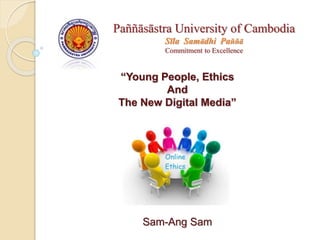
“Young People, Ethics
And
The New Digital Media”
Sam-Ang Sam
Paññāsāstra University of Cambodia
Sīla Samādhi Paññā
Commitment to Excellence
BOOK CONTENTS
1 Introduction
2 The “Good Play”
Approach
3 Ethical Fault Lines in
the New Digital Media
4 Conclusion
CHAPTER CONTENTS
1 Introduction
1.1 TVNewser
1.2 Global Kids
1.3 Lonelygirl15
1.4 The Digital Public
1.5 Speech in the
Blogsphere
1.6 New Digital Frontiers
Terminology
 Cyberspace: The visual realm in
which interactive activities take
place.
 Dialogical: Online liberation on
Gather.com, for example.
 Frontiers: Open spaces; they
often lack comprehensive and well-
enforced rules & regulations and
thus harbor both tremendous
promises and significant perils.
Terminology
 Interactive: Such as multiplayer
as opposed to single-player
games.
 Internet (The): The visual realm
in which interactive activities
take place.
Terminology
 New Digital Media (NDM) (New
Media): The actual technologies
that people use to connect with
one another—including mobile
phones, personal digital assistants
(PDAs), game consoles, and
computers connected to the
Internet.
 Online: The visual realm in which
interactive activities take place.
Terminology
 Participatory: User-contributed
content, such as videos posted
on YouTube.
 Participatory Culture: A culture
of creation and sharing,
mentorship, and civic
engagement that is emerging
online, especially among teens.
Terminology
 Participatory Culture: A culture with
relatively low barriers to artistic
expression and civic engagement, strong
support for creating and sharing one’s
creations, and some type of informal
mentorship whereby what is known by
the most experienced is passed along to
novices. A participatory culture is also
one in which members believe their
contributions matter, and feel some
degree of social connection with one
another (at the least, they care what
other people think about what they have
created).
Terminology
 Web 2.0: The 2nd generation
Internet technologies that
permit, indeed invite, people to
create, share, and modify online
content (Carrie James et al.,
2009, p. 6).
1 Introduction
“PARTICIPATORY CULTURE”
 “Participatory Culture” is a culture of creation
and sharing, mentorship, and civic
engagement that is emerging online,
especially among teens (Media scholar H.
Jenkins (2006) in Carrie James et al., 2009, p.
1).
 When Time magazine declared its 2006
Person of the Year to be “You,” the magazine
was pointing to an undeniable reality: anyone
with an Internet connection can be a reporter,
political commentator, cultural critic, or media
producer (ibid.).
Introduction
 Although Time did not explicitly
frame participation in the new
media as a youth phenomenon,
most of the 15 “citizens of digital
democracy” who were featured
in its December 13 article
(Grossman 2006) were under
the age of 35 (Carrie James et
al., 2009, p. 1).
Introduction
1.1 TVNewser
 In 2004, Brian Stelter, then a
sophomore communications major at
Towson University, started a blog
called “TVNewser” that provides an
ongoing, detailed record of ratings,
gossip, and events in the news
media industry.
 Over the past 3 years, “TVNewser”
has become a chief source of
information for news industry
executives.
Introduction
 His youth and lack of
credentials notwithstanding,
Stelter is considered an
extremely credible source.
 After graduating from college,
Stelter was hired as a media
reporter for the New York Times
(Carrie James et al., 2009, p. 2).
Introduction
1.2 GLOBAL KIDS
 Global Kids
(http://www.globalkids.org) is a New
York-based organization that is
“committed to transforming urban
youth into successful students as
well as global and community
leaders.”
 In 2000, Global Kids launched an
online Leadership Program (OLP)
through which simultaneously build
technical, new media literacy,
leadership, and civic engagement
skills. (Carrie James et al., 2009, p.
Introduction
 Yet, for every digital superkid
and for every example of good
citizenship online, there seem to
be more examples of
(intentional or naïve) misuses—
or at least ethically ambiguous
uses—of digital media. (Carrie
James et al., 2009, p. 2).
Introduction
1.3 LONELYGIRL15
 In June 2006, a series of video
blogs posted on YouTube by a
teenager called Lonelygirl15 began
to capture a wide audience.
 The video depicted a 16-year-old
girl named Bree talking about her
day-to-day existence, including her
experiences being homeschooled
and raised by strict, religious
parents. (Carrie James et al.,
2009, pp. 2-3).
Introduction
 After several months, Bree
was revealed to be Jessica
Rose, a 20-something-
actress who was working
with several filmmaker
friends to produce the video
series. (Carrie James et al.,
2009, p. 3).
Introduction
1.4 THE DIGITAL PUBLIC
 Aleksey Vayner, a senior at Yale
University in 2006, became infamous
after he submitted a résumé to the
investment bank USB.
 Included with the résumé was his online,
self-made video titled “Impossible Is
Nothing,” which appeared to be a record
of Vayner’s diverse talents and depicted
him performing a variety of skills such as
ballroom dancing and extreme
weightlifting. (Carrie James et al., 2009,
Introduction
 The video link was circulated by
email within the bank and soon
beyond it.
 After it began making headlines in
the blogsphere and in major
newspapers, questions were raised
about the authenticity of some of the
footage.
 Vayner subsequently sought legal
advice for what he considered to be
an invasion of privacy. (Carrie
Introduction
1.5 SPEECH IN THE BLOGSPHERE
 On April 6, 2007, a technical writer
and prominent blogger, Kathy Sierra,
published an entry on her blog
entitled “Death Threats against
Bloggers Are NOT ‘Protected
Speech.’”
 For several weeks, Sierra had
received anonymous violent
comments and death threats on her
own blog and on 2 other blogs.
(Carrie James et al., 2009, p. 3).
Introduction
 Following Sierra’s alarming post, a
heated controversy about the
Ethics of Speech unfolded in the
blogsphere.
 Calls for a blogger’s Code of
Conduct were met with angry
protests that indicated how deeply
many participants cherish the
openness and freedoms of
cyberspace. (Carrie James et al.,
2009, p. 3).
Introduction
 Ever since technical technologies
were made widely available,
scholars, educators, policymakers,
and parents have been debating
their implications for young
people’s literacy, attention spans,
social tolerance, and propensity
(tendency; inclination) for
aggression.
 Considerable strides are now
being made in scholarship in many
of these areas. (Carrie James et
Introduction
 The educational benefits of
video games, for example, are
being convincingly documented
by scholars such as Gee
(2003), Johnson (2005), and
Shaffer (2006).
 At the same time, debates
persist about the relationship
between video games and
violence. (Carrie James et al.,
2009, p. 4).
Introduction
 Concerns about ethical issues in the
new media have also been
expressed by journalists, politicians,
ideologues, and educators but have
received less attention from scholars.
 In response to concerns about online
predators, illegal downloading, and
imprudent posting of content online,
a number of cybersafety initiatives
have emerged online and in schools
around the country. (Carrie James et
al., 2009, p. 4).
Introduction
 The Ad Council’s YouTube videos
entitled “Think before You Post”
seek to “to make teen girls aware
of the potential dangers of
sharing and posting personal
information online and of
communicating with unfamiliar
people to help reduce their risk
of sexual victimization and
abduction” (Ad Council 2007).
(Carrie James et al., 2009, p. 4).
Introduction
 Youth-driven outreach groups and
anticyberbullying campaigns, such
as Teenangels and StandUP!, are
making their way into schools.
 Somewhat surprising though,
objective, research-based
accounts of the ethical issues
raised by the new digital media
are scarce. (Carrie James et al.,
2009, p. 4).
Introduction
 This report attempts to fill this gap.
 Some of the digital media’s fault lines that we have
scrutinized are the nature of personal identities
that are being formed online; the fate of personal
privacy in an environment where diverse types of
information can be gleaned and disseminated; the
meaning of authorship in spaces where multiple,
anonymous contributors produce knowledge; the
status of intellectual and other forms of property
that are easily accessible by a broad public; the
ways in which individuals (both known and
anonymous) interact and treat one another in
cyberspace; and the credibility and trustworthiness
of individuals, organizations, and causes that are
regularly trafficking on the Internet (Carrie James
et al., 2009, pp. 4-5).
Introduction
 Five core issues are salient in
the new media:
1. Identity
2. Privacy
3. Ownership & authorship
4. Credibility
5. Participation (Carrie James et
al., 2009, p. 5).
Introduction
 These issues have long been considered
important offline as well.
 Yet in digital spaces, these issues may
carry new or at least distinct ethical
stakes.
 It seems critical to ask whether the new
digital media are giving rise to new
mental models—new “ethical minds”—
with respect to identity, privacy,
ownership & authorship, credibility,
and participation, and whether the new
digital media require a conceptualization
of these issues and the ethical potentials
they carry. (Carrie James et al., 2009, p.
5).
Introduction
 The 5 themes explored here
are ethically significant in the
digital age, but they are not
necessarily the final
defining ethical fault lines
of this age (Carrie James et
al., 2009, p. 5).
Introduction
1.6 NEW DIGITAL FRONTIERS
 The New Digital Media (NDM)
have ushered in a new and
essentially unlimited set of
frontiers.
 Frontiers are open spaces: They
often lack comprehensive and well-
enforced rules & regulations and
thus harbor both tremendous
promises and significant perils.
(Carrie James et al., 2009, p. 6).
Introduction
 On the promising side, the New Digital
Media permit and encourage “Participatory
Culture.”
 As Henry Jenkins and colleagues define it, “A
participatory culture is a culture with relatively
low barriers to artistic expression and civic
engagement, strong support for creating and
sharing one’s creations, and some type of
informal mentorship whereby what is known
by the most experienced is passed along to
novices. A participatory culture is also one in
which members believe their contributions
matter, and feel some degree of social
connection with one another (at the least, they
care what other people think about what they
have created)” (Jenkins et al. (2006, p. 3) in
Carrie James et al., 2009, p. 7).
Introduction
 If leveraged properly, the
Internet can be a powerful tool
for promoting social
responsibility.
 The new media’s capabilities to
promote evil might be in equal
proportion to their capacities to
promote good. (Carrie James et
al., 2009, pp. 7-8).
Introduction
 There are innumerable ways—some
barely conceivable—for the dishonest
to penetrate harms and, in turn, for the
innocent to be victimized.
 The potentials and perils of the new
digital media are reflected in opposing
discourses described as “digital faith”
and “moral panics.” (Carrie James et
al., 2009, p. 8).
Introduction
 Optimist Moore (2003) points to
the “worldwide peace campaign” of
millions of interconnected people
who are working for social issues
and human rights as a “beautiful”
example of “emerging democracy”
in cyberspace, while skeptic Keen
describes the Internet as “a
chaotic human arrangement
with few, if any, formal social
pacts.” (Carrie James et al., 2009,
p. 8).
Introduction
 These disputes echo those that
have raged for decades (if not
longer) about traditional media,
especially with respect to effects
on children. (Carrie James et
al., 2009, p. 8).
Introduction
 Yet, the new media may pose
qualitatively different risks and
opportunities.
 The reality is that most online
situations are rich with promises
and risks, both of which often
carry ethical consequences.
(Carrie James et al., 2009, p. 8).
Introduction
 Like all frontiers, cyberspace will
eventually be regulated in some
fashion, but it is unclear how
regulation will occur and who will
gain and who will lose from the
regulation.
 The blogger’s Code of Conduct
(2007) and the Deleting Online
Predators Act (2006) are recent
efforts in the direction of regulation
that take two different tacks.
(Carrie James et al., 2009, p. 8).
Introduction
 The former, created by bloggers
themselves, establishes
guidelines for conduct; the
latter, a bill introduced by
legislators, restricts young
people’s access to social
networking and other interactive
sites (Carrie James et al., 2009,
pp. 8-9).
Introduction
 Moreover, because commercial
interests have an ever-growing
presence in digital spaces, the extent to
which market forces will have a hand in
regulation and the ethical implications of
their involvement need to be considered.
 Now is the time to ask what a regulated
World Wide Web would look like and how
we can retain the openness and socially
positive potentials of the new digital
media while restraining unethical
conduct. (Carrie James et al., 2009, p. 9).
Introduction
 We believe that such a balance
cannot be struck without a nuanced
understanding of the distinct ethical
fault lines in these rapidly evolving
frontiers.
 Yet, understanding is but a first
step.
 Ultimately, for the promises of the
new digital media to be positively
realized, supports for ethical
participation—indeed for the
creation of “ethical minds”—must
emerge. (Carrie James et al., 2009,
p. 9).
References
James, Carrie, Davis, Katie, Flores,
Andrea,
Francis, John, Pettingill, Linsay,
Rundle, Margaret, and Gardner,
Howard. (2009). Young People, Ethics,
and the New Digital Media.
Cambridge, MA: The MIT Press.
Document File Location
File:
ETHICS_JOURNALISM/YRM_introduction_(L1).pptx
Date: December 19, 2013
Course: Journalistic Principles and Ethics (ENGL
403)

L5 yem introduction

  • 1.
    “Young People, Ethics And TheNew Digital Media” Sam-Ang Sam Paññāsāstra University of Cambodia Sīla Samādhi Paññā Commitment to Excellence
  • 2.
    BOOK CONTENTS 1 Introduction 2The “Good Play” Approach 3 Ethical Fault Lines in the New Digital Media 4 Conclusion
  • 3.
    CHAPTER CONTENTS 1 Introduction 1.1TVNewser 1.2 Global Kids 1.3 Lonelygirl15 1.4 The Digital Public 1.5 Speech in the Blogsphere 1.6 New Digital Frontiers
  • 4.
    Terminology  Cyberspace: Thevisual realm in which interactive activities take place.  Dialogical: Online liberation on Gather.com, for example.  Frontiers: Open spaces; they often lack comprehensive and well- enforced rules & regulations and thus harbor both tremendous promises and significant perils.
  • 5.
    Terminology  Interactive: Suchas multiplayer as opposed to single-player games.  Internet (The): The visual realm in which interactive activities take place.
  • 6.
    Terminology  New DigitalMedia (NDM) (New Media): The actual technologies that people use to connect with one another—including mobile phones, personal digital assistants (PDAs), game consoles, and computers connected to the Internet.  Online: The visual realm in which interactive activities take place.
  • 7.
    Terminology  Participatory: User-contributed content,such as videos posted on YouTube.  Participatory Culture: A culture of creation and sharing, mentorship, and civic engagement that is emerging online, especially among teens.
  • 8.
    Terminology  Participatory Culture:A culture with relatively low barriers to artistic expression and civic engagement, strong support for creating and sharing one’s creations, and some type of informal mentorship whereby what is known by the most experienced is passed along to novices. A participatory culture is also one in which members believe their contributions matter, and feel some degree of social connection with one another (at the least, they care what other people think about what they have created).
  • 9.
    Terminology  Web 2.0:The 2nd generation Internet technologies that permit, indeed invite, people to create, share, and modify online content (Carrie James et al., 2009, p. 6).
  • 10.
    1 Introduction “PARTICIPATORY CULTURE” “Participatory Culture” is a culture of creation and sharing, mentorship, and civic engagement that is emerging online, especially among teens (Media scholar H. Jenkins (2006) in Carrie James et al., 2009, p. 1).  When Time magazine declared its 2006 Person of the Year to be “You,” the magazine was pointing to an undeniable reality: anyone with an Internet connection can be a reporter, political commentator, cultural critic, or media producer (ibid.).
  • 11.
    Introduction  Although Timedid not explicitly frame participation in the new media as a youth phenomenon, most of the 15 “citizens of digital democracy” who were featured in its December 13 article (Grossman 2006) were under the age of 35 (Carrie James et al., 2009, p. 1).
  • 12.
    Introduction 1.1 TVNewser  In2004, Brian Stelter, then a sophomore communications major at Towson University, started a blog called “TVNewser” that provides an ongoing, detailed record of ratings, gossip, and events in the news media industry.  Over the past 3 years, “TVNewser” has become a chief source of information for news industry executives.
  • 13.
    Introduction  His youthand lack of credentials notwithstanding, Stelter is considered an extremely credible source.  After graduating from college, Stelter was hired as a media reporter for the New York Times (Carrie James et al., 2009, p. 2).
  • 14.
    Introduction 1.2 GLOBAL KIDS Global Kids (http://www.globalkids.org) is a New York-based organization that is “committed to transforming urban youth into successful students as well as global and community leaders.”  In 2000, Global Kids launched an online Leadership Program (OLP) through which simultaneously build technical, new media literacy, leadership, and civic engagement skills. (Carrie James et al., 2009, p.
  • 15.
    Introduction  Yet, forevery digital superkid and for every example of good citizenship online, there seem to be more examples of (intentional or naïve) misuses— or at least ethically ambiguous uses—of digital media. (Carrie James et al., 2009, p. 2).
  • 16.
    Introduction 1.3 LONELYGIRL15  InJune 2006, a series of video blogs posted on YouTube by a teenager called Lonelygirl15 began to capture a wide audience.  The video depicted a 16-year-old girl named Bree talking about her day-to-day existence, including her experiences being homeschooled and raised by strict, religious parents. (Carrie James et al., 2009, pp. 2-3).
  • 17.
    Introduction  After severalmonths, Bree was revealed to be Jessica Rose, a 20-something- actress who was working with several filmmaker friends to produce the video series. (Carrie James et al., 2009, p. 3).
  • 18.
    Introduction 1.4 THE DIGITALPUBLIC  Aleksey Vayner, a senior at Yale University in 2006, became infamous after he submitted a résumé to the investment bank USB.  Included with the résumé was his online, self-made video titled “Impossible Is Nothing,” which appeared to be a record of Vayner’s diverse talents and depicted him performing a variety of skills such as ballroom dancing and extreme weightlifting. (Carrie James et al., 2009,
  • 19.
    Introduction  The videolink was circulated by email within the bank and soon beyond it.  After it began making headlines in the blogsphere and in major newspapers, questions were raised about the authenticity of some of the footage.  Vayner subsequently sought legal advice for what he considered to be an invasion of privacy. (Carrie
  • 20.
    Introduction 1.5 SPEECH INTHE BLOGSPHERE  On April 6, 2007, a technical writer and prominent blogger, Kathy Sierra, published an entry on her blog entitled “Death Threats against Bloggers Are NOT ‘Protected Speech.’”  For several weeks, Sierra had received anonymous violent comments and death threats on her own blog and on 2 other blogs. (Carrie James et al., 2009, p. 3).
  • 21.
    Introduction  Following Sierra’salarming post, a heated controversy about the Ethics of Speech unfolded in the blogsphere.  Calls for a blogger’s Code of Conduct were met with angry protests that indicated how deeply many participants cherish the openness and freedoms of cyberspace. (Carrie James et al., 2009, p. 3).
  • 22.
    Introduction  Ever sincetechnical technologies were made widely available, scholars, educators, policymakers, and parents have been debating their implications for young people’s literacy, attention spans, social tolerance, and propensity (tendency; inclination) for aggression.  Considerable strides are now being made in scholarship in many of these areas. (Carrie James et
  • 23.
    Introduction  The educationalbenefits of video games, for example, are being convincingly documented by scholars such as Gee (2003), Johnson (2005), and Shaffer (2006).  At the same time, debates persist about the relationship between video games and violence. (Carrie James et al., 2009, p. 4).
  • 24.
    Introduction  Concerns aboutethical issues in the new media have also been expressed by journalists, politicians, ideologues, and educators but have received less attention from scholars.  In response to concerns about online predators, illegal downloading, and imprudent posting of content online, a number of cybersafety initiatives have emerged online and in schools around the country. (Carrie James et al., 2009, p. 4).
  • 25.
    Introduction  The AdCouncil’s YouTube videos entitled “Think before You Post” seek to “to make teen girls aware of the potential dangers of sharing and posting personal information online and of communicating with unfamiliar people to help reduce their risk of sexual victimization and abduction” (Ad Council 2007). (Carrie James et al., 2009, p. 4).
  • 26.
    Introduction  Youth-driven outreachgroups and anticyberbullying campaigns, such as Teenangels and StandUP!, are making their way into schools.  Somewhat surprising though, objective, research-based accounts of the ethical issues raised by the new digital media are scarce. (Carrie James et al., 2009, p. 4).
  • 27.
    Introduction  This reportattempts to fill this gap.  Some of the digital media’s fault lines that we have scrutinized are the nature of personal identities that are being formed online; the fate of personal privacy in an environment where diverse types of information can be gleaned and disseminated; the meaning of authorship in spaces where multiple, anonymous contributors produce knowledge; the status of intellectual and other forms of property that are easily accessible by a broad public; the ways in which individuals (both known and anonymous) interact and treat one another in cyberspace; and the credibility and trustworthiness of individuals, organizations, and causes that are regularly trafficking on the Internet (Carrie James et al., 2009, pp. 4-5).
  • 28.
    Introduction  Five coreissues are salient in the new media: 1. Identity 2. Privacy 3. Ownership & authorship 4. Credibility 5. Participation (Carrie James et al., 2009, p. 5).
  • 29.
    Introduction  These issueshave long been considered important offline as well.  Yet in digital spaces, these issues may carry new or at least distinct ethical stakes.  It seems critical to ask whether the new digital media are giving rise to new mental models—new “ethical minds”— with respect to identity, privacy, ownership & authorship, credibility, and participation, and whether the new digital media require a conceptualization of these issues and the ethical potentials they carry. (Carrie James et al., 2009, p. 5).
  • 30.
    Introduction  The 5themes explored here are ethically significant in the digital age, but they are not necessarily the final defining ethical fault lines of this age (Carrie James et al., 2009, p. 5).
  • 31.
    Introduction 1.6 NEW DIGITALFRONTIERS  The New Digital Media (NDM) have ushered in a new and essentially unlimited set of frontiers.  Frontiers are open spaces: They often lack comprehensive and well- enforced rules & regulations and thus harbor both tremendous promises and significant perils. (Carrie James et al., 2009, p. 6).
  • 32.
    Introduction  On thepromising side, the New Digital Media permit and encourage “Participatory Culture.”  As Henry Jenkins and colleagues define it, “A participatory culture is a culture with relatively low barriers to artistic expression and civic engagement, strong support for creating and sharing one’s creations, and some type of informal mentorship whereby what is known by the most experienced is passed along to novices. A participatory culture is also one in which members believe their contributions matter, and feel some degree of social connection with one another (at the least, they care what other people think about what they have created)” (Jenkins et al. (2006, p. 3) in Carrie James et al., 2009, p. 7).
  • 33.
    Introduction  If leveragedproperly, the Internet can be a powerful tool for promoting social responsibility.  The new media’s capabilities to promote evil might be in equal proportion to their capacities to promote good. (Carrie James et al., 2009, pp. 7-8).
  • 34.
    Introduction  There areinnumerable ways—some barely conceivable—for the dishonest to penetrate harms and, in turn, for the innocent to be victimized.  The potentials and perils of the new digital media are reflected in opposing discourses described as “digital faith” and “moral panics.” (Carrie James et al., 2009, p. 8).
  • 35.
    Introduction  Optimist Moore(2003) points to the “worldwide peace campaign” of millions of interconnected people who are working for social issues and human rights as a “beautiful” example of “emerging democracy” in cyberspace, while skeptic Keen describes the Internet as “a chaotic human arrangement with few, if any, formal social pacts.” (Carrie James et al., 2009, p. 8).
  • 36.
    Introduction  These disputesecho those that have raged for decades (if not longer) about traditional media, especially with respect to effects on children. (Carrie James et al., 2009, p. 8).
  • 37.
    Introduction  Yet, thenew media may pose qualitatively different risks and opportunities.  The reality is that most online situations are rich with promises and risks, both of which often carry ethical consequences. (Carrie James et al., 2009, p. 8).
  • 38.
    Introduction  Like allfrontiers, cyberspace will eventually be regulated in some fashion, but it is unclear how regulation will occur and who will gain and who will lose from the regulation.  The blogger’s Code of Conduct (2007) and the Deleting Online Predators Act (2006) are recent efforts in the direction of regulation that take two different tacks. (Carrie James et al., 2009, p. 8).
  • 39.
    Introduction  The former,created by bloggers themselves, establishes guidelines for conduct; the latter, a bill introduced by legislators, restricts young people’s access to social networking and other interactive sites (Carrie James et al., 2009, pp. 8-9).
  • 40.
    Introduction  Moreover, becausecommercial interests have an ever-growing presence in digital spaces, the extent to which market forces will have a hand in regulation and the ethical implications of their involvement need to be considered.  Now is the time to ask what a regulated World Wide Web would look like and how we can retain the openness and socially positive potentials of the new digital media while restraining unethical conduct. (Carrie James et al., 2009, p. 9).
  • 41.
    Introduction  We believethat such a balance cannot be struck without a nuanced understanding of the distinct ethical fault lines in these rapidly evolving frontiers.  Yet, understanding is but a first step.  Ultimately, for the promises of the new digital media to be positively realized, supports for ethical participation—indeed for the creation of “ethical minds”—must emerge. (Carrie James et al., 2009, p. 9).
  • 42.
    References James, Carrie, Davis,Katie, Flores, Andrea, Francis, John, Pettingill, Linsay, Rundle, Margaret, and Gardner, Howard. (2009). Young People, Ethics, and the New Digital Media. Cambridge, MA: The MIT Press.
  • 43.
    Document File Location File: ETHICS_JOURNALISM/YRM_introduction_(L1).pptx Date:December 19, 2013 Course: Journalistic Principles and Ethics (ENGL 403)