Present Perfect
or
Past Simple
part 2
A: I’ve lost my keys.
‘A’ has some problems.
What are they?
A: I’ve lost my keys.
B: Oh! How did you lose them?
A: This morning, I tripped going
downstairs. I dropped my bag and
when I picked it up some things
fell out of my pocket. I think I lost
my keys then.
A: I’ve lost my keys.
B: Oh! How did you lose them?
A: This morning, I tripped going
downstairs. I dropped my bag and
when I picked it up some things
fell out of my pocket. I think I lost
my keys then.
A: I’ve lost my keys.
B: Oh! How did you lose them?
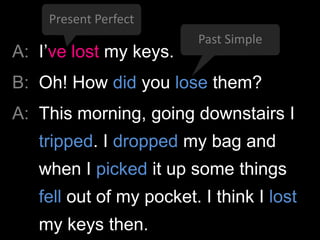
A: This morning, going downstairs I
tripped. I dropped my bag and
when I picked it up some things
fell out of my pocket. I think I lost
my keys then.
Present Perfect
Past Simple
A: I’ve lost my keys.
B: Oh! How did you lose them?
A: This morning, I tripped going
downstairs. I dropped my bag and
when I picked it up some things
fell out of my pocket. I think I lost
them then.
recent past
narrative time
Itrippedgoing
downstairs
Idroppedmybag
Ipickeditup
somethingsfell
outofmypocket
Ilostmykeysthen
Itrippedgoing
downstairs
Idroppedmybag
Ipickeditup
somethingsfell
outofmypocket
Ilostmykeysthen
Itrippedgoing
downstairs
Idroppedmybag
Ipickeditup
somethingsfell
outofmypocket
Ilostmykeysthen
‘narrative time’ is portable
I think the time in a narrative is
like the space in a picture:
it only exists inside its container
A: I’ve lost my keys.
B: Oh! How did you lose them?
A: This morning, I tripped going
downstairs. I dropped my bag and
when I picked it up some things
fell out of my pocket. I think I lost
my keys then.
A: I lost my keys.
A: I lost my keys.
Do we know what
happened next?
A: I lost my keys.
I looked everywhere. In the end I
had to call the locksmith.
or
A: I lost my keys.
But I found them again after 5
minutes—they were in my pocket!
A: I lost my keys.
Do we know what
happened next?
No!
In a narrative we
must wait for the
next verb.
compare
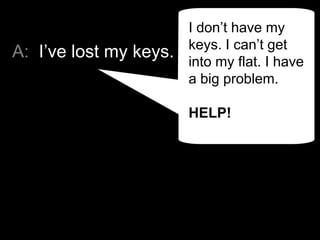
A: I’ve lost my keys.
I don’t have my
keys. I can’t get
into my flat. I have
a big problem.
HELP!
A: I’ve lost my keys.
I don’t have my
keys. I can’t get
into my flat. I have
a big problem.
HELP!
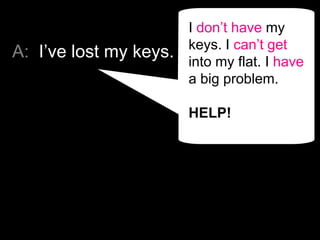
A: I’ve lost my keys.
I don’t have my
keys. I can’t get
into my flat. I have
a big problem.
HELP!
There’s a
‘present
consequence’
to the Present
Perfect for the
recent past
1st RULE
Use the Present Perfect to
announce news.
Use the Past Simple to tell the story
of the news.
A: I’ve lost my keys.
B: Oh! How did you lose them?
A: This morning, I tripped going
downstairs. I dropped my bag and
when I picked it up some things
fell out of my pocket. I think I lost
my keys then.
Ho perso le chiavi.
Le ho perse allora?
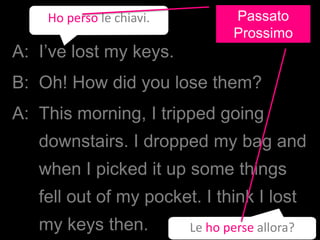
A: I’ve lost my keys.
B: Oh! How did you lose them?
A: This morning, I tripped going
downstairs. I dropped my bag and
when I picked it up some things
fell out of my pocket. I think I lost
my keys then.
Ho perso le chiavi.
Le ho perse allora?
Passato
Prossimo
1st RULE – in translation
Italian uses the Passato Prossimo
both for announcing news and for
(recent)
‘narrative time’.
past simple or present perfect
She [make] a phone call at 3pm.
Look! The President [arrived].
We [not do] the homework for this lesson.
I [never go] to New York.
You [wear] the jacket yesterday?
I’m free. I [finish] all my work.
I [go] there in 2009.
He isn’t here. He [go] to the bar.
You [not watch] the match last night.
You [see] John?
You [see] John when you were at the bar?
past simple or present perfect
She made a phone call at 3pm.
Look! The President has arrived.
We haven’t done the homework for this lesson.
I have never been to New York.
Did you wear the jacket yesterday?
I’m free. I have finished all my work.
I went there in 2009.
He isn’t here. He has gone to the bar.
You didn’t watch the match last night.
Have you seen John?
Did you see John when you were at the bar?
Notice the adverbs
A: I’ve just had a coffee.
a short time ago (+ive)
‘appena’
A: We’ve already seen this film.
no need to repeat (+ive)
‘già’
A: Gianni’s already finished his
homework.
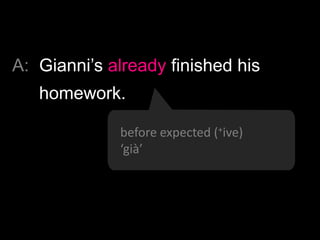
A: Gianni’s already finished his
homework.
before expected (+ive)
‘già’
A: Have you read the
newspaper yet?
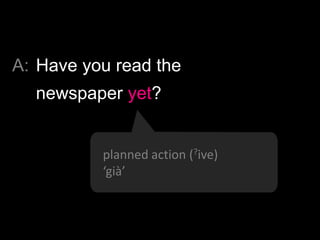
A: Have you read the
newspaper yet?
planned action (?ive)
‘già’
A: We haven’t booked our
holiday yet.
A: We haven’t booked our
holiday yet.
planned action (-ive)
‘ancora’
translate using ‘just’, ‘already’, ‘yet’ and ‘ago’
Ha già fatto la telefonata.
L’abbiamo finito due minuti fa.
L’abbiamo appena finito.
Hai già pranzato?
Abbiamo già letto l’articolo.
(Esso) è appena uscito.
L’abbiamo letto poco fa.
(Lui) è appena andato al bar.
Hai già prenotato la tua vacanza?
Noi non abbiamo prenotato ancora…
…ma John ha già prenotato la sua.
translate using ‘just’, ‘already’, ‘yet’ and ‘ago’
Ha già fatto la telefonata. She has already made the call.
L’abbiamo finito due minuti fa. We finished it two minutes ago.
L’abbiamo appena finito. We’ve just finished it.
Hai già pranzato? Have you had lunch yet?
Abbiamo già letto l’articolo. We’ve already read the article.
(Esso) è appena uscito. It’s just come out.
L’abbiamo letto poco fa. We read it a short time ago.
(Lui) è appena andato al bar. He has just gone to the bar.
Hai già prenotato la tua vacanza? Have you booked your holiday yet?
Noi non abbiamo prenotato ancora… We haven’t booked yet…
…ma John ha già prenotato la sua. …but John has already booked his.
I have had a perfectly
wonderful evening, but
this wasn't it.
www.davidnicholson.it

Present Perfect 2

  • 1.
  • 2.
  • 3.
    A: I’ve lostmy keys. ‘A’ has some problems. What are they?
  • 4.
    A: I’ve lostmy keys. B: Oh! How did you lose them? A: This morning, I tripped going downstairs. I dropped my bag and when I picked it up some things fell out of my pocket. I think I lost my keys then.
  • 5.
    A: I’ve lostmy keys. B: Oh! How did you lose them? A: This morning, I tripped going downstairs. I dropped my bag and when I picked it up some things fell out of my pocket. I think I lost my keys then.
  • 6.
    A: I’ve lostmy keys. B: Oh! How did you lose them? A: This morning, going downstairs I tripped. I dropped my bag and when I picked it up some things fell out of my pocket. I think I lost my keys then. Present Perfect Past Simple
  • 7.
    A: I’ve lostmy keys. B: Oh! How did you lose them? A: This morning, I tripped going downstairs. I dropped my bag and when I picked it up some things fell out of my pocket. I think I lost them then. recent past narrative time
  • 8.
  • 9.
  • 10.
  • 13.
    I think thetime in a narrative is like the space in a picture: it only exists inside its container
  • 14.
    A: I’ve lostmy keys. B: Oh! How did you lose them? A: This morning, I tripped going downstairs. I dropped my bag and when I picked it up some things fell out of my pocket. I think I lost my keys then.
  • 15.
    A: I lostmy keys.
  • 16.
    A: I lostmy keys. Do we know what happened next?
  • 17.
    A: I lostmy keys. I looked everywhere. In the end I had to call the locksmith.
  • 18.
  • 19.
    A: I lostmy keys. But I found them again after 5 minutes—they were in my pocket!
  • 20.
    A: I lostmy keys. Do we know what happened next? No! In a narrative we must wait for the next verb.
  • 21.
  • 22.
  • 23.
    A: I’ve lostmy keys. I don’t have my keys. I can’t get into my flat. I have a big problem. HELP!
  • 24.
    A: I’ve lostmy keys. I don’t have my keys. I can’t get into my flat. I have a big problem. HELP!
  • 25.
    A: I’ve lostmy keys. I don’t have my keys. I can’t get into my flat. I have a big problem. HELP! There’s a ‘present consequence’ to the Present Perfect for the recent past
  • 26.
    1st RULE Use thePresent Perfect to announce news. Use the Past Simple to tell the story of the news.
  • 27.
    A: I’ve lostmy keys. B: Oh! How did you lose them? A: This morning, I tripped going downstairs. I dropped my bag and when I picked it up some things fell out of my pocket. I think I lost my keys then. Ho perso le chiavi. Le ho perse allora?
  • 28.
    A: I’ve lostmy keys. B: Oh! How did you lose them? A: This morning, I tripped going downstairs. I dropped my bag and when I picked it up some things fell out of my pocket. I think I lost my keys then. Ho perso le chiavi. Le ho perse allora? Passato Prossimo
  • 29.
    1st RULE –in translation Italian uses the Passato Prossimo both for announcing news and for (recent) ‘narrative time’.
  • 30.
    past simple orpresent perfect She [make] a phone call at 3pm. Look! The President [arrived]. We [not do] the homework for this lesson. I [never go] to New York. You [wear] the jacket yesterday? I’m free. I [finish] all my work. I [go] there in 2009. He isn’t here. He [go] to the bar. You [not watch] the match last night. You [see] John? You [see] John when you were at the bar?
  • 31.
    past simple orpresent perfect She made a phone call at 3pm. Look! The President has arrived. We haven’t done the homework for this lesson. I have never been to New York. Did you wear the jacket yesterday? I’m free. I have finished all my work. I went there in 2009. He isn’t here. He has gone to the bar. You didn’t watch the match last night. Have you seen John? Did you see John when you were at the bar?
  • 32.
  • 33.
    A: I’ve justhad a coffee.
  • 34.
    A: I’ve justhad a coffee. a short time ago (+ive) ‘appena’
  • 35.
    A: We’ve alreadyseen this film.
  • 36.
    A: We’ve alreadyseen this film. no need to repeat (+ive) ‘già’
  • 37.
    A: Gianni’s alreadyfinished his homework.
  • 38.
    A: Gianni’s alreadyfinished his homework. before expected (+ive) ‘già’
  • 39.
    A: Have youread the newspaper yet?
  • 40.
    A: Have youread the newspaper yet? planned action (?ive) ‘già’
  • 41.
    A: We haven’tbooked our holiday yet.
  • 42.
    A: We haven’tbooked our holiday yet. planned action (-ive) ‘ancora’
  • 43.
    translate using ‘just’,‘already’, ‘yet’ and ‘ago’ Ha già fatto la telefonata. L’abbiamo finito due minuti fa. L’abbiamo appena finito. Hai già pranzato? Abbiamo già letto l’articolo. (Esso) è appena uscito. L’abbiamo letto poco fa. (Lui) è appena andato al bar. Hai già prenotato la tua vacanza? Noi non abbiamo prenotato ancora… …ma John ha già prenotato la sua.
  • 44.
    translate using ‘just’,‘already’, ‘yet’ and ‘ago’ Ha già fatto la telefonata. She has already made the call. L’abbiamo finito due minuti fa. We finished it two minutes ago. L’abbiamo appena finito. We’ve just finished it. Hai già pranzato? Have you had lunch yet? Abbiamo già letto l’articolo. We’ve already read the article. (Esso) è appena uscito. It’s just come out. L’abbiamo letto poco fa. We read it a short time ago. (Lui) è appena andato al bar. He has just gone to the bar. Hai già prenotato la tua vacanza? Have you booked your holiday yet? Noi non abbiamo prenotato ancora… We haven’t booked yet… …ma John ha già prenotato la sua. …but John has already booked his.
  • 45.
    I have hada perfectly wonderful evening, but this wasn't it.
  • 47.