PRESENT PERFECTPRESENT PERFECT
vsvs
PAST SIMPLEPAST SIMPLE
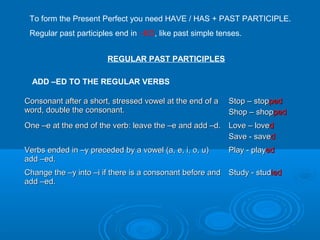
To form the Present Perfect you need HAVE / HAS + PAST PARTICIPLE.
Regular past participles end in –ED, like past simple tenses.
REGULAR PAST PARTICIPLES
ADD –ED TO THE REGULAR VERBS
Consonant after a short, stressed vowel at the end of aConsonant after a short, stressed vowel at the end of a
word, double the consonant.word, double the consonant.
Stop – stopStop – stoppedped
Shop – shopShop – shoppedped
One –e at the end of the verb: leave the –e and add –d.One –e at the end of the verb: leave the –e and add –d. Love – loveLove – lovedd
Save - saveSave - savedd
Verbs ended in –y preceded by a vowel (a, e, i, o, u)Verbs ended in –y preceded by a vowel (a, e, i, o, u)
add –ed.add –ed.
Play - playPlay - playeded
Change the –y into –i if there is a consonant before andChange the –y into –i if there is a consonant before and
add –ed.add –ed.
Study - studStudy - studiedied
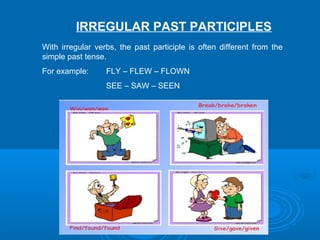
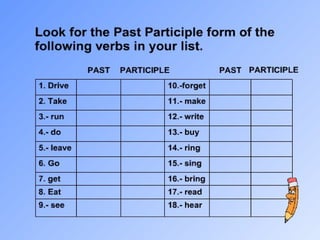
IRREGULAR PAST PARTICIPLES
With irregular verbs, the past participle is often different from the
simple past tense.
For example: FLY – FLEW – FLOWN
SEE – SAW – SEEN
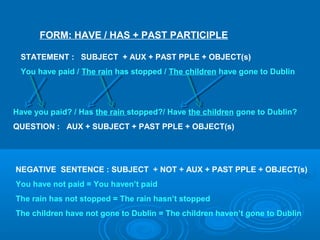
FORM: HAVE / HAS + PAST PARTICIPLE
STATEMENT : SUBJECT + AUX + PAST PPLE + OBJECT(s)
You have paid / The rain has stopped / The children have gone to Dublin
Have you paid? / Has the rain stopped?/ Have the children gone to Dublin?
QUESTION : AUX + SUBJECT + PAST PPLE + OBJECT(s)
NEGATIVE SENTENCE : SUBJECT + NOT + AUX + PAST PPLE + OBJECT(s)
You have not paid = You haven’t paid
The rain has not stopped = The rain hasn’t stopped
The children have not gone to Dublin = The children haven’t gone to Dublin
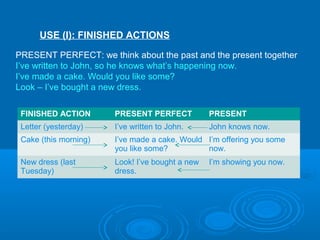
USE (I): FINISHED ACTIONS
PRESENT PERFECT: we think about the past and the present together
I’ve written to John, so he knows what’s happening now.
I’ve made a cake. Would you like some?
Look – I’ve bought a new dress.
FINISHED ACTION PRESENT PERFECT PRESENT
Letter (yesterday) I’ve written to John. John knows now.
Cake (this morning) I’ve made a cake. Would
you like some?
I’m offering you some
now.
New dress (last
Tuesday)
Look! I’ve bought a new
dress.
I’m showing you now.
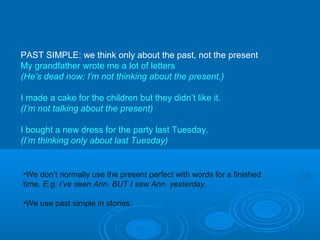
PAST SIMPLE: we think only about the past, not the present
My grandfather wrote me a lot of letters
(He’s dead now; I’m not thinking about the present.)
I made a cake for the children but they didn’t like it.
(I’m not talking about the present)
I bought a new dress for the party last Tuesday.
(I’m thinking only about last Tuesday)
•We don’t normally use the present perfect with words for a finished
time. E.g. I’ve seen Ann. BUT I saw Ann yesterday.
•We use past simple in stories.
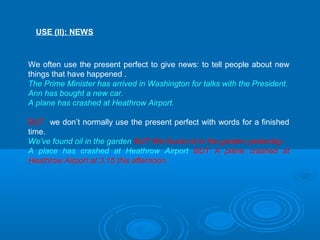
USE (II): NEWS
We often use the present perfect to give news: to tell people about new
things that have happened .
The Prime Minister has arrived in Washington for talks with the President.
Ann has bought a new car.
A plane has crashed at Heathrow Airport.
BUT we don’t normally use the present perfect with words for a finished
time.
We’ve found oil in the garden BUT We found oil in the garden yesterday.
A place has crashed at Heathrow Airport BUT A plane crashed at
Heathrow Airport at 3.15 this afternoon.
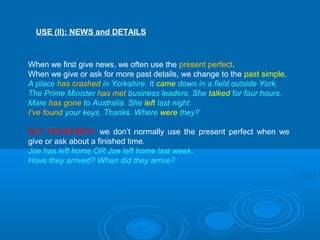
USE (II): NEWS and DETAILS
When we first give news, we often use the present perfect.
When we give or ask for more past details, we change to the past simple.
A place has crashed in Yorkshire. It came down in a field outside York.
The Prime Minister has met business leaders. She talked for four hours.
Mare has gone to Australia. She left last night.
I’ve found your keys. Thanks. Where were they?
BUT REMEMBER: we don’t normally use the present perfect when we
give or ask about a finished time.
Joe has left home OR Joe left home last week.
Have they arrived? When did they arrive?
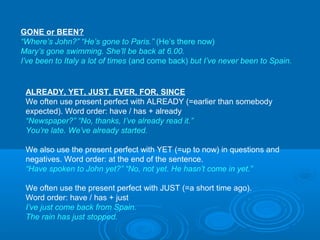
GONE or BEEN?
“Where’s John?” “He’s gone to Paris.” (He’s there now)
Mary’s gone swimming. She’ll be back at 6.00.
I’ve been to Italy a lot of times (and come back) but I’ve never been to Spain.
ALREADY, YET, JUST, EVER, FOR, SINCE
We often use present perfect with ALREADY (=earlier than somebody
expected). Word order: have / has + already
“Newspaper?” “No, thanks, I’ve already read it.”
You’re late. We’ve already started.
We also use the present perfect with YET (=up to now) in questions and
negatives. Word order: at the end of the sentence.
“Have spoken to John yet?” “No, not yet. He hasn’t come in yet.”
We often use the present perfect with JUST (=a short time ago).
Word order: have / has + just
I’ve just come back from Spain.
The rain has just stopped.
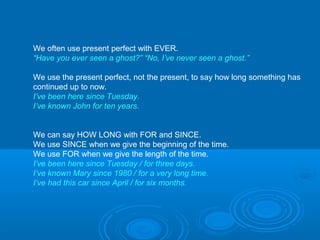
We often use present perfect with EVER.
“Have you ever seen a ghost?” “No, I’ve never seen a ghost.”
We use the present perfect, not the present, to say how long something has
continued up to now.
I’ve been here since Tuesday.
I’ve known John for ten years.
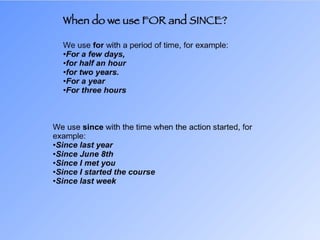
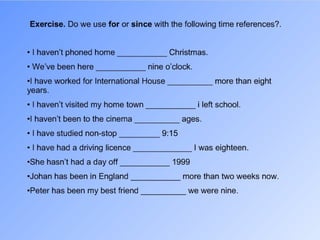
We can say HOW LONG with FOR and SINCE.
We use SINCE when we give the beginning of the time.
We use FOR when we give the length of the time.
I’ve been here since Tuesday / for three days.
I’ve known Mary since 1980 / for a very long time.
I’ve had this car since April / for six months.
Present perfect vs past simple

Present perfect vs past simple

  • 1.
  • 2.
    To form thePresent Perfect you need HAVE / HAS + PAST PARTICIPLE. Regular past participles end in –ED, like past simple tenses. REGULAR PAST PARTICIPLES ADD –ED TO THE REGULAR VERBS Consonant after a short, stressed vowel at the end of aConsonant after a short, stressed vowel at the end of a word, double the consonant.word, double the consonant. Stop – stopStop – stoppedped Shop – shopShop – shoppedped One –e at the end of the verb: leave the –e and add –d.One –e at the end of the verb: leave the –e and add –d. Love – loveLove – lovedd Save - saveSave - savedd Verbs ended in –y preceded by a vowel (a, e, i, o, u)Verbs ended in –y preceded by a vowel (a, e, i, o, u) add –ed.add –ed. Play - playPlay - playeded Change the –y into –i if there is a consonant before andChange the –y into –i if there is a consonant before and add –ed.add –ed. Study - studStudy - studiedied
  • 4.
    IRREGULAR PAST PARTICIPLES Withirregular verbs, the past participle is often different from the simple past tense. For example: FLY – FLEW – FLOWN SEE – SAW – SEEN
  • 6.
    FORM: HAVE /HAS + PAST PARTICIPLE STATEMENT : SUBJECT + AUX + PAST PPLE + OBJECT(s) You have paid / The rain has stopped / The children have gone to Dublin Have you paid? / Has the rain stopped?/ Have the children gone to Dublin? QUESTION : AUX + SUBJECT + PAST PPLE + OBJECT(s) NEGATIVE SENTENCE : SUBJECT + NOT + AUX + PAST PPLE + OBJECT(s) You have not paid = You haven’t paid The rain has not stopped = The rain hasn’t stopped The children have not gone to Dublin = The children haven’t gone to Dublin
  • 7.
    USE (I): FINISHEDACTIONS PRESENT PERFECT: we think about the past and the present together I’ve written to John, so he knows what’s happening now. I’ve made a cake. Would you like some? Look – I’ve bought a new dress. FINISHED ACTION PRESENT PERFECT PRESENT Letter (yesterday) I’ve written to John. John knows now. Cake (this morning) I’ve made a cake. Would you like some? I’m offering you some now. New dress (last Tuesday) Look! I’ve bought a new dress. I’m showing you now.
  • 8.
    PAST SIMPLE: wethink only about the past, not the present My grandfather wrote me a lot of letters (He’s dead now; I’m not thinking about the present.) I made a cake for the children but they didn’t like it. (I’m not talking about the present) I bought a new dress for the party last Tuesday. (I’m thinking only about last Tuesday) •We don’t normally use the present perfect with words for a finished time. E.g. I’ve seen Ann. BUT I saw Ann yesterday. •We use past simple in stories.
  • 9.
    USE (II): NEWS Weoften use the present perfect to give news: to tell people about new things that have happened . The Prime Minister has arrived in Washington for talks with the President. Ann has bought a new car. A plane has crashed at Heathrow Airport. BUT we don’t normally use the present perfect with words for a finished time. We’ve found oil in the garden BUT We found oil in the garden yesterday. A place has crashed at Heathrow Airport BUT A plane crashed at Heathrow Airport at 3.15 this afternoon.
  • 10.
    USE (II): NEWSand DETAILS When we first give news, we often use the present perfect. When we give or ask for more past details, we change to the past simple. A place has crashed in Yorkshire. It came down in a field outside York. The Prime Minister has met business leaders. She talked for four hours. Mare has gone to Australia. She left last night. I’ve found your keys. Thanks. Where were they? BUT REMEMBER: we don’t normally use the present perfect when we give or ask about a finished time. Joe has left home OR Joe left home last week. Have they arrived? When did they arrive?
  • 11.
    GONE or BEEN? “Where’sJohn?” “He’s gone to Paris.” (He’s there now) Mary’s gone swimming. She’ll be back at 6.00. I’ve been to Italy a lot of times (and come back) but I’ve never been to Spain. ALREADY, YET, JUST, EVER, FOR, SINCE We often use present perfect with ALREADY (=earlier than somebody expected). Word order: have / has + already “Newspaper?” “No, thanks, I’ve already read it.” You’re late. We’ve already started. We also use the present perfect with YET (=up to now) in questions and negatives. Word order: at the end of the sentence. “Have spoken to John yet?” “No, not yet. He hasn’t come in yet.” We often use the present perfect with JUST (=a short time ago). Word order: have / has + just I’ve just come back from Spain. The rain has just stopped.
  • 12.
    We often usepresent perfect with EVER. “Have you ever seen a ghost?” “No, I’ve never seen a ghost.” We use the present perfect, not the present, to say how long something has continued up to now. I’ve been here since Tuesday. I’ve known John for ten years. We can say HOW LONG with FOR and SINCE. We use SINCE when we give the beginning of the time. We use FOR when we give the length of the time. I’ve been here since Tuesday / for three days. I’ve known Mary since 1980 / for a very long time. I’ve had this car since April / for six months.