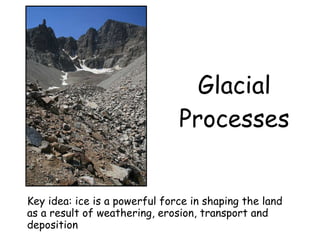
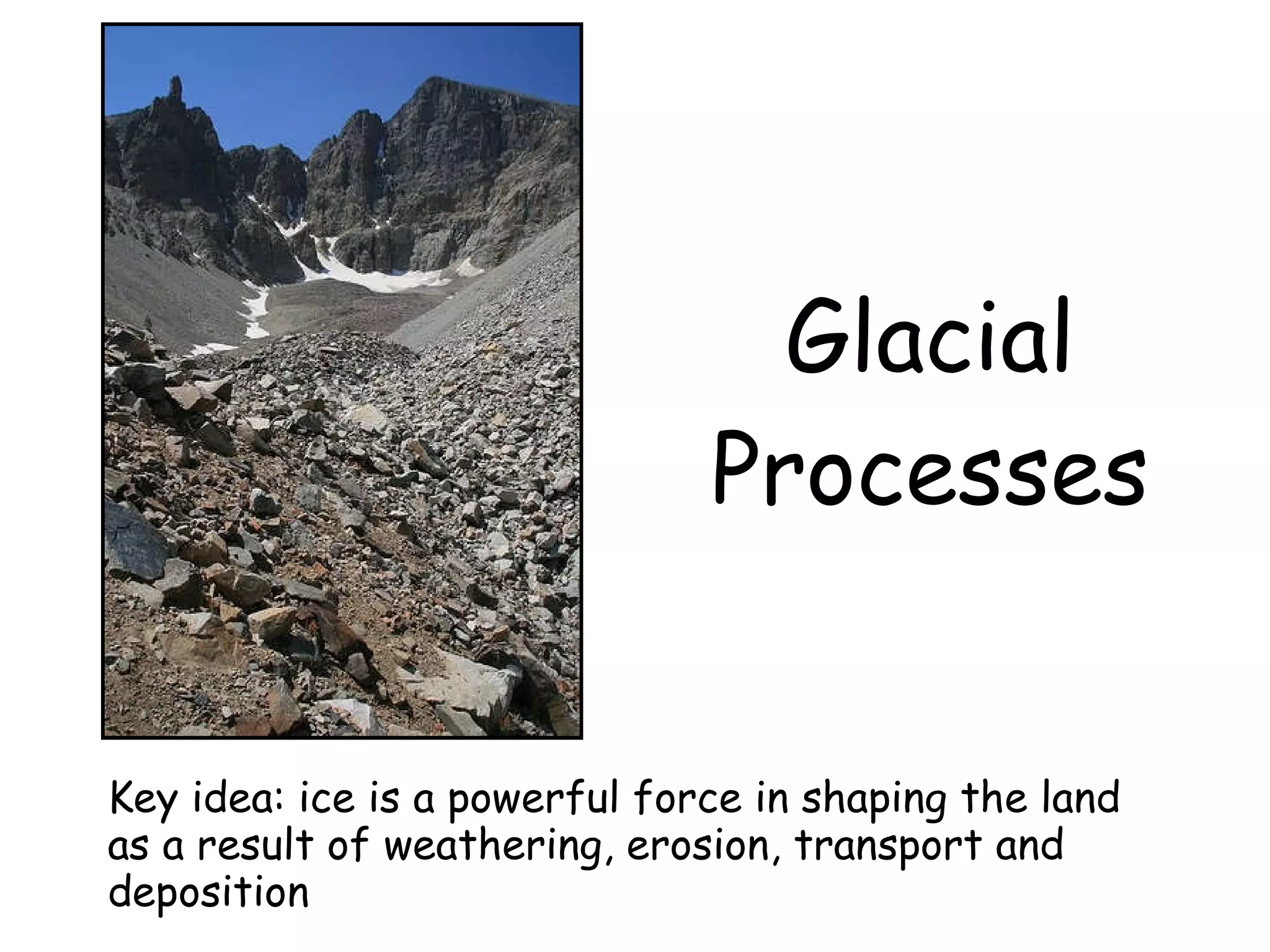
Glacial Processes Key idea: ice is a powerful force in shaping the land as a result of weathering, erosion, transport and deposition
Objectives To be able to explain the following glacial processes: Freeze thaw weathering Processes of erosion -  plucking  and  abrasion Processes of movement and transportation –  rotational slip  and  bulldozing Deposition  and the reasons for it
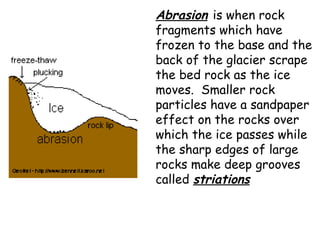
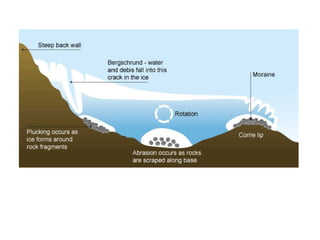
Freeze thaw weathering Freeze-thaw is when meltwater or rain gets into cracks in the bed rock, usually the backwall. At night the water freezes, expands and causes the crack to get larger. Eventually the rock will break away
Erosion  – where rocks are broken down and moved away by ice eg. plucking + abrasion.  Weathering  - where rocks are broken down ‘in situ’ but are not moved away by ice, water or wind. eg. frost shattering. What is the difference between  erosion  and  weathering ?
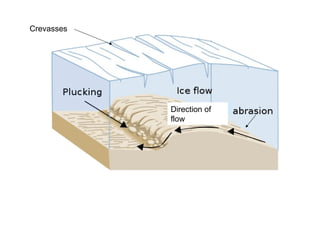
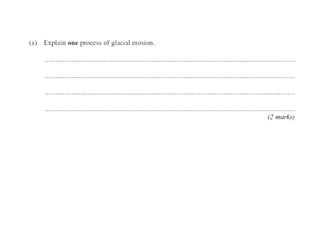
Glacial Erosion   There are two main types of glacial erosion – plucking and abrasion  Plucking  is the tearing away of blocks of rocks as a glacier moves.  These blocks of rock had been frozen to the bottom of the glacier where water had entered joints in the rock and become frozen. When the ice moves downhill, rock is plucked from the back wall.
Abrasion   is when rock fragments which have frozen to the base and the back of the glacier scrape the bed rock as the ice moves.  Smaller rock particles have a sandpaper effect on the rocks over which the ice passes while the sharp edges of large rocks make deep grooves  called  striations
Direction of flow Crevasses
Tasks  ( use textbook NT page 128) 1. Draw labelled diagrams to show how each of the following processes operates: Freeze thaw weathering Plucking Abrasion 2. Explain why the breakdown and removal of rock is quicker when  all three processes operate in the same area Rocks have many lines of weakness
Glacial movement Melting ice in summer produces meltwater This water helps to lubricate the underside of the glacier enabling it to slide downhill =  basal slip. In hollows this movement may be more curved =  rotational slip In winter when the glacier is frozen to the rocky surface the sheer weight of the ice and the influence of gravity cause individual ice crystals to deform in a plastic manner =  internal deformation  also causes the glacier to move downhill
 
Processes of transportation and deposition Moraine is angular rock material which is transported and later deposited by a glacier.  It is deposited when there is a rise in temperature. As the glacier begins to melt it cannot carry as much material
Glacial Deposition Most deposition occurs when the ice melts. As most melting occurs at the snout this is where most deposition occurs Renewed advance of the glacier pushes the debris further downhill like a bulldozer – this process is bulldozing
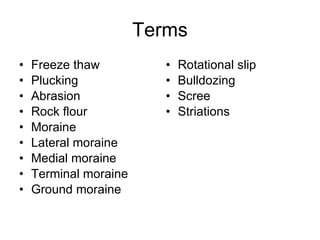
Terms Freeze thaw Plucking Abrasion Rock flour Moraine Lateral moraine Medial moraine Terminal moraine Ground moraine Rotational slip Bulldozing Scree Striations
 
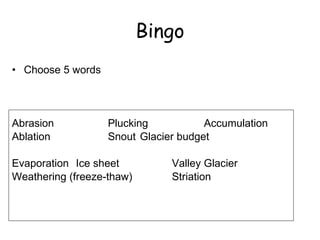
Bingo Choose 5 words Abrasion Plucking Accumulation Ablation Snout Glacier budget Evaporation Ice sheet  Valley Glacier Weathering (freeze-thaw) Striation

L3 Glaciation Processes

  • 1.
    Glacial Processes Keyidea: ice is a powerful force in shaping the land as a result of weathering, erosion, transport and deposition
  • 2.
    Objectives To beable to explain the following glacial processes: Freeze thaw weathering Processes of erosion - plucking and abrasion Processes of movement and transportation – rotational slip and bulldozing Deposition and the reasons for it
  • 3.
    Freeze thaw weatheringFreeze-thaw is when meltwater or rain gets into cracks in the bed rock, usually the backwall. At night the water freezes, expands and causes the crack to get larger. Eventually the rock will break away
  • 4.
    Erosion –where rocks are broken down and moved away by ice eg. plucking + abrasion. Weathering - where rocks are broken down ‘in situ’ but are not moved away by ice, water or wind. eg. frost shattering. What is the difference between erosion and weathering ?
  • 5.
    Glacial Erosion There are two main types of glacial erosion – plucking and abrasion Plucking is the tearing away of blocks of rocks as a glacier moves. These blocks of rock had been frozen to the bottom of the glacier where water had entered joints in the rock and become frozen. When the ice moves downhill, rock is plucked from the back wall.
  • 6.
    Abrasion is when rock fragments which have frozen to the base and the back of the glacier scrape the bed rock as the ice moves. Smaller rock particles have a sandpaper effect on the rocks over which the ice passes while the sharp edges of large rocks make deep grooves called striations
  • 7.
  • 8.
    Tasks (use textbook NT page 128) 1. Draw labelled diagrams to show how each of the following processes operates: Freeze thaw weathering Plucking Abrasion 2. Explain why the breakdown and removal of rock is quicker when all three processes operate in the same area Rocks have many lines of weakness
  • 9.
    Glacial movement Meltingice in summer produces meltwater This water helps to lubricate the underside of the glacier enabling it to slide downhill = basal slip. In hollows this movement may be more curved = rotational slip In winter when the glacier is frozen to the rocky surface the sheer weight of the ice and the influence of gravity cause individual ice crystals to deform in a plastic manner = internal deformation also causes the glacier to move downhill
  • 10.
  • 11.
    Processes of transportationand deposition Moraine is angular rock material which is transported and later deposited by a glacier. It is deposited when there is a rise in temperature. As the glacier begins to melt it cannot carry as much material
  • 12.
    Glacial Deposition Mostdeposition occurs when the ice melts. As most melting occurs at the snout this is where most deposition occurs Renewed advance of the glacier pushes the debris further downhill like a bulldozer – this process is bulldozing
  • 13.
    Terms Freeze thawPlucking Abrasion Rock flour Moraine Lateral moraine Medial moraine Terminal moraine Ground moraine Rotational slip Bulldozing Scree Striations
  • 14.
  • 15.
    Bingo Choose 5words Abrasion Plucking Accumulation Ablation Snout Glacier budget Evaporation Ice sheet Valley Glacier Weathering (freeze-thaw) Striation