Communicable Diseases
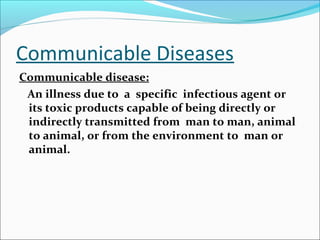
Communicable disease:
An illness due to a specific infectious agent or
its toxic products capable of being directly or
indirectly transmitted from man to man, animal
to animal, or from the environment to man or
animal.
TUBERCULOSIS
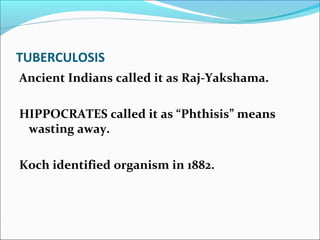
Ancient Indians called it as Raj-Yakshama.
HIPPOCRATES called it as “Phthisis” means
wasting away.
Koch identified organism in 1882.
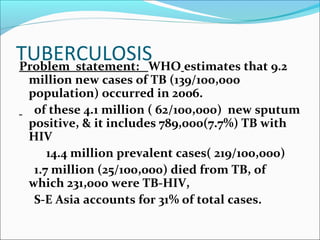
TUBERCULOSISProblem statement: WHO estimates that 9.2
million new cases of TB (139/100,000
population) occurred in 2006.
of these 4.1 million ( 62/100,000) new sputum
positive, & it includes 789,000(7.7%) TB with
HIV
14.4 million prevalent cases( 219/100,000)
1.7 million (25/100,000) died from TB, of
which 231,000 were TB-HIV,
S-E Asia accounts for 31% of total cases.
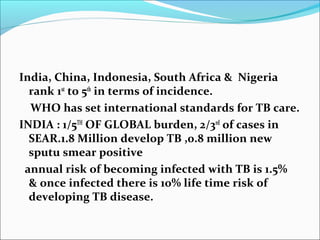
India, China, Indonesia, South Africa & Nigeria
rank 1st
to 5th
in terms of incidence.
WHO has set international standards for TB care.
INDIA : 1/5TH
OF GLOBAL burden, 2/3rd
of cases in
SEAR.1.8 Million develop TB ,0.8 million new
sputu smear positive
annual risk of becoming infected with TB is 1.5%
& once infected there is 10% life time risk of
developing TB disease.
 2 out of every 5 Indians are infected with TB
bacillus.
 everyday 5000 people develop disease.
 patient with infectious pulmonary
tuberculosis can infect 10-15 persons per
year.
 in India 0.37 million people die every year
DOTS launched in March 1997 covered whole
country by March 2006. more than 7.3 million
on DOTS
THE ECONOMIC & SOCIAL
BURDEN
Direct cost of the disease in India annually
estimated at about US$ 3 Billion ( more than
RS. 13000 CRORES).
Only authentic survey, on countrywide basis,
is National Sample Survey(1955-1958) by
ICMR , sample drawn from less than 50% of
population, tuberculin testing was not
included since extensive tuberculin testing &
BCG vaccination had already carried out.
National Tuberculosis Institute, Banglore carried
out 3 longitudinal surveys at Delhi, Banglore &
Chingleput.
Epidemiological indices
- needed to measure the TB problem in a
community, planning & evaluation of control
measures & for international comparison
1. prevalence of infection : % of individuals
who show a positive reaction to the standard
tuberculin test
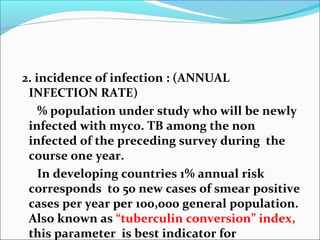
2. incidence of infection : (ANNUAL
INFECTION RATE)
% population under study who will be newly
infected with myco. TB among the non
infected of the preceding survey during the
course one year.
In developing countries 1% annual risk
corresponds to 50 new cases of smear positive
cases per year per 100,000 general population.
Also known as “tuberculin conversion” index,
this parameter is best indicator for
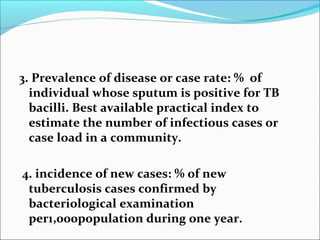
3. Prevalence of disease or case rate: % of
individual whose sputum is positive for TB
bacilli. Best available practical index to
estimate the number of infectious cases or
case load in a community.
4. incidence of new cases: % of new
tuberculosis cases confirmed by
bacteriological examination
per1,000population during one year.
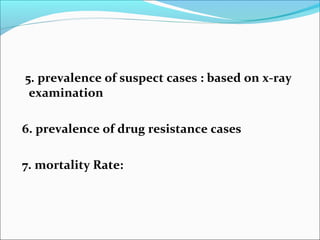
5. prevalence of suspect cases : based on x-ray
examination
6. prevalence of drug resistance cases
7. mortality Rate:
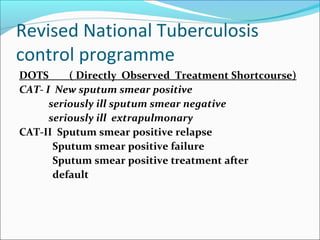
Revised National Tuberculosis
control programme
DOTS ( Directly Observed Treatment Shortcourse)
CAT- I New sputum smear positive
seriously ill sputum smear negative
seriously ill extrapulmonary
CAT-II Sputum smear positive relapse
Sputum smear positive failure
Sputum smear positive treatment after
default
RNTCP Continue…..
CAT III New sputum smear negative, not seriously
ill
New Extra-pulmonary not seriously ill
----------------------------------------------------------------
Preventive measure:
BCG Vaccine
Preventive chemotherapy
DRUG RESISTANCE TB
1. Multidrug resistance (MDR-TB)
DOTS-Plus for MDR-TB
2. Extensive drug TB ( XDR-TB)
Tuberculosis & HIV
Communicable diseases 1

Communicable diseases 1

  • 1.
    Communicable Diseases Communicable disease: Anillness due to a specific infectious agent or its toxic products capable of being directly or indirectly transmitted from man to man, animal to animal, or from the environment to man or animal.
  • 2.
    TUBERCULOSIS Ancient Indians calledit as Raj-Yakshama. HIPPOCRATES called it as “Phthisis” means wasting away. Koch identified organism in 1882.
  • 3.
    TUBERCULOSISProblem statement: WHOestimates that 9.2 million new cases of TB (139/100,000 population) occurred in 2006. of these 4.1 million ( 62/100,000) new sputum positive, & it includes 789,000(7.7%) TB with HIV 14.4 million prevalent cases( 219/100,000) 1.7 million (25/100,000) died from TB, of which 231,000 were TB-HIV, S-E Asia accounts for 31% of total cases.
  • 4.
    India, China, Indonesia,South Africa & Nigeria rank 1st to 5th in terms of incidence. WHO has set international standards for TB care. INDIA : 1/5TH OF GLOBAL burden, 2/3rd of cases in SEAR.1.8 Million develop TB ,0.8 million new sputu smear positive annual risk of becoming infected with TB is 1.5% & once infected there is 10% life time risk of developing TB disease.
  • 5.
     2 outof every 5 Indians are infected with TB bacillus.  everyday 5000 people develop disease.  patient with infectious pulmonary tuberculosis can infect 10-15 persons per year.  in India 0.37 million people die every year DOTS launched in March 1997 covered whole country by March 2006. more than 7.3 million on DOTS
  • 6.
    THE ECONOMIC &SOCIAL BURDEN Direct cost of the disease in India annually estimated at about US$ 3 Billion ( more than RS. 13000 CRORES). Only authentic survey, on countrywide basis, is National Sample Survey(1955-1958) by ICMR , sample drawn from less than 50% of population, tuberculin testing was not included since extensive tuberculin testing & BCG vaccination had already carried out.
  • 7.
    National Tuberculosis Institute,Banglore carried out 3 longitudinal surveys at Delhi, Banglore & Chingleput.
  • 8.
    Epidemiological indices - neededto measure the TB problem in a community, planning & evaluation of control measures & for international comparison 1. prevalence of infection : % of individuals who show a positive reaction to the standard tuberculin test
  • 9.
    2. incidence ofinfection : (ANNUAL INFECTION RATE) % population under study who will be newly infected with myco. TB among the non infected of the preceding survey during the course one year. In developing countries 1% annual risk corresponds to 50 new cases of smear positive cases per year per 100,000 general population. Also known as “tuberculin conversion” index, this parameter is best indicator for
  • 10.
    3. Prevalence ofdisease or case rate: % of individual whose sputum is positive for TB bacilli. Best available practical index to estimate the number of infectious cases or case load in a community. 4. incidence of new cases: % of new tuberculosis cases confirmed by bacteriological examination per1,000population during one year.
  • 11.
    5. prevalence ofsuspect cases : based on x-ray examination 6. prevalence of drug resistance cases 7. mortality Rate:
  • 12.
    Revised National Tuberculosis controlprogramme DOTS ( Directly Observed Treatment Shortcourse) CAT- I New sputum smear positive seriously ill sputum smear negative seriously ill extrapulmonary CAT-II Sputum smear positive relapse Sputum smear positive failure Sputum smear positive treatment after default
  • 13.
    RNTCP Continue….. CAT IIINew sputum smear negative, not seriously ill New Extra-pulmonary not seriously ill ---------------------------------------------------------------- Preventive measure: BCG Vaccine Preventive chemotherapy
  • 14.
    DRUG RESISTANCE TB 1.Multidrug resistance (MDR-TB) DOTS-Plus for MDR-TB 2. Extensive drug TB ( XDR-TB) Tuberculosis & HIV