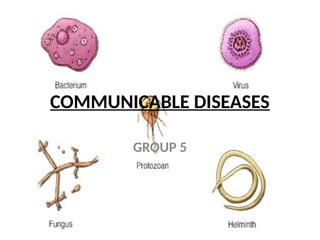
COMMUNICABLE DISEASES
GROUP 5
Group members.
1. Awany Isaac U/240300329/BMI
2. Ekongot Anthony J. Ecuru
U/240300598/BMI
3. Kazibwe Elijah
U/240300412/BMI
4. Masereka Tomasi
U/240300369/BMI
5. Nakabuye Irene
U/240300574/BMI
6. Kagulire Matthew Melvin
U/240300687/BMI
7. Ssenkaayi Mark Raymond
U/240300596/BMI
8. Namusubula Natasha Jane.
U/240300715/BMI
9. Ngoyani Aqram.
10. Namiiro Ashuura
U/240300420/BDU
11. Nasaka Faith U/240300573/BMI
12. Nyangoma Bridget
U/240300397/BMI
NAME REG. NO
Masette Benard CHAIRPERSON U/240300048/BMI
Zacharia Anania Miligo SCRIBE T/240300334/BMI
Eliau Martin U/240300059/BMI
Agaba Elvis U/240300601/BMI
Babirye Florence U/240300056/BMI
Ampiire Javis Vincent U/240300470/BMI
Ofumbi Joy U/240300418/BMI
Nakiranda Druscilla M U/240300564/BMI
Namembe Jameo U/240300347/BMI
Nakayiba Gloria U/240300443/BMI
Group 6
OBJECTIVES
• Definition of communicable diseases.
• Modes of transmission of communicable diseases.
• Some of the common examples of communicable
diseases.
• Transmission cycle of communicable diseases.
• Common symptoms and prevention of the
communicable diseases.
• Challenges faced in control of communicable
diseases, and possible solutions to them.
DefinitIon of terms
• Endemic: Prevailing or continuously present in a community, e.g., TB and Malaria,
Malnutrition, or diseases that are constantly found among people in a particular
area.
• Epidemic: A widespread occurrence of an infectious disease in a community at a
particular time.
• Prevalence: The number of cases of a disease existing at a particular time within a
given population.
• Pandemic: A disease widely prevalent in a population, e.g., HIV/AIDS, Covid.
• Sporadic: Occurrence at irregular intervals or only in a few places; scattered or
isolated.
• Host: refers to humans or animals that come into contact with the agent.
• Disease agent: is defined as a substance, living or nonliving, or a force, tangible or
intangible, the excessive presence or relative lack of which is the immediate cause
of a particular disease.
• Environment: refers to the aggregate of all external conditions and influences
affecting the life and development of organisms, human behavior, and society.
Main Stages of a Disease
• 1. Stage of Susceptibility/Preclinical Phase:
– individuals are at risk of developing the disease but have not yet shown any
symptoms. They may have been exposed to
risk factors (e.g., environmental, genetic) that increase their susceptibility to
the disease.
– During this phase, preventive measures may be effective in reducing the risk of
disease development.
• 2. Stage of Subclinical Disease/Asymptomatic Phase: s,
– Individuals may become infected or develop the condition, but they do not
exhibit any noticeable symptoms.
– last for varying durations, and individuals may unknowingly transmit the
disease to others.
– Regular screenings and diagnostic tests may detect the disease during this
phase.
COUNT….
• 3. Stage of Clinical Disease/Symptomatic Phase:
– This is the phase during which individuals experience symptoms and seek
medical attention.
– Symptoms can range from mild to severe, and the clinical presentation
depends on the disease.
– Diagnosis and treatment typically occur during this stage.
• 4. Stage of Recovery, Disability, or Death:
– Depending on the disease and its severity, individuals may recover completely,
experience varying degrees of disability, or succumb to the disease.
COMMUNICABLE DISEASES.
DEFINITION;
These are infections that occur due to specific infectious
agents or their products and can be transmitted from one
individual to another either directly or indirectly.
– Direct transmission involves spreading of infectious
agents or germs like viruses, bacteria, fungi, protozoans
of disease from infected individual to a healthy one
through touch, blood, body fluids, etc.
– Indirect transmission involves transmision of infectious
agents by elements such as vectors or through other
media like air, water, food, etc.
DIRECT TRANSMISSION
• Individual to individual contact.
• Infectious droplets.
• Mother to unborn either through placenta
during gestation or through vagina during
parturition.
INDIRECT TRANSMISSION.
• Airborne transmission.
• Contaminated objects and surfaces.
• Contaminated food and water.
• Animal/insect transmission (vectors).
• Environmental reservoirs of infectious agents.
EXAMPLES OF COMMON COMMUNICABLE
DISEASES.
• Small pox
• Poliomyelitis
• Measles
• HIV/AIDS
• Malaria
• Tuberculosis
• Influenza
• Severe acute respiratory syndrome(SARS), etc.
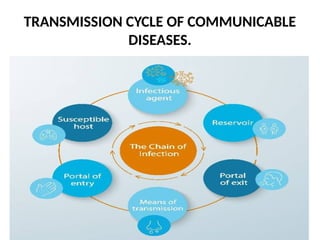
TRANSMISSION CYCLE OF COMMUNICABLE
DISEASES.
EXAMPLES OF INFECTIOUS AGENTS
i. Viruses.
ii. Bacteria.
iii. Fungi.
iv. Protozoans.
v. Helminths(worms).
VIRAL DISEASES
Examples.
i. Influenza.
ii. HIV/AIDS.
iii. Measles.
iv. Chicken pox.
v. Small pox.
vi. Ebola.
vii. Poliomyelitis.
viii. Herpes.
ix. Rabies.
VIRAL DISEASES.
Signs and symptoms;
• Fever.
• Head, body aches.
• Fatigue.
• Sore throat.
• Coughing and(or) sneezing.
• Nausea.
• Vomiting.
• Diarrhea.
• Skin conditions like; rashes, sores, blisters, warts.
BACTERIAL DISEASES.
Examples.
i. Whooping cough.
ii. Tuberculosis.
iii. Gonorrhea.
iv. Chlamydia.
v. Diptheria.
vi. Bacterial pneumonia.
BACTERIAL DISEASES.
Common signs and symptoms.
• Fever.
• Chills.
• Fatigue.
• Headache.
• Diarrhea.
• Stomach ache/pain.
• Nausea.
• Vomiting.
• Cough, sputum, shortness of breath.
FUNGAL DISEASES.
Examples.
i. Ringworm.
ii. Athlete’s foot.
iii. Candidiasis.
iv. Mycetoma.
v. Jock itch.
FUNGAL DISEASES.
Common signs and symptoms.
• Foul odor.
• Discoloration of infected area.
• Rashes.
• Itching and swelling.
• Fever, headache.
• Scaly, flaky skin.
PROTOZOAN DISEASES.
Examples.
i. Malaria.
ii. Sleeping sickness.
iii. Trichomoniasis.
iv. Amoebic dysentery.
PREVENTION OF THE COMMON
COMMUNICABLE DISEASES.
• Thorough and regular hand washing.
• Proper cooking of food.
• Safeguarding and protection of water for drinking.
• Safe handling of food.
• Disinfection of surfaces and personal items.
• Adhering to existing vaccination programs.
• Proper ventilation of living areas.
• Avoid touching of unclean animals especially wild
animals.
CHALLENGES FACED IN COMMUNICABLE
DISEASE CONTROL.
• Remoteness and therefore poor access to healthcare.
• Poverty and inequality.
• Poor hygiene and sanitation amongst individuals and
communities.
• Urbanization, migration, and overcrowding.
• Drug resistance exhibited by some infectious agents.
• Local cultural norms, misconceptions and practices.
SOLUTIONS TO THE CHALLENGES.
• Inter-sectorial collaboration.
• Encouraging community active involvement and
participation.
• Cultivating favorable government policies.
• Investment in infrastructure and research facilities.
• Designing and carrying out community
sensitization programs.
• Etc.
COMMUNICABLE DISEASE HIGH RISK
INDIVIDUALS.
• young children and the elderly.
• Individuals with compromised immunity
systems.
• Non immunized individuals.
• Expectant mothers.
• Individuals with multiple sexual partners.
• Individuals living in crowded societies.

COMMUNICABLE DISEASES- Group 5 & 6 .pptx

  • 1.
  • 2.
    Group members. 1. AwanyIsaac U/240300329/BMI 2. Ekongot Anthony J. Ecuru U/240300598/BMI 3. Kazibwe Elijah U/240300412/BMI 4. Masereka Tomasi U/240300369/BMI 5. Nakabuye Irene U/240300574/BMI 6. Kagulire Matthew Melvin U/240300687/BMI 7. Ssenkaayi Mark Raymond U/240300596/BMI 8. Namusubula Natasha Jane. U/240300715/BMI 9. Ngoyani Aqram. 10. Namiiro Ashuura U/240300420/BDU 11. Nasaka Faith U/240300573/BMI 12. Nyangoma Bridget U/240300397/BMI
  • 3.
    NAME REG. NO MasetteBenard CHAIRPERSON U/240300048/BMI Zacharia Anania Miligo SCRIBE T/240300334/BMI Eliau Martin U/240300059/BMI Agaba Elvis U/240300601/BMI Babirye Florence U/240300056/BMI Ampiire Javis Vincent U/240300470/BMI Ofumbi Joy U/240300418/BMI Nakiranda Druscilla M U/240300564/BMI Namembe Jameo U/240300347/BMI Nakayiba Gloria U/240300443/BMI Group 6
  • 4.
    OBJECTIVES • Definition ofcommunicable diseases. • Modes of transmission of communicable diseases. • Some of the common examples of communicable diseases. • Transmission cycle of communicable diseases. • Common symptoms and prevention of the communicable diseases. • Challenges faced in control of communicable diseases, and possible solutions to them.
  • 5.
    DefinitIon of terms •Endemic: Prevailing or continuously present in a community, e.g., TB and Malaria, Malnutrition, or diseases that are constantly found among people in a particular area. • Epidemic: A widespread occurrence of an infectious disease in a community at a particular time. • Prevalence: The number of cases of a disease existing at a particular time within a given population. • Pandemic: A disease widely prevalent in a population, e.g., HIV/AIDS, Covid. • Sporadic: Occurrence at irregular intervals or only in a few places; scattered or isolated. • Host: refers to humans or animals that come into contact with the agent. • Disease agent: is defined as a substance, living or nonliving, or a force, tangible or intangible, the excessive presence or relative lack of which is the immediate cause of a particular disease. • Environment: refers to the aggregate of all external conditions and influences affecting the life and development of organisms, human behavior, and society.
  • 6.
    Main Stages ofa Disease • 1. Stage of Susceptibility/Preclinical Phase: – individuals are at risk of developing the disease but have not yet shown any symptoms. They may have been exposed to risk factors (e.g., environmental, genetic) that increase their susceptibility to the disease. – During this phase, preventive measures may be effective in reducing the risk of disease development. • 2. Stage of Subclinical Disease/Asymptomatic Phase: s, – Individuals may become infected or develop the condition, but they do not exhibit any noticeable symptoms. – last for varying durations, and individuals may unknowingly transmit the disease to others. – Regular screenings and diagnostic tests may detect the disease during this phase.
  • 7.
    COUNT…. • 3. Stageof Clinical Disease/Symptomatic Phase: – This is the phase during which individuals experience symptoms and seek medical attention. – Symptoms can range from mild to severe, and the clinical presentation depends on the disease. – Diagnosis and treatment typically occur during this stage. • 4. Stage of Recovery, Disability, or Death: – Depending on the disease and its severity, individuals may recover completely, experience varying degrees of disability, or succumb to the disease.
  • 8.
    COMMUNICABLE DISEASES. DEFINITION; These areinfections that occur due to specific infectious agents or their products and can be transmitted from one individual to another either directly or indirectly. – Direct transmission involves spreading of infectious agents or germs like viruses, bacteria, fungi, protozoans of disease from infected individual to a healthy one through touch, blood, body fluids, etc. – Indirect transmission involves transmision of infectious agents by elements such as vectors or through other media like air, water, food, etc.
  • 9.
    DIRECT TRANSMISSION • Individualto individual contact. • Infectious droplets. • Mother to unborn either through placenta during gestation or through vagina during parturition.
  • 10.
    INDIRECT TRANSMISSION. • Airbornetransmission. • Contaminated objects and surfaces. • Contaminated food and water. • Animal/insect transmission (vectors). • Environmental reservoirs of infectious agents.
  • 11.
    EXAMPLES OF COMMONCOMMUNICABLE DISEASES. • Small pox • Poliomyelitis • Measles • HIV/AIDS • Malaria • Tuberculosis • Influenza • Severe acute respiratory syndrome(SARS), etc.
  • 12.
    TRANSMISSION CYCLE OFCOMMUNICABLE DISEASES.
  • 13.
    EXAMPLES OF INFECTIOUSAGENTS i. Viruses. ii. Bacteria. iii. Fungi. iv. Protozoans. v. Helminths(worms).
  • 14.
    VIRAL DISEASES Examples. i. Influenza. ii.HIV/AIDS. iii. Measles. iv. Chicken pox. v. Small pox. vi. Ebola. vii. Poliomyelitis. viii. Herpes. ix. Rabies.
  • 15.
    VIRAL DISEASES. Signs andsymptoms; • Fever. • Head, body aches. • Fatigue. • Sore throat. • Coughing and(or) sneezing. • Nausea. • Vomiting. • Diarrhea. • Skin conditions like; rashes, sores, blisters, warts.
  • 16.
    BACTERIAL DISEASES. Examples. i. Whoopingcough. ii. Tuberculosis. iii. Gonorrhea. iv. Chlamydia. v. Diptheria. vi. Bacterial pneumonia.
  • 17.
    BACTERIAL DISEASES. Common signsand symptoms. • Fever. • Chills. • Fatigue. • Headache. • Diarrhea. • Stomach ache/pain. • Nausea. • Vomiting. • Cough, sputum, shortness of breath.
  • 18.
    FUNGAL DISEASES. Examples. i. Ringworm. ii.Athlete’s foot. iii. Candidiasis. iv. Mycetoma. v. Jock itch.
  • 19.
    FUNGAL DISEASES. Common signsand symptoms. • Foul odor. • Discoloration of infected area. • Rashes. • Itching and swelling. • Fever, headache. • Scaly, flaky skin.
  • 20.
    PROTOZOAN DISEASES. Examples. i. Malaria. ii.Sleeping sickness. iii. Trichomoniasis. iv. Amoebic dysentery.
  • 21.
    PREVENTION OF THECOMMON COMMUNICABLE DISEASES. • Thorough and regular hand washing. • Proper cooking of food. • Safeguarding and protection of water for drinking. • Safe handling of food. • Disinfection of surfaces and personal items. • Adhering to existing vaccination programs. • Proper ventilation of living areas. • Avoid touching of unclean animals especially wild animals.
  • 22.
    CHALLENGES FACED INCOMMUNICABLE DISEASE CONTROL. • Remoteness and therefore poor access to healthcare. • Poverty and inequality. • Poor hygiene and sanitation amongst individuals and communities. • Urbanization, migration, and overcrowding. • Drug resistance exhibited by some infectious agents. • Local cultural norms, misconceptions and practices.
  • 23.
    SOLUTIONS TO THECHALLENGES. • Inter-sectorial collaboration. • Encouraging community active involvement and participation. • Cultivating favorable government policies. • Investment in infrastructure and research facilities. • Designing and carrying out community sensitization programs. • Etc.
  • 24.
    COMMUNICABLE DISEASE HIGHRISK INDIVIDUALS. • young children and the elderly. • Individuals with compromised immunity systems. • Non immunized individuals. • Expectant mothers. • Individuals with multiple sexual partners. • Individuals living in crowded societies.