Module -1
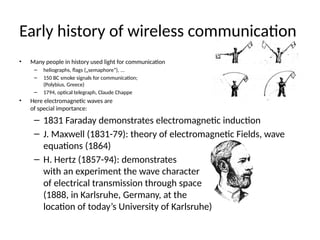
Early history of wireless communication
• Many people in history used light for communication
– heliographs, flags („semaphore“), ...
– 150 BC smoke signals for communication;
(Polybius, Greece)
– 1794, optical telegraph, Claude Chappe
• Here electromagnetic waves are
of special importance:
– 1831 Faraday demonstrates electromagnetic induction
– J. Maxwell (1831-79): theory of electromagnetic Fields, wave
equations (1864)
– H. Hertz (1857-94): demonstrates
with an experiment the wave character
of electrical transmission through space
(1888, in Karlsruhe, Germany, at the
location of today’s University of Karlsruhe)
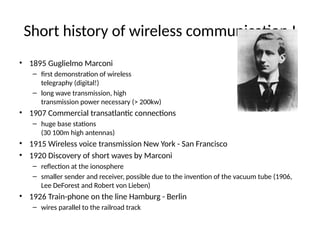
Short history of wireless communication I
• 1895 Guglielmo Marconi
– first demonstration of wireless
telegraphy (digital!)
– long wave transmission, high
transmission power necessary (> 200kw)
• 1907 Commercial transatlantic connections
– huge base stations
(30 100m high antennas)
• 1915 Wireless voice transmission New York - San Francisco
• 1920 Discovery of short waves by Marconi
– reflection at the ionosphere
– smaller sender and receiver, possible due to the invention of the vacuum tube (1906,
Lee DeForest and Robert von Lieben)
• 1926 Train-phone on the line Hamburg - Berlin
– wires parallel to the railroad track
History of wireless communication II
• 1928 many TV broadcast trials (across Atlantic, color TV, TV news)
• 1933 Frequency modulation (E. H. Armstrong)
• 1958 A-Netz in Germany
– analog, 160MHz, connection setup only from the mobile station, no
handover, 80% coverage, 1971 11000 customers
• 1972 B-Netz in Germany
– analog, 160MHz, connection setup from the fixed network too (but location
of the mobile station has to be known)
– available also in A, NL and LUX, 1979 13000 customer in D
• 1979 NMT at 450MHz (Scandinavian countries)
• 1982 Start of GSM-specification
– goal: pan-European digital mobile phone system with roaming
• 1983 Start of the American AMPS (Advanced Mobile Phone System,
analog)
• 1984 CT-1 standard (Europe) for cordless telephones
History of wireless communication III
• 1986 C-Netz in Germany
– analog voice transmission, 450MHz, hand-over possible, digital
signaling, automatic location of mobile device
– Was in use until 2000, services: FAX, modem, X.25, e-mail, 98% coverage
• 1991 Specification of DECT
– Digital European Cordless Telephone (today: Digital Enhanced Cordless
Telecommunications)
– 1880-1900MHz, ~100-500m range, 120 duplex channels, 1.2Mbit/s data
transmission, voice encryption, authentication, up to several 10000
user/km2
, used in more than 50 countries
• 1992 Start of GSM
– in D as D1 and D2, fully digital, 900MHz, 124 channels
– automatic location, hand-over, cellular
– roaming in Europe - now worldwide in more than 170 countries
– services: data with 9.6kbit/s, FAX, voice, ...
History of wireless communication IV
• 1994 E-Netz in Germany
– GSM with 1800MHz, smaller cells
– As Eplus in D (1997 98% coverage of the population)
• 1996 HiperLAN (High Performance Radio Local Area Network)
– ETSI, standardization of type 1: 5.15 - 5.30GHz, 23.5Mbit/s
– recommendations for type 2 and 3 (both 5GHz) and 4 (17GHz) as wireless
ATM-networks (up to 155Mbit/s)
• 1997 Wireless LAN - IEEE802.11
– IEEE standard, 2.4 - 2.5GHz and infrared, 2Mbit/s
– already many (proprietary) products available in the beginning
• 1998 Specification of GSM successors
– for UMTS (Universal Mobile Telecommunication System) as European
proposals for IMT-2000
• Iridium
– 66 satellites (+6 spare), 1.6GHz to the mobile phone
History of wireless communication V
• 1999 Standardization of additional wireless LANs
– IEEE standard 802.11b, 2.4-2.5GHz, 11Mbit/s
– Bluetooth for piconets, 2.4Ghz, <1Mbit/s
• Decision about IMT-2000
– Several “members” of a “family”: UMTS, cdma2000, DECT, …
• Start of WAP (Wireless Application Protocol) and i-mode
– First step towards a unified Internet/mobile communicaiton system
– Access to many services via the mobile phone
• 2000 GSM with higher data rates
– HSCSD offers up to 57,6kbit/s
– First GPRS trials with up to 50 kbit/s (packet oriented!)
• UMTS auctions/beauty contests
– Hype followed by disillusionment (approx. 50 B$ payed in Germany for 6 UMTS
licences!)
• 2001 Start of 3G systems
– Cdma2000 in Korea, UMTS in Europe, Foma (almost UMTS) in Japan
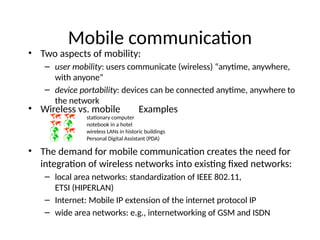
Mobile communication
• Two aspects of mobility:
– user mobility: users communicate (wireless) “anytime, anywhere,
with anyone”
– device portability: devices can be connected anytime, anywhere to
the network
• Wireless vs. mobile Examples
  stationary computer
  notebook in a hotel
  wireless LANs in historic buildings
  Personal Digital Assistant (PDA)
• The demand for mobile communication creates the need for
integration of wireless networks into existing fixed networks:
– local area networks: standardization of IEEE 802.11,
ETSI (HIPERLAN)
– Internet: Mobile IP extension of the internet protocol IP
– wide area networks: e.g., internetworking of GSM and ISDN
Applications I
• Vehicles
– transmission of news, road condition, weather, music via DAB
– personal communication using GSM
– position via GPS
– local ad-hoc network with vehicles close-by to prevent accidents, guidance
system, redundancy
– vehicle data (e.g., from busses, high-speed trains) can be transmitted in
advance for maintenance
• Emergencies
– early transmission of patient data to the hospital, current status, first diagnosis
– replacement of a fixed infrastructure in case of earthquakes, hurricanes, fire
etc.
– crisis, war, ...
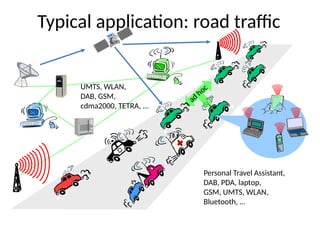
Typical application: road traffic
ad
hoc
UMTS, WLAN,
DAB, GSM,
cdma2000, TETRA, ...
Personal Travel Assistant,
DAB, PDA, laptop,
GSM, UMTS, WLAN,
Bluetooth, ...
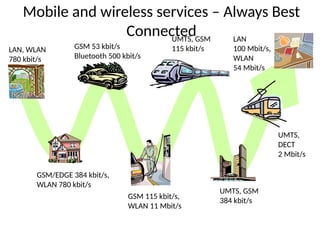
Mobile and wireless services – Always Best
Connected
UMTS,
DECT
2 Mbit/s
UMTS, GSM
384 kbit/s
LAN
100 Mbit/s,
WLAN
54 Mbit/s
UMTS, GSM
115 kbit/s
GSM 115 kbit/s,
WLAN 11 Mbit/s
GSM 53 kbit/s
Bluetooth 500 kbit/s
GSM/EDGE 384 kbit/s,
WLAN 780 kbit/s
LAN, WLAN
780 kbit/s
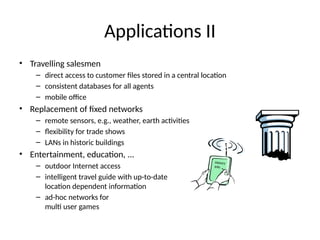
Applications II
• Travelling salesmen
– direct access to customer files stored in a central location
– consistent databases for all agents
– mobile office
• Replacement of fixed networks
– remote sensors, e.g., weather, earth activities
– flexibility for trade shows
– LANs in historic buildings
• Entertainment, education, ...
– outdoor Internet access
– intelligent travel guide with up-to-date
location dependent information
– ad-hoc networks for
multi user games
History
Info
Location dependent services
• Location aware services
– what services, e.g., printer, fax, phone, server etc. exist in the local environment
• Follow-on services
– automatic call-forwarding, transmission of the actual workspace to the current
location
• Information services
– „push“: e.g., current special offers in the supermarket
– „pull“: e.g., where is the Black Forrest Cherry Cake?
• Support services
– caches, intermediate results, state information etc. „follow“ the mobile device
through the fixed network
• Privacy
– who should gain knowledge about the location
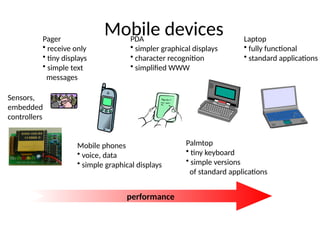
Mobile devices
performance
Pager
• receive only
• tiny displays
• simple text
messages
Mobile phones
• voice, data
• simple graphical displays
PDA
• simpler graphical displays
• character recognition
• simplified WWW
Palmtop
• tiny keyboard
• simple versions
of standard applications
Laptop
• fully functional
• standard applications
Sensors,
embedded
controllers
Effects of device portability
• Power consumption
– limited computing power, low quality displays, small disks due to limited
battery capacity
– CPU: power consumption ~ CV2
f
• C: internal capacity, reduced by integration
• V: supply voltage, can be reduced to a certain limit
• f: clock frequency, can be reduced temporally
• Loss of data
– higher probability, has to be included in advance into the design (e.g.,
defects, theft)
• Limited user interfaces
– compromise between size of fingers and portability
– integration of character/voice recognition, abstract symbols
• Limited memory
– limited value of mass memories with moving parts
– flash-memory or ? as alternative
Wireless networks in comparison to fixed
networks
• Higher loss-rates due to interference
– emissions of, e.g., engines, lightning
• Restrictive regulations of frequencies
– frequencies have to be coordinated, useful frequencies are almost all occupied
• Low transmission rates
– local some Mbit/s, regional currently, e.g., 9.6kbit/s with GSM
• Higher delays, higher jitter
– connection setup time with GSM in the second range, several hundred
milliseconds for other wireless systems
• Lower security, simpler active attacking
– radio interface accessible for everyone, base station can be simulated, thus
attracting calls from mobile phones
• Always shared medium
– secure access mechanisms important
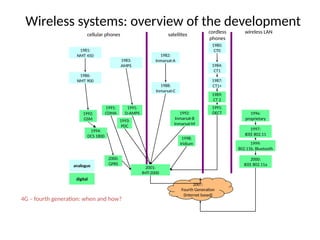
Wireless systems: overview of the development
cellular phones satellites
wireless LAN
cordless
phones
1992:
GSM
1994:
DCS 1800
2001:
IMT-2000
1987:
CT1+
1982:
Inmarsat-A
1992:
Inmarsat-B
Inmarsat-M
1998:
Iridium
1989:
CT 2
1991:
DECT 199x:
proprietary
1997:
IEEE 802.11
1999:
802.11b, Bluetooth
1988:
Inmarsat-C
analogue
digital
1991:
D-AMPS
1991:
CDMA
1981:
NMT 450
1986:
NMT 900
1980:
CT0
1984:
CT1
1983:
AMPS
1993:
PDC
4G – fourth generation: when and how?
2000:
GPRS
2000:
IEEE 802.11a
200?:
Fourth Generation
(Internet based)
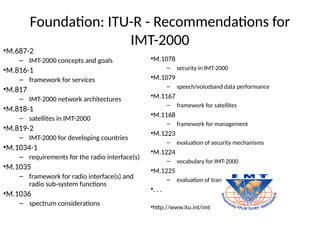
Foundation: ITU-R - Recommendations for
IMT-2000
•M.687-2
– IMT-2000 concepts and goals
•M.816-1
– framework for services
•M.817
– IMT-2000 network architectures
•M.818-1
– satellites in IMT-2000
•M.819-2
– IMT-2000 for developing countries
•M.1034-1
– requirements for the radio interface(s)
•M.1035
– framework for radio interface(s) and
radio sub-system functions
•M.1036
– spectrum considerations
•M.1078
– security in IMT-2000
•M.1079
– speech/voiceband data performance
•M.1167
– framework for satellites
•M.1168
– framework for management
•M.1223
– evaluation of security mechanisms
•M.1224
– vocabulary for IMT-2000
•M.1225
– evaluation of transmission technologies
•. . .
•http://www.itu.int/imt
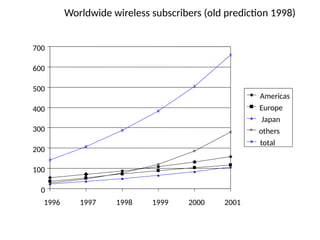
Worldwide wireless subscribers (old prediction 1998)
0
100
200
300
400
500
600
700
1996 1997 1998 1999 2000 2001
Americas
Europe
Japan
others
total
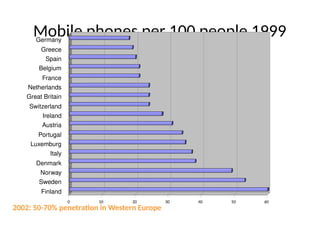
Mobile phones per 100 people 1999
0 10 20 30 40 50 60
Finland
Sweden
Norway
Denmark
Italy
Luxemburg
Portugal
Austria
Ireland
Switzerland
Great Britain
Netherlands
France
Belgium
Spain
Greece
Germany
2002: 50-70% penetration in Western Europe
Worldwide cellular subscriber growth
0
200
400
600
800
1000
1200
1992 1993 1994 1995 1996 1997 1998 1999 2000 2001 2002
Subscribers
[million]
Note that the curve starts to flatten in 2000
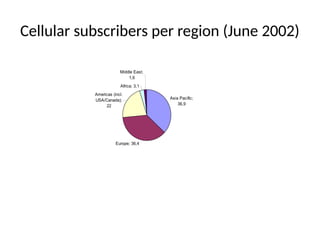
Cellular subscribers per region (June 2002)
Asia Pacific;
36,9
Europe; 36,4
Americas (incl.
USA/Canada);
22
Africa; 3,1
Middle East;
1,6
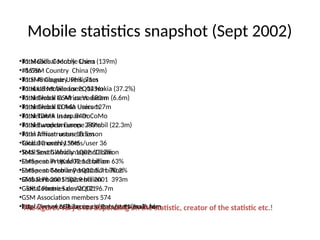
Mobile statistics snapshot (Sept 2002)
•Total Global Mobile Users
• 869m
•Total Analogue Users 71m
•Total US Mobile users 145m
•Total Global GSM users 680m
•Total Global CDMA Users 127m
•Total TDMA users 84m
•Total European users 283m
•Total African users 18.5m
•Total 3G users 130m
•Total South African users 13.2m
•European Prepaid Penetration 63%
•European Mobile Penetration 70.2%
•Global Phone Shipments 2001 393m
•Global Phone Sales 2Q02 96.7m
•http://www.cellular.co.za/stats/stats-main.htm
•#1 Mobile Country China (139m)
•#1 GSM Country China (99m)
•#1 SMS Country Philipines
•#1 Handset Vendor 2Q02 Nokia (37.2%)
•#1 Network In Africa Vodacom (6.6m)
•#1 Network In Asia Unicom
•#1 Network In Japan DoCoMo
•#1 Network In Europe T-Mobil (22.3m)
•#1 In Infrastructure Ericsson
•Global monthly SMSs/user 36
•SMS Sent Globally 1Q02 60 billion
•SMS sent in UK 6/02 1.3 billion
•SMS sent Germany 1Q02 5.7 billion
•SMS Sent 2001 102.9 billion
•GSM Countries on Air 171
•GSM Association members 574
•Total Cost of 3G Licenses in Europe 110bn Euros
The figures vary a lot depending on the statistic, creator of the statistic etc.!
Areas of research in mobile communication
• Wireless Communication
– transmission quality (bandwidth, error rate, delay)
– modulation, coding, interference
– media access, regulations
– ...
• Mobility
– location dependent services
– location transparency
– quality of service support (delay, jitter, security)
– ...
• Portability
– power consumption
– limited computing power, sizes of display, ...
– usability
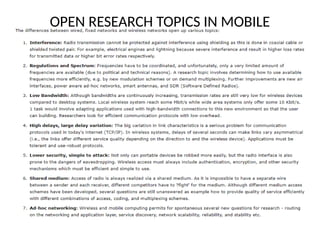
OPEN RESEARCH TOPICS IN MOBILE
COMMUNICATIONS
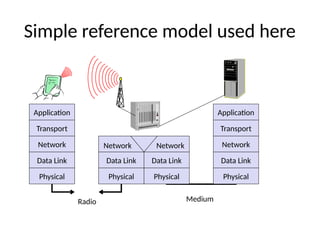
Simple reference model used here
Application
Transport
Network
Data Link
Physical
Medium
Data Link
Physical
Application
Transport
Network
Data Link
Physical
Data Link
Physical
Network Network
Radio
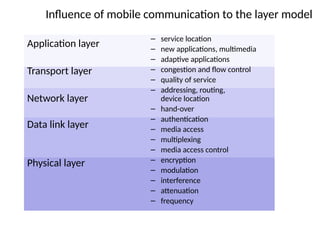
Influence of mobile communication to the layer model
– service location
– new applications, multimedia
– adaptive applications
– congestion and flow control
– quality of service
– addressing, routing,
device location
– hand-over
– authentication
– media access
– multiplexing
– media access control
– encryption
– modulation
– interference
– attenuation
– frequency
Application layer
Transport layer
Network layer
Data link layer
Physical layer
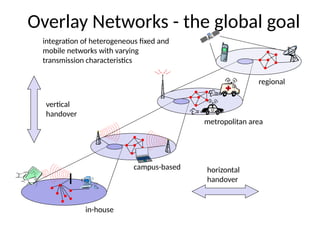
Overlay Networks - the global goal
regional
metropolitan area
campus-based
in-house
vertical
handover
horizontal
handover
integration of heterogeneous fixed and
mobile networks with varying
transmission characteristics

introduction to wireless mobile communications.pptx

  • 1.
  • 2.
    Early history ofwireless communication • Many people in history used light for communication – heliographs, flags („semaphore“), ... – 150 BC smoke signals for communication; (Polybius, Greece) – 1794, optical telegraph, Claude Chappe • Here electromagnetic waves are of special importance: – 1831 Faraday demonstrates electromagnetic induction – J. Maxwell (1831-79): theory of electromagnetic Fields, wave equations (1864) – H. Hertz (1857-94): demonstrates with an experiment the wave character of electrical transmission through space (1888, in Karlsruhe, Germany, at the location of today’s University of Karlsruhe)
  • 3.
    Short history ofwireless communication I • 1895 Guglielmo Marconi – first demonstration of wireless telegraphy (digital!) – long wave transmission, high transmission power necessary (> 200kw) • 1907 Commercial transatlantic connections – huge base stations (30 100m high antennas) • 1915 Wireless voice transmission New York - San Francisco • 1920 Discovery of short waves by Marconi – reflection at the ionosphere – smaller sender and receiver, possible due to the invention of the vacuum tube (1906, Lee DeForest and Robert von Lieben) • 1926 Train-phone on the line Hamburg - Berlin – wires parallel to the railroad track
  • 4.
    History of wirelesscommunication II • 1928 many TV broadcast trials (across Atlantic, color TV, TV news) • 1933 Frequency modulation (E. H. Armstrong) • 1958 A-Netz in Germany – analog, 160MHz, connection setup only from the mobile station, no handover, 80% coverage, 1971 11000 customers • 1972 B-Netz in Germany – analog, 160MHz, connection setup from the fixed network too (but location of the mobile station has to be known) – available also in A, NL and LUX, 1979 13000 customer in D • 1979 NMT at 450MHz (Scandinavian countries) • 1982 Start of GSM-specification – goal: pan-European digital mobile phone system with roaming • 1983 Start of the American AMPS (Advanced Mobile Phone System, analog) • 1984 CT-1 standard (Europe) for cordless telephones
  • 5.
    History of wirelesscommunication III • 1986 C-Netz in Germany – analog voice transmission, 450MHz, hand-over possible, digital signaling, automatic location of mobile device – Was in use until 2000, services: FAX, modem, X.25, e-mail, 98% coverage • 1991 Specification of DECT – Digital European Cordless Telephone (today: Digital Enhanced Cordless Telecommunications) – 1880-1900MHz, ~100-500m range, 120 duplex channels, 1.2Mbit/s data transmission, voice encryption, authentication, up to several 10000 user/km2 , used in more than 50 countries • 1992 Start of GSM – in D as D1 and D2, fully digital, 900MHz, 124 channels – automatic location, hand-over, cellular – roaming in Europe - now worldwide in more than 170 countries – services: data with 9.6kbit/s, FAX, voice, ...
  • 6.
    History of wirelesscommunication IV • 1994 E-Netz in Germany – GSM with 1800MHz, smaller cells – As Eplus in D (1997 98% coverage of the population) • 1996 HiperLAN (High Performance Radio Local Area Network) – ETSI, standardization of type 1: 5.15 - 5.30GHz, 23.5Mbit/s – recommendations for type 2 and 3 (both 5GHz) and 4 (17GHz) as wireless ATM-networks (up to 155Mbit/s) • 1997 Wireless LAN - IEEE802.11 – IEEE standard, 2.4 - 2.5GHz and infrared, 2Mbit/s – already many (proprietary) products available in the beginning • 1998 Specification of GSM successors – for UMTS (Universal Mobile Telecommunication System) as European proposals for IMT-2000 • Iridium – 66 satellites (+6 spare), 1.6GHz to the mobile phone
  • 7.
    History of wirelesscommunication V • 1999 Standardization of additional wireless LANs – IEEE standard 802.11b, 2.4-2.5GHz, 11Mbit/s – Bluetooth for piconets, 2.4Ghz, <1Mbit/s • Decision about IMT-2000 – Several “members” of a “family”: UMTS, cdma2000, DECT, … • Start of WAP (Wireless Application Protocol) and i-mode – First step towards a unified Internet/mobile communicaiton system – Access to many services via the mobile phone • 2000 GSM with higher data rates – HSCSD offers up to 57,6kbit/s – First GPRS trials with up to 50 kbit/s (packet oriented!) • UMTS auctions/beauty contests – Hype followed by disillusionment (approx. 50 B$ payed in Germany for 6 UMTS licences!) • 2001 Start of 3G systems – Cdma2000 in Korea, UMTS in Europe, Foma (almost UMTS) in Japan
  • 8.
    Mobile communication • Twoaspects of mobility: – user mobility: users communicate (wireless) “anytime, anywhere, with anyone” – device portability: devices can be connected anytime, anywhere to the network • Wireless vs. mobile Examples   stationary computer   notebook in a hotel   wireless LANs in historic buildings   Personal Digital Assistant (PDA) • The demand for mobile communication creates the need for integration of wireless networks into existing fixed networks: – local area networks: standardization of IEEE 802.11, ETSI (HIPERLAN) – Internet: Mobile IP extension of the internet protocol IP – wide area networks: e.g., internetworking of GSM and ISDN
  • 9.
    Applications I • Vehicles –transmission of news, road condition, weather, music via DAB – personal communication using GSM – position via GPS – local ad-hoc network with vehicles close-by to prevent accidents, guidance system, redundancy – vehicle data (e.g., from busses, high-speed trains) can be transmitted in advance for maintenance • Emergencies – early transmission of patient data to the hospital, current status, first diagnosis – replacement of a fixed infrastructure in case of earthquakes, hurricanes, fire etc. – crisis, war, ...
  • 10.
    Typical application: roadtraffic ad hoc UMTS, WLAN, DAB, GSM, cdma2000, TETRA, ... Personal Travel Assistant, DAB, PDA, laptop, GSM, UMTS, WLAN, Bluetooth, ...
  • 11.
    Mobile and wirelessservices – Always Best Connected UMTS, DECT 2 Mbit/s UMTS, GSM 384 kbit/s LAN 100 Mbit/s, WLAN 54 Mbit/s UMTS, GSM 115 kbit/s GSM 115 kbit/s, WLAN 11 Mbit/s GSM 53 kbit/s Bluetooth 500 kbit/s GSM/EDGE 384 kbit/s, WLAN 780 kbit/s LAN, WLAN 780 kbit/s
  • 12.
    Applications II • Travellingsalesmen – direct access to customer files stored in a central location – consistent databases for all agents – mobile office • Replacement of fixed networks – remote sensors, e.g., weather, earth activities – flexibility for trade shows – LANs in historic buildings • Entertainment, education, ... – outdoor Internet access – intelligent travel guide with up-to-date location dependent information – ad-hoc networks for multi user games History Info
  • 13.
    Location dependent services •Location aware services – what services, e.g., printer, fax, phone, server etc. exist in the local environment • Follow-on services – automatic call-forwarding, transmission of the actual workspace to the current location • Information services – „push“: e.g., current special offers in the supermarket – „pull“: e.g., where is the Black Forrest Cherry Cake? • Support services – caches, intermediate results, state information etc. „follow“ the mobile device through the fixed network • Privacy – who should gain knowledge about the location
  • 14.
    Mobile devices performance Pager • receiveonly • tiny displays • simple text messages Mobile phones • voice, data • simple graphical displays PDA • simpler graphical displays • character recognition • simplified WWW Palmtop • tiny keyboard • simple versions of standard applications Laptop • fully functional • standard applications Sensors, embedded controllers
  • 15.
    Effects of deviceportability • Power consumption – limited computing power, low quality displays, small disks due to limited battery capacity – CPU: power consumption ~ CV2 f • C: internal capacity, reduced by integration • V: supply voltage, can be reduced to a certain limit • f: clock frequency, can be reduced temporally • Loss of data – higher probability, has to be included in advance into the design (e.g., defects, theft) • Limited user interfaces – compromise between size of fingers and portability – integration of character/voice recognition, abstract symbols • Limited memory – limited value of mass memories with moving parts – flash-memory or ? as alternative
  • 16.
    Wireless networks incomparison to fixed networks • Higher loss-rates due to interference – emissions of, e.g., engines, lightning • Restrictive regulations of frequencies – frequencies have to be coordinated, useful frequencies are almost all occupied • Low transmission rates – local some Mbit/s, regional currently, e.g., 9.6kbit/s with GSM • Higher delays, higher jitter – connection setup time with GSM in the second range, several hundred milliseconds for other wireless systems • Lower security, simpler active attacking – radio interface accessible for everyone, base station can be simulated, thus attracting calls from mobile phones • Always shared medium – secure access mechanisms important
  • 17.
    Wireless systems: overviewof the development cellular phones satellites wireless LAN cordless phones 1992: GSM 1994: DCS 1800 2001: IMT-2000 1987: CT1+ 1982: Inmarsat-A 1992: Inmarsat-B Inmarsat-M 1998: Iridium 1989: CT 2 1991: DECT 199x: proprietary 1997: IEEE 802.11 1999: 802.11b, Bluetooth 1988: Inmarsat-C analogue digital 1991: D-AMPS 1991: CDMA 1981: NMT 450 1986: NMT 900 1980: CT0 1984: CT1 1983: AMPS 1993: PDC 4G – fourth generation: when and how? 2000: GPRS 2000: IEEE 802.11a 200?: Fourth Generation (Internet based)
  • 18.
    Foundation: ITU-R -Recommendations for IMT-2000 •M.687-2 – IMT-2000 concepts and goals •M.816-1 – framework for services •M.817 – IMT-2000 network architectures •M.818-1 – satellites in IMT-2000 •M.819-2 – IMT-2000 for developing countries •M.1034-1 – requirements for the radio interface(s) •M.1035 – framework for radio interface(s) and radio sub-system functions •M.1036 – spectrum considerations •M.1078 – security in IMT-2000 •M.1079 – speech/voiceband data performance •M.1167 – framework for satellites •M.1168 – framework for management •M.1223 – evaluation of security mechanisms •M.1224 – vocabulary for IMT-2000 •M.1225 – evaluation of transmission technologies •. . . •http://www.itu.int/imt
  • 19.
    Worldwide wireless subscribers(old prediction 1998) 0 100 200 300 400 500 600 700 1996 1997 1998 1999 2000 2001 Americas Europe Japan others total
  • 20.
    Mobile phones per100 people 1999 0 10 20 30 40 50 60 Finland Sweden Norway Denmark Italy Luxemburg Portugal Austria Ireland Switzerland Great Britain Netherlands France Belgium Spain Greece Germany 2002: 50-70% penetration in Western Europe
  • 21.
    Worldwide cellular subscribergrowth 0 200 400 600 800 1000 1200 1992 1993 1994 1995 1996 1997 1998 1999 2000 2001 2002 Subscribers [million] Note that the curve starts to flatten in 2000
  • 22.
    Cellular subscribers perregion (June 2002) Asia Pacific; 36,9 Europe; 36,4 Americas (incl. USA/Canada); 22 Africa; 3,1 Middle East; 1,6
  • 23.
    Mobile statistics snapshot(Sept 2002) •Total Global Mobile Users • 869m •Total Analogue Users 71m •Total US Mobile users 145m •Total Global GSM users 680m •Total Global CDMA Users 127m •Total TDMA users 84m •Total European users 283m •Total African users 18.5m •Total 3G users 130m •Total South African users 13.2m •European Prepaid Penetration 63% •European Mobile Penetration 70.2% •Global Phone Shipments 2001 393m •Global Phone Sales 2Q02 96.7m •http://www.cellular.co.za/stats/stats-main.htm •#1 Mobile Country China (139m) •#1 GSM Country China (99m) •#1 SMS Country Philipines •#1 Handset Vendor 2Q02 Nokia (37.2%) •#1 Network In Africa Vodacom (6.6m) •#1 Network In Asia Unicom •#1 Network In Japan DoCoMo •#1 Network In Europe T-Mobil (22.3m) •#1 In Infrastructure Ericsson •Global monthly SMSs/user 36 •SMS Sent Globally 1Q02 60 billion •SMS sent in UK 6/02 1.3 billion •SMS sent Germany 1Q02 5.7 billion •SMS Sent 2001 102.9 billion •GSM Countries on Air 171 •GSM Association members 574 •Total Cost of 3G Licenses in Europe 110bn Euros The figures vary a lot depending on the statistic, creator of the statistic etc.!
  • 24.
    Areas of researchin mobile communication • Wireless Communication – transmission quality (bandwidth, error rate, delay) – modulation, coding, interference – media access, regulations – ... • Mobility – location dependent services – location transparency – quality of service support (delay, jitter, security) – ... • Portability – power consumption – limited computing power, sizes of display, ... – usability
  • 25.
    OPEN RESEARCH TOPICSIN MOBILE COMMUNICATIONS
  • 26.
    Simple reference modelused here Application Transport Network Data Link Physical Medium Data Link Physical Application Transport Network Data Link Physical Data Link Physical Network Network Radio
  • 27.
    Influence of mobilecommunication to the layer model – service location – new applications, multimedia – adaptive applications – congestion and flow control – quality of service – addressing, routing, device location – hand-over – authentication – media access – multiplexing – media access control – encryption – modulation – interference – attenuation – frequency Application layer Transport layer Network layer Data link layer Physical layer
  • 28.
    Overlay Networks -the global goal regional metropolitan area campus-based in-house vertical handover horizontal handover integration of heterogeneous fixed and mobile networks with varying transmission characteristics