Reading & Understanding Basic
Financial Statements
…make better use of the information in financial statements
Lewis & Knopf CPAs, P.C.
• AICPA
• MACPA
• Builders Association of Metro Flint
• Flint, Fenton & Grand Blanc Chambers
of Commerce
• West Flint Business Association
Lewis & Knopf CPAs, P.C.
Services Include:
• Profitability and Efficiency Analysis
• Projections and Business Plans
• Business Valuations
• Auditing & Assurance
• Estate and Gift Planning
• Tax Planning and Preparation
• Traditional Accounting, Bookkeeping
and Payroll Services
Agenda
• Purpose of financial statements
• The Balance Sheet
• The Income Statement
• Statement of Retained Earnings
• Statement of Cash Flows
• Notes to the financial statements
• Fundamental concepts and assumptions
• Accrual vs. cash-basis accounting
• Standards for comparison
• Tools of analysis
Primary Financial Statements
Basic financial statements:
Balance Sheet
Income Statement
 Statement of Retained Earnings
Statement of Cash Flows
Primary Financial Statements
• Primary financial statements answer basic questions
including:
– What is the company’s current financial status?
– What was the company’s operating results for the period?
– How did the company obtain and use cash during the period?
• Summary of the financial position of a company at a
particular date
• Assets: cash, accounts receivable, inventory, land,
buildings, equipment and intangible items
• Liabilities: accounts payable, notes payable and
mortgages payable
• Owners’ Equity: net assets after all obligations have
been satisfied
The Balance Sheet
The Balance Sheet
• What are the resources of the company?
• What are the company’s existing obligations?
• What are the company’s net assets?
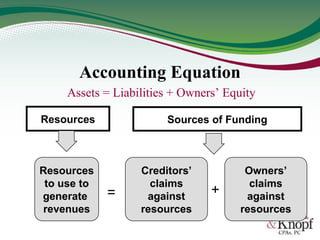
Accounting Equation
Assets = Liabilities + Owners’ Equity
Sources of Funding
Creditors’
claims
against
resources
= +
Owners’
claims
against
resources
Resources
Resources
to use to
generate
revenues
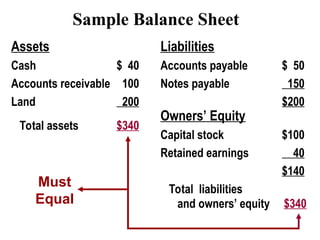
Assets
Cash $ 40
Accounts receivable 100
Land 200
Total assets $340
Liabilities
Accounts payable $ 50
Notes payable 150
$200
Owners’ Equity
Capital stock $100
Retained earnings 40
$140
Total liabilities
and owners’ equity $340
Sample Balance Sheet
Must
Equal
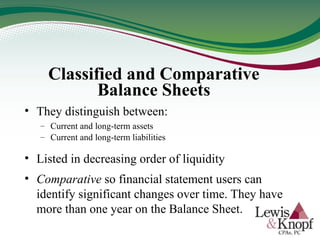
Classified and Comparative
Balance Sheets
• They distinguish between:
– Current and long-term assets
– Current and long-term liabilities
• Listed in decreasing order of liquidity
• Comparative so financial statement users can
identify significant changes over time. They have
more than one year on the Balance Sheet.
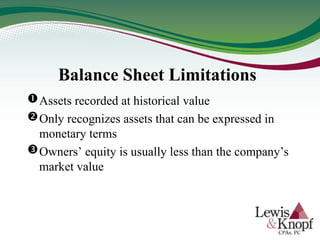
Balance Sheet Limitations
Assets recorded at historical value
Only recognizes assets that can be expressed in
monetary terms
Owners’ equity is usually less than the company’s
market value
The Income Statement
• Shows the results of a company’s operations over a
period of time.
• What goods were sold or services performed that
provided revenue for the company?
• What costs were incurred in normal operations to
generate these revenues?
• What are the earnings or company profit?
The Income Statement
Revenues
• Assets (cash or AR) created through business
operations
Expenses
• Assets (cash or AP) consumed through business
operations
Net Income or (Net Loss)
• Revenues - Expenses
McGraw-Hill/Irwin, 2003
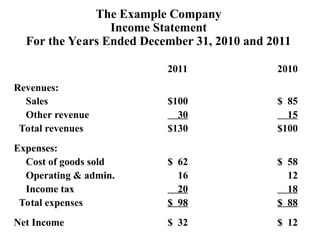
The Example Company
Income Statement
For the Years Ended December 31, 2010 and 2011
2011 2010
Revenues:
Sales $100 $ 85
Other revenue 30 15
Total revenues $130 $100
Expenses:
Cost of goods sold $ 62 $ 58
Operating & admin. 16 12
Income tax 20 18
Total expenses $ 98 $ 88
Net Income $ 32 $ 12
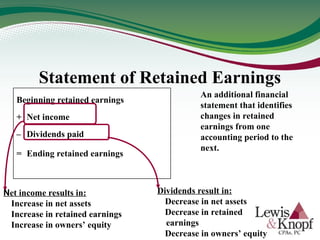
An additional financial
statement that identifies
changes in retained
earnings from one
accounting period to the
next.
Statement of Retained Earnings
Beginning retained earnings
+ Net income
– Dividends paid
= Ending retained earnings
Net income results in:
Increase in net assets
Increase in retained earnings
Increase in owners’ equity
Dividends result in:
Decrease in net assets
Decrease in retained
earnings
Decrease in owners’ equity
Statement of Cash Flows
• Reports the amount of cash collected and paid out
by a company in operating, investing and
financing activities for a period of time.
• How did the company receive cash?
• How did the company use its cash?
• Complementary to the income statement.
• Indicates ability of a company to generate income
in the future.
Statement of Cash Flows
Cash inflows
• Sell goods or services
• Sell other assets or by borrowing
• Receive cash from investments by owners
Cash outflows
• Pay operating expenses
• Expand operations, repay loans
• Pay owners a return on investment
Match Classification of
Cash Flows
• Operating activities – Transactions and events
that enter into the determination of net income.
• Investing activities – Transactions and events that
involve the purchase and sale of securities,
property, plant, equipment, and other assets not
generally held for resale, and the making and
collecting of loans.
• Financing activities – Transactions and events
whereby resources and obtained from, or
repaid to, owners and creditors.
Operating Activities
Cash Inflow
• Sale of goods or
services
• Sale of investments
in trading securities
• Interest revenue
• Dividend revenue
Cash Outflow
• Inventory payments
• Interest payments
• Wages
• Utilities, rent
• Taxes
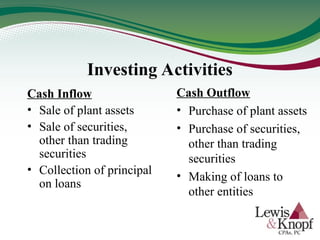
Investing Activities
Cash Inflow
• Sale of plant assets
• Sale of securities,
other than trading
securities
• Collection of principal
on loans
Cash Outflow
• Purchase of plant assets
• Purchase of securities,
other than trading
securities
• Making of loans to
other entities
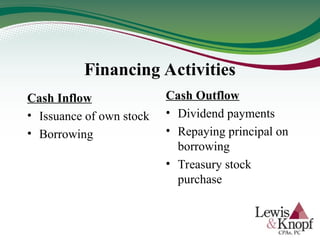
Financing Activities
Cash Inflow
• Issuance of own stock
• Borrowing
Cash Outflow
• Dividend payments
• Repaying principal on
borrowing
• Treasury stock
purchase
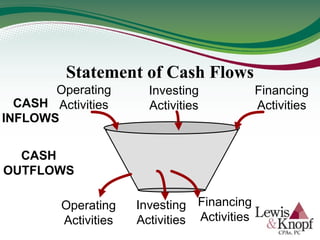
CASH
OUTFLOWS
Operating
Activities
Financing
Activities
Investing
Activities
CASH
INFLOWS
Financing
Activities
Operating
Activities
Investing
Activities
Statement of Cash Flows
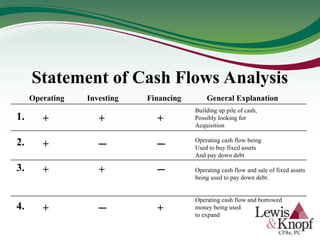
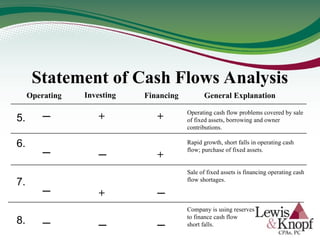
Statement of Cash Flows Analysis
Operating Investing Financing General Explanation
Building up pile of cash,
Possibly looking for
Acquisition
Operating cash flow being
Used to buy fixed assets
And pay down debt
Operating cash flow and sale of fixed assets
being used to pay down debt.
Operating cash flow and borrowed
money being used
to expand
1.
2.
3.
4.
+
+
+
+
+
─
+
─
+
─
─
+
Statement of Cash Flows Analysis
Operating Investing Financing General Explanation
Operating cash flow problems covered by sale
of fixed assets, borrowing and owner
contributions.
Rapid growth, short falls in operating cash
flow; purchase of fixed assets.
Sale of fixed assets is financing operating cash
flow shortages.
Company is using reserves
to finance cash flow
short falls.
5.
6.
7.
8.
─
─
─
─
+
─
+
─
+
+
─
─
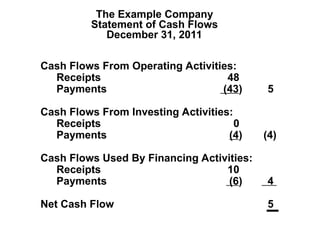
The Example Company
Statement of Cash Flows
December 31, 2011
Cash Flows From Operating Activities:
Receipts 48
Payments (43) 5
Cash Flows From Investing Activities:
Receipts 0
Payments (4) (4)
Cash Flows Used By Financing Activities:
Receipts 10
Payments (6) 4
Net Cash Flow 5
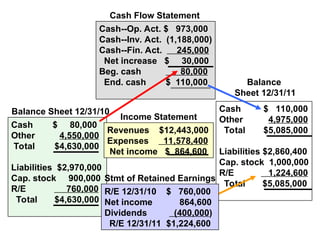
Balance Sheet 12/31/10
Cash $ 80,000
Other 4,550,000
Total $4,630,000
Liabilities $2,970,000
Cap. stock 900,000
R/E 760,000
Total $4,630,000
Revenues $12,443,000
Expenses 11,578,400
Net income $ 864,600
Income Statement
Cash $ 110,000
Other 4,975,000
Total $5,085,000
Liabilities $2,860,400
Cap. stock 1,000,000
R/E 1,224,600
Total $5,085,000
Balance
Sheet 12/31/11
Cash--Op. Act. $ 973,000
Cash--Inv. Act. (1,188,000)
Cash--Fin. Act. 245,000
Net increase $ 30,000
Beg. cash 80,000
End. cash $ 110,000
Cash Flow Statement
R/E 12/31/10 $ 760,000
Net income 864,600
Dividends (400,000)
R/E 12/31/11 $1,224,600
Stmt of Retained Earnings
Notes to the Financial Statements
• Notes are used to convey information required
by GAAP or to provide further explanation.
Notes to the Financial Statements
Four general types of notes:
Summary of significant accounting policies:
assumptions and estimates.
Additional information about the summary totals.
Disclosure of important information that is not
recognized in the financial statements.
Supplementary information required by the FASB or
the SEC.
• Separate Entity Concept
• Arm’s-Length Transactions
• Cost Principle
• Monetary Measurement Concept
• Going Concern Assumption
What Are The Fundamental
Concepts and Assumptions?
Entity ─ The organizational unit for which
accounting records are maintained.
Separate entity concept ─ The activities of an
entity are to be separate from those of its individual
owners.
• Proprietorship
• Partnership
• Corporation
Separate Entity Concept
The Cost Principle
• All transactions are recorded at historical cost.
• Historical cost is assumed to represent the fair
market value of the item at the date of the transaction
because it reflects the actual use of resources by
independent parties.
The Monetary Measurement
Concept
• Accountants measure only those economic activities
that can be measured in monetary terms.
• Listed values may not be the same as actual market
values:
– Inflation
– Measurement issues
The Going Concern Assumption
• An entity will have a continuing existence for the
foreseeable future.
Why Use Accrual Accounting?
• GAAP – Generally Accepted Accounting
Principles
• Business requires periodic, timely reporting
• Accrual-basis accounting better measures a firm’s
performance than does cash flow data.
The Time Period Concept
The life of a business is divided into distinct and
relatively short time periods so the accounting
information can be timely, generally 12 months or
less.
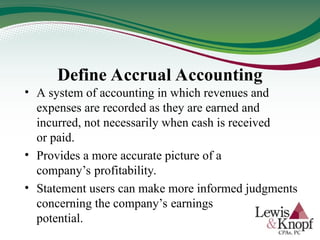
Define Accrual Accounting
• A system of accounting in which revenues and
expenses are recorded as they are earned and
incurred, not necessarily when cash is received
or paid.
• Provides a more accurate picture of a
company’s profitability.
• Statement users can make more informed judgments
concerning the company’s earnings
potential.
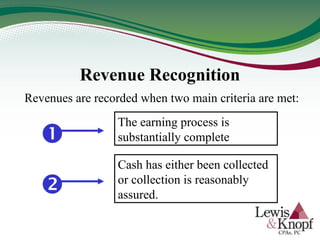
Revenue Recognition
Revenues are recorded when two main criteria are met:
Cash has either been collected
or collection is reasonably
assured.
The earning process is
substantially complete


The Matching Principle
• All costs and expenses incurred in generating
revenues must be recognized in the same
reporting period as the related revenues.
• This process of matching expenses with
recognized revenues determines the amount of net
income reported on the income statement.
costs and expenses
related revenues
Cash-Basis Accounting
• Revenues and expenses are recognized only when
cash is received or payments are made.
• Mainly used by small businesses.
• Not an accurate picture of true profitability.
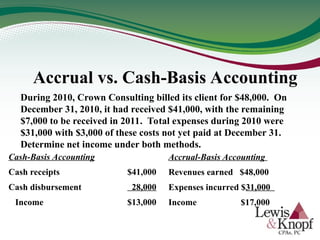
During 2010, Crown Consulting billed its client for $48,000. On
December 31, 2010, it had received $41,000, with the remaining
$7,000 to be received in 2011. Total expenses during 2010 were
$31,000 with $3,000 of these costs not yet paid at December 31.
Determine net income under both methods.
Cash-Basis Accounting
Cash receipts $41,000
Cash disbursement 28,000
Income $13,000
Accrual-Basis Accounting
Revenues earned $48,000
Expenses incurred $31,000
Income $17,000
Accrual vs. Cash-Basis Accounting
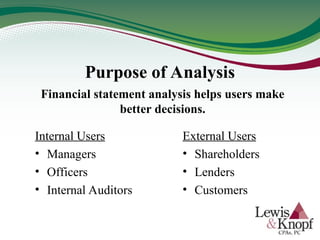
Purpose of Analysis
Internal Users
• Managers
• Officers
• Internal Auditors
External Users
• Shareholders
• Lenders
• Customers
Financial statement analysis helps users make
better decisions.
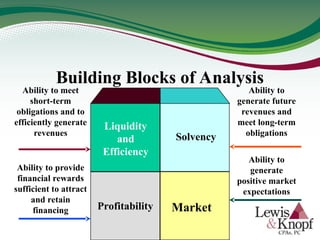
Liquidity
and
Efficiency
Solvency
Profitability Market
Ability to meet
short-term
obligations and to
efficiently generate
revenues
Ability to
generate future
revenues and
meet long-term
obligations
Ability to
generate
positive market
expectations
Ability to provide
financial rewards
sufficient to attract
and retain
financing
Building Blocks of Analysis
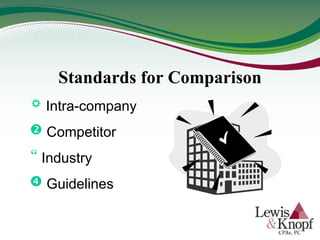
 Intra-company
 Competitor
 Industry
 Guidelines
Standards for Comparison
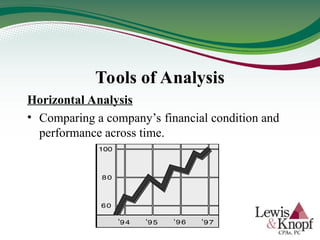
Tools of Analysis
Horizontal Analysis
• Comparing a company’s financial condition and
performance across time.
Tools of Analysis
Vertical Analysis
• Comparing a company’s financial condition and
performance to a base amount.
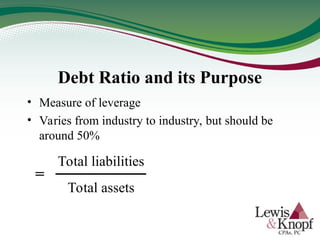
Debt Ratio and its Purpose
• Measure of leverage
• Varies from industry to industry, but should be
around 50%
Total liabilities
Total assets
=
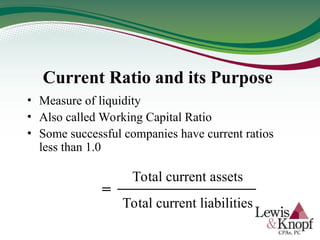
Current Ratio and its Purpose
• Measure of liquidity
• Also called Working Capital Ratio
• Some successful companies have current ratios
less than 1.0
Total current assets
Total current liabilities
=
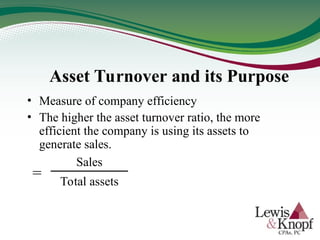
Asset Turnover and its Purpose
• Measure of company efficiency
• The higher the asset turnover ratio, the more
efficient the company is using its assets to
generate sales.
Sales
Total assets
=
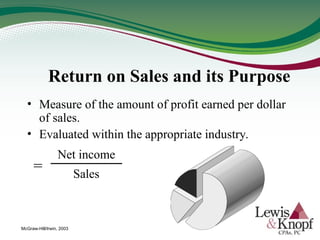
Return on Sales and its Purpose
• Measure of the amount of profit earned per dollar
of sales.
• Evaluated within the appropriate industry.
Net income
Sales
=
McGraw-Hill/Irwin, 2003
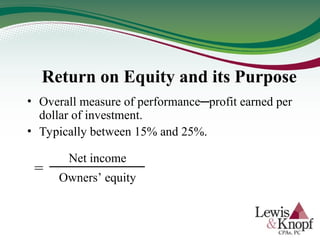
Return on Equity and its Purpose
• Overall measure of performance─profit earned per
dollar of investment.
• Typically between 15% and 25%.
Net income
Owners’ equity
=
Thank You!

Reporting_and_Financial_Statements_1.ppt

  • 1.
    Reading & UnderstandingBasic Financial Statements …make better use of the information in financial statements
  • 2.
    Lewis & KnopfCPAs, P.C. • AICPA • MACPA • Builders Association of Metro Flint • Flint, Fenton & Grand Blanc Chambers of Commerce • West Flint Business Association
  • 3.
    Lewis & KnopfCPAs, P.C. Services Include: • Profitability and Efficiency Analysis • Projections and Business Plans • Business Valuations • Auditing & Assurance • Estate and Gift Planning • Tax Planning and Preparation • Traditional Accounting, Bookkeeping and Payroll Services
  • 4.
    Agenda • Purpose offinancial statements • The Balance Sheet • The Income Statement • Statement of Retained Earnings • Statement of Cash Flows • Notes to the financial statements • Fundamental concepts and assumptions • Accrual vs. cash-basis accounting • Standards for comparison • Tools of analysis
  • 5.
    Primary Financial Statements Basicfinancial statements: Balance Sheet Income Statement  Statement of Retained Earnings Statement of Cash Flows
  • 6.
    Primary Financial Statements •Primary financial statements answer basic questions including: – What is the company’s current financial status? – What was the company’s operating results for the period? – How did the company obtain and use cash during the period?
  • 7.
    • Summary ofthe financial position of a company at a particular date • Assets: cash, accounts receivable, inventory, land, buildings, equipment and intangible items • Liabilities: accounts payable, notes payable and mortgages payable • Owners’ Equity: net assets after all obligations have been satisfied The Balance Sheet
  • 8.
    The Balance Sheet •What are the resources of the company? • What are the company’s existing obligations? • What are the company’s net assets?
  • 9.
    Accounting Equation Assets =Liabilities + Owners’ Equity Sources of Funding Creditors’ claims against resources = + Owners’ claims against resources Resources Resources to use to generate revenues
  • 10.
    Assets Cash $ 40 Accountsreceivable 100 Land 200 Total assets $340 Liabilities Accounts payable $ 50 Notes payable 150 $200 Owners’ Equity Capital stock $100 Retained earnings 40 $140 Total liabilities and owners’ equity $340 Sample Balance Sheet Must Equal
  • 11.
    Classified and Comparative BalanceSheets • They distinguish between: – Current and long-term assets – Current and long-term liabilities • Listed in decreasing order of liquidity • Comparative so financial statement users can identify significant changes over time. They have more than one year on the Balance Sheet.
  • 12.
    Balance Sheet Limitations Assetsrecorded at historical value Only recognizes assets that can be expressed in monetary terms Owners’ equity is usually less than the company’s market value
  • 13.
    The Income Statement •Shows the results of a company’s operations over a period of time. • What goods were sold or services performed that provided revenue for the company? • What costs were incurred in normal operations to generate these revenues? • What are the earnings or company profit?
  • 14.
    The Income Statement Revenues •Assets (cash or AR) created through business operations Expenses • Assets (cash or AP) consumed through business operations Net Income or (Net Loss) • Revenues - Expenses McGraw-Hill/Irwin, 2003
  • 15.
    The Example Company IncomeStatement For the Years Ended December 31, 2010 and 2011 2011 2010 Revenues: Sales $100 $ 85 Other revenue 30 15 Total revenues $130 $100 Expenses: Cost of goods sold $ 62 $ 58 Operating & admin. 16 12 Income tax 20 18 Total expenses $ 98 $ 88 Net Income $ 32 $ 12
  • 16.
    An additional financial statementthat identifies changes in retained earnings from one accounting period to the next. Statement of Retained Earnings Beginning retained earnings + Net income – Dividends paid = Ending retained earnings Net income results in: Increase in net assets Increase in retained earnings Increase in owners’ equity Dividends result in: Decrease in net assets Decrease in retained earnings Decrease in owners’ equity
  • 17.
    Statement of CashFlows • Reports the amount of cash collected and paid out by a company in operating, investing and financing activities for a period of time. • How did the company receive cash? • How did the company use its cash? • Complementary to the income statement. • Indicates ability of a company to generate income in the future.
  • 18.
    Statement of CashFlows Cash inflows • Sell goods or services • Sell other assets or by borrowing • Receive cash from investments by owners Cash outflows • Pay operating expenses • Expand operations, repay loans • Pay owners a return on investment
  • 19.
    Match Classification of CashFlows • Operating activities – Transactions and events that enter into the determination of net income. • Investing activities – Transactions and events that involve the purchase and sale of securities, property, plant, equipment, and other assets not generally held for resale, and the making and collecting of loans. • Financing activities – Transactions and events whereby resources and obtained from, or repaid to, owners and creditors.
  • 20.
    Operating Activities Cash Inflow •Sale of goods or services • Sale of investments in trading securities • Interest revenue • Dividend revenue Cash Outflow • Inventory payments • Interest payments • Wages • Utilities, rent • Taxes
  • 21.
    Investing Activities Cash Inflow •Sale of plant assets • Sale of securities, other than trading securities • Collection of principal on loans Cash Outflow • Purchase of plant assets • Purchase of securities, other than trading securities • Making of loans to other entities
  • 22.
    Financing Activities Cash Inflow •Issuance of own stock • Borrowing Cash Outflow • Dividend payments • Repaying principal on borrowing • Treasury stock purchase
  • 23.
  • 24.
    Statement of CashFlows Analysis Operating Investing Financing General Explanation Building up pile of cash, Possibly looking for Acquisition Operating cash flow being Used to buy fixed assets And pay down debt Operating cash flow and sale of fixed assets being used to pay down debt. Operating cash flow and borrowed money being used to expand 1. 2. 3. 4. + + + + + ─ + ─ + ─ ─ +
  • 25.
    Statement of CashFlows Analysis Operating Investing Financing General Explanation Operating cash flow problems covered by sale of fixed assets, borrowing and owner contributions. Rapid growth, short falls in operating cash flow; purchase of fixed assets. Sale of fixed assets is financing operating cash flow shortages. Company is using reserves to finance cash flow short falls. 5. 6. 7. 8. ─ ─ ─ ─ + ─ + ─ + + ─ ─
  • 26.
    The Example Company Statementof Cash Flows December 31, 2011 Cash Flows From Operating Activities: Receipts 48 Payments (43) 5 Cash Flows From Investing Activities: Receipts 0 Payments (4) (4) Cash Flows Used By Financing Activities: Receipts 10 Payments (6) 4 Net Cash Flow 5
  • 27.
    Balance Sheet 12/31/10 Cash$ 80,000 Other 4,550,000 Total $4,630,000 Liabilities $2,970,000 Cap. stock 900,000 R/E 760,000 Total $4,630,000 Revenues $12,443,000 Expenses 11,578,400 Net income $ 864,600 Income Statement Cash $ 110,000 Other 4,975,000 Total $5,085,000 Liabilities $2,860,400 Cap. stock 1,000,000 R/E 1,224,600 Total $5,085,000 Balance Sheet 12/31/11 Cash--Op. Act. $ 973,000 Cash--Inv. Act. (1,188,000) Cash--Fin. Act. 245,000 Net increase $ 30,000 Beg. cash 80,000 End. cash $ 110,000 Cash Flow Statement R/E 12/31/10 $ 760,000 Net income 864,600 Dividends (400,000) R/E 12/31/11 $1,224,600 Stmt of Retained Earnings
  • 28.
    Notes to theFinancial Statements • Notes are used to convey information required by GAAP or to provide further explanation.
  • 29.
    Notes to theFinancial Statements Four general types of notes: Summary of significant accounting policies: assumptions and estimates. Additional information about the summary totals. Disclosure of important information that is not recognized in the financial statements. Supplementary information required by the FASB or the SEC.
  • 30.
    • Separate EntityConcept • Arm’s-Length Transactions • Cost Principle • Monetary Measurement Concept • Going Concern Assumption What Are The Fundamental Concepts and Assumptions?
  • 31.
    Entity ─ Theorganizational unit for which accounting records are maintained. Separate entity concept ─ The activities of an entity are to be separate from those of its individual owners. • Proprietorship • Partnership • Corporation Separate Entity Concept
  • 32.
    The Cost Principle •All transactions are recorded at historical cost. • Historical cost is assumed to represent the fair market value of the item at the date of the transaction because it reflects the actual use of resources by independent parties.
  • 33.
    The Monetary Measurement Concept •Accountants measure only those economic activities that can be measured in monetary terms. • Listed values may not be the same as actual market values: – Inflation – Measurement issues
  • 34.
    The Going ConcernAssumption • An entity will have a continuing existence for the foreseeable future.
  • 35.
    Why Use AccrualAccounting? • GAAP – Generally Accepted Accounting Principles • Business requires periodic, timely reporting • Accrual-basis accounting better measures a firm’s performance than does cash flow data.
  • 36.
    The Time PeriodConcept The life of a business is divided into distinct and relatively short time periods so the accounting information can be timely, generally 12 months or less.
  • 37.
    Define Accrual Accounting •A system of accounting in which revenues and expenses are recorded as they are earned and incurred, not necessarily when cash is received or paid. • Provides a more accurate picture of a company’s profitability. • Statement users can make more informed judgments concerning the company’s earnings potential.
  • 38.
    Revenue Recognition Revenues arerecorded when two main criteria are met: Cash has either been collected or collection is reasonably assured. The earning process is substantially complete  
  • 39.
    The Matching Principle •All costs and expenses incurred in generating revenues must be recognized in the same reporting period as the related revenues. • This process of matching expenses with recognized revenues determines the amount of net income reported on the income statement. costs and expenses related revenues
  • 40.
    Cash-Basis Accounting • Revenuesand expenses are recognized only when cash is received or payments are made. • Mainly used by small businesses. • Not an accurate picture of true profitability.
  • 41.
    During 2010, CrownConsulting billed its client for $48,000. On December 31, 2010, it had received $41,000, with the remaining $7,000 to be received in 2011. Total expenses during 2010 were $31,000 with $3,000 of these costs not yet paid at December 31. Determine net income under both methods. Cash-Basis Accounting Cash receipts $41,000 Cash disbursement 28,000 Income $13,000 Accrual-Basis Accounting Revenues earned $48,000 Expenses incurred $31,000 Income $17,000 Accrual vs. Cash-Basis Accounting
  • 42.
    Purpose of Analysis InternalUsers • Managers • Officers • Internal Auditors External Users • Shareholders • Lenders • Customers Financial statement analysis helps users make better decisions.
  • 43.
    Liquidity and Efficiency Solvency Profitability Market Ability tomeet short-term obligations and to efficiently generate revenues Ability to generate future revenues and meet long-term obligations Ability to generate positive market expectations Ability to provide financial rewards sufficient to attract and retain financing Building Blocks of Analysis
  • 44.
     Intra-company  Competitor Industry  Guidelines Standards for Comparison
  • 45.
    Tools of Analysis HorizontalAnalysis • Comparing a company’s financial condition and performance across time.
  • 46.
    Tools of Analysis VerticalAnalysis • Comparing a company’s financial condition and performance to a base amount.
  • 47.
    Debt Ratio andits Purpose • Measure of leverage • Varies from industry to industry, but should be around 50% Total liabilities Total assets =
  • 48.
    Current Ratio andits Purpose • Measure of liquidity • Also called Working Capital Ratio • Some successful companies have current ratios less than 1.0 Total current assets Total current liabilities =
  • 49.
    Asset Turnover andits Purpose • Measure of company efficiency • The higher the asset turnover ratio, the more efficient the company is using its assets to generate sales. Sales Total assets =
  • 50.
    Return on Salesand its Purpose • Measure of the amount of profit earned per dollar of sales. • Evaluated within the appropriate industry. Net income Sales = McGraw-Hill/Irwin, 2003
  • 51.
    Return on Equityand its Purpose • Overall measure of performance─profit earned per dollar of investment. • Typically between 15% and 25%. Net income Owners’ equity =
  • 52.