Management Accounting
Management     Accounting is "the process of
 identification, measurement, accumulation,
 analysis, preparation, interpretation and
 communication of information used by
 management to plan, evaluate and control within
 an entity and to assure appropriate use of and
 accountability for its resources.
Management accounting also comprises the
 preparation of financial reports for non-
 management groups such as shareholders,
 creditors, regulatory agencies and tax authorities.
Cost accounting is a central element of managerial
 accounting.
MEANING OF COST
ACCOUNTING
• Cost accounting is the process of
  determining and accumulating the cost of
  product or activity. It is a process of
  accounting for the incurrence and the
  control of cost.
• It also covers classification, analysis, and
  interpretation of cost.
• In other words, it is a system of accounting,
  which provides the information about the
  ascertainment, and control of costs of
  products, or services.
Scope of Cost Accounting
• Cost book-keeping: It involves maintaining complete
  record of all costs incurred from their incurrence to
  their charge to departments, products and services.
• Cost system: Systems and procedures are devised for
  proper accounting for costs.
• Cost ascertainment: Ascertaining cost of products,
  processes, jobs, services, etc., is the important function
  of cost accounting. Cost ascertainment becomes the
  basis of managerial decision making such as pricing,
  planning and control.
• Cost Analysis: It involves the process of finding out the
  causal factors of actual costs varying from the budgeted
  costs and fixation of responsibility for cost increases.
• Cost comparisons: Cost accounting also includes comparisons
  between cost from alternative courses of action such as use
  of technology for production, cost of making different
  products and activities, and cost of same product/ service
  over a period of time.
• Cost Control: Cost accounting is the utilization of cost information
  for exercising control. It involves a detailed examination of
  each cost in the light of benefit derived from the incurrence
  of the cost. Thus, we can state that cost is analyzed to
  know whether the current level of costs is satisfactory in
  the light of standards set in advance.
• Cost Reports: Presentation of cost is the ultimate function of cost
  accounting. These reports are primarily for use by the
  management at different levels. Cost Reports form the basis
  for planning and control, performance appraisal and
  managerial decision making.
Objectives of cost accounting
Determining    selling price,
Controlling cost
Providing information for decision-making
Ascertaining costing profit
Facilitating preparation of financial and
 other statements.
Importance of Cost accounting
1. Importance to Management
•   Helps in ascertainment of cost
•   Aids in Price fixation
•   Helps in Cost reduction Elimination of wastage
•   Helps in identifying unprofitable activities
•   Helps in checking the accuracy of financial
    account
•   Helps in fixing selling Prices
•   Helps in Inventory Control
•   Helps in estimate
2. Importance to Employees : Worker and
  employees have an interest in which they are
  employed. An efficient costing system benefits
  employees through incentives plan in their enterprise,
  etc.

3 Creditors : They can base their judgement about the
 profitability and prospects of the enterprise upon the
 studies and reports submitted by the cost accountant.

4. Importance to National Economy : An efficient
  costing system benefits national economy by stepping
  up the government revenue by achieving higher
  production. The overall economic developments of a
  country take place due to efficiency of production.
LIMITATIONS OF COST
     ACCOUNTING

• It is expensive
• The results shown by cost accountant differ
  from those shown by financial accountant.
• It is unnecessary because it involves
  duplication of work.
• Costing system itself does not control costs. If
  the management is alert and efficient, it can
  control cost without the help of the cost
  accounting. Therefore it is unnecessary.
What is cost?
Cost  is foregoing or sacrifice , measured
 in monetary terms, incurred or
 potentially to be incurred , to achieve a
 specific purpose.
Thus it has three features:
i. Sacrifice : it is current or future decrease in cash
    or other asset or increase in liabilities.
ii. Money value : it is always in monetary terms.
iii. Stated objective : it is some benefit in the
    future.
Important terminologies
Cost object : the purpose or object for
 which cost is measured is called cost
 object or cost unit. It may be unit of
 product, a machine, a job ,a
 department ,an order and so on.
Cost centre : When costs are
 accumulated for an organizational unit or
 department it is called cost centre.
Types of cost
1 Manufacturing Cost
• Direct cost : Cost associated directly
  with the final product.eg. Leather used
  for manufacturing shoes.
  It may be
  Direct Material : cost of raw material used
  to produce finished product.
  Direct Labor : cost of labor used for
  converting raw material into finished
  product.
•   Indirect cost : Cost which cannot be directly identified
    with the cost object. Eg Salary of the watchman.

    It may be
    Indirect Material : cost of material which do not become
    a part of finished product.eg. Grease.
    Indirect Labor : cost of labor not used for converting
    raw material into finished product.eg salary of clerk.

•   Factory overhead : All manufacturing cost except direct
    material and labour are included in factory overhead.
    Indirect material and labor cost are included in Factory
    overhead.Other Eg. Rent, power, taxes etc.
2 Non Manufacturing cost
Distribution cost : cost incurred to
  perform marketing functions.Also known
  as selling cost or marketing cost.
General and administrative costs : cost
  not covered under any of the
  categories.eg salary of the
  administrators , accounting cost etc.
Cost Concept
Classification of Cost Concept according to
 management needs:
Income Measurement
Profit Planning
Costs Control
Special Situations requiring special
 decisions
Cost Concept relating to income
measurement
Product  cost and period cost
Absorbed and unabsorbed cost
Expired and Unexpired cost
Joint product cost and separable cost
Product cost and period cost
Product    cost : These cost are identified
 with goods produced or purchased for
 resale.
Example – raw material and direct labor
 cost
Period cost : they vary with passage of
 time and not volume of production.
Example – Rent, insurance premium, salary.
 Thus these cost are matched against the
 revenue of the current period.
Absorbed and unabsorbed cost
• Fixed cost add value to the product and
  this value is well taken into account in
  determining the selling price.
• Therefore, these costs must be absorbed
  by the revenue of the period in which the
  product have been sold and not
  necessarily in the year in which they have
  been incurred.
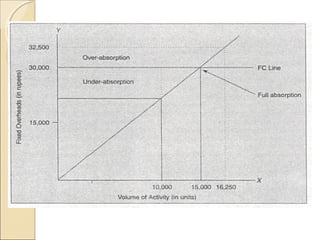
• Let us understand this concept with the
  help of Example and graph.
Suppose   that the fixed coat are Rs. 30000
 normal production is 15000 units.it means
 every unit of product absorbs Rs. 2 of Fixed
 cost.Thus absorbed cost is the which is
 charged to production.
Now if company produce only 10000 units
 then cost incurred is Rs.20000 and Rs. 10000
 constitute unabsorbed cost.Thus unabsorbed
 cost is cost which remains uncharged to
 production.(This happens when production is
 below normal production)
Now  if company produce 16250 units
then cost incurred is Rs.32500 and Rs.
2500 constitute over absorbed cost.(This
happens when production is above
normal production)
Expired and unexpired cost
An  Expired cost is one which cannot
 contribute to the production of the
 future revenues. It is a cost that has been
 recognized as an expense. When an
 entity fully consumes or receives benefit
 from a cost it is an expired cost.

Unexpired   cost is one which has
 capability of contributing to the
 production of revenue in the future.
Joint Product cost & Separable
cost
Jointproduct cost are the cost of a single
 process or a series of processes that
 simultaneously produce two or more
 products of significant sales value.

Separable  cost refers to any cost that can
 be attributed to particular product or
 process.
Cost concept relating to profit
planning
Fixed   , variable and semi- variable/mixed
 cost
Future cost and budgeted cost
Fixed , variable and semi-
variable cost
Fixed  cost are costs associated with
 those inputs which do not vary with
 changes in the volume of output or
 activity within specified range of activity
 or output for a given budget period. Eg.
 Rent of factory.
Variable cost tend to vary in total in the
 direct proportion or in a one to one
 relationship to changes in production
 activity. Eg. Material cost , direct labor
 cost.
Future cost and Budgeted cost
Future  cost are reasonably expected to
 be incurred at some future date as a
 result of a current decision.

Budgeted   costs when an operating plan
 involving future costs is accepted and
 incorporated formally in the budget for a
 specific period , such cost get converted
 to what is called budgeted costs.
Cost concept for Decision
making
Relavantand irrelivant cost
Incremental cost/ differential cost
Out of pocket cost and sunk cost
Opportunity cost and imputed cost
Relevant Cost
It is a cost that differs between
 alternatives being considered.
Cost which is influenced by decisions is a
 relevant cost and hence it is important
 for decision makers.
Examples are Incremental
 cost/Differential cost which are the cost
 which will be incurred if management
 chooses one course of action as opposed
 to another.
Irrelevant Cost
Irrelevant cost are not affected by a
 decision, regardless of the choice that is
 made.
Sunk costs are the examples
Sunk cost are the cost which have
 already been incurred in past and will not
 require current cash expenditure.
Depreciation , cost of issue of new
 shares and debentures are the examples
 of Sunk cost.
Out of Pocket cost
These   are the costs which will be
 required currently or in near future in
 cash are out of the pocket costs.
It is wrong to say that all fixed cost are
 sunk cost and all variable cost are out of
 pocket cost
Salary of CEO is fixed but it is not sunk
 because it will be paid in near future so it
 is out of pocket
If manufacturing process change and
Opportunity cost
Opportunity    cost represents the benefits
 foregone by not choosing the second best
 alternative in favor of the best one.
These are associated only with feasible
 alternatives.

An   imputed cost is any cost that results
 from using an asset instead of renting,
 selling, or lending it. The term also applies
 to forgone income from choosing not to

Management Accounting

  • 1.
  • 2.
    Management Accounting Management Accounting is "the process of identification, measurement, accumulation, analysis, preparation, interpretation and communication of information used by management to plan, evaluate and control within an entity and to assure appropriate use of and accountability for its resources. Management accounting also comprises the preparation of financial reports for non- management groups such as shareholders, creditors, regulatory agencies and tax authorities. Cost accounting is a central element of managerial accounting.
  • 3.
    MEANING OF COST ACCOUNTING •Cost accounting is the process of determining and accumulating the cost of product or activity. It is a process of accounting for the incurrence and the control of cost. • It also covers classification, analysis, and interpretation of cost. • In other words, it is a system of accounting, which provides the information about the ascertainment, and control of costs of products, or services.
  • 4.
    Scope of CostAccounting • Cost book-keeping: It involves maintaining complete record of all costs incurred from their incurrence to their charge to departments, products and services. • Cost system: Systems and procedures are devised for proper accounting for costs. • Cost ascertainment: Ascertaining cost of products, processes, jobs, services, etc., is the important function of cost accounting. Cost ascertainment becomes the basis of managerial decision making such as pricing, planning and control. • Cost Analysis: It involves the process of finding out the causal factors of actual costs varying from the budgeted costs and fixation of responsibility for cost increases.
  • 5.
    • Cost comparisons:Cost accounting also includes comparisons between cost from alternative courses of action such as use of technology for production, cost of making different products and activities, and cost of same product/ service over a period of time. • Cost Control: Cost accounting is the utilization of cost information for exercising control. It involves a detailed examination of each cost in the light of benefit derived from the incurrence of the cost. Thus, we can state that cost is analyzed to know whether the current level of costs is satisfactory in the light of standards set in advance. • Cost Reports: Presentation of cost is the ultimate function of cost accounting. These reports are primarily for use by the management at different levels. Cost Reports form the basis for planning and control, performance appraisal and managerial decision making.
  • 6.
    Objectives of costaccounting Determining selling price, Controlling cost Providing information for decision-making Ascertaining costing profit Facilitating preparation of financial and other statements.
  • 7.
    Importance of Costaccounting 1. Importance to Management • Helps in ascertainment of cost • Aids in Price fixation • Helps in Cost reduction Elimination of wastage • Helps in identifying unprofitable activities • Helps in checking the accuracy of financial account • Helps in fixing selling Prices • Helps in Inventory Control • Helps in estimate
  • 8.
    2. Importance toEmployees : Worker and employees have an interest in which they are employed. An efficient costing system benefits employees through incentives plan in their enterprise, etc. 3 Creditors : They can base their judgement about the profitability and prospects of the enterprise upon the studies and reports submitted by the cost accountant. 4. Importance to National Economy : An efficient costing system benefits national economy by stepping up the government revenue by achieving higher production. The overall economic developments of a country take place due to efficiency of production.
  • 9.
    LIMITATIONS OF COST ACCOUNTING • It is expensive • The results shown by cost accountant differ from those shown by financial accountant. • It is unnecessary because it involves duplication of work. • Costing system itself does not control costs. If the management is alert and efficient, it can control cost without the help of the cost accounting. Therefore it is unnecessary.
  • 10.
    What is cost? Cost is foregoing or sacrifice , measured in monetary terms, incurred or potentially to be incurred , to achieve a specific purpose. Thus it has three features: i. Sacrifice : it is current or future decrease in cash or other asset or increase in liabilities. ii. Money value : it is always in monetary terms. iii. Stated objective : it is some benefit in the future.
  • 11.
    Important terminologies Cost object: the purpose or object for which cost is measured is called cost object or cost unit. It may be unit of product, a machine, a job ,a department ,an order and so on. Cost centre : When costs are accumulated for an organizational unit or department it is called cost centre.
  • 12.
    Types of cost 1Manufacturing Cost • Direct cost : Cost associated directly with the final product.eg. Leather used for manufacturing shoes. It may be Direct Material : cost of raw material used to produce finished product. Direct Labor : cost of labor used for converting raw material into finished product.
  • 13.
    Indirect cost : Cost which cannot be directly identified with the cost object. Eg Salary of the watchman. It may be Indirect Material : cost of material which do not become a part of finished product.eg. Grease. Indirect Labor : cost of labor not used for converting raw material into finished product.eg salary of clerk. • Factory overhead : All manufacturing cost except direct material and labour are included in factory overhead. Indirect material and labor cost are included in Factory overhead.Other Eg. Rent, power, taxes etc.
  • 14.
    2 Non Manufacturingcost Distribution cost : cost incurred to perform marketing functions.Also known as selling cost or marketing cost. General and administrative costs : cost not covered under any of the categories.eg salary of the administrators , accounting cost etc.
  • 15.
    Cost Concept Classification ofCost Concept according to management needs: Income Measurement Profit Planning Costs Control Special Situations requiring special decisions
  • 16.
    Cost Concept relatingto income measurement Product cost and period cost Absorbed and unabsorbed cost Expired and Unexpired cost Joint product cost and separable cost
  • 17.
    Product cost andperiod cost Product cost : These cost are identified with goods produced or purchased for resale. Example – raw material and direct labor cost Period cost : they vary with passage of time and not volume of production. Example – Rent, insurance premium, salary. Thus these cost are matched against the revenue of the current period.
  • 18.
    Absorbed and unabsorbedcost • Fixed cost add value to the product and this value is well taken into account in determining the selling price. • Therefore, these costs must be absorbed by the revenue of the period in which the product have been sold and not necessarily in the year in which they have been incurred. • Let us understand this concept with the help of Example and graph.
  • 19.
    Suppose that the fixed coat are Rs. 30000 normal production is 15000 units.it means every unit of product absorbs Rs. 2 of Fixed cost.Thus absorbed cost is the which is charged to production. Now if company produce only 10000 units then cost incurred is Rs.20000 and Rs. 10000 constitute unabsorbed cost.Thus unabsorbed cost is cost which remains uncharged to production.(This happens when production is below normal production)
  • 20.
    Now ifcompany produce 16250 units then cost incurred is Rs.32500 and Rs. 2500 constitute over absorbed cost.(This happens when production is above normal production)
  • 22.
    Expired and unexpiredcost An Expired cost is one which cannot contribute to the production of the future revenues. It is a cost that has been recognized as an expense. When an entity fully consumes or receives benefit from a cost it is an expired cost. Unexpired cost is one which has capability of contributing to the production of revenue in the future.
  • 23.
    Joint Product cost& Separable cost Jointproduct cost are the cost of a single process or a series of processes that simultaneously produce two or more products of significant sales value. Separable cost refers to any cost that can be attributed to particular product or process.
  • 24.
    Cost concept relatingto profit planning Fixed , variable and semi- variable/mixed cost Future cost and budgeted cost
  • 25.
    Fixed , variableand semi- variable cost Fixed cost are costs associated with those inputs which do not vary with changes in the volume of output or activity within specified range of activity or output for a given budget period. Eg. Rent of factory. Variable cost tend to vary in total in the direct proportion or in a one to one relationship to changes in production activity. Eg. Material cost , direct labor cost.
  • 26.
    Future cost andBudgeted cost Future cost are reasonably expected to be incurred at some future date as a result of a current decision. Budgeted costs when an operating plan involving future costs is accepted and incorporated formally in the budget for a specific period , such cost get converted to what is called budgeted costs.
  • 27.
    Cost concept forDecision making Relavantand irrelivant cost Incremental cost/ differential cost Out of pocket cost and sunk cost Opportunity cost and imputed cost
  • 28.
    Relevant Cost It isa cost that differs between alternatives being considered. Cost which is influenced by decisions is a relevant cost and hence it is important for decision makers. Examples are Incremental cost/Differential cost which are the cost which will be incurred if management chooses one course of action as opposed to another.
  • 29.
    Irrelevant Cost Irrelevant costare not affected by a decision, regardless of the choice that is made. Sunk costs are the examples Sunk cost are the cost which have already been incurred in past and will not require current cash expenditure. Depreciation , cost of issue of new shares and debentures are the examples of Sunk cost.
  • 30.
    Out of Pocketcost These are the costs which will be required currently or in near future in cash are out of the pocket costs. It is wrong to say that all fixed cost are sunk cost and all variable cost are out of pocket cost Salary of CEO is fixed but it is not sunk because it will be paid in near future so it is out of pocket If manufacturing process change and
  • 31.
    Opportunity cost Opportunity cost represents the benefits foregone by not choosing the second best alternative in favor of the best one. These are associated only with feasible alternatives. An imputed cost is any cost that results from using an asset instead of renting, selling, or lending it. The term also applies to forgone income from choosing not to