theory
 All human languages are innate.
Babies

are

programmed

to

distinguish

between ungrammatical and grammatical.
 Environment makes a basic contribution.
 Interaction between people and objects
 The importance of the environment
 Children seem to be aware that language is rule
governed.
 They get engaged with the search of language
rules.
E.g. Use of negatives - No jump – Don´t jump
1) Earliest vocalization
2) Cooing – velar sounds

3) Babbling – vowel sounds – fricative – nasal
4) 9 months – use vocalization to express
emotions and emphasis
 12 – 18 months a child speaks single - words
 Generally these words are objects
milk - Mummy – Daddy – door - toy
 A child is able to speak two separated words
and combined them to get a meaning.
 Context is essential.
Eg. Milk and cookies.
o possession
o request
o Catch someone´s attention
 Two – Three years old

 Telegraph format
 Multi-words utterances
 E.g. Emma want doll
The child linguistic production is a matter of
trying out constructions and testing if they

work or not.
1. Present progressive

- ING-

2. Plural – ‘s
3. Irregular past form
4. Possessives - Joe‘s

5. Copula - Joe is happy
6. Regular past - ed
7. Third person singular simple present - He says..
8. auxiliary be
Stage 1
No. No doll .

Stage 2
Mum no doll
Don´t touch my doll
Stage 3

I can´t do that. He don´t know

Stage 4
You didn´t bring me the doll.

She doesn´t want it.
Wh- questions

1. What?
2. Where? Who?
3. Why?
4. When? How?
Stage 1
 Cookie? My doll?
 Where´s dad? What´s that?

Stage 2


You like this?
Stage 3
 Can I go? Are you there?
 Fronting – Do I can have a cookie?
Stage 4



Are you going to play with me?

 Do dogs like ice-cream?
Stage 5
 Wh- questions
 Yes-No questions
 Negative questions are still a bit
difficult.
Stage 6
 Children are able to correctly form all
questions types.
Limited vocabulary and different meanings
Acquisition: refers to the gradual development of
ability in a language by using it naturally.
Learning: conscious process of accumulating
knowledge of vocabulary and grammar.
 Universal Grammar
 Lack of time to acquire a language.
 Known of the language.
 Difficulties in pronunciation.
 http://www.youtube.com/watch?v=Z907QwXpU
qA
 Unwilling or embarrassment
 Lack of empathy with the culture
 Grammar-translation
 Long list of words.
 Memorize grammatical rules.
 Emphasis on the written language.
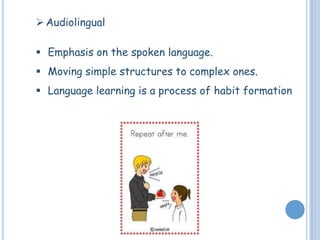
 Audiolingual

 Emphasis on the spoken language.
 Moving simple structures to complex ones.
 Language learning is a process of habit formation
 Direct
 No translation is allowed
 The meaning is to be conveyed through the use
of demonstration and visual aids.
Linguistic system and considered the basis of all L2
production.
 Once L2 learners achieve success they
feel more motivated to learn.
 Use L2 . accurately, appropriately and flexibly


Grammatical competence involves the accurate use
of words and structures in L2.



Sociolinguistic competence enable students to learn
to know when to say what to whom.



Strategic competence is the ability to organize a
message effectively and to overcome if there is
any difficulty.

FIRST LANGUAGE AND SECOND LANGUAGE ACQUISITION

  • 4.
  • 5.
     All humanlanguages are innate. Babies are programmed to distinguish between ungrammatical and grammatical.  Environment makes a basic contribution.
  • 6.
     Interaction betweenpeople and objects  The importance of the environment
  • 8.
     Children seemto be aware that language is rule governed.  They get engaged with the search of language rules. E.g. Use of negatives - No jump – Don´t jump
  • 9.
    1) Earliest vocalization 2)Cooing – velar sounds 3) Babbling – vowel sounds – fricative – nasal 4) 9 months – use vocalization to express emotions and emphasis
  • 10.
     12 –18 months a child speaks single - words  Generally these words are objects milk - Mummy – Daddy – door - toy
  • 11.
     A childis able to speak two separated words and combined them to get a meaning.  Context is essential. Eg. Milk and cookies. o possession o request o Catch someone´s attention
  • 12.
     Two –Three years old  Telegraph format  Multi-words utterances  E.g. Emma want doll
  • 13.
    The child linguisticproduction is a matter of trying out constructions and testing if they work or not.
  • 14.
    1. Present progressive -ING- 2. Plural – ‘s 3. Irregular past form 4. Possessives - Joe‘s 5. Copula - Joe is happy 6. Regular past - ed 7. Third person singular simple present - He says.. 8. auxiliary be
  • 15.
    Stage 1 No. Nodoll . Stage 2 Mum no doll Don´t touch my doll
  • 16.
    Stage 3 I can´tdo that. He don´t know Stage 4 You didn´t bring me the doll. She doesn´t want it.
  • 17.
    Wh- questions 1. What? 2.Where? Who? 3. Why? 4. When? How?
  • 18.
    Stage 1  Cookie?My doll?  Where´s dad? What´s that? Stage 2  You like this?
  • 19.
    Stage 3  CanI go? Are you there?  Fronting – Do I can have a cookie? Stage 4  Are you going to play with me?  Do dogs like ice-cream?
  • 20.
    Stage 5  Wh-questions  Yes-No questions  Negative questions are still a bit difficult. Stage 6  Children are able to correctly form all questions types.
  • 21.
    Limited vocabulary anddifferent meanings
  • 23.
    Acquisition: refers tothe gradual development of ability in a language by using it naturally. Learning: conscious process of accumulating knowledge of vocabulary and grammar.
  • 25.
  • 26.
     Lack oftime to acquire a language.  Known of the language.  Difficulties in pronunciation.  http://www.youtube.com/watch?v=Z907QwXpU qA
  • 27.
     Unwilling orembarrassment  Lack of empathy with the culture
  • 28.
     Grammar-translation  Longlist of words.  Memorize grammatical rules.  Emphasis on the written language.
  • 29.
     Audiolingual  Emphasison the spoken language.  Moving simple structures to complex ones.  Language learning is a process of habit formation
  • 30.
     Direct  Notranslation is allowed  The meaning is to be conveyed through the use of demonstration and visual aids.
  • 31.
    Linguistic system andconsidered the basis of all L2 production.
  • 32.
     Once L2learners achieve success they feel more motivated to learn.
  • 33.
     Use L2. accurately, appropriately and flexibly  Grammatical competence involves the accurate use of words and structures in L2.  Sociolinguistic competence enable students to learn to know when to say what to whom.  Strategic competence is the ability to organize a message effectively and to overcome if there is any difficulty.