Language Development Milestones
Edited by Nicole Sax and Erin Weston
(in partial fulfillment of the requirements of the degree of
Master of Science in Speech-Language Pathology
at the University of Alberta, January, 2007)
The following charts provide a summary of typical language developmental milestones within the four major domains of
language (i.e. pragmatics, semantics, syntax, and phonology). Each chart focuses on different age ranges, which include
0 to 8 months, 8 to 12 months, 12 to 18 months, 18 to 24 months, 24 to 36 months, 36 to 48 months, and 48 to 60
months.
Within the chart, key findings from the international adoption literature pertaining to specific skills are highlighted in a
shaded box. At the bottom of the chart, more general information for that specific age range is provided. Each finding
from the adoption literature is followed by a number, which corresponds to its number in the reference list.
In addition, the following general findings from the international adoption research did not correspond to any specific age
range:
The majority of internationally-adopted children are within or above the normal range after two or more years of
exposure to English. (3)
In general, the older the child is at the time of adoption, the greater the delays that can be expected. However,
they appear to start catching up by about one year post-adoption. (8)
Although expressive language and mean length of utterance is delayed, children showed the same developmental
growth patterns as their non-adopted peers. (10)
Overall, grammatical morphemes were acquired in the same developmental order as non-adopted peers, but a
short-term delay was exhibited. (11)
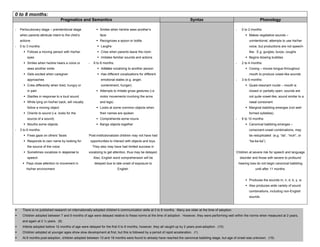
0 to 8 months:
Pragmatics and Semantics Syntax Phonology
- Perlocutionary stage – preintentional stage
when parents attribute intent to the child’s
actions
- 0 to 3 months:
Follows a moving person with his/her
eyes
Smiles when he/she hears a voice or
sees another smile
Gets excited when caregiver
approaches
Cries differently when tired, hungry or
in pain
Startles in response to a loud sound
While lying on his/her back, will visually
follow a moving object
Orients to sound (i.e. looks for the
source of a sound)
Mouths some objects
- 3 to 6 months:
Fixes gaze on others’ faces
Responds to own name by looking for
the source of the voice
Sometimes vocalizes in response to
speech
Pays close attention to movement in
his/her environment
Smiles when he/she sees another’s
face
Recognizes a spoon or bottle
Laughs
Cries when parents leave the room
Imitates familiar sounds and actions
- 6 to 8 months:
Initiates vocalizing to another person
Has different vocalizations for different
emotional states (e.g. anger,
contentment, hunger)
Attempts to imitate gross gestures (i.e.
motor movements involving the arms
and legs)
Looks at some common objects when
their names are spoken
Comprehends some nouns
Bangs objects together
Post-institutionalized children may not have had
opportunities to interact with objects and toys.
They also may have had limited success in
vocalizing to get attention, thus may be delayed.
Also, English word comprehension will be
delayed due to late onset of exposure to
English.
- 0 to 2 months:
Makes vegetative sounds –
unintentional; attempts to use his/her
voice, but productions are not speech-
like. E.g. gurgles, burps, coughs
Begins blowing bubbles
- 2 to 4 months:
Cooing – moves tongue throughout
mouth to produce vowel-like sounds
- 3 to 6 months:
Quasi-resonant nuclei – mouth is
closed or partially open; sounds are
not quite vowel-like; sound similar to a
nasal consonant
Marginal babbling emerges (not well-
formed syllables)
- 6 to 10 months:
Canonical babbling emerges –
consonant-vowel combinations, may
be reduplicated (e.g. “da”, “muh”, or
“ba-ba-ba”)
Children at severe risk for speech and language
disorder and those with severe to profound
hearing loss do not begin canonical babbling
until after 11 months.
Produces the sounds m, n, d, b, y, w
Also produces wide variety of sound
combinations, including non-English
sounds
There is no published research on internationally-adopted children’s communication skills at 0 to 8 months. Many are older at the time of adoption.
Children adopted between 7 and 9 months of age were delayed relative to these norms at the time of adoption. However, they were performing well within the norms when measured at 2 years,
and again at 2 ½ years. (8)
Infants adopted before 12 months of age were delayed for the first 5 to 6 months, however, they all caught up by 2 years post-adoption. (10)
Children adopted at younger ages show slow development at first, but this is followed by a period of rapid acceleration. (1)
At 6 months post-adoption, children adopted between 10 and 18 months were found to already have reached the canonical babbling stage, but age of onset was unknown. (15)
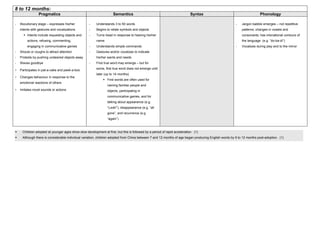
8 to 12 months:
Pragmatics Semantics Syntax Phonology
- Illocutionary stage – expresses his/her
intents with gestures and vocalizations
Intents include requesting objects and
actions, refusing, commenting,
engaging in communicative games
- Shouts or coughs to attract attention
- Protests by pushing undesired objects away
- Waves goodbye
- Participates in pat-a-cake and peek-a-boo
- Changes behaviour in response to the
emotional reactions of others
- Imitates novel sounds or actions
- Understands 3 to 50 words
- Begins to relate symbols and objects
- Turns head in response to hearing his/her
name
- Understands simple commands
- Gestures and/or vocalizes to indicate
his/her wants and needs
- First true word may emerge – but for
some, first true word does not emerge until
later (up to 14 months)
First words are often used for
naming familiar people and
objects, participating in
communicative games, and for
talking about appearance (e.g.
“Look!”), disappearance (e.g. “all
gone”, and recurrence (e.g.
“again”)
- Jargon babble emerges – not repetitive
patterns; changes in vowels and
consonants; has intonational contours of
the language (e.g. “do-ba-di”)
- Vocalizes during play and to the mirror
Children adopted at younger ages show slow development at first, but this is followed by a period of rapid acceleration. (1)
Although there is considerable individual variation, children adopted from China between 7 and 12 months of age began producing English words by 9 to 12 months post-adoption. (1)
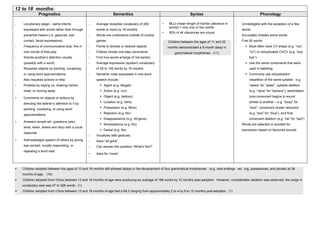
12 to 18 months:
Pragmatics Semantics Syntax Phonology
- Locutionary stage – same intents
expressed with words rather than through
preverbal means (i.e. gestures, eye
contact, facial expressions)
- Frequency of communicative acts: five in
one minute of free play
- Solicits another’s attention vocally
(possibly with a word)
- Requests objects by pointing, vocalizing,
or using word approximations
- Also requests actions or help
- Protests by saying no, shaking his/her
head, or moving away
- Comments on objects or actions by
directing the listener’s attention to it by
pointing, vocalizing, or using word
approximations
- Answers simple wh- questions (who,
what, when, where and why) with a vocal
response
- Acknowledges speech of others by giving
eye contact, vocally responding, or
repeating a word said
- Average receptive vocabulary of 200
words or more by 18 months
- Words are understood outside of routine
games
- Points to familiar or desired objects
- Follows simple one-step commands
- First true words emerge (if not earlier)
- Average expressive (spoken) vocabulary
of 50 to 100 words by 18 months
- Semantic roles expressed in one-word
speech include:
Agent (e.g. Abigail)
Action (e.g. run)
Object (e.g. balloon)
Location (e.g. here)
Possession (e.g. Mine)
Rejection (e.g. No)
Disappearance (e.g. All-gone)
Nonexistence (e.g. No)
Denial (e.g. No)
- Vocalizes with gestures
- Says “all gone”
- Can answer the question “What’s this?”
- Asks for “more”
- MLU (mean length of his/her utterance in
words) = only one or two words
- 50% of all utterances are nouns
- Unintelligible with the exception of a few
words
- Accurately imitates some words
- First 50 words:
Most often have CV shape (e.g. “ma”,
“no”) or reduplicated CVCV (e.g. “bye
bye”).
Use the same consonants that were
used in babbling
Commonly use reduplication
(repetition of the same syllable - e.g.
“wawa” for “water”, syllable deletion
(e.g. “nana” for “banana”), assimilation
(one consonant begins to sound
similar to another – e.g. “boop” for
“boot”, consonant cluster reduction
(e.g. “boo” for “blue”), and final
consonant deletion (e.g. “be” for “bed”)
- Words are selected or avoided for
expression based on favoured sounds
Children adopted between the ages of 13 and 18 months still showed delays in the development of four grammatical morphemes (e.g. verb endings -ed, -ing, possessives, and plurals) at 36
months of age. (10)
Children adopted from China between 13 and 18 months of age were producing an average of 186 words by 12 months post-adoption. However, considerable variation was observed; the range in
vocabulary size was 47 to 326 words. (1)
Children adopted from China between 13 and 18 months of age had a ML3 ranging from approximately 2 to 4 by 9 to 12 months post-adoption. (1)
Children between the ages of 11 and 23
months demonstrated a 9 month delay in
grammatical morphemes. (11)
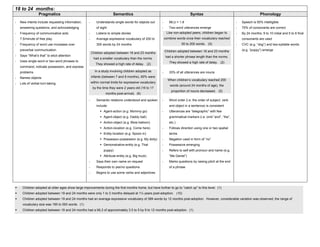
18 to 24 months:
Pragmatics Semantics Syntax Phonology
- New intents include requesting information,
answering questions, and acknowledging
- Frequency of communicative acts:
7.5/minute of free play
- Frequency of word use increases over
preverbal communication
- Says “What’s that” to elicit attention
- Uses single word or two-word phrases to
command, indicate possession, and express
problems
- Names objects
- Lots of verbal turn-taking
- Understands single words for objects out
of sight
- Listens to simple stories
- Average expressive vocabulary of 200 to
300 words by 24 months
- Semantic relations understood and spoken
include:
Agent-action (e.g. Mommy go)
Agent-object (e.g. Daddy ball)
Action-object (e.g. Blow balloon)
Action-location (e.g. Come here)
Entity-location (e.g. Spoon in)
Possessor-possession (e.g. My dolly)
Demonstrative-entity (e.g. That
puppy)
Attribute-entity (e.g. Big truck)
- Says their own name on request
- Responds to yes/no questions
- Begins to use some verbs and adjectives
- MLU = 1.8
- Two-word utterances emerge
- 33% of all utterances are nouns
- Word order (i.e. the order of subject, verb
and object in a sentence) is consistent
- Utterances are “telegraphic” with few
grammatical markers (i.e. omit “and”, “the”,
etc.)
- Follows direction using one or two spatial
terms
- Negation used in form of “no”
- Possessive emerging
- Refers to self with pronoun and name (e.g.
“Me Daniel”)
- Marks questions by raising pitch at the end
of a phrase
- Speech is 50% intelligible
- 70% of consonants are correct
- By 24 months, 9 to 10 initial and 5 to 6 final
consonants are used
- CVC (e.g. “dog”) and two-syllable words
(e.g. “puppy”) emerge
Children adopted at older ages show large improvements during the first months home, but have further to go to “catch up” to this level. (1)
Children adopted between 19 and 24 months were only 1 to 3 months delayed at 1½ years post-adoption. (10)
Children adopted between 19 and 24 months had an average expressive vocabulary of 389 words by 12 months post-adoption. However, considerable variation was observed; the range of
vocabulary size was 185 to 593 words. (1)
Children adopted between 19 and 24 months had a ML3 of approximately 3.5 to 5 by 9 to 12 months post-adoption. (1)
Children adopted between 18 and 23 months
had a smaller vocabulary than the norms.
They showed a high rate of delay. (2)
Children adopted between 18 and 23 months
had a shorter phrase length than the norms.
They showed a high rate of delay. (2)
Like non-adopted peers, children began to
combine words once their vocabulary reached
50 to 200 words. (5)
When children’s vocabulary reached 200
words (around 24 months of age), the
proportion of nouns decreased. (5)
In a study involving children adopted as
infants (between 7 and 8 months), 60% were
within normal limits for expressive vocabulary
by the time they were 2 years old (16 to 17
months post-arrival). (6)
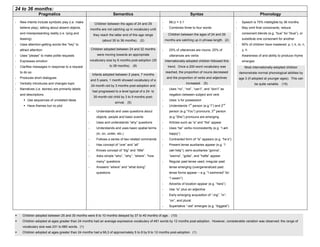
24 to 36 months:
Pragmatics Semantics Syntax Phonology
- New intents include symbolic play (i.e. make
believe play), talking about absent objects,
and misrepresenting reality (i.e. lying and
teasing)
- Uses attention-getting words like “hey” to
attract attention
- Uses “please” to make polite requests
- Expresses emotion
- Clarifies messages in response to a request
to do so
- Produces short dialogues
- Verbally introduces and changes topic
- Narratives (i.e. stories) are primarily labels
and descriptions
Use sequences of unrelated ideas
Have themes but no plot
- Understands and uses questions about
objects, people and basic events
- Uses and understands “why” questions
- Understands and uses basic spatial terms
(in, on, under, etc.)
- Follows a series of two related commands
- Has concept of “one” and “all”
- Knows concept of “big” and “little”
- Asks simple “who”, “why”, “where”, “how
many” questions
- Answers “where” and “what doing”
questions
- MLU = 3.1
- Combines three to four words
- 25% of utterances are nouns; 25% of
utterances are verbs
- Uses “no”, “not”, “can’t”, and “don’t” as
negation between subject and verb
- Uses ’s for possession
- Understands 1
st
person (e.g.“I”) and 2
nd
person (e.g.“You”) pronouns; 3
rd
person
(e.g.“She”) pronouns are emerging
- Articles such as “a” and “the” appear
- Uses “be” verbs inconsistently (e.g. “I am
happy”)
- Contracted form of “is” appears (e.g. “he’s”)
- Present tense auxiliaries appear (e.g. “I
can help”); semi-auxiliaries “gonna”,
“wanna”, “gotta”, and “hafta” appear
- Regular past tense used; irregular past
tense emerging (overgeneralized past
tense forms appear – e.g. “I swimmed” for
“I swam”)
- Adverbs of location appear (e.g. “here”)
- Use “is” plus an adjective
- Early emerging acquisition of “-ing”, “in”,
“on”, and plural
- Superlative “-est” emerges (e.g. “biggest”)
- Speech is 75% intelligible by 36 months
- May omit final consonants, reduce
consonant blends (e.g. “bue” for “blue”), or
substitute one consonant for another
- 90% of children have mastered: p, t, k, m, n,
y, h
- Awareness of and ability to produce rhyme
emerges
Children adopted between 25 and 30 months were 8 to 10 months delayed by 37 to 40 months of age. (10)
Children adopted at ages greater than 24 months had an average expressive vocabulary of 481 words by 12 months post-adoption. However, considerable variation was observed; the range of
vocabulary size was 231 to 680 words. (1)
Children adopted at ages greater than 24 months had a ML3 of approximately 5 to 8 by 9 to 12 months post-adoption. (1)
Children between the ages of 24 and 29
months are catching up in phrase length. (2)
Children between the ages of 24 and 29
months are not catching up in vocabulary until
they reach the latter end of this age range
(about 35 to 36 months). (2)
Infants adopted between 2 years, 7 months
and 5 years, 1 month showed vocabulary of a
24-month-old by 3 months post-adoption and
had progressed to a level typical of a 24- to
30-month-old child by 3 to 9 months post-
arrival. (5)
Internationally-adopted children followed this
trend. Once a 200-word vocabulary was
reached, the proportion of nouns decreased
and the proportion of verbs and adjectives
increased. (5)
Children adopted between 24 and 32 months
were moving towards an appropriate
vocabulary size by 6 months post-adoption (30
to 38 months). (8) Most internationally-adopted children
demonstrate normal phonological abilities by
age 3 (if adopted at younger ages). This can
be quite variable. (15)
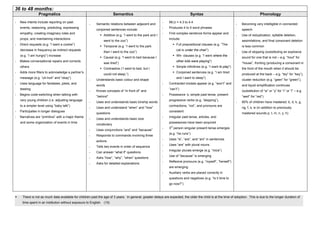
36 to 48 months:
Pragmatics Semantics Syntax Phonology
- New intents include reporting on past
events, reasoning, predicting, expressing
empathy, creating imaginary roles and
props, and maintaining interactions
- Direct requests (e.g. “I want a cookie”)
decrease in frequency as indirect requests
(e.g. “I am hungry”) increase
- Makes conversational repairs and corrects
others
- Adds more fillers to acknowledge a partner’s
message (e.g. “uh-huh” and “okay”)
- Uses language for fantasies, jokes, and
teasing
- Begins code-switching when talking with
very young children (i.e. adjusting language
to a simpler level using “baby talk”)
- Participates in longer dialogues
- Narratives are “primitive” with a major theme
and some organization of events in time
- Semantic relations between adjacent and
conjoined sentences include:
Additive (e.g. “I went to the park and I
went to the zoo”)
Temporal (e.g. “I went to the park
then I went to the zoo”)
Causal (e.g. “I went to bed because I
was tired”)
Contrastive (“I went to bed, but I
could not sleep.”)
- Understands basic colour and shape
words
- Knows concepts of “in front of” and
“behind”
- Uses and understands basic kinship words
- Uses and understand “when” and “how”
questions
- Uses and understands basic size
vocabulary
- Uses conjunctions “and” and “because”
- Responds to commands involving three
actions
- Tells two events in order of sequence
- Can answer “what if” questions
- Asks “how”, “why”, “when” questions
- Asks for detailed explanations
- MLU = 4.3 to 4.4
- Produces 4 to 5 word phrases
- First complex sentence forms appear and
include:
Full prepositional clauses (e.g. “The
cat is under the chair”)
Wh- clauses (e.g. “I went where the
other kids were playing”)
Simple infinitives (e.g. “I want to play”)
Conjoined sentences (e.g. “I am tired
and I want to sleep”)
- Contracted modals appear (e.g. “won’t” and
“can’t”)
- Possessive ’s, simple past tense, present
progressive verbs (e.g. “skipping”),
contractions, “not”, and pronouns are
consistent
- Irregular past tense, articles, and
possessives have been acquired
- 3
rd
person singular present tense emerges
(e.g. “he runs”)
- Uses “is”, “are”, and “am” in sentences
- Uses “are” with plural nouns
- Irregular plurals emerge (e.g. “mice”)
- Use of “because” is emerging
- Reflexive pronouns (e.g. “myself”, “herself”)
are emerging
- Auxiliary verbs are placed correctly in
questions and negatives (e.g. “Is it time to
go now?”)
- Becoming very intelligible in connected
speech
- Use of reduplication, syllable deletion,
assimilations, and final consonant deletion
is less common
- Use of stopping (substituting an explosive
sound for one that is not – e.g. “hout” for
“house”, fronting (producing a consonant in
the front of the mouth when it should be
produced at the back – e.g. “tey” for “key”),
cluster reduction (e.g. “geen” for “green”),
and liquid simplification continues
(substitution of “w” or “y” for “r” or “l” – e.g.
“wed” for “red”)
- 90% of children have mastered: b, d, k, g,
ng, f, s, w (in addition to previously
mastered sounds p, t, m, n, y, h)
There is not as much data available for children past the age of 3 years. In general, greater delays are expected, the older the child is at the time of adoption. This is due to the longer duration of
time spent in an institution without exposure to English. (15)
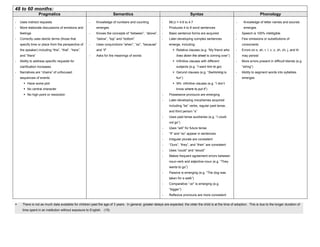
48 to 60 months:
Pragmatics Semantics Syntax Phonology
- Uses indirect requests
- More elaborate discussions of emotions and
feelings
- Correctly uses deictic terms (those that
specify time or place from the perspective of
the speaker) including “this”, “that”, “here”,
and “there”
- Ability to address specific requests for
clarification increases
- Narratives are “chains” of unfocused
sequences of events
Have some plot
No central character
No high point or resolution
- Knowledge of numbers and counting
emerges
- Knows the concepts of “between”, “above”,
“below”, “top” and “bottom”
- Uses conjunctions “when”, “so”, “because”
and “if”
- Asks for the meanings of words
- MLU = 4.6 to 4.7
- Produces 4 to 8 word sentences
- Basic sentence forms are acquired
- Later-developing complex sentences
emerge, including:
Relative clauses (e.g. “My friend who
lives down the street is coming over”)
Infinitive clauses with different
subjects (e.g. “I want him to go)
Gerund clauses (e.g. “Swimming is
fun”)
Wh- infinitive clauses (e.g. “I don’t
know where to put it”)
- Possessive pronouns are emerging
- Later-developing morphemes acquired
including “be” verbs, regular past tense,
and third person “s”
- Uses past tense auxiliaries (e.g. “I could
not go”)
- Uses “will” for future tense
- “If” and “so” appear in sentences
- Irregular plurals are consistent
- “Ours”, “they”, and “their” are consistent
- Uses “could” and “would”
- Makes frequent agreement errors between
noun-verb and adjective-noun (e.g. “They
wants to go”)
- Passive is emerging (e.g. “The dog was
taken for a walk”)
- Comparative “-er” is emerging (e.g.
“bigger”)
- Reflexive pronouns are more consistent
- Knowledge of letter names and sounds
emerges
- Speech is 100% intelligible
- Few omissions or substitutions of
consonants
- Errors on s, sh, r, l, v, z, zh, ch, j, and th
may persist
- More errors present in difficult blends (e.g.
“string”)
- Ability to segment words into syllables
emerges
There is not as much data available for children past the age of 3 years. In general, greater delays are expected, the older the child is at the time of adoption. This is due to the longer duration of
time spent in an institution without exposure to English. (15)
Chart references:
Gard, A., Gillman, L., & Gorman, J. (1993). Speech and Language
Development Chart (2nd
Ed.). Austin: Pro-Ed.
Paul, Rhea (2001). Language Disorders From Infancy Through
Adolescence (2nd
Ed.). St. Louis: Mosby.
International adoption literature:
1. Pollock, K.E. (2005). Early language growth in children
adopted from China: Preliminary normative data. Seminars In Speech
and Language, 26, 22-3232.
2. Xing Tan, T. & Yang, Y. (2005). Language development of
Chinese adoptees 18-35 months old. Early Childhood Research
Quarterly, 20, 57-68.
3. Roberts, J.A., Pollock, K.E., Krakow, R., Price, J., Fulmer,
K.C., & Wang, P.P. (2005). Language development in preschool-age
children adopted from China. Journal of Speech, Language, and Hearing
Research, 48, 93-107.
4. Pollock, K.E., Price, J.R. & Fulmer, K.C. (2003). Speech-
language acquisition in children adopted from China: A longitudinal
investigation of two children. Journal of Multilingual Communication
Disorders, 1, 184-193.
5. Geren, J., Snedeker, J., & Ax, L. (2005). Starting over: A
preliminary study of early lexical and syntactic development in
internationally adopted preschoolers. Seminars in Speech and Language,
26, 44-53.
6. Krakow, R.A., & Roberts, J. (2003). Acquisition of English
vocabulary by young Chinese adoptees. Journal of Multilingual
Communication Disorders, 1, 169-176.
7. Roberts, J.A., Pollock, K.E. & Krakow, R. (2005). Continued
catch-up and language delay in children adopted from China. Seminars
in Speech and Language, 26, 76-85.
8. Krakow, R.A., Tao, S. & Roberts, J. (2005). Adoption age
effects on English language acquisition: Infants and toddlers from China.
Seminars in Speech and Language, 26, 33-43.
9. Glennen, S. (2005). New arrivals: Speech and language
assessment for internationally adopted infants and toddlers within the first
months home. Seminars in Speech and Language, 26, 10-21.
10. Glennen, S. & Masters, M.G. (2002). Typical and atypical
language development in infants and toddlers adopted from Eastern
Europe. American Journal of Speech-Language Pathology, 11, 417-433.
11. Glennen, S., Rosinsky-Grunhut, A., & Tracy, R. (2005).
Linguistic interference between L1 and L2 in internationally adopted
children. Seminars in Speech and Language, 26, 64-75.
12. Glennen, S. & Bright, B.J. (2005). Five years later:
Language in school-age internationally adopted children. Seminars in
Speech and Language, 26, 86-101.
13. Meese, R.L. (2005). A few new children:
Postinstitutionalized children of intercountry adoption. The Journal of
Special Education, 39, 157-167.
14. Glennen, S. (2002). Language development and delay in
internationally adopted infants and toddlers: A review. American Journal
of Speech-Language Pathology, 11, 333-339.
15. Pollock, K.E. & Price, J.R. (2005). Phonological skills of children
adopted from China: Implications for assessment. Seminars in Speech
and Language, 26, 54-63.

Milestones

  • 1.
    Language Development Milestones Editedby Nicole Sax and Erin Weston (in partial fulfillment of the requirements of the degree of Master of Science in Speech-Language Pathology at the University of Alberta, January, 2007) The following charts provide a summary of typical language developmental milestones within the four major domains of language (i.e. pragmatics, semantics, syntax, and phonology). Each chart focuses on different age ranges, which include 0 to 8 months, 8 to 12 months, 12 to 18 months, 18 to 24 months, 24 to 36 months, 36 to 48 months, and 48 to 60 months. Within the chart, key findings from the international adoption literature pertaining to specific skills are highlighted in a shaded box. At the bottom of the chart, more general information for that specific age range is provided. Each finding from the adoption literature is followed by a number, which corresponds to its number in the reference list. In addition, the following general findings from the international adoption research did not correspond to any specific age range: The majority of internationally-adopted children are within or above the normal range after two or more years of exposure to English. (3) In general, the older the child is at the time of adoption, the greater the delays that can be expected. However, they appear to start catching up by about one year post-adoption. (8) Although expressive language and mean length of utterance is delayed, children showed the same developmental growth patterns as their non-adopted peers. (10) Overall, grammatical morphemes were acquired in the same developmental order as non-adopted peers, but a short-term delay was exhibited. (11)
  • 2.
    0 to 8months: Pragmatics and Semantics Syntax Phonology - Perlocutionary stage – preintentional stage when parents attribute intent to the child’s actions - 0 to 3 months: Follows a moving person with his/her eyes Smiles when he/she hears a voice or sees another smile Gets excited when caregiver approaches Cries differently when tired, hungry or in pain Startles in response to a loud sound While lying on his/her back, will visually follow a moving object Orients to sound (i.e. looks for the source of a sound) Mouths some objects - 3 to 6 months: Fixes gaze on others’ faces Responds to own name by looking for the source of the voice Sometimes vocalizes in response to speech Pays close attention to movement in his/her environment Smiles when he/she sees another’s face Recognizes a spoon or bottle Laughs Cries when parents leave the room Imitates familiar sounds and actions - 6 to 8 months: Initiates vocalizing to another person Has different vocalizations for different emotional states (e.g. anger, contentment, hunger) Attempts to imitate gross gestures (i.e. motor movements involving the arms and legs) Looks at some common objects when their names are spoken Comprehends some nouns Bangs objects together Post-institutionalized children may not have had opportunities to interact with objects and toys. They also may have had limited success in vocalizing to get attention, thus may be delayed. Also, English word comprehension will be delayed due to late onset of exposure to English. - 0 to 2 months: Makes vegetative sounds – unintentional; attempts to use his/her voice, but productions are not speech- like. E.g. gurgles, burps, coughs Begins blowing bubbles - 2 to 4 months: Cooing – moves tongue throughout mouth to produce vowel-like sounds - 3 to 6 months: Quasi-resonant nuclei – mouth is closed or partially open; sounds are not quite vowel-like; sound similar to a nasal consonant Marginal babbling emerges (not well- formed syllables) - 6 to 10 months: Canonical babbling emerges – consonant-vowel combinations, may be reduplicated (e.g. “da”, “muh”, or “ba-ba-ba”) Children at severe risk for speech and language disorder and those with severe to profound hearing loss do not begin canonical babbling until after 11 months. Produces the sounds m, n, d, b, y, w Also produces wide variety of sound combinations, including non-English sounds There is no published research on internationally-adopted children’s communication skills at 0 to 8 months. Many are older at the time of adoption. Children adopted between 7 and 9 months of age were delayed relative to these norms at the time of adoption. However, they were performing well within the norms when measured at 2 years, and again at 2 ½ years. (8) Infants adopted before 12 months of age were delayed for the first 5 to 6 months, however, they all caught up by 2 years post-adoption. (10) Children adopted at younger ages show slow development at first, but this is followed by a period of rapid acceleration. (1) At 6 months post-adoption, children adopted between 10 and 18 months were found to already have reached the canonical babbling stage, but age of onset was unknown. (15)
  • 3.
    8 to 12months: Pragmatics Semantics Syntax Phonology - Illocutionary stage – expresses his/her intents with gestures and vocalizations Intents include requesting objects and actions, refusing, commenting, engaging in communicative games - Shouts or coughs to attract attention - Protests by pushing undesired objects away - Waves goodbye - Participates in pat-a-cake and peek-a-boo - Changes behaviour in response to the emotional reactions of others - Imitates novel sounds or actions - Understands 3 to 50 words - Begins to relate symbols and objects - Turns head in response to hearing his/her name - Understands simple commands - Gestures and/or vocalizes to indicate his/her wants and needs - First true word may emerge – but for some, first true word does not emerge until later (up to 14 months) First words are often used for naming familiar people and objects, participating in communicative games, and for talking about appearance (e.g. “Look!”), disappearance (e.g. “all gone”, and recurrence (e.g. “again”) - Jargon babble emerges – not repetitive patterns; changes in vowels and consonants; has intonational contours of the language (e.g. “do-ba-di”) - Vocalizes during play and to the mirror Children adopted at younger ages show slow development at first, but this is followed by a period of rapid acceleration. (1) Although there is considerable individual variation, children adopted from China between 7 and 12 months of age began producing English words by 9 to 12 months post-adoption. (1)
  • 4.
    12 to 18months: Pragmatics Semantics Syntax Phonology - Locutionary stage – same intents expressed with words rather than through preverbal means (i.e. gestures, eye contact, facial expressions) - Frequency of communicative acts: five in one minute of free play - Solicits another’s attention vocally (possibly with a word) - Requests objects by pointing, vocalizing, or using word approximations - Also requests actions or help - Protests by saying no, shaking his/her head, or moving away - Comments on objects or actions by directing the listener’s attention to it by pointing, vocalizing, or using word approximations - Answers simple wh- questions (who, what, when, where and why) with a vocal response - Acknowledges speech of others by giving eye contact, vocally responding, or repeating a word said - Average receptive vocabulary of 200 words or more by 18 months - Words are understood outside of routine games - Points to familiar or desired objects - Follows simple one-step commands - First true words emerge (if not earlier) - Average expressive (spoken) vocabulary of 50 to 100 words by 18 months - Semantic roles expressed in one-word speech include: Agent (e.g. Abigail) Action (e.g. run) Object (e.g. balloon) Location (e.g. here) Possession (e.g. Mine) Rejection (e.g. No) Disappearance (e.g. All-gone) Nonexistence (e.g. No) Denial (e.g. No) - Vocalizes with gestures - Says “all gone” - Can answer the question “What’s this?” - Asks for “more” - MLU (mean length of his/her utterance in words) = only one or two words - 50% of all utterances are nouns - Unintelligible with the exception of a few words - Accurately imitates some words - First 50 words: Most often have CV shape (e.g. “ma”, “no”) or reduplicated CVCV (e.g. “bye bye”). Use the same consonants that were used in babbling Commonly use reduplication (repetition of the same syllable - e.g. “wawa” for “water”, syllable deletion (e.g. “nana” for “banana”), assimilation (one consonant begins to sound similar to another – e.g. “boop” for “boot”, consonant cluster reduction (e.g. “boo” for “blue”), and final consonant deletion (e.g. “be” for “bed”) - Words are selected or avoided for expression based on favoured sounds Children adopted between the ages of 13 and 18 months still showed delays in the development of four grammatical morphemes (e.g. verb endings -ed, -ing, possessives, and plurals) at 36 months of age. (10) Children adopted from China between 13 and 18 months of age were producing an average of 186 words by 12 months post-adoption. However, considerable variation was observed; the range in vocabulary size was 47 to 326 words. (1) Children adopted from China between 13 and 18 months of age had a ML3 ranging from approximately 2 to 4 by 9 to 12 months post-adoption. (1) Children between the ages of 11 and 23 months demonstrated a 9 month delay in grammatical morphemes. (11)
  • 5.
    18 to 24months: Pragmatics Semantics Syntax Phonology - New intents include requesting information, answering questions, and acknowledging - Frequency of communicative acts: 7.5/minute of free play - Frequency of word use increases over preverbal communication - Says “What’s that” to elicit attention - Uses single word or two-word phrases to command, indicate possession, and express problems - Names objects - Lots of verbal turn-taking - Understands single words for objects out of sight - Listens to simple stories - Average expressive vocabulary of 200 to 300 words by 24 months - Semantic relations understood and spoken include: Agent-action (e.g. Mommy go) Agent-object (e.g. Daddy ball) Action-object (e.g. Blow balloon) Action-location (e.g. Come here) Entity-location (e.g. Spoon in) Possessor-possession (e.g. My dolly) Demonstrative-entity (e.g. That puppy) Attribute-entity (e.g. Big truck) - Says their own name on request - Responds to yes/no questions - Begins to use some verbs and adjectives - MLU = 1.8 - Two-word utterances emerge - 33% of all utterances are nouns - Word order (i.e. the order of subject, verb and object in a sentence) is consistent - Utterances are “telegraphic” with few grammatical markers (i.e. omit “and”, “the”, etc.) - Follows direction using one or two spatial terms - Negation used in form of “no” - Possessive emerging - Refers to self with pronoun and name (e.g. “Me Daniel”) - Marks questions by raising pitch at the end of a phrase - Speech is 50% intelligible - 70% of consonants are correct - By 24 months, 9 to 10 initial and 5 to 6 final consonants are used - CVC (e.g. “dog”) and two-syllable words (e.g. “puppy”) emerge Children adopted at older ages show large improvements during the first months home, but have further to go to “catch up” to this level. (1) Children adopted between 19 and 24 months were only 1 to 3 months delayed at 1½ years post-adoption. (10) Children adopted between 19 and 24 months had an average expressive vocabulary of 389 words by 12 months post-adoption. However, considerable variation was observed; the range of vocabulary size was 185 to 593 words. (1) Children adopted between 19 and 24 months had a ML3 of approximately 3.5 to 5 by 9 to 12 months post-adoption. (1) Children adopted between 18 and 23 months had a smaller vocabulary than the norms. They showed a high rate of delay. (2) Children adopted between 18 and 23 months had a shorter phrase length than the norms. They showed a high rate of delay. (2) Like non-adopted peers, children began to combine words once their vocabulary reached 50 to 200 words. (5) When children’s vocabulary reached 200 words (around 24 months of age), the proportion of nouns decreased. (5) In a study involving children adopted as infants (between 7 and 8 months), 60% were within normal limits for expressive vocabulary by the time they were 2 years old (16 to 17 months post-arrival). (6)
  • 6.
    24 to 36months: Pragmatics Semantics Syntax Phonology - New intents include symbolic play (i.e. make believe play), talking about absent objects, and misrepresenting reality (i.e. lying and teasing) - Uses attention-getting words like “hey” to attract attention - Uses “please” to make polite requests - Expresses emotion - Clarifies messages in response to a request to do so - Produces short dialogues - Verbally introduces and changes topic - Narratives (i.e. stories) are primarily labels and descriptions Use sequences of unrelated ideas Have themes but no plot - Understands and uses questions about objects, people and basic events - Uses and understands “why” questions - Understands and uses basic spatial terms (in, on, under, etc.) - Follows a series of two related commands - Has concept of “one” and “all” - Knows concept of “big” and “little” - Asks simple “who”, “why”, “where”, “how many” questions - Answers “where” and “what doing” questions - MLU = 3.1 - Combines three to four words - 25% of utterances are nouns; 25% of utterances are verbs - Uses “no”, “not”, “can’t”, and “don’t” as negation between subject and verb - Uses ’s for possession - Understands 1 st person (e.g.“I”) and 2 nd person (e.g.“You”) pronouns; 3 rd person (e.g.“She”) pronouns are emerging - Articles such as “a” and “the” appear - Uses “be” verbs inconsistently (e.g. “I am happy”) - Contracted form of “is” appears (e.g. “he’s”) - Present tense auxiliaries appear (e.g. “I can help”); semi-auxiliaries “gonna”, “wanna”, “gotta”, and “hafta” appear - Regular past tense used; irregular past tense emerging (overgeneralized past tense forms appear – e.g. “I swimmed” for “I swam”) - Adverbs of location appear (e.g. “here”) - Use “is” plus an adjective - Early emerging acquisition of “-ing”, “in”, “on”, and plural - Superlative “-est” emerges (e.g. “biggest”) - Speech is 75% intelligible by 36 months - May omit final consonants, reduce consonant blends (e.g. “bue” for “blue”), or substitute one consonant for another - 90% of children have mastered: p, t, k, m, n, y, h - Awareness of and ability to produce rhyme emerges Children adopted between 25 and 30 months were 8 to 10 months delayed by 37 to 40 months of age. (10) Children adopted at ages greater than 24 months had an average expressive vocabulary of 481 words by 12 months post-adoption. However, considerable variation was observed; the range of vocabulary size was 231 to 680 words. (1) Children adopted at ages greater than 24 months had a ML3 of approximately 5 to 8 by 9 to 12 months post-adoption. (1) Children between the ages of 24 and 29 months are catching up in phrase length. (2) Children between the ages of 24 and 29 months are not catching up in vocabulary until they reach the latter end of this age range (about 35 to 36 months). (2) Infants adopted between 2 years, 7 months and 5 years, 1 month showed vocabulary of a 24-month-old by 3 months post-adoption and had progressed to a level typical of a 24- to 30-month-old child by 3 to 9 months post- arrival. (5) Internationally-adopted children followed this trend. Once a 200-word vocabulary was reached, the proportion of nouns decreased and the proportion of verbs and adjectives increased. (5) Children adopted between 24 and 32 months were moving towards an appropriate vocabulary size by 6 months post-adoption (30 to 38 months). (8) Most internationally-adopted children demonstrate normal phonological abilities by age 3 (if adopted at younger ages). This can be quite variable. (15)
  • 7.
    36 to 48months: Pragmatics Semantics Syntax Phonology - New intents include reporting on past events, reasoning, predicting, expressing empathy, creating imaginary roles and props, and maintaining interactions - Direct requests (e.g. “I want a cookie”) decrease in frequency as indirect requests (e.g. “I am hungry”) increase - Makes conversational repairs and corrects others - Adds more fillers to acknowledge a partner’s message (e.g. “uh-huh” and “okay”) - Uses language for fantasies, jokes, and teasing - Begins code-switching when talking with very young children (i.e. adjusting language to a simpler level using “baby talk”) - Participates in longer dialogues - Narratives are “primitive” with a major theme and some organization of events in time - Semantic relations between adjacent and conjoined sentences include: Additive (e.g. “I went to the park and I went to the zoo”) Temporal (e.g. “I went to the park then I went to the zoo”) Causal (e.g. “I went to bed because I was tired”) Contrastive (“I went to bed, but I could not sleep.”) - Understands basic colour and shape words - Knows concepts of “in front of” and “behind” - Uses and understands basic kinship words - Uses and understand “when” and “how” questions - Uses and understands basic size vocabulary - Uses conjunctions “and” and “because” - Responds to commands involving three actions - Tells two events in order of sequence - Can answer “what if” questions - Asks “how”, “why”, “when” questions - Asks for detailed explanations - MLU = 4.3 to 4.4 - Produces 4 to 5 word phrases - First complex sentence forms appear and include: Full prepositional clauses (e.g. “The cat is under the chair”) Wh- clauses (e.g. “I went where the other kids were playing”) Simple infinitives (e.g. “I want to play”) Conjoined sentences (e.g. “I am tired and I want to sleep”) - Contracted modals appear (e.g. “won’t” and “can’t”) - Possessive ’s, simple past tense, present progressive verbs (e.g. “skipping”), contractions, “not”, and pronouns are consistent - Irregular past tense, articles, and possessives have been acquired - 3 rd person singular present tense emerges (e.g. “he runs”) - Uses “is”, “are”, and “am” in sentences - Uses “are” with plural nouns - Irregular plurals emerge (e.g. “mice”) - Use of “because” is emerging - Reflexive pronouns (e.g. “myself”, “herself”) are emerging - Auxiliary verbs are placed correctly in questions and negatives (e.g. “Is it time to go now?”) - Becoming very intelligible in connected speech - Use of reduplication, syllable deletion, assimilations, and final consonant deletion is less common - Use of stopping (substituting an explosive sound for one that is not – e.g. “hout” for “house”, fronting (producing a consonant in the front of the mouth when it should be produced at the back – e.g. “tey” for “key”), cluster reduction (e.g. “geen” for “green”), and liquid simplification continues (substitution of “w” or “y” for “r” or “l” – e.g. “wed” for “red”) - 90% of children have mastered: b, d, k, g, ng, f, s, w (in addition to previously mastered sounds p, t, m, n, y, h) There is not as much data available for children past the age of 3 years. In general, greater delays are expected, the older the child is at the time of adoption. This is due to the longer duration of time spent in an institution without exposure to English. (15)
  • 8.
    48 to 60months: Pragmatics Semantics Syntax Phonology - Uses indirect requests - More elaborate discussions of emotions and feelings - Correctly uses deictic terms (those that specify time or place from the perspective of the speaker) including “this”, “that”, “here”, and “there” - Ability to address specific requests for clarification increases - Narratives are “chains” of unfocused sequences of events Have some plot No central character No high point or resolution - Knowledge of numbers and counting emerges - Knows the concepts of “between”, “above”, “below”, “top” and “bottom” - Uses conjunctions “when”, “so”, “because” and “if” - Asks for the meanings of words - MLU = 4.6 to 4.7 - Produces 4 to 8 word sentences - Basic sentence forms are acquired - Later-developing complex sentences emerge, including: Relative clauses (e.g. “My friend who lives down the street is coming over”) Infinitive clauses with different subjects (e.g. “I want him to go) Gerund clauses (e.g. “Swimming is fun”) Wh- infinitive clauses (e.g. “I don’t know where to put it”) - Possessive pronouns are emerging - Later-developing morphemes acquired including “be” verbs, regular past tense, and third person “s” - Uses past tense auxiliaries (e.g. “I could not go”) - Uses “will” for future tense - “If” and “so” appear in sentences - Irregular plurals are consistent - “Ours”, “they”, and “their” are consistent - Uses “could” and “would” - Makes frequent agreement errors between noun-verb and adjective-noun (e.g. “They wants to go”) - Passive is emerging (e.g. “The dog was taken for a walk”) - Comparative “-er” is emerging (e.g. “bigger”) - Reflexive pronouns are more consistent - Knowledge of letter names and sounds emerges - Speech is 100% intelligible - Few omissions or substitutions of consonants - Errors on s, sh, r, l, v, z, zh, ch, j, and th may persist - More errors present in difficult blends (e.g. “string”) - Ability to segment words into syllables emerges There is not as much data available for children past the age of 3 years. In general, greater delays are expected, the older the child is at the time of adoption. This is due to the longer duration of time spent in an institution without exposure to English. (15)
  • 9.
    Chart references: Gard, A.,Gillman, L., & Gorman, J. (1993). Speech and Language Development Chart (2nd Ed.). Austin: Pro-Ed. Paul, Rhea (2001). Language Disorders From Infancy Through Adolescence (2nd Ed.). St. Louis: Mosby. International adoption literature: 1. Pollock, K.E. (2005). Early language growth in children adopted from China: Preliminary normative data. Seminars In Speech and Language, 26, 22-3232. 2. Xing Tan, T. & Yang, Y. (2005). Language development of Chinese adoptees 18-35 months old. Early Childhood Research Quarterly, 20, 57-68. 3. Roberts, J.A., Pollock, K.E., Krakow, R., Price, J., Fulmer, K.C., & Wang, P.P. (2005). Language development in preschool-age children adopted from China. Journal of Speech, Language, and Hearing Research, 48, 93-107. 4. Pollock, K.E., Price, J.R. & Fulmer, K.C. (2003). Speech- language acquisition in children adopted from China: A longitudinal investigation of two children. Journal of Multilingual Communication Disorders, 1, 184-193. 5. Geren, J., Snedeker, J., & Ax, L. (2005). Starting over: A preliminary study of early lexical and syntactic development in internationally adopted preschoolers. Seminars in Speech and Language, 26, 44-53. 6. Krakow, R.A., & Roberts, J. (2003). Acquisition of English vocabulary by young Chinese adoptees. Journal of Multilingual Communication Disorders, 1, 169-176. 7. Roberts, J.A., Pollock, K.E. & Krakow, R. (2005). Continued catch-up and language delay in children adopted from China. Seminars in Speech and Language, 26, 76-85. 8. Krakow, R.A., Tao, S. & Roberts, J. (2005). Adoption age effects on English language acquisition: Infants and toddlers from China. Seminars in Speech and Language, 26, 33-43. 9. Glennen, S. (2005). New arrivals: Speech and language assessment for internationally adopted infants and toddlers within the first months home. Seminars in Speech and Language, 26, 10-21. 10. Glennen, S. & Masters, M.G. (2002). Typical and atypical language development in infants and toddlers adopted from Eastern Europe. American Journal of Speech-Language Pathology, 11, 417-433. 11. Glennen, S., Rosinsky-Grunhut, A., & Tracy, R. (2005). Linguistic interference between L1 and L2 in internationally adopted children. Seminars in Speech and Language, 26, 64-75. 12. Glennen, S. & Bright, B.J. (2005). Five years later: Language in school-age internationally adopted children. Seminars in Speech and Language, 26, 86-101. 13. Meese, R.L. (2005). A few new children: Postinstitutionalized children of intercountry adoption. The Journal of Special Education, 39, 157-167. 14. Glennen, S. (2002). Language development and delay in internationally adopted infants and toddlers: A review. American Journal of Speech-Language Pathology, 11, 333-339. 15. Pollock, K.E. & Price, J.R. (2005). Phonological skills of children adopted from China: Implications for assessment. Seminars in Speech and Language, 26, 54-63.