Portfolio Management
           LECTURE TWO


        Fundamental Analysis


            Prepared By:
      Noorulhadi Qureshi
 Lecturer Govt College of Management
          Sciences Peshawar
Fundamental Analysis
Fundamental Analysis is to evaluate a lot
 information about the past performance
 and the expected future performance of
 companies, industries and the economy
 as a whole before taking the investment
 decision. Such evaluation or analysis is
 called fundamental analysis.
Fundamental Analysis (con’t)
Fundamental analysis is really a logical and systematic
   approach to estimating the future dividends and
   share price.
Fundamental analysis is performed on historical and
   present data, but with the goal of making financial
   forecasts. There are several possible objectives:
• To conduct a company stock valuation and predict
   its probable price evolution,
• to make a projection on its business performance,
• to evaluate its management and make internal
   business decisions,
• to calculate its risk.
Fundamental analysis includes:
• Economic analysis
• Industry analysis
• Company analysis
Fundamental Analysis
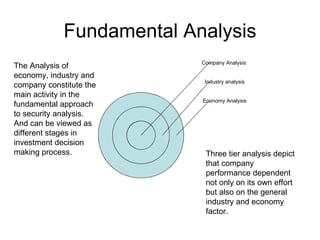
                           Company Analysis
The Analysis of
economy, industry and
                            Industry analysis
company constitute the
main activity in the
                           Economy Analysis
fundamental approach
to security analysis.
And can be viewed as
different stages in
investment decision
making process.             Three tier analysis depict
                            that company
                            performance dependent
                            not only on its own effort
                            but also on the general
                            industry and economy
                            factor.
Economy Analysis
                   Boom Economy:
  Income rise and demand for goods will increase the industries

       and companies in general tend to be prosperous.


           Recession Economy:
Income decline and demand for goods will decrease the industries
     and companies in general tend to be bad performance
Economy analysis (con’t)
Growth rates of national income(GRNI)
GRNI is an important variable can be
 calculated by GDP, NNP, and GDP to
 analysis the growth rate of economy.
Four stages of economy or economic cycle
 i.e depression, recovery, boom and
 recovery of economy of nation also impact
 on security performance.
• Depression: At this stage demand is low and
  declining inflation often high and so are interest rate,
  companies usually reduce activities and securities
  performance is poor.
• Recovery: Economy begin to revive after depression,
  demand pick up leading, production and activities
  increase.
• Boom: High demand with high investment and
  production, companies earn more profit
• Recession: Companies slowly begins
  downturn in demand, production and
  employment, profits are also decline.
Inflation:
Inflation prevailing significant impact on
  company performance. High inflation
  upset company plan. Demand goes down
  because purchasing power fall, high
  inflation impact company performance
  adversely. Inflation is measured both in
WPI (Wholesale price index)
CPI (Consumer price index)
Interest Rate
Interest rates determine the cost and
  availability of credit for companies
  operating in an economy.
Low interest rate=> easily and cheaply available
  credit.
                  => lower cost of finance
                  => high profitability
High interest rate => higher cost of production
=>lower profitability
=>Lower demand
Government revenue, expenditure and deficit
• Government is the largest investor in economy
  of any country thus revenue, expenditure and
  deficit have significance impact on the
  performance of industries and companies.
• Expenditure stimulate demand and creates job.
• The excess of expenditure over revenue is
  deficit, (budget deficit), most expenditure are
  spent on infrastructure, and deficit financing
  fuel inflation.
Exchange rate
• The balance of trade in import and export
  determine the rate of exchange rate.
• Depreciation of local currency improve the
  competitive position in foreign market the
  performance of exported product but it would
  also make the imported product more
  expensive.
• A foreign Exchange reserves is needed to meet
  several commitments such as payment for
  import and servicing of foreign depts.
Infrastructure.
• Development of a economy depends very
  much on the infrastructure available. Industry
  needs electricity for its manufacturing activities
  road and railways to transport raw material and
  finished good. Communication channels help
  supplier and customers.
• Good infrastructure is symptoms of development.
• Bad infrastructure lead to inefficiencies, low
  productivity wastages and delay.
• Investors should analysis the infrastructure of any
  economy.
Seasonal impact
• Pakistani economy depends on agriculture
  sectors, the economy is also depend the
  performance of agriculture, optimistic
  forecasting of weather condition will prosper the
  economy condition.
• Weather forecasting becomes a matter of great
  concern for investor in the economy of
  agricultural country.
02 fundamental analysis

02 fundamental analysis

  • 1.
    Portfolio Management LECTURE TWO Fundamental Analysis Prepared By: Noorulhadi Qureshi Lecturer Govt College of Management Sciences Peshawar
  • 2.
    Fundamental Analysis Fundamental Analysisis to evaluate a lot information about the past performance and the expected future performance of companies, industries and the economy as a whole before taking the investment decision. Such evaluation or analysis is called fundamental analysis.
  • 3.
    Fundamental Analysis (con’t) Fundamentalanalysis is really a logical and systematic approach to estimating the future dividends and share price. Fundamental analysis is performed on historical and present data, but with the goal of making financial forecasts. There are several possible objectives: • To conduct a company stock valuation and predict its probable price evolution, • to make a projection on its business performance, • to evaluate its management and make internal business decisions, • to calculate its risk.
  • 4.
    Fundamental analysis includes: •Economic analysis • Industry analysis • Company analysis
  • 5.
    Fundamental Analysis Company Analysis The Analysis of economy, industry and Industry analysis company constitute the main activity in the Economy Analysis fundamental approach to security analysis. And can be viewed as different stages in investment decision making process. Three tier analysis depict that company performance dependent not only on its own effort but also on the general industry and economy factor.
  • 6.
    Economy Analysis Boom Economy: Income rise and demand for goods will increase the industries and companies in general tend to be prosperous. Recession Economy: Income decline and demand for goods will decrease the industries and companies in general tend to be bad performance
  • 7.
    Economy analysis (con’t) Growthrates of national income(GRNI) GRNI is an important variable can be calculated by GDP, NNP, and GDP to analysis the growth rate of economy. Four stages of economy or economic cycle i.e depression, recovery, boom and recovery of economy of nation also impact on security performance.
  • 8.
    • Depression: Atthis stage demand is low and declining inflation often high and so are interest rate, companies usually reduce activities and securities performance is poor. • Recovery: Economy begin to revive after depression, demand pick up leading, production and activities increase. • Boom: High demand with high investment and production, companies earn more profit • Recession: Companies slowly begins downturn in demand, production and employment, profits are also decline.
  • 9.
    Inflation: Inflation prevailing significantimpact on company performance. High inflation upset company plan. Demand goes down because purchasing power fall, high inflation impact company performance adversely. Inflation is measured both in WPI (Wholesale price index) CPI (Consumer price index)
  • 10.
    Interest Rate Interest ratesdetermine the cost and availability of credit for companies operating in an economy. Low interest rate=> easily and cheaply available credit. => lower cost of finance => high profitability High interest rate => higher cost of production =>lower profitability =>Lower demand
  • 11.
    Government revenue, expenditureand deficit • Government is the largest investor in economy of any country thus revenue, expenditure and deficit have significance impact on the performance of industries and companies. • Expenditure stimulate demand and creates job. • The excess of expenditure over revenue is deficit, (budget deficit), most expenditure are spent on infrastructure, and deficit financing fuel inflation.
  • 12.
    Exchange rate • Thebalance of trade in import and export determine the rate of exchange rate. • Depreciation of local currency improve the competitive position in foreign market the performance of exported product but it would also make the imported product more expensive. • A foreign Exchange reserves is needed to meet several commitments such as payment for import and servicing of foreign depts.
  • 13.
    Infrastructure. • Development ofa economy depends very much on the infrastructure available. Industry needs electricity for its manufacturing activities road and railways to transport raw material and finished good. Communication channels help supplier and customers. • Good infrastructure is symptoms of development. • Bad infrastructure lead to inefficiencies, low productivity wastages and delay. • Investors should analysis the infrastructure of any economy.
  • 14.
    Seasonal impact • Pakistanieconomy depends on agriculture sectors, the economy is also depend the performance of agriculture, optimistic forecasting of weather condition will prosper the economy condition. • Weather forecasting becomes a matter of great concern for investor in the economy of agricultural country.