20CE501PE
INDUSTRIAL
WASTE
MANAGEMENT
UNIT II- WASTE WATER
TREATMENT PROCESSES
Pre and primary treatment of waste water –
Equalization – Neutralization – Sedimentation
– Oil separation- Sour water strippers –
Floatation – Coagulation, precipitation and
metals removal– coagulation – Heavy metals
removal – Aeration and mass transfer;
mechanism of oxygen transfer – Aeration
equipment – Air stripping of volatile organic
compounds.
Wastewater treatment is the process of
improving the quality of wastewater and
converting it into an effluent that can be either
returned to the nature or incorporated to the water
cycle with minimum environmental issues or that
can be reused.
The end user may be drinking, industrial
water supply, irrigation, river flow maintenance,
water recreation or many other uses, including
being safely returned to the environment.
Treatment of Industrial Effluents
Brine treatment
Solids removal (e.g. Chemical precipitation,
filtration),
oils and grease removal,
Removal of biodegradable organics,
Removal of other organics,
Removal of acids and alkalis, and
Removal of toxic materials
WASTE WATER PRETREATMENT
To remove harmful materials before being discharged
to a sewer system under the control of a publicly owned
wastewater treatment plant.
The goal of pretreatment is to remove waste solids in the water
• Suspended solids and dissolved solids
• Metals
• Synthetic chemicals
The different stages involved in the preliminary ,secondary & Tertiary treatment
The nature of treatment may be:
 Physical treatment
the pollutants are removed using physical processes like settling, surface adhesion,
filtration etc. without employing a chemical reaction and biochemical agent
 Chemical treatment
Involves processes like neutralization, precipitation, oxidation and
coagulation which employs selected chemicals to condition or modify the characteristics
of the wastes
 Biological treatment
resembles the natural bio-degradation of organics in the environment which
occurs slowly. The treatment is done by microorganisms (mostly bacteria), which
uses the organic materials in the waste water as substrate for energy and as a
source of carbon for new bacterial cell growth.
PRIMARY TREATMENT OF
INDUSTRIAL EFFLUENTS
• Screening
• Neutralization
• Equalization
• Sedimentation
• Coagulation
SCREENING
It is a process through which large materials like
wooden pieces, metal pieces, paper, rags, pebbles, fibers
etc. are removed. The rotary and circulation filters are
used now a day in modern industries to remove large
materials.
It is a process through which large materials like
wooden pieces, metal pieces, paper, rags, pebbles, fibers
etc. are removed. The rotary and circulation filters are
used now a day in modern industries to remove large
materials
• Coarse screens
• fine screens
• • micro screen
TYPES OF WASTEWATER SCREENS
COARSE OF SCREENING IN
WASTEWATER TREATMENT
Openings ranging from 6 to 150 mm
Parallel bars, rods or wires,
wire mesh or perforated plates
Circular or rectangular shapes.
It is also called a “bar rack”
and used to remove coarse
solids such as rags and large
objects that may clog or cause
damage to other
appurtenances
MICROSCREENS FOR WASTEWATER
SCREENING
 These screens are
typically low-speed
drum screens.
 The drums are lined
with filtering fabrics
with openings of 10 to
35µm.
 Wastewater enters the
drum, and the retained
solid waste is collected
and disposed of waste
FINE SCREENING
• Openings less than 6mm called fine screens.
• wire cloth, wedge wire or perforated plates.
• Drum Screens (rotating cylinders in the flow
channel)
• Step Screens (fixed and movable plates across
the width of the channel)
• Static Wedge Wire Screens (used by large
treatment plants with ample floor space)
Drum Screens
Drum screens are ideal for wastewater
pretreatment in small and medium-sized sewage
treatment plants when the wastewater is pumped.
Wastewater flows into the drum, where a deflector
divides it evenly. Influent water passes through the
perforated plate, which screens solids from the
flow.
A large flight auger carries the waste to the end of
the drum, where it empties into an integrated
washer/compactor or directly into a dumpster.
Step Screens
• Step Screens are “stepping” type of screening
systems for separating suspended solids.
• Handle large flow rates of sewage or process
flows with small head loss, low energy
consumption and minimal maintenance.
Static Wedge Wire Screens
• Wedge wire screen is a metal mesh element
widely used in screening, filtration,
dehydration and declining operations for
sieving and filtration. It has high strength,
rigidity and loads carrying capacity and can be
made into variety shapes of rigid screening
filters.
NEUTRALIZATION
• When pH of the industrial waste is too high or
too low then it should be neutralized by acid or
alkali and only neutral effluent should be
discharged into the public sewer.
• Lime stone treatment
• Caustic soda treatment
For neutralization of alkaline effluent the
following techniques are used.
Carbon dioxide treatment- to make its pH
almost 7.
Sulphuric acid treatment- to make its pH almost
7.
Utilizing waste boiler – Flue gas- 12% carbon
dioxide is utilized- neutral.
EQUALIZATION
• When effluent is discharged from factory then
its pH along with the quantity of suspended
solids, dissolved solids etc. vary from the
beginning to the last depending upon the
dilution, velocity and the amount of reactants
etc.
Equalization Tanks
The equalization tanks are provided
(i) to balance fluctuating flows or
concentrations,
(ii) to assist self neutralization, or
(iii) to even out the effect of a periodic "slug"
discharge from a batch process
Types of Equalization Tanks
• Flow through type -mainly useful in assisting
self neutralization
• Intermittent flow type
• Variable inflow/constant discharge type
Intermittent flow type
• Flow balancing and self-neutralization are both
achieved by using two tanks, intermittently
one after another. One tank is allowed to fill up
after which it is checked for pH (or any other
parameter) and then allowed to empty out. The
second tank goes through a similar routine.
Intermittent flow type tanks are economic for
small flows from industries
Variable inflow/constant discharge
type
• When flows are large an equalization tank of
such a size may have to be provided that
inflow can be variable while outflow is at a
constant rate, generally by a pump.
The volume of the equalization basin
SEDIMENTATION
• This treatment is only employed for the
settlement of suspended particles by gravity. This
technique is only used in the beginning to settle
down the solid particles in a high suspension
effluent.
• When a thick layer of sediment continues to
settle, this is known as consolidation. When
consolidation of sediment, or sludge, is assisted
by mechanical means then this is known as
thickening.
SEDIMENTATION
• In water treatment sedimentation might be used to
reduce the concentration of particles in
suspension before the application of coagulation.
• There is a variety of methods for applying
sedimentation and include:
• Horizontal Flow,
• Radial flow,
• Inclined Plate,
• Ballasted flocculation and
• Flocculation blanket sedimentation
Horizontal Flow
Radial flow tanks
Inclined settling
• An approach to providing a large are with a
small footprint is to use inclined plates or
tubes. These are usually constructed with
lightweight material in modular form which
can be easily positioned in a concrete or steel
tank
Inclined settling
• Flow between such inclined plates can be co-
current, counter-current or crossflow. In the co-
current arrangement, the water flows downward
between the plates n the direction of particle
settlement.
• In the counter-current arrangement, the water
flows upward between the plates against the
direction of particle settlement. In cross-flow the
water flows across the plates, i.e. horizontal, at
right angles to the direction of particle settlement.
Ballasted sedimentation
• The purpose of flocculation is to assist coagulated
particles to collide and adhere so as to grow into
larger particles that might settle faster, and for the
particle size distribution to be as small as
possible. Flocculation can be assisted by the
application of high molecular weight polymers
called polyelectrolyte.
• In the first instance flocculation does not increase
particle density – a property of flocs is that their
density decreases with increase in particle size.
Ballasted sedimentation
• The density of floc particles can be increased
by application of a ballasting agent such as
Bentonite or fine sand. it is possible to recover
it for recycling by means of passing the sludge
collected from the sedimentation tank through
hydro cyclones.
Floc blanket sedimentation
• The first floc blanket tanks had an inverted
pyramidal shape topped by a short vertical
section. This is because the view is taken that
floc in the suspension is still functioning as
floc should, helping to remove the particles in
the incoming water.
• when sediment is allowed to accumulate on the
floor of a tank that might appropriately be
referred to as a sludge blanket.
Floc blanket sedimentation
• The incoming suspension was fed downward into
the apex of the pyramidal hopper by a single pipe.
The blanket occupied most of the pyramidal
hopper.
• The comparative success of floc blanket settling
resulted in adaptation of premix-recirculation
tanks being developed to include floc blanket
zones. However, more effective developments and
cheaper designs led to use of flat-bottomed
rectangular tanks fed by an arrangement of
multiple inlet pipes
OIL SEPARATION
• An oil water separator is a piece of equipment
used to treat wastewater, making it safe to
discharge into an approved discharge point, such
as a sewer.
Different types of oil water separators
• Coalescing plate separators
• Vertical gravity separators
• Hydro cyclone separators
• Petrol and oil interceptor pits
FLOATATION
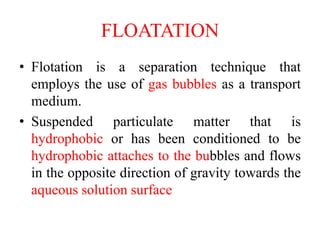
• Flotation is a separation technique that
employs the use of gas bubbles as a transport
medium.
• Suspended particulate matter that is
hydrophobic or has been conditioned to be
hydrophobic attaches to the bubbles and flows
in the opposite direction of gravity towards the
aqueous solution surface
Dissolved Air Flotation
COAGULATION
• Coagulation is the chemical water treatment
process used to remove solids from water, by
manipulating electrostatic charges of particles
suspended in water.
• This process introduces small, highly charged
molecules into water to destabilize the charges
on particles, colloids, or oily materials in
suspension.
Floe formation
• When coagulant is added to the water and
thoroughly mixed, it produces a thick insoluble
gelatinous precipitate. This precipitate is called
floe.
• The floe has the property of arresting the
suspended impurities in water during its
downward settlement towards the bottom of
the tank.
Electrical charges
• The flock ions are electrically charged
(positive) while all the colloidal particles have
negative charge.
• Therefore floes attract the colloidal particles
and cause their removal easily by settlement at
bottom of the vessel in which it is used.
Coagulants most commonly used
1. Ferrous sulphate and lime.
2. Magnesium carbonate.
3. Polyelectrolyte.
4. Aluminium sulphate.
5. Sodium aluminate.
6. Chlorinated copperas
Dry fed Devices
HEAVY METAL REMOVAL
• Heavy metals are non-biodegradable and could be
carcinogenic thus, the presence of these metals in
water by improper amounts could result in critical
health issues to living organisms.
• The mentioned metals and others such as silver
(Ag), iron (Fe), manganese (Mn), molybdenum
(Mo), boron (B), calcium (Ca), antimony (Sb),
cobalt (Co), etc. are commonly available in
wastewater and need to be removed
Adsorption-based separation
Membrane Filtration
Ultra filtration
• Ultra filtration (UF) is used at low Trans-
Membrane operating Pressure.
• UF membrane pores may be larger than the
heavy metal ions.
• Micellar Enhanced Ultra Filtration (MEUF)
and polymer enhanced ultra filtration (PEUF).
• MEUF has high flux and high selectivity,
leading to low-energy consumption, high
removal efficiency, and less space demand.
Heavy metals are in low concentrations.
• PEUF is formed through the integration of UF
and binding polymers.
• The functional groups of the bonding polymers
could be sulfonate, phosphonic, carboxylated,
or amine, and they are bonded via chelating or
ionic bonds.
• PEUF are also known as polymer-supported,
complexation,
Nanofiltration
• Nanofiltration (NF) is used to concentrate
constituents whose molecular weight is
>1000 Da and remove solutes whose size of
0.0005–0.007 μm with molecular weights
>200 Da.
• Thus, the operating range of NF is between UF
and reverse osmosis (RO) processes.
Microfiltration
• Microporous membrane to remove micron-sized
particles, bacteria, viruses, protozoa,
contaminants, pollutants, etc., from a
solvent/fluid/solution.
• MF process is also a low pressure-driven
membrane process, whose membrane pores are in
the range of 0.1–10 μm.
• Some of the MF membranes are made of silica,
ceramics, zirconia, alumina, PVC, polysulfone,
Reverse Osmosis
• RO is a pressure-driven separation process that
employs a semi-permeable membrane (pore
size 0.5–1.5 nm) to allow only smaller
molecules to pass.
• RO process reverses the normal osmosis
process by applying pressure (20–70 bar) > the
osmotic pressure of the feed solution.
• The molecular size of the solutes blocked is
usually in the range of 0.00025–0.003 μm.
Forward Osmosis
• Forward osmosis (FO) is an osmosis process
that requires a membrane to balance selectivity
and permeated water flux.
• In FO, a semi-permeable membrane separates
a feed solution from the draw solution the
draw solution is usually at a higher osmotic
pressure compared to the feed solution.
Electro dialysis Method
• Electro dialysis method in which alternative
charged positive and negative membranes take
place, Electro dialysis (ED) is used to
separates ions at the expense of electric
potential difference.
• ED uses a series of cation exchange
membranes (CEM) and anion exchange
membranes (AEM), alternatively arranged in
parallel, to separate ionic solutes
AERATION
• Aeration brings water and air in close contact
in order to remove dissolved gases (such as
carbon dioxide) and oxidizes dissolved metals
such as iron, hydrogen sulfide, and volatile
organic chemicals (VOCs).
• Aeration is often the first major process at the
treatment plant. During aeration, constituents
are removed or modified before they can
interfere with the treatment processes.
Chemicals Removed or Oxidized by
Aeration
• • Ammonia
• • Chlorine
• • Carbon dioxide
• • Hydrogen sulfide
• • Methane
• • Iron and Manganese
Air stripping
– Air stripping is a process by which a liquid,
usually wastewater, is brought into intimate
contact with a gas, usually air, so that some
undesirable volatile substances present in the
liquid phase can be released and carried away by
the gas.
– These procedures produce a condition in which a
large surface area of the water to be treated is
exposed to air, which promotes transfer of the
contaminant from the liquid phase to the gaseous
phase
• Air stripping can be quite effective in removing
volatile organic chemicals (VOCs) from water.
• Air stripping has been shown to be capable of
removing up to 90 percent of the most highly
volatile VOCs.
• Disadvantages
• If too much oxygen is injected into the water,
the water becomes supersaturated, which may
cause corrosion or air binding in filters.
• Other Problems include slow removal of the
hydrogen sulfide from the towers, algae
production, clogged filters.

UNIT-II-IWM.pptx

  • 1.
  • 2.
    UNIT II- WASTEWATER TREATMENT PROCESSES Pre and primary treatment of waste water – Equalization – Neutralization – Sedimentation – Oil separation- Sour water strippers – Floatation – Coagulation, precipitation and metals removal– coagulation – Heavy metals removal – Aeration and mass transfer; mechanism of oxygen transfer – Aeration equipment – Air stripping of volatile organic compounds.
  • 3.
    Wastewater treatment isthe process of improving the quality of wastewater and converting it into an effluent that can be either returned to the nature or incorporated to the water cycle with minimum environmental issues or that can be reused. The end user may be drinking, industrial water supply, irrigation, river flow maintenance, water recreation or many other uses, including being safely returned to the environment.
  • 4.
    Treatment of IndustrialEffluents Brine treatment Solids removal (e.g. Chemical precipitation, filtration), oils and grease removal, Removal of biodegradable organics, Removal of other organics, Removal of acids and alkalis, and Removal of toxic materials
  • 5.
    WASTE WATER PRETREATMENT Toremove harmful materials before being discharged to a sewer system under the control of a publicly owned wastewater treatment plant. The goal of pretreatment is to remove waste solids in the water • Suspended solids and dissolved solids • Metals • Synthetic chemicals
  • 6.
    The different stagesinvolved in the preliminary ,secondary & Tertiary treatment
  • 7.
    The nature oftreatment may be:  Physical treatment the pollutants are removed using physical processes like settling, surface adhesion, filtration etc. without employing a chemical reaction and biochemical agent  Chemical treatment Involves processes like neutralization, precipitation, oxidation and coagulation which employs selected chemicals to condition or modify the characteristics of the wastes  Biological treatment resembles the natural bio-degradation of organics in the environment which occurs slowly. The treatment is done by microorganisms (mostly bacteria), which uses the organic materials in the waste water as substrate for energy and as a source of carbon for new bacterial cell growth.
  • 8.
    PRIMARY TREATMENT OF INDUSTRIALEFFLUENTS • Screening • Neutralization • Equalization • Sedimentation • Coagulation
  • 9.
    SCREENING It is aprocess through which large materials like wooden pieces, metal pieces, paper, rags, pebbles, fibers etc. are removed. The rotary and circulation filters are used now a day in modern industries to remove large materials. It is a process through which large materials like wooden pieces, metal pieces, paper, rags, pebbles, fibers etc. are removed. The rotary and circulation filters are used now a day in modern industries to remove large materials
  • 10.
    • Coarse screens •fine screens • • micro screen TYPES OF WASTEWATER SCREENS
  • 11.
    COARSE OF SCREENINGIN WASTEWATER TREATMENT Openings ranging from 6 to 150 mm Parallel bars, rods or wires, wire mesh or perforated plates Circular or rectangular shapes. It is also called a “bar rack” and used to remove coarse solids such as rags and large objects that may clog or cause damage to other appurtenances
  • 12.
    MICROSCREENS FOR WASTEWATER SCREENING These screens are typically low-speed drum screens.  The drums are lined with filtering fabrics with openings of 10 to 35µm.  Wastewater enters the drum, and the retained solid waste is collected and disposed of waste
  • 13.
    FINE SCREENING • Openingsless than 6mm called fine screens. • wire cloth, wedge wire or perforated plates. • Drum Screens (rotating cylinders in the flow channel) • Step Screens (fixed and movable plates across the width of the channel) • Static Wedge Wire Screens (used by large treatment plants with ample floor space)
  • 14.
    Drum Screens Drum screensare ideal for wastewater pretreatment in small and medium-sized sewage treatment plants when the wastewater is pumped. Wastewater flows into the drum, where a deflector divides it evenly. Influent water passes through the perforated plate, which screens solids from the flow. A large flight auger carries the waste to the end of the drum, where it empties into an integrated washer/compactor or directly into a dumpster.
  • 16.
    Step Screens • StepScreens are “stepping” type of screening systems for separating suspended solids. • Handle large flow rates of sewage or process flows with small head loss, low energy consumption and minimal maintenance.
  • 17.
    Static Wedge WireScreens • Wedge wire screen is a metal mesh element widely used in screening, filtration, dehydration and declining operations for sieving and filtration. It has high strength, rigidity and loads carrying capacity and can be made into variety shapes of rigid screening filters.
  • 18.
    NEUTRALIZATION • When pHof the industrial waste is too high or too low then it should be neutralized by acid or alkali and only neutral effluent should be discharged into the public sewer.
  • 19.
    • Lime stonetreatment • Caustic soda treatment For neutralization of alkaline effluent the following techniques are used. Carbon dioxide treatment- to make its pH almost 7. Sulphuric acid treatment- to make its pH almost 7. Utilizing waste boiler – Flue gas- 12% carbon dioxide is utilized- neutral.
  • 20.
    EQUALIZATION • When effluentis discharged from factory then its pH along with the quantity of suspended solids, dissolved solids etc. vary from the beginning to the last depending upon the dilution, velocity and the amount of reactants etc.
  • 21.
    Equalization Tanks The equalizationtanks are provided (i) to balance fluctuating flows or concentrations, (ii) to assist self neutralization, or (iii) to even out the effect of a periodic "slug" discharge from a batch process
  • 22.
    Types of EqualizationTanks • Flow through type -mainly useful in assisting self neutralization • Intermittent flow type • Variable inflow/constant discharge type
  • 23.
    Intermittent flow type •Flow balancing and self-neutralization are both achieved by using two tanks, intermittently one after another. One tank is allowed to fill up after which it is checked for pH (or any other parameter) and then allowed to empty out. The second tank goes through a similar routine. Intermittent flow type tanks are economic for small flows from industries
  • 24.
    Variable inflow/constant discharge type •When flows are large an equalization tank of such a size may have to be provided that inflow can be variable while outflow is at a constant rate, generally by a pump.
  • 25.
    The volume ofthe equalization basin
  • 26.
    SEDIMENTATION • This treatmentis only employed for the settlement of suspended particles by gravity. This technique is only used in the beginning to settle down the solid particles in a high suspension effluent. • When a thick layer of sediment continues to settle, this is known as consolidation. When consolidation of sediment, or sludge, is assisted by mechanical means then this is known as thickening.
  • 27.
    SEDIMENTATION • In watertreatment sedimentation might be used to reduce the concentration of particles in suspension before the application of coagulation. • There is a variety of methods for applying sedimentation and include: • Horizontal Flow, • Radial flow, • Inclined Plate, • Ballasted flocculation and • Flocculation blanket sedimentation
  • 28.
  • 29.
  • 30.
    Inclined settling • Anapproach to providing a large are with a small footprint is to use inclined plates or tubes. These are usually constructed with lightweight material in modular form which can be easily positioned in a concrete or steel tank
  • 31.
    Inclined settling • Flowbetween such inclined plates can be co- current, counter-current or crossflow. In the co- current arrangement, the water flows downward between the plates n the direction of particle settlement. • In the counter-current arrangement, the water flows upward between the plates against the direction of particle settlement. In cross-flow the water flows across the plates, i.e. horizontal, at right angles to the direction of particle settlement.
  • 32.
    Ballasted sedimentation • Thepurpose of flocculation is to assist coagulated particles to collide and adhere so as to grow into larger particles that might settle faster, and for the particle size distribution to be as small as possible. Flocculation can be assisted by the application of high molecular weight polymers called polyelectrolyte. • In the first instance flocculation does not increase particle density – a property of flocs is that their density decreases with increase in particle size.
  • 33.
    Ballasted sedimentation • Thedensity of floc particles can be increased by application of a ballasting agent such as Bentonite or fine sand. it is possible to recover it for recycling by means of passing the sludge collected from the sedimentation tank through hydro cyclones.
  • 34.
    Floc blanket sedimentation •The first floc blanket tanks had an inverted pyramidal shape topped by a short vertical section. This is because the view is taken that floc in the suspension is still functioning as floc should, helping to remove the particles in the incoming water. • when sediment is allowed to accumulate on the floor of a tank that might appropriately be referred to as a sludge blanket.
  • 35.
    Floc blanket sedimentation •The incoming suspension was fed downward into the apex of the pyramidal hopper by a single pipe. The blanket occupied most of the pyramidal hopper. • The comparative success of floc blanket settling resulted in adaptation of premix-recirculation tanks being developed to include floc blanket zones. However, more effective developments and cheaper designs led to use of flat-bottomed rectangular tanks fed by an arrangement of multiple inlet pipes
  • 36.
    OIL SEPARATION • Anoil water separator is a piece of equipment used to treat wastewater, making it safe to discharge into an approved discharge point, such as a sewer. Different types of oil water separators • Coalescing plate separators • Vertical gravity separators • Hydro cyclone separators • Petrol and oil interceptor pits
  • 38.
    FLOATATION • Flotation isa separation technique that employs the use of gas bubbles as a transport medium. • Suspended particulate matter that is hydrophobic or has been conditioned to be hydrophobic attaches to the bubbles and flows in the opposite direction of gravity towards the aqueous solution surface
  • 39.
  • 40.
    COAGULATION • Coagulation isthe chemical water treatment process used to remove solids from water, by manipulating electrostatic charges of particles suspended in water. • This process introduces small, highly charged molecules into water to destabilize the charges on particles, colloids, or oily materials in suspension.
  • 41.
    Floe formation • Whencoagulant is added to the water and thoroughly mixed, it produces a thick insoluble gelatinous precipitate. This precipitate is called floe. • The floe has the property of arresting the suspended impurities in water during its downward settlement towards the bottom of the tank.
  • 42.
    Electrical charges • Theflock ions are electrically charged (positive) while all the colloidal particles have negative charge. • Therefore floes attract the colloidal particles and cause their removal easily by settlement at bottom of the vessel in which it is used.
  • 43.
    Coagulants most commonlyused 1. Ferrous sulphate and lime. 2. Magnesium carbonate. 3. Polyelectrolyte. 4. Aluminium sulphate. 5. Sodium aluminate. 6. Chlorinated copperas
  • 44.
  • 45.
    HEAVY METAL REMOVAL •Heavy metals are non-biodegradable and could be carcinogenic thus, the presence of these metals in water by improper amounts could result in critical health issues to living organisms. • The mentioned metals and others such as silver (Ag), iron (Fe), manganese (Mn), molybdenum (Mo), boron (B), calcium (Ca), antimony (Sb), cobalt (Co), etc. are commonly available in wastewater and need to be removed
  • 46.
  • 47.
  • 49.
    Ultra filtration • Ultrafiltration (UF) is used at low Trans- Membrane operating Pressure. • UF membrane pores may be larger than the heavy metal ions. • Micellar Enhanced Ultra Filtration (MEUF) and polymer enhanced ultra filtration (PEUF). • MEUF has high flux and high selectivity, leading to low-energy consumption, high removal efficiency, and less space demand.
  • 50.
    Heavy metals arein low concentrations. • PEUF is formed through the integration of UF and binding polymers. • The functional groups of the bonding polymers could be sulfonate, phosphonic, carboxylated, or amine, and they are bonded via chelating or ionic bonds. • PEUF are also known as polymer-supported, complexation,
  • 51.
    Nanofiltration • Nanofiltration (NF)is used to concentrate constituents whose molecular weight is >1000 Da and remove solutes whose size of 0.0005–0.007 μm with molecular weights >200 Da. • Thus, the operating range of NF is between UF and reverse osmosis (RO) processes.
  • 52.
    Microfiltration • Microporous membraneto remove micron-sized particles, bacteria, viruses, protozoa, contaminants, pollutants, etc., from a solvent/fluid/solution. • MF process is also a low pressure-driven membrane process, whose membrane pores are in the range of 0.1–10 μm. • Some of the MF membranes are made of silica, ceramics, zirconia, alumina, PVC, polysulfone,
  • 53.
    Reverse Osmosis • ROis a pressure-driven separation process that employs a semi-permeable membrane (pore size 0.5–1.5 nm) to allow only smaller molecules to pass. • RO process reverses the normal osmosis process by applying pressure (20–70 bar) > the osmotic pressure of the feed solution. • The molecular size of the solutes blocked is usually in the range of 0.00025–0.003 μm.
  • 54.
    Forward Osmosis • Forwardosmosis (FO) is an osmosis process that requires a membrane to balance selectivity and permeated water flux. • In FO, a semi-permeable membrane separates a feed solution from the draw solution the draw solution is usually at a higher osmotic pressure compared to the feed solution.
  • 55.
    Electro dialysis Method •Electro dialysis method in which alternative charged positive and negative membranes take place, Electro dialysis (ED) is used to separates ions at the expense of electric potential difference. • ED uses a series of cation exchange membranes (CEM) and anion exchange membranes (AEM), alternatively arranged in parallel, to separate ionic solutes
  • 56.
    AERATION • Aeration bringswater and air in close contact in order to remove dissolved gases (such as carbon dioxide) and oxidizes dissolved metals such as iron, hydrogen sulfide, and volatile organic chemicals (VOCs). • Aeration is often the first major process at the treatment plant. During aeration, constituents are removed or modified before they can interfere with the treatment processes.
  • 57.
    Chemicals Removed orOxidized by Aeration • • Ammonia • • Chlorine • • Carbon dioxide • • Hydrogen sulfide • • Methane • • Iron and Manganese
  • 58.
    Air stripping – Airstripping is a process by which a liquid, usually wastewater, is brought into intimate contact with a gas, usually air, so that some undesirable volatile substances present in the liquid phase can be released and carried away by the gas. – These procedures produce a condition in which a large surface area of the water to be treated is exposed to air, which promotes transfer of the contaminant from the liquid phase to the gaseous phase
  • 59.
    • Air strippingcan be quite effective in removing volatile organic chemicals (VOCs) from water. • Air stripping has been shown to be capable of removing up to 90 percent of the most highly volatile VOCs. • Disadvantages • If too much oxygen is injected into the water, the water becomes supersaturated, which may cause corrosion or air binding in filters. • Other Problems include slow removal of the hydrogen sulfide from the towers, algae production, clogged filters.