VII. Water TreatmentVII. Water Treatment
A. Treatment of wastewater andA. Treatment of wastewater and
B. Treatment of drinking waterB. Treatment of drinking water
Objectives - students should:Objectives - students should:
List and describe treatment methods forList and describe treatment methods for
wastewater.wastewater.
List and describe treatment methods forList and describe treatment methods for
drinking water.drinking water.
Compare and contrast treatment methodsCompare and contrast treatment methods
and goals of wastewater and drinkingand goals of wastewater and drinking
water.water.
Justification for wastewaterJustification for wastewater
treatment:treatment:
Pollution from sewage is a primaryPollution from sewage is a primary
environmental health hazardenvironmental health hazard
(wastewater effluent).(wastewater effluent).
The purpose of municipal wastewaterThe purpose of municipal wastewater
treatment is to limit pollution of thetreatment is to limit pollution of the
receiving watercourse.receiving watercourse.
The receiving watercourse may also beThe receiving watercourse may also be
a source of drinking water.a source of drinking water.
Goals of wastewater treatment:Goals of wastewater treatment:
Reduction ofReduction of organic loadorganic load of theof the
wastewater effluent to limitwastewater effluent to limit
eutrophication (BOD, COD limits),eutrophication (BOD, COD limits),
Reduction ofReduction of microbiologicalmicrobiological
contaminationcontamination that may transmitthat may transmit
infectious disease.infectious disease.
Municipal wastewater treatmentMunicipal wastewater treatment
facility and regulationsfacility and regulations
Municipal wastewater treatment facilities, orMunicipal wastewater treatment facilities, or
“Publicly Owned Treatment Works” (POTWs), or“Publicly Owned Treatment Works” (POTWs), or
“Water Reclamation Districts” are designed to“Water Reclamation Districts” are designed to
reduce environmental health risks of untreatedreduce environmental health risks of untreated
wastewater.wastewater.
Levels of treatment required are based on NPDESLevels of treatment required are based on NPDES
regulations.regulations.
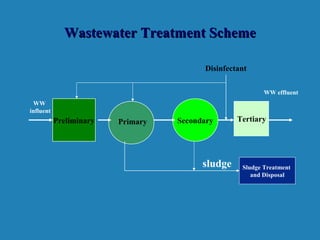
Wastewater Treatment SchemeWastewater Treatment Scheme
Preliminary Secondary
WW
influent
WW effluent
sludge
Primary Tertiary
Disinfectant
Sludge Treatment
and Disposal
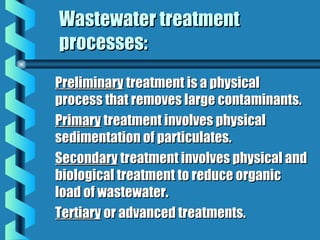
Wastewater treatmentWastewater treatment
processes:processes:
PreliminaryPreliminary treatment is a physicaltreatment is a physical
process that removes large contaminants.process that removes large contaminants.
PrimaryPrimary treatment involves physicaltreatment involves physical
sedimentation of particulates.sedimentation of particulates.
SecondarySecondary treatment involves physical andtreatment involves physical and
biological treatment to reduce organicbiological treatment to reduce organic
load of wastewater.load of wastewater.
TertiaryTertiary or advanced treatments.or advanced treatments.
Nitrification-denitrification process toNitrification-denitrification process to
remove N and Premove N and P
FiltrationFiltration
Carbon AdsorptionCarbon Adsorption
Constructed (Man-made] WetlandConstructed (Man-made] Wetland
Tertiary or Advanced TreatmentTertiary or Advanced Treatment
More than 25% of all households in the U.S. areMore than 25% of all households in the U.S. are
served by on-site treatment systems.served by on-site treatment systems.
About 3 billion gallons of wastewater isAbout 3 billion gallons of wastewater is
discharged each day to on-site wastewaterdischarged each day to on-site wastewater
treatment systems.treatment systems.
Potential disease transmission risks throughPotential disease transmission risks through
wastewater should be limited.wastewater should be limited.
On-site wastewaterOn-site wastewater
treatmenttreatment
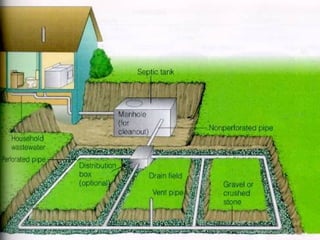
Septic systemsSeptic systems typically consist of:typically consist of:
A septic tankA septic tank (concrete, with inlet and outlet,(concrete, with inlet and outlet,
baffles, and removable top for cleaning),baffles, and removable top for cleaning),
which collects and holds waste,which collects and holds waste,
A drain fieldA drain field oror tile fieldtile field (plastic or tile pipe(plastic or tile pipe
with outlets) which allows wastewater effluentwith outlets) which allows wastewater effluent
to infiltrate slowly into soils.to infiltrate slowly into soils.
Plumbing connectionsPlumbing connections..
Typical septic system design:Typical septic system design:
Periodic summeryPeriodic summery
Treatment of wastewater is necessary to protectTreatment of wastewater is necessary to protect
the environment and preserve the quality of waterthe environment and preserve the quality of water
for drinking.for drinking.
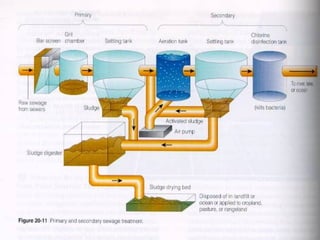
Treatment of municipal wastewater typicallyTreatment of municipal wastewater typically
includes preliminary, primary treatment,includes preliminary, primary treatment,
secondary treatment, and tertiary treatment.secondary treatment, and tertiary treatment.
On-site wastewater treatment is facilitated byOn-site wastewater treatment is facilitated by
septic tank systems.septic tank systems.
B. Drinking water treatment:B. Drinking water treatment:
ClarificationClarification - primarily a- primarily a physicalphysical
process, but may be aided by addition ofprocess, but may be aided by addition of
chemicals.chemicals.
FiltrationFiltration - also primarily- also primarily physicalphysical, but, but
chemicals may aid the process.chemicals may aid the process.
DisinfectionDisinfection - typically a- typically a chemicalchemical
process that reduces pathogenicprocess that reduces pathogenic
microorganisms.microorganisms.
B1. Clarification of drinkingB1. Clarification of drinking
water:water:
Clarification removes particulates thatClarification removes particulates that
contribute to turbidity and contaminationcontribute to turbidity and contamination
of water.of water.
Clarification is aided by chemicals whichClarification is aided by chemicals which
cause particulates to aggregate,cause particulates to aggregate,
precipitate, and form sediment (sludge).precipitate, and form sediment (sludge).
B2. Filtration:B2. Filtration:
Separate nonsettleable solids from water.Separate nonsettleable solids from water.
Combined with coagulation/clarification,Combined with coagulation/clarification,
filtration can remove 84%-96% turbidity,filtration can remove 84%-96% turbidity,
coliform bacteria 97-99.95%, and >99%coliform bacteria 97-99.95%, and >99%
Giardia.Giardia.
Rapid filtrationRapid filtration - uses gravity (faster- uses gravity (faster
flow).flow).
Slow filtrationSlow filtration - uses gravity [slower- uses gravity [slower
flow].flow].
Pressure sand filtersPressure sand filters -use water-use water
pressure.pressure.
• Diatomaceous earth (DE) filtrationDiatomaceous earth (DE) filtration
MicrostrainingMicrostraining - uses fine steel fabric- uses fine steel fabric
(sometimes used prior to other filtrations).(sometimes used prior to other filtrations).
Type of FiltrationType of Filtration
Filter MediaFilter Media
Filter media should be:Filter media should be:
• coarse enough to retain large quantities of floccoarse enough to retain large quantities of floc
• sufficiently fine to prevent passage of suspended solidssufficiently fine to prevent passage of suspended solids
• deep enough to allow relative long filter runsdeep enough to allow relative long filter runs
Granular-medium filters (Rapid Sand Filters]Granular-medium filters (Rapid Sand Filters]
• Anthracite on the very top (least dense),Anthracite on the very top (least dense),
• fine sand on top of supporting coarse sand(less dense),fine sand on top of supporting coarse sand(less dense),
which lays on top ofwhich lays on top of
• gravel layer (highest density).gravel layer (highest density).
Cleaning (backwashing) filtersCleaning (backwashing) filters
Determination of how often to back-washDetermination of how often to back-wash
can be made on the basis of:can be made on the basis of:
• Head loss (pressure loss),Head loss (pressure loss),
• Loss of water quality (e.g., increased turbidity),Loss of water quality (e.g., increased turbidity),
oror
• Time since last backwash.Time since last backwash.
Backwashing processBackwashing process
Water flow is reversed through the filterWater flow is reversed through the filter
bed.bed.
• TheThe raterate of backwash is designed to partiallyof backwash is designed to partially
expand (fluidize) the filter bed.expand (fluidize) the filter bed.
• Suspended matter is removed bySuspended matter is removed by shearshear forcesforces
as the water moves through the fluidized bed.as the water moves through the fluidized bed.
• AdditionalAdditional cleaning occurs when particles ofcleaning occurs when particles of
the bed abrade against each other.the bed abrade against each other.
Flow control through filtersFlow control through filters
Constant-rate filtrationConstant-rate filtration
• Flow rate is controlled by limiting theFlow rate is controlled by limiting the
discharge rate, limiting the rate of inflow by adischarge rate, limiting the rate of inflow by a
weir, orweir, or
• by pumping or use of influent flow-splittingby pumping or use of influent flow-splitting
weir.weir.
Declining-rate filtrationDeclining-rate filtration
• Rate of flow declines as the rate of head lossRate of flow declines as the rate of head loss
builds (influent- or effluent-controlled).builds (influent- or effluent-controlled).
Periodic Summary:Periodic Summary:
Drinking water treatment typicallyDrinking water treatment typically
include clarification, filtration andinclude clarification, filtration and
disinfection.disinfection.
Drinking water treatment should makeDrinking water treatment should make
water both potable and palatable.water both potable and palatable.
Wastewater and drinking waterWastewater and drinking water
treatment processes are similar intreatment processes are similar in
several ways.several ways.
VII. Water TreatmentVII. Water Treatment
B3. Disinfection of drinkingB3. Disinfection of drinking
waterwater
Objectives - students should:Objectives - students should:
Define and give examples of types ofDefine and give examples of types of
disinfection techniques for drinkingdisinfection techniques for drinking
water.water.
Distinguish between physical andDistinguish between physical and
chemical disinfection techniques.chemical disinfection techniques.
Evaluate the safety, cost, effectiveness,Evaluate the safety, cost, effectiveness,
and popularity of various disinfectionand popularity of various disinfection
techniques.techniques.
Types of disinfection:Types of disinfection:
Physical disinfection techniques includePhysical disinfection techniques include
boiling and irradiation with ultravioletboiling and irradiation with ultraviolet
light.light.
Chemical disinfection techniques includeChemical disinfection techniques include
adding chlorine, bromine, iodine, and ozoneadding chlorine, bromine, iodine, and ozone
to water.to water.
Physical disinfection (boiling):Physical disinfection (boiling):
Boiling kills vegetative bacterial cells, butBoiling kills vegetative bacterial cells, but
spores, viruses, and some protozoa mayspores, viruses, and some protozoa may
survive long periods of boiling.survive long periods of boiling.
Boiling may also volatilize VOC’s.Boiling may also volatilize VOC’s.
Boiling is an effective method for smallBoiling is an effective method for small
batches of water during water emergencies.batches of water during water emergencies.
Boiling is prohibitivelyBoiling is prohibitively expensiveexpensive for largefor large
quantities of water.quantities of water.
Physical disinfectionPhysical disinfection
(UV radiation):(UV radiation):
Ultraviolet radiation is an effective andUltraviolet radiation is an effective and
relatively safe disinfection method, but isrelatively safe disinfection method, but is
relatively expensive and not widely used.relatively expensive and not widely used.
UV light disrupts DNA of microbial cells,UV light disrupts DNA of microbial cells,
preventing reproduction.preventing reproduction.
Specific wavelengths, intensities,Specific wavelengths, intensities,
distances, flow rates, and retention timesdistances, flow rates, and retention times
are required.are required.
Chemical disinfection:Chemical disinfection:
Chemicals added to water for disinfectionChemicals added to water for disinfection
include chlorine, bromine, and iodine.include chlorine, bromine, and iodine.
Bromine is not recommended for drinkingBromine is not recommended for drinking
water disinfection, but may be used forwater disinfection, but may be used for
pool water.pool water.
Iodine is sometimes used for drinkingIodine is sometimes used for drinking
water disinfection, but causes a badwater disinfection, but causes a bad
aftertaste.aftertaste.
Chlorine disinfection:Chlorine disinfection:
Chlorination is a cheap, effective, relativelyChlorination is a cheap, effective, relatively
harmless (and therefore most popular)harmless (and therefore most popular)
disinfection method.disinfection method.
Chlorine is added as a gas or hypochloriteChlorine is added as a gas or hypochlorite
solution.solution.
Hypochlorous acid and hypochlorite ionsHypochlorous acid and hypochlorite ions
form in solution, which are strong chemicalform in solution, which are strong chemical
oxidants, and kill microbes.oxidants, and kill microbes.
Chlorine disinfection (cont.):Chlorine disinfection (cont.):
Combined chlorine is the proportion thatCombined chlorine is the proportion that
combines with organic matter.combines with organic matter.
Free chlorine is the amount thatFree chlorine is the amount that remainsremains
to kill microbes in the distribution systemto kill microbes in the distribution system
(0.5 ppm, 10 min.)(0.5 ppm, 10 min.)
Total chlorine is the combined concen-Total chlorine is the combined concen-
tration of combined and free chlorine.tration of combined and free chlorine.
Disinfection By-Products (DBPs)Disinfection By-Products (DBPs)
Chlorine (or bromine or iodine) + “precursors”Chlorine (or bromine or iodine) + “precursors”
(organic compounds) = THM(Trihalomethanes)(organic compounds) = THM(Trihalomethanes)
• eg. Chloroform (CHCleg. Chloroform (CHCl33), Bromoform (CHBr), Bromoform (CHBr33), Iodoform), Iodoform
(CHI(CHI33), chlorobromoform (CHBrCl), chlorobromoform (CHBrCl22), Bromochloroform), Bromochloroform
(CHBr(CHBr22Cl), Bromoidodform (CHBrCl), Bromoidodform (CHBr22I), etc.I), etc.
THMs are carcinogenicTHMs are carcinogenic
Choroamine disinfection reduce THMs productionChoroamine disinfection reduce THMs production
due to preferential reaction of chlorine withdue to preferential reaction of chlorine with
ammoniaammonia
Ozonation:Ozonation:
Ozone (OOzone (O33) is an effective, relatively) is an effective, relatively
harmless disinfection method, but isharmless disinfection method, but is
expensive (and therefore less popular thanexpensive (and therefore less popular than
chlorine).chlorine).
Ozone is a strong oxidant, that producesOzone is a strong oxidant, that produces
hydroxyl free radicals that react withhydroxyl free radicals that react with
organic and inorganic molecules in waterorganic and inorganic molecules in water
to kill microbes.to kill microbes.
Summary:Summary:
Disinfection is the destruction ofDisinfection is the destruction of
microorganisms in drinking water to safemicroorganisms in drinking water to safe
levels.levels.
Disinfection techniques include physicalDisinfection techniques include physical
(boiling, ultraviolet light) and chemical(boiling, ultraviolet light) and chemical
methods (chlorine, bromine, iodine, andmethods (chlorine, bromine, iodine, and
ozone).ozone).

Water treatment i

  • 1.
    VII. Water TreatmentVII.Water Treatment A. Treatment of wastewater andA. Treatment of wastewater and B. Treatment of drinking waterB. Treatment of drinking water
  • 2.
    Objectives - studentsshould:Objectives - students should: List and describe treatment methods forList and describe treatment methods for wastewater.wastewater. List and describe treatment methods forList and describe treatment methods for drinking water.drinking water. Compare and contrast treatment methodsCompare and contrast treatment methods and goals of wastewater and drinkingand goals of wastewater and drinking water.water.
  • 3.
    Justification for wastewaterJustificationfor wastewater treatment:treatment: Pollution from sewage is a primaryPollution from sewage is a primary environmental health hazardenvironmental health hazard (wastewater effluent).(wastewater effluent). The purpose of municipal wastewaterThe purpose of municipal wastewater treatment is to limit pollution of thetreatment is to limit pollution of the receiving watercourse.receiving watercourse. The receiving watercourse may also beThe receiving watercourse may also be a source of drinking water.a source of drinking water.
  • 4.
    Goals of wastewatertreatment:Goals of wastewater treatment: Reduction ofReduction of organic loadorganic load of theof the wastewater effluent to limitwastewater effluent to limit eutrophication (BOD, COD limits),eutrophication (BOD, COD limits), Reduction ofReduction of microbiologicalmicrobiological contaminationcontamination that may transmitthat may transmit infectious disease.infectious disease.
  • 5.
    Municipal wastewater treatmentMunicipalwastewater treatment facility and regulationsfacility and regulations Municipal wastewater treatment facilities, orMunicipal wastewater treatment facilities, or “Publicly Owned Treatment Works” (POTWs), or“Publicly Owned Treatment Works” (POTWs), or “Water Reclamation Districts” are designed to“Water Reclamation Districts” are designed to reduce environmental health risks of untreatedreduce environmental health risks of untreated wastewater.wastewater. Levels of treatment required are based on NPDESLevels of treatment required are based on NPDES regulations.regulations.
  • 6.
    Wastewater Treatment SchemeWastewaterTreatment Scheme Preliminary Secondary WW influent WW effluent sludge Primary Tertiary Disinfectant Sludge Treatment and Disposal
  • 7.
    Wastewater treatmentWastewater treatment processes:processes: PreliminaryPreliminarytreatment is a physicaltreatment is a physical process that removes large contaminants.process that removes large contaminants. PrimaryPrimary treatment involves physicaltreatment involves physical sedimentation of particulates.sedimentation of particulates. SecondarySecondary treatment involves physical andtreatment involves physical and biological treatment to reduce organicbiological treatment to reduce organic load of wastewater.load of wastewater. TertiaryTertiary or advanced treatments.or advanced treatments.
  • 9.
    Nitrification-denitrification process toNitrification-denitrificationprocess to remove N and Premove N and P FiltrationFiltration Carbon AdsorptionCarbon Adsorption Constructed (Man-made] WetlandConstructed (Man-made] Wetland Tertiary or Advanced TreatmentTertiary or Advanced Treatment
  • 10.
    More than 25%of all households in the U.S. areMore than 25% of all households in the U.S. are served by on-site treatment systems.served by on-site treatment systems. About 3 billion gallons of wastewater isAbout 3 billion gallons of wastewater is discharged each day to on-site wastewaterdischarged each day to on-site wastewater treatment systems.treatment systems. Potential disease transmission risks throughPotential disease transmission risks through wastewater should be limited.wastewater should be limited. On-site wastewaterOn-site wastewater treatmenttreatment
  • 11.
    Septic systemsSeptic systemstypically consist of:typically consist of: A septic tankA septic tank (concrete, with inlet and outlet,(concrete, with inlet and outlet, baffles, and removable top for cleaning),baffles, and removable top for cleaning), which collects and holds waste,which collects and holds waste, A drain fieldA drain field oror tile fieldtile field (plastic or tile pipe(plastic or tile pipe with outlets) which allows wastewater effluentwith outlets) which allows wastewater effluent to infiltrate slowly into soils.to infiltrate slowly into soils. Plumbing connectionsPlumbing connections.. Typical septic system design:Typical septic system design:
  • 13.
    Periodic summeryPeriodic summery Treatmentof wastewater is necessary to protectTreatment of wastewater is necessary to protect the environment and preserve the quality of waterthe environment and preserve the quality of water for drinking.for drinking. Treatment of municipal wastewater typicallyTreatment of municipal wastewater typically includes preliminary, primary treatment,includes preliminary, primary treatment, secondary treatment, and tertiary treatment.secondary treatment, and tertiary treatment. On-site wastewater treatment is facilitated byOn-site wastewater treatment is facilitated by septic tank systems.septic tank systems.
  • 14.
    B. Drinking watertreatment:B. Drinking water treatment: ClarificationClarification - primarily a- primarily a physicalphysical process, but may be aided by addition ofprocess, but may be aided by addition of chemicals.chemicals. FiltrationFiltration - also primarily- also primarily physicalphysical, but, but chemicals may aid the process.chemicals may aid the process. DisinfectionDisinfection - typically a- typically a chemicalchemical process that reduces pathogenicprocess that reduces pathogenic microorganisms.microorganisms.
  • 15.
    B1. Clarification ofdrinkingB1. Clarification of drinking water:water: Clarification removes particulates thatClarification removes particulates that contribute to turbidity and contaminationcontribute to turbidity and contamination of water.of water. Clarification is aided by chemicals whichClarification is aided by chemicals which cause particulates to aggregate,cause particulates to aggregate, precipitate, and form sediment (sludge).precipitate, and form sediment (sludge).
  • 16.
    B2. Filtration:B2. Filtration: Separatenonsettleable solids from water.Separate nonsettleable solids from water. Combined with coagulation/clarification,Combined with coagulation/clarification, filtration can remove 84%-96% turbidity,filtration can remove 84%-96% turbidity, coliform bacteria 97-99.95%, and >99%coliform bacteria 97-99.95%, and >99% Giardia.Giardia.
  • 17.
    Rapid filtrationRapid filtration- uses gravity (faster- uses gravity (faster flow).flow). Slow filtrationSlow filtration - uses gravity [slower- uses gravity [slower flow].flow]. Pressure sand filtersPressure sand filters -use water-use water pressure.pressure. • Diatomaceous earth (DE) filtrationDiatomaceous earth (DE) filtration MicrostrainingMicrostraining - uses fine steel fabric- uses fine steel fabric (sometimes used prior to other filtrations).(sometimes used prior to other filtrations). Type of FiltrationType of Filtration
  • 18.
    Filter MediaFilter Media Filtermedia should be:Filter media should be: • coarse enough to retain large quantities of floccoarse enough to retain large quantities of floc • sufficiently fine to prevent passage of suspended solidssufficiently fine to prevent passage of suspended solids • deep enough to allow relative long filter runsdeep enough to allow relative long filter runs Granular-medium filters (Rapid Sand Filters]Granular-medium filters (Rapid Sand Filters] • Anthracite on the very top (least dense),Anthracite on the very top (least dense), • fine sand on top of supporting coarse sand(less dense),fine sand on top of supporting coarse sand(less dense), which lays on top ofwhich lays on top of • gravel layer (highest density).gravel layer (highest density).
  • 19.
    Cleaning (backwashing) filtersCleaning(backwashing) filters Determination of how often to back-washDetermination of how often to back-wash can be made on the basis of:can be made on the basis of: • Head loss (pressure loss),Head loss (pressure loss), • Loss of water quality (e.g., increased turbidity),Loss of water quality (e.g., increased turbidity), oror • Time since last backwash.Time since last backwash.
  • 20.
    Backwashing processBackwashing process Waterflow is reversed through the filterWater flow is reversed through the filter bed.bed. • TheThe raterate of backwash is designed to partiallyof backwash is designed to partially expand (fluidize) the filter bed.expand (fluidize) the filter bed. • Suspended matter is removed bySuspended matter is removed by shearshear forcesforces as the water moves through the fluidized bed.as the water moves through the fluidized bed. • AdditionalAdditional cleaning occurs when particles ofcleaning occurs when particles of the bed abrade against each other.the bed abrade against each other.
  • 21.
    Flow control throughfiltersFlow control through filters Constant-rate filtrationConstant-rate filtration • Flow rate is controlled by limiting theFlow rate is controlled by limiting the discharge rate, limiting the rate of inflow by adischarge rate, limiting the rate of inflow by a weir, orweir, or • by pumping or use of influent flow-splittingby pumping or use of influent flow-splitting weir.weir. Declining-rate filtrationDeclining-rate filtration • Rate of flow declines as the rate of head lossRate of flow declines as the rate of head loss builds (influent- or effluent-controlled).builds (influent- or effluent-controlled).
  • 22.
    Periodic Summary:Periodic Summary: Drinkingwater treatment typicallyDrinking water treatment typically include clarification, filtration andinclude clarification, filtration and disinfection.disinfection. Drinking water treatment should makeDrinking water treatment should make water both potable and palatable.water both potable and palatable. Wastewater and drinking waterWastewater and drinking water treatment processes are similar intreatment processes are similar in several ways.several ways.
  • 23.
    VII. Water TreatmentVII.Water Treatment B3. Disinfection of drinkingB3. Disinfection of drinking waterwater
  • 24.
    Objectives - studentsshould:Objectives - students should: Define and give examples of types ofDefine and give examples of types of disinfection techniques for drinkingdisinfection techniques for drinking water.water. Distinguish between physical andDistinguish between physical and chemical disinfection techniques.chemical disinfection techniques. Evaluate the safety, cost, effectiveness,Evaluate the safety, cost, effectiveness, and popularity of various disinfectionand popularity of various disinfection techniques.techniques.
  • 25.
    Types of disinfection:Typesof disinfection: Physical disinfection techniques includePhysical disinfection techniques include boiling and irradiation with ultravioletboiling and irradiation with ultraviolet light.light. Chemical disinfection techniques includeChemical disinfection techniques include adding chlorine, bromine, iodine, and ozoneadding chlorine, bromine, iodine, and ozone to water.to water.
  • 26.
    Physical disinfection (boiling):Physicaldisinfection (boiling): Boiling kills vegetative bacterial cells, butBoiling kills vegetative bacterial cells, but spores, viruses, and some protozoa mayspores, viruses, and some protozoa may survive long periods of boiling.survive long periods of boiling. Boiling may also volatilize VOC’s.Boiling may also volatilize VOC’s. Boiling is an effective method for smallBoiling is an effective method for small batches of water during water emergencies.batches of water during water emergencies. Boiling is prohibitivelyBoiling is prohibitively expensiveexpensive for largefor large quantities of water.quantities of water.
  • 27.
    Physical disinfectionPhysical disinfection (UVradiation):(UV radiation): Ultraviolet radiation is an effective andUltraviolet radiation is an effective and relatively safe disinfection method, but isrelatively safe disinfection method, but is relatively expensive and not widely used.relatively expensive and not widely used. UV light disrupts DNA of microbial cells,UV light disrupts DNA of microbial cells, preventing reproduction.preventing reproduction. Specific wavelengths, intensities,Specific wavelengths, intensities, distances, flow rates, and retention timesdistances, flow rates, and retention times are required.are required.
  • 28.
    Chemical disinfection:Chemical disinfection: Chemicalsadded to water for disinfectionChemicals added to water for disinfection include chlorine, bromine, and iodine.include chlorine, bromine, and iodine. Bromine is not recommended for drinkingBromine is not recommended for drinking water disinfection, but may be used forwater disinfection, but may be used for pool water.pool water. Iodine is sometimes used for drinkingIodine is sometimes used for drinking water disinfection, but causes a badwater disinfection, but causes a bad aftertaste.aftertaste.
  • 29.
    Chlorine disinfection:Chlorine disinfection: Chlorinationis a cheap, effective, relativelyChlorination is a cheap, effective, relatively harmless (and therefore most popular)harmless (and therefore most popular) disinfection method.disinfection method. Chlorine is added as a gas or hypochloriteChlorine is added as a gas or hypochlorite solution.solution. Hypochlorous acid and hypochlorite ionsHypochlorous acid and hypochlorite ions form in solution, which are strong chemicalform in solution, which are strong chemical oxidants, and kill microbes.oxidants, and kill microbes.
  • 30.
    Chlorine disinfection (cont.):Chlorinedisinfection (cont.): Combined chlorine is the proportion thatCombined chlorine is the proportion that combines with organic matter.combines with organic matter. Free chlorine is the amount thatFree chlorine is the amount that remainsremains to kill microbes in the distribution systemto kill microbes in the distribution system (0.5 ppm, 10 min.)(0.5 ppm, 10 min.) Total chlorine is the combined concen-Total chlorine is the combined concen- tration of combined and free chlorine.tration of combined and free chlorine.
  • 31.
    Disinfection By-Products (DBPs)DisinfectionBy-Products (DBPs) Chlorine (or bromine or iodine) + “precursors”Chlorine (or bromine or iodine) + “precursors” (organic compounds) = THM(Trihalomethanes)(organic compounds) = THM(Trihalomethanes) • eg. Chloroform (CHCleg. Chloroform (CHCl33), Bromoform (CHBr), Bromoform (CHBr33), Iodoform), Iodoform (CHI(CHI33), chlorobromoform (CHBrCl), chlorobromoform (CHBrCl22), Bromochloroform), Bromochloroform (CHBr(CHBr22Cl), Bromoidodform (CHBrCl), Bromoidodform (CHBr22I), etc.I), etc. THMs are carcinogenicTHMs are carcinogenic Choroamine disinfection reduce THMs productionChoroamine disinfection reduce THMs production due to preferential reaction of chlorine withdue to preferential reaction of chlorine with ammoniaammonia
  • 32.
    Ozonation:Ozonation: Ozone (OOzone (O33)is an effective, relatively) is an effective, relatively harmless disinfection method, but isharmless disinfection method, but is expensive (and therefore less popular thanexpensive (and therefore less popular than chlorine).chlorine). Ozone is a strong oxidant, that producesOzone is a strong oxidant, that produces hydroxyl free radicals that react withhydroxyl free radicals that react with organic and inorganic molecules in waterorganic and inorganic molecules in water to kill microbes.to kill microbes.
  • 33.
    Summary:Summary: Disinfection is thedestruction ofDisinfection is the destruction of microorganisms in drinking water to safemicroorganisms in drinking water to safe levels.levels. Disinfection techniques include physicalDisinfection techniques include physical (boiling, ultraviolet light) and chemical(boiling, ultraviolet light) and chemical methods (chlorine, bromine, iodine, andmethods (chlorine, bromine, iodine, and ozone).ozone).