KYOTO PROTOCOL
N.GNANA PRADEP
VP22ARCH010002
KYOTO PROTOCOL
• The Kyoto Protocol to the United Nations
Framework Convention on Climate Change was
adopted in Kyoto, Japan, in December 1997 and
entered into force on 16 February 2005.
• The rules and requirements for implementing
the Kyoto Protocol were further elaborated in a
package of decisions called the Marrakesh
Accords. The Marrakesh Accords were formally
adopted by the CMP (Climate Change
Conference) at its first session in Montreal,
Canada, in December 2005
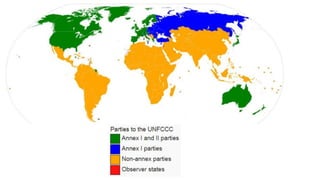
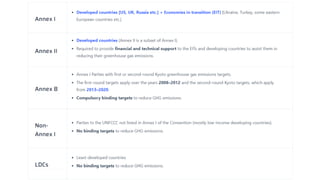
• The protocol commits that ''Annex 1 countries"
(developed countries) reduce their emissions to
ten percent below year 1990 levels.
• Each country has a prescribed number of
'emission units' which make up the target
emissions
• The Kyoto Protocol provides mechanisms for
countries to meet their emission targets
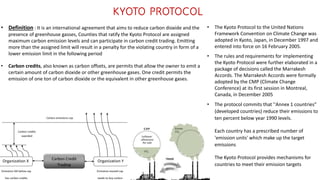
• Definition : It is an international agreement that aims to reduce carbon dioxide and the
presence of greenhouse gasses, Counties that ratify the Kyoto Protocol are assigned
maximum carbon emission levels and can participate in carbon credit trading. Emitting
more than the assigned limit will result in a penalty for the violating country in form of a
lower emission limit in the following period
• Carbon credits, also known as carbon offsets, are permits that allow the owner to emit a
certain amount of carbon dioxide or other greenhouse gases. One credit permits the
emission of one ton of carbon dioxide or the equivalent in other greenhouse gases.
KYOTO PROTOCOL
Greenhouse Gasses:
• Carbon Dioxide (CO2)
• Methane (CH4)
• Nitrous Oxide (N2O)
• Hydro Fluro Carbons (HFC’s)
• Perfluoro Carbons (PFC’s)
• Sulphur Hexafluoride (SF6’s)
Natural Greenhouse Gases
Man-Made Greenhouse Gases
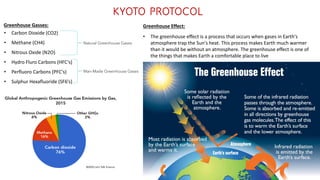
• The greenhouse effect is a process that occurs when gases in Earth's
atmosphere trap the Sun's heat. This process makes Earth much warmer
than it would be without an atmosphere. The greenhouse effect is one of
the things that makes Earth a comfortable place to live
Greenhouse Effect:
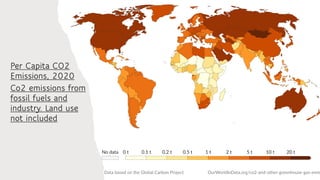
Per Capita CO2
Emissions, 2020
Co2 emissions from
fossil fuels and
industry. Land use
not included
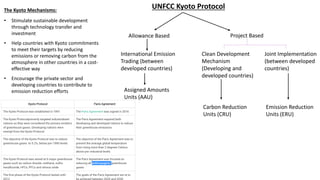
• Stimulate sustainable development
through technology transfer and
investment
• Help countries with Kyoto commitments
to meet their targets by reducing
emissions or removing carbon from the
atmosphere in other countries in a cost-
effective way
• Encourage the private sector and
developing countries to contribute to
emission reduction efforts
The Kyoto Mechanisms:
Allowance Based
UNFCC Kyoto Protocol
Project Based
International Emission
Trading (between
developed countries)
Clean Development
Mechanism
(Developing and
developed countries)
Joint Implementation
(between developed
countries)
Carbon Reduction
Units (CRU)
Emission Reduction
Units (ERU)
Assigned Amounts
Units (AAU)
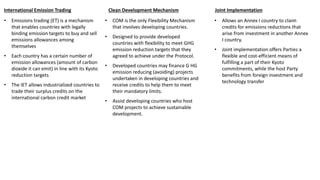
• Emissions trading (ET) is a mechanism
that enables countries with legally
binding emission targets to buy and sell
emissions allowances among
themselves
• Each country has a certain number of
emission allowances (amount of carbon
dioxide it can emit) in line with its Kyoto
reduction targets
• The IET allows industrialized countries to
trade their surplus credits on the
international carbon credit market
International Emission Trading
• COM is the only Flexibility Mechanism
that involves developing countries.
• Designed to provide developed
countries with flexibility to meet GHG
emission reduction targets that they
agreed to achieve under the Protocol.
• Developed countries may finance G HG
emission reducing (avoiding) projects
undertaken in developing countries and
receive credits to help them to meet
their mandatory limits.
• Assist developing countries who host
COM projects to achieve sustainable
development.
Clean Development Mechanism
• Allows an Annex I country to claim
credits for emissions reductions that
arise from investment in another Annex
I country.
• Joint implementation offers Parties a
flexible and cost-efficient means of
fulfilling a part of their Kyoto
commitments, while the host Party
benefits from foreign investment and
technology transfer
Joint Implementation
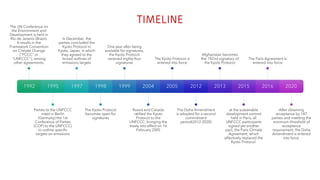
TIMELINE
1992
The UN Conference on
the Environment and
Development is held in
Rio de Janeiro (Brazil).
It results in the
Framework Convention
on Climate Change
("FCCC" or
"UNFCCC"), among
other agreements.
1995
Parties to the UNFCCC
meet in Berlin
(Germany) the 1st
Conference of Parties
(COP) to the UNFCCC)
to outline specific
targets on emissions
1997
In December, the
parties concluded the
Kyoto Protocol in
Kyoto, Japan, in which
they agreed to the
broad outlines of
emissions targets
1998
The Kyoto Protocol
becomes open for
signatures
1999
One year after being
available for signatures,
the Kyoto Protocol
received eighty-four
signatures
2004
Russia and Canada
ratified the Kyoto
Protocol to the
UNFCCC, bringing the
treaty into effect on 16
February 2005
2005
The Kyoto Protocol is
entered into force
2012
The Doha Amendment
is adopted for a second
commitment
period(2012-2020)
2013
Afghanistan becomes
the 192nd signatory of
the Kyoto Protocol
2015
at the sustainable
development summit
held in Paris, all
UNFCCC participants
signed yet another
pact, the Paris Climate
Agreement, which
effectively replaced the
Kyoto Protocol.
2016
The Paris Agreement is
entered into force
2020
After obtaining
acceptance by 147
parties and meeting the
minimum threshold of
acceptance
requirement, the Doha
Amendment is entered
into force.
• https://www.pmfias.com/kyoto-protocol-paris-agreement/
• https://www.google.com/
• https://www.youtube.com/watch?v=LW8zdP8gxJE&list=PLpLxyomknRt-
AbLqDqcGyhtDJFSfPWxtk&index=1
• https://unfccc.int/kyoto_protocol#:~:text=In%20short%2C%20the%20Ky
oto%20Protocol,accordance%20with%20agreed%20individual%20target
s.
• https://mrunal.org/2012/09/climate-change-kyoto-protocol-carbon-
trading.html#238
• https://ourworldindata.org/per-capita-co2
Source:
Kyoto Protocol Short Presentation

Kyoto Protocol Short Presentation

  • 1.
  • 2.
    KYOTO PROTOCOL • TheKyoto Protocol to the United Nations Framework Convention on Climate Change was adopted in Kyoto, Japan, in December 1997 and entered into force on 16 February 2005. • The rules and requirements for implementing the Kyoto Protocol were further elaborated in a package of decisions called the Marrakesh Accords. The Marrakesh Accords were formally adopted by the CMP (Climate Change Conference) at its first session in Montreal, Canada, in December 2005 • The protocol commits that ''Annex 1 countries" (developed countries) reduce their emissions to ten percent below year 1990 levels. • Each country has a prescribed number of 'emission units' which make up the target emissions • The Kyoto Protocol provides mechanisms for countries to meet their emission targets • Definition : It is an international agreement that aims to reduce carbon dioxide and the presence of greenhouse gasses, Counties that ratify the Kyoto Protocol are assigned maximum carbon emission levels and can participate in carbon credit trading. Emitting more than the assigned limit will result in a penalty for the violating country in form of a lower emission limit in the following period • Carbon credits, also known as carbon offsets, are permits that allow the owner to emit a certain amount of carbon dioxide or other greenhouse gases. One credit permits the emission of one ton of carbon dioxide or the equivalent in other greenhouse gases.
  • 3.
    KYOTO PROTOCOL Greenhouse Gasses: •Carbon Dioxide (CO2) • Methane (CH4) • Nitrous Oxide (N2O) • Hydro Fluro Carbons (HFC’s) • Perfluoro Carbons (PFC’s) • Sulphur Hexafluoride (SF6’s) Natural Greenhouse Gases Man-Made Greenhouse Gases • The greenhouse effect is a process that occurs when gases in Earth's atmosphere trap the Sun's heat. This process makes Earth much warmer than it would be without an atmosphere. The greenhouse effect is one of the things that makes Earth a comfortable place to live Greenhouse Effect:
  • 4.
    Per Capita CO2 Emissions,2020 Co2 emissions from fossil fuels and industry. Land use not included
  • 7.
    • Stimulate sustainabledevelopment through technology transfer and investment • Help countries with Kyoto commitments to meet their targets by reducing emissions or removing carbon from the atmosphere in other countries in a cost- effective way • Encourage the private sector and developing countries to contribute to emission reduction efforts The Kyoto Mechanisms: Allowance Based UNFCC Kyoto Protocol Project Based International Emission Trading (between developed countries) Clean Development Mechanism (Developing and developed countries) Joint Implementation (between developed countries) Carbon Reduction Units (CRU) Emission Reduction Units (ERU) Assigned Amounts Units (AAU)
  • 8.
    • Emissions trading(ET) is a mechanism that enables countries with legally binding emission targets to buy and sell emissions allowances among themselves • Each country has a certain number of emission allowances (amount of carbon dioxide it can emit) in line with its Kyoto reduction targets • The IET allows industrialized countries to trade their surplus credits on the international carbon credit market International Emission Trading • COM is the only Flexibility Mechanism that involves developing countries. • Designed to provide developed countries with flexibility to meet GHG emission reduction targets that they agreed to achieve under the Protocol. • Developed countries may finance G HG emission reducing (avoiding) projects undertaken in developing countries and receive credits to help them to meet their mandatory limits. • Assist developing countries who host COM projects to achieve sustainable development. Clean Development Mechanism • Allows an Annex I country to claim credits for emissions reductions that arise from investment in another Annex I country. • Joint implementation offers Parties a flexible and cost-efficient means of fulfilling a part of their Kyoto commitments, while the host Party benefits from foreign investment and technology transfer Joint Implementation
  • 9.
    TIMELINE 1992 The UN Conferenceon the Environment and Development is held in Rio de Janeiro (Brazil). It results in the Framework Convention on Climate Change ("FCCC" or "UNFCCC"), among other agreements. 1995 Parties to the UNFCCC meet in Berlin (Germany) the 1st Conference of Parties (COP) to the UNFCCC) to outline specific targets on emissions 1997 In December, the parties concluded the Kyoto Protocol in Kyoto, Japan, in which they agreed to the broad outlines of emissions targets 1998 The Kyoto Protocol becomes open for signatures 1999 One year after being available for signatures, the Kyoto Protocol received eighty-four signatures 2004 Russia and Canada ratified the Kyoto Protocol to the UNFCCC, bringing the treaty into effect on 16 February 2005 2005 The Kyoto Protocol is entered into force 2012 The Doha Amendment is adopted for a second commitment period(2012-2020) 2013 Afghanistan becomes the 192nd signatory of the Kyoto Protocol 2015 at the sustainable development summit held in Paris, all UNFCCC participants signed yet another pact, the Paris Climate Agreement, which effectively replaced the Kyoto Protocol. 2016 The Paris Agreement is entered into force 2020 After obtaining acceptance by 147 parties and meeting the minimum threshold of acceptance requirement, the Doha Amendment is entered into force.
  • 10.
    • https://www.pmfias.com/kyoto-protocol-paris-agreement/ • https://www.google.com/ •https://www.youtube.com/watch?v=LW8zdP8gxJE&list=PLpLxyomknRt- AbLqDqcGyhtDJFSfPWxtk&index=1 • https://unfccc.int/kyoto_protocol#:~:text=In%20short%2C%20the%20Ky oto%20Protocol,accordance%20with%20agreed%20individual%20target s. • https://mrunal.org/2012/09/climate-change-kyoto-protocol-carbon- trading.html#238 • https://ourworldindata.org/per-capita-co2 Source: