KYOTOPROTOCOL
KYOTO PROTOCOL
2
• The Kyoto Protocol is an international agreement that aimed to manage and reduce
carbon dioxide emissions and other greenhouse gases.
• The Protocol was adopted at a conference in Kyoto, Japan, in 1997 and became
international law on February 16, 2005.
• Aim: Commits the parties to reduce GHGs emission
• The Protocol was linked to the United Nations Framework Convention on Climate
Change (UNFCCC).
COP 3 of UNFCCC on 11 December 1997 in Kyoto, Japan
 average 5% emission reduction compared to 1990 levels over the
five year period 2008–2012 (the first commitment period).
 The protocol called for reducing the emission of six greenhouse
gases; Carbon dioxide (CO2), Methane (CH4), Nitrous oxide
(N2O), Hydrofluorocarbons (HFCs), Perfluorocarbons (PFCs),
Sulphur hexafluoride (SF6).
 Kyoto Protocol introduced Carbon trading/ Emissions trading.
3
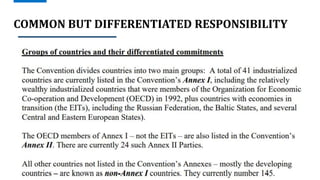
COMMON BUT DIFFERENTIATED RESPONSIBILITY
4
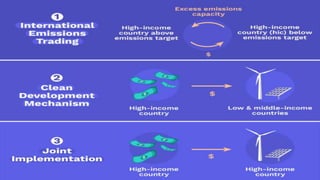
 Annex I Party may transfer
Kyoto units to or acquire units
from another Annex I Party.
 The unit associated with are
called an assigned amount units
(AAU)
 The CDM is also a project-based
mechanism.
 CDM credits may be generated
from emission reduction projects
or from afforestation and
reforestation projects in non-
Annex I Parties.
 Certified emission reductions
(CERs
5
KYOTO MECHANISM
Emissions Trading
Article 17
Clean Development Mechanism
(CDM)-Article 12
Joint implementation (JI)
Article 6
 Project-based mechanism
 One Annex I Party can invest in
a project that reduces emissions
in another Annex I Party.
 The unit associated with JI is
called an emission reduction unit
(ERU).
6
Emissions trading under Article 17; •Joint implementation (JI) under Article 6; •Clean development mechanism (CDM)
under Article 12
7
Source: A GUIDE TO THE CLIMATE CHANGE CONVENTION AND ITS KYOTO PROTOCOL, Preliminary
version Issued for informational purposes only. 4
7
KYOTO PROTOCOL
8
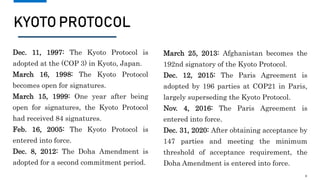
Dec. 11, 1997: The Kyoto Protocol is
adopted at the (COP 3) in Kyoto, Japan.
March 16, 1998: The Kyoto Protocol
becomes open for signatures.
March 15, 1999: One year after being
open for signatures, the Kyoto Protocol
had received 84 signatures.
Feb. 16, 2005: The Kyoto Protocol is
entered into force.
Dec. 8, 2012: The Doha Amendment is
adopted for a second commitment period.
March 25, 2013: Afghanistan becomes the
192nd signatory of the Kyoto Protocol.
Dec. 12, 2015: The Paris Agreement is
adopted by 196 parties at COP21 in Paris,
largely superseding the Kyoto Protocol.
Nov. 4, 2016: The Paris Agreement is
entered into force.
Dec. 31, 2020: After obtaining acceptance by
147 parties and meeting the minimum
threshold of acceptance requirement, the
Doha Amendment is entered into force.
8
 The World Meteorological Organization (WMO) and the United
Nations Environment Programme (UNEP) joined forces to create
the IPCC in 1988.
 It’s a committee on climate change, formed by leading climate
experts and scientists around the world.
 The aim of the IPCC is to review all the latest scientific research
and give regular reports on climate change.
 The Intergovernmental Panel on Climate Change (IPCC) is the
United Nations body for assessing the science related to climate
change.
9
FAILURE OF THE PROTOCOL
10
Emissions trading under Article 17; •Joint implementation (JI) under Article 6; •Clean development
mechanism (CDM) under Article 12
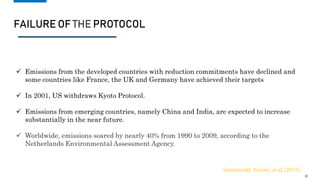
 Emissions from the developed countries with reduction commitments have declined and
some countries like France, the UK and Germany have achieved their targets
 In 2001, US withdraws Kyoto Protocol.
 Emissions from emerging countries, namely China and India, are expected to increase
substantially in the near future.
 Worldwide, emissions soared by nearly 40% from 1990 to 2009, according to the
Netherlands Environmental Assessment Agency.
Grunewald, Nicole, et al (2015)
10
11
Emissions trading under Article 17; •Joint implementation (JI) under Article 6; •Clean development mechanism (CDM)
under Article 12
 With the Intergovernmental Panel on Climate Change (IPCC) now claiming that some climate
change is unavoidable and irreversible (IPCC 2014), it is clear that the Kyoto Protocol has failed in
its primary mission: to reduce the amount of GHGs entering the atmosphere.
 Clean Development Mechanism(CDM) that allowed many countries to increase their individual
gross emissions.
The Global Output of Carbon Dioxide
 1990 22.7billion tons;
 2008 31.7 billion and
 2013 36 billion
Rosen, A. M. (2015) 11
12
Emissions trading under Article 17; •Joint implementation (JI) under Article 6; •Clean development mechanism (CDM)
under Article 12
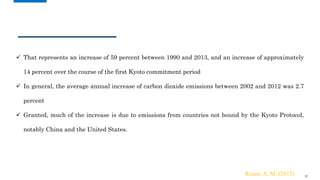
 That represents an increase of 59 percent between 1990 and 2013, and an increase of approximately
14 percent over the course of the first Kyoto commitment period
 In general, the average annual increase of carbon dioxide emissions between 2002 and 2012 was 2.7
percent
 Granted, much of the increase is due to emissions from countries not bound by the Kyoto Protocol,
notably China and the United States.
Rosen, A. M. (2015) 12
13
Emissions trading under Article 17; •Joint implementation (JI) under Article 6; •Clean development mechanism (CDM)
under Article 12
https://www.epa.gov/ghgemissions/global-greenhouse-gas-emissions-data
13
REFERENCES
14
1. The Editors of Encyclopedia Britannica. (2022, September 8). Kyoto Protocol | History, Provisions, & Facts.
Encyclopedia Britannica. Retrieved October 17, 2022, from https://www.britannica.com/event/Kyoto-Protocol
2. https://unfccc.int/kyoto_protocol
3. What Is The Kyoto Protocol? Definition, History, Timeline, Status. (2022, August 12). Investopedia. Retrieved
October 17, 2022, from https://www.investopedia.com/terms/k/kyoto.asp
4. Robinson, D. (2022, July 6). Kyoto Protocol: Definition, Facts & Signatories. Earth.Org. Retrieved October 17,
2022, from https://earth.org/the-kyoto-protocol/
5. Clark, D. (2021, August 25). Has the Kyoto protocol made any difference to carbon emissions? The Guardian.
Retrieved October 17, 2022, from https://www.theguardian.com/environment/blog/2012/nov/26/kyoto-protocol-
carbon-emissions
6. A Guide To The Climate Change Convention And Its Kyoto Protocol Preliminary version Issued for informational
purposes only. (n.d.).
7. Ki-moon, B. (n.d.). “Climate change is the defining challenge of our age.”
8. Grunewald, N., & Martinez-Zarzoso, I. (2016). Did the Kyoto Protocol fail? An evaluation of the effect of the Kyoto
Protocol on CO2 emissions. Environment and Development Economics, 21(1), 1–22.
https://doi.org/10.1017/S1355770X15000091
9. Rosen, A. M. (2015). The wrong solution at the right time: The failure of the kyoto protocol on climate change.
Politics and Policy, 43(1), 30–58. https://doi.org/10.1111/polp.12105
14

Kyoto Protocol.pptx

  • 1.
  • 2.
    KYOTO PROTOCOL 2 • TheKyoto Protocol is an international agreement that aimed to manage and reduce carbon dioxide emissions and other greenhouse gases. • The Protocol was adopted at a conference in Kyoto, Japan, in 1997 and became international law on February 16, 2005. • Aim: Commits the parties to reduce GHGs emission • The Protocol was linked to the United Nations Framework Convention on Climate Change (UNFCCC). COP 3 of UNFCCC on 11 December 1997 in Kyoto, Japan
  • 3.
     average 5%emission reduction compared to 1990 levels over the five year period 2008–2012 (the first commitment period).  The protocol called for reducing the emission of six greenhouse gases; Carbon dioxide (CO2), Methane (CH4), Nitrous oxide (N2O), Hydrofluorocarbons (HFCs), Perfluorocarbons (PFCs), Sulphur hexafluoride (SF6).  Kyoto Protocol introduced Carbon trading/ Emissions trading. 3
  • 4.
    COMMON BUT DIFFERENTIATEDRESPONSIBILITY 4
  • 5.
     Annex IParty may transfer Kyoto units to or acquire units from another Annex I Party.  The unit associated with are called an assigned amount units (AAU)  The CDM is also a project-based mechanism.  CDM credits may be generated from emission reduction projects or from afforestation and reforestation projects in non- Annex I Parties.  Certified emission reductions (CERs 5 KYOTO MECHANISM Emissions Trading Article 17 Clean Development Mechanism (CDM)-Article 12 Joint implementation (JI) Article 6  Project-based mechanism  One Annex I Party can invest in a project that reduces emissions in another Annex I Party.  The unit associated with JI is called an emission reduction unit (ERU).
  • 6.
    6 Emissions trading underArticle 17; •Joint implementation (JI) under Article 6; •Clean development mechanism (CDM) under Article 12
  • 7.
    7 Source: A GUIDETO THE CLIMATE CHANGE CONVENTION AND ITS KYOTO PROTOCOL, Preliminary version Issued for informational purposes only. 4 7
  • 8.
    KYOTO PROTOCOL 8 Dec. 11,1997: The Kyoto Protocol is adopted at the (COP 3) in Kyoto, Japan. March 16, 1998: The Kyoto Protocol becomes open for signatures. March 15, 1999: One year after being open for signatures, the Kyoto Protocol had received 84 signatures. Feb. 16, 2005: The Kyoto Protocol is entered into force. Dec. 8, 2012: The Doha Amendment is adopted for a second commitment period. March 25, 2013: Afghanistan becomes the 192nd signatory of the Kyoto Protocol. Dec. 12, 2015: The Paris Agreement is adopted by 196 parties at COP21 in Paris, largely superseding the Kyoto Protocol. Nov. 4, 2016: The Paris Agreement is entered into force. Dec. 31, 2020: After obtaining acceptance by 147 parties and meeting the minimum threshold of acceptance requirement, the Doha Amendment is entered into force. 8
  • 9.
     The WorldMeteorological Organization (WMO) and the United Nations Environment Programme (UNEP) joined forces to create the IPCC in 1988.  It’s a committee on climate change, formed by leading climate experts and scientists around the world.  The aim of the IPCC is to review all the latest scientific research and give regular reports on climate change.  The Intergovernmental Panel on Climate Change (IPCC) is the United Nations body for assessing the science related to climate change. 9
  • 10.
    FAILURE OF THEPROTOCOL 10 Emissions trading under Article 17; •Joint implementation (JI) under Article 6; •Clean development mechanism (CDM) under Article 12  Emissions from the developed countries with reduction commitments have declined and some countries like France, the UK and Germany have achieved their targets  In 2001, US withdraws Kyoto Protocol.  Emissions from emerging countries, namely China and India, are expected to increase substantially in the near future.  Worldwide, emissions soared by nearly 40% from 1990 to 2009, according to the Netherlands Environmental Assessment Agency. Grunewald, Nicole, et al (2015) 10
  • 11.
    11 Emissions trading underArticle 17; •Joint implementation (JI) under Article 6; •Clean development mechanism (CDM) under Article 12  With the Intergovernmental Panel on Climate Change (IPCC) now claiming that some climate change is unavoidable and irreversible (IPCC 2014), it is clear that the Kyoto Protocol has failed in its primary mission: to reduce the amount of GHGs entering the atmosphere.  Clean Development Mechanism(CDM) that allowed many countries to increase their individual gross emissions. The Global Output of Carbon Dioxide  1990 22.7billion tons;  2008 31.7 billion and  2013 36 billion Rosen, A. M. (2015) 11
  • 12.
    12 Emissions trading underArticle 17; •Joint implementation (JI) under Article 6; •Clean development mechanism (CDM) under Article 12  That represents an increase of 59 percent between 1990 and 2013, and an increase of approximately 14 percent over the course of the first Kyoto commitment period  In general, the average annual increase of carbon dioxide emissions between 2002 and 2012 was 2.7 percent  Granted, much of the increase is due to emissions from countries not bound by the Kyoto Protocol, notably China and the United States. Rosen, A. M. (2015) 12
  • 13.
    13 Emissions trading underArticle 17; •Joint implementation (JI) under Article 6; •Clean development mechanism (CDM) under Article 12 https://www.epa.gov/ghgemissions/global-greenhouse-gas-emissions-data 13
  • 14.
    REFERENCES 14 1. The Editorsof Encyclopedia Britannica. (2022, September 8). Kyoto Protocol | History, Provisions, & Facts. Encyclopedia Britannica. Retrieved October 17, 2022, from https://www.britannica.com/event/Kyoto-Protocol 2. https://unfccc.int/kyoto_protocol 3. What Is The Kyoto Protocol? Definition, History, Timeline, Status. (2022, August 12). Investopedia. Retrieved October 17, 2022, from https://www.investopedia.com/terms/k/kyoto.asp 4. Robinson, D. (2022, July 6). Kyoto Protocol: Definition, Facts & Signatories. Earth.Org. Retrieved October 17, 2022, from https://earth.org/the-kyoto-protocol/ 5. Clark, D. (2021, August 25). Has the Kyoto protocol made any difference to carbon emissions? The Guardian. Retrieved October 17, 2022, from https://www.theguardian.com/environment/blog/2012/nov/26/kyoto-protocol- carbon-emissions 6. A Guide To The Climate Change Convention And Its Kyoto Protocol Preliminary version Issued for informational purposes only. (n.d.). 7. Ki-moon, B. (n.d.). “Climate change is the defining challenge of our age.” 8. Grunewald, N., & Martinez-Zarzoso, I. (2016). Did the Kyoto Protocol fail? An evaluation of the effect of the Kyoto Protocol on CO2 emissions. Environment and Development Economics, 21(1), 1–22. https://doi.org/10.1017/S1355770X15000091 9. Rosen, A. M. (2015). The wrong solution at the right time: The failure of the kyoto protocol on climate change. Politics and Policy, 43(1), 30–58. https://doi.org/10.1111/polp.12105 14

Editor's Notes

  • #4 Second commitment period (2013 to 2020)
  • #5 Annex-I Developed Country Annex-II Developed Country subset of Annex-I Annex-B Quantified emission limitation or reduction targets as contained in Annex B to the Kyoto Protocol Non- Annex-I
  • #10 Second commitment period (2013 to 2020)
  • #11 FAILURE OF THE PROTOCOL the protocol didn't become international law until more than halfway through the 1990–2012 period. By that point, global emissions had risen substantially. Some countries and regions, including the European Union, were on track by 2011 to meet or exceed their Kyoto goals, but other large nations were falling woefully short. And the two biggest emitters of all - the United States and China - churned out more than enough extra greenhouse gas to erase all the reductions made by other countries during the Kyoto period