KYOTO PROTOCOL
Origin and
Adoptions
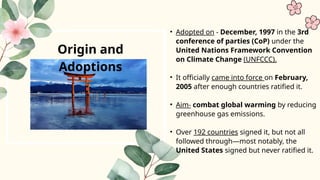
• Adopted on - December, 1997 in the 3rd
conference of parties (CoP) under the
United Nations Framework Convention
on Climate Change (UNFCCC).
• It officially came into force on February,
2005 after enough countries ratified it.
• Aim- combat global warming by reducing
greenhouse gas emissions.
• Over 192 countries signed it, but not all
followed through—most notably, the
United States signed but never ratified it.
Emission Reduction Targets
• It required 37 industrialized
countries and the European Union
to reduce their emissions by an
average of 5% below 1990 levels
during the first commitment period
(2008–2012).
• Developing countries, including
major emitters like China and India,
were exempt from these binding
targets because they were still
growing their economies.
.
The targets were different for each
country:
• The European Union - 8%.
• Japan and Canada - 6%.
• Russia - 0% (because emissions had
already dropped significantly after the
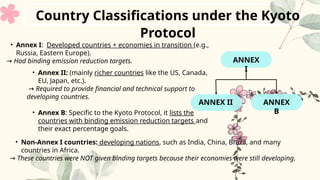
• Annex II: (mainly richer countries like the US, Canada,
EU, Japan, etc.).
→ Required to provide financial and technical support to
developing countries.
• Annex B: Specific to the Kyoto Protocol, it lists the
countries with binding emission reduction targets and
their exact percentage goals.
Country Classifications under the Kyoto
Protocol
• Annex I: Developed countries + economies in transition (e.g.,
Russia, Eastern Europe).
→ Had binding emission reduction targets.
• Non-Annex I countries: developing nations, such as India, China, Brazil, and many
countries in Africa.
→ These countries were NOT given binding targets because their economies were still developing.
ANNEX
I
ANNEX II ANNEX
B
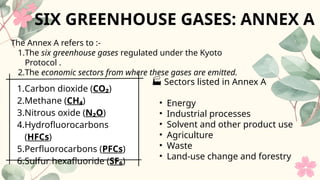
1.Carbon dioxide (CO₂)
2.Methane (CH₄)
3.Nitrous oxide (N₂O)
4.Hydrofluorocarbons
(HFCs)
5.Perfluorocarbons (PFCs)
6.Sulfur hexafluoride (SF₆)
SIX GREENHOUSE GASES: ANNEX A
The Annex A refers to :-
1.The six greenhouse gases regulated under the Kyoto
Protocol .
2.The economic sectors from where these gases are emitted.
🏭 Sectors listed in Annex A
• Energy
• Industrial processes
• Solvent and other product use
• Agriculture
• Waste
• Land-use change and forestry
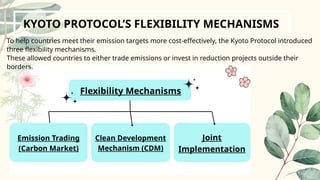
Flexibility Mechanisms
KYOTO PROTOCOL’S FLEXIBILITY MECHANISMS
To help countries meet their emission targets more cost-effectively, the Kyoto Protocol introduced
three flexibility mechanisms.
These allowed countries to either trade emissions or invest in reduction projects outside their
borders.
Emission Trading
(Carbon Market)
Clean Development
Mechanism (CDM)
Joint
Implementation
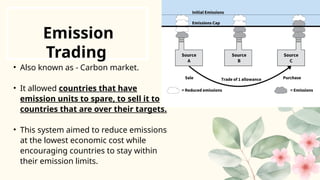
• Also known as - Carbon market.
• It allowed countries that have
emission units to spare, to sell it to
countries that are over their targets.
• This system aimed to reduce emissions
at the lowest economic cost while
encouraging countries to stay within
their emission limits.
Emission
Trading
Clean Development Mechanism
(CDM)
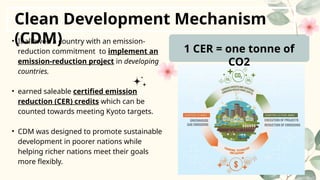
• It allowed a country with an emission-
reduction commitment to implement an
emission-reduction project in developing
countries.
• earned saleable certified emission
reduction (CER) credits which can be
counted towards meeting Kyoto targets.
• CDM was designed to promote sustainable
development in poorer nations while
helping richer nations meet their goals
more flexibly.
1 CER = one tonne of
CO2
Joint Implementation
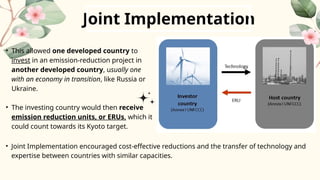
• This allowed one developed country to
invest in an emission-reduction project in
another developed country, usually one
with an economy in transition, like Russia or
Ukraine.
• The investing country would then receive
emission reduction units, or ERUs, which it
could count towards its Kyoto target.
• Joint Implementation encouraged cost-effective reductions and the transfer of technology and
expertise between countries with similar capacities.
• The United States never ratified it, despite being one of the world’s
largest emitters.
• Developing countries like China and India had no binding targets,
even though their emissions were rapidly increasing.
• There were no strong enforcement mechanisms, so countries that
missed their targets faced few consequences.
Challenges
• its main goal is to limit global warming to well below 2°C,
preferably 1.5°C, compared to pre-industrial levels.
• Countries set their own nationally determined
contributions, or NDCs, which they update every five years.
• While it’s not legally binding in terms of penalties, it relies on
transparency and peer pressure to encourage compliance
and ambition.
Transition to PARIS
AGREEMENT
• Kyoto Protocol: First major global effort to reduce greenhouse gases
• Introduced binding targets and flexibility mechanisms
• Faced challenges: limited participation, lack of enforcement, major
emitters excluded
• Lessons learned led to the Paris Agreement
• Paris Agreement: more inclusive, flexible, and forward-looking
• Ongoing need for global cooperation on climate change
CONCLUSION
Thank you!

Kyoto Protocol Presentation | Climate Change & International Agreements

  • 1.
  • 2.
    Origin and Adoptions • Adoptedon - December, 1997 in the 3rd conference of parties (CoP) under the United Nations Framework Convention on Climate Change (UNFCCC). • It officially came into force on February, 2005 after enough countries ratified it. • Aim- combat global warming by reducing greenhouse gas emissions. • Over 192 countries signed it, but not all followed through—most notably, the United States signed but never ratified it.
  • 3.
    Emission Reduction Targets •It required 37 industrialized countries and the European Union to reduce their emissions by an average of 5% below 1990 levels during the first commitment period (2008–2012). • Developing countries, including major emitters like China and India, were exempt from these binding targets because they were still growing their economies. . The targets were different for each country: • The European Union - 8%. • Japan and Canada - 6%. • Russia - 0% (because emissions had already dropped significantly after the
  • 4.
    • Annex II:(mainly richer countries like the US, Canada, EU, Japan, etc.). → Required to provide financial and technical support to developing countries. • Annex B: Specific to the Kyoto Protocol, it lists the countries with binding emission reduction targets and their exact percentage goals. Country Classifications under the Kyoto Protocol • Annex I: Developed countries + economies in transition (e.g., Russia, Eastern Europe). → Had binding emission reduction targets. • Non-Annex I countries: developing nations, such as India, China, Brazil, and many countries in Africa. → These countries were NOT given binding targets because their economies were still developing. ANNEX I ANNEX II ANNEX B
  • 5.
    1.Carbon dioxide (CO₂) 2.Methane(CH₄) 3.Nitrous oxide (N₂O) 4.Hydrofluorocarbons (HFCs) 5.Perfluorocarbons (PFCs) 6.Sulfur hexafluoride (SF₆) SIX GREENHOUSE GASES: ANNEX A The Annex A refers to :- 1.The six greenhouse gases regulated under the Kyoto Protocol . 2.The economic sectors from where these gases are emitted. 🏭 Sectors listed in Annex A • Energy • Industrial processes • Solvent and other product use • Agriculture • Waste • Land-use change and forestry
  • 6.
    Flexibility Mechanisms KYOTO PROTOCOL’SFLEXIBILITY MECHANISMS To help countries meet their emission targets more cost-effectively, the Kyoto Protocol introduced three flexibility mechanisms. These allowed countries to either trade emissions or invest in reduction projects outside their borders. Emission Trading (Carbon Market) Clean Development Mechanism (CDM) Joint Implementation
  • 7.
    • Also knownas - Carbon market. • It allowed countries that have emission units to spare, to sell it to countries that are over their targets. • This system aimed to reduce emissions at the lowest economic cost while encouraging countries to stay within their emission limits. Emission Trading
  • 8.
    Clean Development Mechanism (CDM) •It allowed a country with an emission- reduction commitment to implement an emission-reduction project in developing countries. • earned saleable certified emission reduction (CER) credits which can be counted towards meeting Kyoto targets. • CDM was designed to promote sustainable development in poorer nations while helping richer nations meet their goals more flexibly. 1 CER = one tonne of CO2
  • 9.
    Joint Implementation • Thisallowed one developed country to invest in an emission-reduction project in another developed country, usually one with an economy in transition, like Russia or Ukraine. • The investing country would then receive emission reduction units, or ERUs, which it could count towards its Kyoto target. • Joint Implementation encouraged cost-effective reductions and the transfer of technology and expertise between countries with similar capacities.
  • 10.
    • The UnitedStates never ratified it, despite being one of the world’s largest emitters. • Developing countries like China and India had no binding targets, even though their emissions were rapidly increasing. • There were no strong enforcement mechanisms, so countries that missed their targets faced few consequences. Challenges
  • 11.
    • its maingoal is to limit global warming to well below 2°C, preferably 1.5°C, compared to pre-industrial levels. • Countries set their own nationally determined contributions, or NDCs, which they update every five years. • While it’s not legally binding in terms of penalties, it relies on transparency and peer pressure to encourage compliance and ambition. Transition to PARIS AGREEMENT
  • 12.
    • Kyoto Protocol:First major global effort to reduce greenhouse gases • Introduced binding targets and flexibility mechanisms • Faced challenges: limited participation, lack of enforcement, major emitters excluded • Lessons learned led to the Paris Agreement • Paris Agreement: more inclusive, flexible, and forward-looking • Ongoing need for global cooperation on climate change CONCLUSION
  • 13.